Home Blog Page 5315

Two Consunji-led firms included in Bloomberg’s gender-equality index

CONSUNJI-led DMCI Holdings, Inc. and Semirara Mining and Power Corp. (SMPC) made it to Bloomberg’ gender-equality index (GEI), which tracks public firms in disclosing efforts to support gender equality through policy development and transparency.

“Diversity and representation matter. When different voices and perspectives are included in the conversation, companies benefit from a wider range of ideas and insights,” DMCI Holdings and SMPC Chairman Isidro A. Consunji said in a media release.

This is the third straight year that DMCI and SMPC landed in Bloomberg’ GEI. In 2023, only four publicly listed companies in the Philippines joined the GEI. This year’ roster includes 484 companies from 45 countries and regions.

“We continue to see an increase in both interest and membership globally, reflecting a shared goal of transparency in gender-related metrics,” Peter T. Grauer, chairman of Bloomberg, said in a media release.

GEI measures the performance of public firms’ commitment to gender equality through leadership and talent pipelines; equal pay and gender pay parity; inclusive culture; anti-sexual harassment policies ;and external brand.

The Consunji-led companies both submitted a social survey developed by Bloomberg. Companies included in this year’ index posted a score above a global threshold established by Bloomberg “to reflect disclosure and the achievement or adoption of best-in-class statistics and policies.”

Participation in the survey is said to be voluntary and had no associated cost. The index is also not ranked. Public companies that have a market capitalization of about $1 billion are eligible to be included in the index.

DMCI Holdings was incorporated in 1995 as a holding company to consolidate the construction business, construction component companies, and related interests of the Consunji group. SMPC, on the other hand, has interest in the exploration, development, and mining of coal resources on Semirara Island in Antique. — Ashley Erika O. Jose

DC Comics fandom celebrates return of Swamp Thing to big screen

Cover of Swamp Thing, Vol. 1, #9 (March-April 1974). Art by Bernie Wrightson. — DC COMICS/EN.WIKIPEDIA.ORG/

LOS ANGELES — He looks like a giant, angry vegetable and fights tirelessly to protect his wetland home. He has made his way from comic books to film, television, and video games. His name is Swamp Thing, and he is returning to the big screen with his own horror movie on a revamped DC Studios slate.

Cover of Swamp Thing, Vol. 1, #9 (March-April 1974). Art by Bernie Wrightson. — DC COMICS/EN.WIKIPEDIA.ORG/

In DC Comics, Swamp Thing interacts with several other characters’ storylines, making him a common thread throughout the greater DC Universe, often helping to save it. Fans on Tuesday reveled in DC Studios co-CEO James Gunn’s plans to bring the superhero back into the cinematic mix.

“Makes sense, if they want to cover the corners of established parts of DC, Swamp Thing is a must,” The Raven’s Loft tweeted. Josh Parker also tweeted: “I’m honestly really glad we’re getting Swamp Thing back.”

Another project that garnered fan praise is a TV series for Amanda Waller, the leader of the Suicide Squad, played by Viola Davis. “She’s the perfect way to get characters together,” Playboi Cyr tweeted.

The early positive reaction is a boon for Mr. Gunn, the director of three Guardians of the Galaxy movies at Marvel, who hit some criticism early on with his plans for the DC Universe under new owner Warner Bros Discovery.

In December, Mr. Gunn said that a Superman movie without lead actor Henry Cavill will be part of the DC slate and Cavill will not reprise the role because the movie focuses on “an earlier part of Superman’s life.”

For many fans, this was the first of many unsatisfying answers. Dwayne “The Rock” Johnson tweeted more disappointing news for some DC fans: “James Gunn and I connected, and Black Adam will not be in their first chapter of storytelling.”

While fans were overwhelmingly positive about Mr. Gunn’s direction, some were skeptical.

“lol I feel bad for dc. This is not even better. It’s more variety but won’t be as huge as you think,” tweeted EmilyBluntCompany. — Reuters

Pouch partners with Strike to help facilitate remittances

PAYMENT SYSTEMS operator Pouch has partnered with digital payments platform Strike to facilitate remittance payments from the United States to the Philippines.

Through the partnership, customers including Filipino migrants in the US can now send dollars to recipients in the Philippines and have the funds received in local currency.

“The US to Philippines remittance market is one of the largest in the world, and until now, most Filipino-Americans have been limited to outdated options,” Pouch Chief Executive Officer (CEO) Ethan Rose said in a statement.

“With Pouch’s partnership with Strike, we are revolutionizing the way cross-border payments are made, empowering people to easily send money to their loved ones back home. We are proud to be a part of building the world’s most powerful payment network for global transactions,” he added.

Citing World Bank data, Pouch said the Philippines is one of the top five global remittance markets in the world as many Filipino families rely on money sent home to cover household expenses. But the average transaction fee is about 4.57% of the total value.

It said it seeks to help achieve the World Bank’s goal of reducing money transfer costs to 3% by 2030 by providing more efficient and convenient payments across borders at the best possible exchange rates.

“Remittances are a broken system and Strike delivers an incredibly empowering experience for people to send money around the world in nearly an instant,” Strike Founder and CEO Jack Mallers said.

“We’re excited to partner with Pouch to advance financial inclusion and bring fast, low-cost cross-border payments via the Lightning Network to the Philippines. Our technology allows us to both improve on the existing cross-border experience and include those that have previously been excluded by legacy payment rails,” he added.

Pouch started in 2021 and built the country’s first lightning wallet to give Filipinos access to globally connected digital payments.

Pouch is connecting the Philippines with the lightning network to ensure clients can operate on this new payment standard.

It said Bitcoin’s lightning network is a technology that boosts financial inclusion and the efficiency of cross-border payments.

Remittances grew by 5.7% to $2.644 billion in November 2022, central bank data showed.

For the January-November period, cash remittances coursed through banks rose 3.3% to $29.38 billion, from $28.43 billion a year earlier. This was below the central bank’s 4% remittance growth projection for 2022. — K.B. Ta-asan

Building customer trust in a cookie-less world

TRUSTPAIR.COM

FOR the longest time, marketers relied on third party cookies to accurately target consumers, derive insights into their preferences and behavior, and deliver personalized ads.

Increasingly, they are losing this ability to target new consumers and augment existing customer data. The focus needs to shift towards attracting their target audiences and building trusting relationships with them.

Although several browsers have been blocking third party cookies for some time, it still came as something of a shock when Google announced in January 2020 that they planned to phase them out. This move was followed in March that year by Apple blocking such cookies on the Safari browser, by default. Firefox banned them, and Microsoft’s Edge also began gradually blocking them — meaning all the major browsers are now either blocking or planning to block third party cookies.

REASONS FOR BLOCKING THIRD-PARTY COOKIES
Why did these crucial players in the online world decide to do this?

In a blog post announcing the move, Google said: “Our goal for this open-source initiative is to make the web more private and secure for users, while also supporting publishers.”

However, given that blocking third party cookies means sacrificing some advertising revenue, perhaps the move is not entirely altruistic.

One reason for blocking may be user perception. Many users find cookies irritating and intrusive. They will say they don’t want to be tracked across the websites they visit — but in fact relatively few users actively choose to make opt-out the default.

DATA PRIVACY
A more significant driver is the growth of regulation around data privacy. Europe’s General Data Protection Regulation (GDPR) does not explicitly ban them, but its regulations state that a website cannot store third-party cookies without the consent of its users. If the user denies consent, then the site must block it. In fact, it cannot load the cookie script before receiving consent.  This complex approach puts the responsibility for checking compliance on publishers — it is simpler for them to avoid possible problems by blocking third party cookies altogether.

Regulators elsewhere in the world also typically closely follow the provisions of GDPR, although Singapore’s Personal Data Protection Act (PDPA) actually preceded it, being passed in 2012. The PDPA recognizes both the need to protect individuals’ personal data and the need of organizations to collect, use or disclose personal data for legitimate and reasonable purposes.

In Malaysia, the country’s PDPA came into force in 2013. This Act revolves around end-user consent, requiring websites to obtain express and explicit consent from visitors before activating any cookies and trackers that process personal data.

FIRST-PARTY COOKIE POWER
A third, and rather compelling, reason for Google to block third party cookies is the power of their first party cookies. In 2021, Google accounted for an estimated 28.6% of the total digital advertising revenue generated in the United States and was the largest digital ad publisher in the country. After Google come Facebook and Amazon, with 23.8% and 11.3%, respectively. The network of first party information these sites control is overwhelming, given that the company dominates the market space with Android at 85% of the smartphone market and Chrome at 64% of the browser market.

So how are businesses to maintain the data-driven strategies that are so critical to their operations in the face of the loss of cookies, increasing privacy regulations and the privacy initiatives being launched by big tech players? The latter includes the Apple App Privacy Report, which allows users to track everything an app does, and what sort of data it has accessed.

Instead of focusing on reducing data acquisition costs, the imperative for marketers is to develop a first party data strategy, double down on identity management, and make the most of the data they do have by bringing real value to customers via personalizing interactions — which leads them to want to provide information. Understanding your customers and the preferences to engage with them in a meaningful way can help to create experiences that build loyalty.

GIVING USERS VALUE
Customer data is growing more valuable by the minute. Marketers need to become savvy and develop unique strategies to encourage customers to participate in a two-way dialogue and opt-in to data collection and analytics. The only way to accomplish this will be to optimize customer journeys, meeting them in real time with communications and content that provide demonstrable value.

The key to achieving this is “trust.” Companies are typically driven more by commercial advantage than by concerns about consumer data privacy, but the trajectory of increasing regulation around privacy means they will have no choice but to adopt strategies more protective of consumers’ data welfare.

One way to gain back some of the trust is to be transparent about what data is being collected and how it is being used. At minimum, marketers should be asking certain questions, such as: Do individuals know when data is being collected? Do they understand how it is being used, especially when artificial intelligence (AI) or machine learning algorithms (where the decision parameters are less transparent) are making decisions? Can they easily get answers to their data-related questions? Is it easy for people to opt-out?

SEEKING CONSENT BUILDS TRUST
Consent is also an important element of trust. It is broadly accepted that companies should ask permission to communicate with their customers — this approach is termed “permission marketing.” Most privacy laws specify, using the GDPR definition, that consent should be “freely given, specific, informed, unambiguous,” and articulated by a “clear affirmative action.”

Marketing must move away from manipulating website visitors through soft opt-in processes, lack of opt-out, or simple blanket opt-in check box for all communication and analysis activities, and instead ask for and store consent on a more individualized action-oriented basis.

The marketer’s objective remains the same — to obtain information of value from the consumer. This requires something to be given back in return — in the new cookie-less world, some of the options that can be used are value-add services, contextualized, personalized content, and personalized offers.

A Customer Data Platform can help marketers fully amplify the consumer profile, pulling in online and offline data, detecting digital events, and dynamically updating identities in real time. All of this helps personalize communications and deliver real value to the consumer.

For example, 1-800-FLOWERS.COM takes a data-driven approach to engage their customers, successfully utilizing AI and machine learning on the SAS platform to calculate the next best offer across a myriad of digital marketing channels. Using analytical models to provide scoring, customers are shown personalized gift ideas based on their known preference and buying history.  This contributes to campaigning efforts and can help drive customer engagement and loyalty.

It is crucial that marketers do not take the lazy step of just replacing third party cookies with an alternative tracking option. The drive to greater consumer data privacy is unstoppable, and anything short of true comprehensive data-based marketing, driven by analytics, will attract penalties for non-compliance.


Andreas Heiz is the director of customer intelligence solutions in SAS Institute.

Film academy says it will not disqualify surprise Oscar nominee Riseborough

ANDREA RISEBOROUGH in a scene from To Leslie.

LOS ANGELES — Hollywood’s motion picture academy will not revoke the unexpected best actress nomination for To Leslie star Andrea Riseborough, the group’s chief executive said on Tuesday after a review of an aggressive campaign on her behalf.

Ms. Riseborough was nominated for best actress for playing an alcoholic single mother in the little-seen film, a shock to awards pundits who had not expected her to be in the mix.

The surprise nomination sparked questions about whether a campaign for Ms. Riseborough had violated lobbying rules set by the Academy of Motion Picture Arts and Sciences. Several A-list stars posted social media comments touting her performance.

On Tuesday, Academy CEO Bill Kramer said the organization “has determined the activity in question does not rise to the level that the film’s nomination should be rescinded.”

“However, we did discover social media and outreach campaigning tactics that caused concern. These tactics are being addressed with the responsible parties directly,” Mr. Kramer added.

The academy limits how studios can reach out to voters, how often and what they can say in any communications as part of their Oscars campaigns.

Winners of the Academy Awards will be announced on March 12. — Reuters

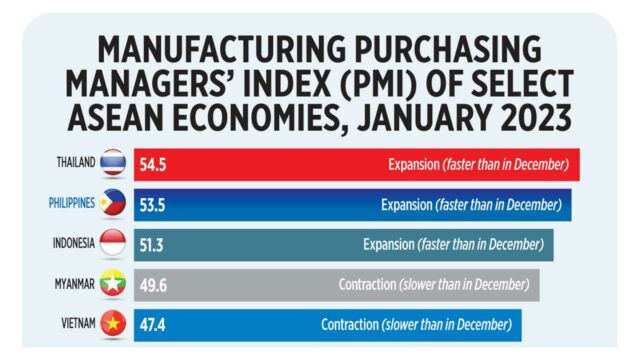
Manufacturing Purchasing Managers’ Index (PMI) of select ASEAN economies, January 2023

FACTORY ACTIVITY in the Philippines continued to expand, hitting a seven-month high in January, as firms ramped up production levels due to an uptick in foreign demand. Read the full story.

Manufacturing Purchasing Managers’ Index (PMI) of select ASEAN economies, January 2023

How PSEi member stocks performed — February 1, 2023

Here’s a quick glance at how PSEi stocks fared on Wednesday, February 1, 2023.


PSEi tracks Wall Street’s rise before Fed decision

PHILIPPINE STOCKS rebounded on Wednesday, tracking Wall Street’s climb ahead of the US Federal Reserve’s policy decision and despite continued worries over elevated inflation that could slow down consumer spending.

The benchmark Philippine Stock Exchange index (PSEi) surged by 242.51 points or 3.57% to close at 7,035.76 on Wednesday, while the broader all shares index went up 96.77 points or 2.69% to end at 3,687.17.

“Philippine shares climbed as traders assessed how firms are faring amid high inflation and fears of slowing consumer spending. Meanwhile, US equities ended January on a good note, as strong earnings and encouraging inflation data pushed the indices to their best levels since January 2019,” Regina Capital Development Corp. Head of Sales Luis A. Limlingan said in a Viber message.

Rizal Commercial Banking Corp. (RCBC) Chief Economist Michael L. Ricafort likewise said in a Viber message that the PSEi rose as it took its cue from overnight gains on Wall Street amid the latest easing in US wage inflation data and US home prices, which could support a less hawkish stance from the Fed.

Major US stock indexes rose on Tuesday as labor cost data encouraged investors about the Fed’s aggressive approach to taming inflation a day ahead of the central bank’s critical policy decision, Reuters reported.

The Dow Jones Industrial Average rose 368.95 points or 1.09% to 34,086.04; the S&P 500 gained 58.83 points or 1.46% to 4,076.60; and the Nasdaq Composite added 190.74 points or 1.67% to 11,584.55.

US labor costs increased at their slowest pace in a year in the fourth quarter as wage growth slowed, Labor department data showed.

The US central bank on Wednesday is expected to hike the fed funds rate by 25 basis points, following a 2022 in which the Fed aggressively boosted rates to control soaring inflation.

Aside from the Fed’s rate decision on Wednesday, Chair Jerome Powell’s news conference will be scrutinized for whether the rate-hiking cycle may be coming to a close and for signs of how long rates could stay elevated.

Back home, all sectoral indices closed higher on Wednesday. Services surged by 73.47 points or 4.34% to 1,766.10; holding firms added 245.16 points or 3.69% to end at 6,881.67; industrials went up by 301.98 points or 3.13% to 9,924.60; property increased by 82.38 points or 2.79% to end at 3,035.41; financials rose by 49.10 points or 2.74% to 1,839.50; and mining and oil climbed by 78.53 points or 0.72% at 10,894.80.

Value turnover went down to P8.99 billion on Wednesday with 1.06 billion shares changing hands from the P11.27 billion with 1.54 billion issues traded on Tuesday.

Advancers beat decliners, 143 versus 49, while 43 names closed unchanged.

Net foreign buying was at P763.97 million on Wednesday versus the P812.43 million in net selling seen the previous trading day.

RCBC’s Mr. Ricafort placed the PSEi’s support at 6,650-6,750 and resistance at 7,100. — Justine Irish D. Tabile with Reuters

Peso rebounds vs dollar as US data support bets of less hawkish FOMC

MARI GIMENEZ-UNSPLASH

THE PESO rebounded against the dollar on Wednesday as slower US employment and housing data supported expectations of a less hawkish policy stance by the Federal Reserve.

The local currency closed at P54.475 versus the greenback on Wednesday, appreciating by 16.5 centavos from Tuesday’s P54.64 finish, data from the Bankers Association of the Philippines’ website showed.

The peso opened Wednesday’s trading session slightly weaker at P54.655 per dollar. Its worst showing was at P54.67, while its intraday best was its close of P54.475 against the greenback.

Dollars traded went down to $958.9 million on Wednesday from $984.31 million on Tuesday.

The peso followed an easing in US wage inflation and home prices, Rizal Commercial Banking Corp. Chief Economist Michael L. Ricafort said in a Viber message.

“The peso appreciated after the slower-than-expected US employment costs bolstered expectations of a softer 25-basis-point (bp) Fed rate hike,” a trader likewise said in an e-mail.

The US Labor department said the employment cost index rose 1% in fourth quarter of 2022, the smallest advance in a year, also following a 1.2% gain in the July-September period, Reuters reported.

Wages and salaries also rose 1%, up 5.1% year on year. It was the smallest gain since the fourth quarter of 2021, after rising 1.3% in the third quarter.

Meanwhile, house prices measured by the Federal Housing Finance Agency rose 8.2% in the 12 months through November after climbing 9.8% in October.

The Federal Open Market Committee (FOMC) was expected to announce a 25-bp hike at the end of its Jan. 31 to Feb. 1 policy meeting overnight.

Aside from the rate decision, investors are also waiting for policy hints from Fed Chair Jerome H. Powell’s news briefing after the FOMC meeting.

The peso was also supported the stock market’s surge on Wednesday that almost reversed the declines posted in the first two days of the week, Mr. Ricafort added.

The benchmark Philippine Stock Exchange index surged by 242.51 points or 3.57% to close at 7,035.76 on Wednesday.

For Thursday, the trader said peso-dollar trading will take its cue from Mr. Powell’s comments overnight.

The trader sees the peso moving from P54.35 to P54.55 on Thursday, while Mr. Ricafort expects it to trade at P54.40 to P54.60 per dollar. — A.M.C. Sy with Reuters

Manila may get more defense gear with Austin visit

DEFENSE.GOV

By Kyle Aristophere T. Atienza, Reporter

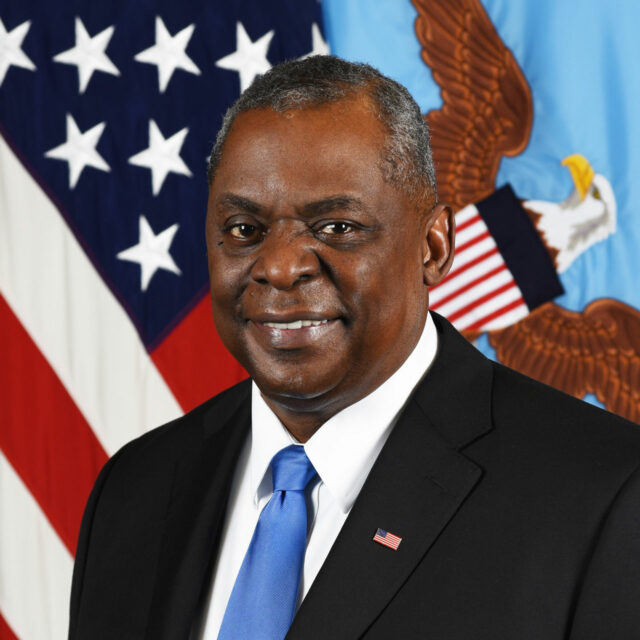
US DEFENSE Secretary Lloyd J. Austin’s visit to the Philippines would probably lead to Manila getting more military hardware from its top ally, political analysts said on Wednesday, citing his ties to the American defense industry.

Mr. Austin, who arrived in the Philippines on Tuesday night, would likely echo the security doctrine of the Obama administration, which started a pivot to Asia and pursued a policy that allowed the US to have access to certain Philippine bases, they added.

Hansley A. Juliano, a political economy researcher, expects Mr. Austin to also lobby on behalf of the US military industry complex during his Philippine visit.

“It is likely to translate to deals on military hardware,” he said in a Facebook Messenger chat.

Mr. Austin, 69, has been on the board of Raytheon, a major defense contractor, since 2016, US-based Project On Government Oversight said in a website post published in 2020 after US President Joseph R. Biden appointed him Defense chief.

“He’s also a partner at the investment firm Pine Island, which recently started targeting the defense industry,” it added.

Mr. Austin is expected to meet with his Philippine counterpart Carlito G. Galvez, Jr. and other senior officials.

The meetings will focus on building “strong bilateral relationship,” the US official tweeted, attaching a video of him being given honors upon his arrival.

They would discuss “a range of security initiatives” and advance a“shared vision” of a free Indo-Pacific region, he added.

Mr. Austin’s visit comes weeks after Chinese authorities drove away a Filipino fishing vessel in a Philippine-claimed area in the South China Sea on Jan. 9.

“US interests in the Philippines tend to be transparent these days,” Mr. Juliano said. “It’s about bolstering their active allies — Taiwan and Japan — and ensuring we swing back to their influence vis-a-vis our economic and territory clashes with China.”

“There is also base expansion activity to consider beyond the current visiting forces agreement (VFA), which has been the driving demand of many realists and hawks in the Philippine security sector,” he added.

Mr. Austin’s Manila trip is part of his East Asia visit, which also focuses on the US alliance with South Korea.

“This trip is a testament to the idea that the current Biden administration sees an important function for its Indo-Pacific alliances in terms of directly balancing against China’s position in the region,” said Enrico V. Gloria, who teaches foreign policy at the University of the Philippines.

“It also signifies the spiraling relations between these two major powers,” he said in a Messenger chat.

He said the public could expect agreements on expanding the security cooperation between the Philippines and US and building on the momentum of the military exercises with the US held last year. There would also be pledges to strengthen existing commitments under the Enhanced Defense Cooperation Agreement (EDCA), which allows the presence of American forces in certain military bases in the Philippines. 

“We may also expect some clarity on granting access and developing new agreed locations based on the purposes stipulated under EDCA,” he said. These could range from “humanitarian assistance to bolstering our defense capabilities amid external threats and challenges arising on the Philippines’ western front.”

“These may benefit our Navy and Air Force in terms of bolstering maritime domain awareness capabilities and enhancing interoperability with their US counterparts.”

“We should be expecting something new on EDCA, particularly some confirmation on the final arrangements on the five locations that US forces will be given access to,” Herman Joseph S. Kraft, a political science professor at UP, said in a Viber message.

EDCA, which was signed in 2014 under the late President Benigno S.C. Aquino III, has been subjected to criticisms, with some groups saying the agreement does not benefit the country.

“We view the EDCA’s implementation as the return of US bases in our country, a means to allow the indefinite stationing of US troops in the Philippines,” Bagong Alyansang Makabayan said in a statement.

“This is a throwback to the Cold War era when countries like the Philippines were used for US wars of aggression in Asia,” it said. “It is a gross violation of our national sovereignty.”

EDCA bars American forces from establishing permanent bases in the Philippines because this would violate the Philippine Constitution.

“While it’s not necessarily a bad thing to step up cooperation, it must be done in a way that is sensitive to surrounding communities,” Karl Gerrard See, a security analyst, said in a Messenger chat. “Increased US presence through an expanded EDCA must be implemented consultatively in conjunction with affected parties.”

He said any expansion of EDCA should incorporate lessons learned since its first enforcement in 2014 took into consideration economic costs.

“Any discussion about expanding overseas basing or EDCA must also avoid being too loud or immediate to avoid triggering the regional power,” he said. “[US Speaker] Nancy Pelosi’s visit to Taiwan should be a cautionary tale for this.”

EXPANDED ACCESS
Mr. Austin’s visit to the Philippines this week is expected to bring an announcement of expanded US access to military bases in the country, a senior Philippine official said on Tuesday.

Washington is eager to extend its security options in the Philippines as part of efforts to deter any move by China against self-ruled Taiwan, while Manila wants to bolster defense of its territorial claims in the disputed South China Sea.

US officials have said Washington hopes for an access agreement during Mr. Austin’s visit, and that Washington had proposed additional sites under the enhanced military pact.

“There’s a push for another four or five of these EDCA sites,” a senior Philippine official said. “We are going to have definitely an announcement of some sort. I just don’t know how many would be the final outcome of that.”

The official declined to be named because of the sensitivity of the matter.

Manila and Washington have a mutual defense treaty and have been discussing US access to four more bases on the northern land mass of Luzon, the closest part of the Philippines to Taiwan, as well as another on the island of Palawan, facing the disputed Spratly Islands in the South China Sea.

EDCA allows US access to Philippine bases for joint training, pre-positioning of equipment and building of facilities such as runways, fuel storage and military housing, but not a permanent presence. The US military already has access to five such sites.

The Philippine official said increased US access was needed to benefit both countries.

“We don’t want it to be directed to just the use of the United States, purely for their defense capabilities … It has to be mutually beneficial,” he said.

“And obviously, we want to make sure that no country will see… anything that we’re doing… was directed towards any conflict or anything of that sort,” he added.

He noted that after canceling a deal for the purchase of heavy-lift helicopters from Russia last year, the Philippines had reached a deal with Washington to upgrade a couple of Blackhawk helicopters that could be used for disaster relief.

Gregory Poling, a Southeast Asia expert at Washington’s Center for Strategic and International Studies think tank, said access to sites in northern Luzon would help US efforts to deter any Chinese move against Taiwan by putting the waters to the south of the island within range of shore-based missiles.

He said the US and Philippine marines were pursuing similar capabilities with ground-based rockets, with Manila’s particular interest being to protect its South China Sea claims.

The Philippines is among several countries at odds with China in the South China Sea and has been angered by the constant presence of vessels in its exclusive economic zone it says are manned by Chinese militia. China is also the Philippines’ main trading partner. — with Reuters 

Philippine police chief joins top cop review committee

PHILIPPINE STAR/ MIGUEL DE GUZMAN

By John Victor D. Ordoñez, Reporter

THE PHILIPPINES’ national police chief will be part of a five-man team that will look into the records of top police officers who may be involved in the illegal drug trade, the Department of Interior and Local Government (DILG) said on Wednesday.

“The advisory group will be conducting the review of police officers voluntarily and without salary,” Interior Secretary Benjamin C. Abalos, Jr. told a news briefing streamed live on Facebook.

“It is only proper that the national police chief  is there to steer the committee since he is in the position to give decent intelligence reports.”

The five-man advisory body will be composed of national police chief General Rodolfo S. Azurin, Jr., Baguio City Mayor Benjamin B. Magalong, ex-Defense Secretary Gilberto C. Teodoro, retired police Major General Isagani R. Nerez and a fifth person who declined to be named, he said.

The committee should have a member from civil society, Jaime B. Naval, who teaches political science at the University of the Philippines (UP), said by telephone.

“Let us have more representation from the outside looking in for the panel’s credibility and integrity,” he said.

Herman Joseph S. Kraft, who also teaches political science at UP, said Mr. Azurin’s role could raise questions about the panel’s independence.

“I guess the logic is understandable, but what does ‘steering the committee’ mean? Doesn’t this raise questions about the autonomy of the committee?” he said via Viber.

Last month, the Interior chief called on all colonels and generals to resign after a probe found many top police officers were involved in the illegal drug trade.

The review could take as long as three months, Mr. Azurin said. The committee will then submit its recommendations to the National Police Commission, which is headed by the Interior chief.

Mr. Azurin, who quit his job on Jan. 5, earlier said the committee should be composed of people outside the police and DILG to ensure fairness.

The police chief’s record had been screened after he submitted his courtesy resignation, Mr. Abalos said.

Only one top-level police officer did not heed the call to quit before the Jan. 31. deadline, he said.

Mr. Abalos noted that five senior cops did not resign since they had retired, while six others were about to retire.

He earlier said the committee and National Police Commission would continue investigating retired senior cops involved in illegal drugs.

“We fully respect his right,” he said, declining to name the senior cop. “I am not ordering or commanding anyone. It’s an appeal.”

President Ferdinand R. Marcos, Jr. earlier said the Interior secretary’s quit call was part of his plan to do something about the country’s illegal drug problem.

He told police in August to temper their use of force while doing their jobs. Mr. Abalos said in July the anti-illegal drug campaign would be “as intensive as before.”

A total of 2,518 drug suspects were arrested during illegal drug operations from Jan. 1 to 16, 146 of whom were considered high-value targets, Mr. Azurin said last month.

Police seized about P81 million worth of illegal drugs in 1,831 drug operations.

Political experts have said the Marcos government should enforce the law instead of asking top cops to quit, which they said could foster impunity in the country.

Ephraim B. Cortez, president of the National Union of People’s Lawyers, earlier said those involved in drugs should be investigated, identified and prosecuted.”

At least 25 policemen have been charged with murder in connection with ex- President Rodrigo R. Duterte’s anti-illegal drug campaign, Justice Secretary Jesus Crispin C. Remulla told the United Nations Human Rights Council in November. An inter-agency task force on extralegal killings had investigated at least 17,000 cops.

Data released by the Philippine government in June 2021 showed that at least 6,117 suspected drug dealers had been killed in police operations. Human rights groups estimate that as many as 30,000 suspects died.

The Philippines accepted more than 200 recommendations from the UN Human Rights Council in November, including investigating extralegal killings and protecting journalists.

More than 30 member-states of the UN body urged the Marcos government to do something about these.

“We hope to finish the review process in three months,” Mr. Abalos said. “The sooner we finish, the better.”

Marcos approves creation of new water management office 

PPP.GOV.PH

PRESIDENT FERDINAND R. Marcos, Jr. has approved the creation of a water resource management body, which will be under the department overseeing the countrys natural resources, according to the presidential palace.  

The creation of the Water Resource Management Office (WRMO) will help the government manage the countrys water resources and respond to the current environmental challenges through a concerted government effort,the Presidential Communications Office said in a statement.  

The WRMO will be positioned as an interim agency pending the passage of a proposed law that will establish a department on water management with a Cabinet-level head. Related bills have been filed in both chambers of Congress.   

The new offices first action should be reducing the countrys reliance on groundwater and deep wells, as well as managing surface water supply, the President was quoted as saying.   

The WRMO would be under the Department of Environment and Natural Resources (DENR) and will be a transitory body pending the creation of a Water Resources Department,the Palace said.   

The new offices recommendations must be followed by state-owned corporations promoting water services such as the Metropolitan Waterworks and Sewerage System (MWSS) and Local Water Utilities Administration (LWUA) and the DENRs water resources board, the Palace said, citing Mr. Marcos.  

The new offices main functions also include formulating and ensuring the implementation of the Integrated Water Management Plan (IWMP), which will integrate various plans of different agencies.  

The IWMP, which will serve as the main guiding document for the WRMO, will respond to the current environmental challenges and manage water resources through a concerted government effort engaging various sectors,the PCO said.   

The Palace said Mr. Marcos will issue an executive order to enable the National Water Resources Board of DENR, MWSS, LWUA and the other water-related agencies to have a collaborative mechanism with the WRMO. Kyle Aristophere T. Atienza 

ADVERTISEMENT
ADVERTISEMENT