Home Blog Page 5311

Team PHL decimates Serbia 2, shares lead with Poland, India

SKIPPER James Infiesto smothered Luka Bulatovic in 57 moves of a Bishop’s Opening on board three, and Darry Bernardo, a 42-move winner over Vladan Petrovic of another Caro-Kann duel on board four. — FIDE

FIDE Chess Olympiad for People with Disabilities

FIDE Master Sander Severino continued to show top form as he powered the Philippines to a 3.5-.5 demolition of Serbia 2 Wednesday to remain unscathed and in the title hunt in the 1st FIDE Chess Olympiad for People with Disabilities in Belgrade, Serbia.

Mr. Severino, a former world champion for the physically disabled, wielded the Caro-Kann Defense like a magic wand and totally outplayed an overwhelmed Mile Bjelanovic in 44 moves on board one to highlight the Filipino’s decimation of the Serbians.

Thanks to the triumph, the Philippines, which is being backed by the Philippine Sports Commission, shared the lead with top seed Poland and traditional powerhouse India after three rounds of this six-round tournament with six match points apiece.

Also pulling off equally impressive triumphs were playing skipper James Infiesto, who smothered Luka Bulatovic in 57 moves of a Bishop’s Opening on board three, and Darry Bernardo, a 42-move winner over Vladan Petrovic of another Caro-Kann duel on board four.

Henry Lopez capped the win with a 42-move draw with Stefan Mitrovic on board two.

The Filipinos were tangling fancied Poles in the fourth round at press time with hopes of essaying another upset and fueling the former’s ambitious bid of emerging the champions in the event’s historic first staging.

And Mr. Severino, who remained unbeaten with three wins, is expected to be in front of the battle.

Mr. Severino, a 37-year-old Silay, Negros Occidental native, was diagnosed with muscle dystrophy, or degeneration of the bones, in an early age. — Joey Villar

Strong Group loses to Lebanon’s Dynamo, 89-83

PHILIPPINES’ representative Strong Group settled for second place in the group phase, setting the stage for a tougher match-up against powerhouse Al Riyadi in the quarterfinals of the 32nd Dubai International Basketball Championship at the Al Nasr Club Hall.

With a chance to finish No. 1 in Group A, the Philippine representative fumbled its way to a close 89-83 loss against Lebanon’s Dynamo in the battle of unbeaten squads entering the knockout rounds.

At 3-1, Strong Group has been drawn to another stacked Lebanese team in Al Riyadi, bannered by Lebanon national team guard Wael Arakji, in the win-or-go-home set at 1 a.m. (Manila time) today.

Featuring other Lebanese national team campaigners like Amir Saoud, Hayk Gyokchan and AJ Majok, Al Riyadi finished third in Group B due to a lower quotient following a three-way tie with compatriot Sports Club Beirut and Tunisia’s Club Africain at 2-1.

Al Riyadi is the same team that Mighty Sports Philippines defeated in the 2020 Dubai edition to complete a tournament sweep and become the first non-Middle Eastern champion team.

Strong Group, owned by Frank and Jacob Lao, is looking to duplicate that feat despite an expected steeper climb against Al Riyadi following a costly loss to Dynamo in a meltdown on Thursday.

The wards of coach Charles Tiu led by 81-78 in the last three minutes only to bleed for just two points the rest of the way as Dynamo unleashed an 11-2 finishing kick to steal the match and secure the group leadership.

Shabazz Muhammad carded 25 points to lead Strong Group while Jerom Lastimosa (14) and Nick Young (11) chipped in help for the local team also backed by Mighty Sports and Acrocity.

Renaldo Balkman, though not feeling well, added 10 markers, nine boards and two blocks for the Strong Group that beat the United Arab Emirates (UAE) national team, 91-87, Libya’s Al Nasr, 93-76, and Syria’s Al Wahda, 87-61. — John Bryan Ulanday

Ayala Group partners with sports groups to boost athletes’ competitiveness

AYALA Vermosa Sports Hub’s training facilities.

THE AYALA Group said it is building partnerships with various sports organizations to help improve the competitiveness of national athletes.

The group’s Ayala Center for Excellence in Sports (ACES) is teaming up with the Philippine Rugby Football Union, World Archery Philippines, and the Triathlon Association of the Philippines, Francisco R. Milan, chair of the Ayala Group HR Council and strategic adviser for human resources of the Ayala Corp., announced on Wednesday.

“ACES will be opening discussions with various national and local government bodies on collaboration toward the goal of increasing national sports competitiveness in international events,” he said in an e-mailed statement.

ACES also has a pilot program called Atletang Ayala, which launched in April last year, with the goal of supporting the national athletes through full-salaried employment at part-time hours in participating Ayala companies.

Eight selected athletes were given free access to Ayala Vermosa Sports Hub’s training facilities, plus an opportunity to enroll for free in select courses at De La Salle University.

“As an Atletang Ayala athlete, they have signed yearly contracts that can be renewed annually until the 2024 Olympics, contingent on the attainment of clear performance measures,” Mr. Milan said. 

The performance metrics, Mr. Milan told BusinessWorld, are as follows: satisfactory ratings in their annual performance appraisals as Ayala Group employees; qualification as national team members for the 2023 Asian Games in Guangzhou, China; and participation in ACES and their assigned business unit’s programs, including employee engagement activities. 

Atletang Ayala’s pioneer batch are deployed in the following business units: 

• Prince Alejo (karate) and Pia Bidaure (archery) are cadet engineers-in-training with ACEN;

• Jasmine Alkhaldi (swimming) is an ACES program associate at Ayala Corp.;

• Xiandi Chua (swimming) is an HR associate at IMI;

• Abby Bidaure (archery) is an HR Associate at AC Motors;

• Andrea Robles (archery) is an employee engagement specialist at Globe;

• Noel Jose (fencing) is a finance associate at AC Motors; and

• Nathaniel Perez (fencing) is a management trainee with Ayala Multipurpose Cooperative

Mr. Milan said the Ayala Group recognizes the qualities that athletes bring to the workplace.

“Athletes are team players who are passionate, resilient, goal-oriented, and have good work ethic,” he said.

“It’s also about being able to work in synergy with their coaches and teammates, and this is an important trait we uphold in the Ayala Group.”

The plan is to expand the scale of the program by building on the learnings from the pilot, Mr. Milan added.

“We’ve observed how our athletes’ dedication and discipline extend beyond their sports, and this shows in the working relationships they have built with Ayala group employees they have collaborated with,” he said. — Patricia B. Mirasol

Tampa Bay Buccaneers quarterback Tom Brady retiring for good

TOM BRADY announced Wednesday morning that he retiring “for good” from football. Mr. Brady, 45, initially retired from professional football last Feb. 1. He changed his mind 40 days later and returned to play the 2022 season with the Tampa Bay Buccaneers.

On Wednesday, Mr. Brady took to social media and said the following in a video: “Good morning, guys. I’ll get to the point right away. I’m retiring for good.

“I know the process was a pretty big deal last time, so when I woke up this morning, I figured I’d just press record and let you guys know first. I won’t be longwinded. You only get one super emotional retirement essay, and I used mine up last year, so really thank you guys so much to every single one of you for supporting me.

“My family, my friends, my teammates, my competitors — I could go on forever, there’s too many,” Mr. Brady said in the video, fighting back tears. “Thank you guys for allowing me to live my absolute dream. I wouldn’t change a thing. Love you all.”

Mr. Brady concludes one of the most decorated NFL careers of all time. Among his records: most Super Bowl championships (seven), most regular-season wins by a quarterback (251), most postseason wins by a quarterback (35), most passes completed (7,753), most pass attempts (12,050), most passing yards (89,214) and most passing touchdowns (649).

He is a three-time NFL Most Valuable Player and a 15-time Pro Bowl selection.

Mr. Brady spent his first 20 seasons with the New England Patriots, then joined the Tampa Bay Buccaneers ahead of the 2020 season and led them to a Super Bowl championship in his first campaign.

In 2021, he led the NFL in passing yards (5,316) and passing touchdowns (43) before those numbers fell to 4,694 and 25, respectively, in 2022 as the Buccaneers finished 8-9. Tampa Bay made the playoffs as the champion of the weak NFC South before getting hammered by Dallas in the wild-card round. — Reuters

Boston Celtics crush Brooklyn Nets following stunning first quarter

THE BOSTON Celtics didn’t do much wrong in the opening quarter and breezed to a 139-96 home victory over the depleted Brooklyn Nets on Wednesday night.

Boston was 18-for-29 from the field (62.1 percent) in the opening frame and led 46-16 after 12 minutes. It was the largest lead the Celtics have had after the first quarter in franchise history.

The Celtics made eight of 11 3-pointers in the period — including their first seven attempts — and outrebounded Brooklyn 20-6. The 2018-19 Golden State Warriors hold the NBA record for most points in a first quarter (51).

Brooklyn trailed 79-45 at halftime and 110-72 after three quarters. Boston’s lead peaked at 49 in the fourth quarter.

Boston’s Jayson Tatum scored a game-high 31 points. He also had nine rebounds, four assists, two steals and a blocked shot before the Celtics put their starters on the bench after three quarters. Jaylen Brown added 26 points. — Reuters

Stewart heads to NY

Breanna Stewart is headed to New York, and Liberty fans are rejoicing with cause. After all, she isn’t the biggest name in the 2023 Women’s National Basketball Association free agency sweepstakes for nothing. She’s arguably the best player in the league, boasting of three regular season and Finals Most Valuable Player awards, five All-WNBA selections, four All-Defensive team selections, and last year’s scoring title. In other words, she can do it all, with her mere presence significantly elevating her squad’s competitiveness.

Considering the run-up to Stewart’s announcement of the move, it’s no surprise that reactions ran the gamut of emotions. Even as Gothamites rightly rejoiced, followers of the Storm were downcast; she had been wearing green and yellow since being taken first overall in the 2016 draft as the most decorated player in National Collegiate Athletic Association annals, and there was a reasonable expectation that she would stay in the Emerald City. Never mind that she likewise took meetings with Lynx and Mistics officials.

To be sure, it wasn’t as if Stewart’s change in address came from left field. She hailed from nearby Syracuse, and moving to New York puts her wife closer to native Girona in Spain. She also deemed her transfer to the Big Apple crucial to her campaign for WNBA players to be provided with chartered flights; last year, franchise owners Joe and Clara Tsai were fined a whopping $500,000 for sponsoring the same to and from road games. And so impassioned is she in her push that she has expressed willingness to donate proceeds from the use of her name, image, and likeness to subsidize the endeavor.

Significantly, Stewart could not have been clearer as to why she exchanged zip codes.  As she told ESPN SportsCenter’s Malika Andrews, “I want to go to the place where I can continue to help this league become better, to continue to raise the standard … I feel like, why not go to the biggest market in all of sports?” Which is to say her objectives go beyond what she can achieve on the court, and precisely because of what she is able to achieve on the court. Added Lindsay Kagawa Colas of Wasserman, her agent, in a statement provided ESPN, “she owned the process and the responsibility that comes with power in ways that hopefully will impact how smart free agents of all genders approach similar opportunities.”

In any case, her arrival in the East Coast shifts the balance of power. Whether the Liberty can finally claim their first title remains to be seen. The Aces have the hardware, and have become even more formidable with the addition of two-time MVP awardee Candace Parker. The good news is that the green and black still have ample salary cap space to go for another marquee name. And given their needs, their target should be six-time assists leader Courtney Vandersloot, who, not coincidentally, is also repped by Colas. In the meantime, the concrete jungle is awash in champagne wishes and caviar dreams.


Anthony L. Cuaycong has been writing Courtside since BusinessWorld introduced a Sports section in 1994. He is a consultant on strategic planning, operations and human resources management, corporate communications, and business development.

Sleepless in Malacañang

Imagine inflation keeping President Bongbong Marcos awake at night. This much the President admitted last week in an interview with television journalists at Malacañang. Troubling him are the most pestering of farm products, such as onion and sugar, thanks to traders and hoarders.

He must have realized what is going on as he argued that “even if we bring tons of onions (to the market), the prices won’t go down tomorrow. It will pass through the system. It takes a little while, but it won’t be that long, this year.” Quite optimistic, but over time, he expected that “because we put onions and sugar in the market, somehow the supply will feed the demand, the prices will go down.”

The President should not worry about spending sleepless nights, for he is not alone.

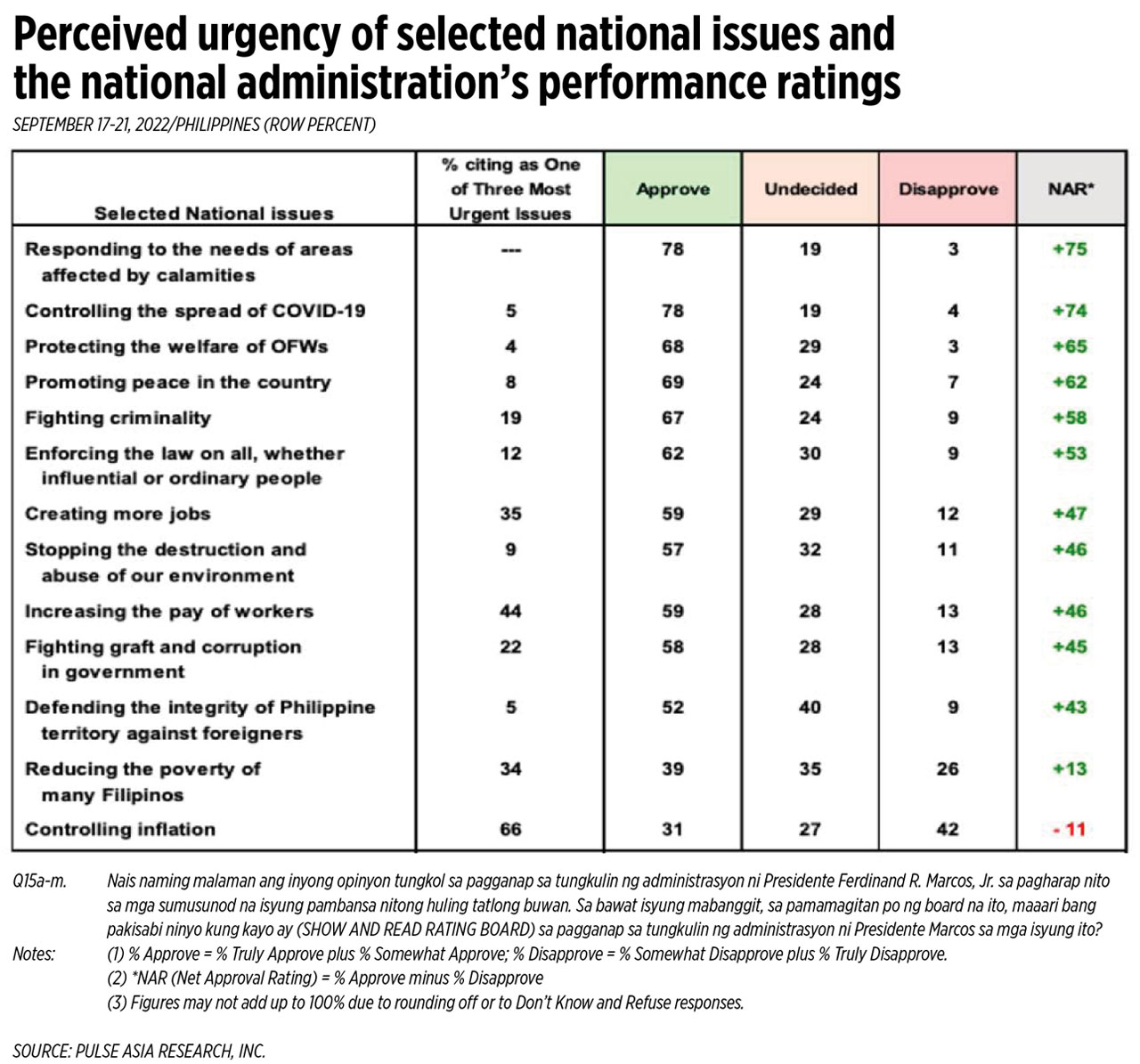
Of the 13 “perceived urgency of selected national issues,” Pulse Asia Research reported that 66% of survey respondents cited controlling inflation as the top urgent national concern. The survey was done in the middle of the President’s first six months in Malacañang and the results were released on Oct. 6. During that time, the issue of sugar imports and the subsequent sharp increase in sugar prices hogged the headlines and the headline inflation. Sugar is a key ingredient to many food products in the consumer price index, affecting both small and big food industries. This must have initiated the President’s waking hours at night.

Sleepless nights continued with the spike in white onion prices in local markets to as high as P400 per kilo in the early part of August last year. The President was advised by his appointed officials that bad governance was behind the problem. Logistical problems of storage were driven by what we may describe as territorial capture, as local government units attempted to exact tolls that were made even worse by various checkpoints by uniformed personnel.

But the President must have also been alerted in the last couple of days that the price of garlic has started to shoot up to P400 per kilo and it’s driven by farmers’ decision to shift to onions. Even as the Agriculture department insisted that “we don’t have a shortage of garlic,” in the same breath there was an admission that the Philippines today suffers from a “small supply of local garlic.” We have yet to establish the substitutability between local and imported garlic, but they must be close substitutes. It is possible the President’s sleepless nights are due also to some people around him who denied any shortage of the commodity while disclosing that we only produce a mere 4% of our garlic requirements.

Earlier, the Agriculture department itself expressed disbelief that even egg prices had escalated to as much as P10 a piece. Central Luzon was reportedly affected by bird flu that required the culling of about 1.8 million chickens. A shift of supply to southern and northern Luzon should increase logistical costs.

If tomatoes follow this series of commodity inflation, as what was experienced in India last year for several months, restaurants and households would have a hard time serving Filipino-style omelets. But the issue of inflation is beyond eggs, onions, and garlic.

It is also about its social consequences, intended or otherwise, and therefore it is at the heart of political governance.

If 66% of respondents of the Pulse Asia survey — the same survey that predicted the Marcos victory at the May 2022 polls — cited inflation as most serious and urgent issue, 44% of the respondents were also spot on considering the increase in workers’ pay as second priority. If prices are rising fast and furious, the immediate buffer is to adjust the people’s purchasing power. Their third priority is most logical and this is to create more jobs. Some 35% of the respondents were convinced that job creation could be a good mitigant. Many respondents succeeded in connecting these dots.

While the administration appears to have scored net positive approval for increasing the pay of workers — and this must be due to the cash payout and special adjustments in workers’ pay during the pandemic, as well as in job creation, thanks to the new industries of movers and home cooking and catering — it is important not to ignore the share of the undecided. They either had little information or were plain secretive about their true sentiment.

In the case of inflation control, the government scored a net disapproval of 11%. Some 42% of the respondents considered government efforts had failed and 31% approved of how inflation was managed. The undecided respondents were less than those who supported public measures against price stability measures.

The reason for the President’s sleepless nights has important implications on the dynamics of inflation. As the Bank for International Settlements (BIS) last year observed, the broadening price pressures may have caused households and firms to move out of the zone of “rational inattention.” Arguably, inflation may not have that much influence on their behavior, and instead pushed them to focus on just a few consumer items.

In the case of the Filipinos, they have precisely turned more attentive to price movements of, yes, rice, sugar, onions, garlic, and perhaps in the near future, tomatoes. It is possible that other items in the consumer basket are priced more reasonably but consumers have limited ability to consider all inflation developments in their own decision to consume or invest.

Based on this, one can expect households and firms to behave in a way that could protect their purchasing power, by demanding more pay, or profit, by selling high. This process could feed into higher inflation expectations. Demand for higher wages and price adjustments could only lead to inflation becoming even more entrenched.

All up, if these price trends of omelet ingredients continue and inflation expectations remain uncertain, the Bangko Sentral ng Pilipinas (BSP) may have to sustain its tightening mode much longer.

We have some clues.

Last week in Frankfurt, BSP Governor Philip Medalla assured the investment community that by the end of the third quarter or by the fourth quarter, inflation would be below 4%. Due to large base effects, inflation is expected to tip 2% in early 2024. His caveat was very revealing, if not too obvious. It’s impossible to rule out another supply shock, and the BSP was correct in anchoring its forecast on a successful resolution of agricultural shortages. This is a very strong assumption.

While it was good for the BSP to telegraph the direction of its policy stance, how long this could be sustained is a difficult task. If the Agriculture department remains in disarray, the prices of these omelet ingredients are bound to run away.

Moreover, the latest inflation footprint for January and its implications on one-year ahead forecast may justify sustained tightening. Two days ago, the BSP announced its projection for January at between 7.5-8.3% “due to a rise in power and water rates, and higher pump prices.” Utilities and energy are new variables in the equation. If this forecast holds, the January 2023 inflation would be the 10th straight month that price movements surpassed the 2-4% inflation target of government. In fact, the BSP’s optimism that the decline in LPG prices in January is good for inflation might be transitory. In fact, LPG prices already rose by over P120 per tank yesterday, and an 11-kg LPG tank would now cost over P1,000.

The IMF resident representative Ragnar Gudmundson two days ago also expected a breach in the inflation target for this year. More BSP interest rate tightening may be in order, according to him.

What is more revealing is the IMF’s estimate of what needs to be done at this point. “In the case of the Philippines, we estimate that the neutral real rate, which is the net of inflation interest rate where monetary policy is neither contractionary nor expansionary stands between 1% and 2%.”

If inflation for this year is 4.5% for BSP and 4.7% for IMF, given its current policy rate of 5.5%, then the BSP will have to continue jacking up by a maximum of around 100 basis points to 6.5%. Pray that the BSP’s ammunition would remain adequate should the Maharlika bill be rushed into law.

President Marcos should brace himself for more sleepless nights.


Diwa C. Guinigundo is the former deputy governor for the Monetary and Economics Sector, the Bangko Sentral ng Pilipinas (BSP). He served the BSP for 41 years. In 2001-2003, he was alternate executive director at the International Monetary Fund in Washington, DC. He is the senior pastor of the Fullness of Christ International Ministries in Mandaluyong.


Corazon Aquino’s legacy

PORTRAIT of the late President Corazon Aquino by visual artist Celeste Lecaroz — EN.WIKIPEDIA.ORG

The family and friends of the late President Corazon Aquino marked her 90th birthday on Jan. 25. No one in government even mentioned it, but it would have been surprising if any one of them had done so. Not only is the Executive branch of government firmly in the hands of the immediate family of the dictator she helped oust in the 1986 People Power uprising (the 37th anniversary of which will be in 22 days); its allies and other kin are also in control of both houses of Congress and the Judiciary.

Neither was there any indication that the citizenry took notice of it or was even aware of it, since, in the first place, they are troubled by such concerns as coping with the high prices of basic commodities, where to get the wherewithal to make both ends meet, surviving unseasonal floods, and the surge in the crime rate, and the many other ills Filipino flesh is heir to.

But in testimony to how successfully the trolls and media hacks of her and her family’s political foes have reinvented the events of 1986 to 2016, if Corazon Aquino had been remembered at all in recent times, it was mostly in less than positive terms.

She has been maliciously and falsely depicted as indifferently playing mahjongg with Carmelite sisters when she was in Cebu during the initial days of the 1986 civilian-military mutiny, when thousands of Filipinos began massing at Quezon City’s Epifanio de lost Santos Avenue (EDSA) to protect military elements opposed to Marcos Sr. Her running against the latter in the 1986 “snap” elections has also been painted as no more than a selfish attempt to advance her family’s economic interests. She has been accused as well of being “pro-communist” and of prolonging the country’s problems with the insurgency when she released political prisoners upon her ascension to the Presidency.

Mrs. Aquino was far from perfect, but neither was she the evil plotter that she and her family have been depicted by the partisans of dictatorship and tyranny. A member of Tarlac province’s Cojuangco dynasty, whose antecedents had been in government since the First Philippine Republic, she was educated in the country’s most “exclusive” Catholic schools. She also attended universities in the United States, from one of which she graduated from with a major in the French language, which she spoke fluently.

She later married into the then rising Aquino family, and was thrown into the maelstrom of Philippine politics by the aspirations of her husband, Benigno “Ninoy” Aquino, Jr., for the Presidency. That goal brought them into a collision course with the far more aggressive ambitions of Ferdinand Marcos, Sr.

The assassination of Ninoy at the then Manila International Airport tarmac on Aug. 21, 1983 upon his return from medical treatment in the United States forced her to contest the Presidency against Marcos Sr. during the “snap” elections of Feb. 7, 1986. The latter had reluctantly called those elections under pressure from the US, the government of which believed that without a regime legitimized by credible elections, the so-called “communist insurgency” would grow even more rapidly.

During the campaign, the Marcos camp ridiculed Mrs. Aquino for supposedly being unskilled in the arts of governance, and described her as “a mere housewife” unworthy of the Presidency. But neither those claims nor the fraud, vote-buying, and intimidation during those elections succeeded in convincing most Filipinos that Marcos had won it.

Independent election watchdogs as well as the Catholic Church found Corazon Aquino the winner. The disgruntled sectors of the military supported her at the EDSA uprising that eventually escalated into Marcos Sr.’s ouster and the “mere housewife’s” rise to the Presidency.

The 1986 overthrow of the Marcos dictatorship fanned hopes that the political, economic, and social changes that had been at the heart of Filipino aspirations since the reform and revolutionary periods of Philippine history would finally be realized. But Corazon Aquino and the politicians and bureaucrats around her soon dashed those hopes to pieces.

Like other members of the political, social, and economic elite, she could not escape the limitations of her class and the demands of her familial interests. Instead of the “revolution” that the 1986 EDSA Mutiny promised, under her and her allies’ direction it restored the limited democracy that had been in place during the three decades prior to the imposition of martial law.

For instance, instead of prodding her allies in the reconstituted Congress into crafting a bill abolishing the tenancy system that the US Agency for International Development’s (US-AID) Roy Prosterman had then described as “the worst on the planet,” and whose continuation, he also warned, would lead to full-scale civil war, what Corazon Aquino supported and what passed that landlord-dominated body in 1987 was a supposedly “comprehensive” agrarian reform program that contained so many exceptions it hardly addressed the festering land problem that had driven rebellions for decades. Neither could she prevent the police’s massacre at Mendiola of farmers demanding authentic land reform. And she also favored Senate approval of a new treaty that would continue to allow US military bases in Philippine territory, not only because the US supported her against the succession of coup attempts against her, but also because she believed in the benevolence of that country’s intentions.

But she did dismantle the Marcos dictatorship, and by doing so made possible the resumption of the democratization process that kleptocracy had interrupted. Through a new Constitution, she restored Congress, the independence of the judiciary, and the freedoms, such as the right to due process, that had been curtailed by one-man rule.

Its emphasis on human rights, equality, and the rule of law makes the 1987 Constitution the most progressive among the other basic laws — the Malolos Constitution, the 1936 Charter, and Marcos Sr.’s 1973 version — that the Philippines has had. If there is anything for which Corazon Aquino deserves to be remembered, it is for her enabling the making of that document possible. She convened the 1986 Constitutional Commission of libertarian lawyers, artists, writers, and public servants who, with the horrific lessons of the martial law period in mind, put together a document protective of human rights and restrictive of the coercive powers of government to preempt another dictatorship.

The 1987 Constitution has been repeatedly threatened with amendments by those ruling oligarchs and their front men who claim to be interested only in amending its economic provisions, but who are also likely to extend their terms in office and to tamper with its Bill of Rights and the limits on the Presidential power to declare martial law. The very same attempts could be in the offing again: the dynasty-dominated House of Representatives began hearings on charter change on Jan. 26 despite widespread opposition to it.

Defending the Constitution, particularly its Bill of Rights and its other provisions such as those favoring Filipino primacy in the country’s economic development from the self-serving advocates of tyranny and of opening the country to unrestricted foreign exploitation is even more urgent today than in times past.

Should Congress decide to either convene itself into a constituent assembly or to call for elections for delegates to a constitutional convention, the citizenry must closely monitor the process — not because the 1987 Constitution is Corazon Aquino’s most outstanding legacy, but because, at this critical stage in the country’s history, it is among the people’s few remaining means of defense against the return of authoritarian rule and the further ruin of this country.


Luis V. Teodoro is on Facebook and Twitter (@luisteodoro).

www.luisteodoro.com

The passion for child protection

ISAAC QUESADA-UNSPLASH

“We are here not only to celebrate our 25th Anniversary but also to reflect on our purpose, how we can rekindle our passion and we can inflame the whole country… So that every province will have a women and children protection unit and every abused woman and child in the country will know that we are here for them.” — Bernadette J. Madrid MD, Executive Director of the Child Protection Network Foundation, Inc.

In the United Nations Convention on the Right of the Child, Child Protection is a recognized right. A goal in the UN Agenda of Sustainable Development is to end all forms of violence against children.

Child abuse is a silent crime. According to research data, it affects one billion children worldwide. The medico-social consequences are constrained by the issues of poverty, the lack of sufficient governmental and social infrastructure, and conflict.

In the 2016 study by the Council for the Welfare of Children on Violence against Children in the Philippines, the statistics revealed that three out of five Filipino children (66.3%) were abused, that 62.8% were psychologically abused, and 65% were bullied. One in five children — 21.5% — have experienced sexual abuse.

The Philippine General Hospital – Child Protection Unit (PGH-CPU) was established in 1997.

David G. Bradley and Dr. Victoria LM Herrera spearheaded the full framework analysis, in consultation with Child Abuse pediatrics experts at Rady Children’s Hospital, the University of California San Diego, and Boston Children’s Hospital, Harvard Medical School. The philanthropic vision of the Advisory Board Foundation (ABF), now CityBridge Foundation (CBF), was responsible for the CPU.

The analysis identified that most street children were physically or sexually abused. Assessment was done regarding the needs, resources, and strategic multidisciplinary partners, in consultation with the Chancellor of the University of the Philippines (UP) Manila, government agencies, NGOs, and workers on the frontlines.

Twenty-five years ago, the first 24/7 hospital-based CPU was created to prioritize and provide integrated medical care and interdisciplinary resources for abused children and their families.

The Child Protection Network Foundation (CPN) is responsible for the establishment of CPUs nationwide to reduce child abuse and neglect, and to increase accessibility to child protection services. Its seed funding initiatives was provided by ABF (now CBF) with the critical support of the Chancellor and Vice-Chancellor of the UP Manila System, the Dean of the UP College of Medicine, the cabinet secretaries of the departments of Social Welfare, Justice, and Health, the Chancellor of the Philippines Judicial Academy, clinical and scientific advisors, legal consultants and partners, among many others.

“The PGH-CPU and CPN embody the fruition of vision into opportunity and success. Operationalization was facilitated by a ‘right place, right time, right people’ scenario with the convergence of recognition of need, readiness of multidisciplinary expertise support of institutional leaders, tactical logistics and the shared spirit of generosity of all those involved.” (Acta Medica Philippina, The National Health Science Journal)

The operations and the success of the PGH-CPU were due to the leadership and dedication of Dr. Bernadette Madrid, who is the founding director of both the PGH-CPU and CPN, and her staff. She was conferred the prestigious Ramon Magsaysay Award last November. In her acceptance speech, she generously acknowledged CPN and shared the award with all those who have worked with her and who have supported their passion to help the children.

At the silver anniversary of PGH-CPU, the founders gave their inspiring remarks.

“It’s great to be among advocates of children. My presence here is to show you that the University of the Philippines Manila appreciates the work of the Child Protection Unit. Even during the lockdown, I saw how you innovated, how you made yourselves available despite the fact that borders were closed. That is really something to be a model for the rest of the country. We may have different paths but because we are dealing with children we are in the right place, thinking of the future of the country,” said Carmencita D. Padilla, MD, the Chancellor of UP Manila.

“Your work is not left unnoticed internationally, and, of course, by PGH. We always try to make sure that the support you need is given, and as long as Dr. Madrid is there, there is nothing that we can refuse,” declared Gerardo D. Legaspi, MD, the Director of UP-PGH.

“The work that CPU and CPN is doing is something I am very proud of and something very meaningful, something I’m very blessed to be part of… I hope tonight will also contribute to a happy memory given that you should all applaud yourselves for 25 years of amazing work,” said Julio Sy, Jr., Trustee of the Child Protection Network Foundation, Inc.

“We thank our partners who have supported us and continue to support us. To all our donors, our deepest gratitude. Thank you for helping us provide the children in our care the best service. Together we can stop violence against women and children. On to the next 25 years!” cheered Katrina Legarda, the Director of the National Network for Women and Children Protection Units, Child Protection Network Foundation, Inc.

Bravo to the visionaries, the dedicated, hardworking founders and staff, the generous Trustees of and partners of PGH-CPU, CPN Foundation, and all the passionate protectors of women and children!


Maria Victoria Rufino is an artist, writer and businesswoman. She is president and executive producer of Maverick Productions.

mavrufino@gmail.com

Coming soon: Attorney Chatbox?

POSSESSED PHOTOGRAPHY-UNSPLASH

The way things are going, it was bound to happen: “A quartet of law professors at the University of Minnesota used the popular artificial intelligence chatbot to generate answers to exams in four courses last semester, then graded them blindly alongside actual students’ tests.”

And how did the chatbot do? “If applied across the curriculum, that would still be enough to earn the chatbot a law degree,” Reuters reported on Jan. 26.

ChatGPT is a chatbot program, essentially a software application normally employed to simulate and conduct online conversations. Last December, it was reportedly asked to “draft a brief to the United States Supreme Court on why its decision on same-sex marriage should not be overturned; Explain the concept of personal jurisdiction; Develop a list of deposition questions for the plaintiff in a routine motor vehicle accident; Create a contract for the sale of real estate in Massachusetts — and half a dozen others,” according to a Reuters report on Dec. 9.

The program did reasonably well, able to exhibit a fair bit of analysis, citation of precedents, and (quite gratifyingly, when compared to the appalling written language skills of many law students today) grammatically quite competent.

But the impact of artificial intelligence would be felt soonest and most significantly on routine legal work: government forms (such as a corporation’s reportorial requirements, contract drafting, and simple legal queries).

In 2018, an article on the World Economic Forum (WEF) website (“This AI outperformed 20 corporate lawyers at legal work”) told of how a “group of 20 experienced lawyers” were made “to test their skills and knowledge against [an] AI-powered algorithm.”

“When it came to speed, the AI far surpassed the legal minds, taking just 26 seconds to review all five documents compared to the lawyers’ average speed of 92 minutes.”

The WEF goes on to point out that 23% of a lawyer’s function can now be duplicated by artificial intelligence. However, it is more likely another 25% could be removed from lawyers due to technology as a whole.

Now take the foregoing within the context of a global economy likely headed for a recession. The International Monetary Fund itself reporting that “global growth is projected to fall from an estimated 3.4% in 2022 to 2.9% in 2023.” Ultimately, “the balance of risks remains tilted to the downside.”

In short, the clientele which law firms expect to generate income from are seemingly headed for uncertain waters. And yet, law firms themselves have internal struggles of their own: “According to Thomson Reuters, demand for law services dropped for the second consecutive quarter, contracting by 0.7% in the third quarter, following a growth rate of negative 0.5% in the second quarter. This decline has been driven largely by the decrease in demand for legal services related to mergers and acquisitions, which was 13.7% lower than in the third quarter of 2021.”

Furthermore, “the most concerning factor of the third quarter is that productivity has continued to slide, decreasing 3.8% following two consecutive quarterly declines.” And one big reason for the drop in productivity? That very 2020s malaise: mental health — “In a 2022 mental health survey by the American Bar Association, 74% of lawyers reported that their work environment contributed to mental health issues,” consultancy group RSM said in a Dec. 16 report.

At least from the client’s perspective, they need not worry about an AI’s mental health. Consider, as stated in this column last week, “legal education and law schools [have been transformed by] today’s social media culture into some weird psychosocial daily soap opera where the law students are the lead characters.”

Bottomline: the legal profession — to retain relevance, survive, and thrive — needs to let go of its old model of providing general legal services and instead put emphasis on abilities to tackle more complex legal issues.

For that, it is thus needed urgently for the law profession as a whole to change and adapt as efficiently and quickly as possible. Trash the present insistence on DIE (diversity, inclusivity, and equity) policies. And return ruthlessly to the mindset of rigorous, utterly uncompromising, standards.

For legal education in particular, the direction should not be technical specialization at the law school level but rather one that leads to a profession that is more analytical, capable of melding different disciplines, and adept at identifying opportunities or open strategic possibilities rather than mere solutions.

This means accepting only, and then training, law students of greater capacity for memory and analysis, as well as mental quickness and linguistic skill. Naturally, this in greater probability entails either far far fewer but far far better lawyers.

The other route is to bifurcate the profession, either by competence or expertise (e.g., Britain’s solicitor/barrister model or medicine’s fellow/diplomate stratification).

The better strategy seems to be both: develop better lawyers first, then bifurcate the profession.


Jemy Gatdula is a senior fellow of the Philippine Council for Foreign Relations and a Philippine Judicial Academy law lecturer for constitutional philosophy and jurisprudence

https://www.facebook.com/jigatdula/

Twitter @jemygatdula

HK seeks to woo visitors with 500,000 free flights

People walk in front of the Hong Kong Observation Wheel in Hong Kong, China China Sept. 5, 2019. — REUTERS

HONG KONG — Hong Kong leader John Lee unveiled on Thursday a promotion campaign that will include 500,000 free flights to lure back visitors, businesses and investors to the financial hub after more than three years of tough COVID-19 curbs.

The “Hello Hong Kong” campaign was launched with dancers and flashing neon lights in the city’s main convention center, next to its famous harbor, with a backdrop bearing the slogan in various languages including Russian and Spanish.

Mr. Lee, speaking in English, said the campaign would show that the city was open for tourism and was aimed at boosting business and investment in the Chinese special administrative region.

“Hong Kong is now connected to mainland China and the whole international world, and there will be no isolation, no quarantine and no restrictions on experiencing … enjoying the hustle and bustle of Asia’s world city,” Mr. Lee said.

The launch was attended by a range of officials including from the city’s tourism, trade and aviation departments.

Hong Kong was largely sealed off behind closed borders for much of the past three years in a bid to ward off COVID, with mandatory quarantine of up to three weeks for people arriving as well as intensive testing and screening.

The former British closely followed China’s zero-COVID policy until the middle of 2022 when it began to gradually unwind its rules.

Hong Kong dropped most of its remaining COVID rules in December but the wearing of masks remains mandatory unless exercising, as well as daily rapid antigen testing for students.

There remains a quota system for travelers between the mainland and Hong Kong and a requirement that they must do a COVID test. Three of Hong Kong’s border checkpoints with China have remained closed.

China announced in December that it would scrap most of its COVID curbs and it reopened its borders to the world in January, despite a surge in infections.

Hong Kong business groups, diplomats and many residents deplored Hong Kong COVID rules, saying they threatened its competitiveness and standing as an international financial center, especially after a period of political tension over pro-democracy protests. — Reuters

Cryptocurrency hacks stole record $3.8 billion in 2022

REUTERS

SEOUL — Last year was the worst on record for cryptocurrency heists, with hackers stealing as much as $3.8 billion, led by attackers linked to North Korea who netted more than ever before, a US-based blockchain analytics firm said in a report on Wednesday.

The report by Chainalysis found hacking activity that “ebbed and flowed” throughout the year, with “huge spikes” in March and October. October was the biggest single month ever for cryptocurrency hacking, with $775.7 million stolen in 32 separate attacks, the report said.

The cryptocurrency market floundered in 2022, as risk appetite diminished and various crypto firms collapsed. Investors were left with large losses and regulators stepped up calls for more consumer protection.

At the time, Chainalysis and other firms confirmed to Reuters that North Korean-related accounts had lost millions of dollars in value.

But that did not deter hackers.

North Korea-linked hackers such as those in the cybercriminal syndicate Lazarus Group have been by far the most prolific cryptocurrency hackers, stealing an estimated $1.7 billion worth of multiple attacks last year, the report said.

“In 2022, they shattered their own records for theft,” it said.

North Korea has denied allegations of hacking or other cyberattacks.

According to a panel of experts monitoring United Nations sanctions, North Korea has increasingly relied on hacking to fund its missile and nuclear weapons programs, particularly as publicly declared trade dwindled under sanctions and COVID-19 lockdowns.

“It isn’t a stretch to say that cryptocurrency hacking is a sizable chunk of the nation’s economy,” Chainalysis said.

For the first time last year, US law enforcement seized $30 million in stolen funds from North Korea-linked hackers.

“These hacks will get harder and less fruitful with each passing year,” Chainalysis predicted.

Targets in “decentralized finance” or DeFi, a thriving segment in the cryptocurrency sector, accounted for more than 82% of the cryptocurrency stolen in 2022, the report said.

DeFi applications, many of which run on the Ethereum blockchain, are financial platforms that enable crypto-denominated lending outside of traditional banks.

Last year saw a record amount of crypto transactions related to illicit activity overall, reaching $20.1 billion, Chainalysis said in January. — Reuters

ADVERTISEMENT
ADVERTISEMENT