Home Blog Page 5283

North Korea shows off largest-ever number of nuclear missiles at nighttime parade

SEOUL — Nuclear-armed North Korea showcased its missile production muscle during a nighttime parade, state media reported on Thursday, displaying more intercontinental ballistic missiles (ICBMs) than ever before and hinting at a new solid-fuel weapon.

North Korea held the widely anticipated nighttime military parade in Pyongyang on Wednesday to mark the 75th anniversary of the founding of its army, state news agency KCNA said.

Leader Kim Jong Un attended with his daughter, who is seen as playing a possible future leadership role in the hereditary dictatorship.

The ICBMs showed North Korea’s “greatest” nuclear strike capability, KCNA said, adding that the parade also featured tactical nuclear units.

Imagery released by state media showed as many as 11 Hwasong-17s, North Korea’s largest ICBMs, which are suspected to have the range to strike nearly anywhere in the world with a nuclear warhead.

“This is cumulatively more ICBM launchers than we’ve ever seen before at a North Korean parade,” Ankit Panda of the United States–based Carnegie Endowment for International Peace, said on Twitter.

If such ICBMs are equipped with multiple warheads, that number could be enough to saturate existing U.S. missile defence systems, he added.

The Hwasong-17 was first tested last year.

NEW MISSILES
The country has forged ahead with its ballistic missile programme, launching larger and more advanced missiles despite United Nations Security Council resolutions and sanctions.

“This time, Kim Jong Un let North Korea’s expanding tactical and long-range missile forces speak for themselves,” said Leif-Eric Easley, a professor at Ewha University in Seoul. “The message Pyongyang wants to send internationally, demonstrating its capabilities to deter and coerce, will likely come in the form of solid-fuel missile tests and detonation of a miniaturized nuclear device.”

The Hwasong-17s were followed by what some analysts said could be a prototype or mockup of a new solid-fuel ICBM in canister launchers.

The canisterized ICBMs appeared different from those shown in a 2017 parade, Panda said.

Most of the country’s largest ballistic missiles use liquid fuel, which requires them to be loaded with propellant at their launch site – a time-consuming process.

Developing a solid-fuel ICBM has long been seen as a key goal for the country, as it could make its nuclear missiles harder to spot and destroy during a conflict.

It is unclear how close the suspected new missile could be to testing. North Korea has sometimes displayed mockups at the parades. — Reuters

What’s in store for the travel accommodation industry in 2023?

Despite economic challenges, the rebound in hotel markets is expected to continue as countries open their borders, according to an industry expert.

“People are talking about revenge travel. I don’t necessarily believe that one. I think there has always been a desire to travel, and now that the gates have opened up, I see people returning to travel and enjoying themselves, especially in the luxury segment,” Mark Willis, chief executive officer of Fairmont Hotels & Resorts, tells BusinessWorld.

Text and interview: Arjay L. Balinbin

Videography/Video editing: Joseph Emmanuel L. Garcia and Earl R. Lagundino

Alphabet shares dive after Google AI chatbot Bard flubs answer in ad

STOCK PHOTO | Image by Gerd Altmann from Pixabay

LONDON – Alphabet, Inc. lost $100 billion in market value on Wednesday after its new chatbot shared inaccurate information in a promotional video and a company event failed to dazzle, feeding worries that the Google parent is losing ground to rival Microsoft Corp.

Alphabet shares slid as much as 9% during regular trading with volumes nearly three times the 50-day moving average. They pared losses after hours and were roughly flat. The stock had lost 40% of its value last year but rallied 15% since the beginning of this year, excluding Wednesday’s losses.

Reuters was first to point out an error in Google’s advertisement for chatbot Bard, which debuted on Monday, about which satellite first took pictures of a planet outside the Earth’s solar system.

Google has been on its heels after OpenAI, a startup Microsoft is backing with around $10 billion, introduced software in November that has wowed consumers and become a fixation in Silicon Valley circles for its surprisingly accurate and well-written answers to simple prompts.

Google’s live-streamed presentation on Wednesday morning did not include details about how and when it would integrate Bard into its core search function. A day earlier, Microsoft held an event touting that it had already released to the public a version of its Bing search with ChatGPT functions integrated.

Bard’s error was discovered just before the presentation by Google, based in Mountain View, California.

“While Google has been a leader in AI innovation over the last several years, they seemed to have fallen asleep on implementing this technology into their search product,” said Gil Luria, senior software analyst at D.A. Davidson. “Google has been scrambling over the last few weeks to catch up on Search and that caused the announcement yesterday (Tuesday) to be rushed and the embarrassing mess up of posting a wrong answer during their demo.”

Microsoft shares rose around 3% on Wednesday, and were flat in post-market trading.

Alphabet posted a short GIF video of Bard in action via Twitter, promising it would help simplify complex topics, but it instead delivered an inaccurate answer.

In the advertisement, Bard is given the prompt: “What new discoveries from the James Webb Space Telescope (JWST) can I tell my 9-year old about?” Bard responds with a number of answers, including one suggesting the JWST was used to take the very first pictures of a planet outside the Earth’s solar system, or exoplanets. The first pictures of exoplanets were, however, taken by the European Southern Observatory’s Very Large Telescope (VLT) in 2004, as confirmed by NASA.

“This highlights the importance of a rigorous testing process, something that we’re kicking off this week with our Trusted Tester program,” a Google spokesperson said. “We’ll combine external feedback with our own internal testing to make sure Bard’s responses meet a high bar for quality, safety and groundedness in real-world information.”

FORMIDABLE COMPETITOR

Alphabet is coming off a disappointing fourth quarter as advertisers cut spending.

The search and advertising giant is moving quickly to keep pace with OpenAI and rivals, reportedly bringing in founders Sergey Brin and Larry Page to accelerate its efforts.
“People are starting to question is Microsoft going to be a formidable competitor now against Google’s really bread-and-butter business,” said King Lip, chief strategist at Baker Avenue Wealth Management, which owns Alphabet and Microsoft shares.

Lip cautioned, though, that concerns about Alphabet may be overblown, saying: “I think still Bing is a far, far cry away from Google’s search capabilities.”

The new ChatGPT software has injected excitement into technology firms after tens of thousands of job cuts in recent weeks and executive pledges to pare back on so-called moonshot projects. AI has become a fixation for tech executives who have mentioned it as much as six times more often on recent earnings calls than in prior quarters, Reuters found.

The appeal of AI-driven search is that it could spit out results in plain language, rather than in a list of links, which could make browsing faster and more efficient. It remains unclear what impact that might have on targeted advertising, the backbone of search engines like Google.

Chatbot AI systems also carry risks for corporations because of inherent biases in their algorithms that can skew results, sexualize images or even plagiarize, as consumers testing the service have discovered. Microsoft, for instance, released a chatbot on Twitter in 2016 that quickly began generating racist content before being shut down. And an AI used by news site CNET was found to produce factually incorrect or plagiarized stories.

At the time of writing, the Bard ad had been viewed on Twitter more than a million times. — Reuters

VOX POPULI | After three years of travel restrictions, where do Filipinos want to go now?

MANY FILIPINOS are now going on “revenge travels” after spending the past three years confined to their homes due to strict mobility rules amid a public health crisis.

In a post-pandemic world, Filipinos are eager to create new memories, whether they travel locally or abroad.

The Philippine Travel Agencies Association, Inc. held its annual Travel Expo from Feb. 3 to 5, offering a variety of travel deals. As the first one taking place post-pandemic, many Filipinos flocked to the scene.

The requirements were what stopped people from traveling, said Angelica, 32, who went to the expo hoping for flight packages.

“We waited for the pandemic to die down before even checking flights,” she said.

When it comes to dream destinations, Filipinos have been eyeing neighboring Southeast Asian countries.

For Aldrin, 43, who has done vlogs in Catanduanes, foreign culture and heritage are the next boxes he’s looking to tick.

“Vietnam is where I want to go because of the deep culture that they have,” he said. “When it comes to heritage sites, I would go with Thailand.”

For distant countries, it’s important to find promos that can somewhat get costs down, said Kenji, 47.

“I’m planning to go to the United States by this year, so I hope I can get a promo from this event.” he said.

Edward, 38, already acted on his excitement to travel last year and managed to book a trip to Japan, his dream destination.

Cristina, 34, and Nino, 35, lamented that they had traveled a lot before the pandemic, to countries like the United Arab Emirates and Australia. They hope to add more stamps to their passports this year as a family.

For younger Filipinos like Patrick, 24, the hunt for affordable deals is all the more important given his limited budget.

“It will only be my second time traveling internationally,” he shared.

When it comes to why Filipinos travel, the answers are simple: “family bonding” and “building memories,” according to Imelda, 57.

Marie, 23, added that stress is a major factor since traveling refreshes people by exposing them to beautiful sights. — Brönte H. Lacsamana

Jobless rate eases to 3-year low in ’22

A worker makes Christmas decorations in a workshop in Barangay San Vicente, Angono, Rizal. The jobless rate improved to 4.3% in December, according to the Philippine Statistics Authority. — PHILIPPINE STAR/WALTER BOLLOZOS

THE PHILIPPINES’ unemployment rate eased to a three-year low of 5.4% in 2022, despite a slight uptick in December, the Philippine Statistics Authority (PSA) said on Wednesday. 

Preliminary results from the PSA showed the unemployment rate stood at 4.3% in December, a tad higher than November’s 4.2% jobless rate but smaller than the 6.6% in December 2021.

The PSA said there were 2.22 million jobless Filipinos in December, up 43,000 from the 2.18 million unemployed in November.  However, this was a better than the 3.28 million jobless recorded in December 2021.

Philippine Labor Force Situation

This brought the full-year jobless rate to 5.4%, which is the lowest since the 5.1% in 2019 or before the coronavirus pandemic, PSA Undersecretary and National Statistician Claire Dennis S. Mapa said during the briefing.

This was equivalent to 2.67 jobless Filipinos last year, the lowest number since 2.26 million in 2019. In 2021, the unemployment rate stood at 7.8%, equivalent to 3.71 million.

“The government remains committed to providing more, better and green job opportunities to Filipinos and sustaining a vibrant labor market through the strategies articulated in the Philippine Development Plan 2023-2028,” National Economic and Development Authority Secretary Arsenio M. Balisacan said in the statement.

Job quality improved in December, as the underemployment rate fell to 12.6% from 14.4% in November and the 14.7% in December 2021. This translated to 6.197 million underemployed Filipinos or persons already working but still looking for more work or longer working hours.

For 2022, the underemployment rate averaged 14.2%, the lowest in three years or since the 14% in 2019.

PSA data showed the size of the labor force population reached 51.22 million in December, bringing the labor force participation rate (LFPR) to 66.4% of the country’s working-age population. This was lower than the 67.5% seen in November.

Last year, LFPR averaged to 64.7%, the largest share since the redefinition of the jobs situation survey in 2005.

The employment rate dipped to 95.7% in December, from 95.8% in the previous month. This means 49 million Filipinos had jobs in December, about 704,000 less than in November.

For the full year, the share of employed persons was at 94.6%, also the largest since 94.9% in 2019.

On average, an employed Filipino worked 40.3 hours a week in December, higher than the 39.3 hours logged the previous month and the 39.7 hours in the same month in 2021.

Philippine Annual Labor Force Situation

SEASONAL TREND?
ING Bank N.V. Manila Senior Economist Nicholas Antonio T. Mapa said the holiday season in December may have affected the manufacturing subsector as factories had their year-end shutdown.

“We also saw a decrease in jobs for the wholesale and retail trade, possibly as holiday spending wound down post-Christmas. We did see some offsetting increase in agriculture employment, but this was unable to fully offset the decrease,” Mr. Mapa said.

In terms of sectoral share of employment, services remained the top employer in December with an employment rate of 58.9%, down from 60.5% in November. Likewise, the share of workers in the industry sector narrowed to 17.1% from 18.1% previously.

The agriculture sector accounted for 24% of the total employed persons in December, up from 21.4% in November.

“Employment losses were seen in manufacturing, wholesale and retail trade, and accommodation and food service activities. This came as a surprise as we anticipated higher demand in these sectors given the holiday season,” China Banking Corp. Chief Economist Domini S. Velasquez said in a report sent to BusinessWorld.

Manufacturing, which accounts for about 44.7% of the industry sector, shed more than half a million jobs month on month in December.

Wholesale and retail trade, which accounts for 37.9% of the services sector, dropped 387,000 workers month on month in December.

MIXED OUTLOOK
After the month-on-month rise in unemployment in December, Ms. Velasquez said she expects “slightly worse figures” in January.

“However, as the economy continues its vigorous growth in 2023, the labor market will likely remain strong, posting unemployment rates around 5% moving forward,” she said.

“On the downside, although we have not seen layoffs in 2022 despite an environment of high interest rates, further monetary tightening might eventually push businesses to reduce the number of workers. Approval of another round of wage hike this year will also be a significant risk to the labor market,” she added.

For ING Bank’s Mr. Mapa, manufacturing jobs may see gains as factor activity hit a seven-month high in January, citing the S&P Global Philippines’ latest Purchasing Managers’ Index (PMI) report.

“Manufacturing activity was jumpstarted in January so we could see an improvement on this front. Slower growth may reverse some of the gains so far. We can hopefully see the unemployment rate stay at these levels while seeing the underemployment rate fall. This would signal improved job creation quality,” ING’s Mr. Mapa said the jobs market will take its cue from the economy’s recovery this year.

“Unfortunately, we believe growth momentum has the odds stacked against it given surging inflation and rising borrowing costs,” he added.

Inflation soared to a 14-year high of 8.7% in January, fueling bets of further interest rate hikes to anchor expectations.

The Monetary Board increased the benchmark key rate by 350 bps to a 14-year high of 5.5% in 2022. Its next policy review meeting is on Feb. 16.

The BSP sees inflation averaging 4.5% this year before easing to 2.8% in 2024. — Ana Olivia A. Tirona


Dollar reserves near $100B as of end-January

United States one-dollar bills are seen in this Nov. 14, 2014 file photo — REUTERS

GROSS INTERNATIONAL RESERVES (GIR) rose to a six-month high as of end-January, as foreign currency deposits with the central bank included the proceeds from the Philippine government’s global bond issuance.

Preliminary data released by the Bangko Sentral ng Pilipinas (BSP) late on Tuesday showed the GIR increased by 3.7% to $99.7 billion in January, from the $96.1 billion as of end-December 2022. Year on year, dollar reserves fell by 7.4%.

This is the highest level of dollar reserves since the $99.84 billion posted in July 2022.

“The month-on-month increase in the GIR level reflected mainly the National Government’s (NG) net foreign currency deposits with the BSP, which include proceeds from its issuance of ROP (Republic of the Philippines) global bonds,” the central bank said in a statement.   

Foreign currency deposits more than doubled to $2.11 billion as of end-January, from $942.8 million in the previous month and from the $831.7-million level a year ago.

The Marcos administration raised $3 billion from its second global bond issuance in January. The Bureau of the Treasury (BTr) sold $500 million worth of 5.5-year bonds, $1.25 billion worth of 10.5-year bonds, and $1.25 billion worth of 25-year sustainability bonds.

The central bank also attributed the higher GIR to “the upward valuation adjustments in the value of the BSP’s gold holdings due to the increase in the price of gold in the international market, and net income from the BSP’s investments abroad.”

As of end-January, the level of dollar reserves is enough to cover about six times the country’s short-term external debt based on original maturity and four times based on residual maturity.

It is also equivalent to 7.5 months’ worth of imports of goods and payments of services and primary income.

Ample foreign exchange buffers protect an economy from market volatility and ensure the country is able to pay its debts in the event of an economic downturn.

“The BSP continues to rebuild its GIR, (and it’s) now close to $100 billion. Although most of the increase was due to the ROP issuance and valuation, the BSP may have also been able to rebuild its buffer stock via foreign exchange operations,” ING Bank N.V. Manila Senior Economist Nicholas Antonio T. Mapa said in an e-mail.

In a note, Rizal Commercial Banking Corp. Chief Economist Michael L. Ricafort said the GIR may have also picked up in January after the seasonal increase in US dollar and foreign currency inflows. He noted the higher holiday-related spending in December may have continued into the new year.

According to the BSP, net international reserves increased by $3.6 billion or 3.7% to $99.7 billion as of end-January 2022 from $96.1 billion a month prior.

Net international reserves are the difference between the BSP’s reserve assets (GIR) and reserve liabilities such as short-term foreign debt, and credit and loans from the International Monetary Fund (IMF).

Broken down, the central bank’s foreign investments reached $83.25 billion, up by 2.3% from the $81.37 billion in the previous month. Year on year, foreign investments slumped by 10.4%.

The country’s reserve position in the IMF inched up 0.9% to $797.3 million as of end-January from $789.8 million in the prior month. Year on year, it slipped by 0.4%.

Reserves in the form of gold were valued at $9.80 billion as of end-January, up by 5.6% from the $9.28 billion as of end-December 2022 and up by 6.8% from the $9.18-billion level a year earlier.

Special drawing rights — or the amount the country can tap from the IMF — was unchanged at $3.764 billion for the second straight month. However, it was 4.3% lower year on year.

“BSP has displayed that it was able to weather the 2022 storm with the bulk of its GIR intact as the cache of foreign reserves was able to help allay concerns about dollar liquidity at the height of financial market stress,” Mr. Mapa said.

The BSP intervenes in the foreign exchange market to smoothen volatility.

Mr. Mapa said he expects GIR to inch up in the next few months “on expectations for a mild appreciation trend for the peso.”

Mr. Ricafort said GIR growth could be supported by rising remittances, business processing outsourcing revenues, exports, as well as a fast recovery in foreign tourism.

The BSP projects the GIR level at $93 billion by end-2023. — Keisha B. Ta-asan

Inflation likely peaked in January, says BSP chief

Fresh produce is being sold at the Marikina public market in this file photo. Inflation surged to a new 14-year high of 8.7% in January. — PHILIPPINE STAR/WALTER BOLLOZOS

HEADLINE INFLATION “most likely” peaked in January, but there could be surprise shocks that may affect prices moving forward, Bangko Sentral ng Pilipinas (BSP) Governor Felipe M. Medalla said on Wednesday.

“(Inflation) was actually higher than the high end of our forecast,” he told reporters in a Viber message.

Inflation accelerated to a fresh 14-year high of 8.7% in January from 8.1% in December. This is well above the 7.5% to 8.3% forecast range given by the BSP.

Mr. Medalla said inflation “most likely” peaked in January. “(But) of course, I can’t rule out another surprise supply shock.”

January marked the 10th consecutive month that inflation was above the BSP’s 2-4% target range.

The BSP in a statement late on Tuesday said the January inflation data showed the “need for sustained efforts to combat price pressures, particularly non-monetary government measures to mitigate the impact of persistent supply-side constraints.”

“The BSP remains focused on restoring inflation to the government target and stands ready to adjust its monetary policy settings as necessary to anchor inflation expectations and safeguard the inflation target over the policy horizon,” it said.

The BSP expects inflation to average 4.5% this year before easing to 2.8% in 2024.

In a note released on Wednesday, Nomura Global Market Research revised its full-year inflation forecast in the Philippines to 5.6% in 2023 from 4.4% previously after the release of the faster-than-expected January print.

“Food price inflation may remain high for a while as supply constraints may not be easily resolved, as recent episodes have demonstrated,” Nomura said.

It noted that second-round effects will “likely be larger and last for longer,” keeping core inflation high.

Core inflation, which excludes volatile prices of food and fuel, jumped to 7.4% in January from 6.9% in December and 1.8% in the same month in 2022. This is the fastest core inflation print in more than two decades or since 8.2% in December 2000.

“If food price inflation remains high, as we now expect, other related items, particularly food services, will also likely pick up, as we have seen in other countries in the region,” Nomura said.

Food inflation quickened to 11.2% from 10.6% a month ago and 1.6% in January 2022, which was the fastest since the 11.3% in March 2009.

Nomura said the continued increase in power rates may also exacerbate second-round effects, and contribute to higher inflation.

“On monetary policy, we maintain our forecast that BSP will hike its policy rate by 25 bps (basis points) in each of the next two monetary board meetings in February and March, taking the policy rate to 6%, which would be our forecast for the terminal rate in this hiking cycle,” Nomura said, adding that the probability of a 50-bp hike at the Feb. 16 meeting is “relatively low.”

The central bank has raised 350 basis points (bps) last year, bringing its benchmark policy rate to a 14-year high of 5.5%.

Nomura said the BSP could cut rates by 50 bps by the fourth quarter as inflation is expected to ease, bringing the policy rate back to 5.5% by end-2023.

“This would also be more consistent with our new CPI (consumer price index) inflation forecast with a trajectory in which inflation returns to BSP’s 2-4% target only by Q4. In 2024, we also now see a lower policy rate of 4.5% versus 5% previously, consistent with our US team’s view of a lower fed funds rate,” it added.

Meanwhile, ING Bank N.V. Manila Senior Economist Nicholas Antonio T. Mapa said the BSP’s cumulative rate hikes already slowed investments, but not consumer revenge spending.

“BSP has been one of the most active central banks in the region. This alongside the fact that the Philippines still records the fastest inflation in ASEAN (Association of Southeast Asian Nations) suggests that rate hikes were never the right tool to meet supply side-oriented inflation head-on,” Mr. Mapa said.

He expects to see a further slowdown in capital formation as the “lagged impact of aggressive tightening takes hold.”

The Philippine economy grew by 7.2% in the fourth quarter, bringing the full-year expansion to 7.6%.

Gross capital formation, the investment component of the economy, grew by 5.9% last quarter, though slower than 21.8% in the third quarter and 14.2% a year ago. Full-year growth was 16.8%, slower than 20.3% in 2021.

“Rate hikes were never designed to snuff out excessive revenge spending but BSP’s recent raising of credit card rate caps will be the right tool to cool some excess demand,” Mr. Mapa added. — Keisha B. Ta-asan

DTI releases new SRP for basic commodities

A woman shops for groceries at a supermarket in Quezon City. — PHILIPPINE STAR/MIGUEL ANTONIO DE GUZMAN

THE PRICES of some basic commodities, such as canned meat, sardines, noodles and bread, have gone up by as much as 10%, according to the new suggested retail price (SRP) bulletin released by the Department of Trade and Industry (DTI) on Wednesday.   

Trade Undersecretary Ruth B. Castelo said the latest SRP bulletin showed there were price increases for 76 shelf keeping units (SKUs), while 141 SKUs retained their prices from the August 2022 bulletin.

In a Viber message, she said the price adjustments in the new bulletin are the “most fair and reasonable increases” that the DTI can allow to make sure the products remain affordable and available.

Ms. Castelo said retail prices of several basic necessities and prime commodities (BNPCs), such as canned meat, sardines, noodles, bread, and milk, were raised.

“A few non-food items also increased prices like candles,” she added.

Ms. Castelo said 58 SKUs raised prices by up to a maximum of 10%, although 19 of these only implemented price adjustments of between 1% and 5%.

“(Prices of) only 18 SKUs are adjusted a little over 10%, mostly non-food items,” she added.   

The DTI issued the new SRP bulletin on Wednesday, after it missed its original release target in January.   

Ms. Castelo said the new SRP bulletin was released following the DTI’s “long validation review and study.

“We are compelled to allow price adjustments of some manufactured BNPCs to make sure that manufacturers continue to produce these fast-moving consumer goods,” she said.

Various manufacturers have previously sought to increase product prices due to surging prices of raw materials and services.   

Inflation surged to a fresh 14-year high of 8.7% in January, as food prices continued to rise. This was also higher than the 8.1% in December, and 3% a year ago.

In January, the American Chamber of Commerce of the Philippines, Inc. urged the DTI to publish SRP bulletin on a regular basis to help manufacturers to “adequately plan their operations and finances.”   

Republic Act (RA) No. 7581, as amended by RA 10623 or the Price Act, directs the DTI and other government agencies to ensure the availability of BNPCs at reasonable prices without denying a fair investment return for legitimate businesses.    

Meanwhile, Trade Secretary Alfredo E. Pascual said in a separate statement that it is intensifying the implementation of policies related to consumer prices, logistics and supply chain management, investment promotion, and collaboration with other government agencies in a bid to address surging inflation.

Mr. Pascual said the DTI is coordinating with manufacturers to ensure the “stable supply and reasonable pricing” of BNPCs both during crisis and non-crisis periods.    

“The DTI continues to capacitate Local Price Coordinating Councils to enforce monitoring, compliance, and accountability of all stakeholders at various supply chain stages, including market masters, administrators, retailers, and wholesalers. Along with this, our monitoring taskforce conducts regular price and supply monitoring of BNPCs, ensuring accessibility of affordable goods,” he said.   

Mr. Pascual said the DTI is also aiming to reduce the logistics costs of manufacturers to help them cut operational expenses.

“We have the Supply Chain and Logistics Management Division under DTI that is working to lower logistics costs and simplify the transport of products from the point of origin to its destination,” he said.

The DTI also said that it is collaborating with other government agencies such as the Philippine Competition Commission to look into cases involving anti-competitive activities. — Revin Mikhael D. Ochave

Fairmont targets local partnerships for expansion

Global Chief Executive Officer of Fairmont Hotels & Resorts Mark Willis

By Arjay L. Balinbin, Sub-editor

FAIRMONT Hotels & Resorts, which recently celebrated the 10th anniversary of its flagship hotel in the Philippines, is eyeing more partnerships to expand its presence in the country, according to the company’s top official.

“We would love to do more in the Philippines, of course,” Mark Willis, global chief executive officer of Fairmont Hotels & Resorts, told BusinessWorld on Tuesday when asked if the brand was looking for other local partnerships besides the Ayala group.

“From a Fairmont perspective, we’re definitely missing a resort hotel here. And as you know, there are beautiful resort locations in the Philippines, whether it be Cebu, Boracay, or many of the wonderful beach and resort locations here, so if there is an opportunity to grow the brand in the Philippines, we would love to,” he added.

The Fairmont Makati celebrated its 10 years on Feb. 7. Mr. Willis, AyalaLand Hotels and Resorts Corp. Board of Director Al Legaspi and President Javier D. Hernandez, and Fairmont Makati’s Cluster General Manager Bernd Schneider graced the occasion.

“This is also a great place to do business. You can see that as international travel starts to return to Asia as it opens up,” Mr. Willis said. “The Philippines is right up there, and hopefully business will return quickly, and if we get the opportunity, I’d love to do another hotel here, of course.”

Mr. Willis is responsible for the luxury brand’s portfolio of more than 100 hotels in operation and under development globally. Prior to taking the helm at Fairmont, he was the chief executive officer for India, Middle East, Africa and Turkey at Accor, overseeing a portfolio of more than 520 hotels in operation and development across 20-plus diverse brands.

Fairmont is part of Accor, a global hospitality group that operates in more than 5,000 locations across 110 countries.

According to Mr. Willis, Fairmont is set to open more than 30 hotels in the next 36 months, nine of which will be in Asia.

“We have some great properties coming up in Vietnam, Tokyo (Japan), Maldives, and Udaipur and Shimla in India,” he said, adding that Fairmont’s biggest presence in Asia remains in China.

The luxury hotel brand is also keen on expanding its partnership with AyalaLand.

“I’m careful who we associate the brand with. We are looking for long-term, strategic partners, and we definitely have it here, with AyalaLand for sure,” Mr. Willis said.

AyalaLand, the brand’s partner for Fairmont Makati, has “a wealth of knowledge of the industry, which brings a lot to the table,” he noted. “If we have the opportunity to expand with them, of course, we would love to.”

Mr. Willis described the latest performance of Fairmont Makati, which has 280 rooms and suites, as “outperforming 2019.”

“The hotel is performing really well. The future looks particularly bright. They have aggressive figures on the table for 2023, agreed upon by everybody to go forward, and I am sure that the hotel will reach those targets and, hopefully, exceed those targets,” he added.

The property has seven food and beverage outlets, the signature Willow Stream spa, a recreational fitness center and swimming pool, flexible meeting rooms, and one of Makati City’s largest ballrooms.

Infrawatch PH says registration of SIM cards progressing slowly

PHILIPPINE STAR/KRIZ JOHN ROSALES

PUBLIC policy think tank Infrawatch PH has expressed concern over the slow progress in the registration of subscriber identity module (SIM) cards, saying the current pace might result in only around 69.52% of the total number of subscribers getting registered.

“In other words, this means the removal of at least 51.5 million subscribers by the April [26,] 2023 deadline,” Infrawatch PH Convenor Terry L. Ridon said in a letter sent to the National Telecommunications Commission (NTC) dated Feb. 7.

With the “deeply concerning” pace, Mr. Ridon said telecommunication companies might push for changes in the implementing rules and regulations to hasten registration. He said the government should not allow shortcuts in the registration as defined by Republic Act. No. 11934.

“Allowing changes in registration procedure and requirements will defeat the purpose of the SIM Card Registration Act, particularly the wisdom of Congress to fight online scams and spams, and other malevolent activities undertaken through digital means,” said Mr. Ridon.

On Wednesday, the Department of Information and Communications Technology (DICT) announced that it recorded 30.01 million SIM registrations, which is only 17.76% of the 168.98 million subscribers nationwide. The SIM card registration process started on Dec. 27, 2022.

“We are seeing good progress in terms of the registered subscribers, and we look forward to how this will translate to a safer and more secure digital communications in the coming days,” DICT Secretary Ivan John E. Uy said in a press release.

According to the DICT, Smart Communications, Inc. reported a total of 15.48 million SIMs registered, which represents 22.76% of its total subscribers, while Globe Telecom, Inc. recorded 12.2 million SIMs registered or 13.89% of its total subscribers.

Meanwhile, DITO Telecommunity Corp. reported a total of 2.33 million SIMs registered which represents 17.79% of its total subscribers.

The DICT said it will be rolling out more registration booths this week, while its Davao unit tied up with the NTC to help people register in the remote areas of Laak town in Davao de Oro.

“The SIM registration in remote areas is intended to ensure that we are reaching out in areas with limited telecommunication or internet access to assist them in registering their SIMs. The DICT’s Free Wi-Fi sites will serve as the hubs for SIM registration in geographically isolated and disadvantaged areas,” DICT Spokesperson and Undersecretary Anna Mae Yu Lamentillo said.

In a separate press release, Globe announced that it will be supporting the government-led SIM registration assistance by deploying booths in 15 areas this week.

Starting Feb. 8, Globe and the DICT will roll out SIM card registration booths in Cotabato, La Union, Isabela, Pampanga, Batangas, Camarines Sur, Leyte, Misamis Oriental, Agusan del Sur, Mountain Province, Antique, Cebu and Davao del Sur.

“We are committed to ensuring that every customer can access SIM registration support whether they prefer to do it online or offline. We’re working hand-in-hand with the government to provide on-ground assistance in areas where our customers need us most,” said Cleo Santos, head of Globe’s channel management group. — Justine Irish D. Tabile

A sweet taste of Japan

HAKATA Amaou Marugoto Strawberry Daifuku and Koshian Black Bean Paste

SORRY, ladies. In Japan, apparently, during Valentine’s Day, it’s the women who give gifts to the men.

“It’s different from the world standard. In the Philippines, men give confectionery or something to women. In Japan, it has been a day for women to present something to men to express their feelings,” said Sudo Makoto, Director at Japan External Trade Organization (JETRO) at the sidelines of a press conference for the Nukumori Valentine’s Fair opening at the Mitsukoshi Mall on Feb. 1.

There are some sweet choices at the Nukumori Valentine’s Fair (“nukumori” translates to “warmth”) one can give as gifts this Valentine’s Day. The fair runs from Feb. 1 to Feb. 14 at the Mitsukoshi Mall BGC Events Space in BGC, Taguig.

While we had sashimi and several meat skewers all washed down with sake during the press conference, we also got to sample some of the sweet treats that will be offered during the fair. Aside from the several booths selling specially packaged Pocky, there are at least three desserts that will come to our shores for the first time.

Baumkuchen of Sanporoku, a sort of pastry covered in chocolate, derives from a German dessert which resembles rings in trees (baumkuchen means “tree cake” or “log cake” in German). This Japanese version calls to mind the bark of birch trees with the swirled patterns on the chocolate coating. This uses ingredients from Japan like sugar, Tokachi flour, eggs, and butter. Mr. Makoto pronounces this a personal favorite.

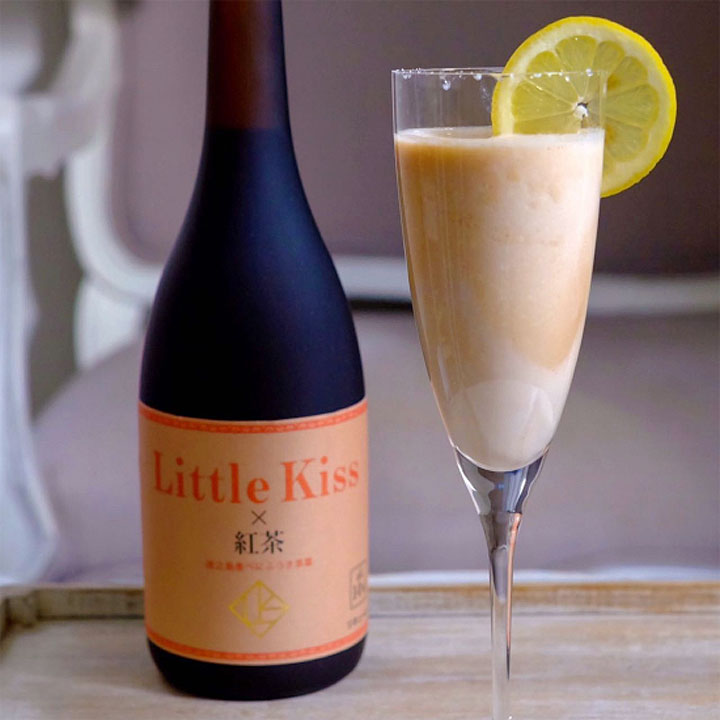
Liquor was also on the menu, and we particularly liked Higashi Sake Brewery’s Little Kiss Black Tea Shochu. It uses Benifuuki black tea leaves from Tokunoshima in Kagoshima Prefecture soaked in Kome Shochu — a distilled beverage slightly stronger than sake.

Next came the Hakata Amaou Marugoto Strawberry Daifuku — a single strawberry enveloped in either black or white bean paste, then encased in mochi (a sort of rice cake that is used to wrap usually sweet food). Finally, they also let us taste Wakasaya Honpo’s Raisin Cream Sandwich and Hokkaido Butter Rich Cookies, made with dairy from Hokkaido.

Hokkaido, Japan’s second largest island, is known around the world for the distinctive flavor of its milk, which passes on to products like cheese and butter. Mr. Makoto is a Hokkaido native, and he’s glad to describe the place as a way to explain their products. “You can taste the air in Hokkaido,” he said in an interview.

“You can imagine. There is a great (environment) without the dust from cars; without the dust from factories. There is good grass so that the cow can eat good food,” he said. “Beautiful cows can make beautiful milk.”

In jest, he added, “Hokkaido makes me like this.”

Japanese products have a reputation of excellence behind them, and Mr. Makoto tries to explain why. “Personally, I think Japanese people make products with care. They want to achieve the best… in Japan, and also the world,” he said. “They want to achieve better quality.” — Joseph L. Garcia

Roxas Holdings’ net loss widens to P196 million as expenses rise

ROXAS HOLDINGS, Inc.’s attributable net loss inched up to P195.93 million in its October-December quarter from P194.92 million a year earlier, after incurring higher expenses.

During the period, the company booked P4.18 billion in gross revenues, up by almost six times from P715.68 million a year ago.

“[It is] primarily due to the extended refinery operations and early start of distillery operations, which brought about an increase in volume sold of ethanol and refined sugar,” the company said.

The bulk of the company’s revenues came from the sale of goods, with raw sugar and refined sugar sales contributing P2 billion and P1.31 billion, respectively.

In the three months that ended December 2022, Roxas Holdings’ cost of sales reached P4.15 billion, up by almost six times from the P704.74 million booked last year.

Most of the company’s incurred expenses were from the cost of direct materials used, which reached P3.84 billion during the quarter.

On. Feb 3, the company announced that it was changing its fiscal year to January-December of each year, from the previous one that starts in October and ends in September of the following year.

As a consequence, the company will also be changing the date of its annual stockholders’ meeting to every third Wednesday of June each year, from every second Wednesday of March each year.

Roxas Holdings is engaged in the operations of mill and refinery facilities to manufacture sugar and allied products.

Its wholly owned subsidiaries include Central Azucarera Don Pedro, Inc., CADP Insurance Agency, Inc., CADP Port Services, Inc., RHI Pacific Commercial Corp., and Northeastern Port Storage Corp.

On the stock market on Wednesday, shares in Roxas Holdings closed unchanged at 80 centavos apiece. — Justine Irish D. Tabile

ADVERTISEMENT
ADVERTISEMENT