Home Blog Page 5270

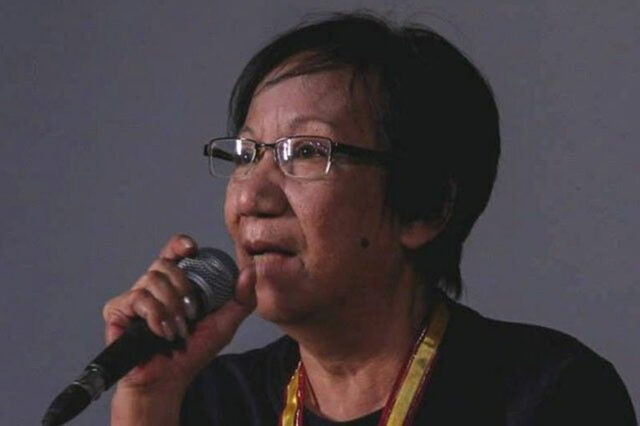
Writer, activist Lualhati Bautista, 77  

FACEBOOK/LUALHATI BAUTISTA

Writer, novelist, and activist Lualhati Bautista passed away at the age of 77 on Sunday morning.     

“Sad news for our Torres Clan, our first cousin Lualhati Bautista died at 77 years old this morning,” the late writer’s cousin Sonny Ross Samonte said in a Facebook post on Feb. 12.     

Born in Tondo, Manila on Dec. 2, 1945, Ms. Bautista studied journalism at the Lyceum of the Philippines. The publication of her first short story “Katugon ng Damdamin” in Liwayway Magazine launched her writing career.     

Ms. Bautista is best known for her novels Dekada ’70 (1983); Bata, Bata, Pa’no Ka Ginawa? (1984); and Gapo (1980) – all titles which earned Carlos Palanca Memorial for Literature awards.    

Apart from being a novelist, Ms. Bautista also wrote screenplays for film and television. The film Bulaklak sa City Jail won Best Story and Best Screenplay at the Metro Manila Film Festival in 1984, while the 2002 film adaptation of her novel Dekada ’70 also earned Best Story and Best Screenplay recognition from the Urian Awards and Young Critics Circle. The series Isang Kabanata sa Libro ng Buhay ni Leilani Cruzaldo won Best Drama Story for TV at the Catholic Mass Media Awards in 1987.    

Ms. Bautista also served as vice-president of the Screenwriters Guild of the Philippines and as chair of the Kapisanan ng mga Manunulat ng Nobelang Popular. She was a founding member of the Concerned Artists of the Philippines Women’s Desk and Writers in Cultural and Creative Alternatives.     

In 1986, Ms. Bautista became a national fellow for fiction by the University of the Philippines (UP) Creative Writing Center. She also received the Diwata Award for best writer at the 16th International Women’s Film Festival of the UP Film Center in 2006.   

Ms. Bautista was also an activist who criticized the sociopolitical system in the country – issues and topics were evident in her writing.   

Among her last published titles were Bayan Ko, an anthology of short stories, in 2019; and Alitaptap sa Gabing Madilim, a poetry collection, in 2020. — MAPS

US fighter jet shoots down unidentified cylindrical object over Canada

STOCK PHOTO | Image from Pixabay

WASHINGTON/OTTAWA — A US F-22 fighter jet shot down an unidentified cylindrical object over Canada on Saturday, the second such instance in as many days, as North America appeared on edge following a week-long Chinese spying balloon saga that drew the global spotlight.

Separately, the US military also scrambled fighter jets in Montana to investigate a radar anomaly that triggered a brief federal closure of airspace.

“Those aircraft did not identify any object to correlate the radar hits,” the North American Aerospace Defense Command (NORAD) said in a statement.

Canadian Prime Minister Justin Trudeau first announced Saturday’s shootdown over the northern Yukon territory, saying Canadian forces would recover and analyze the wreckage.

Canadian Defense Minister Anita Anand declined to speculate about the origin of the object, which she said was cylindrical in shape.

She stopped short of calling it a balloon but said it was smaller than the Chinese balloon shot down off South Carolina’s coast a week ago, though similar in appearance.

Aloft at 40,000 feet (12,200 meters), it posed a risk to civilian air traffic and was shot down at 3:41 EST (2041 GMT), she added.

“There is no reason to believe that the impact of the object in Canadian territory is of any public concern,” Ms. Anand told a news conference.

The Pentagon said NORAD detected the object over Alaska late on Friday.

US fighter jets from Joint Base Elmendorf-Richardson, Alaska, monitored the object as it crossed over into Canadian airspace, where Canadian CF-18 and CP-140 aircraft joined the formation.

“A US F-22 shot down the object in Canadian territory, using an AIM 9X missile following close co-ordination between US and Canadian authorities,” Pentagon spokesman Brig. Gen. Patrick Ryder said in a statement.

US President Joseph R. Biden authorized the US military to work with Canada to take down the high-altitude craft after a call between Mr. Biden and Mr. Trudeau, the Pentagon said.

The White House said Mr. Biden and Mr. Trudeau agreed to continue close coordination to “defend our airspace.”

“The leaders discussed the importance of recovering the object in order to determine more details on its purpose or origin,” it said in a statement.

A day earlier, Mr. Biden ordered another shootdown of an unidentified flying object near Deadhorse, Alaska.

On Saturday, the US military remained tight-lipped about what, if anything, it had learned as recovery efforts were underway on the Alaskan sea ice.

On Friday, the Pentagon offered only a few details, such as that the object was the size of a small car, was flying at about 40,000 feet (12,200 m), could not maneuver and appeared to be unmanned.

US officials have been trying to learn about the object since it was first spotted on Thursday.

“We have no further details at this time about the object, including its capabilities, purpose, or origin,” Northern Command said on Saturday.

It mentioned difficult Arctic weather conditions, including wind chill, snow, and limited daylight that can hinder search and recovery.

“Personnel will adjust recovery operations to maintain safety,” it added.

On Feb. 4, a US F-22 fighter jet brought down what the US government called a Chinese surveillance balloon off the coast of South Carolina following its week-long journey across the United States and portions of Canada.

China has said it was a civilian research vessel.

Some US lawmakers criticized Mr. Biden for not shooting down the Chinese balloon sooner. The US military had recommended waiting until it was over the ocean, for fear of injuries from falling debris.

US personnel have been scouring the ocean to recover debris and the undercarriage of electronic gadgetry since the shootdown of the 200-foot (60-meter) -tall Chinese high-altitude surveillance balloon.

The Pentagon has said a significant amount of the balloon had already been recovered or located, suggesting American officials may soon have more information about any Chinese espionage capabilities aboard.

Sea conditions on Feb. 10 “permitted dive and underwater unmanned vehicle (UUV) activities and the retrieval of additional debris from the sea floor,” Northern Command said.

“The public may see US Navy vessels moving to and from the site as they conduct offload and resupply activities.” — Reuters

Looting and hygiene worries add to rescuers’ burden in Turkey

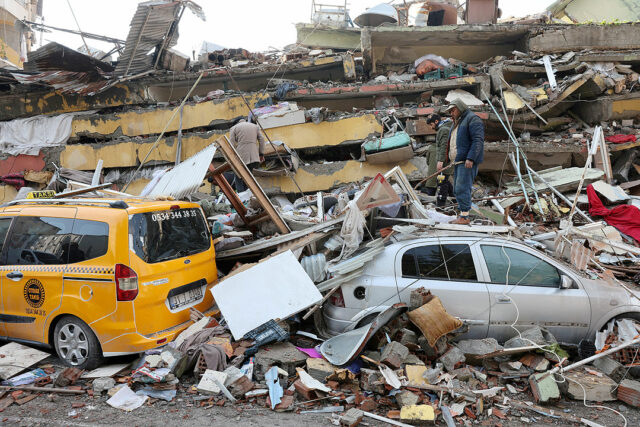
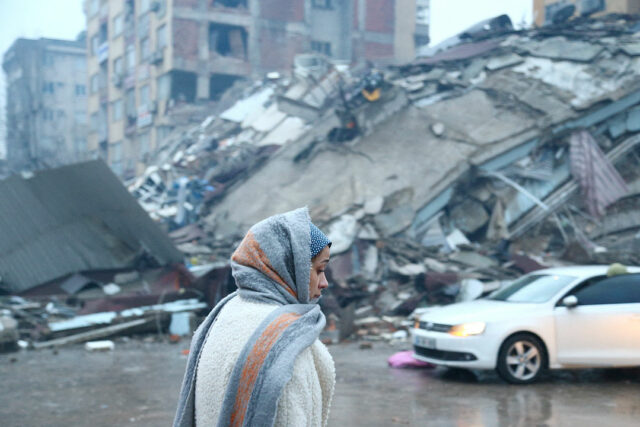
PEOPLE inspect the damage as rescuers search for survivors in the aftermath of a deadly earthquake in Hatay, Turkey, Feb. 8. — REUTERS

ANTAKYA, Turkey — Volunteers struggling to find ever fewer survivors in the quake-hit Turkish city of Antakya said on Saturday ransacking and hygiene problems were adding to their daunting task.

One resident, searching for a colleague buried in a collapsed building, said he witnessed looting in the first days after Monday’s quake before leaving the city for a village.

“People were smashing the windows and fences of shops and cars,” said Mehmet Bok, 26, now back in Antakya and searching for a work colleague in a collapsed building.

German aid organizations suspended rescue operations in the quake region on Saturday, citing security problems and reports of clashes between groups of people and gunfire.

Turkish authorities have not commented on any unrest, but President Tayyip Erdogan said on Saturday the government would deal firmly with looters and other criminal behavior, noting that a state of emergency had been declared.

The death toll has surpassed 25,300 in Turkey and Syria.

Another rescuer, Gizem from the southeastern province of Sanliurfa, said she had also seen looters in the four days she had been in Antakya.

“We cannot intervene much as most of the looters carry knives. They caught a looter today, people chased after him,” she said in the city where there was a heavy police and military presence directing traffic, helping rescuers and handing out food.

She described Antakya as a place of death and destruction when she arrived. “We could not hold back our tears,” she said as ambulance sirens wailed in the background.

“If people don’t die here under the rubble, they’ll die from injuries, if not they will die from infection. There is no toilet here. It is a big problem,” she said, adding that there were not enough body bags for all the dead.

“The bodies are all over the roads, with only blankets on them.”

Townsfolk were wearing masks to cover the smell of death.

Others echoed concerns about hygiene, especially insufficient numbers of working lavatories.

There were long lines at temporary mobile toilets but many people said they were simply finding a hidden spot, leading to complaints about stench.

“I think right now what’s needed most is hygiene products. We have toilet problems, I am scared that some disease will spread,” said one man, who declined to give his name and who traveled from Antalya to help in rescue operations.

He said there was little coordination, with everyone doing what they can to save lives and some collapsed buildings still untouched in side streets.

“We are digging for hours and hours,” he said, describing pulling alive from the rubble overnight a 56-year old woman, her face covered with dust, who had fallen into the stairwell of an apartment building.

“We’ve pulled out some 150-200 dead bodies.” — Reuters

Bolsonaro mulls return to Brazil in coming weeks

EN.WIKIPEDIA.ORG

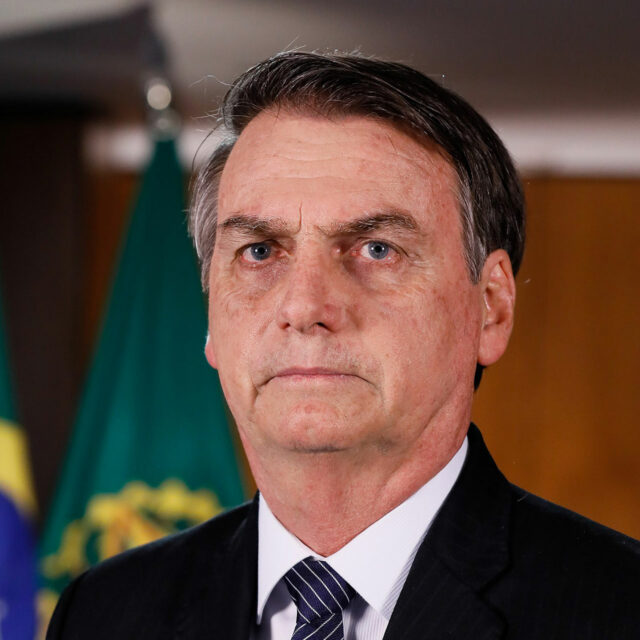
MEXICO CITY — Former Brazilian president Jair Bolsonaro said on Saturday he plans to return to Brazil “in the coming weeks,” after having spent more than a month in the United States.

Mr. Bolsonaro flew to Florida two days before incumbent Luiz Inacio Lula da Silva was sworn in as the new president on Jan. 1, and later applied for a six-month tourist visa to continue his stay in the United States.

“There is no place like home … We know Brazil is a fantastic country,” Mr. Bolsonaro told a gathering of Brazilians in Boca Raton, a video posted online by broadcaster CNN showed.

“I also want to return to Brazil. I intend to return to Brazil in the coming weeks.”

A swift return to Brazil could pose risks for Mr. Bolsonaro, who is accused of instigating a violent election denial movement in his home country.

Brazil’s Supreme Court has agreed to open an investigation into Mr. Bolsonaro for allegedly encouraging anti-democratic protests that ended in the storming of government buildings by his supporters in Brasilia.

His plans to return were put in question after his lawyer told Reuters last month the former president would like to “enjoy being a tourist in the United States for a few months before deciding what his next step will be.”

Still, a US official with knowledge of the situation told Reuters this week that officials believe Mr. Bolsonaro will return to Brazil after the carnival festival, which ends on Feb. 22. — Reuters

Office cake culture lives on in Britain despite health warning

AMIRALI MIRHASHEMIAN-UNSPLASH

LONDON — When Katie Mulligan baked a beetroot cake for her colleagues at a London advertising agency, she was focused on getting the recipe right rather than whether it was acceptable to bring treats into the office.

But office cake culture has recently been challenged by the head of Britain’s food regulator, Susan Jebb, who grabbed headlines last month by comparing it to passive smoking.

“I just don’t think there’s a real equivalence there,” Ms. Mulligan, 30, said at her north London home. “With cakes, it’s up to you whether you eat it.”

With a passion to bake and cook, Ms. Mulligan says her cakes help colleagues beat the afternoon slump — and beetroot is a relatively healthy option.

Ms. Jebb, however, believes cakes in the office are an example of a society that is promoting unhealthy food choices.

“If nobody brought in cakes into the office, I would not eat cakes in the day,” Ms. Jebb told The Times newspaper.

“But because people do bring cakes in, I eat them. Now, OK, I have made a choice, but people were making a choice to go into a smoky pub.”

Ms. Jebb, who was not speaking on behalf of the Food Standards Agency, made the comment days after parliament published a report that said 25.9% of adults in England were obese and a further 37.9% were overweight, citing a 2021 survey.

The United States ranked highest in the world for obesity levels with 43%, the report added citing OECD Health Statistics, while Britain as a whole, not just England, was at 28%.

The trend in the UK is “only going to get worse,” said Katharine Jenner, director of Obesity Health Alliance, a coalition of over 40 organizations that tackle obesity by influencing government policy.

Obesity is costing Britain’s National Health Service and the wider society something like 60 billion pounds ($72.63 billion) a year, she said.

The country needs to change its broader food culture and soon.

“I reckon we’re about in the (19)60s’ equivalent of sugar and diet-related ill health compared to smoking. So, we’ve got a long way to go,” she said.

At Ms. Mulligan’s office, enjoying the beetroot cake and its edible flower garnishes, while striking up conversations, provides a welcome break for her colleagues and lightens up office life.

“It helps build friendships. It creates a really lovely atmosphere,” said advertising strategist Bish Morgan, 26.

“As long as people are sensible and strike the right balance then yeah, I still think it’s a lovely thing to do in the office.” — Reuters

Citicore prepares for IPO, to invest $4B in renewable energy

Citicore Renewable Energy Corp., one of the Philippines’ biggest solar power producers, is planning to go public this year to fund a $4 billion investment in new solar projects over the next five years, its chief executive officer said on Friday.

“For a country such as ours with limited oil and coal but have abundant sun, wind and water, it is imperative we deploy capital investment into renewable energy,” Citicore President and CEO Oliver Y. Tan told reporters.

Citicore will file documents for an initial public offering in the second quarter and complete its listing within the year, Mr. Tan said, adding it will be large enough to attract foreign investors for an international tranche.

Fresh capital from the listing will allow Citicore, which has an installed capacity of 241 megawatts via solar panels, to invest $800 million this year to increase output to 1 gigawatt (GW), and around $4 billion to reach 5 GW within five years, Mr. Tan said.

The Philippines, an archipelagic country among the most vulnerable to climate change, aims to increase renewables in its power mix to 35% by 2030, from 21% in 2020, and to 50% by 2040. Coal accounted for nearly 60% in 2020.

Citicore is also pursuing seven offshore wind projects with a total capacity of 3 GW.

Citicore is the parent firm of Citicore Energy REIT Corp. and is a sister company of Megawide Construction Corp.

Citicore REIT on Friday listed its maiden ASEAN Green Bond in the Philippines’ fixed income trading platform. It raised 4.5 billion pesos ($82.6 million) from its bond sale to fund acquisition of land for its renewable energy portfolio. — Reuters

FDI net inflows drop to $793M in November

PHILSTAR FILE PHOTO

By Keisha B. Ta-asan, Reporter

FOREIGN DIRECT investments (FDI) in the Philippines plummeted 43.6% in November to $793 million and 13.4% to $8.43 billion in the 11-month period, suggesting a weaker global economic outlook.

FDI net inflows also fell 14.1% from the $923-million inflows in October, data released by the Bangko Sentral ng Pilipinas (BSP) on Friday showed.

The November figure was the lowest monthly FDI inflow since the $626 million in September 2022.

Net Foreign Direct Investment (November 2022)“This resulted from the drop in non-residents’ net investments in debt instruments and reinvestment of earnings. Meanwhile, net placements of equity capital rose year-on-year for the third consecutive month,” the central bank said in a statement.

Non-residents’ net investments in debt instruments of local affiliates dropped 55.2% to $540 million in November, from $1.21 billion in the same month in 2021.

Reinvestment of earnings also decreased 12.6% year on year to $73 million in November.

Meanwhile, investments in equity and investment fund shares rose 25.1% to $253 million in November, from $202 million a year earlier.

Non-residents’ net investments in equity capital (other than reinvestment of earnings) increased 51.8% to $180 million in November, from $118 million in the same month a year prior.

Broken down, equity capital placements grew 47.3% to $195 million, while withdrawals increased 8.8% to $15 million.

The equity placements were mainly from Japan, Singapore, and the United States, and invested mostly in manufacturing, information and communication, and real estate industries.

The decrease in FDI net inflows is likely driven by the weaker global economic outlook for 2023, UnionBank of the Philippines, Inc. Chief Economist Ruben Carlo O. Asuncion said in a Viber message.

“Although these were 2022 numbers, it may be possible that global firms have already started factoring in the said outlook already even before moving into the new year,” he said.

“The backdrop of higher interest rates and the uncertainty of monetary policy brought about by elevated inflation,” he added.

In the country alone, the Monetary Board raised borrowing costs by 75 basis points (bps) on Nov. 17 last year, bringing the overnight reverse repurchase rate to 5% in order to curb red-hot inflation and mirror the US Federal Reserve’s tightening.

Headline inflation rose to 8% in November from the 7.7% in October and 3.7% in November 2021.

The year-on-year decline in FDI net inflows is also due to higher base effects, Rizal Commercial Banking Corp. Chief Economist Michael L. Ricafort said in a Viber message.

FDI net inflows stood at $1.41 billion in November 2021, which was one of the largest net inflows in the country since the pandemic started, he said.

“The slowdown in the net FDI data may also have to do with higher short-term interest rates and the peak in long-term interest rates in the US…(and a) risk of recession in the US, which is the world’s largest economy,” Mr. Ricafort added.

The US Federal Reserve at its Nov. 1-2 2022 meeting hiked interest rates by 75 bps, which brought the key rate to 3.75-4% at that time.

YEAR TO DATE

For the first 11 months of 2022, FDI net inflows fell 13.4% to $8.43 billion from $9.74 billion in the comparable year-ago period.

“By component, non-residents’ net investment in debt instruments and reinvestment of earnings declined while their net placements of equity capital increased during the period,” the BSP said.

BSP data showed foreign investments in debt instruments declined 17.7% year on year to $5.90 billion in the January-to-November period.

Reinvestment of earnings fell by 8% to $1.08 billion in the 11 months through November 2022.

Investments in equity and investment fund shares also declined 1.4% to $2.53 billion in the 11-month period.

Meanwhile, net foreign investments in equity capital grew 4.2% to $1.44 billion.

Most of these placements were also from Japan, Singapore, and the United States.

The BSP expects FDI net inflows at $8.5 billion by end-2022 and at $11 billion by end-2023.

The country is still on track to hit the government’s projection for 2022, according to Mr. Ricafort.

“Market sentiment had improved since November 2022 when US inflation/consumer price index data eased further and long-term interest rates started to ease, thereby leading to some easing of long-term borrowing costs/financing costs for investments/FDIs,” he said.

France doesn’t rule out fighter jets for Ukraine, but says more immediate firepower needed

MEMBERS of the Honor Guard attend a rising ceremony of Ukraine's biggest national flag to mark the Day of the State Flag, amid Russia's attack on Ukraine, in Kyiv, Ukraine, Aug. 23. — UKRAINIAN PRESIDENTIAL PRESS SERVICE/REUTERS

KYIV – French President Emmanuel Macron said on Friday he did not rule out sending fighter jets to Ukraine at some point, but that Kyiv was in need of more immediate military firepower, as Ukrainian officials said a fresh Russian offensive was underway.

President Volodymyr Zelenskiy has long urged Ukraine’s allies to send jet fighters and on Thursday said that several European leaders were ready to supply aircraft.

“Europe will be with us until our victory. I’ve heard it from a number of European leaders…about the readiness to give us the necessary weapons and support, including the aircraft,” Zelenskiy told a news conference in Brussels, where he attended a European Union summit.

Such a move would be one of the biggest shifts yet in Western support and Moscow has warned it would escalate and prolong the conflict.

“I exclude absolutely nothing,” Macron said when asked about the possibility of sending jets at the end of a summit of EU leaders.

But Macron said the current priority was to help Ukraine in the weeks and months ahead, and fighter jets could not be delivered in that timeframe and it would take time to train Ukrainian pilots to fly them.

Macron said the priority should be on items such as artillery, which had proven to be effective and on which Ukrainian forces were already trained. He said it might be necessary to intensify delivery of such items and Ukraine’s allies would examine this possibility in coming days.

As the anniversary of Russia’s invasion approaches on Feb. 24, Kyiv has predicted an aggressive onslaught from Moscow aimed at notching territorial gains it can trumpet at the one-year mark, after months of little movement.

Asked on Ukrainian television if he agreed that the Russian offensive had already begun, Pavlo Krylenko, governor of the eastern Donetsk region, said on Thursday: “Yes, definitely.”

Around eastern towns like Bakhmut, Avdiivka and Vuhledar that have witnessed some of the bloodiest battles of the war, “the enemy’s forces and means are escalating there with daily intensity, he said.

According to Oleg Zhdanov, a Ukrainian military analyst, defenders in Bakhmut were still being supplied from the west, but were under pressure from three sides, with Russian forces entering two northern districts of the city two days ago.

“In the Avdiivka sector, Russian troops are trying to bring in reserves in order to take control of the centre of the contested town of Marinka,” Zhdanov said in his regular roundup of developments in conflict delivered on YouTube.

He said Ukrainian forces still controlled the centre of Marinka, contrary to Russian media reports that mopping up operations were underway.

The wider Donbas area of the east, comprised of Donetsk and Luhansk, has been one of Russia’s major objectives, and the Kremlin declared them in the autumn to be among four annexed territories after referendums decried as shams by the West.

“Over the past week to 10 days, the frequency of shelling has increased. The daily number of attacks has increased,” Luhansk governor Serhiy Haidai told Ukrainian Radio NV on Thursday.

He said there was a major new Russian assault around Kreminna, along a northern stretch of the eastern front, but that Moscow’s forces were “having no significant success.”

Reuters could not independently verify the battlefield accounts.

KYIV EXPECTS WEAPONS, AIRCRAFT

Western countries that have provided Ukraine with arms have so far refused to send fighter jets or long-range weapons capable of striking deep inside Russia for fear of being drawn further into the conflict.

Zelenskiy began a European tour on Wednesday with a meeting in London with Britain’s Rishi Sunak and dinner in Paris with France’s Emmanuel Macron and Germany’s Olaf Scholz.

Sunak promised to train Ukrainian pilots to fly advanced NATO fighter jets. He stopped short of offering to supply the planes, but said nothing was off the table.

Zelenskiy said that some of what he had been promised in Paris by Macron and Scholz was still secret.

MOSCOW WARNS WEST AGAINST ESCALATION

Kremlin spokesman Dmitry Peskov said it would be Ukrainians who suffered if Britain or other Western countries supplied fighter jets to Kyiv, and that the line between indirect and direct Western involvement in the war was disappearing.

Russian forces have been advancing recently for the first time in half a year, fortified with tens of thousands of freshly mobilized recruits, in relentless winter battles that both sides describe as some of the bloodiest of the war.

At least 17 Russian missiles hit the southeastern Ukrainian city of Zaporizhzhia in an hour on Friday morning, its acting mayor, Anatolii Kurtiev, said. The attacks targeted energy infrastructure, he said on the Telegram messaging app, adding that information was being collected on damage and casualties.

Russian forces also launched a series of overnight strikes that knocked out power supplies in parts of Kharkiv, Ukraine’s second city, local officials said on Friday. There was no word on casualties.

“The occupiers hit critical infrastructure. There were about 10 explosions,” Kharkiv governor Oleh Synehubov said on Telegram. “In some regions, there are power cuts. Emergency services are on site.”

Russia launched the war it calls a “special military operation” to combat what it describes as a security threat from Ukraine’s ties to the West. Ukraine and the West say Russia’s invasion is an unprovoked land grab. — Reuters


EU leaders agree targeted, temporary support for green industry

THE MAIN entrance of the European Union Commission headquarters is seen in Brussels July 1, 2013. — REUTERS

BRUSSELS – European Union leaders agreed on Friday they should allow “targeted, temporary and proportionate” support to ensure Europe’s future as a manufacturing base for green tech products and counter US and Chinese competition.

The European Commission has proposed loosening rules on state aid for investments in renewable energy, decarbonizing industry, hydrogen or zero-emission vehicles, partly in response to the U.S. Inflation Reduction Act (IRA).

EU leaders have expressed concern that local content requirements of much of the $369 billion of subsidies in the IRA have will encourage companies to abandon Europe for the United States.

German Chancellor Olaf Scholz said he was confident that talks between the transatlantic partners could limit discrimination against companies based in Europe.

“When we are looking at our competitiveness, we need to do our own homework and do everything to ensure that we do not have an international subsidy race,” he told a news conference at the end of the leaders’ summit in Brussels.

The International Energy Agency estimates the global market for mass-produced clean energy technologies will triple to $650 billion a year by 2030.

Europe wants a piece of the action, but sectors from solar panels to wind turbine blades and vehicle batteries are dominated by China, with well over 50% of the market.

The Commission is set to propose a Net-Zero Industry Act to speed up permits for green projects and a Critical Raw Materials Act to boost recycling and diversify sourcing to be less reliant on Chinese processors.

Commission President Ursula von der Leyen said they would be presented before the next time EU leaders meet on March 22-23.

Funding is proving the most controversial element of the plan.

There is widespread resistance to joint borrowing and some concern that looser state aid rules would unsettle the EU internal market because subsidies in the two largest economies, Germany and France, would dwarf offerings elsewhere.

Countries such as the Netherlands, Ireland, the Czechs and the Nordics have expressed concern this could lead to excessive non-targeted subsidies and say work to improve the EU single market would be more effective. — Reuters

US says to provide $85M humanitarian aid to Turkey, Syria

A woman stands near a collapsed building after an earthquake in Kahramanmaras, Turkey Feb. 6, 2023. — REUTERS

WASHINGTON – The United States said on Thursday it will provide $85 million in urgent humanitarian assistance to Turkey and Syria after a massive earthquake that killed more than 20,000 people.

The announcement by the US Agency for International Development (USAID) came shortly after US Secretary of State Antony Blinken spoke with Turkish Foreign Minister Mevlut Cavusoglu, their second call in four days.

The death toll across both countries has now surpassed the more than 17,000 killed in 1999 when a similarly powerful quake hit northwest Turkey.

Hundreds of thousands of people in both countries have been left homeless in the middle of winter. Many have camped out in makeshift shelters in supermarket car parks, mosques, roadsides or amid the ruins, often desperate for food, water and heat.

“This new funding is supporting USAID’s humanitarian partners to deliver urgently-needed aid for millions of people in Türkiye and in Syria,” USAID said in a statement.

Washington has already sent to Turkey teams consisting of around 160 people and 12 dogs, whose top priority is to help save people from under thousands of collapsed buildings. Paramedics, emergency responders, hazardous material technicians and others have already arrived.

Blinken’s call with Cavusoglu was to understand from Ankara “what they would like to see from the United States” in terms of assistance from the United States in the aftermath of the disaster, State Department spokesperson Ned Price told a daily briefing.

“The foreign minister (Cavusoglu) did offer to Secretary Blinken some specifics. We will do everything we possibly can to fulfill the needs that the Turks have put forward,” Price said.

US helicopters are helping rescue personnel reach difficult to access areas and Washington is pre-positioning relief equipment it hopes will join the recovery efforts, Price said.

Washington is also sending concrete breakers, generators, medical supplies, tents, water and water purification systems, he added. — Reuters

Defiant Ortega frees political prisoners in Nicaragua, expels them to US

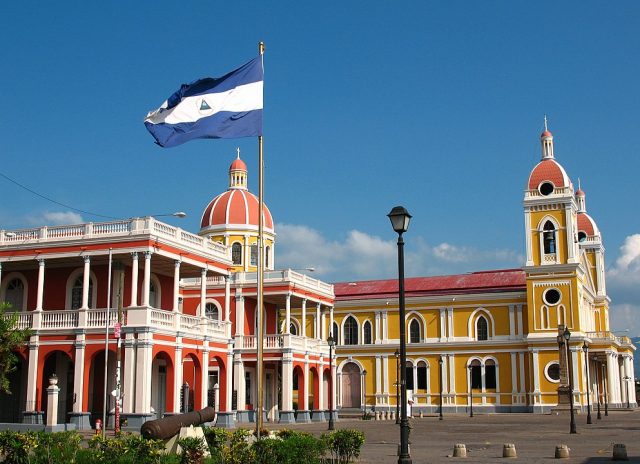
WIKIMEDIA COMMONS

MANAGUA/WASHINGTON – More than 200 Nicaraguan political prisoners were freed and flown to the United States on Thursday, nearly all of them prominent government critics jailed in President Daniel Ortega’s crackdown on dissent over recent years.

Ortega later described the surprise release as a push to expel criminal provocateurs who sought to undermine Nicaragua, while the United States hailed it as a “constructive step” toward improving human rights.

The freed political prisoners include five former presidential hopefuls who sought to challenge the increasingly authoritarian Ortega in a 2021 election only to be jailed in an unprecedented dragnet and criminalizing of political dissent in the Central American country.

Flanked by top security officials and sitting in front of national and ruling party flags, Ortega in his televised remarks said that all the prisoners sought to undermine national sovereignty, deriding them as “agents” of foreign powers.

“Let them have their mercenaries,” he said.

Earlier on Thursday, an Ortega loyalist judge denounced the released prisoners as “traitors” who he said had been deported.

Hours later, at Dulles International Airport near Washington, crowds of people waited to greet loved ones, waving flags and chanting “Free!”

A US official told Reuters that Managua sought to show its desire to improve relations with Washington.

In his remarks, Ortega insisted he did not make any concessions to US officials ahead of the release, or ask that economic sanctions be lifted.

“This wasn’t about any negotiation,” he said, waving his finger from side to side.

In 2021, Washington imposed sanctions and denounced Ortega’s re-election as a “sham” after all of his top opponents were rounded up and detained by police in the months leading up to the vote, with journalists and religious figures also later imprisoned.

In a statement, US Secretary of State Antony Blinken praised the release as “a constructive step towards addressing human rights abuses” that could also lead to further dialogue between the countries.

Those freed will be allowed to enter the United States on emergency humanitarian grounds, the administration of President Joe Biden said in a note to Congress.

‘STRATEGIC MOVE’

Ortega’s allies in Congress planned to change the law to allow officials to strip the freed prisoners of their citizenship, which would effectively close off any plan they might have of returning home someday.

Even if no quid-pro-quo led to the mass release, some analysts think the isolated Ortega was motivated to prioritize his political survival above all.

“It’s a strategic move,” said Valeria Vasquez, a Central America analyst with consultancy Control Risks.

“They probably know they needed to do this to keep afloat, to stay in power,” she added, referring to Ortega and his wife, Vice President Rosario Murillo.

Among those freed were former presidential candidates Juan Sebastian Chamorro, Felix Maradiaga, Miguel Mora, Medardo Mairena and Arturo Cruz, as well as prominent student activist Lesther Aleman, a Nicaraguan judicial document showed.

Blinken said prominent dual-citizen businessman Michael Healy, who had been jailed for 13 years, was also released.

Many of the 100 or so people at Dulles Airport awaiting the arrival of those released waved Nicaraguan flags and signs bering the name of their freed loved one. Some sang “My Nicaragua,” a cherished national song.

Ariana Gutierrez Pinto, 28, said she was eager to be reunited with her 63-year-old mother, Evelyn Pinto, who had been released just in time to celebrate her birthday.

“There were days when I lost hope, but my father was always optimistic, the whole family was optimistic. And my mother was, too,” said the younger Pinto said. “She never lost hope.”

Erika Guevara, Americas’ director for rights group Amnesty International, credited a sustained pressure campaign over years for helping bring about the release of prisoners.

She pointed to “courageous and relentless condemnation” of Ortega’s repression both inside Nicaragua and overseas as a catalyst that generated global awareness of abuses.

In addition to the 222 individuals who were expelled to the United States, two others were freed but chose not to travel, of whom one was prominent Ortega critic and Catholic Bishop Rolando Alvarez. Ortega said the cleric is now back behind bars. — Reuters

Asia stocks head for second weekly loss as Fed rate worries flare

REUTERS

TOKYO – Asia-Pacific stocks fell on Friday, slumping toward a second weekly loss as investors fretted about the potential for further Federal Reserve tightening and the effect on the US economy.

US short-term Treasury yields held near a one-month high, helping the dollar tick up against major peers, after Richmond Fed President Thomas Barkin overnight added to a chorus of hawkish central bank commentary in recent days.

MSCI’s broadest index of Asia-Pacific shares sank 0.54% and was on course for a 1% weekly decline, after losing 1.16% in the previous week.

Mainland Chinese blue chips lost 0.41% and the Hang Seng tumbled 1.19%. China’s January factory gate prices fell more than economists expected, suggesting that flashes of domestic demand that had stoked consumer prices after the zero-COVID policy ended are not yet strong enough to rekindle upstream sectors.

Australia’s benchmark slid 0.56% and South Korea’s Kospi shed 0.49%.

Japan’s Nikkei bucked the trend with a 0.5% rise, boosted by some strong earnings reports.

US equity futures were flat, after the S&P 500 sank 0.88% overnight.

“Is inflation calming? That’s really the core question for this year,” Barkin said in a podcast on the Richmond Fed’s website, adding that he felt the decline so far had been “distorted” by some falling goods prices.

At the start of the week, investors had been cheered after Fed Chair Jerome Powell refrained from striking a more hawkish posture following after a much stronger than expected jobs report at the end of last week.

“Powell maintained a relatively dovish tone, and markets took that as a green light to rally, but pretty much 24 hours later we got a stream of extremely hawkish Fed speak,” said Tony Sycamore, a strategist at IG.

“If rates go past that five, five-and-a-quarter percent range that the Fed has previously indicated, markets are definitely not priced for that – absolutely not.”

Money markets currently see a peak in the current rate cycle around 5.15% in July.

The two-year Treasury yield eased slightly to around 4.48% in Tokyo, after touching the highest since Jan. 6 at 4.514% overnight. The 10-year yield edged down to around 3.67% after bumping around 3.96% mid-week, also the highest since Jan. 6.

The US dollar index, which measures the greenback against six peers including the euro and yen, ticked up slightly to 103.28, sticking to the middle of its range this week. It touched 103.96 on Tuesday for the first time since Jan. 6 as well.

Meanwhile, crude oil prices dipped in early trade on Friday but were headed for a weekly gain with the market continuing to seesaw between fears of a recession hitting the United States and hopes for strong fuel demand recovery in China, the world’s top oil importer.

Brent crude futures fell 28 cents, or 0.3%, to $84.22 a barrel, while US West Texas Intermediate (WTI) crude futures fell 35 cents, or 0.5%, to $77.71. — Reuters

ADVERTISEMENT
ADVERTISEMENT