Home Blog Page 5252

PHL seen to join Shanghai, SG, Tokyo as region’s top data center hub

BW FILE PHOTO

The Philippines is likely to join Shanghai, Singapore (SG), and Tokyo as the region’s top data center destination, according to real estate expert Santos Knight Frank (SKF), citing increasing digital consumption in the country and government support.

With information technology (IT) capacity in Metro Manila estimated at 163 megawatts (MW), the Philippines is seen as a strong candidate for hyperscalers looking to expand, SKF Chairman and Chief Executive Officer Rick M. Santos said at a briefing on Thursday. 

Hyperscalers are big technology organizations with massive network, power, and space requirements. 

“The country has high digital consumption due to rapid e-commerce adoption and Filipinos being one of the top social media users in the world. Data centers are looking for hubs where most of their users are at, and that’s the Philippines,” Mr. Santos said.  

In Asia, the powerhouses are Shanghai with a capacity of 1183MW, Singapore with a 1065-MW capacity, and Tokyo with a 998-MW capacity. 

With the current ban on data centers in Singapore, other markets are being looked at, with Manila’s capacity for IT, land, and engineering-trained talent regarded to be strong for Southeast Asia. 

“There’s government support as well, with the Department of Information and Communications Technology encouraging use of the cloud for the development of infrastructure,” Mr. Santos said.

The growth in e-commerce and logistics has also created a lot of demand for construction material storage and warehouses, according to the SKF’s analysis. With this, the growth of logistics space outside of the Philippine capital is expected to continue as data centers are built.  

The expansion of industrial parks in other areas like North Luzon will “benefit the industrial sector,” said Mr. Santos.  

Morgan McGilvray, SKF’s senior director for occupied strategy and solutions, added that the office market has a similar optimistic provincial outlook. The key driver for this is companies expanding into regional locations like Iloilo, Davao, Bacolod, and Clark.  

“This is seen among business process outsourcing companies looking to establish various headquarters,” he said.  

SKF also noted that the annual Metro Manila office space supply saw a healthy jump to 10.4 million square meters (sq.m.) in 2022, from 7.6 million in 2021.   

“This is a mixture of spillover from construction delays during the pandemic and developers building and supplying more space again,” Mr. McGilvray noted. — Brontë H. Lacsamana

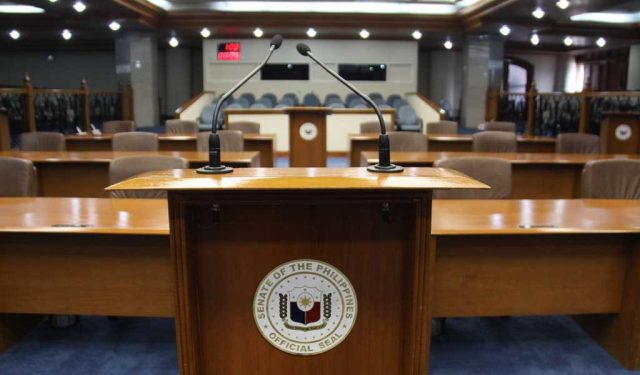
Honorable Senators of the Republic

BW FILE PHOTO

Let me share through this column my letter to the Philippine Senate regarding my position as a former public servant at the Bangko Sentral ng Pilipinas on the proposed Maharlika Investment Fund. I argue that “there is nothing in Senate Bill 1670 to promote economic growth and social development that is not presently undertaken by existing public institutions in collaboration with the private sector.” Thus, an investment fund is not worth undermining our existing institutions. I thank Mr. Calixto Chikiamco, President of the Foundation for Economic Freedom, for submitting it to the Philippine Senate during the public hearing on the issue by the Commitee on Banks, Financial Institutions and Currencies chaired by Senator Mark Villar on Feb. 15, 2023.

Thank you for allowing us to speak our mind on the Maharlika Investment Fund (MIF). I fully subscribe to the position paper of the Foundation for Economic Freedom, jointly issued with the Management Association of the Philippines and the UP Alumni Association. However, as a former public servant at the Bangko Sentral ng Pilipinas (BSP), I wish to underscore a few basic points.

There is nothing in Senate Bill (SB) No. 1670 to promote economic growth and social development that is not presently undertaken by existing public institutions in collaboration with the private sector. In fact, President Bongbong Marcos himself declared when he approved the 2023 National Budget of P5.268 trillion that the budget “will provide the government with a tool to transform the economy, as well as in carrying the needed structural changes toward realizing the administration’s goals.” Aside from the annual national budget worth P5.268 trillion for 2023, Public-Private Partnership and Build-Operate-Transfer arrangements have long been used to promote economic growth and social development. Likewise, government financial institutions (GFIs) extend credit and invest in agriculture, infrastructure and various industries.

Honorable Senators, the MIF is many things. One, it is untimely; two, its method of sourcing funds could destabilize public finance and ultimately raise our national debt; three, the BSP could be compromised as an autonomous and independent monetary authority; and four, it could further worsen governance and patronage. In other words, there is a great likelihood for market failure.

One, creating the MIF is untimely. Governments create wealth or investment funds to pursue special goals when they enjoy balance of payments surpluses, official foreign currency operations, proceeds from privatizations and fiscal surpluses, and windfall receipts from commodity and metal sales. Putting up the MIF simply as an “additional investment platform” is a costly undertaking for the government.

The Philippines is no recipient of any of these surpluses. Instead, what we have are serious balance of payments deficit, large fiscal deficit reaching historical highs in excess of 6% of GDP and as a result of huge borrowing due partly to the pandemic, a debt-to-GDP ratio exceeding 60%. We have nothing to invest at this point.

Two, the proposed alternative sources of funding are most destabilizing. SB No. 1670 proposes instead to source the funding from the GFIs such as the Development Bank of the Philippines (DBP), and the Land Bank of the Philippines (LBP), as well as from government-owned and -controlled corporations (GOCCs) other than the pension funds.

a. Diverting funds from GFIs and GOCCs to establish the MIF is self-defeating. The MIF is proposed to be funded by investment from GFIs and GOCCs; the same GFIs that needed public support during the pandemic. Diversion of funds from the GFIs to MIF for investment purposes would force the National Government to borrow funds to compensate for the loss of these earmarked funds to sustain governmental operations. This is also true when GOCC funds are used.

b. Using GFIs’ funds for MIF could affect their financial health and may result in potential bank run and systemic risks. GFIs’ investible funds earmarked to MIF are deductible from their regulatory capital. Therefore, these GFIs could be constrained from both lending to key areas of the economy and investing in other infrastructure and social development projects. This could then lead to contagion and trigger a series of bank runs especially now that the banking system’s balance sheets have arguably weakened due to the pandemic.

c. Mandating GFIs as contributors also distorts the regulatory environment. For instance, measures to safeguard deposits might need to be eased to facilitate their proposed contributions to the MIF. Doing such would introduce unfair competitive implications for the other banks. Likewise, this excessive regulatory forbearance may lead to undercalculation of their overall risk profile and may adversely affect the safety and soundness of their operations. This spells bad news for millions of depositors who, when apprehensive, can cause bank runs and financial instability.

d. MIF can constrain GFIs’ flexibility in their investment and lending strategy. By mandating GFIs to invest in MIF, their flexibility to diversify their portfolio could be affected. By allowing future exposure to MIF in the form of debt securities could result in overconcentration of loans and affect the loan portfolio of GFIs because they will be guaranteed by the government. Banks adhere to best practices and good governance because it is the right thing to do, and the BSP requires compliance with them. The General Banking Law of 2000, for instance, limits government banks equity ceilings to ensure diversification of their portfolio and mitigate their risk exposures. GFIs should be given the flexibility to determine their overall investment strategy consistent with their business model, target market and strategy for keeping their competitiveness and profitability.

Three, another fundamental objection to the MIF is the inclusion of the BSP as among those that will contribute to the MIF. This could put the country’s sole monetary authority’s independence and credibility at risk because it preempts the use of its declared income to the MIF rather than to building up its equity base as prescribed by its amended charter. This would be problematic since the BSP’s ability to perform its mandate of safeguarding price and financial stability is also determined by the adequacy of its financial resources. With lower capitalization, the BSP’s conduct of monetary policy could be seriously impaired.

Some argue that even with a mere P50-billion capitalization, the BSP has succeeded in maintaining price and financial stability by expanding its balance sheet. Given the on-going pandemic, the large fiscal deficit and higher public debt, coupled with the sustained uncertainty in the global markets, it is important to ensure that the BSP’s balance sheet remains appropriately disciplined.

Four, without proper safeguards, the MIF could be a potential channel for corruption and bad governance. So-called Sovereign Wealth Funds (SWFs) succeed in an environment of good governance, rules-based public management, and the absence of special interest groups. Experiences from other countries show that without good governance, SWFs are prone to mismanagement. The Papua New Guinea’s former Mineral Resource Stabilization Fund, Ecuador’s Stabilization Fund for Investment and Debt Reduction, and Nauru and Tonga funds started well but because of mismanagement and incompetent investment decisions were all abolished. Malaysia’s experience with 1MDB is another cautionary tale of how SWFs can be abused.

It bears noting that SB No. 1670 proposes to exempt the MIF from the GOCC Governance Act of 2011, Government Procurement Reform Act and the Salary Standardization Act; and payment of taxes and customs duties on any imports of supplies and equipment. These laws ensure adherence to good governance, and therefore exempting the MIF from such laws is like giving it a blanket authority to abuse. The BSP, for example, demands “a higher standards of knowledge and expertise in the field of finance, economics, risk and governance,” on top of bank regulation and supervision and yet, no law has been passed by Congress to exempt it from most of these laws, in the spirit of good governance. Finally, instead of requiring this special body to remit its earnings directly to the government, the Senate bill mandates that 25% of all of its earnings should go to “families falling below the poverty threshold as determined by the Philippine Statistics Authority” in the form of poverty and subsistence subsidies. Is Congress abdicating its power over the budget?

This is hardly the best time to create the MIF. Earmarking resources for funding the budget deficit could drive the government to incur higher borrowing or impose higher taxes, or both. An investment fund is not worth undermining our existing institutions. We have managed to grow all these years and we have also charted the next six years to achieve robust and resilient economic growth in the new development plan, all without this costly investment fund.

Thank you very much.

Sincerely yours,
Diwa C. Guinigundo
Former Deputy Governor for the Monetary and Economics Sector
Bangko Sentral ng Pilipinas Fellow, Foundation for Economic Freedom


Diwa C. Guinigundo is the former deputy governor for the Monetary and Economics Sector, the Bangko Sentral ng Pilipinas (BSP). He served the BSP for 41 years. In 2001-2003, he was alternate executive director at the International Monetary Fund in Washington, DC. He is the senior pastor of the Fullness of Christ International Ministries in Mandaluyong.

Real problems need real solutions

PHILIPPINE STAR/ WALTER BOLLOZOS

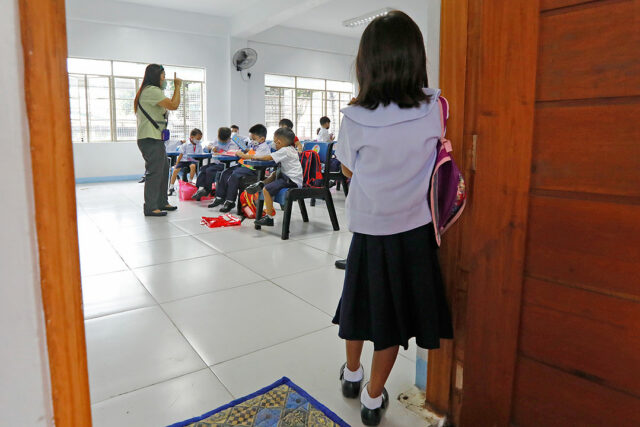
Most if not all Filipinos when asked will say that they value education because it assures the employability of their children. Education is for them either a way out of want and poverty, a means of continuing to live in the middle-class manner to which they have been accustomed, or, if they are among the very rich, merely something that would go well with the credentials of their sons as the future CEOs of their company.

Its role in the making of a democratic, humane, and just society does not usually figure in their calculations, and neither does its being equally crucial to each individual’s development and productivity as a citizen and as a human being. But there is also the widespread and quite disturbing view that education has its limits — that one can be “too learned” and therefore deserving of the dismissive “masyadong marunong” epithet, which is usually reserved for the critical and questioning, such as, say, student activists.

However, whatever their views on education may be and whatever their class differences, most Filipinos, if not all, do their utmost to start their children young. The wealthy and even some middle-class families enroll them in the most expensive and presumably best schools. Their poorer counterparts put them in public schools, which in the more remote areas of the country can mean the children’s walking for kilometers in sun and rain, sometimes across rivers, hilly terrain, and along mountain trails.

They all know that education begins with such fundamentals as reading and writing, and adding, subtracting, dividing, and multiplying sums. But already in crisis for decades — haunted by shortfalls in classrooms and teachers as well as books and equipment — the basic education system of the Philippines fell even further behind that of other countries during the two-year-long pandemic lockdown.

Learners, parents, and teachers struggled with a host of problems in the 2021 “new normal” Department of Education (DepEd) policy of limited face-to-face classes in November that year. Schools reopened in 2022, but the system continued to lag behind that of most countries for a number of reasons, one of them the Duterte policy of keeping schools closed until a vaccine became available.

In the first year of the lockdown, the basic education system (K-12) failed to develop effective programs for remote learning, mixed, or blended teaching. Because of the economic downturn, more than 25% of pre-school to high school students also failed to enroll, and nearly 2,000 public and private schools were forced to close.

The Economic Policy Institute identified in September 2020 as a “critical opportunity gap” in online learning the uneven access to computers and the internet. That “digital divide” affected not only learners but also their parents and teachers who had problems in adjusting to the different teaching methods the pandemic had forced on teachers. It also further marginalized students with special needs.

But the ills of the educational system are even more disturbing than those caused by government ineptitude during the pandemic. The World Bank (WB) July 2021 assessment of the state of the country’s education mentioned a host of problems that have been plaguing the educational system even before COVID-19. It found that more than 80% of Filipino students could not meet minimum levels of proficiency in reading, writing, and mathematics even before the pandemic lockdown.

The most that then Education Secretary Leonor Briones could do in 2021 was to demand an apology from the World Bank for not alerting Department of Education (DepEd) on the release of the study: she did not dispute its findings. The Duterte administration itself showed little to no interest in education. While DepEd continued to receive the biggest share of the national budget, its allocations were still insufficient in addressing such problems as the classroom and teacher shortages.

The same administration pointedly raised police and military salaries while ignoring the long-standing need for similar increases in teacher wages. It instead militarized the bureaucracy while increasing its own 2022 confidential, intelligence, and contingency funds.

If there is anything that demands a comprehensive, “whole-of-nation” approach to its problems, it is education. What is needed is to identify the priority issues in it that demand solutions, and to craft the relevant policies. But no sense of urgency drove the past regime to address the perennial problems of the educational system. Neither was it even remotely interested in looking into how other countries remedied or mitigated the negative impact of the pandemic on their own educational systems.

The crisis in education demands urgent solutions. But Briones’ successor at DepEd has so far done little to address the above issues. Vice-President Sara Duterte’s Basic Education Report (BER) showcased her supposed commitment to solving the problems of the system which she had earlier crowed she could solve within six years.

During a public forum in which she presented the BER last January, VP-cum-DepEd Secretary Duterte described herself as “a mother of four learners” who is at the same time responsible for 28 million others, making her “interest in the future of Philippine education… very personal.” She admitted that Filipino students are not “academically proficient.” But her BER, though long in rhetoric, was far short in the specifics of how exactly she would address it.

She provided information that has long been conventional knowledge, such as the shortage in classrooms and resources, which she described as the “most pressing issue” in education; the low literacy and numeracy levels of learners that the 2018 report of the Program for International Student Assessment (PISA) found; the cluttered K-12 program’s failure to assure the employability of graduates; and the lack of training and support systems for teachers.

She did mention plans to address these problems, such as revising the K-12 curriculum and providing more training programs for teachers and school administrators. Duterte’s statements on these deficiencies were welcomed by education experts, but her report neither presented data nor described what steps DepEd would take to solve the many other problems she admitted have hounded the educational system for decades.

Among them, certainly, is the need to address the salary and staffing problems that have long been a factor in the dismal state of Philippine education. But she did not mention anything about raising teachers’ salaries or increasing the number of the guidance counselors and teaching assistants that are needed to reduce the burdens on teachers.

Neither did her report reveal the progress of DepEd’s K-12 review, in which, incidentally, the involvement of such stakeholders as teachers’ and parents’ groups has been minimal, if at all. There is as well the need to assure language proficiency as a fundamental requirement for better learning, to achieve which a number of strategies are available. But the Duterte BER had nothing to say about it. Improving teacher training should similarly be in the agenda. It should ideally consist of improving access to research facilities, books and competent instructors at the formal schooling stage, and providing continuing teacher education after. But the Duterte BER provided little detail about it.

Unless the real problems of Philippine basic education are addressed with real solutions, it will continue to be the less than reliable foundation for the making of the employable citizens millions of parents hope their children will be. Least of all will it be the sound basis for their contributing to the development of the society of progress, peace, justice, humaneness and freedom that has long eluded these troubled isles.


Luis V. Teodoro is on Facebook and Twitter (@luisteodoro).

www.luisteodoro.com

Signals of nature

NICOLE AVAGLIANO-UNSPLASH

The currents of change are confusing, distracting, turbulent.

The world events are spinning and counter-spinning. The terrifying disasters — upheavals, earthquakes, tsunamis, and volcanic eruptions are threatening the safety of the inhabitants of our planet. These are warning signals that we should protect the environment and respect Mother Nature.

For a change in mood, one seeks the spiritual solace of silence, art and music, and the mental stimulation of books. During the period of meditation, one can relish prolonged moments of solitude, seek inspiration. It is a chance to immerse oneself in images — fleeting dreams or memories. One can shut out the angst and turmoil of the outer world. A period of creative idleness is slowly transformed into a fountain of energy.

One of the most spectacular sights in the world is sunset. On a breezy afternoon, the clouds dissipate in the powder blue sky and the golden orb commands attention. It changes from hot yellow to fiery orange as it slowly descends into the horizon. Then the cobalt sky has streaks of vermillion. The rippling ultramarine sea has glinting reflections of burnished gold like a river moving over the waves.

Afterglow is peach, tangerine, and violet. Then the vast night sky becomes a dramatic stage. The luminous moon glows brightly as the stars recede into the indigo background. Like a pantomime play at a curtain call, the constellations blink, curtsy and fade into the wings.

A cool, misty dawn breaks over the silhouette of a distant mountain against a slate gray, lavender sky. The treetops shimmer and shiver with dewdrops as the wind ruffles the leaves.

In a solitary aerie parched above a park, the unfolding panorama is mesmerizing.

The early morning sky is a wash of watercolors blending into a precious painting. A distant rainbow completes the heavenly tableau.

It is a rare luxury to watch a sunrise.

The palest pink, blush, mauve, lilac hues merge into translucent blue gauze. Fine brushstrokes of iridescent rays appear in the hazy horizon as the sun climbs tentatively.

It is a dazzling burst of power as the solar ball switches on. The cerulean blue sky has translucent cotton cirrus clouds. On the sea, the horizon blends with the sky so that it could be a sunrise or sunset depending on the intensity of the colors.

The city stirs, reluctantly.

During the period of reflection, one draws from divine grace and inner resources. It builds up slowly until the dreams are transferred onto the canvas. The process of creation is unhurried in the subconscious. One waits patiently for art to unfold. Sometimes, it comes as a sudden burst of colors.

Here are quotes from Oscar Wilde on human nature and art.

“Every single work of art is the fulfillment of a prophecy.” — “De Profundis”

“Art never expresses anything except itself.” — The Decay of Lying

“Music is the perfect type of art. Music can never reveal its ultimate secret.”

“For a dreamer is one who can only find his way by moonlight, and his punishment is that he sees the dawn before the rest of the world.”

“Life is simply a mauvais quart d’heure made up of exquisite moments.” — The Critic as Artist

“Nothing refines but the intellect.” — A Woman of No Importance

“The only way to get of a temptation is to yield to it.”

“Questions are never indiscreet. Answers sometimes are.”

“We are all in the gutter, but some of us are looking at the stars.”

“When the gods wish to punish us, they answer our prayers.”

“The only difference between a saint and a sinner is that every saint has a past, and every sinner has a future.” — An Ideal Husband


Maria Victoria Rufino is an artist, writer and businesswoman. She is president and executive producer of Maverick Productions.

mavrufino@gmail.com

The future of Catholicism is with the Traditional Latin Mass

JOSH APPLEGATE-UNSPLASH

For some inexplicable reason, the Traditional Latin Mass has become the villain.

This amidst allegations that some prominent or influential members of the Catholic clergy have been caught or accused of sexual improprieties, generally with young men. One was famously caught using the dating app Grindr. Still another was accused of abusing nuns about a decade ago.

Church corruption is also in the news, with this or that report of clerical persecution in China, while the Vatican Bank is again being hounded by charges of financial manipulations.

Take those within the context that, since Vatican II, attendance at Mass (e.g., attendance by Filipino Catholics has fallen to 56%), those availing of the sacrament of confession, marriages and baptisms (e.g., 57% of newborn Filipinos are illegitimate, with teenage pregnancies and marriage annulments on the rise) have steadily deteriorated. Even belief in the core teaching of Transubstantiation fell significantly:

A “new Pew Research Center survey finds that most self-described Catholics don’t believe this core teaching. In fact, nearly seven-in-10 Catholics (69%) say they personally believe that during Catholic Mass, the bread and wine used in Communion ‘are symbols of the body and blood of Jesus Christ.’ Just one-third of US Catholics (31%) say they believe that ‘during Catholic Mass, the bread and wine actually become the body and blood of Jesus.’

In addition to asking Catholics what they believe about the Eucharist, the new survey also included a question that tested whether Catholics know what the church teaches on the subject. Most Catholics who believe that the bread and wine are symbolic do not know that the church holds that transubstantiation occurs. Overall, 43% of Catholics believe that the bread and wine are symbolic and also that this reflects the position of the church. Still, one-in-five Catholics (22%) reject the idea of transubstantiation, even though they know about the church’s teaching.” (“Just one-third of US Catholics agree with their church that Eucharist is body, blood of Christ,” August 2019, https://pewrsr.ch/3I1ekn3).

Priestly ordinations are also down: “After skyrocketing from about 27,000 in 1930 to 58,000 in 1965, the number of priests in the United States dropped to 45,000 in 2002. By 2020, there will be about 31,000 priests — and only 15,000 will be under the age of 70. Right now there are more priests aged 80 to 84 than there are aged 30 to 34.” (“The Stark Fruits of Vatican II,” Michael Davies, The Stark Fruits of Vatican II (catholicapologetics.info))

There is one area — aside from the vibrant faith of the Catholics in Africa — where Catholic churches are filled to the brim, where the faithful do take the time to study and speak out on the teachings of the Church, where Mass attendance is robust, and young couples are marrying more and more and — equally importantly — having more and more children to be later baptized into the Catholic faith.

That is the Traditional Latin Mass community.

And that — sadly and ironically — is what is seemingly being suppressed by Church authorities.

For non-Catholics, a short note: the Traditional Latin Mass isn’t a Mass merely said in Latin. Today’s “ordinary Mass” (i.e., the Novus Ordo) can also be celebrated in Latin. Instead, as Pope Benedict XVI pointed out: “the two forms of the Mass [are] as follows: The Novus Ordo is the ordinary form of the Roman Rite, and the Latin Mass is the extraordinary form. Both are valid, and any qualified priest can celebrate either form.” (See peterboroughdiocese.org).

After the incredibly gracious release of the Apostolic Letter Summorum Pontificum, which allowed priests and the faithful greater freedom to celebrate the Mass in its pre-Vatican II form, came the quite puzzling Traditiones Custodes, which — a mere 14 years later — abrogated substantially the freedoms granted by the former.

But the logic of Summorum is quite beautiful in its simplicity and correctness: what was true and valid for 2,000 years could not all of a sudden be considered otherwise and discarded just like that.

And this is not a view shared by “Tradicals” alone:

“The Traditional Latin Mass isn’t just extraordinary in its form — its attendance among 18- to 29-year-olds bucks the downward trends in religiosity among that demographic.

“Pew Research data shows that only around a quarter of Catholics between the ages of 18 and 29 attend church once a week or more, compared to 98% of Latin Mass goers in the same demographic, according to research published by the Priestly Fraternity of St. Peter.

“The research also shows that young people’s move toward tradition is largely self-motivated rather than the outcome of outside influence: ‘We can see that personal preferences (reverence, curiosity, solemnity, and music) account for 58% of the total, while peer influences (friends, spouses) account for 18% of the total. Thus, to the tune of 76%, the impetus to attend the Latin Mass among 18- to 39-year-olds seems to be largely coming internally from within their own generation, rather than being inherited from previous generations’.” (“3 Reasons Why the Latin Mass Is So Attractive to Young People (According to a 22-Year-Old),” NCRegister, August 2021).

And indeed, many of today’s prominent (and quite pious) Catholics have been drawn to the serene glories of the Traditional Latin Mass: from famous theologian and Opus Dei faithful Scott Hahn, to US Supreme Court Justices Clarence Thomas and (the late) Antonin Scalia, to political commentator Michael Knowles, to recent Super Bowl game winning kicker Harrison Butker.

Unfortunately, many senior members of the clergy seem determined to put down the Traditional Latin Mass, calling the younger priests and younger laity that expressed enthusiasm for the Extraordinary Form of being out of touch, “dinosaurs,” or stuck in the past.

But, as respected philosopher and exorcist Fr. Chad Ripperger pointed out, it is precisely the older clergy that is out of touch: stuck in the pop culture sounds and look of the 1960s and 1970s, of hippy ecumenism, and the “if it feels good, do it” movement.

And this is precisely borne out by the younger generation that prefer the Traditional Latin Mass: “Felt banners, open-concept churches, guitar masses, and basically every hymn written after 1968 that were once ‘pastoral’ and ‘inclusive’ are now ‘boomer’ and ‘cringe’.”

For the young, our future, they read it accurately: the Traditional Latin Mass (TLM) is a rebellion against modernism, of shallow change for the sake of change. The TLM represents both an anchor and compass, it — more than anything else seen — embodies the idea of a Church eternal and forever new.

If the argument against the TLM is that it attracts schismatics or “sede vacantists,” then that is highly fallacious: first because it assumes a causality, second it creates a strawman, and third it confuses a problem with a wrong message, as well as defective induction. If the problem is the schismatics, then address that without having to destroy something validly recognized by the Church for two millennia. There is simply no need to throw the baby out along with the bath water.

The Traditional Latin Mass is simply beautiful and embodies what a sacrament should be. That it appeals to our senses should not be discounted because that is precisely one reason why a sacrament was made in the first place. The sights and sounds, the smells, even taste and touch — are all geared to make us pay attention not to the priest but to the proper center of our worship: God.

Equally importantly, the Traditional Latin Mass addresses a long felt need amongst the faithful for piety and solemnity, which is getting harder and harder to find despite the generally available Novus Ordo Masses around.

A false calumny against the TLM is that it is elitist. Not so. Attend a TLM and you will see faithful from all walks of life, rich or poor, educated and the simple, from the more mature and many of the young. It is common to know of the faithful traveling many miles just to attend a TLM Mass. It is a congregation of varying personalities and backgrounds but sharing in common a love for God and the eternal and inherent truths taught by the Church.

If by “Catholic” is meant universality, then the foregoing, read alongside consideration of Mass attendance trends, show the Traditional Latin Mass is fully Catholic indeed.

Finally, the Traditional Latin Mass ultimately embodies and fulfills our desire for obedience to the Church. That we surrender our ego and constant need for novelty and change in respect to all the millions of faithful that have gone before us and those still to come. That in worshipping God, we do it not how we want it but in united communion with all the faithful, seen or unseen.

GK Chesterton insightfully wrote: “Do not be so open minded that your brains fall out.” And that: “the object of opening the mind, as of opening the mouth, is to shut it again on something solid.” Or, to paraphrase a great Catholic, Flannery O’Conner, if in the end all religion or beliefs are the same, then “to hell with it.” Because a Church open to everything, willing to compromise on anything, ultimately stands for nothing.

Indeed. As St. Josemaria Escriva plainly put it: “Holy intransigence is not bigotry.” Because true charity can only be with truth.

And because of that, it may very well be that the future of the Catholic Church lies in the “intransigence” of those gathering persistently to hear the Traditional Latin Mass.


Jemy Gatdula is a senior fellow of the Philippine Council for Foreign Relations and a Philippine Judicial Academy law lecturer for constitutional philosophy and jurisprudence

https://www.facebook.com/jigatdula/

Twitter @jemygatdula

China says US balloons flew over Xinjiang, Tibet

CARLOS DE SOUZA-UNSPLASH

BEIJING — Diplomatic friction festered between the United States and China on Wednesday as Beijing charged that US high altitude balloons flew over its Xinjiang and Tibet regions and said it would take measures against US entities that undermine Chinese sovereignty.

Washington and Beijing are locked in a tussle over flying objects after the US military this month shot down what it called a Chinese spy balloon over the coast of South Carolina. Beijing says its balloon was a civilian research vessel mistakenly blown off course, and that Washington overreacted.

This week, China countered that US balloons had flown over its airspace without permission more than 10 times on round-the-world flights since May 2022.

“Without the approval of relevant Chinese authorities, it has illegally flown at least 10 times over China’s territorial airspace, including over Xinjiang, Tibet and other provinces,” Chinese Foreign Ministry spokesperson Wang Wenbin told a regular daily briefing on Wednesday.

The White House has disputed China’s allegations.

Washington has added six Chinese entities connected to Beijing’s suspected surveillance balloon program to an export blacklist.

“The US has abused force, overreacted, escalated the situation, and used this as a pretext to illegally sanction Chinese companies and institutions,” Mr. Wang said.

“China is firmly opposed to this and will take countermeasures against relevant US entities that undermine China’s sovereignty and security in accordance with the law,” Mr. Wang said, without specifying the measures.

The balloon dispute has delayed efforts by both sides to try to patch up frayed relations, although US President Joseph R. Biden has also said that he does not believe ties between the two countries were weakened by the incident.

US Secretary of State Antony Blinken, who postponed a planned trip to Beijing over the balloon, is considering meeting China’s top diplomat, Wang Yi, in Munich this week, sources have said.

US Deputy Secretary of State Wendy Sherman said later on Wednesday that communication with China had not stopped, but gave no details about any future high-level meetings.

“We hope when conditions make sense that we will be seeing each other face-to-face again. No announcements today,” she said

Ms. Sherman reiterated that China’s claims about US balloons were false.

“They have now said that there have been a gazillion balloons by the US over China. That is absolutely not true. There are no US government balloons over China,” she told an event at the Brookings Institution in Washington. — Reuters

Turkey quake could result in loss of up to 1% of country’s GDP in 2023

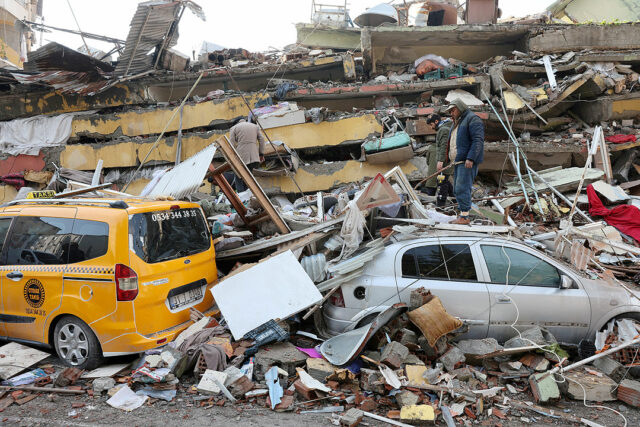
PEOPLE inspect the damage as rescuers search for survivors in the aftermath of a deadly earthquake in Hatay, Turkey, Feb. 8. — REUTERS

LONDON — The potential economic effects of the earthquake in Turkey could result in a loss of up to 1% of the country’s gross domestic product (GDP) this year, the European Bank for Reconstruction and Development (EBRD) said in a report published on Thursday.

The bank added this is a “reasonable estimate” due to the expected boost from reconstruction efforts later this year, which will offset the negative impact to infrastructure and supply chains.

“The earthquake affected to a large extent agricultural areas and areas where there is light manufacturing, so spillovers to other sectors are limited,” EBRD chief economist Beata Javorcik told Reuters.

Turkey and neighboring Syria have been rocked by a devastating earthquake on Feb. 6 which has killed more than 41,000 people and left millions in need of humanitarian aid, with many survivors having been left homeless in near-freezing winter temperatures.

Growth for Turkey, the single biggest recipient of EBRD funds, has been revised down to 3% from 3.5% in 2023, without considering the impact of the earthquake in the estimates.

The bank added that growing external financing requirements and political uncertainty associated with elections in 2023 create significant economic vulnerabilities.

Turkey’s earthquake has thrown into disarray plans for elections to be held by June, sparking frantic debate within President Tayyip Erdogan’s government and the opposition over a possible delay.

“As depreciation of the Turkish lira outpaced inflation since 2015, Turkey’s exports have been growing fast, benefiting from lower costs expressed in US dollars,” the report added.

Turkey’s lira hit a fresh record low on Wednesday. — Reuters

David Malpass surprises with early exit from World Bank

IMAGE VIA WORLD BANK / GRANT ELLIS / CC BY-NC-ND 2.0

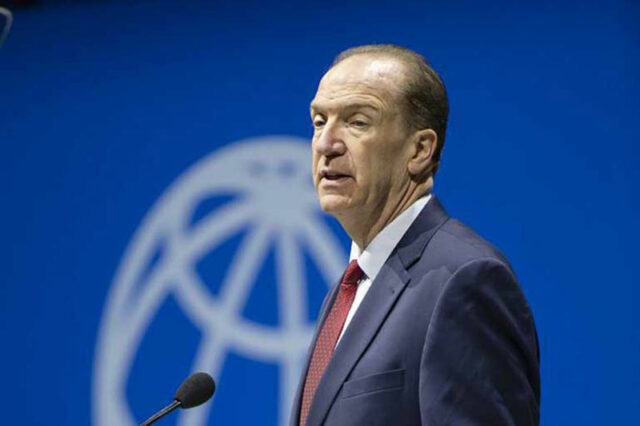
WASHINGTON — World Bank President David Malpass on Wednesday said he would leave his post well before his term ends, months after running afoul of the White House for failing to say whether he accepts the scientific consensus on global warming.

Mr. Malpass, appointed by former President Donald Trump, will depart the multilateral development bank, which provides billions of dollars a year in funding for developing economies, by the end of June. His five-year term was due to end in April 2024.

The former investment banker informed US Treasury Secretary Janet Yellen of his decision on Tuesday, a source familiar with the matter said.

Mr. Malpass, who survived multiple calls for his resignation last fall and was not expected to be offered a second term, gave no specific reason for the move, saying in a statement, “after a good deal of thought, I’ve decided to pursue new challenges.”

Mr. Malpass has been under pressure from Ms. Yellen in recent months to accelerate reforms aimed at changing the way the World Bank operates to ensure broader lending to combat climate change and other global challenges.

Ms. Yellen thanked Mr. Malpass for his service in a statement, saying: “The world has benefited from his strong support for Ukraine in the face of Russia’s illegal and unprovoked invasion, his vital work to assist the Afghan people, and his commitment to helping low-income countries achieve debt sustainability through debt reduction.”

The US Treasury chief said the United States would soon nominate a replacement for Mr. Malpass and looked forward to the bank’s board undertaking a “transparent, merit-based and swift nomination process for the next World Bank president.”

Ms. Yellen last month declined comment when asked if the United States would support a second term for Mr. Malpass.

Mr. Malpass is expected to stay at least through the April meetings of the World Bank and International Monetary Fund, but could leave his post before the end of June, given the timeline for nominating and confirming a successor, one source said.

By long-standing tradition, the US government selects the head of the World Bank, while European leaders choose the leader of its larger partner, the International Monetary Fund (IMF).

Nadia Daar, who heads the Washington office of Oxfam International, said the process should be opened to more candidates to improve the credibility of the institution.

“If shareholders really want to ‘evolve’ the @WorldBank, Malpass’ successor must be hired based on an open and merit-based selection process,” she said on Twitter.

Mr. Malpass took up the World Bank helm in April 2019 after serving as the top official for international affairs at US Treasury in the Trump administration. Before that, he served as the chief economist for the now-defunct investment bank Bear Stearns for more than a decade.

In fiscal 2022, the World Bank committed more than $104 billion to projects around the globe, according to the bank’s annual report.

Leaving at the end of the fiscal year at the end of June was a natural time to step aside, a source familiar with Mr. Malpass’ thinking said. Doing so will give his successor time to put their imprint on the reforms before the joint meetings of the World Bank and the IMF in Morocco in October.

Two of the top contenders for the post are Samantha Power, who currently leads the US Agency for International Development (USAID) and served as US ambassador to the United Nations under President Barack Obama, and Rajiv Shah, former USAID administrator under Obama and currently president of the Rockefeller Foundation, a philanthropic group.

The World Bank’s governors are expected to approve the bank’s “evolution roadmap” for reforms incorporating US-requested changes, such as balance sheet adjustments that free up an additional $2 billion for lending in fiscal 2024, at the spring meetings of the IMF and World Bank set for mid-April.

FEELING THE HEAT ON CLIMATE
Pressure to shake up the leadership of the World Bank to pave the way for a new president who would reform the Bank to more aggressively respond to climate change has been building for over two years from the United Nations, other world leaders and environmental groups.

In November 2021, Special Adviser to the U.N. Secretary-General on Climate Change Selwin Hart called out the World Bank for “fiddling while the developing world burns” and called the institution an “ongoing underperformer” on climate action.

Pressure on Mr. Malpass was reignited last September when the World Bank chief fumbled answering a question about whether he believed in the scientific consensus around climate change, which drew condemnation from the White House.

Environmental groups cheered his departure. “This is great news. It is hard to think of a worse fit for World Bank President than an alleged climate denier and the chief economist of Bear Stearns ahead of the 2008 recession,” said Bronwen Tucker, Global Public Finance Campaign Co-Manager at Oil Change International.

According to the bank’s 2021 annual report, Mr. Malpass earned $525,000 in annual net salary that year, and the bank made more than $340,000 in annual contributions to a pension plan and other benefits. — Reuters

UN to mark Russia invasion of Ukraine anniversary by urging ‘just peace’

REUTERS

UNITED NATIONS — Marking one year since Russia invaded Ukraine, the UN General Assembly will vote next week on a draft resolution stressing “the need to reach, as soon as possible, a comprehensive, just and lasting peace” in line with the founding United Nations Charter.

It again demands Moscow withdraw its troops and calls for a halt to hostilities. The 193-member General Assembly is likely to vote next Thursday after two days of speeches by dozens of states to mark the Feb. 24 anniversary of the start of the war.

Ukraine and its supporters hope to deepen Russia’s diplomatic isolation by seeking yes votes from nearly three-quarters of the General Assembly to match — if not better — the support received for several resolutions last year.

“We count on very broad support from the membership. What is at stake is not just the fate of Ukraine, it is the respect of the independence, sovereignty and territorial integrity of every state,” said European Union Ambassador Olof Skoog, who helped lead the drafting of the General Assembly resolution.

Russia’s Deputy UN Ambassador Dmitry Polyanskiy declined to comment on the draft resolution, which member states received on Wednesday.

The General Assembly has been the focus for UN action on Ukraine because the 15-member Security Council has been paralyzed by Russia, which holds a veto power along with the United States, China, France and Britain.

The Security Council has instead held dozens of meetings on Ukraine in the past year and will again discuss the war next Friday at a ministerial gathering. Diplomats say Russian Foreign Minister Sergei Lavrov is unlikely to travel to New York.

‘ATTACK ON A NEIGHBOR’
General Assembly resolutions are not legally-binding but carry political weight.

Ukraine had wanted the General Assembly draft resolution to enshrine a 10-point peace plan proposed by Ukrainian President Volodymyr Zelensky, but diplomats said the draft was simplified in a bid to garner as much support as possible.

As Russia and the West have vied for diplomatic influence, some states — particularly in the global South — worry they are squeezed in the middle of an intense geopolitical rivalry.

Russia was diplomatically isolated last year, when 141 states voted on March 2 to denounce its invasion and demand Moscow withdraw its troops. Just weeks later, 140 states voted to demand aid access and civilian protection and criticize Russia for a creating a “dire” humanitarian situation in neighboring Ukraine.

Then 143 countries voted on Oct. 12 to condemn Russia’s “attempted illegal annexation” of four partially occupied regions in Ukraine and called on all countries not to recognize the move.

Moscow has tried to chip away at its isolation. Ahead of a vote in April that resulted in Russia’s suspension from the UN Human Rights Council, Russia warned countries that a vote for the measure would be considered an “unfriendly gesture” and taken into account in the development of bilateral relations.

Russia says it launched what it calls a “special military operation” to “denazify” Ukraine and protect Russian speakers, and also now accuses the West of waging a “proxy war” against it by arming Ukraine and imposing sanctions on Moscow.

The United States and western allies have called the invasion an unprovoked land grab against a sovereign nation.

At the United Nations, the United States and other western countries have worked to maintain diplomatic support for Ukraine by focusing on the founding UN Charter, a key principle of which is respect for sovereignty and territorial integrity.

“You cannot be neutral when there is a country that is attacking another country,” US Ambassador to the United Nations, Linda Thomas-Greenfield, said last month. “It’s an attack on the UN Charter. It’s an attack on the sovereignty of an independent country. It’s an attack on a neighbor.” — Reuters

Avian flu spreads to new countries, threatens non-stop ‘war’ on poultry

CHICAGO — Avian flu has reached new corners of the globe and become endemic for the first time in some wild birds that transmit the virus to poultry, according to veterinarians and disease experts, who warn it is now a year-round problem.

Reuters spoke to more than 20 experts and farmers on four continents who said the prevalence of the virus in the wild signals that record outbreaks will not abate soon on poultry farms, ramping up threats to the world’s food supply. They warned that farmers must view the disease as a serious risk all year, instead of focusing prevention efforts during spring migration seasons for wild birds.

Outbreaks of the virus have widened in North and South America, Europe, Asia and Africa, undefeated by summer heat or winter cold snaps, since a strain arrived in the United States in early 2022 that was genetically similar to cases in Europe and Asia.

On Wednesday, Argentina and Uruguay each declared national sanitary emergencies after officials confirmed the countries’ first infections. Argentina found the virus in wild birds, while dead swans in Uruguay tested positive.

Egg prices set records after the disease last year wiped out tens of millions of laying hens, putting a staple source of cheap protein out of reach to some of the world’s poorest at a time the global economy is reeling from high inflation.

Wild birds are primarily responsible for spreading the virus, according to experts. Waterfowl like ducks can carry the disease without dying and introduce it to poultry through contaminated feces, saliva and other means.

Farmers’ best efforts to protect flocks are falling short.

In the United States, Rose Acre Farms, the country’s second-largest egg producer, lost about 1.5 million hens at a Guthrie County, Iowa, production site last year, even though anyone who entered barns was required to shower first to remove any trace of the virus, Chief Executive Marcus Rust said.

A company farm in Weld County, Colorado, was infected twice within about six months, killing more than three million chickens, Mr. Rust said. He thinks wind blew the virus in from nearby fields where geese defecated. “We got nailed,” Mr. Rust said. “You just pull your hair out.”

The United States, Britain, France and Japan are among countries that have suffered record losses of poultry over the past year, leaving some farmers feeling helpless.

“Avian flu is occurring even in a new poultry farm with modern equipment and no windows, so all we could do now is ask God to avoid an outbreak,” said Shigeo Inaba, who raises chickens for meat in Ibaraki prefecture near Tokyo.

Poultry in the Northern Hemisphere were previously considered to be most at risk when wild birds are active during spring migration. Soaring levels of the virus in a broad range of waterfowl and other wild birds mean poultry now face high risks year round, experts said.

“It’s a new war,” said Bret Marsh, the state veterinarian in the US state of Indiana. “It’s basically a 12-month vigil.”

In a sign the threat is expected to persist, Mr. Marsh is seeking funds from Indiana’s lawmakers to hire an additional poultry veterinarian and poultry health-specialist. Indiana lost more than 200,000 turkeys and other birds over the past year, while total US deaths top 58 million birds, according to US government data, surpassing the previous 2015 record.

The virus is usually deadly to poultry, and entire flocks are culled when even one bird tests positive.

Vaccinations are not a simple solution: they may reduce but not eliminate the threat from the virus, making it harder to detect its presence among a flock. Still, Mexico and the EU are among those vaccinating or considering shots.

GLOBAL PROBLEM
Wild birds have spread the disease farther and wider around the world than ever before, likely carrying record amounts of the virus, said Gregorio Torres, the head of the science department at the Paris-based World Organization for Animal Health, an intergovernmental group and global authority on animal diseases. The virus changed from previous outbreaks to a form that is probably more transmissible, he told Reuters.

“The disease is here to stay at least in the short term,” Mr. Torres said.

Mr. Torres could not confirm the virus is endemic in wild birds worldwide, though other experts said it is endemic in certain birds in places like the United States.

While the virus can infect people, usually those who have contact with infected birds, the World Health Organization says the risk to humans is low.

The form of the virus circulating is infecting a broader range of wild birds than previous versions, including those that do not migrate long distances, said David Suarez, acting laboratory director of the US government’s Southeast Poultry Research Laboratory in Georgia.

Such infections of “resident” birds are helping the virus to persist throughout the year when it didn’t previously, he said.

Black vultures, which inhabit the southern United States and previously avoided infections, are now among the species suffering, said David Stallknecht, director of the Southeastern Cooperative Wildlife Disease Study at the University of Georgia.

The virus has also infected mammals like foxes, bears and seals.

“We all have to believe in miracles,” Mr. Stallknecht said, “but I really can’t see a scenario where it’s going to disappear.”

CROSSING BORDERS
High virus levels in birds like blue-winged teal, ducks that migrate long distances, helped spread the virus to new parts of South America, Mr. Stallknecht said.

Countries including Peru, Ecuador and Bolivia in recent months reported their first cases.

Ecuador imposed a three-month animal-health emergency on Nov. 29, two days after its first case was detected, the country’s Ministry of Agriculture and Livestock said. So far, more than 1.1 million birds have died, the ministry said.

Infections in Uruguay and Bolivia put the disease close to top global chicken exporter Brazil, which has never confirmed a case. Brazilian Agriculture Minister Carlos Favaro said on Wednesday the country investigated three suspected cases, but test results came back negative.

“Everyone is focused on preventing the flu from reaching our country,” said Gian Carlos Zacchi, who raises chickens for processor Aurora in Chapecó in Brazil’s Santa Catarina state.

Some experts suspect climate change may be contributing to the global spread by altering wild birds’ habitats and migratory paths.

“The wild bird dynamics have shifted, and that’s allowed the viruses that live in them to shift as well,” said Carol Cardona, an avian flu expert and professor at the University of Minnesota.

Farmers are trying unusual tactics to protect poultry, with some using machines that make loud noises to scare off wild birds, experts said.

In Rhode Island, Eli Berkowitz, an egg producer and chief executive of Little Rhody Foods, sprayed the disinfectant Lysol on goose poop on a walkway of his farm in case it contained the virus. He also limits visitors to the farm, a more traditional precaution.

Mr. Berkowitz said he is bracing for March and April when migration season will pose an even greater risk to poultry.

“You’d better buckle up and hold on for your dear life,” he said. — Reuters

High cost to women as African apps spread gospel of gig work

STOCK PHOTO | Image by Pexels from Pixabay

 – Women who mop, sweep and clean homes across Africa are riding a new wave of digital platforms that promise flexible work and fresh opportunity – but critics say the fast-growing apps only expose the gig workers to age-old abuse and exploitation.

They say the women – many of them vulnerable migrants – run a gamut of risks by signing up for gig work on the new apps, from underpay to assault, injury to debt, reputational damage as well as scant benefits and zero trade union representation.

“The narrative of the gig economy is that domestic workers have flexibility, but in reality they have less autonomy, they feel subordinated to both the platform and the clients,” said Kelle Howson, a researcher who is an expert on gig work in South Africa.

Exact figures on domestic gig work in Africa are hard to pin down – in part due to the digitization of an often informal, unprotected sector.

Some 81% of the world’s domestic workers are employed informally with no access to labor protection, according to the International Labour Organization (ILO). And critics say gig platforms could only perpetuate this.

Some half a dozen platforms have sprung up in the last decade across the continent, connecting tens of thousands of unemployed women to clients and drawing in venture capital of roughly US$20 million.

The sector’s rapid growth and its risky nature are raising red flags for human rights watchdogs, who point to mounting worker unrest in Latin America and Asia against a business model they say is unfair.

“Domestic work happens behind closed doors so there is less visibility and, partly as a result of this, domestic workers are more vulnerable to exploitation,” said Howson, who works with Fairwork, a gig research project at Britain’s Oxford Internet Institute.

The platforms say they create much needed jobs, but act only as mediators, not actual employers, a scenario that can expose domestic workers to psychological pressure, financial exploitation and physical risk. And can let bad employers or arms-length platforms evade responsibility when things go wrong.

Take Fiona, a 36-year-old domestic worker who mopped floors, scrubbed toilets and wiped countertops in tens of South African homes for almost six months and did it all, essentially, for free.

This was because her travel and mobile phone data costs surpassed what little she earned in the 400-hour probation period she said was mandatory for her to register on a local gig platform.

“When you are desperate for a job, you just take it,” said Fiona, who survived the probation period by borrowing from friends to top up her initial earnings of about $130 a month.

Her platform of choice was Sweep South – the country’s biggest app for gig work – which was launched in 2014 by local entrepreneurs.

Gig workers on sites such as Sweep South say they fear being kicked off the apps if they dare to speak out against practices that are intrinsic to the platforms and which they say can be exploitative.

Inadequate safety protocols, penalties for sick days, low pay, and denial of lunch and bathroom breaks are just some of the concerns shared with the Thomson Reuters Foundation by more than a dozen app-based cleaners, former employees and customers.

Interviewed in three countries across the continent, all asked to use pseudonyms for fear of being barred from their apps after speaking out.

“We worry that these apps are undoing all the progress we fought so hard for,” said Gloria Kente, a former domestic worker turned organizer in the South African Domestic and Service Allied Workers Union.

“Just because it is digital, it doesn’t mean the battle for our rights has changed,” said Kente, 59, who has spent the last decade fighting for worker rights.


BACKBONE OF THE ECONOMY

Globally, domestic workers represent 2.3% of the world’s workforce – some 76 million people – and the majority of them work informally, without proper contracts or benefits.

More than three in four are women.

And the women of sub-Saharan Africa are especially vulnerable, according to UN Women, which says 63% of the world’s women who live in extreme poverty are found in that region.

Supporters of the sector say the platforms open doors for people who would not otherwise find paid work, and that the workers like the new regime of flexible, on-demand jobs.

Among the biggest platforms are South Africa’s Sweep South, Nigeria’s Eden Life and Egypt’s Filkhedma, promising a lifeline to desperate job seekers in regions with few other openings.

Critics say that migrants are among the most vulnerable.

From Sudanese women mopping Egyptian floors to Zimbabweans washing the clothes of South Africans, many on the app are far from home, without family and cannot find any other work.

“I thank them for creating these jobs,” said Naledi, a 33-year-old Zimbabwean cleaner in South Africa, home to an estimated 1 million domestic workers.

“But we are afraid to complain in case we lose the work.”

Venture capitalists backed Sweep South, which now has 30,000 registered workers and was expanding into new markets, before cost concerns put an expansion into Kenya and Nigeria on hold.

Egypt’s Filkhedma – born in 2014 – was bought by Sweep South a year ago as part of a grand plan to fan out across the continent. It now has 300 registered domestic workers.

About one third of domestic workers are already hired through agencies or platforms, according to the informal worker charity WIEGO, a figure that gig economy experts say is likely to grow as both unemployment and tech access expands across the continent.

Already, at least 365 digital platforms are found in eight African countries alone, connecting some 4.8 million workers to an average 92,000 users each month, according to South African think tank Cenfri.


‘RED DEVIL’

The complaints levelled at the apps mostly center on their imbalance of power.

Sick leave is a case in point.

When Nancy woke with flu one winter day last year – a day she was meant to clean a client’s house – she was forced to cancel on the Sweep South South Africa app, only to spot what some workers call the “red devil emoji” next to her name.

The emoji stayed for 30 days, long after her flu had left.

“I was so ashamed, and worried it would impact me getting work,” said Nancy, who felt nervous to challenge a rating that tracks her reliability and her average customer rating in case it fell still further.

Sweep South said the red unhappy face – the firm stressed this was not a devil icon – appears if a cleaner’s rating falls below average. It stays up for 30 days – absent any “SweepStar” appeal – and is not visible to customers, Sweep South added.

“The constant tacit threat of deactivation … reduces those workers’ power and agency,” said Howson of Fairwork.

“They don’t know if they might wake up tomorrow and have lost their livelihoods.”

Allegations of wrongdoing can also put a worker on the back foot.

A former Sweep South senior employee said that when domestic workers were accused of stealing, external arbitrations were held by an ex-police detective. The source said the detective would sometimes base his verdict solely on reading a worker’s body language in a video interview.

“The customer was always right,” he said, requesting anonymity for fear of reprisal.

Sweep South said that while accusations of theft are very rare, guilt was determined “based on a balance of probabilities and extensive interviews of both the client, any witnesses, and the SweepStar” herself.

The SweepStar is permanently deactivated from the platform if she is found guilty.

If deemed innocent, the SweepStar will be reactivated and the client may face deactivation or could be reported to the relevant authorities.

Sweep South did not give figures on how many clients or cleaners had been barred from the app.


FAIR COMMISSION

The biggest bugbear for most gig workers is fair pay – or the lack of it.

Sweep South stipulates on its site that SweepStars get between 80% and 96% of the total booking fee based on their experience, and 65% during the first “2 to 3 months trial period to recoup costs”.

But domestic workers interviewed by the Thomson Reuters Foundation said even after the 400-hour trial period, their payments fluctuated from area to area, making budgeting near impossible.

Cleaners from all three apps said they could spend up to 65% of their daily earnings on data and public transport to get to work. Sub-Saharan Africa has some of the world’s highest data costs.

Sweep South said its earnings model took into account a host of factors from supply and demand, location, the cleaner’s performance rating, and the date and length of any job.

In Nigeria, 22-year-old Dare has worked for both local cleaning app Eden Life and Sweep South, which launched in Nigeria in July 2022. Eden Life was founded in 2019 with 70+ domestic workers.

SweepSouth paid him N7,000 ($11) for half a day scraping paint and cement stains off floors, windows and toilets of a newly-built three-bedroom apartment in Lagos.

The worker said he received no extra compensation despite logging a complaint about a job he called far more strenuous than the simple task outlined on the app.

“I had to make a video to let them know what I did was different from what they told me about the job. They said I was complaining too much – I just has to clean it,” the 22-year-old recalled.

Further north of the continent, domestic gig workers voice similar challenges.

Mona El Sayed, a 36-year-old Sudanese cleaner cum English teacher who is based in Cairo, joined Filkhedma in September to feed her three children as the cost of living spiked.

But her share of the earnings, she said, felt unfair after the platform kept a quarter for itself.

“The price of one order is 295 Egyptian pounds ($12), I take 218 Egyptian pounds ($9) from that figure…it’s pennies,” she said.

Moataz Dinana, co-founder of Filkhedma, said there was a “bonus model” that offers financial rewards to those who have higher ratings every month to supplement their income.


WHAT WORKER RIGHTS?

Regulating domestic work is a challenge largely because it goes unseen, behind closed doors, says the ILO.

More than a third of the world’s domestic workers are not entitled to maternity leave.

But the apps are quick to distance themselves from labor rights issues.

“We are just a marketplace,” said Dinana of Filkhedma, explaining why employees who find work through the platform get no benefits such as maternity or sick leave.

In Nigeria, 22-year-old Adam is still waiting to hear back from Eden Life after he broke his arm when he fell down a flight of stairs mopping a client’s floor last year.

While Eden Life said it does not have a medical plan for its cleaners, it does reimburse them for any treatment if they provide photographic proof of an injury or an invoice from a hospital.

Despite sending a photo of his injured arm to his line manager on WhatsApp, and several attempts to follow up his request, Adam did not hear back and had to pay for the treatment himself.

Eden Life said it hoped to add a feedback section to the site so workers like Adam can make seek redress. However, it gave no timeline for launching the new feature.


MIDDLE MAN

A former executive at one of the biggest gig worker sites said the platforms relied on their status as middle man in the triangle to shun certain responsibilities for the job-seekers it connected to vacancies.

Take the insurance scheme that operates in South Africa, where an employee can be registered with the Unemployment Insurance Fund (UIF) through the Department of Employment and Labour.

Should the worker then become unemployed or unable to work, short-term relief is provided to the worker through the department.

A total of 2% of the employee’s salary must be paid into the UIF each month – half paid by the employer, and the other half can be deducted from the worker’s wages.

But that depends on everyone paying into the insurance pot.

“The client and the platform don’t pay UIF – even if they are hired five days a week by the same person – because workers are not actually considered employees,” said the former Sweep South employee.

“The workers just fall between the cracks,” they said.


WORK WITH US’

The very nature of the virtual registration to find work on these platforms make it hard for cleaners to share their grievances in-person and push for benefits, said Howson from Fairwork.

In countries such as India, Brazil and Mexico, gig domestic workers are pushing back against online exploitation through protests, and even designing their own worker-led apps.

Kente said the way forward was for platforms to consult the gig workers who power their profits and create a more ethical model for flexible business.

“These apps are growing around the world, but there must be a conversation with us, the unions, who have been working at the forefront of domestic worker rights for so many years,” she said.

“My message to these apps is work with us, don’t leave us behind.” – Reuters

In South Korea, free subway rides for the elderly become a political headache

STOCK PHOTO | Image by Jang Hwan Cho from Pixabay

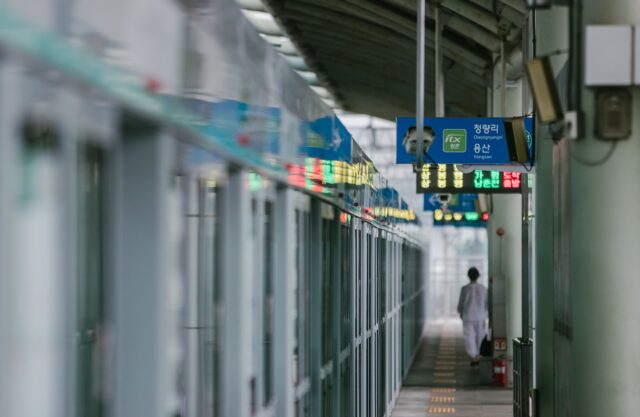
 – Every day, 71-year-old Park Gyung-sun delivers flowers, documents and other packages around Seoul – a job popular among senior citizens who are entitled to ride the city’s subways for free.

The work, dubbed “silver delivery” in South Korea, earns Park, a former market stall owner, up to 700,000 won ($550) a month. The company he works for is just one of two dozen in the capital.

“It’s fun and good for my health,” Park told Reuters. “But honestly, I wouldn’t be doing it if subway rides weren’t free because there wouldn’t be much left over for me.”

Free rides have been a perk enjoyed nationally by those 65 and older for four decades and are credited with keeping senior citizens active. They have, however, become a thorny political issue as South Korea‘s population rapidly ages and subway operating costs soar.

There is no talk of doing away with the benefit altogether but some cities that operate subways are threatening steep fare hikes or a lifting of the eligible age unless the national government shoulders some of the cost. The finance ministry is staunchly opposed.

The dispute is part of broader challenges for Asia’s fourth-largest economy where the cost of senior welfare is surging and comes amid debate on raising the retirement age from 60 and how to ensure a sustainable national pension scheme.

It’s also left President Yoon Suk-yeol in a quandary. He promised fiscal consolidation upon taking office in May but also counts elderly voters as a key support base.

Consumers are already unhappy with inflation at 24-year highs, steep utility price hikes and an economy that in the last quarter posted its first contraction in more than two years.

Some members of his ruling People Power party have warned that any scaling back of subway perks for the elderly will not help their chances in next year’s parliamentary election – one where the party is seeking to retake a majority so Yoon can push forward with his reform agenda.

The free ride problem is set to only get worse over time.

More than 18% of South Korea‘s population of 51 million is aged 65 or older. That proportion is projected to hit 30% in 2035 and 40% in 2050, according to the country’s statistics agency.

In the greater Seoul area, where almost 3.7 million people are 65 or older, more than 233 million free rides were taken last year. That cost Seoul Metro some 315 billion won ($250 million), equivalent to 30% of its debt.

To cope, Seoul unveiled plans in December to hike subway fares for the first time since 2015, by as much as 30%, although free rides for the elderly will remain in place.

Planned fare hikes could only be minimized if “there is at least some state assistance,” Mayor Oh Se-hoon told a news conference last week, noting the free ride policy had been imposed on cities by former military dictator Chun Doo-hwan in the early 1980s.

For its part, the finance ministry says it has funded building and improving subway systems, and the cities should handle operating costs.

“In the case of Seoul, they are in fact in a far more solid financial position than the country, and given that situation, I think it is a bit too much to ask the state to take responsibility for this,” Vice Finance Minister Bang Ki-sun told Reuters.

Daegu, a large city in South Korea‘s southeast, said recently it will consider increasing the minimum eligible age in gradual stages to 70. Another city, Daejeon, is looking at a similar policy.

Sixty percent of Koreans support raising the minimum age for senior citizen benefits including free subway rides to 70, according to a Gallup poll released last week. Thirty-four percent were opposed.

The welfare ministry will review whether local governments are entitled to change minimum age eligibility levels, Yoon’s office said in response to a Reuters request for comment on the matter. – Reuters

ADVERTISEMENT
ADVERTISEMENT