
How PSEi member stocks performed — February 23, 2023
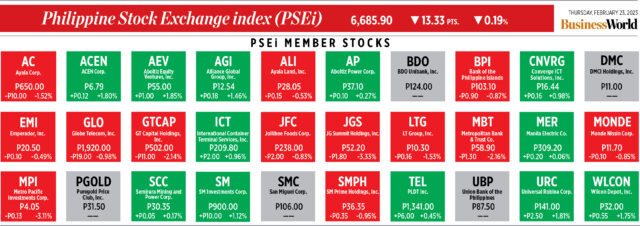
Here’s a quick glance at how PSEi stocks fared on Thursday, February 23, 2023.
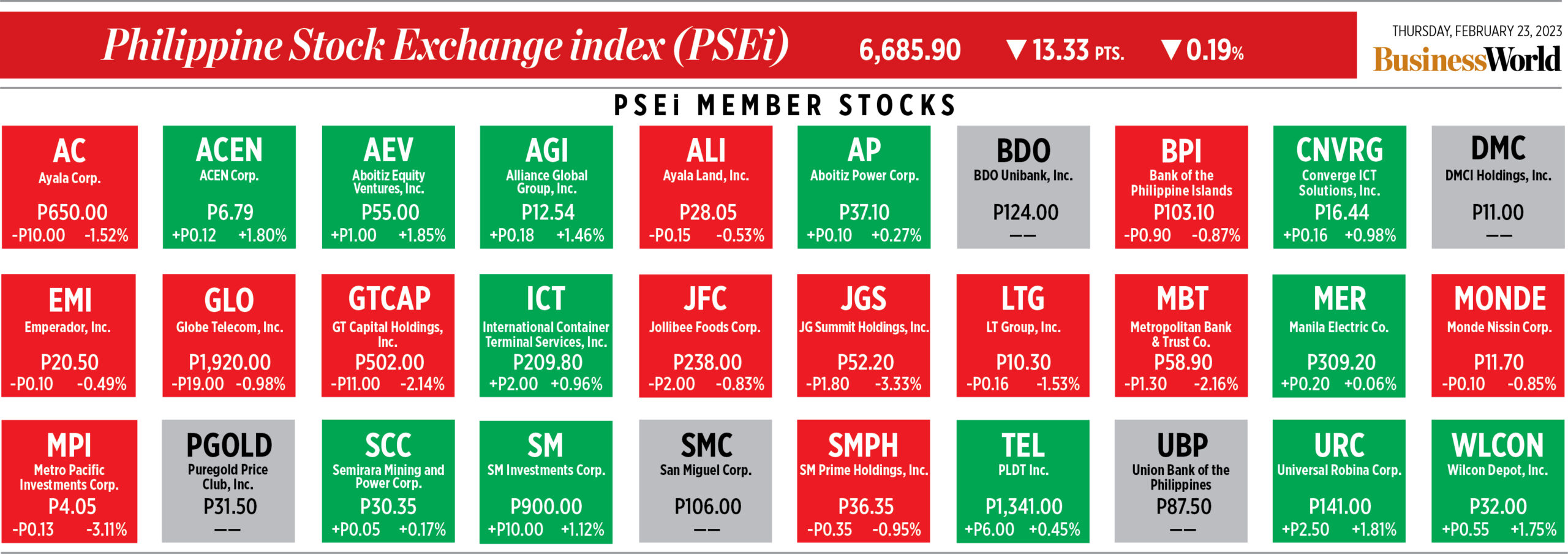

Here’s a quick glance at how PSEi stocks fared on Thursday, February 23, 2023.
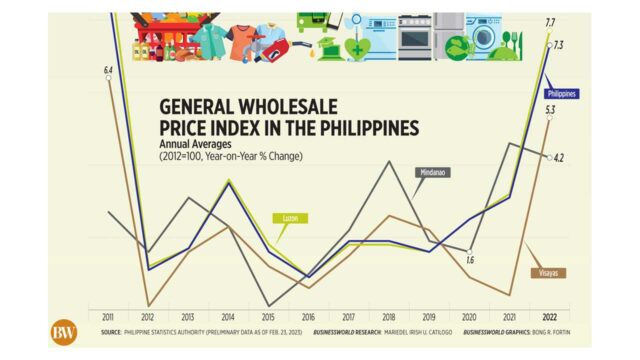
GROWTH in the bulk prices of general goods eased in December for a third straight month to 6.7% year on year, tempering the 2022 average to 7.3%, which is still an 11-year high. Read the full story.

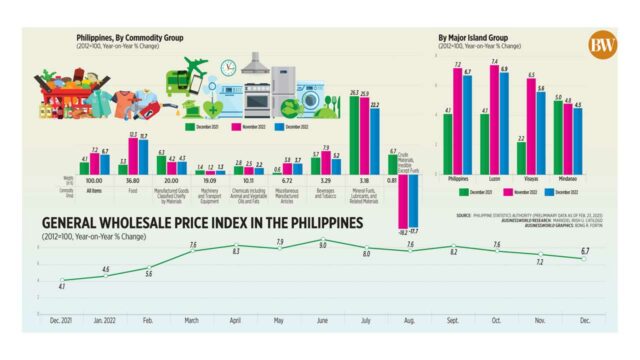
GROWTH in the bulk prices of general goods eased in December for a third straight month to 6.7% year on year, tempering the 2022 average to 7.3%, which is still an 11-year high. Read the full story.

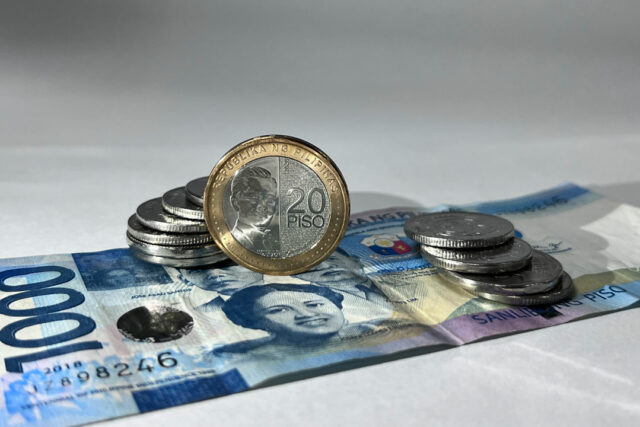
THE PESO rose against the dollar on Thursday as global crude oil prices dropped to two-week lows, helping ease inflation concerns.
The local currency closed at P54.87 versus the greenback on Thursday, appreciating by 31 centavos from Wednesday’s P55.18 finish, Bankers Association of the Philippines data showed.
The peso opened Thursday’s session at P55.12 per dollar. Its intraday best was its closing level of P54.87, while its weakest showing was at P55.15 against the greenback.
Dollars traded rose to $1.109 billion on Thursday from $1.006 billion on Wednesday.
The peso strengthened as global crude oil prices eased to two-week lows, Rizal Commercial Banking Corp. Chief Economist Michael L. Ricafort said in a Viber message.
“The peso appreciated, driven by profit taking from market participants and tracking the decline in global crude oil prices,” a trader said in an e-mail.
Oil prices fell by $2 per barrel to their lowest in two weeks on Wednesday, Reuters reported.
Brent crude futures settled $2.45 or 3% lower at $80.60 per barrel. West Texas Intermediate crude futures dropped by $2.41 or 3% to end at $74.05 a barrel.
The settlement levels were the lowest for both benchmarks since Feb. 3.
Prices dropped on growing concerns over oil demand as the US Federal Reserve aims to keep hiking rates to reduce surging consumer prices, based on the minutes of its meeting earlier this month.
The US central bank hiked its target interest rate by 25 basis points (bps) to a range between 4.5% and 4.75% during its Jan. 31 to Feb. 1 meeting. This brought cumulative increases since March 2022 to 450 bps.
The Fed’s next policy meeting is on March 21-22.
The trader said the peso will likely strengthen further on Friday amid an expected downward revision to the fourth-quarter US gross domestic product report.
The trader expects the peso to trade between P54.70 and P54.95 against the greenback on Friday, while Mr. Ricafort gave a forecast range of P54.80 to P55. — AMCS
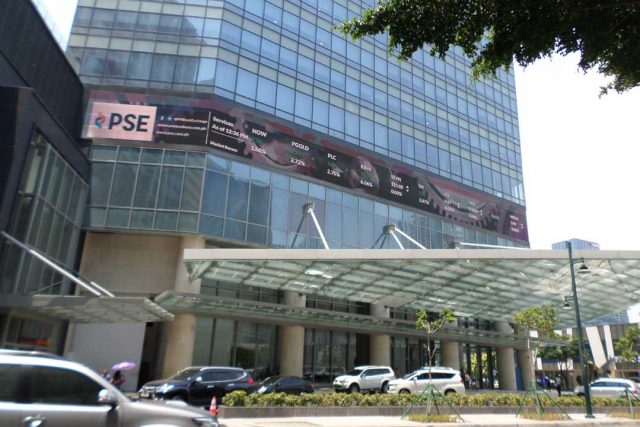
PHILIPPINE SHARES declined on Thursday as investors priced in the minutes of the US Federal Reserve’s meeting earlier this month, which were released overnight.
The benchmark Philippine Stock Exchange index (PSEi) went down by 13.33 points or 0.19% to close at 6,685.90 on Thursday, while the broader all shares index dropped by 7.16 points or 0.2% to end at 3,572.20.
“The local bourse declined further this Thursday as investors digested the minutes of the Fed meeting,” Philstocks Financial, Inc. Research Analyst Claire T. Alviar said in a Viber message.
“Philippine shares have fallen deeper as market participants mull the summary of the Fed’s latest meeting, contemplating the central bank’s next action to curb inflation,” Regina Capital Development Corp. Head of Sales Luis A. Limlingan said in a Viber message.
Rizal Commercial Banking Corp. (RCBC) Chief Economist Michael L. Ricafort in a Viber message likewise said the PSEi closed lower for a second straight day “as Federal Reserve officials continued to anticipate further increases in borrowing costs would be necessary to bring inflation down to their 2% target when they met earlier in February 2023.”
Minutes from the Federal Reserve’s Jan. 31-Feb. 1 meeting said that “almost all” Fed officials agreed to slow the pace of increases in interest rates to a quarter of a percentage point, Reuters reported.
There was also solid backing though for the belief that the risks of high inflation remained a “key factor” that would shape monetary policy and further rate hikes would be necessary until it was controlled.
At that meeting, the US central bank raised the fed funds rate by 25 basis points (bps) to a range between 4.5% and 4.75%, bringing cumulative hikes since March 2022 to 425 bps. Its next policy review is on March 21-22.
Back home, the majority of sectoral indices closed lower on Thursday. Property went down by 21.86 points or 0.75% to 2,885.76; financials declined by 10.68 points or 0.59% to 1,797.26; mining and oil lost 52.41 points or 0.47% to end at 11,041.42; and holding firms fell by 12.93 points or 0.20% to 6,452.
Meanwhile, services gained 7.03 points or 0.42% to 1,672.50; and industrials went up by 21 points or 0.21% to 9,634.78.
Value turnover declined to P4.35 billion on Thursday with 932.40 million shares changing hands from the P4.93 billion with 1.34 billion issues traded on Wednesday.
Decliners narrowly outnumbered advancers, 90 versus 85, while 39 names closed unchanged.
Net foreign selling went down to P712.96 million on Thursday from P752.34 million on Wednesday.
Regina Capital’s Mr. Limlingan put the PSEi’s support at 6,400 to 6,500 and resistance at 6,794.13 to 6,800, while RCBC’s Mr. Ricafort placed immediate major support at 6,250 and resistance at 7,000 to 7,100. — Ashley Erika O. Jose with Reuters
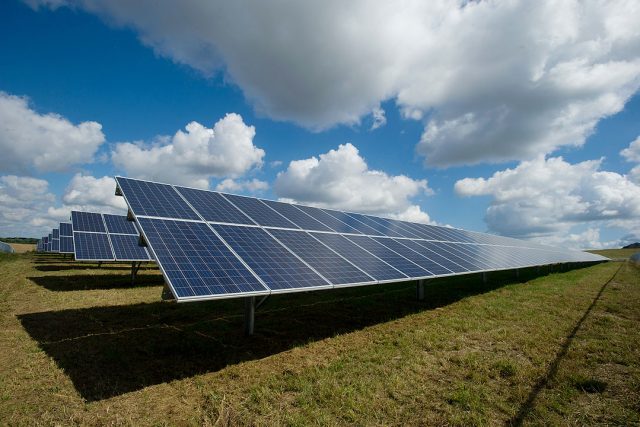
THE Energy Regulatory Commission (ERC) said it will extend the suspension of feed-in tariff allowance (FIT-All) collection until August, citing the need to provide relief to consumers as electricity bills rise.
In a statement, the ERC said the resulting reduction on power bills is estimated at P0.0364 per kilowatt-hour.
“With this extension, we want to assure the consumers that the Commission continues to be vigilant in pursuing measures to reduce power rates without compromising security of supply which, in this case, comes from RE plants,” ERC Chairperson and Chief Executive Officer Monalisa C. Dimalanta said in a Viber message.
In November, the ERC suspended the collection of FIT-All between December and February. The latest decision takes effect in March.
“In view of the rising level of inflation and cost of living affecting millions of Filipino households, the ERC re-evaluated the FIT-All Fund balance and found its healthy status, which can sufficiently cover the FIT-All payment requirements for six more months,” the ERC said.
FIT-All is a uniform charge levied on all on-grid electricity customers, calculated and set annually. The fund these payments go into support the development and promotion of renewable energy (RE).
FIT-All funds payments to RE developers who have secured a fixed rate for electricity generated by their projects.
“Our renewable energy developers under the FIT program can likewise be confident that we are diligently monitoring the FIT-All Fund to make sure there is sufficient balance to cover payments for the renewable power supplied to all consumers,” Ms. Dimalanta said.
Meanwhile, the ERC has directed distribution utilities, retail electricity suppliers and the National Grid Corp. of the Philippines to report compliance with the original FIT-All collection suspension.
“The directive was issued in order for the Commission to ensure correct and timely compliance of these said entities, as the collection agents,” the ERC said. — Ashley Erika O. Jose

AN OPPOSITION Senator said those involved in importing 260 20-foot containers of sugar through the port of Batangas could have committed economic sabotage, after the shipments bypassed the regular import process authorized by a formal sugar order.
Senator Ana Theresia N. Hontiveros-Baraquel in a statement on Thursday described the three companies involved in the Batangas shipments as “handpicked” by government officials, and alleged that their activities constituted cartel-like behavior.
“How can this be anything but government-sponsored smuggling?” she added.
Ms. Hontiveros said the size of the shipment could be considered “large-scale agricultural smuggling.”
Republic Act 10845, which classifies large-scale smuggling of agricultural products as economic sabotage, allows no bail for the smuggling of produce in their raw state as well as the smuggling of items that have undergone simple processing or preservation.
The no-bail rule applies to shipments valued at P1 million for most farm items. For rice the threshold is P10 million.
“Our laws, specifically the Anti-Agricultural Smuggling Act, penalize the entry of sugar valued no lower than P1,000,000 into the country without valid permits,” Ms. Hontiveros said.
“So, when Department of Agriculture (DA) Senior Undersecretary Domingo F. Panganiban yesterday admitted freely that… the three companies (were given the go-ahead) to import sugar, we hope that they are ready to face serious criminal and administrative charges,” she added.
The arrival of the shipment in Batangas on Feb. 9 came on the strength of a memorandum issued by the Office of the Executive Secretary, Mr. Panganiban said on Wednesday, preceding the issuance of a formal sugar order by the industry regulator by several days.
“In response to the directive of the President to address inflation and create a buffer stock and given that sugar is one of the components of most of commodities that drives the consistently high inflation rate, I acted with haste and interpreted the memorandum issued by the Office of the Executive Secretary as an approval to proceed with the imports,” he said.
Sugar imports typically need to be cleared by the Sugar Regulatory Administration (SRA). In this case, the SRA issued Sugar Order No. 6 authorizing imports of 440,000 metric tons of the commodity, part of which was to help form a buffer stock to stabilize prices.
“Seven months since the sugar import fiasco was first exposed, do we have another fiasco here? Who are the masterminds again responsible? What or who were the reasons as to why the Usec. was compelled to make such hasty decisions?” Ms. Hontiveros said.
Agriculture and sugar officials last year resigned following the recall of Sugar Order No. 4, signed after a meeting with the President had convinced them of an urgent need to import 300,000 metric tons of sugar, believing as well that they were fully authorized to act.
“Once and for all, for the peace of mind and wallets of our consumers, I urge the President to lead the signing of an above-board sugar order akin to past sugar orders authorizing multiple importers to import sugar,” Ms. Hontiveros said.
Sugar Order No. 6 took effect on Feb. 18, and the authorities said on Wednesday that they were still taking applications from importers seeking to bring in sugar until the Thursday deadline.
“The directive of the executive secretary to me was a manifestation that that directive is already a sugar order,” Mr. Panganiban said.
As a result, he said he instructed three companies that were “capable” and “accredited” to proceed with the sugar imports “provided that they agree to reduce the prices (to a level) that is commercially acceptable… and that they will shoulder the cost of warehousing.”
The Senator added that “if the cartels are allowed to thrive and profit, this will only result in more kickbacks, shady deals and corruption. Sugar prices will not go down,” she added. — Alyssa Nicole O. Tan
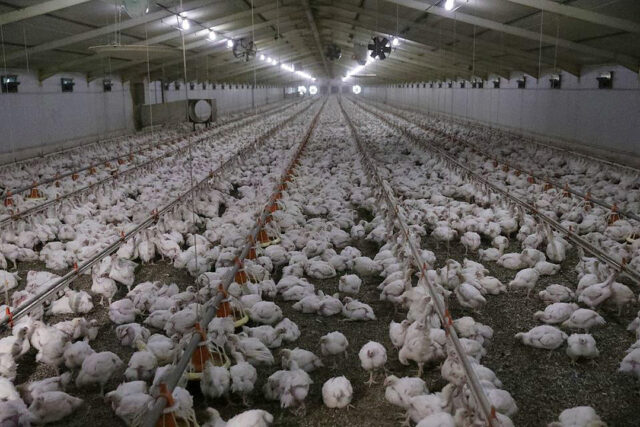
POULTRY and hog production rose in the fourth quarter, the Philippine Statistics Authority (PSA) said.
Chicken production in the last three months of 2022 rose 2.2% year on year to 483.03 thousand metric tons (MT), on a liveweight basis.
Central Luzon was the top producer of chicken at 179.14 thousand MT, followed by Calabarzon (78.73 thousand MT), Northern Mindanao (50.29 thousand MT), Western Visayas (31.71 thousand MT), and Central Visayas (27.29 thousand MT).
“These regions accounted for 74.3% of the country’s total chicken production during the quarter,” the PSA said.
Native chicken and layer chicken populations rose 3.9% and 3.4%, respectively. The inventory of broiler chicken decreased 1.9%.
The average farmgate price of chicken was P120.85 per kilogram, up 20.4% from a year earlier.
Chicken egg production during the quarter grew 0.2% year on year to 174.58 thousand MT.
Top producer was Calabarzon at 50.93 thousand MT, followed by Central Luzon (32.87 thousand MT), Central Visayas (19.51 thousand MT), Northern Mindanao (19.16 thousand MT), and Davao Region (9.09 thousand MT).
These regions accounted for 75.1% of national production.
According to the PSA, the average farmgate price of chicken egg realized by commercial farms was up 18.3% at P6.22 during the quarter.
United Broiler Raisers Association President Elias Jose M. Inciong said broiler production varies by how the industry gauges demand.
“The production conditions are ideal or optimal in the first and last quarters of every year. (During) cool temperatures, there is a bias towards lower equilibrium prices,” he said.
The PSA said duck output rose 4.3% year on year to 7.08 thousand MT.
Central Luzon posted volume of 2.14 thousand MT, followed by Soccsksargen (1.19 thousand MT), Western Visayas (0.72 thousand MT), Cagayan Valley (0.58 thousand MT), and Bangsamoro Autonomous Region in Muslim Mindanao (0.35 thousand MT).
Bird populations grew in smallhold and semi-commercial farms by 9.7% and 30.2%, respectively. Some 70% of the bird inventory was held by smallholders while 28% were grown in semi-commercial farms.
The average farmgate price of duck for meat was P180.44 per kilogram, down 5.1% from a year earlier.
Hog production rose 3.4% year on year to 465.32 thousand MT, the PSA said.
Central Visayas was the top hog producer at 56.80 thousand MT, followed by Northern Mindanao (56.62 thousand MT), Western Visayas (54.39 thousand MT), Calabarzon (52.06 thousand MT), and Central Luzon (38.49 thousand MT).
“These regions accounted for 55.6% of the country’s total hog production during the quarter,” the PSA said.
According to the PSA, all farm categories posted increases in swine population.
The average farmgate price of hogs for slaughter was up 7% at P163.09 per kilogram during the quarter. — Sheldeen Joy Talavera
MONDELEZ Philippines, Inc. topped the list of importers paying duty and taxes to the Bureau of Customs (BoC) last year, the BoC said on Thursday.
The top taxpayers by duties and taxes paid were food and beverage company Mondelez Philippines, Inc., Cigarette maker JT International Philippines, Inc., and pharmaceutical firm GlaxoSmithKline Philippines, Inc.
Others on the list were Unilever Philippines, Inc., Chevron Philippines, Inc., Nestlé Philippines, Inc., Novartis Healthcare Phils., Inc., Pilipinas Shell Petroleum Corp., Fast Retailing Philippines, Inc., and Toyota Motor Philippines Corp.
Meanwhile, the BoC’s top five taxpayers based on voluntary compliance were Nestlé, Wyeth Philippines, Inc., JT International, Mondelez, and Henkel Philippines Applied Technologies, Inc.
“We recognize and value our stakeholders for their contributions to the revenue generation of our country, enabling the National Government to provide better welfare support and implement national development programs dedicated to improving the lives of our citizens,” Customs Commissioner Bienvenido Y. Rubio said in a statement. — Luisa Maria Jacinta C. Jocson

THE German-Philippine Chamber of Commerce and Industry, Inc. (GPCCI) said the Senate’s recent vote to join the Regional Comprehensive Economic Partnership (RCEP) puts the Philippines in a position to better compete with its neighbors.
“The inclusion of the Philippines in RCEP would allow the country to finally access economic benefits and will put us on equal footing with our neighbors in ASEAN region as well as Australia, China, Japan, South Korea, and New Zealand,” GPCCI President Stefan Schmitz said in a statement on Thursday.
The RCEP, billed as the world’s largest free trade agreement (FTA), was ratified by the Senate on Feb. 21. Participating countries are entitled to the import and export of goods with minimal to zero restrictions on quantity, tariffs, or import taxes.
RCEP members include the 10 Association of Southeast Asian Nations (ASEAN) countries, Australia, China, Japan, South Korea, and New Zealand.
The FTA is set to take effect in the Philippines in May.
“We are confident that the Philippines’ entry into RCEP can finally complement the advantages brought about by the economic reforms such as the amendments to the Retail Trade Liberalization Act, Foreign Investments Act, and Public Service Act,” GPCCI Executive Director Christopher Zimmer said.
“Furthermore, we are confident that RCEP shall further strengthen the Philippines’ position in the region, promote more investments, and improve market access,” he added. — Revin Mikhael D. Ochave
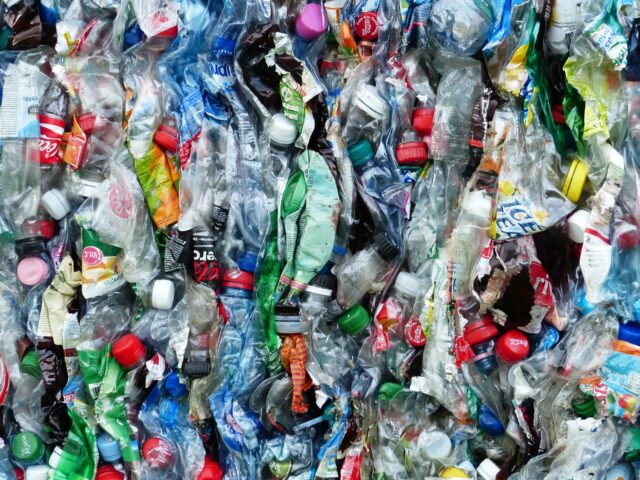
THE Department of Environment and Natural Resources (DENR) said on Thursday that more than 500 companies have registered to comply with Republic Act 11898 or the Extended Producer Responsibility (EPR) Act of 2022, which holds companies responsible for managing the impact of their product packaging over their full life cycle.
“Since we launched the EPR program, more than 500 private companies have registered. We also hope to simplify the entire process. I’m hopeful with the EPR program, having heard the willingness of the private sector to be part of the program,” Environment Undersecretary Carlos Primo C. David said during a Stratbase ADR Institute briefing.
“After we collect all the plastics collected by the producers themselves, what do we do with it? Maybe one alternative, beyond recycling, is waste-to-energy,” he said.
According to Mr. David, among the projects being proposed to the DENR are reclamation, offshore wind power, offshore quarrying, and waste-to-energy projects.
Apart from reclamation, he noted that the rest are new .so there is a need to develop systems for project evaluation and monitoring once they are in operation.
Environment Management Bureau Director Gilbert C. Gonzales noted that the “linear” approach of waste management must shift to a “circular economy” model, which minimizes waste and incentivizes recycling.
Climate Reality Project Philippine Branch Manager Nazrin D. Castro said that shifting to the circular economy model “can help avoid excessive consumption, waste, and use of fossil fuels by using, reusing, repairing, and recycling existing materials and products.”
According to a survey conducted by Pulse Asia, 8 out of 10 Filipinos expressed a preference for products and services produced by firms that they believed to be environmentally responsible.
“Given this message, there is at least one challenge and this is for firms to satisfy this preference by providing products and services within the reach of consumers,” Pulse Asia President Ronald D. Holmes said. — Sheldeen Joy Talavera

GROWTH in the bulk prices of general goods eased in December for a third straight month to 6.7% year on year, tempering the 2022 average to 7.3%, which is still an 11-year high.
According to preliminary data from the Philippine Statistics Authority (PSA), the general wholesale price index (GWPI) in December eased from 7.2% a month earlier. In December 2021, the GWPI rose 4.1%.
December marked the third consecutive month that the GWPI retreated after hitting a peak of 8.2% in September. The December reading was the lowest since the 5.6% posted in February 2022.
The 2022 average was more than double the 3.1% average recorded in 2021, but remained the highest since the 8.7% posted in 2011.
“Prices of items that were affected by global commodity price spikes due to the war in Ukraine — fuel prices, food inputs such as fertilizers, and the like, have softened. And this will eventually be reflected in the spending of Filipinos,” China Banking Corp. Chief Economist Domini S. Velasquez said in an e-mail.
The statistics agency said that slower growth in prices of the heavily weighted food commodity were a drag on the overall GWPI, with a year-on-year growth of 11.7% in December from 12.3% previously.
“(The) prices of food are higher than the previous month (on a month-on-month basis) pointing to ongoing pressure on food items,” Ms. Velasquez said.
Other categories that registered slower price growth month on month were chemicals including animal and vegetable oils and fats (2.2% in December from 2.5% in November), miscellaneous manufactured articles (3.7% from 3.8%), beverages and tobacco (5.2% from 7.9%), and mineral fuels, lubricants and related materials (22.2% from 25.9%).
Meanwhile, growth in bulk prices expanded in manufactured goods classified chiefly by materials (4.3% from 4.2%), and machinery and transport equipment (1.3% from 1.2%). Likewise, price growth in crude materials, inedible except fuels slowed to 17.7% from 18.2% in November.
Ms. Velasquez said that prices of mineral fuels, lubricants, related products, and food stood out most in 2022 as the Ukraine war affected global prices of many commodities.
In 2022, prices of food and mineral fuels, lubricants and related products rose 9.9% (from 2.1% in 2021) and 40.1% (from 17.7%), accordingly.
Russia invaded Ukraine exactly one year ago, applying the brakes on the global economic recovery following the pandemic.
Luzon, the Visayas and Mindanao bulk price growth in December eased to 6.9% (from 7.4%), 5.6% (from 6.5%), and 4.5% (from 4.8%), respectively.
In 2022, wholesale price growth of general goods in Mindanao eased to 4.2% in 2022 from 4.6% previously.
Price growth in Luzon and the Visayas accelerated to 7.7% (from 3.2%) and 5.3% (from 0.4%).
“The overall deceleration in the year-on-year GWPI print is still good news for inflation moving forward. As wholesale prices trend down, we expect this to push back retail prices. This will eventually be reflected in the (consumer price index) and consumer spending,” Ms. Velasquez added.
Headline inflation was 8.7% in January, accelerating from 8.1% in December, driven by the surge in food prices and fuel costs, the PSA reported. — Ana Olivia A. Tirona
