Home Blog Page 5210

Ex-producer Harvey Weinstein sentenced to 16 years on LA rape conviction

STOCK PHOTO | Image by Mihai Surdu from Pixabay

 – Harvey Weinstein, the onetime Hollywood titan who came to epitomize a culture of pervasive sexual misconduct by powerful men that ignited the #MeToo movement, was sentenced on Thursday to 16 years in prison for the 2013 rape of an actress in Los Angeles.

The sentence, to run consecutively to the 23-year prison term that Weinstein, 70, already is serving for a sexual misconduct conviction in New York, made it all the more likely the Oscar-winning exproducer will spend the rest of his life incarcerated.

Mr. Weinstein, seated in a wheelchair in brown jail garb, professed his innocence and implored the judge, “I beg your mercy,” moments before she pronounced his sentence. The two-hour proceeding unfolded in the same Los Angeles courtroom where a jury in December found Mr. Weinstein guilty of rape, forcible oral copulation and sexual penetration by a foreign object.

The charges stemmed from an assault on a former model and actress, identified in court as Jane Doe 1, at a Los Angeles hotel in February 2013.

Addressing the court through tears and a trembling voice near the end of Thursday’s hearing, the woman said she had been a “very happy and confident woman” until Weinstein raped her. Then, “I lost my identity. I thought for sure that no one could love me. I was heartbroken, empty and alone,” she added, choking back sobs.

The 16-year prison term handed down by Superior Court Judge Lisa Lench was more lenient than the maximum 24 years recommended by prosecutors but far more stiff than the sentence sought by Weinstein‘s lawyers.

Defense counsel Mark Werksman asked that Weinstein get no more than three years for each of the three counts on which he was convicted, to be served concurrent to one another, arguing the charges stemmed from “one continuing sexual assault” that occurred in “one frenzied 10- to 15-minute ordeal,” rather than as three separate criminal acts.

It was a rare courtroom admission of guilt by defense lawyers, even as Weinstein himself continued to deny any wrongdoing.

In his statement to the court, Mr. Weinstein insisted he did not know Jane Doe 1 and argued that she had fabricated her account for money.

“This is a made-up story. Jane Doe 1 is an actress. She can turn the tears on,” Mr. Weinstein told the judge. “Please don’t sentence me to life in prison.”

The defense also asked the judge to take into account Mr. Weinstein‘s age and deteriorating health, including coronary artery disease and severe spinal issues.


FALL FROM HOLLYWOOD GRACE

It marked the latest low point in a remarkable fall from grace for the co-founder of Miramax Films, the wildly successful US movie production and distribution house that produced such films as “Shakespeare in Love” and “Pulp Fiction.” Mr. Weinstein won an Oscar in 1999 as producer of “Shakespeare in Love,” that year’s Academy Award winner for best picture.

Mounting sexual misconduct allegations against Weinstein helped fuel the #MeToo movement, which has encouraged women to speak out about sexual harassment and abuse by powerful men in media, politics and other endeavors. The movement, which went viral on social media in 2017, seeks to break a culture of silence that has long allowed such conduct to go unchallenged.

Weinstein has said all of his sexual encounters were consensual.

Dave Ring, an attorney for Jane Doe 1, said Thursday’s sentencing provided his client “with closure and relief, knowing Weinstein will spend the rest of his life in prison where he belongs.”

The Los Angeles jury acquitted Mr. Weinstein of charges relating to a second alleged victim and failed to reach a unanimous verdict on charges arising from two other accusers.

One of them, documentary filmmaker Jennifer Siebel Newsom, now the wife of California Governor Gavin Newsom, had disclosed she was the alleged rape victim referred to in court records as Jane Doe 4.

Ms. Lench declared a mistrial on the deadlocked charges, and the Los Angeles County District Attorney’s Office has yet to decide whether to seek to retry Weinstein on those counts.

Defense attorneys argued that the women willingly had sex with Weinstein because they believed he would advance their careers, part of what they said was a widespread “casting couch” culture in the film industry. In two of the cases, they said the alleged sexual contact was fabricated.

Before pronouncing sentence, the judge denied a defense motion to throw out Mr. Weinstein‘s conviction and grant him a new trial.

Mr. Weinstein was found guilty of sexual misconduct in New York in February 2020, and is appealing the New York conviction and prison sentence. He was extradited from New York to California in July 2021 to face trial in Los Angeles. – Reuters

In Bangladesh, new school textbook features transgender people

STOCK PHOTO | Image by Pexels from Pixabay

 – Wearing bright saris and heavy make-up, many of Bangladesh’s transgenders, or hijras, spend their days begging from people stuck in traffic and shopkeepers who give them small change in exchange for lucky blessings.

The government recognized hijras as a third gender in 2013, but they remain marginalized in a country where sexual activity between people of the same sex is illegal. Many hijras live in abject poverty and have no opportunity for a proper education, much less a job. Many are forced to beg or engage in sex work to survive.

But on January 1, new textbooks were rolled out for millions of schoolchildren between the age of 11 and 13 featuring a segment on transgenders.

The textbook contains images of transgenders in respectable jobs, including a beautician, a development worker and an elected mayor, and the fictional story of a child who transitions, takes a female name and goes to live with a transgender community.

The creators of the book hope it will help nurture acceptance.

“We have piloted it in very small areas, and we got a very positive result, response from our students, because it was a completely unknown matter to them. It is new knowledge for them and they accepted it very well,” said Muhammad Moshiuzzaman, a member of the National Curriculum and Textbook Board.

“I think they are human beings just like us. We came to know about them by learning from the book, we think we should help them with their progress,” said Fatiah Alam, 12, a student at Gomail High school on the outskirts of the capital Dhaka, one of the schools that uses the new textbook.

Officials estimate there are about 10,000 hijras in Bangladesh but rights groups say the figure could be as high as 1.5 million in the country of 170 million people.

The textbook has not been welcomed by everyone. A large crowd of conservative Muslims angered by the inclusion of hijras recently held a protest at Dhaka’s main mosque calling for the textbook to be recalled.

Nevertheless, the transgender community and their supporters are hopeful that the textbooks will spread awareness and in turn help improve their status in society.

“If our story catches people’s attention and they keep our suffering in mind, that will be good for us. Those who learn more about us will hopefully understand and then work towards our development in the future,” transgender community leader Jonak told Reuters at her office in Dhaka. – Reuters

War in Ukraine drags into second year, Russia isolated in UN vote

Army soldier figurines are displayed in front of the Ukrainian and Russian flag colors background in this illustration taken, Feb. 13, 2022. — REUTERS/DADO RUVIC/ILLUSTRATION

 – The war in Ukraine entered its second year on Friday with no end in sight and Russia isolated at the United Nations in a vote demanding its forces withdraw, while G7 leaders are set to coordinate on more help for Ukraine.

As fighting raged on in Ukraine‘s east and south, its allies around the world showed their support on the first anniversary of Russia’s invasion.

Paris lit up the Eiffel Tower in the Ukrainian flag colors of blue and yellow and people draped in Ukrainian flags gathered at a vigil in London. In Brussels, European Union buildings were similarly lit up in the colors.

The UN General Assembly overwhelmingly adopted a resolution on Thursday marking the war’s anniversary and demanding Russia pull out and stop fighting.

There were 141 votes in favor and 32 abstentions. Six countries joined Russia to vote no – Belarus, North Korea, Eritrea, Mali, Nicaragua and Syria.

Russia’s ally China abstained on the U.N. vote.

Russia’s Deputy UN Ambassador Dmitry Polyanskiy dismissed the action at the United Nations as “useless”.

Ukrainian President Volodymyr Zelenskiy hailed the vote.

“This resolution is a powerful signal of unflagging global support for Ukraine,” he said in a post on Twitter.

On the battlefield, the Ukraine military reported increased Russian activity in the east and south as the anniversary approached, with at least 25 towns and villages in three northern regions along the Russian border under fire.

Reuters was not able to verify battlefield reports.

Russian President Vladimir Putin had ordered a full-scale invasion of Ukraine on Feb. 24 last year to seize Kyiv and topple the pro-European government, but those hopes were dashed by a fierce defense and military blunders that embarrassed Moscow.

Ukraine had success with counter-offensives in late 2022 to grab back much of the territory it had lost. Russia now controls around a fifth of Ukraine.


TRENCH WARFARE

The war, which Russia calls a “special military operation” to protect its sovereignty, has settled into attritional trench warfare, with rising losses on both sides, particularly this year in fighting in and around the eastern town of Bakhmut.

Some US and Western officials estimate Russia’s casualties at nearly 200,000 dead and wounded, while in November the top US general said more than 100,000 troops on each side had been killed or wounded.

It is impossible to independently verify casualties in what has become the worst conflict in Europe since World War Two.

Millions of Ukrainians have fled their country and tens of thousands of civilians have been killed.

The village of Bucha in the north near Kyiv, where mass graves were discovered, and the bombed out southern city of Mariupol became symbols of what Ukraine and its allies described as Russian brutality.

Ukraine and the West have accused Russia of war crimes, but it denies targeting civilians.

Far from the military campaigns, the war has damaged the world economy and a Cold War chill has set into international relations, with Putin raising the specter of nuclear weapons and signaling a desire to double down on a conflict that prompted tough Western sanctions.

With Mr. Zelenskiy insisting on his country’s sovereignty and Moscow’s withdrawal, the prospects of peace appear bleak.

“We don’t know when the war will end. But what we do know is that when the war ends, we need to ensure that history doesn’t repeat itself,” NATO Secretary-General Jens Stoltenberg told Reuters on Thursday.

“We need to ensure that we break the cycle of Russian aggression. We need to prevent Russia from chipping away at European security,” he said.


SUPPORT FOR UKRAINE

US President Joe Biden will meet virtually on Friday with G7 leaders and Mr. Zelenskiy to mark the anniversary and announce new sanctions against those aiding Russia’s war effort, the White House said.

White House National Security Adviser Jake Sullivan said the United States would provide an additional $2 billion in security assistance.

The United States has said China is considering providing weapons to Russia, which could intensify the conflict into a confrontation between Russia and China on one side and Ukraine and the US-led NATO on the other.

Beijing’s top diplomat visited Moscow this week and pledged a deeper relationship between the countries and Putin on Thursday hailed “new frontiers” in ties and signaled China’s leader Xi Jinping would visit.

Mr. Xi is expected to deliver a “peace speech” on Friday, though some analysts have cast doubt on whether China’s efforts to act as peacemaker will go beyond rhetoric.

The Chinese foreign ministry said in a position paper on Friday that dialogue and negotiation were the only viable ways to resolve the conflict.

“Conflict and war benefit no one. All parties must stay rational and exercise restraint, avoid fanning the flames and aggravating tensions, and prevent the crisis from deteriorating further or even spiraling out of control,” the ministry said.

Reflecting the Kremlin’s increasingly hawkish tone, Russian Defense Minister Sergei Shoigu on Thursday cast the war as an existential fight against a hostile West.

Ukraine and its allies say the invasion is an unjustified land grab aimed at subjugating a sovereign state.

Further ratcheting up tension, Mr. Putin announced plans on Thursday to deploy new Sarmat multi-warhead intercontinental ballistic missiles this year. This week, he suspended Russia’s participation with the United States in the New START, or Strategic Arms Reduction Treaty, on nuclear arms control.

Russia’s military focus is on seizing the eastern Ukrainian regions of Donetsk and Luhansk, which together form the industrial area known as the Donbas near the Russian border.

Close to a Ukrainian tank park near Bakhmut, which has become Russia’s main target, constant explosions could be heard on Thursday.

“If we give up Bakhmut, everything else will get even more complicated. We can’t give it up, under any circumstance. We will hold through,” Junior Sergeant Oleh Slavin, a tank operator, told Reuters. – Reuters

White supremacists behind over 80% of extremism-related US murders in 2022

STOCK PHOTO | Image by Rudy and Peter Skitterians from Pixabay

 – Mass shootings in the United States accounted for most extremism-related fatalities last year in the country with over 80% of those murders committed by white supremacists, data released by the Anti-Defamation League (ADL) showed on Thursday.

The advocacy group labeled 25 murders in 2022 as “extremist-related,” with 18 of those “committed in whole or part for ideological motives.”

Two mass shootings – one in May in Buffalo, New York, wherein an avowed white supremacist fatally shot 10 Black people, and another in November in Colorado Springs wherein five people were killed in an LGBTQ nightclub – accounted for most of the extremist-related murders of 2022, the ADL report showed.

White supremacists commit the highest number of domestic extremist-related murders in most years, but in 2022 the percentage was unusually high: 21 of the 25 murders were linked to white supremacists, according to the ADL report.

“All the extremist-related murders in 2022 were committed by right-wing extremists of various kinds,” the ADL report said.

ADL’s Center on Extremism reported an overall decrease from 2021 when 33 extremist-related killings were documented. ADL had documented 22 extremist-related killings in 2020.

Human rights groups have raised concerns over white supremacy in the United States in recent years.

President Joe Biden has labeled white supremacy as poison and called on Americans to reject it. In December, he established an inter-agency group to coordinate efforts to counter antisemitism, Islamophobia and related forms of bias and discrimination.

The issue of white supremacy came back into headlines late last year when former President Donald Trump hosted white supremacist Nick Fuentes at his private club in Florida. Trump said the encounter with Fuentes happened inadvertently while he was having dinner with Ye, the musician formerly known as Kanye West. – Reuters

Canadian privacy regulators launch joint investigation into TikTok

SOLEN FEYISSA-UNSPLASH

 – Canada is launching a joint federal and provincial investigation into short-video app TikTok over concerns about the Chinese-owned platform’s collection, use and disclosure of personal information, the Privacy Commissioner of Canada said on Thursday.

The federal privacy regulator, as well as provincial counterparts in Quebec, British Columbia and Alberta, will examine whether TikTok‘s practices are in compliance with Canadian privacy laws, the commissioner’s office said in a statement.

They will focus on examining “whether valid and meaningful consent is being obtained for the collection, use and disclosure of personal information,” according to the statement.

A spokesperson for TikTok said the privacy and safety of users “is always a top priority” and the probe was an opportunity to “set the record straight” on how the company protects the privacy of Canadians.

Canada joins governments and regulators from around the world that have been scrutinizing TikTok because of concerns China could use the app to harvest users’ data or advance its interests. TikTok is owned by Chinese company ByteDance Ltd.

The European Union’s two biggest policy-making institutions have banned TikTok from staff phones, while the US Senate in December passed a bill to bar federal employees from using the app on government-owned devices.

The investigation also adds another potential thorn in Sino-Canadian relations which have been tense for various reasons, including recent accusations by Ottawa that China has tried to influence its elections and that it has been running air and maritime surveillance activities.

Beijing denies those allegations and has urged Ottawa to stop unwarranted speculation and smearing. – Reuters

China’s BYD in talks with Philippines for EV plant

Original image from https://www.byd.com.ph/

The Philippines, Vietnam and Indonesia are competing to host an electric-vehicle assembly plant for BYD Co., the world’s second-largest maker of EVs, according to a top Philippine trade and investment official.The Chinese auto giant is in an “advanced stage of discussions” with the Philippines, the Southeast Asian nation’s Trade Undersecretary Ceferino Rodolfo said in an interview on Wednesday. BYD representatives scoured the Philippines for possible factory sites during a visit late last year and the company may decide on the site during the second quarter, said Rodolfo, who also heads the Board of Investments.BYD, which is already set to build its first EV production facility in Southeast Asia in Thailand, is still exploring whether the new factory will be a full-blown assembly plant or a final-assembly facility with car parts shipped in from overseas, said Lanie Dormiendo, director for the Philippines’ International Investments Promotion Service.A spokesperson for Shenzhen-based BYD said the company doesn’t have “any relevant information to disclose.”Talks between BYD and Indonesia over a potential investment in an EV factory in the country are ongoing, according to a person familiar with the matter who asked not to be named as the discussions are private. The Indonesian government is offering a slew of tax holidays, incentives and access to battery raw materials to convince the carmaker to set up there rather than expanding in a neighboring country like Thailand, the person said.BYD didn’t immediately respond to a request for comment on Indonesia.Southeast Asian nations are racing to attract investments in EVs as global carmakers pivot away from the combustion engine, a transition that China has been dominating. Great Wall Motor Co. has already set up a production line in Thailand, while nickel-rich Indonesia has drawn interest from both BYD and rival Tesla Inc.With an economy that expanded the most in nearly half a century last year, the Philippines is courting top-tier producers of EVs and batteries like BYD with tax breaks and other incentives under a law passed last year as rising oil prices help accelerate the global shift away from gas-fueled cars.Indonesia and the Philippines, which together account for almost half the world’s nickel reserves, are a good fit for electric-car and makers of batteries where the metal is a key component. Rodolfo said BYD, which uses lithium iron phosphate in its EV batteries, is considering the Philippines for its growth potential.“We’re not a low-cost destination, but we are a destination for companies who are looking for solutions for their Net Zero carbon commitments,” he said.The Philippines has previously lost out on investment opportunities to its neighbors given its power rates are among the costliest in the region. But it is positioning as a hub for sustainable manufacturing facilities, Rodolfo said. The country aims to increase the share of renewable energy to half of its electricity mix from around 30% currently by 2040.Chinese battery making giant Contemporary Amperex Technology Co. Ltd., or CATL, is also in talks with Philippine government officials to invest in a plant to process nickel for electric car batteries, along with its subsidiary Brunp, said Rodolfo, 52, who’s been with the government’s trade and investment agencies for a decade.CATL did not immediately respond to a request for comment.Rodolfo was part of President Ferdinand Marcos Jr.’s entourage in the US and China, two of nine nations the Philippine leader has visited since he assumed office nearly eight months ago. Those trips generated about $63 billion in investment commitments, according to his office. – Bloomberg

JPMorgan should reveal more about CEO Dimon’s role in Epstein accounts -US Virgin Islands

REUTERS

 – JPMorgan Chase & Co. should disclose more about Chief Executive Jamie Dimon’s role in business decisions related to Jeffrey Epstein, the US Virgin Islands said in its lawsuit accusing the bank of aiding in the financier’s sex trafficking.

In a Thursday filing in Manhattan federal court, the US Virgin Islands said JPMorgan‘s wrongful conduct continued at least until August 2019, when Mr. Epstein killed himself.

But it said JPMorgan has agreed to provide relevant documents for Mr. Dimon only through 2014, and should provide documents for the next five years.

The US Virgin Islands called Mr. Dimon “a likely source of relevant and unique information” about decisions to retain Mr. Epstein as a client, and discussions on Mr. Epstein‘s referrals of prominent and wealthy potential clients.

According to the filing, the business referral relationship continued after Mr. Epstein stopped being a client.

JPMorgan is seeking the lawsuit’s dismissal. It did not immediately respond to requests for comment after business hours on the latest filing. Mr. Dimon has not been accused of wrongdoing.

The US Virgin Islands is suing JPMorgan for unspecified damages, saying the bank should have known about its “high-risk” former client’s misconduct on a private island he owned there.

It has also criticized former JPMorgan private banking chief Jes Staley for staying on good terms with Epstein and exchanging emails that discussed young women and contained sexual content.

Mr. Epstein was a JPMorgan client from 2000 to 2013, maintaining his relationship even after pleading guilty in 2008 to a Florida state prostitution charge.

He died in August 2019 at age 66 in a Manhattan jail cell while awaiting trial on sex trafficking charges.

A separate complaint filed last month by Mr. Epstein victims against JPMorgan, which the bank also wants dismissed, said Mr. Dimon and other executives decided to “monitor the public news” about Mr. Epstein‘s misconduct, yet did not sever ties with Mr. Epstein.

Mr. Dimon and Mr. Staley, who later served as Barclays Plc’s chief executive, are not defendants in either lawsuit.

Mr. Staley has acknowledged having a friendship with Mr. Epstein but denied knowing about his alleged crimes.

The case is Government of the US Virgin Islands v JPMorgan Chase Bank NA, US District Court, Southern District of New York, No. 22-10904. – Reuters

Biden nominates former Mastercard CEO Ajay Banga to head World Bank

REUTERS

 – US President Joe Biden nominated former Mastercard Inc. CEO Ajay Banga to lead the World Bank, betting the India-born executive’s ties to the private sector and emerging markets will jump-start the 77-year-old institution’s overhaul to better address climate change.

Mr. Biden‘s nomination on Thursday of Banga, 63, now a US citizen, all but assures he will assume a job that oversees billions of dollars of funding, as it races to help developing countries address climate change.

The World Bank (WB) on Wednesday said it expects to select a new president by early May to replace David Malpass, who announced his resignation last week after months of controversy sparked by his initial refusal to say if he accepted the scientific consensus on climate change, and pressure by Treasury Secretary Janet Yellen for him to adopt “bolder” reforms.

“I think the speed of the nomination, less than 48 hours after the WB board launched the process, reflects a desire to discourage any challengers and wrap it up quickly,” said Scott Morris, a senior fellow at the Center for Global Development and a former US Treasury official.

Mr. Biden noted Mr. Banga‘s decades of experience building global companies and public-private partnerships to fund responses to climate change and migration and said he had a proven track record working with global leaders.

Ajay is uniquely equipped to lead the World Bank at this critical moment in history,” Mr. Biden said in a statement, hailing the business executive’s Indian roots and knowledge of the challenges facing developing countries and ability to mobilize private capital to tackle big problems.

Mr. Banga‘s work in India and other emerging markets, his “obsession” with expanding financial inclusion, and his deep knowledge of new technologies could help bridge the divide between rich countries and emerging markets, said Luis Alberto Moreno, who worked closely with Banga while serving as president of the Inter-American Development Bank.

“He can really be a force for change,” Mr. Moreno said, noting that Mr. Banga enjoyed the trust of financial markets.

India was expected to support Mr. Banga‘s candidacy, according to Krishnamurthy Subramanian, the former top economic adviser to the Indian government who now serves as India’s executive director at the International Monetary Fund. “It’s an elegant solution.”


DIVERSITY

The bank has historically been headed by someone from the United States, its largest shareholder, while a European heads the International Monetary Fund (IMF), but developing countries and emerging markets have pushed to widen those choices.

Mr. Banga‘s nomination is the first to be made public, but the bank will accept nominations from other member countries through March 29. Germany, another major shareholder, this week said the job should go to a woman since the bank has never been headed by a woman.

A senior US administration official said they did not know if other countries would nominate candidates for the post.

Asked about Washington’s decision not to nominate a woman, the official said Mr. Banga had “a personal conviction and excellent track record promoting diversity, equity and inclusion in the work that he does” and would bring that view to the bank.

But Jeff Hauser, who heads the progressive Revolving Door Project, demanded Biden retract the nomination of a top official from a “rapacious international private equity firm” who had previously worked only in private sector firms.

“Neither private equity, nor MasterCard, nor Citigroup, nor PepsiCo, nor Nestlé, nor Dow promote shared prosperity. They all do vastly more to exacerbate inequality than to fight it,” he said in a statement.

Oxfam International said the next bank president should be chosen through a transparent global process. “The World Bank is not a US bank, a commercial bank, or a private equity firm. For a job of this stature, we need more than a tap on the shoulder from President Biden.”

Mr. Banga is vice chair of General Atlantic, a US private equity firm that administration officials said has invested over $800 million in EV charging solutions, solar power and sustainable farming.

He retired in December 2021 after 12 years at the helm of Mastercard, where administration officials noted that he helped 500 million unbanked people join the digital economy, averted layoffs of the bank‘s 19,000 employees during the COVID-19 pandemic, and led work on climate, gender and sustainable agriculture.

Vice President Kamala Harris said Banga brought “great insight, energy and persistence” to his role as co-chair of the Partnership for Central America, which has mobilized $4.2 billion in public, private and nonprofit funds to advance economic opportunity in northern Central America. – Reuters

Converge supports ASEAN ICT chiefs’ push for digital inclusion, transformation

Lauds DICT for successful hosting of milestone event

Leading fiber broadband provider Converge ICT Solutions, Inc. (PSE: CNVRG) supports the push of ICT ministers in the ASEAN region for continued digital transformation in Southeast Asia, especially amid ongoing recovery from the COVID-19 pandemic.

This developed as Converge took part in the activities supporting the Philippine-led ASEAN Digital Ministers’ Meeting held in Boracay from Feb. 9-10, 2023.

“As a player ourselves in the digital economy, we are proud of the Philippines’ Department of Information and Communications Technology (DICT) for spearheading the talks as the region makes progress on the ASEAN Digital Masterplan. As a private sector player, we vow cooperation in the ASEAN bloc’s aim for digital transformation particularly in the context of the region’s recovery framework from the COVID-19 pandemic,” said Converge CEO and Co-Founder Dennis Anthony Uy.

During the Digital Ministers’ Meeting, member states were urged to continue implementation of recommended actions in the ASEAN Digital Masterplan 2025, to realize the vision of ASEAN to become “a leading digital community and economic bloc, powered by secure and transformative digital services, technologies and ecosystem.”

Moreover, ASEAN ICT ministers pushed to further intensify cooperation among member states to accelerate the region’s digital transformation efforts to support the ASEAN Comprehensive Recovery Framework, also known as the bloc’s consolidated exit strategy from the COVID-19 crisis.

At the end of the two-day forum, the Ministers released the Boracay Declaration, summing up the agreements arrived at following their closed-door discussions.

Converge supported the milestone event by providing a high bandwidth or 1 Gigabit per second (Gbps) pure fiber connectivity to the meeting venue in Shangri-La Boracay, ensuring smooth communications among all delegates, senior officials, management, and the organizers. Converge also participated in the trade fair and sponsored the gala night which was attended by ICT leaders from the region and the country.
“We congratulate the DICT for spearheading the successful ADGMin in Boracay. As a member country, the Philippines is given the opportunity to host this important event once every decade. We commend the DICT for ensuring a safe, pleasant, and smooth experience for all the delegates,” said Jesus C. Romero, Converge Chief Operations Officer, who represented the company during the event.

“We are also very proud to be a connectivity partner for the DICT as we know that strong and reliable connectivity is a critical component in the success of such events. Not only are we able to highlight the beauty of the country through destinations such as Boracay. But we can also showcase the world-class digital infrastructure available in these locations,” added Mr. Romero.

The ADGMin brought together heads of delegation of the 10 Southeast Asian members — Brunei, Cambodia, Indonesia, Laos, Malaysia, Myanmar, the Philippines, Singapore, Thailand, and Vietnam — and its dialogue partners China, Japan, Republic of Korea, India, the United States of America, the European Union, and the International Telecommunications Union.

With the theme, “Synergy Towards a Sustainable Digital Future,” the gathering gave the avenue for ASEAN countries to forge stronger partnerships in addressing key challenges, both present and future in their respective countries, the region, and the world.

Providing connectivity to the ADGMin also signals the availability of Converge to customers in Boracay.

“We are thrilled to be here in Boracay, one of the most amazing places in the world. Our Go Deep and Go National strategy are bearing fruit as Converge has now arrived in what is dubbed as one of the best beaches in the world. Now Boracay can also move forward to having a world-class digital infrastructure powered by the Converge end-to-end fiber network. We look forward to delivering great things for big and small businesses, government and the residents of the island,” said Mr. Romero.

Visit convergeict.com/business for more details.


Spotlight is BusinessWorld’s sponsored section that allows advertisers to amplify their brand and connect with BusinessWorld’s audience by enabling them to publish their stories directly on the BusinessWorld Web site. For more information, send an email to online@bworldonline.com.

Join us on Viber at https://bit.ly/3hv6bLA to get more updates and subscribe to BusinessWorld’s titles and get exclusive content through www.bworld-x.com.

Championing a new age of sustainable, inclusive Philippine business

By Bjorn Biel M. Beltran, Special Features and Content Assistant Editor

Many organizations around the world, including the United Nations and the World Economic Forum, urge countries and governments to never forget the lessons imparted by the coronavirus pandemic.

In the span of two years, the world was upended and it was only through the advancement of technology and the collaboration of the international community that stopped the virus from causing more damage than it already had.

Moving forward, calls to “Build Back Better” urged governments, legislators, policy makers, industry leaders, and the public to consider sustainability as a necessity in ensuring the recovery from the COVID-19 crisis to be durable and resilient.

“Unchecked, global environmental emergencies such as climate change and biodiversity loss could cause social and economic damages far larger than those caused by COVID-19. To avoid this, economic recovery packages should be designed to ‘build back better’,” the Organisation for Economic Co-operation and Development wrote in a report.

Corporations and major businesses, then, have a responsibility to do their part to steer the future in a direction that is inclusive, sustainable, and advantageous for everyone. Good governance is now essential.

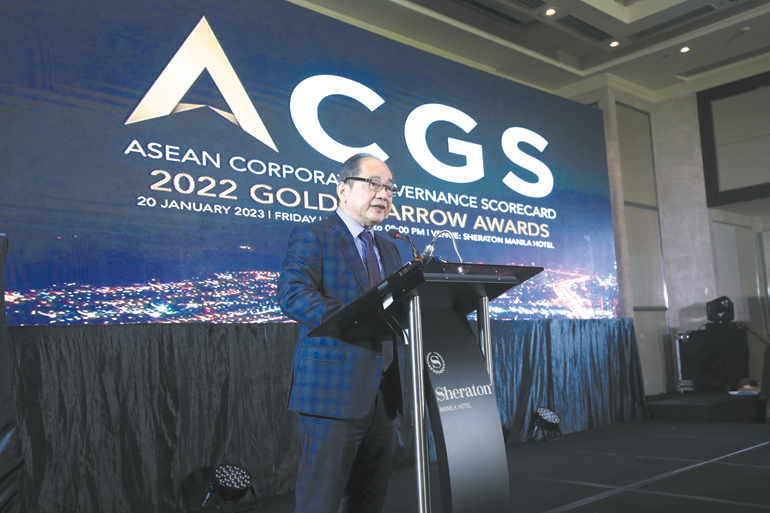
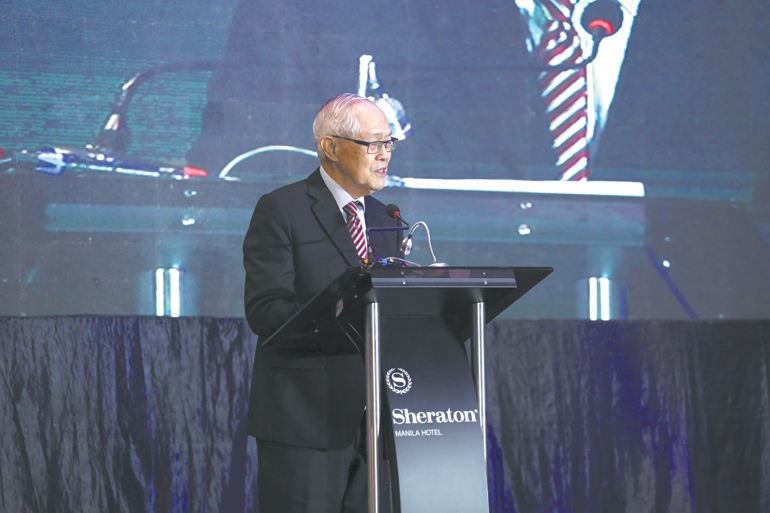
This is the main driver behind the growing relevance of environmental, sustainability, and governance (ESG) standards, and why the Institute of Corporate Directors (ICD) hold its annual ASEAN Corporate Governance Scorecard (ACGS) Golden Arrow Awards.

The recently concluded awards program honors the best publicly traded firms in the Philippines in terms of corporate governance according to the ACGS, serving as models of the pinnacle of what a company should be in the post-pandemic world.

The ACGS evaluates how well businesses facilitate shareholders’ rights and equitable treatment, relate to their various stakeholders, ensure transparency and accountability through prompt disclosure of material information, and assess how effectively the board sets the company’s strategic direction, oversees management, and upholds the board’s accountability to the business and its shareholders.

The 184 questions on the scorecard are based on information that is readily accessible on the websites of the companies. It aspires to improve corporate governance norms and procedures throughout the nation and attract investors to well-governed publicly traded Philippine enterprises.

Companies that received at least 80 points in the ACGS Assessment are given the Golden Arrow. At this point, the business has demonstrated visible compliance with both the ACGS’s international best practices and the Philippine Code of Corporate Governance. There will be five performance levels in corporate governance awarded.

Winners

The businesses that received Golden Arrows this year are as follows:

China Banking Corp. (China Bank) President William C. Whan (center) receives the five-arrow recognition for China Bank from (L-R) SEC Chairman Emilio B. Aquino, ICD Vice-Chair & President Ma. Aurora D. Geotina-Garcia, PSE President and CEO Ramon S. Monzon, and ICD Chairman Atty. Cesar L. Villanueva.

Three businesses reached a score range of 120 to 130 points, and thus won the top five-arrow recognition. Ayala Land, Inc., China Banking Corp., and Globe Telecom, Inc. were recognized by the ICD as the cream of the crop in terms of how they implement ESG standards into their operations.

Following them in the 110 to 119 score range with the four-arrow recognition are Aboitiz Power Corp.; Ayala Corp.; Bank of the Philippine Islands; BDO Unibank, Inc.; Belle Corp.; First Gen Corp.; Manila Water Co., Inc.; Philippine National Bank; Rizal Commercial Banking Corp.; SM Investments Corp.; SM Prime Holdings, Inc.; and The Philippine Stock Exchange, Inc.

In the 100 to 109 score range with the three-arrow recognition are 2GO Group, Inc.; Aboitiz Equity Ventures, Inc.; AC Energy Corp.; APC Group, Inc.; AyalaLand Logistics Holdings Corp.; Cebu Holdings, Inc.; First Philippine Holdings Corp.; GT Capital Holdings, Inc.; Integrated Micro-Electronics, Inc.; LT Group, Inc.; Manila Electric Co. (Meralco); Metro Pacific Investments Corp.; Metropolitan Bank & Trust Company; Philex Mining Corp.; PLDT, Inc.; San Miguel Food and Beverage, Inc.; Security Bank Corp.; and Semirara Mining and Power Corp.

With the two-arrow recognition at 90 to 99 points are AREIT, Inc.; Cebu Air, Inc.; DMCI Holdings, Inc.; Eagle Cement Corp.; Far Eastern University, Inc.; Megawide Construction Corp.; Nickel Asia Corp.; Petron Corp.; Philippine Seven Corp.; Phinma Corp.; Premium Leisure Corp.; PXP Energy Corp.; Roxas Holdings, Inc.; Union Bank of the Philippines; Universal Robina Corp.; and Wilcon Depot, Inc.

Finally, winning a golden arrow recognition at 80 to 89 points are A Brown Company, Inc.; ABS-CBN Corp.; AllHome Corp.; Alliance Select Foods International, Inc.; Asia United Bank Corp.; Atlas Consolidated Mining and Development Corp.; Axelum Resources Corp.; Benguet Corp.; Cemex Holdings Philippines, Inc.; Century Pacific Food, Inc.; Concepcion Industrial Corp.; Converge Information and Communications Technology Solutions, Inc.; Cosco Capital, Inc.; Crown Asia Chemicals Corp.; and D&L Industries, Inc.

Also on this list are Discovery World Corp.; Euro-Med Laboratories Phil., Inc.; Filinvest Development Corp.; Filinvest Land, Inc.; House of Investments, Inc.; International Container Terminal Services, Inc.; Jollibee Foods Corp.; Lopez Holdings Corp.; Manila Bulletin Publishing Corp.; Megaworld Corp.; MerryMart Consumer Corp.; Philippine Bank of Communications; Philippine Business Bank; RFM Corp.; Robinsons Land Corp.; Robinsons Retail Holdings, Inc.; SBS Philippines Corp.; STI Education Systems Holdings, Inc.; Vista Land & Lifescapes, Inc.; Vivant Corp.; and Xurpas, Inc.

The ACGS is an initiative of the ASEAN Capital Markets Forum (ACMF) that started in collaboration with the Asian Development Bank in 2011. It is aimed at raising the corporate governance standards and practices among ASEAN publicly listed companies (PLCs), making well-governed ASEAN PLCs attractive to investors and promoting ASEAN as an investment asset class.

The Scorecard was benchmarked against international best practices that encourage PLCs to go beyond national legislative requirements.

ESG as a key to long-term prosperity

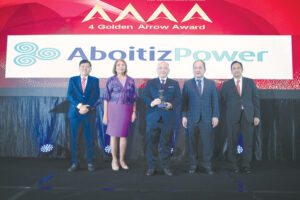
AboitizPower Vice-President for Reputation Management Suiee Suarez (center) receives the 4-arrow recognition for AboitizPower from (L-R) SEC Chairman Emilio B. Aquino, ICD Vice-Chair & President Ma. Aurora D. Geotina-Garcia, PSE President and CEO Ramon S. Monzon, and ICD Chairman Atty. Cesar L. Villanueva.

AboitizPower, one of the companies awarded four golden arrows, told BusinessWorld in an e-mail how they implement ESG standards into their long-term growth strategy.

“AboitizPower firmly believes that effective corporate governance is key to ensuring an organization’s long-term growth and sustainability,” Mickey Colayco, SVP Chief Legal and Compliance Officer at Aboitiz Equity Ventures, Inc., said.

“In the company, as it is with the entire Aboitiz Group, a robust corporate governance framework ensures that its purpose and strategies are well articulated, properly managed and implemented, in alignment with the overall strategic goals of the Aboitiz Group.”

In its mission of becoming the country’s “first Techglomerate,” AboitizPower reaffirmed its commitment of “Transforming Energy for a Better World” via decarbonization, digitalization and innovation, and growth beyond the core.

One of the biggest endeavors of the company towards this goal is its 10-year growth strategy of expanding its renewable energy capacities to 4,600 megawatts, or 50% of its generation portfolio, by 2030.

“Recently, the Group embarked on what we call the Great Transformation, an attempt to course correct at the level of the individual team member and at the organizational Aboitiz Group level,” Mr. Colayco said.

“Through these efforts, and in its aspiration to be truly sustainable, AboitizPower will become not just a profitable organization, but one that drives positive economic, social and environmental impact over the long term.”

Good governance recognition, a win for AboitizPower efforts in transforming energy for a better world

THE GOLDEN ARROWS. Aboitiz Group receives three plaques of recognition from the ACGS Golden Arrow Awards. Photo shows VP for Corporate Affairs Suiee Suarez (L) who received the 4-arrow plaque of recognition for AboitizPower. With him are Atty. Sammy Santos and Atty. Mailene de la Torre of Aboitiz Equity Ventures, who accepted the 3-arrow plaque of recognition for Aboitiz Equity Ventures, Inc.; and James Ileto, who took the 3-arrow plaque of recognition for Union Bank of the Philippines.

Aboitiz Power Corp.’s Environmental, Social, and Governance (ESG) strategies and efforts hit the mark in the ASEAN Corporate Governance Scorecard (ACGS) Golden Arrow Award, owing to its time-tested values and refreshed purpose of transforming energy for a better world.

In its 2021 ACGS assessment, the 4-arrow recognition AboitizPower received reflected the importance it placed on sustainably managing the organization, attaining the targets it has set for itself, and realizing its strategic growth ambitions. Moreover, it showed their willingness to go beyond national legislative requirements in corporate governance. Beyond complying with the Philippine Code of Corporate Governance, publicly-listed companies are also benchmarked against international best practices.

“I am incredibly proud of our team for this success. This recognition affirms our dedication to upholding the highest corporate governance and ethical standards. It inspires us to continue pushing the boundaries of excellence in all we do,” said AboitizPower President and Chief Executive Officer Emmanuel “Manny” Rubio.

“We will strive for the highest standards of excellence in every aspect of our business as we seek to deliver long-term value to our stakeholders.”

Overall, AboitizPower improved its total score to 111.33 in 2021 from 93.31 the previous year, as it saw marked improvements in metrics that measured the rights of shareholders, the role of stakeholders, disclosure and transparency, and responsibilities of the Board. Year on year, it also maintained its perfect score for the equitable treatment of shareholders.

AboitizPower attributes these developments to its doubling down on its vision of building a sustainable enterprise that generates long-term equitable value for people, planet, and prosperity. It views corporate governance as a two-way street; being an important aspect of how it is sustainably managed and how it manages to build and maintain a relationship of trust with external stakeholders.

The company believes that business growth balanced with a strong social component and healthy environmental practices are key elements to building a sustainable business for its team members, shareholders, and communities now and for generations to come.

While ESG has always been a part of its planning and operations, AboitizPower has become more vocal and active in its advocacies, especially amidst a Great Transformation along with the rest of the Aboitiz Group. As a transformed organization, AboitizPower will focus on decarbonization, digitalization and innovation, and growth beyond the core. To this end, the people of AboitizPower continue to live out the organization’s core values of Integrity, Teamwork, Innovation, Responsibility, and Service Excellence, and are flourishing alongside the accomplishment of the organization’s goals.

In recent years, AboitizPower has improved the volume of public disclosures on its website. This is evidenced by the publishing not just of its standard financial performance, but also of its non-financial performance indicators like its social and environmental impacts.

The AboitizPower Board of Directors has also been more earnest in overseeing and shaping the implementation of the company’s ESG strategies, including the strengthening of its anti-bribery and corruption guidelines, and promotion of sustainable business practices within the company and across its whole value chain.

At the same time, AboitizPower pursues its 10- year growth strategy where it will expand its renewable energy portfolio, called Cleanergy, to 4,600 megawatts (MW) or 50% of its total generating capacity by 2030. AboitizPower will help advance business and communities through the supply of reliable and responsibly-sourced energy from run-of-river, large hydro, solar, geothermal, and wind sources.

AboitizPower’s Great Transformation journey serves to strengthen its role in fueling the country’s economic growth and empowering communities while managing climate-related risks. As it harnesses opportunities brought forth by new technologies and innovations, AboitizPower will continue to elevate the value and scalability of its ESG framework for a better and brighter Philippines.


Spotlight is BusinessWorld’s sponsored section that allows advertisers to amplify their brand and connect with BusinessWorld’s audience by enabling them to publish their stories directly on the BusinessWorld Web site. For more information, send an email to online@bworldonline.com.

Join us on Viber at https://bit.ly/3hv6bLA to get more updates and subscribe to BusinessWorld’s titles and get exclusive content through www.bworld-x.com.

Customs service through the years

BW FILE PHOTO

Trade is widely seen at the center of economic development. But, on the other hand, when the trade is illicit or goods are smuggled, economic growth could be held back. Hence, it is crucial to make trade facilitation efficient and bolstering border security — a duty handed over to the Bureau of Customs (BoC).

The BoC has been taking on the supervision of import and export cargoes; the prevention and suppression of smuggling; and ensuring lawful collection of revenues. This February, the agency remembers how it has transformed since it was first established as the Philippine Customs Service 121 years ago.

Yet, even as the agency was instituted only in 1902, the history of customs service and trade in the Philippines dates many centuries back, even before the coming of the West to the country. The Philippines has already been trading with its neighbor countries, with the people adopting the barter system of commodities as money were not the medium of exchange then. Before permitting the merchants to engage in their trade, the datus or rajahs collected tributes from them. This, according to BoC, is the country’s earliest form of a tariff.

But just as trade has a long history, so does smuggling. There were merchants who deem the tribute was excessive, thus resorting to evade paying by unloading their goods through concealment and deception, which the BoC considered as smuggling in its primitive form.

The practice of collecting tributes was followed as the Customs Law of the Land.

During the Spanish colonization, when nearly all of the country’s trades became under the full control of Spain, three important statutes involving customs were passed. These included the Spanish Customs Law, which was a concept of ad valorem levied on import and export; the establishment of a Tariff Board, which drew up a tariff of fixed values for all imported articles on which 10% ad valorem duty was uniformly collected; and another Tariff Law in 1891 that lasted until the end of Spanish colonization of the Philippines, which established the specific duties on all imports and certain exports.

The enforcement of the Spanish Tariff Code of 1891 carried on when the Americans came to the Philippines. It remained in effect until the Tariff Revision Law of 1901 was enacted by the Philippine Commission.

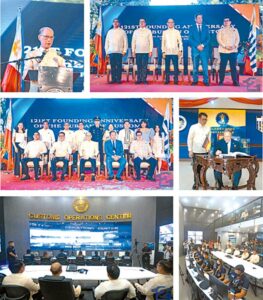
Photos from facebook.com/BureauOfCustomsPH

On Oct. 24, 1900, Act No. 33 was passed, which abolished and changed the position of Captain of the Port to Collector of Customs in all ports of entry except the Port of Manila, where the former designation was retained.

The Philippine Commission passed more important laws during the formation of the Civil Government. Among these were the Tariff Revision Law of 1902; the Philippine Administrative Act No. 355, which was followed by the Customs Service Act No. 355 known as the Philippine Customs Service Act; and the Public Act No. 430, which changed the Philippine Customs Service into the Bureau of Customs and Immigration under the supervision and control of the Department of Finance and Justice. When the Department of Justice was separated, the customs service remained under the Department of Finance up until the present.

The Bureau of Immigration eventually became a separate office from the BoC through the Commonwealth Act No. 613.

In 1957, Congress enacted the Republic Act No. 1937 known as the Tariff and Customs Code of the Philippines. It was otherwise known as the “Tariff Law of the Republic of the Philippines,” becoming the first official expression of an autonomous Philippine Tariff Policy.

The law revising the Tariff & Customs Code of the Philippines was passed by Congress in 1972. But before it could be implemented, Proclamation No. 1081 was issued, which declared Martial Law in the country.

On Oct. 27, 1972, the late former President Ferdinand E. Marcos signed Presidential Decree No, 34, which amended the Tariff & Customs Code of the Philippines. On June 11, 1978, the Tariff & Customs Code was further amended, modified, and supplemented by new positions to make the code responsive in accordance with the then New Society’s developmental programs.

The Tariff & Customs Code had to be revised again with the country’s accession to the Customs Co-Operation Council (CCC) so the country’s tariff system would be aligned with the CCC Nomenclature. This led to the Tariff & Customs Code of 1982, revised by virtue of Executive Order No. 688, which is currently enforced.

Several reorganizations took place at the BoC. From the one pursuant to Customs Administrative Order No. 4-65 by authority of Sec. 550 and 551 of the Revised Administrative Code of Republic Act No. 4164 in 1965; the amendment of the Customs Administrative Order No. 4065; the Presidential Decree No. 1 that took effect in 1972; to the Presidential Decree No. 689 in 1975. The BoC’s last major reorganization happened through Executive Order No. 127 after the EDSA Revolution in 1986.

When the computerization program initiated to be implemented, the Management Information System and Technology Group (MISTG) of BoC had to be created in 1998.

Today, the BoC continues to work on its duties on border control, trade facilitation, and lawful revenue collection in the country, with the hopes of becoming a modernized and credible customs administration.

But throughout its 121-year history, the BoC’s journey was not without controversies. It has received a negative impression from the general public, as some regarded it as the “most corrupt” government agency.

In his article published on the WCO (World Customs Organization) News website in 2021, then-Customs Commissioner Rey Leonardo B. Guerrero shared that he was met with abundant challenges when he was appointed in the position in October 2018. These included administrative to operational concerns and systemic deficiencies, which put BoC at risk to corrupt practices. The former commissioner and his team had therefore been doing the work to reform the negatives, for the organization’s transformation, and execute their mandate.

The BoC recounted that it has been in “a state of flux” since the end of October 2018. Former President Rodrigo R. Duterte had directed to put drastic measures in place to address graft and corruption in the agency. In 2019, the BoC began its era of reform and innovation.

In 2020, the Customs Memorandum Order No. 08-2020 took effect, which detailed the guidelines in the implementation of the Zero-Contact Policy. One of the objectives of the policy is to “promote a regime free of perception of graft and corruption by minimizing face-to-face transaction” in the BoC.

Among other initiatives implemented to transform the agency was the Customs Computerization Program. As automation is already part of the BoC’s 10-point priority program in 2019, it has helped the agency manage the situation during the COVID-19 lockdown. As of July 2022, over 91% of Customs processes have been automated. The BoC looks to full digitalization of its processes this year.

Former Commissioner Yogi Filemon L. Ruiz said the BoC carries on with collaboration efforts for the digitalization of customs processes. It also continues enhancing trade facilitation, intensifying border control initiatives, and bettering revenue collections.

“We are confident that with the leadership of our President Ferdinand R. Marcos, Jr. and the guidance of our Finance Secretary Benjamin E. Diokno, we will be able to achieve our goals again this year and for the years to come,” Mr. Ruiz said.

The BoC celebrated its 121st anniversary this February, with the adoption of WCO’s theme for 2023, “Nurturing the Next Generation by Promoting a Culture of Knowledge-sharing and Professional Pride in Customs.” — Chelsey Keith P. Ignacio