TORONTO – Canada has expunged historic indecency and anti-abortion laws targeting women and the LGBTQ community, the government said on Tuesday, in a criminal justice system reform that will allow people convicted under such offences to clear their records.
The repealed laws had targeted women and lesbian, gay, bisexual, transgender and queer (LGBTQ) individuals‘ access to abortion as well as to bathhouses, nightclubs and swinger clubs, considered to be safe spaces for queer communities.
“Canadians deserve non-discriminatory policies that put their safety first,” Marci Ien, Minister for Women and Gender Equality and Youth said in the statement.
She said the government recognizes that past laws and regulations were unjust and compromised the freedoms of LGBTQ communities and women.
By repealing these laws, people with previous convictions can apply for an expungement order for free under the 2018 Expungement of Historically Unjust Convictions Act, which allows for permanent destruction of “historically unjust records of conviction.”
Applicants will need information regarding the conviction to meet certain criteria. If the person convicted has passed away, a family member or trustee may apply on their behalf.
The Royal Canadian Mounted Police have used indecency laws to raid gay nightclubs and bathhouses across Canada, charging customers, employees and performers. In 1981, some 286 men were charged under these outdated laws in Toronto for being at a bawdy house.
The anti-abortion law has been outdated since 1988 when the Supreme Court of Canada named the law unconstitutional. – Reuters
One of Australia‘s top government bureaucrats on Wednesday demanded Russia crack down on the large number of cyber criminals operating in the country, saying their actions posed a threat to national security.
The comments come as Canberra reforms its cybersecurity policy following a raft of cyber attacks on some of the country’s largest companies.
“The greatest density of cyber criminals, particularly those with ransomware, are in Russia,” Michael Pezzullo, Secretary of the Department of Home Affairs, told the AFR Business Summit in Sydney.
“They are not a rule of law country and the thought that you can apply conventional law enforcement disciplines … is completely naive.
“We call on the Russian government to bring those hackers to heel.”
A spokesperson for the Russian embassy did not immediately respond to a request for comment.
The Australian government last month said it planned to overhaul its cybersecurity rules as well as set up an agency in Mr. Pezzullo’s department to coordinate government investment in the field and help coordinate responses to hacker attacks.
The move follows a rise in cyber attacks since late last year with breaches reported by at least eight companies, including health insurer Medibank Private Ltd. and telco Optus, owned by Singapore Telecommunications Ltd.
An attack on critical technology infrastructure was one of the greatest threats to Australian national security, Mr. Pezzullo said.
“A cyber attack could actually come unattributed…it could be a criminal act or it could be a proxy actor working with or on behalf of a state, or it could be a state,” he said.
“The blurring and the ambiguity that it generates is a challenge just for policy, let alone regulation.”
The United States and Britain sanctioned several Russians accused of cyber attacks last month, saying ransomware attacks have paralyzed businesses, schools and hospitals. – Reuters
WASHINGTON – The White House backed legislation introduced on Tuesday by a dozen senators to give the administration new powers to ban Chinese-owned video app TikTok and other foreign-based technologies if they pose national security threats.
The endorsement boosts efforts by a number of lawmakers to ban the popular app, which is owned by Chinese company ByteDance and used by more than 100 million Americans.
The bill would give the Commerce Department the ability impose restrictions up to and including banning TikTok and other technologies that pose national security risks, said Democratic Senator Mark Warner, who chairs the Intelligence Committee. It would also apply to foreign technologies from China, Russia, North Korea, Iran, Venezuela and Cuba, he said.
TikTok criticized the measure, saying in a statement that any “US ban on TikTok is a ban on the export of American culture and values to the billion-plus people who use our service worldwide.”
The bill would require Commerce Secretary Gina Raimondo to identify and address foreign threats to information and communications technology products and services. Raimondo’s office declined to comment.
TikTok has come under increasing fire over fears that user data could end up in the hands of the Chinese government, undermining Western security interests.
The senators introducing the legislation, led by Warner and Republican John Thune, also includes Democrats Tammy Baldwin, Joe Manchin, Michael Bennet, Kirsten Gillibrand and Martin Heinrich along with Republicans Deb Fischer, Jerry Moran, Dan Sullivan, Susan Collins and Mitt Romney.
Warner said it was important the government do more to make clear what it believes are the national security risks from TikTok. “It’s going to be incumbent on the government to show its cards in terms of how this is a threat,” Warner said.
White House national security adviser Jake Sullivan praised the bipartisan bill, saying it “would strengthen our ability to address discrete risks posed by individual transactions, and systemic risks posed by certain classes of transactions involving countries of concern in sensitive technology sectors.”
“We look forward to continue working with both Democrats and Republicans on this bill, and urge Congress to act quickly to send it to the President’s desk,” he said in a statement.
Ms. Raimondo, in a separate statement, said she “welcomes this legislative framework for addressing these threats and protecting Americans’ safety and national security” and vowed to work with senators “to advance this legislation through Congress.”
TikTok Chief Executive Shou Zi Chew is due to appear before Congress on March 23.
Senator Marco Rubio told Fox News on Tuesday that Warner’s bill doesn’t go far enough, saying that it “takes steps” in the direction of barring TikTok in the United States.
“We should pass a bill that bans TikTok,” Mr. Rubio said. “I have the only bipartisan, bicameral bill that actually does that.”
The House Foreign Affairs Committee last week voted along party lines on a bill sponsored by Republican Representative Michael McCaul to give Biden the power to ban TikTok after President Donald Trump was stymied by courts in 2020 in his efforts to ban TikTok and Chinese messaging app WeChat.
Democrats opposed McCaul’s bill, saying it was rushed and required due diligence through debate and consultation with experts. Some major bills aimed at China such as a chips funding bill took 18 months to win approval. McCaul said he thinks the full House could vote on his bill this month.
The US government’s Committee on Foreign Investment in the United States (CFIUS), a powerful national security body, in 2020 unanimously recommended ByteDance divest TikTok because of fears that user data could be passed on to China’s government.
TikTok and CFIUS have been negotiating for more than two years on data security requirements. TikTok said it has spent more than $1.5 billion on rigorous data security efforts and rejects spying allegations.
“The swiftest and most thorough way to address any national security concerns about TikTok is for CFIUS to adopt the proposed agreement that we worked with them on for nearly two years,” TikTok said Tuesday. – Reuters
The seal for the Board of Governors of the Federal Reserve System is on display in Washington, DC, U.S. on June 14, 2017. — REUTERS/JOSHUA ROBERTS/FILE PHOTO
WASHINGTON – The Federal Reserve will likely need to raise interest rates more than expected in response to recent strong data and is prepared to move in larger steps if the “totality” of incoming information suggests tougher measures are needed to control inflation, Fed Chair Jerome Powell told U.S. lawmakers on Tuesday.
“The latest economic data have come in stronger than expected, which suggests that the ultimate level of interest rates is likely to be higher than previously anticipated,” the U.S. central bank chief said in his semi-annual testimony before the Senate Banking Committee.
While some of that unexpected economic strength may have been due to warm weather and other seasonal effects, Powell said it may also be a sign the Fed needs to do more to temper inflation, perhaps even returning to larger rate increases than the quarter-percentage-point steps officials had been intending to use going forward.
“If the totality of the data were to indicate that faster tightening is warranted, we would be prepared to increase the pace of rate hikes,” Powell said.
The comments were Powell’s first since inflation unexpectedly jumped in January, and marked a stark acknowledgement that the “disinflationary process” he spoke of repeatedly in a Feb. 1 news conference was not unfolding smoothly.
Senators responded with a broad set of questions and pointed criticism around whether the Fed was diagnosing the inflation problem correctly and if price pressures could be tamed without significant damage to economic growth and the job market.
Democrats on the committee focused on the role high corporate profits may be playing in persistent inflation, with Senator Elizabeth Warren of Massachusetts charging that the Fed was “gambling with people’s lives” through rate hikes that, by the central bank’s most recent projections, would lead the unemployment rate to increase by more than a percentage point – a loss associated in the past with economic recessions.
“You claim there is only one solution: Lay off millions of workers,” Warren said.
“Will working people be better off if we just walk away from our jobs and inflation rebounds?” Powell retorted.
“Raising interest rates certainly won’t stop business from exploiting all these crises to jack up prices,” said Senator Sherrod Brown, a Democrat from Ohio who chairs the committee.
Republicans focused on whether energy policy was restricting supply and keeping prices higher than needed, and whether restrained federal spending could help the Fed’s cause.
“The only way to get this sticky inflation down is to attack it at the monetary side and the fiscal side. The more we help on the fiscal side, the fewer people you will have to throw out of work,” said Senator John Kennedy, a Republican from Louisiana.
“It could work out that way,” said Powell, who at a separate point in the hearing agreed with Democratic lawmakers’ assertions that lower corporate profits could help lower inflation, and with Republicans’ arguments that more energy production could help lower prices.
“It’s not for us to point fingers,” the Fed chief said.
‘SURPRISINGLY HAWKISH’
Powell’s remarks, virtually assuring that Fed officials will project a higher endpoint for the central bank’s benchmark overnight interest rate at the upcoming March 21-22 meeting, sparked a quick repricing in bond markets as investors boosted bets that the Fed would approve a half-percentage-point rate hike when they meet in two weeks.
The Fed’s policy rate is currently in the 4.50%-4.75% range. As of December, officials saw that rate rising to a peak of around 5.1%, a level investors expect may move at least half a percentage point higher now.
Equity markets added to initial losses and ended the day sharply lower, with the S&P 500 index dropping more than 1.5%. The U.S. dollar also rose, and yields on the 2-year Treasury climbed above 5% – the highest since 2007.
Powell’s statement was “surprisingly hawkish,” said Michael Brown, a market analyst with TraderX in London. With a 50-basis-point rate hike now in play, Brown said a strong monthly jobs report on Friday would likely lead to “calls for a 6% terminal rate,” nearly a percentage point higher than Fed officials had projected as of December.
The March 10 release of the Labor Department’s jobs report for February and an inflation report next week were cited by Powell as important in shaping what the Fed does at its next meeting.
Powell will testify again on Wednesday before the U.S. House of Representatives Financial Services Committee.
‘LONG WAY TO GO’
The hearing and Powell’s testimony honed in on an issue that is now at the center of the Fed’s discussions as officials try to determine whether recent data will prove to be a “blip,” or end up signaling that inflation remains stickier than thought and warrants a tougher response from the Fed.
In his testimony, Powell noted that much of the impact of the central bank’s monetary policy may still be in the pipeline, with the labor market still sustaining a 3.4% unemployment rate not seen since 1969, and strong wage gains.
While Powell said he thought the Fed’s 2% inflation target could still be met without dealing a major blow to the U.S. labor market, he acknowledged on Tuesday that “there will very likely be some softening in labor market conditions.”
How much remains unclear, but Powell said the focus will remain more squarely on how inflation behaves.
Inflation has fallen since Powell’s last appearances before Congress. After topping out at an annual rate of 9.1% in June, the Consumer Price Index dropped to 6.4% in January; the separate Personal Consumption Expenditures price index, which the Fed uses as the basis for its 2% target, peaked at 7% in June and had fallen to 5.4% as of January.
But that remains too high, Powell said.
“The process of getting inflation back down to 2% has a long way to go and is likely to be bumpy,” Powell said, adding later in the hearing that “the social costs of failure are very, very high.” — Reuters
As more businesses embrace cloud migration to achieve growth and resilience, enhancing their connectivity in multiple locations to run cloud-based applications seamlessly has been the standard for a successful enterprise.
Software-Defined Wide Area Network (SD-WAN) allows companies to easily deploy connectivity to multiple office sites and branches, making it faster for them to expand their operations. SD-WAN also simplifies and improves the control and management of IT infrastructure by upgrading legacy networks to a more advanced architecture, allowing the network to understand and prioritize bandwidth for optimal traffic delivery.
But for cloud-first enterprises looking to accelerate their multi-branch connectivity with a comprehensive Wide Area Network (WAN) edge-to-cloud networking solution, they can benefit the most from Globe’s Enhanced Managed SD-WAN powered by Aruba EdgeConnect.
“As the country’s leading digital solutions provider, we ensure that we’re always a step ahead by developing innovative solutions that help enterprises scale their businesses,” said Chris Cheng, Vice President for Connectivity and Digital Products, Globe Business, Enterprise Group. “With our partnership with HPE Aruba Networking, we can deliver an enhanced SD-WAN experience tailored to manage distributed and more complex branch networks for our enterprise clients.”
Enhanced Managed SD-WAN optimizes your network, boosting the performance of latency-sensitive applications, such as cloud-based applications with video streaming features, and mobile apps with peak usage that multiple employees use simultaneously. It maximizes the available bandwidth for enterprises to improve their connectivity, by upgrading the transmission of repetitive data across the WAN in a single, unified SD-WAN edge platform.
This solution also upgrades network architecture from a typical hub-and-spoke setup, where a hub serves as the central point of connectivity, to a more resilient and flexible mesh network architecture that has the ability to traverse or rotate traffic within branch networks. This allows for direct communication between sites, eliminating the need for a central hub, and thus cutting inefficiencies in an enterprise network.
It also features advanced security on top of consistent network protection, with a built-in next-generation firewall with identity-based access control capabilities. Its cloud security automated orchestration allows businesses to automate and accelerate the integration of security partners’ advanced services.
Globe Business Managed Services ensures the continued availability and performance of customers’ SD-WAN networks through 24/7 proactive network monitoring and expert technical support, through Globe’s award-winning Managed Services Network Operations Center (NOC) manned by Aruba-certified engineers. This allows companies to focus on their core business and elevate their enterprise by driving strategic decisions, while Globe runs the back-end, support, and maintenance 24/7.
“We are proud to partner with Globe in delivering the enhanced, highly available and secure, best-in-class managed SD-WAN service to meet the digital transformation demands of Philippine enterprises,” said Tushar Deshpande, Head of Global Service Provider APJ, HPE Aruba Networking. “Together, not only can we offer greater WAN agility and flexibility, and boost user experiences at branch offices as customers rapidly migrate applications to the cloud, our hassle-free, transport-agnostic solution simultaneously optimizes application performance, business productivity, and lower costs.”
Always on the lookout for new technologies that help enterprises drive growth and achieve resilience, Globe Business has fostered this continuing partnership to enable companies efficiently migrate to the cloud, combining its expertise and HPE Aruba Networking’s ecosystem of certified IT-driven solutions to provide the right support for every business’ digital transformation.
This collaboration allows enterprises to innovate their business processes, in line with Globe’s dedication to supporting the United Nations Sustainable Development Goals (SDGs), particularly UN SDG No. 9, which highlights the role of innovation as a crucial driver of economic growth and development.
Spotlight is BusinessWorld’s sponsored section that allows advertisers to amplify their brand and connect with BusinessWorld’s audience by enabling them to publish their stories directly on the BusinessWorld Web site. For more information, send an email to online@bworldonline.com.
Join us on Viber at https://bit.ly/3hv6bLA to get more updates and subscribe to BusinessWorld’s titles and get exclusive content through www.bworld-x.com.
Volunteers dressed in personal protective equipment clean up the oil spill from the sunken fuel tanker MT Princess Empress, on the shore of Pola, Oriental Mindoro province, Philippines, March 7, 2023. -- REUTERS/Eloisa Lopez
POLA, Philippines – Residents of a central Philippine province affected by an oil spill from a sunken tanker endured the powerful stench of petroleum as they cleaned it up using buckets and mugs while authorities raced to contain environmental damage.
Wearing personal protective equipment and masks, residents of the town of Pola in Oriental Mindoro, with the help of Philippine coast guard crew, collected debris soaked in oil and wiped thick sludge from rocks along the shore.
“Here in our area the oil is really thick and the smell is strong,” said 34-year-old resident Maribel Famadico while cleaning along the shore with other volunteers.
“There is so much oil that we become nauseous when we are not wearing protection. Many are feeling unwell because of the stench,” she added.
Philippine authorities said on Monday they believed they have found the tanker that sank off Oriental Mindoro last week and that they planned to deploy a remotely-operated autonomous vehicle to pinpoint its exact location.
The tanker, the MT Princess Empress, is thought to be lying at about 1,200 feet below sea level, off Oriental Mindoro province, though the information still needed to be verified, according to the environment ministry.
The vessel was carrying about 800,000 liters of industrial fuel oil when it suffered engine trouble on Feb. 28 in rough seas.
Famadico said ridding the shore and rocks of oil will likely take days.
“(The oil) comes back with the tide. Yesterday we cleaned this area but there is more again today,” she said.
Marine scientists at the University of the Philippines said about 36,000 hectares of coral reef, mangroves and sea-grass were potentially in danger of being affected by the oil slick. — Reuters
We have seen the world grind to a halt in the first 2 years of the pandemic, but in 2022, economies started to open up, especially when restrictions started to ease up across the country,
With this, Filipino consumers are coming out in record numbers – and the fresh produce section is again filled with buyers picking their best possible choice of fresh produce of the season, with added intent to increase vitamin intake. This also comes after the government’s Food and Nutrition Research Institute (FNRI) reiterated its call to follow the “Pinggang Pinoy” healthy diet, which requires the consumption of at least 400 grams or five portions of fruits and vegetables daily, as these are rich in both soluble and insoluble dietary fibers, phytochemicals, vitamins, and minerals that help prevent diseases.”
This market opportunity came at a great time for Hort Innovation, the Australian grower-owned organization, as it has been on the forefront in advocating for bigger and regular consumption for fresh produce.
Its marketing campaign aptly called ‘Grown in Good Nature’– brings to life how Australia’s ‘good nature’, both in environment and disposition as people, allows them to grow the best produce in the world – and with their presence in the country, it is now more accessible to Filipino consumers.
Australia has consistently delivered premium crops to the Philippines year in and out, bringing only high-quality produce straight from their pristine orchards. David Daniels, General Manager of Citrus Australia, revealed in last year’s media launch that “the Philippines ranks as Australia’s fourth largest citrus market. In 2012, we exported a single container of oranges —to the Philippines, just 26 tonnes. Last year (2021), we reached a record trade volume of 15,000 tonnes in mandarins and oranges. And that was despite major challenges with labor and disruptions to the supply chain.”
The ‘Grown in Good Nature’ campaign covered strategic programs with 9 major retail partners – covering 148 outlets. The program delivered an average sales growth of 53%, a solid proof of the growing acceptance of Australian produce.
As the programs were geared towards cementing the presence of Australian Oranges while making the new campaign visible, several activities were lined up such as the successful event launch attended by partners and media, which was instrumental in getting a new partnership with Metro Supermarket; in-store POS displays across 150 stores nationwide, sampling promotions of about 360 days coupled with 180 days of push selling and visibility with media.
These efforts would not have been possible without the full support of Austrade. The horticulture sub-brand ‘Grown in Good Nature’ was created in support of Austrade’s effort to unify all Australian products under an umbrella brand, ‘Australia’s Nation Brand’, while still allowing industries to establish their presence.
For 2023, the momentum continues as fresh new harvests from their farms, starting with Australian Table Grapes, kicks off the season in April, during the Philippine summer.
Spotlight is BusinessWorld’s sponsored section that allows advertisers to amplify their brand and connect with BusinessWorld’s audience by enabling them to publish their stories directly on the BusinessWorld Web site. For more information, send an email to online@bworldonline.com.
Join us on Viber at https://bit.ly/3hv6bLA to get more updates and subscribe to BusinessWorld’s titles and get exclusive content through www.bworld-x.com.
Fans and smartphone enthusiasts are about to get another exciting surprise from the leading smartphone brand vivo as it gears up to release yet another technological masterpiece in the V series line. The iteration of the vivo V25 Series, the vivo V27 Series dubbed as the #TheAuraPortraitMaster, is said to offer fans a one-of-a-kind camera feature that’s sure to upgrade any smartphone into a studio in one’s pocket.
With vivo’s impressive history of successful launches, it’s expected that this new feature will be just as functional and stylish — if not more — as vivo’s previous innovations. The vivo V27 Series is likely to follow the direction of its predecessor and combine powerful and versatile camera features in a lightweight build that many users will surely love.
What we know so far
Committed to catering to young users’ needs, vivo is said to pack this latest addition to its line of premium smartphones with a built-in ring light called the aura light. This replaces the usual camera flash and makes portrait shots clearer and more natural-looking. This feature also gives images a soft light effect usually found in photos done in professional studio setups. The aura light portrait gives photographs and videos studio-standard lighting and enhances facial features and makes the subject’s skin look luminous.
Continuing its tradition of working with global leaders and pioneers in the imaging world as it did with ZEISS for the vivo X80 Series, the smartphone brand is said to have worked with SONY to create its customized ultra-sensing sensors that ensure higher-quality images even in low light or dark settings. The customized sensor not only produces brighter images but also has Optical Image Stabilization (OIS) capabilities, giving fans more stable photographs and better in-action shots.
The vivo V27 series is also expected to pack an EIS+OIS Hybrid Imaging Stabilization feature found in the brand’s higher-end devices to minimize out-of-angle and shaky videos. Industry buzz further indicates this vivo V27 Series will also have a 50MP HD front camera with an upgraded auto-focus feature that captures the subject’s face with greater accuracy and speed, ensuring clear photographs each time.
Signature vivo features to expect
A closer study of vivo’s recent launches will show the smartphone brand puts emphasis on functionality while also prioritizing style and comfort. Talk about accessories that match your OOTDs! The Photochromic 2.0 technology remains a staple in the V series and is predicted to be paired with a slim and flat frame design. The vivo V27 series will be lightweight and handy with an ergonomic grip, perfect for on-the-go users who relish making the most of spontaneous moments.
Based on the V series’ design philosophy, this new addition will likely have a simple and elegant casing. Its rear camera layout will exude minimalism and lean more toward the less is more philosophy.
Excited to have the new studio device in your pocket? Follow vivo’s official Facebook, Instagram, Twitter and YouTube pages to get the latest updates about the new vivo V27 series.
Spotlight is BusinessWorld’s sponsored section that allows advertisers to amplify their brand and connect with BusinessWorld’s audience by enabling them to publish their stories directly on the BusinessWorld Web site. For more information, send an email to online@bworldonline.com.
Join us on Viber at https://bit.ly/3hv6bLA to get more updates and subscribe to BusinessWorld’s titles and get exclusive content through www.bworld-x.com.
Colorful traditional jeepneys wait for passengers at the corner of EDSA and Aurora Boulevard in Quezon City, July 1, 2022. — PHILIPPINE STAR/MIGUEL DE GUZMAN
Colorful traditional jeepneys wait for passengers at the corner of EDSA and Aurora Boulevard in Quezon City, July 1, 2022. Inflation eased in February, mainly due to lower transport costs. — PHILIPPINE STAR/MIGUEL DE GUZMAN
By Keisha B. Ta-asan, Reporter
PHILIPPINE INFLATION eased for the first time in six months in February as transport and food prices rose at a slower pace, the statistics agency said.
Core inflation, however, accelerated to the fastest pace in over 22 years, which will likely ensure the Bangko Sentral ng Pilipinas (BSP) continues its tightening path.
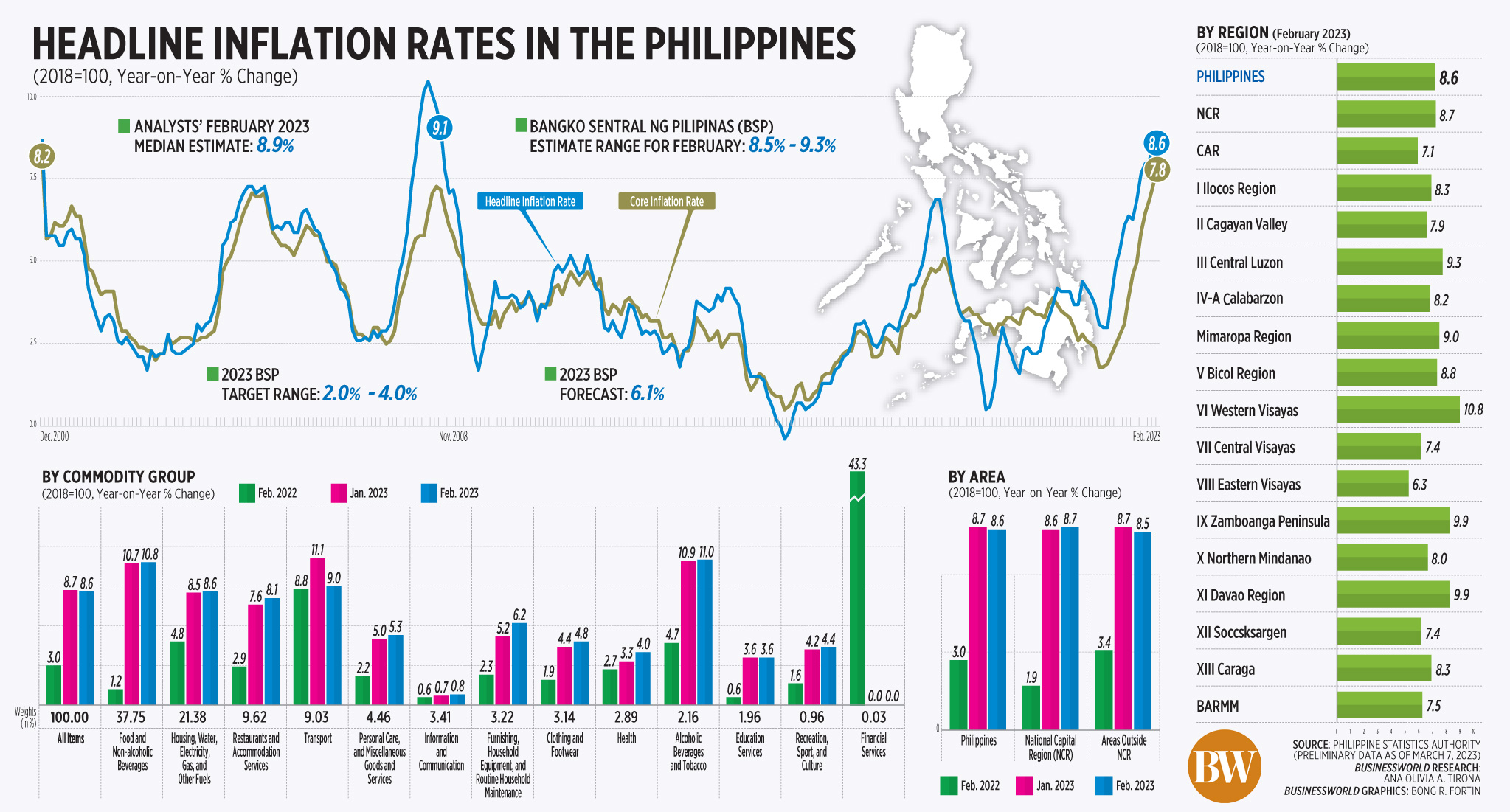
Preliminary data from the Philippine Statistics Authority (PSA) showed the consumer price index (CPI) slowed to 8.6% in February, from the 14-year high 8.7% in January. Still, this was faster than the 3% in February 2022.
February inflation was below the 8.9% median in a BusinessWorld poll conducted last week, but within the Bangko Sentral ng Pilipinas’ (BSP) 8.5-9.3% projection.
Stripping out seasonality factors, consumer prices dipped by 0.3% in February from 1% a month earlier.
Core inflation, which discounted volatile prices of food and fuel, quickened to 7.8% in February from 7.4% in January and 1.9% in the same month in 2022.
This is the quickest rise in core inflation in over 22 years or since 8.2% in December 2000.
Core inflation has been rising since March 2022.
For the first two months of the year, inflation averaged 8.6%. The BSP expects inflation to average 6.1% this year.
At a press briefing, PSA Undersecretary and National Statistician Claire Dennis S. Mapa said transport was the main source of the deceleration in February inflation as prices of gasoline and diesel declined.
Transport inflation slowed to 9% in February, from 11.1% in January, as price increases in gasoline and diesel eased.
Pump price adjustments stood at a net decrease of P0.50 a liter for gasoline, P5.45 a liter for diesel and P6.85 a liter for kerosene in February.
On the other hand, nine out of 13 commodity groups posted faster inflation rates, led by food and non-alcoholic beverages (10.8% in February from 10.7% in January).
Other commodities that posted higher annual increases were alcoholic beverages and tobacco (11% from 10.9% in January), furnishings and household equipment (6.2% from 5.2%), clothing and footwear (4.8% from 4.4%), and health (4% from 3.3%).
Meanwhile, food inflation slightly eased to 11.1% in February from 11.2% in January and 1.1% in the same month in 2022.
Mr. Mapa said the downtrend in food inflation was due to slower annual growth of vegetables, tubers, plantains and cooking bananas (33.1% in February from 37.8% in January), and rice (2.2% from 2.7%). Price increases in corn; meat; oils and fats; and sugar, confectionary and desserts, also slowed during the month.
However, higher annual increases were seen in flour, bread and other bakery products; fish and other seafood; milk and other dairy products; fruits and nuts; and ready-made food products.
National Economic and Development Authority (NEDA) Secretary Arsenio M. Balisacan said the government should rethink its strategies to combat elevated food prices.
“The country’s current high inflation is largely driven by domestic, supply-side constraints. Agricultural imports were ill-timed and food supplies have been inadequate. The solution is to get to the root of the problem, including fixing the bottlenecks along all segments of the agricultural value chain,” he said in a statement.
Hongkong and Shanghai Banking Corp. (HSBC) economist for the Association of Southeast Asian Nations (ASEAN) Aris Dacanay said the slower February inflation was due to favorable base effects.
“Across all sub-commodity baskets, only transport CPI eased on a year on year basis given some favorable base effects in fuel prices. It has been a year since global oil prices first spiked. As a result, gasoline and diesel CPI eased substantially to 3.8% (from 9.6%) and 14.2% year on year (30.5%), respectively,” Mr. Dacanay said.
Fuel prices surged amid Russia’s invasion of Ukraine that started in late February last year.
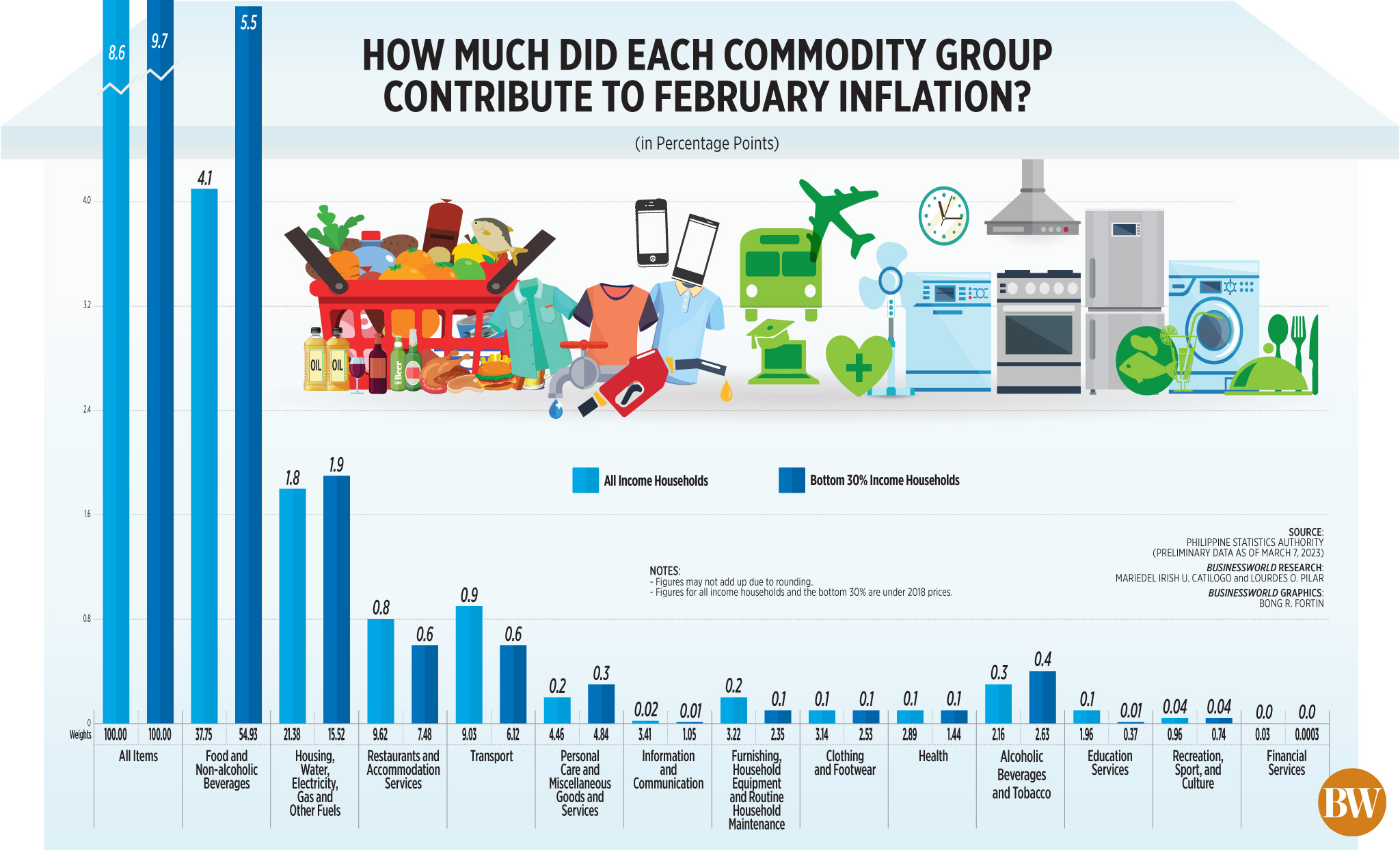
‘STICKY’ CORE INFLATION Inflation for the bottom 30% income households quickened to 9.7% in February, steady from a month ago but faster than the 3.5% print last year.
Food inflation for the bottom 30% households rose slightly to 10.5% in February from 10.4% in January, PSA’s Mr. Mapa said.
In the National Capital Region (NCR), headline inflation climbed to 8.7% in February from 8.6% in January and 1.9% a year ago. Mr. Mapa said this is the fastest print since 9.5% in December 2000.
Outside of NCR, consumer prices went down 8.5% from 8.7% in January and 3.4% a year prior.
PSA’s Mr. Mapa said an increase in gasoline and diesel prices as well as “sticky” core inflation may still drive inflation higher in March.
Local oil companies on Tuesday increased gasoline prices by P0.40 per liter, diesel by P1.50 per liter and kerosene by P1.25 per liter.
Mr. Mapa noted that a deceleration in meat and vegetable prices may help slow inflation this month as the weight of food in the CPI basket is around 35% for all income households, and around 51% for the bottom 30%.
“While we are seeing a slight drop in prices, particularly with food, prices are still elevated… We’re still facing challenges particularly with our core inflation. Core inflation is continuously increasing,” Mr. Mapa said in mixed English and Filipino.
According to HSBC’s Mr. Dacanay, it’s hard to determine whether inflation has peaked as consumer demand is still strong.
“Indeed, the momentum of inflation eased significantly in February, but it’s difficult to determine the peak with confidence given the extent to which inflation was spreading to other goods and services,” he said.
Bank of the Philippine Islands (BPI) Lead Economist Emilio S. Neri, Jr. said inflation may have peaked already, and will slow in the coming months.
“But the decline will likely be gradual due to upside risks outside of oil. The agriculture sector continues to struggle amid structural problems, preventing it from keeping up with the country’s rising population,” Mr. Neri said. “With core inflation still rising, the BSP may need to hike further in the coming months.”
An all-of-government approach is needed to address inflation and the pressure is now on the fiscal side, Finance Secretary Benjamin E. Diokno said on Tuesday.
Trade Secretary Alfredo E. Pascual said the government must also intensify campaigns to lower prices of basic necessities, especially agriculture products.
RATE HIKE OUTLOOK The BSP said it projects inflation to remain above target until the fourth quarter this year before easing to the low end of the 2-4% target range by January 2024. This is due to negative base effects and a likely decline in global oil and non-oil prices.
However, uncertainties in the global food market, supply constraints, additional transport fare hikes, and higher-than-expected wage adjustments this year were cited as upside risks to the inflation outlook.
“The BSP remains prepared to adjust its monetary policy settings as necessary to prevent inflation expectations from becoming disanchored and safeguard the inflation target over the policy horizon,” the central bank said in a statement.
The BSP has raised rates by a total of 400 basis points (bps) since May 2022, bringing the policy rate to 6% — the highest since 2007.
It expects inflation to average 6.1% this year, before easing to 3.1% in 2024.
ING Bank N.V. Manila Senior Economist Nicholas Antonio T. Mapa expects the BSP to further tighten policy, but likely at a slower pace as inflation eased in February.
“BSP Governor Medalla recently shared that he would only consider a 50-bp rate hike should headline inflation top 9%. (This) inflation report solidifies our expectation that Governor Medalla can opt for a 25-bp rate increase, taking the overnight reverse repurchase rate to 6.25%, which should likely be the peak for this tightening cycle,” Mr. Mapa said.
He added the peso may face pressures in the near term as easing inflation “opens the door for a less aggressive policy response from the central bank.”
Following the PSA’s announcement, the local currency closed at P55 versus the greenback on Tuesday, depreciating by 12 centavos from Monday’s P54.88 finish.
The behavior of the peso this year will largely depend on what the US Federal Reserve will do, said BPI’s Mr. Neri.
“If US activity prints weaken significantly, the US central bank may pause more quickly or even cut interest rates earlier than expected. This will diminish the strength of the US dollar and provide support to other emerging market currencies like the peso,” he said.
The US Federal Reserve raised the fed funds rate by 25 bps to 4.5-4.75%. It has hiked rates by a total of 450 bps since March 2022. The Fed’s next policy review will be on March 21 and 22.
THE NATIONAL Government’s (NG) outstanding debt hit a record high of P13.698 trillion at the end of January as the government ramped up domestic and external borrowings, the Bureau of the Treasury (BTr) said on Tuesday.
Data from the BTr showed that the outstanding debt jumped by P279.63 billion or 2.1% from the P13.419 trillion at the end of December “due to the net availment of domestic and external debt.”
Year on year, the debt stock rose by 13.9% from P12.03 trillion.
As of end-January, more than two-thirds or 68.5% of total outstanding debt were from domestic sources, while the rest was from foreign creditors.
Domestic debt climbed by 12.2% to P9.385 trillion as of January, from P8.368 trillion a year ago. It also inched up by 1.9% from the P9.208 trillion as of end-December 2022.
The BTr attributed the higher domestic debt mainly to “net availment of domestic financing amounting to P179.16 billion offsetting the P2.61-billion effect of local currency appreciation against the US dollar on foreign denominated onshore securities.”
Based on figures from the BTr, the peso appreciated by 2.3% to P54.571 against the dollar from the P55.815 at end-December.
The government mainly borrows from domestic sources to mitigate foreign currency risk.
Meanwhile, external debt increased by 17.8% to P4.314 trillion at end-January from P3.662 trillion in the previous year. Month on month, it went up by 2.4% from P4.21 trillion.
Broken down, external debt consisted of P1.868 trillion in loans and P2.445 trillion in global bonds.
“The increase in NG’s external obligation for January was brought on by the P186.56 billion net availment of foreign loans and P10.36-billion impact of third currency adjustments against the US dollar. However, peso appreciation reduced the peso value of foreign currency denominated debt by P93.84 billion,” the BTr said.
As of end-January, the NG’s overall guaranteed obligations dropped by 1.3% to P393.84 billion from P399.05 billion in the previous month. Year on year, it declined by 6.8% from P422.52 billion.
Analysts said that the increase in debt was due to the government’s recent bond offerings.
“This may have to do with the $3-billion global bond offering of the National Government in January,” Rizal Commercial Banking Corp. Chief Economist Michael L. Ricafort said in a Viber message.
The government raised $3 billion from a US dollar bond issuance in January, its first for the year.
Mr. Ricafort said that debt could rise further due to the government’s retail Treasury bond (RTB) issuance in February, which raised P283.711 billion.
The government has also signaled a dollar-denominated RTB offering in the second quarter.
Union Bank of the Philippines, Inc. Chief Economist Ruben Carlo O. Asuncion said there was “quite a jump” in debt in January, noting that currency movements have also been noted as important debt drivers.
“My sense is that January usually is a good time to avail of financing opportunities to support economic growth expenditures. Although debt availments are carefully programmed throughout the fiscal year, January is one of the important months,” he said in a Viber message.
Mr. Ricafort also noted that new official development assistance and other multilateral funding for infrastructure projects would also add to the country’s outstanding debt in the coming months.
The government plans to borrow P2.207 trillion this year, where 75% is expected to be sourced domestically.
As of end-December, the country’s debt-to-gross domestic product (GDP) ratio stood at 60.9%, improving from the 63.7% debt-to-GDP ratio as of end-September.
This debt-to-GDP ratio is lower than the 61.8% target under the medium-term fiscal framework, but still above the 60% threshold considered manageable by multilateral lenders for developing economies.
The government is aiming to cut the debt-to-GDP ratio to less than 60% by 2025, and further down to 51.5% by 2028.
A worker arranges sacks of rice. — PHILIPPINE STAR/WALTER BOLLOZOS
THE DEPARTMENT of Finance (DoF) is recommending additional imports of rice, corn, sugar, pork, and other key commodities this year to address an expected supply deficit and to tame prices.
“The total rice deficit of the country is estimated at 1.8 million metric tons (MT) or 10.4% of demand this year. This rice deficit, which is equivalent to 42 days, must be met with additional buffers in anticipation of typhoons that could destroy potential harvest,” Finance Secretary Benjamin E. Diokno said at a sectoral meeting with President Ferdinand R. Marcos, Jr. on Tuesday.
A copy of his presentation was provided to journalists.
The Finance chief said the government should import 3 million MT of rice to secure a 30-day buffer, but noted this should not coincide with the harvest season.
The Philippines imported around 3.8 million MT of rice last year.
Citing estimates from the DA, Mr. Diokno said yellow corn is also seen to have a deficit of 2.8 million MT this year. This is equivalent to 34.7% of total yellow corn demand and almost 125 days of feed requirements.
“This must be addressed through temporary and timely importations to avoid affecting the production of other industries such as hog and poultry,” the Finance chief said.
For refined sugar, Mr. Diokno said that there will be a deficit of 75,546 MT by the end of August 2023. This represents 6.4% of total demand.
He said the supply of refined sugar will be insufficient if there are no new imports, driving up retail prices.
Mr. Diokno said there is an estimated pork supply deficit of 309.1 thousand MT (TMT), equivalent to 17.1% of demand or 62.5 days of pork supply.
“To fulfill the 2023 supply deficit and maintain at least a 30-day buffer stock of pork in 2023, the DA estimates that the country needs to import around 457.5 TMT of pork,” he said.
The DA also anticipates a fish supply deficit of 648.3 thousand MT or 18.1% of demand by the end of the year.
“There is a need to continue calibrated importation of fish to ensure local availability of the commodity at more affordable prices while the municipal and coastal/marine fish resources are enriched and revitalized,” Mr. Diokno said.
He noted inflation has continued to quicken due to food supply shortages and higher utility rates.
Headline inflation eased to 8.6% in February from the 14-year high of 8.7% in January, while core inflation accelerated to a more than 22 year-high of 7.8% during the month.
Food inflation slightly eased to 11.1% in February from 11.2% in January, due to a slower rise in prices of vegetables, rice, corn, meat and sugar.
However, there were higher annual increase in prices of flour, fish, milk, fruits and ready-made food.
In a televised Palace briefing, Mr. Diokno said that there is a need to focus on agriculture production and productivity to help bring down prices.
“I emphasized that in order to tackle inflation we need to have a whole of government approach…We need to focus on (bringing down) prices of commodities,” Mr. Diokno said.
He said the government needs to trim the processes and procedures that delay the transport of imports. This includes fast-tracking government processes on clearances for agricultural goods, removing the certificate of necessity to import for fish, digitizing and centralizing the sanitary and phytosanitary (SPS) import clearance system, implementing the equivalence principle for the SPS agreement, and removing the required Authority to Release Imported Goods on fertilizers and feeds ingredients.
The country will also import more fertilizers from Saudi Arabia and China, Mr. Diokno said.
The DA is currently negotiating with the Saudi Fund for Development for urea fertilizer this year, while the Department of Foreign Affairs will apply for more development assistance from China for fertilizer imports.
NEW COMMITTEE In statement, National Economic and Development Authority (NEDA) Secretary Arsenio M. Balisacan said Mr. Marcos has approved the creation of an Inter-agency Committee on Inflation and Market Outlook that will serve as an advisory body on measures to “mitigate inflation and ensure food and energy security.”
“The advisory body will lead the close monitoring of inflation (particularly on food and energy and their main drivers and causes), facilitate regular and efficient data-sharing among concerned agencies, assess the supply-demand situation for energy and essential food commodities, provide forward estimates given various scenarios,” he said.
Co-chaired by Mr. Diokno and Mr. Balisacan, the committee will also monitor global and regional developments that may affect commodity prices. It will submit quarterly reports to the President on the food and energy supply-demand situation and outlook for the country.
Mr. Marcos also approved the creation of an Economic Development Group, which will “assist the Executive department in harmonizing, coordinating, complementing, and synergizing the efforts that will ensure the country’s rapid, inclusive, and sustained growth.” — Luisa Maria Jacinta C. Jocson