Home Blog Page 5110

Party-list rep seeks urgent certification on bills to lower fuel prices

PHILIPPINE STAR/ MIGUEL DE GUZMAN

A PARTY-LIST representative on Monday called on President Ferdinand R. Marcos, Jr. to certify as urgent several bills that lower oil prices to help consumers burdened by inflation.   

An urgent certification from the president means these bills can be fast-tracked by being passed on third reading immediately after the second reading.  

Malacañang and the legislative leadership should concentrate more on measures that would alleviate the suffering of ordinary Filipinos especially in lowering oil price, so that other products will have decreasing prices as well,ACT-Teachers Party-list Rep. France L. Castro said in a statement.   

Ms. Castro and two other progressive party-list representatives filed House Bills (HBs) 400, 3003, 3004, 3005 and 3006 to reduce the price of oil and other petroleum products by removing excise tax, renationalizing Petron, unbundling oil prices, institutionalizing a procurement process for petroleum and regulating the downstream oil industry, respectively.   

HB 400 seeks to scrap excise tax and value-added tax on petroleum products. It will amend Section 49 of the Tax Reform for Acceleration and Inclusion Law and Section 109 of the National Internal Revenue Code.   

HB 3003 proposes that the Philippine National Oil Company (PNOC) acquire a majority stake of subscribed stocks of Petron Corp. during the first year of its effectivity. The government will appropriate P4 billion for the initial purchase of stocks.   

Under the bill, the PNOC will reacquire 100% ownership within a four-year period.   

“As can be seen there are numerous House measures just waiting to be prioritized by Malacañang and the House leadership,” Ms. Castro said.   

This bills package when made into law can lower oil prices, cause a domino effect in lowering basic products and services and at least alleviate the suffering of consumers.Matthew Carl L. Montecillo

Philippine fertility rate drops to lowest since 1970s at 1.9

PARK-GOERS enjoy a ride at the Quezon Memorial Circle in this November 2021 photo, when the government started to further ease restrictions in Metro Manila. — PHILIPPINE STAR/ MICHAEL VARCAS

THE AVERAGE number of kids of Filipino women of childbearing age has gone down to 1.9 this year from 2.7 in 2018, bucking an expected increase due to limited access to family planning services during the coronavirus pandemic, according to the Commission on Population and Development (POPCOM). 

In a statement on Monday, POPCOM noted that the fertility rate of females aged 15 to 49 has been on a downward trend since the 1970s, which was at six children per woman.    

It added that the decline from 2017 to 2022 was the sharpest ever recorded.  

The latest fertility rate was based on the Philippine Statistics Authoritys National Health Demographic Survey 2022 presented Friday.   

Lolito R. Tacardon, POPCOM officer in charge-executive director, said this development can be considered as a breakthroughfor the countrys programs on population and development as well as family planning, which were instituted more than five decades ago.  

He said the fertility rate decline presents an opportunity to speed up and enhance socioeconomic growth.     

Economic gains from the demographic transition can be funneled to reduce poverty and improve labor force participation. The country will continue to see a robust labor force at over 63% of the population until 2030 or 2035, which is a full dozen years away, he said.   

At the household level, lower fertility also means greater opportunity for personal development of couples and individuals, which can redound to more savings and investments, he added.   

The Philippinesfertility rate is now the third lowest among southeast Asian nations, after Singapores 1.1 and Thailands 1.5, Mr. Tacardon noted.   

At the same time, the POPCOM head acknowledged that the country must also address concerns on teenage pregnancies and reducing fertility in rural areas where the rates are still high.MSJ 

Gilas Pilipinas caps its Window 5 assignments in FIBA with a bang

KAI SOTTO delivers 11 markers, nine rebounds, and three assists. — FIBA

GILAS Pilipinas blasted new-look Saudi Arabia, 76-63, yesterday morning (Manila time) in Jeddah to cap its Window 5 assignments in the FIBA World Cup Asian Qualifiers with a bang and come out of its Middle East road trip unscathed.

Fired up by a big Filipino crowd that virtually transformed the King Abdullah Sports City Arena into a “home” court, the Nationals took care of business against a rival who provided a tougher challenge than the ones they previously routed, 84-46, in Jordan Clarkson’s Manila homecoming back in August.

The 13-point victory in Jeddah came three days after Gilas stamped its class on fancied Jordan in its territory in Amman, 74-66, giving coach Chot Reyes’ crew a perfect 2-0 in the November window.

“They (Saudi) came out and played hard, they came in with a good game plan, and we expected it,” said Mr. Reyes of the Saudis, who paraded a retooled squad under Dutch mentor Johan Raijokkers for the return match.

“We knew the high quality of this team so we mentally prepared ourselves to struggle, especially coming from a tough game in Jordan,” added Mr. Reyes.

The Filipinos started to find their groove in the second quarter, where they stifled Saudi to nine points en route to a six-point separation at the break. They cranked it up some more in the final 20 minutes, seizing a 16-point tear and keeping the home side no closer than eight heading home.

And throughout this run, the roaring OFWs in Jeddah were rallying them on.

“We stayed patient through our early struggles and I think we got a lot of energy from the crowd. They really gave us a huge boost. They wouldn’t allow us to lose until we hit our stride and hit our shots,” said Mr. Reyes. “Then we’re able to use our defense essentially to pull off the victory.”

Without Mr. (Jordan) Clarkson this time around, Gilas turned to a balanced assault to repeat against Saudi.

RR Pogoy and Dwight Ramos shot 13 apiece while Kai Sotto delivered 11 markers, nine rebounds and three assists, CJ Perez netted 10 and reigning PBA MVP Scottie Thompson accounted for nine points, nine boards and three assists.

“In the first half, we were too excited and committed a lot of turnovers,” said Mr. Thompson. “Good thing we recovered in the second half and pulled it off.”

Counting its dispatching of Saudi in the fourth window, the Philippines has now won its last three matches in the qualifiers.

The 2023 World Cup co-hosts ranked third in Group E after this set of games with 13 points on a 5-3 record behind fellow qualified teams Lebanon (15 on 7-1) and New Zealand (14 on 6-2). Jordan sat at No. 4 with 12 points (4-4) ahead of Saudi (10 on 2-6) in the race for a ticket to the global extravaganza.

Gilas will resume its campaign in February in front of home supporters with Justin Brownlee eyed as a possible naturalized player versus Lebanon and Jordan. — Olmin Leyba

The Scores:

Philippines 76 — Ramos 13, Pogoy 13, Sotto 11, Perez 10, Thompson 9, Parks 8, Aguilar 6, Kouame 5, Malonzo 1, Oftana 0, Erram 0, Quiambao 0.

Saudi Arabia 63 — Ma. Almarwani 19, Abdel Gabar 16, Mo. Almarwani 8, Kadi 6, Aljohar 5, Ashoor 4, Shubayli 2, Mohammed 2, Belal 1, Saleh 0, Almuwallad 0, Albargawi 0.

Quarterscores: 16-16, 31-25, 55-45, 76-63.

Cignal, F2 Logistics stay in semis berth hunt against PLDT, Akari at the Big Dome

CIGNAL HD Spikers — PVL

Games Tuesday
(Smart Aranata Coliseum)
2:30 p.m. — Cignal vs PLDT
5:30 p.m. — F2 vs Akari

CIGNAL and F2 Logistics aim to stay in the semifinal hunt as the two tackle PLDT and Akari, respectively, today in the Premier Volleyball League Reinforced Conference at the Smart Araneta Coliseum.

The HD Spikers and the Cargo Movers are currently tied at fourth spot with identical 3-2 records and a win in their games set 2:30 p.m. and 5:30 p.m. would send them back at No. 3 alongside the Petro Gazz Angels (4-2) and closer to the next phase.

Cignal is coming off a 25-22, 34-32, 15-25, 16-25, 15-13 squeaker over Petro Gazz Thursday while F2 is riding the crest of a giant-sized, come-from-behind 22-25, 23-25, 25-20, 25-19, 15-11 upset of title favorite Creamline last week also at the Big Dome.

The HD Spikers will have their hands full against their sister team, the HD Spikers, who are fighting for dear semis life with a 2-4 mark.

PLDT stayed in contention after eliminating Akari, 25-11, 25-21, 25-19, also Tuesday.

Cignal will depend again on Tai Bierria and Ces Molina, who uncorked 19 and 13 points, respectively, as well as Riri Meneses, who had a solid 11-hit performance the last time out.

For F2 Logistics, it is out to extend its streak to four as it hopes to draw another powerful effort from the prolific Lindsay Stalzer and the power-hitting Kim Dy, who starred last game with 27 and 18 points.

“We just have to keep working hard,” said F2 Logistics mentor Benson Bocboc.

Kalei Mau had a rough game against Creamline but managed to chip in 11 points, the same output by grizzled vet Abi Marano.

And expect F2 Logistics to throw everything it has against a Prisilla Rivera-led Akari, which is already out of the running but will try to salvage some measure of pride and close out its campaign with a win. — Joey Villar

Raph Trinidad bags silver at Singha IWWF World Championship in Thailand

EZRA ACAYAN/RED BULL

THE 21-YEAR-OLD Red Bull wakeboarding athlete Raph Trinidad took home silver in the Men’s Wakeboard Finals Open at this year’s International Waterski & Wakeboard Federation (IWWF) Championship on Thursday, Nov. 3, 2022, in Thailand at Esc Thai Wake Park.

The young Filipino wakeboarder scored an 85.67, earning him second place and racking up another impressive accolade to the wakeboarding virtuoso’s young career.

Following his run at the championship, Mr. Trinidad shared a highlight reel of his final run in which he stated, “Super stoked to land the run I’ve always dreamed of and so thankful to bag another silver medal from the world championships.” He then expressed his admiration from the crowd involved and let his admiration be known to everyone who’s been part of his preparation ahead of the competition.

Mr. Trinidad is no stranger to bringing glory to his country as he’s been known as the first Filipino to earn himself a spot at the world rankings in cable wakeboarding by the International Waterski and Wakeboard Federation. In 2019, the Filipino wakeboarder gave the Philippines its first silver medal at the 10th IWWF World Wakeboard Championships and secured another silver medal in the 2019 Southeast Asian Games.

At such a young age, the world of wakeboarding is looking bright for Mr. Raph Trinidad and the Philippines can count on this young man to carry the country’s pride on his shoulders with every competitive run throughout his career.

CSB tries anew to book Final Four slot against SSC-R

Games Tuesday
(Filoil EcoOil Centre)
12 p.m. — SSC-R vs CSB
3 p.m. — UPHSD vs AU

DENIED last time, College of St. Benilde (CSB) tries one more time for a victory that would propel it to the Final Four for the first time in two decades as it squares off with a desperate San Sebastian College (SSC-R) today in NCAA Season 98 at the Filoil EcoOil Centre.

Playing shorthanded without three players, the Blazers tried but failed to book that precious semis spot last game only to succumb to the University of Perpetual Help (UPHSD) Altas, 89-83, Friday and reel to third spot and a 10-4 record.

But they will have another opportunity when they tackle the Stags at 12 p.m.

“If we win, we are in the Final Four,” said CSB coach Charles Tiu.

The last time CSB made it that far was in 2002, two years after it claimed its first and only seniors championship in the league to date.

They almost ended the long drought when it finished fourth in the standings only to lose in the play-in, a novel system which was implemented only last year due to the COVID-19 pandemic-shortened season, and eventually crashed out a season ago.

CSB will remain without Mark Sangco and Chris Flores, who will serve the last of the two-game suspensions assessed to them for their involvement in the John Amores-centered brawl last week.

Big man Ladis Lepalam, for his part, returns to action after serving his one-game ban last time.

CSB is expecting it to be tough though as it will face a SSC-R squad clinging to its diminishing Final Four hope.

The Stags fell to the Lyceum of the Philippines University Pirates (11-5) in a 73-65 defeat Sunday but remained in the race with a 6-8 record.

That is assuming they could sweep their last four remaining games and pray at least one of the Blazers and the San Beda Lions (10-5) would drop all their last assignments.

Meanwhile, UPHSD (7-9) and Arellano University (6-9) battle it out at 3 p.m. in a non-bearing contest. — Joey Villar

Karateka protegé emerges at PSC Women’s Martial Arts Festival

PSC

SAMANTHA Veguillas has begun to follow the footsteps of her father after winning the individual kata in karate at the ongoing 8th Women’s Martial Arts Festival (WMA) 2022 at the Ninoy Aquino Stadium.

The 19-year-old Ms. Veguillas defeated Joan Denise Lumbao, her teammate at the Association for the Advancement of Karate, by a slim margin after scoring 23.20 points against Ms. Lumbao’s 22.80 in Day 2 of the multi-contact sports event organized by the Philippine Sports Commission (PSC).

Ms. Veguillas is the daughter of former karate champion Chino Veguillas, a team kata gold medalist in the 1993 Southeast Asian Games in Singapore.

Featuring the nation’s finest women athletes in 11 sports, the WMA is being streamed live at the PSC’s YouTube channel and the PSC WMA Festival FB page.

The six-day festival for the finest Filipino women martial arts athletes is supported by Pocari Sweat and Go21.

Princess Nicole Ramirez ruled the -50kg kumite after defeating Rochelle Dano while Ma. Yvone German toppled Marie June Adriano in the -55kg finals of the competition the serves as the initial tuneup and countdown to the 6th Asian Indoor and Martial Arts Games in Thailand exactly a year after the WMA’s closing ceremony.

The trio of Fatima A-Isha Lim Hamsain, Baby Angel Lamore and Christina Colonia of Maharlika Karatedo of the Philippines clinched the gold medal in the team kata with a score of 22.20 points.

They outperformed MKPI/CLSU JKS-MKKPI’s Marie June Adriano, Jerahmeel Pedines Trases and Julie Mae Bonifacio, who compiled 20.20 points.

Over at the Judo Training Center, Helen Aclopen topped the -52 kgs category in kurash after beating Shaira Batalla, Charmea Quelino defeated Ma. Veneza Dayao in the -63kgs for the gold and Eunice Lucero reigned supreme in the -78kgs.

In pencak silat at the Rizal Memorial Coliseum, national team members Angeline Virina (Tanding Class A), Hanna Mae Ibutnande (Tanding Class C) and Angel-ann Singh (Tanding Class D) claimed the gold medals in their respective categories.

Eala commits support to national boxers all the way to Paris Olympics

(L-R) ABAP Sec-Gen Marcus Jarwin Manalo, PSC Commissioner Bong Coo, 2022 ASBC Asian Elite Boxing Championships bronze medalists Hergie Bacyadan (women’s middleweight) and Nesthy Petecio (women’s featherweight), gold medalist Carlo Paalam (men’s bantamweight), together with PSC Chairman Noli Eala and ABAP President Ed Picson in a courtesy visit at RMSC, Manila on Monday. — PSC

PHILIPPINE Sports Commission (PSC) chair Noli Eala yesterday renewed the agency’s commitment to support the national boxers’ quest at claiming a historic Olympic gold medal in the 2024 Paris Games.

Mr. Eala’s reassurance came after he welcomed back Carlo Paalam, Nesthy Petecio and Hergie Bacdayan from their heroic efforts in the ASBC Asian Elite Boxing Championships in Amman, Jordan recently.

Mr. Paalam took the gold while Mmess. Petecio and Bacdayan a bronze each.

“We are in full support of our national boxers all the way to Paris Olympics,” said Mr. Eala.

Mr. Eala said he had already talked to Association of Boxing Alliances in the Philippines president Ed Picson about leveling up the support and programs for the elite athletes.

“We will look into the possibility of building a team composed of coaches and sports science experts,” said Mr. Eala referring to a blueprint similar to the one the agency created for Tokyo Olympic gold winner Hidilyn Diaz and World Championship pole-vault bronze medalist EJ Obien, who were provided with a foreign coach, a strength conditioning trainer, a nutritionist and a psychologist.

Mr. Picson, who was with secretary-general Marcus Manalo, for his part, said the national team will take an early holiday break and will return early to training on Dec. 4 to prepare for multiple events next year including the Phnom Penh Southeast Asian Games.

“Our boxers have a nice facility in Baguio, which we thank the PSC for. We are making that sacrifice now, in the lead-up to tournaments happening as early as February next year, prior to the Cambodia SEA Games, and eventually to Paris,” said Mr. Picson.

The country had its biggest haul in a single Olympic edition after a pair of silver by Mr. Paalam and Ms. Petecio and a bronze by Eumir Marcial in last year’s Tokyo Games but missed out on a very first mint in the sport.

But with the PSC giving its all-out support again, the wait could be over in Paris. — Joey Villar

Inclusive business for an inclusive ASEAN

MARIO GOGH-UNSPLASH

From Nov. 8 to 13, the 40th and 41st ASEAN Summit was held in Cambodia with the theme “ASEAN A.C.T: Addressing Challenges Together,” underscoring the Association of Southeast Asian Nation’s spirit of “Togetherness” as one community and the common will in its collective endeavor to address and overcome challenges facing the region.

Under this theme, Cambodia, the current ASEAN Chair, will build on the achievements of the previous chairmanships and steer ASEAN’s collective efforts to accomplish its important tasks, especially in expediting the building process of an equitable, strong, and inclusive ASEAN Community.

The 2022 theme brought me back to the ASEAN Summit in 2017 when the Philippines was ASEAN Chair. That year was a milestone for equality and inclusivity as ASEAN leaders took big strides in prioritizing and emphasizing the importance of women’s economic empowerment and inclusive business.

In August 2017, during the Women’s Business Conference in Manila, the Manila Statement was delivered and the Action Agenda on Women’s Economic Empowerment (AAWEE) was launched and adopted in the same year by the ASEAN leaders. Also in 2017, the ASEAN leaders called for greater emphasis on creating an enabling environment for inclusive business (IB).

Fast forward to today, I was fortunate to participate in a regional gathering — the 5th ASEAN Inclusive Business (IB) Summit in Siem Reap, Cambodia to talk about how IB creates an impact and helps empower women economically in ASEAN.

In the session entitled “Delivering Impact through Women in IB,” we discussed different models, best practices, and actions required to accelerate impact on women through IB. Allow me to share some of my insights and recommendations in that panel.

EMPOWERING WOMEN AT THE BOTTOM OF THE PYRAMID
Women who participate in the value chain as suppliers or producers have the ability to generate their own income, contribute to household finances, and eventually build their personal wealth. Beyond economics, women entrepreneurs will not only be financially empowered but also develop their self-esteem and confidence. Female entrepreneurs could also improve on their social skills as doing business will require them to deal with their employees, their own suppliers, banks, funding sources, and government agencies with whom they must develop relationships.

Women who are gainfully employed will also become financially independent, have the purchasing power and capacity to participate in the value chain as consumers and clients of women MSMEs themselves. This creates a significant impact on the economy, given that the majority of the purchasing decisions in households are made by women. However, women need equal access and opportunity for employment and to become successful professionals through gender-sensitive policies of employers.

Among many concrete examples, I spoke about ASEAN Access where the Philippine Women’s Economic Network (PhilWEN) was designated by the Department of Trade and Industry as Network Partner. ASEAN Access is an online portal serving as the first port of call for ASEAN SMEs and other businesses for information on trade and market access in ASEAN. The portal is overseen by the ASEAN Coordinating Committee on Micro, Small and Medium Enterprises (ACCMSME) specifically to support MSMEs with ambitions to go international and expand their markets in the region.

RECOMMENDATIONS AND QUESTIONS FOR THE PUBLIC AND PRIVATE SECTORS
Here are some recommendations and questions to ponder on if we are serious about making inclusive business work for women:

• Mainstreaming women’s economic empowerment in policies and providing incentives for inclusive business practices. Companies should encourage their bidders to provide information on the gender ratio of employees, officers, and board members, the percentage of goods and services purchased from women MSMEs, among others, as part of data requirements. Banks can also encourage loan applicants to submit data on their gender policies. Such practices could motivate companies to increase women’s representation in their workforce and supply chains.

• Financing programs that allow for smart gender investing in women-owned and women-led enterprises can enhance women’s access to finance. Many creative and “out of the box” business concepts are often developed by women.

• Programs that value and promote gender-responsive procurement or the selection of services, goods, and civil works are necessary in creating resilient and expansive enterprises. Do our governments have gender-based procurement policies where a percentage of procurement is allocated for goods and services from women-owned and led businesses? Similarly, the private sector can intentionally invite women to participate in their value chain to supply their needs.

• Flexible working arrangements: Do companies have women-friendly workplace policies and practices that recognize the double burden of unpaid care work so that women can remain employed, be economically independent, and have the purchasing power to buy goods and services sold by women entrepreneurs?

• Provision of support to business and industry association, such as the ASEAN Women Entrepreneurs’ Network (AWEN) and PhilWEN that extend assistance for women to access the marketplace and provide for opportunities in the ASEAN supply chain network.

• Networking and mentorship opportunities. Are organizations and coalitions open to forging efforts, which promote networking and mentorship activities?

AN ALL-ASEAN APPROACH
While the private sector can do much more to scale up inclusive business and strengthen gender-inclusiveness, ASEAN institutions must also demonstrate a clear commitment to strengthening women economically by establishing the legal framework for inclusive business and introduce policies that help women out of poverty.

Development partners play a significant role in coordinating and strengthening the conditions in which women-inclusive businesses can grow like acting as financiers, since the more innovative women-inclusive initiatives often come from social enterprises.

Not one organization or one sector alone but an all-ASEAN approach is key to achieve the vision of ASEAN for inclusivity.

Women are over-represented among the poor. It’s about time we make women the core constituent of inclusive businesses.

This article reflects the personal opinion of the author and does not reflect the official stand of the Management Association of the Philippines or MAP.


Ma. Aurora “Boots” D. Geotina-Garcia is a member of the MAP ESG Committee, and the MAP Diversity & Inclusion Committee. She is vice-chair of ICD, the founding chair and president of PhilWEN, and president of Mageo Consulting, Inc., a corporate finance advisory services firm.

map@map.org.ph

magg@mageo.net

FTX is a signal to brush up on your red flags

JONATHAN BORBA-UNSPLASH

ONLY when the tide goes out do you discover who’s been swimming naked, as Warren Buffett famously said. After more than a decade or near-zero interest rates and the mother of all stock-market parties, the tide of free money is most definitely receding. The bankruptcy of Sam Bankman-Fried’s FTX empire is a foretaste of what may be to come. While the crypto world dances to an arcane beat that may be only tangentially connected to the realm of conventional finance, it’s emblematic of more straitened times that a business valued at $32 billion only a few months ago couldn’t find anyone to put up the extra funds that would enable it to keep going.

If history is a guide, the uptrend in corporate failures to be expected from rising costs of capital is likely to be accompanied by an increasing incidence of fraud. The Enron Corp. and WorldCom, Inc. scandals both blew up in the years after the bursting of the dotcom bubble, another period of near-free money, at least for companies that could tinge themselves with a new-economy aura. Bernie Madoff’s investment firm finally collapsed during the nadir of the global financial crisis in 2008, exposing the world’s largest-ever Ponzi scheme. In the UK, Polly Peck International Plc expanded rapidly during the go-go 1980s before foundering in the 1991 recession. Its chief executive officer was later jailed for theft. The 1997-98 Asian crisis uncovered abuses across some of China’s international trust and investment corporations. The list goes on.

“You’re going to get a lot more frauds,” Christopher Leahy, Singapore-based managing director of research and advisory firm Blackpeak Group, told the Asian Corporate Governance Association conference in London. With a recession coming, “we should prepare ourselves,” he said. “Everywhere you look there are potential land mines.”

It may be time for investors to brush up on the forgotten skills of scouring balance sheets, profit-and-loss accounts, and cash-flow statements for red flags. It wouldn’t be surprising if these fundamental building blocks of value investing have atrophied in the post-crisis era. The practice of finding and buying companies that are trading for less than their intrinsic worth hasn’t worked out too well for much of the post-crisis era. Little wonder: Who needs the downside protection of conservative finances and margin of safety when companies can shake the magic money tree for whatever they need? Those easy conditions are receding in the rearview mirror, though. Here are some broad principles that may give you a chance of spotting the next listed company fraud scandal before it blows up:

Read the accounts, duh. More importantly, read from the back. The front is where the pretty pictures, colorful charts and corporate spin go. The notes at the back, usually voluminous pages of densely typed text and figures, are where anything unpleasant gets buried.

Don’t ignore the obvious. The Madoff fraud was always hiding in plain sight. Former security industry executive Harry Markopolos repeatedly provided the Securities and Exchange Commission with a list of red flags, such as his suspiciously consistent returns. His scheme had swelled to $65 billion before it collapsed. An old investment adage holds: If something is too good to be true, it probably is. All those who invested with Madoff ignored that cautionary wisdom.

There are no stupid questions. Accounting can be fiendishly complicated. For all that, it’s driven by a basic logic. Balance sheets have to balance. And if the accounts are so convoluted that they can’t be understood even by a numerate reader familiar with financial statements, then perhaps the company doesn’t want you to understand them — raising the question, why?

Watch for anomalies. Pay particular attention to anything that looks unusual or doesn’t appear to make sense. Leahy told of one Indonesian company that his firm was engaged to scrutinize on behalf of a potential investor, which suspected that something wasn’t right. Eventually, it found a disclosure in the notes of a $60 million cash outflow, with an explanation that conflicted with what the company had said elsewhere. “There’s a reason people do transactions,” he said. “If there’s a transaction that doesn’t make sense, then you have to find out the reason.”

Listen to whistle-blowers. Most whistle-blowers are insiders who know what is happening inside their company and are unhappy about it, according to Leahy. They played a part in the downfall of Enron and WorldCom. There is a lot of potential downside in being a whistle-blower, and very little upside. That means they deserve to be taken seriously — though by the time a whistle-blower’s report becomes public, you’re probably already too late to avoid a loss.

No country has a monopoly on fraud. Accounting scandals span markets across the world, from Wirecard AG in Germany, to Parmalat SpA in Italy, to Olympus Corp. in Japan. And the variety of potential red flags is too numerous to list: overstating revenue; understating liabilities; excessively high inventories; contradictions between the income and cash-flow statements; unexplained loans; excessive numbers of related-party transactions — to name just a few. Whole books have been written on the subject, notably Howard Schilit’s Financial Shenanigans: How to Detect Accounting Gimmicks & Fraud in Financial Reports. It might be time to give that another scan. Happy reading.

BLOOMBERG OPINION

Fleeing China? Credit crises lurk everywhere in emerging markets

CARLOS DE SOUZA-UNSPLASH

GLOBAL INVESTORS who had enough of Chinese real estate developers’ default drama have been looking for safe havens elsewhere. They are coming away feeling disappointed. Credit crises are lurking in every corner of emerging markets and the latest scares are no less dramatic.

Earlier this month, South Korea’s Heungkuk Life Insurance Co. rattled the bond investors with a surprise decision not to call its $500-million perpetual note. Panic selling spread well beyond Seoul. Even perpetuals issued by Hong Kong-listed AIA Group, a well-run insurer with A+ rating from S&P Global Ratings, tumbled.

The obscure Korean insurer had opened a Pandora’s box. It challenged an unspoken market convention that financial companies would always redeem their perpetuals on their first call date, even if the decision makes no economic sense. Heungkuk changed its mind a week later amid a broader selloff.

As Heungkuk’s drama was playing out, investors started to ask whether Korea, a usually quiet space where about 76% of outstanding credit is rated single-A and above, is seeing a crunch too. Legoland Korea, a theme park operator, defaulted on its commercial paper in late September; the nation’s corporate bond market shrank the most on record in October; and corporate credit spreads are at the highest in a decade. Heungkuk’s surprise move may well be a sign that just like Chinese companies, Korea, Inc. is losing access to refinance its borrowings.

At the heart of Korea’s emerging credit crisis appears to be a funding issue. In April 2020, regulators allowed banks to relax their liquidity coverage ratios so they could boost lending to the COVID-stricken economy. But as Korea reopened and Seoul unwound its emergency measures, banks have been left scrambling for funding, offering higher rates for time deposits and changing the way they lend. Credit for the insurance sector, for one, is seeing a drastic slowdown, according to data compiled by Bank of America Merrill Lynch.

Vietnam, often hailed as the next China, is seeing its own version of a developer scare. Builders are struggling to obtain loans and sell bonds following the detention in early October of Truong My Lan, the chairwoman of real estate conglomerate Van Thinh Phat Holdings Group. A convertible issue by No Va Land Investment Group tumbled on media reports that the country’s second-largest listed builder is restructuring its business.

When I was on a reporting trip there in August, it became evident that, just like China, Vietnam was forming its own property bubble, and that a regulatory crackdown was in the works. From people’s love for real estate, to the practice of pre-sales, to developers’ poor corporate governance, Vietnam shares too many similarities with China for Hanoi’s comfort.

This perhaps explains why investors are crowding back to Chinese developers as soon as there is any concrete news of Beijing’s support. For those looking to bottom fish, dollar bonds issued by Chinese high-yield builders have already lost two-thirds of their value this year. Meanwhile, the rest of emerging markets do not look any prettier.

For years, global investors knew the likes of China Evergrande Group were swimming naked. What they did not know, and are starting to find out, is that many other developing nations are as audacious swimmers as the Chinese builders.

BLOOMBERG OPINION

Growth, power transmission, and Poland

There are three topics this week and we go straight to them.

HIGH GDP GROWTH IN 3RD QUARTER
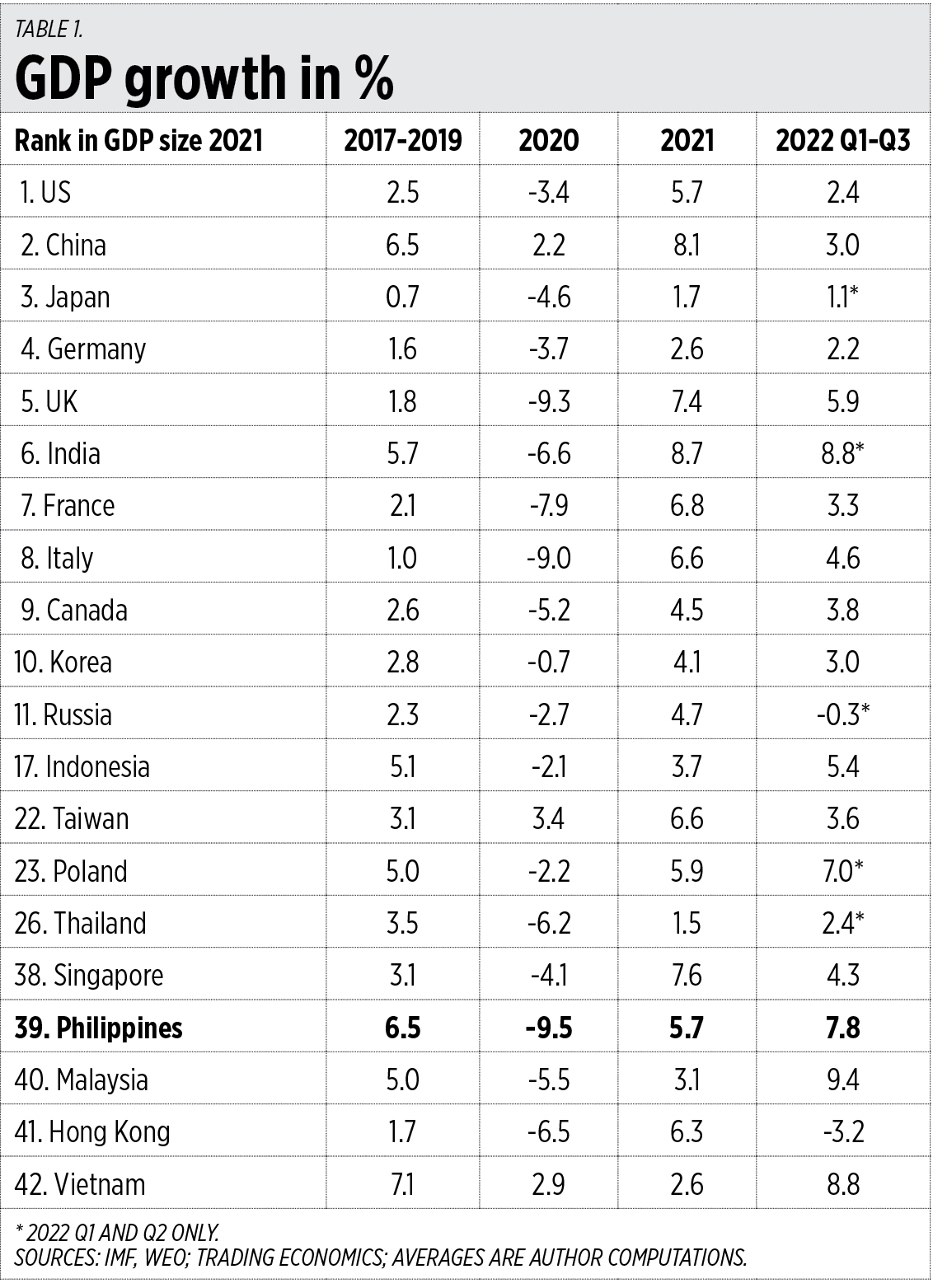
The Philippine Statistics Authority (PSA) reported some good news last Thursday — the country’s GDP growth in the third quarter (Q3) was 7.6%.

Of the 16 private economists polled by BusinessWorld (“Q3 GDP growth likely slowed — poll,” Nov. 7), only two — Ser Peña-Reyes of Ateneo and Jonas Ravelas of eManagement — made near projections of 7.7% and 7%, respectively.

Until early October, all the multilaterals — the Asian Development Bank, the World Bank, and the International Monetary Fund (ADB, WB, IMF) — projected growth of 6.5% in 2022. Since they knew that Q1 and Q2 average growth was already at 7.8%, they implied that the average growth in Q3 and Q4 would only be 5.2%. Far out. They may have good econometric models but archaic and unrealistic assumptions in plugging numbers to their models.

This column projected that the Philippines’ GDP growth would be 7-7.5% for Q3 2022. I wrote the following statements in BusinessWorld:

1. “The DBCC growth target of 6.5%-7.5% in 2022 is attainable — and we will likely surpass it. The growth target from 2023-2028 of 6.5%-8% is also attainable.” (“Growth recovery, declining births, and rising power demand,” Aug. 15).

2. “I see growth of 7-7.5% in Q3 and this will likely be sustained in Q4. So, the full year 2022 growth would be around 7.5%, not the 6.5% projection of the multilaterals.” (“Today’s topics: Economic briefing in Washington DC, PPP Center, Tariff Commission, and agencies with no secretaries,” Oct. 17).

3. “I retain my growth projection for the Philippines of 7-7.5% in Q3, Q4, and full year 2022.” (“This week: Growth, commodities inflation, and birth deflation,” Oct. 31).

In 2020, the Philippines had the worst economic contraction in Asia. This year, it looks like the Philippines will have the fourth fastest growth in Asia after Malaysia, Vietnam and India (see Table 1).
What explains the fast growth in Q3? I see three immediate reasons.

One, the lifting of the lockdown by President Ferdinand Marcos, Jr., the assurance in his first state of the nation address last July that he would not impose any more lockdowns.

Two, the very early formation of the competent economic team. Then the early announcement by Finance Secretary Benjamin Diokno that there would be no tax hikes in major sectors despite the huge public debt that ballooned over the last two years. Budget Secretary Amenah Pangandaman also announced measures to have fiscal discipline via bureaucracy rightsizing. National Economic and Development Authority Secretary Arsenio Balisacan announced the medium-term plan and more government intervention that was not included there.

Three, the series of Philippine Economic Briefing (PEB) investment roadshows by the president and the economic team in September alone — in Jakarta and Singapore on Sept. 6 and 7, and New York City on Sept. 22. This sent a clear, explicit signal to domestic and foreign investors that market-oriented reforms are already in place for them.

My projection for Q4 GDP growth is 7.5-8%. I will explain the basis for this in the next few weeks.

POWER SUBSIDIES, TRANSMISSION AND GENERATION
I want to comment on these four recent reports in BusinessWorld.

1. “ERC determining extent of subsidies for marginalized power consumers” (Nov. 7)

2. “NGCP fined P5.1 million over failure to maintain adequate reserve power” (Nov. 8)

3. “Grid operator to appeal P5.1-million ERC fine” (Nov. 10)

4. “Meralco raises electricity rates for November” (Nov. 10)

Report number one is about Republic Act (RA) 11552 extending the lifeline rate, or subsidies for low usage consumers, from 20 to 50 years. There are two problems with endless subsidies like this law. One, not all low-usage consumers are poor — they may be rich people who have vacation houses somewhere and just occasionally use these and hence, consumption is low. And, two, other consumers will be forced to pay for that subsidy and this will distort household savings and spending.

Reports number two and three show that the National Grid Corp. of the Philippines (NGCP) — the only remaining private monopoly nationwide — is indeed part of the reason why there are still regular yellow and red low power alerts happening this year. Power supply and reserves are often thin and can lead to rotating blackouts, which can lead to damaged appliances and machines, the frequent use of gensets by companies and candles by the poor, and few investors coming in. While ageing power plants and a sudden spike in power demand can be blamed, the NGCP has its share of blame because of its continued failure to procure adequate levels of reserve power exclusively contracted to them to ensure grid security and stability.

The monopoly has a dual role and responsibility, as a network and a system operator and has been lacking in both roles. If it does not want to secure firm contracts for ancillary services and grid reliability, then it can leave its role as the system operator and give it to Transco.

I saw the NGCP press release that was published in bilyonaryo.com, and find it weird and deceptive. It talked about politics and “political maneuvers” when the real issues are grid stability, and how we can avoid having regular yellow-red alerts even during the rainy months.

The Energy Regulatory Commission (ERC) is correct. The NGCP, the monopolist, should shape up, pay the fines, obey the regulator or risk losing the franchise that granted it a monopoly nationwide in power transmission function.

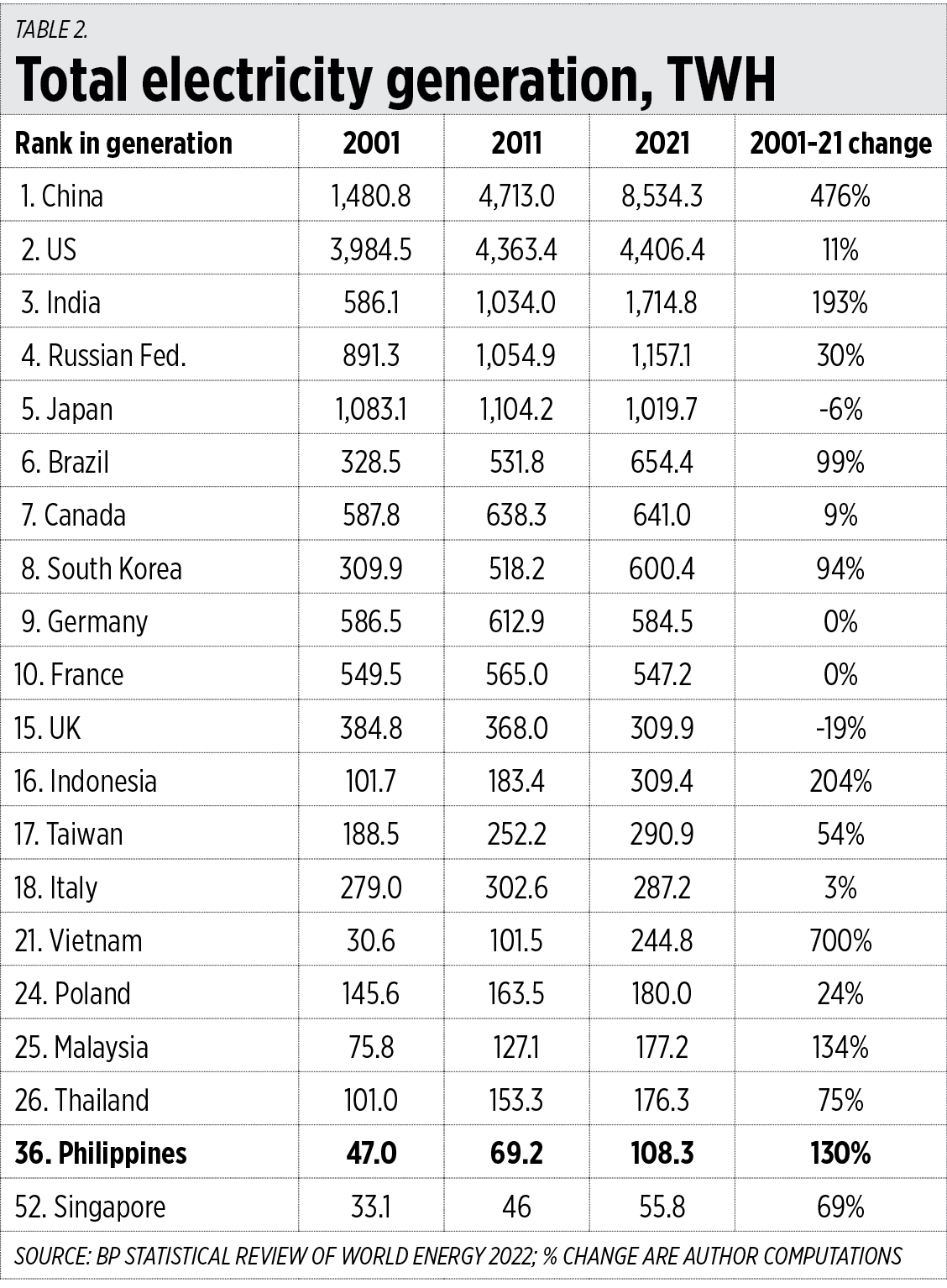
The Philippines has low GDP partly because of its low power generation capacity. In 2021, the country produced a total (on-grid plus off-grid power) of only 108.3 terawatt-hours (TWH), of which the combined contribution of solar plus wind was only about 2.7 TWH or just 2.5% of total. Vietnam’s power generation is more than twice our’s, Malaysia and Thailand’s are about two-thirds larger, than the Philippines (see Table 2).
Many companies might want to expand operations but they see that they will face blackouts due to the low power supply and margins, so they postpone expansion. And this puts a brake on more economic growth.

Countries with high expansion in power generation over the last two decades (at least 130%, see Table 2) are also the same countries that had GDP growth of 5% or higher prior to the lockdowns of 2020-2021 (see Table 1) — China, India, Indonesia, Vietnam, Malaysia, and the Philippines. They are also poised to have at least 5% growth this year. Nonetheless, the Philippines must expand its power generation significantly from the current average of about 5-6 TWH/year to 8-9 TWH/year in 2023-2028. Vietnam’s generation increases by about 18 TWH/year.

Report number four is about the rise in power generation charge by plants with power supply agreements (PSAs), and not due to distribution charge or spot market generation cost and other factors. Meralco remains a responsible distribution utility that keeps its overall, all-in price of below P10/kwh while many electric cooperatives nationwide have rates that are twice its level, which penalize many consumers in the provinces.

POLAND NATIONAL DAY
Upon the invitation of the Embassy of Poland to the Philippines, I attended the celebration of their national day on Nov. 11 at the Blue Leaf Pavillion, McKinley Hill, Taguig City. It was the second event by the embassy that I attended. The first was when Marcin Przydacz, Undersecretary of State in the Polish Ministry of Foreign Affairs, came to Manila for a press conference on July 13 on the subject of Poland-Asia economic cooperation and the war in Ukraine.

Before the program started, I briefly spoke with Poland’s Ambassador, Jaroslaw Szczepankiewicz, and thanked him personally for the invitation. Among the guests from the diplomatic community in Manila that I met that night were the Thai Ambassador Vasin Ruangprateepsaeng, the Indonesian Ambassador Agus Widjojo, and Czech Republic First Secretary and Consul Jan Krivos.

Poland is the 23rd largest economy in the world (its 2021 GDP size was $679 billion) and 10th largest in Europe. I included Poland in both tables in this column to further situate its economic and energy capacity. The Philippines’ main trade partners in Europe are the Netherlands, Germany, the United Kingdom, and France. There should be good business potentials between the Philippines and Poland when there is closer trade and investment promotion activities done in both countries.


Bienvenido S. Oplas, Jr. is the president of Minimal Government Thinkers.

minimalgovernment@gmail.com