Home Blog Page 5109

Coca-Cola PH, Save Philippine Seas help expand community-based waste solution programs through Reimagine Recycling Year 4 

Five community-based programs that offer circular economy solutions have each received up to Php 500,000 in grant funding from the Reimagine Recycling initiative of Save Philippine Seas and Coca-Cola Foundation Philippines, with special participation from Tetra Pak Philippines.

Reimagine Recycling is a program that aims to help non-government groups with emerging circular economy solutions that address issues in solid waste management and help improve the welfare of the informal waste sector. The program will help expand these projects through capacity-building workshops on stakeholder management, communications and business models, mentoring, and financial grant funding. 

Now in its fourth year, it sought program proposals to support and fund through Coca-Cola Foundation Philippines, Coca-Cola Philippines’ social investment arm. Since the call for applications was opened in June 2022, 10 were shortlisted to present their waste solutions and receive training and tools that will equip them in growing their initiatives.

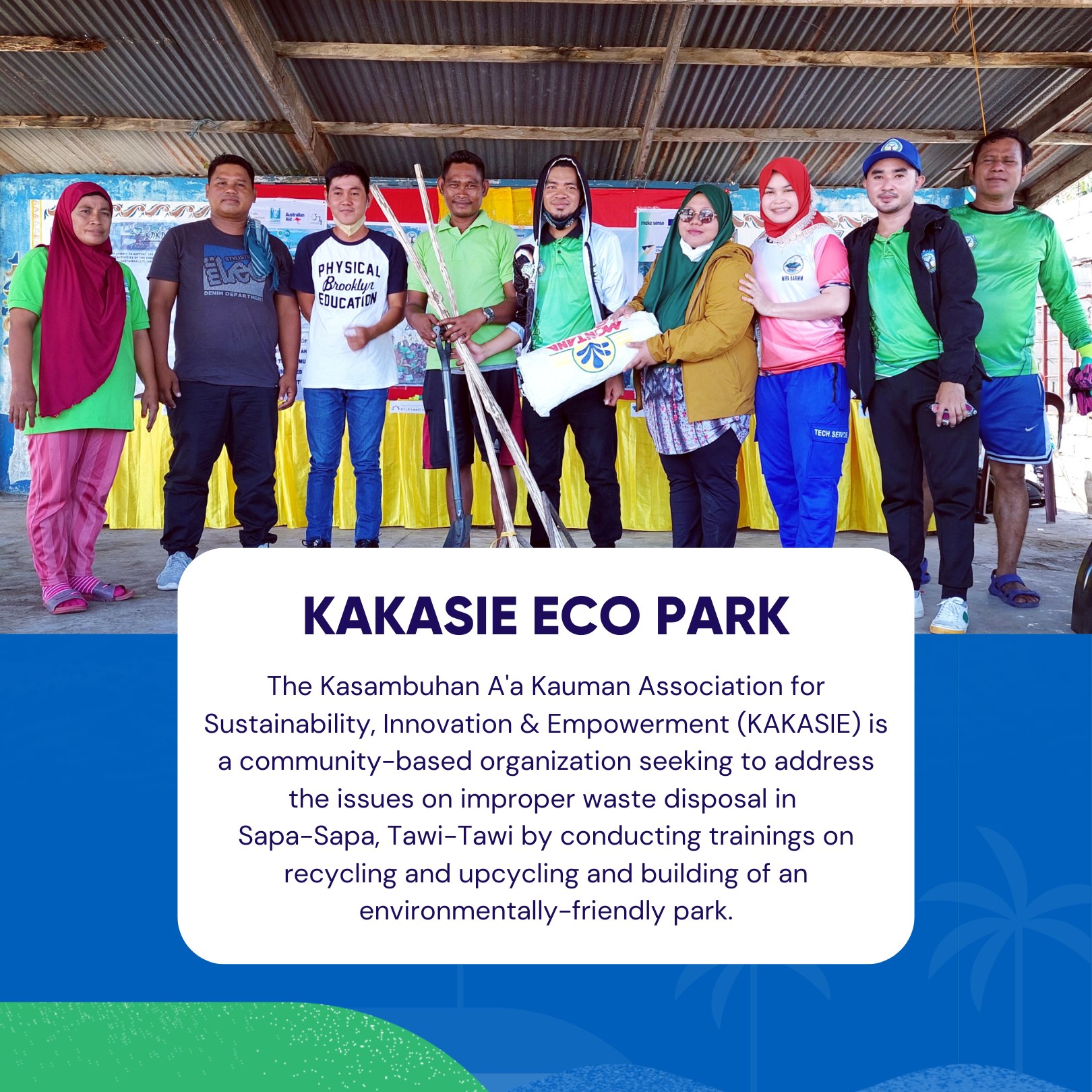
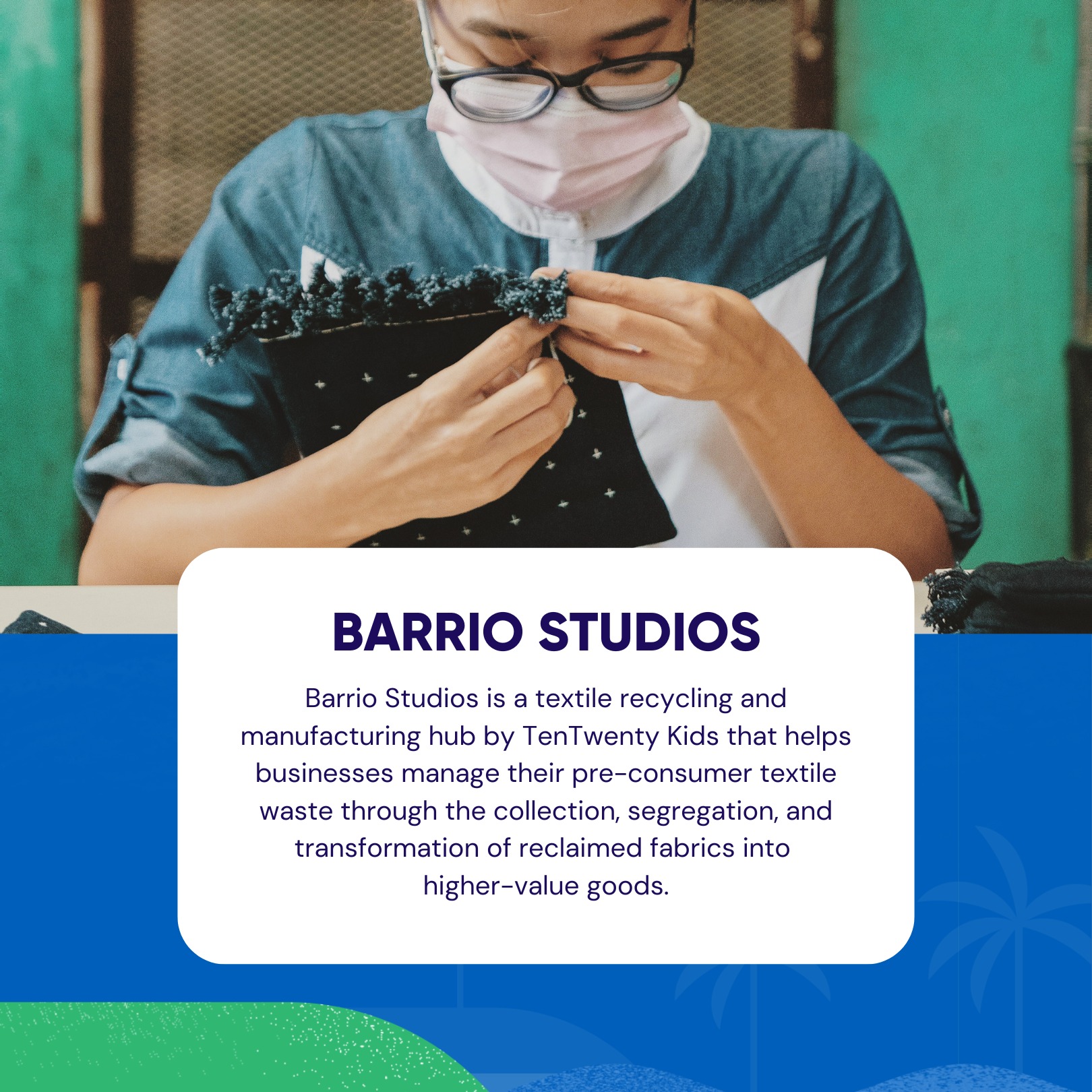
Out of the 10 shortlisted initiatives, Alon and Araw, Barrio Studios, #RefillNotLandfill, Sagip Kalikasan and KAKASIE Eco-Park were awarded grants and will continue their work this time with more project funding, not just on collection and recycling but also in educating communities on proper waste segregation and management.

“We at Coca-Cola believe in the power of partnerships to help address waste pollution and help establish a circular economy in the Philippines. This is why we continue to be supportive of collaborations like Reimagine Recycling that empower innovative and sustainable waste management solutions that create impact in the communities they serve,” said Tony del Rosario, President of Coca-Cola Philippines and Vice President for the East Franchise Operations of Coca-Cola ASEAN and South Pacific. “By partnering with Save Philippine Seas and Tetra Pak Philippines, we can help support entrepreneurs to scale up their existing programs that promote a circular economy, while also strengthening our efforts to achieve our goal of a World Without Waste.”
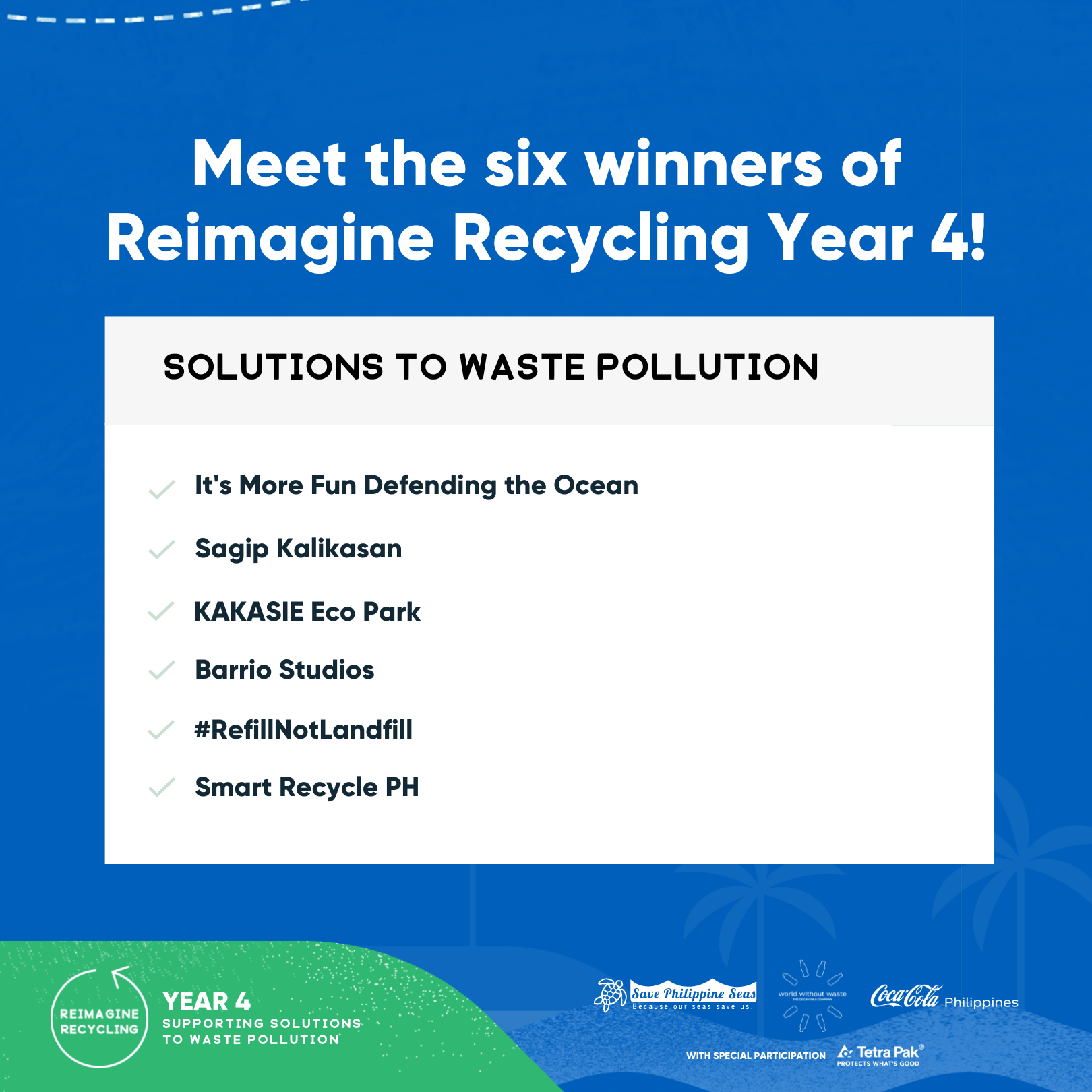

With additional funding from Coca-Cola Philippines and its partners, winners of Reimagine Recycling Year 4 can now focus on expanding and building a stronger foundation for its initiatives:

  • Alon and Araw provides opportunities for underprivileged children of coastal communities through sports, which enable them to foster love for the environment and aspire for a future with a better quality of life. Alon and Araw regularly conducts coastal cleanups as well as sports, education, and personal development workshops that reinforce important values and encourage responsibility within the family, society, and the environment;
  • Barrio Studios is a textile and manufacturing hub by TenTwenty Kids that helps businesses manage their pre-consumer textile waste through the collection, segregation, and transformation of reclaimed fabrics into higher-value goods;
  • #RefillNotLandfill is an advocacy of Suds Sustainable Pods, the country’s first pod brand that offers personal hygiene and household cleaning products packaged in water-soluble film that is biodegradable, non-toxic, and waste-free, offering a sustainable solution to sanitation. Suds was created to help reduce plastic waste and carbon footprint while providing a sustainable alternative that effectively cleans;
  • Sagip Kalikasan aims to prevent the leakage of plastics into the ocean through environmental education, waste segregation, and collection in the municipalities of Naic, Marogondon and General Trias, Cavite. And lastly;
  • Kasambuhan A’a Kauman Association for Sustainability, Innovation and Empowerment (KAKASIE) seeks to help address issues on improper waste disposal in Sapa-sapa, Tawi-Tawi by conducting regular training on recycling and upcycling. The community-based organization also aims to build an environmentally-friendly park.

“It is truly inspiring to work closely with entrepreneurs and advocates on programs that help tackle waste pollution—from plastic waste collection, managing textile waste, to educational training. We are excited to support this year’s Reimagineers and see their initiatives grow through the resources and mentorship provided by the program,” said Anna Oposa, Executive Director of Save Philippine Seas.

Smart Recycle PH was also awarded the Tetra Pak Special Award with grant funding for helping bridge ordinary citizens, business organizations, and verified collection partners, especially for the benefit of local junk shop owners.

“We congratulate Smart Recycle PH for the milestone they have achieved. We’re grateful for the opportunity to support high-potential community-based programs that not only advance grassroots innovation and circularity, but also share our commitment to protecting what’s good through multilateral collaborations,” said Michael Wu, Managing Director, Tetra Pak Market Malaysia, Singapore, Philippines & Indonesia. “Together with our partners, we hope to continue empowering the next generation to make a positive impact in building a future without waste.”

“Consistent with our mission to help uplift the lives of the communities that we serve, Coca-Cola Foundation Philippines will continue to support innovations that will empower communities and inspire Filipinos to initiate their own waste solution programs, as this year’s Reimagineers have,” said Cecile Alcantara, President of Coca-Cola Foundation Philippines, Inc. “This year’s winners have proven that there are individuals and organizations who are eager to step up and create an impact in their own ways, and we in the Coca-Cola Foundation always welcome such efforts,” she adds.

In 2018, The Coca-Cola Company, through its World Without Waste vision, announced its global ambition to support a circular economy to help eliminate waste through the continual use of packaging as a valuable resource. In addition to the Reimagine Recycling program, Coca-Cola Philippines is accelerating more waste management solutions aligned with its World Without Waste goals. The company has this year opened PETValue, the first bottle-to-bottle recycling facility in the country. PETValue is a joint venture between Coca-Cola Beverages Philippines Inc. and Indorama Ventures, a global leader in packaging solutions. Coca-Cola also continues to find and deploy sustainable, effective solutions to help address the waste issue with the support of partners and communities.

For more information about Reimagine Recycling, please visit https://www.savephilippineseas.org/.

You may also read more about Coca-Cola Philippines’ World Without Waste initiatives at https://www.coca-cola.com.ph/news/our-world-without-waste-progress.


Spotlight is BusinessWorld’s sponsored section that allows advertisers to amplify their brand and connect with BusinessWorld’s audience by enabling them to publish their stories directly on the BusinessWorld Web site. For more information, send an email to online@bworldonline.com.

Join us on Viber to get more updates from BusinessWorld: https://bit.ly/3hv6bLA.

Arthaland’s Savya Financial Center one with the government in revitalizing MSME sector

From left to right: Ma. Angelina B. Magsanoc (VP-Marketing), Christopher G. Narciso (Executive VP),
Cornelio S. Mapa Jr. (Executive VP and Treasurer), Leonardo T. Po (Director and Treasurer – Century Pacific Food, Inc.),
Enrique Y. González (Director), Teodoro Alexander T. Po (Vice Chairman, President and CEO - Century Pacific Food,
Inc.), Oliver L. Chan (Senior VP), and Sheryll P. Verano (Senior VP).

Savya Financial Center, was recently unveiled with His Excellency President Ferdinand R. Marcos Jr. leading the ribbon-cutting ceremony. During his keynote speech, the President said this new financial hub is a welcome space for small and medium local enterprises, to find and create meaningful opportunities for their businesses.

Built in partnership between Arthaland, Esquire Financing Inc. and Mitsubishi Estate Corporation, Savya Financial Center is the first premium green office building in ARCA South, Taguig. Its sustainability features will help Micro, Small and Medium Enterprises (MSMEs) grow their businesses.

President Ferdinand ‘Bongbong’ Marcos Jr. led the ribbon-cutting ceremony alongside Herbert Sy (Director – China Bank), Ravi Uttamchandani (Vice Chairman and Treasurer– Esquire Financing Inc.), Rex Mendoza (Director – Esquire Financing Inc.), Rajan Uttamchandani (Chairman and Chief Executive Officer – Esquire Financing Inc.), Ashok Uttamchandani (Chairman Emeritus – Esquire Financing Inc.), Bianca Zobel (Social Secretary), Enrique Y. González (Director – Arthaland), Leonardo T. Po (Director and Treasurer – Century Pacific Food, Inc.)

“This building’s sustainable features and use of state-of-the-art technology promote a safe, healthy, and more productive working environment for its occupants. Its various features will provide its occupants water and energy savings by as much as 40%. It has a hospital grade air filtration system for good indoor air quality 24/7. Savya Financial Center will also be powered by 100% renewable energy to decarbonize the building’s operations. These are just some of the features that will allow Savya Financial Center to provide a positive impact on people and the planet. That is why more companies are moving to green buildings because they see the financial, environmental, and social benefits of doing so.” said Enrique Y. González, Director of Arthaland.

Savya Financial Center is a world-class building in an ideal location for many businesses as well as government offices that seek to be better connected to private sector companies whose requirements it services. These companies and government agencies have the same desire to place sustainability and the health of their employees at the highest priority.

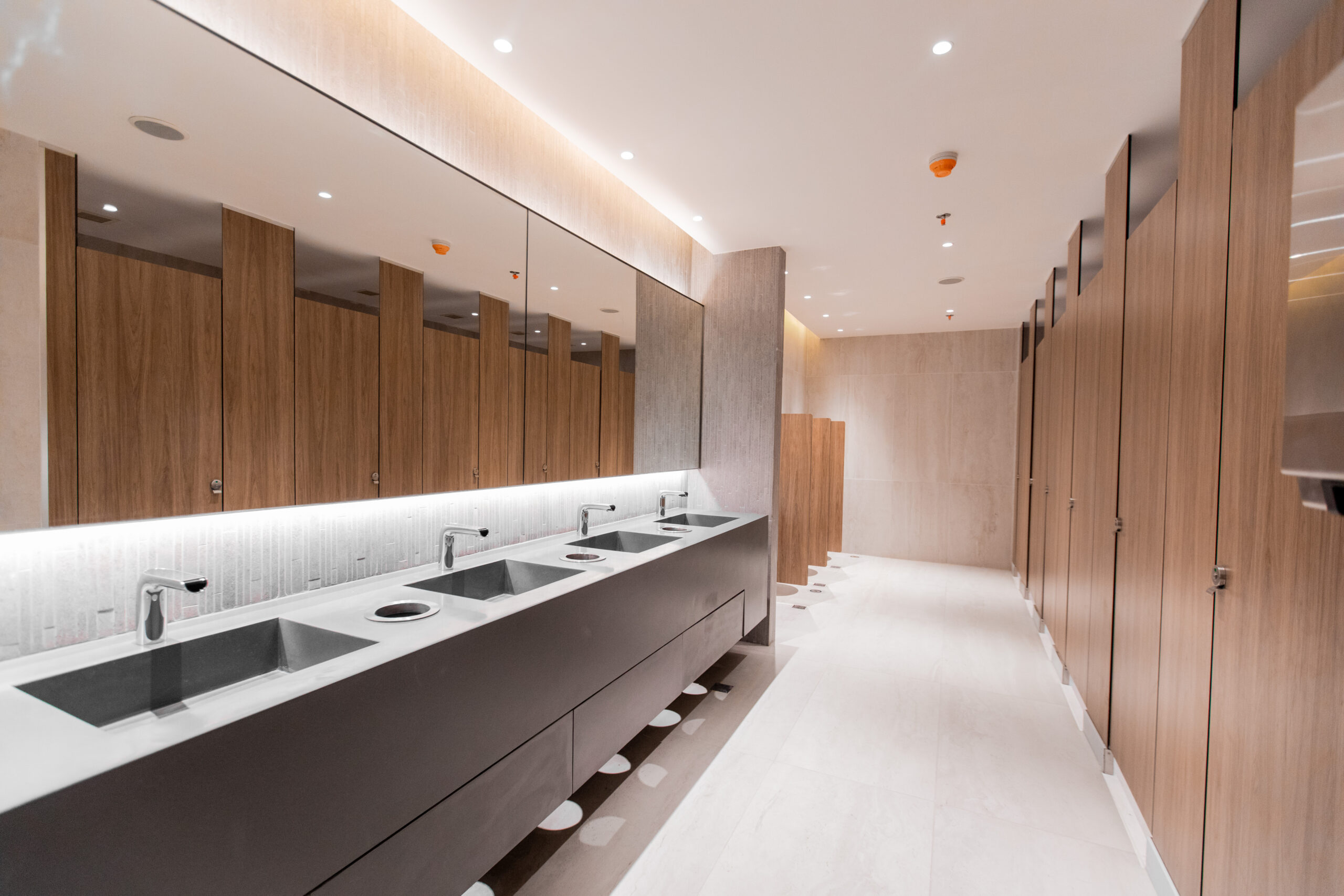
Operable double-glazed low-e glass windows that help reduce operating costs and promote a healthier and more productive environment

“We hope by dedicating this facility to the growth and education of MSMEs by providing access to finance and support services we will be able to support the government’s vision of empowering and fueling dreams of MSMEs throughout the country,” said Rajan Uttamchandani, Chairman and Chief Executive Officer of Esquire Financing Inc.

The development of ARCA South is in full swing and soon, it will be one of the most connected Central Business and Lifestyle Districts of Metro Manila. The main advantage of ARCA South is its accessibility, especially when the Taguig Integrated Terminal Exchange is operational which will provide the connection to different modes of transportation. The efficiency of this integrated terminal exchange is significantly enhanced by its upcoming connectivity to major infrastructure – the C5 ramp, the Skyway ramp from South Luzon Expressway, the Mega Manila subway station, and the access to the Southeast Metro Manila Expressway. All these will provide a seamless and more efficient travel for thousands of employees who will be living and working within the new CBD, decongesting other areas of Metro Manila.

Hands-free and low-flow plumbing fixtures that help combat virus-transmission and reduce water consumption

Arthaland is the only property developer in the country whose projects are all certified locally and internationally as green and sustainable. It is the first property developer in Asia to be a signatory to the World Green Building Council’s Net Zero Carbon Buildings Commitment. 100% of its projects are registered and are on-track for net zero carbon certification. Arthaland has proven that building green works and hopes that others will follow suit for the benefit of generations to come.


Spotlight is BusinessWorld’s sponsored section that allows advertisers to amplify their brand and connect with BusinessWorld’s audience by enabling them to publish their stories directly on the BusinessWorld Web site. For more information, send an email to online@bworldonline.com.

Join us on Viber to get more updates from BusinessWorld: https://bit.ly/3hv6bLA.

Job quality worsens in September

Commuters wait for public transportation along Ortigas Extension in Cainta, Rizal, Sept. 14, 2022. — PHILIPPINE STAR/ WALTER BOLLOZOS

By John Victor D. Ordoñez, Reporter

THE UNEMPLOYMENT RATE in September dropped to a new low since the start of the coronavirus pandemic, but job quality continued to worsen, the Philippine Statistics Authority (PSA) said on Tuesday.

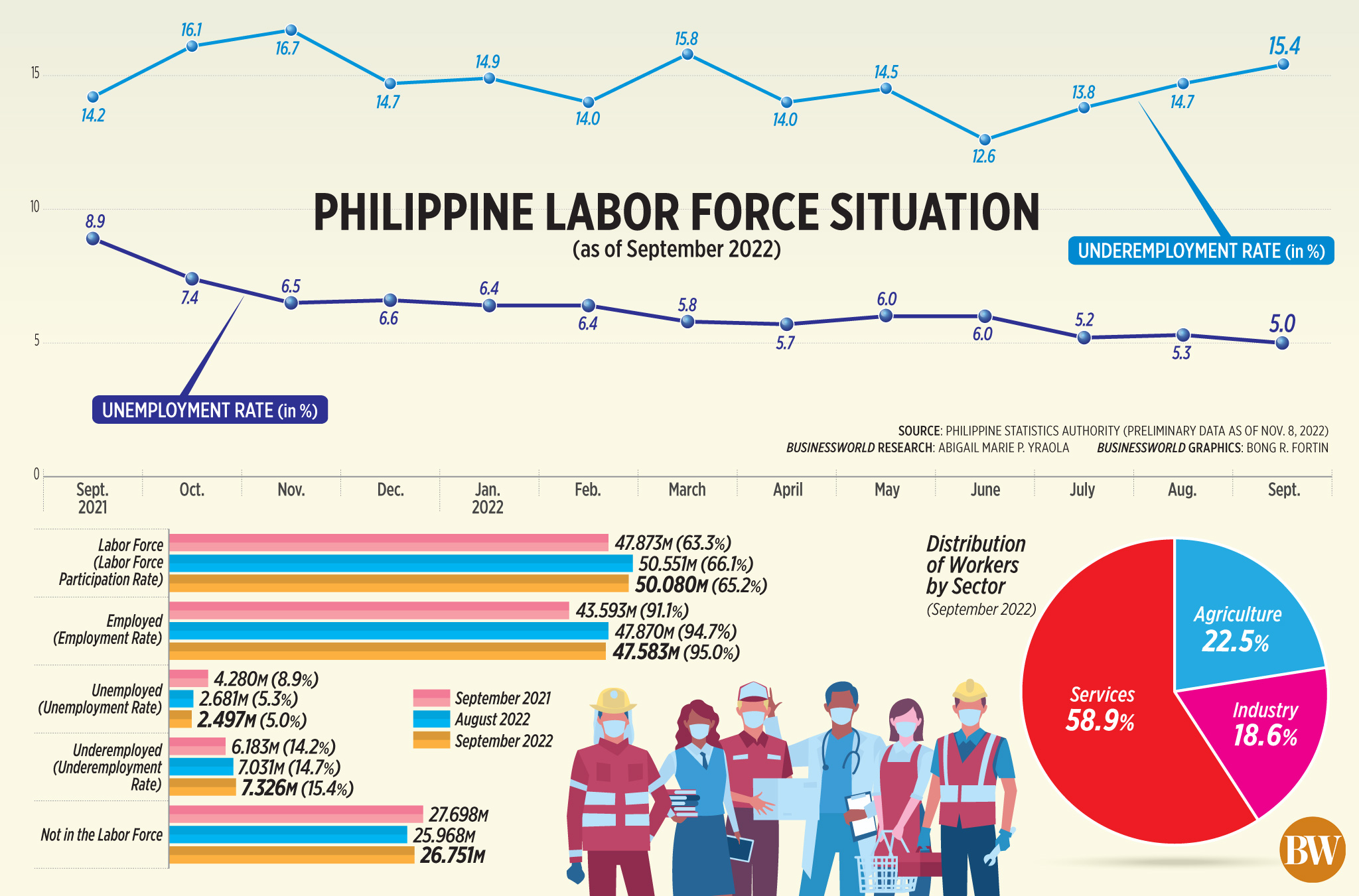
Preliminary data from the PSA’s Labor Force Survey (LFS) showed the September jobless rate eased to 5%, from 5.3% % in August and 8.9% in the same month last year.

This was equivalent to 2.5 million jobless Filipinos in September, lower than 2.681 million in August and 4.28 million in September 2021.

PHL labor force situation

The month saw the lowest number of unemployed Filipinos since October 2019, when 2.05 million were jobless.

“The recent survey results show the gains of the full reopening of our economy,” Socioeconomic Planning Secretary Arsenio M. Balisacan said in a statement.

Metro Manila and most provinces have been at the most lenient alert level since March, allowing businesses to operate at full capacity.

However, job quality further deteriorated in September as the underemployment rate — or the rate of employed Filipinos seeking for more work — rose to a six-month high of 15.4%. This was higher than the 14.7% underemployment rate in August, and 14.2% a year earlier.

September also marked the third straight month that underemployment has increased.

In absolute terms, the number of underemployed Filipinos increased to 7.33 million in September from 7.031 million in August, “as more than 882,000 individuals sought to earn additional income with the spike in commodity prices due to inflation,” the National Economic and Development Authority (NEDA) said.

Labor Force Participation Rate (LFPR) — the share of the Filipino workforce to the total working age population of 15 years old and over — slipped to 65.2% in September, from 66.1% in August. The September LFPR was still higher than the 63.3% seen a year ago.

The size of the total labor force dropped to 50.08 million in September, from 50.551 million in August.

PSA Undersecretary and National Statistician Claire Dennis S. Mapa said the school opening in September led to some to opt out of the job market and return to the classroom.

Mr. Mapa said the unemployment rate will likely stay near the 5% level for the last three months of 2022. For the nine-month period, the unemployment rate already averaged 5.7%.

In 2019, the unemployment rate was at 5.1%.

“Before the pandemic, there was a seasonal increase in employment numbers and percentage, and there was a decrease in unemployed numbers and percentage in the last quarter, primarily because we have a lot of seasonal jobs, at the malls and shops. With the current condition we don’t know if it will show up in the numbers,” he said in mixed English and Filipino.

Elevated inflation may hurt job creation in the next few months.

“Of course, the increasing inflation rate will bring challenges since it will impact the demand for jobs,” Mr. Mapa said.

Headline inflation accelerated to 7.7% in October from 6.9% in September which was the fastest increase in nearly 14 years.

Meanwhile, the employment rate stood at 95% in September, up from 94.7 in August and 91.1% in the same month a year ago. The NEDA said this was the highest recorded employment rate since January 2022, mainly due to the “significant de-escalation of community quarantine restrictions.”

This translated to 47.58 million employed Filipinos, slightly less than 47.87 million a month prior but higher than the 43.59 million in September 2021.

PSA data showed an employed Filipino on average worked 39.6 hours a week in September compared with 40.5 weekly hours in August.

By sector, services remained the top employer as it accounted for 58.9% of the total working population, followed by agriculture (22.5%) and industry (18.6%).

The manufacturing sector posted the highest monthly increase in jobs, adding 780,000 to 4.45 million workers in September.

“(The manufacturing jobs growth) speaks positively of the resilience of demand despite high costs of doing business. However, persistently high costs of raw materials, borrowing, and labor, as well as a dimmer external outlook could impede job growth in the sector,” China Banking Corp. Chief Economist Domini S. Velasquez said in a Quick Take report.

On the other hand, wholesale and retail trade saw jobs drop by 335,000 to 10.71 million in September.

Ms. Velasquez said job losses were seen particularly in food and beverage retail, such as supermarkets and sari-sari stores, “as rising input costs likely squeezed profits.”

PSA data also showed 120,000 job losses in agriculture and forestry in September.

“With fewer laborers for production, domestic supply of agricultural commodities could be at risk and possibly stoke inflation further,” Ms. Velasquez said.

Michael L. Ricafort, chief economist at Rizal Commercial Banking Corp., said the jobs situation may improve in December as companies typically hire more to cope with increased demand.

“During the holiday season, some companies have seasonal increases in employment. They also post their highest revenues of the year,” he said in a Viber message.

China Bank’s Ms. Velasquez said the outlook for underemployment is “shaky.”

“Underemployment will likely remain elevated as high inflation leaves low-income workers looking for additional income to augment higher cost of living,” she said.

Federation of Free Workers Vice-President Julius H. Cainglet said workers still need higher wages to cope with rising prices of food and utilities.

NPL ratio further eases in September

PHILIPPINE STAR/ WALTER BOLLOZOS
Soured loans held by big banks fell for a seventh month in a row in September as the economy continued to reopen. — PHILIPPINE STAR/ WALTER BOLLOZOS

By Keisha B. Ta-asan, Reporter

BAD DEBTS held by big banks declined for a seventh straight month in September, bringing the nonperforming loan (NPL) ratio to its lowest in 25 months as the economy continued to reopen.

The banking industry’s nonperforming loans dropped by 14.6% year on year to P415.225 billion in September from P486.362 in the same month last year, based on the latest data from the Bangko Sentral ng Pilipinas (BSP).

The September figure was also 0.6% lower than the P418 billion seen in August.

This brought the systemwide NPL ratio to 3.43% in September, easing from 3.53% in August, and 4.44% in September 2021.

The September NPL ratio was the lowest in 25 months or since the 2.84% recorded in August 2020.

Loans are deemed as nonperforming once a borrower has not paid for at least 90 days after the due date. These soured loans pose risks to the asset quality of banks as borrowers are likely to default on these debts.

“Lower reported NPLs is still mostly driven by the reopening story of the PHL economy this year. With more businesses returning to pre-pandemic performance, less firms need to delay payments of their obligations,” Bank of the Philippine Islands (BPI) Lead Economist Emilio S. Neri, Jr. said in a Viber message.

Since March, Metro Manila and most provinces have been under the most lenient alert level that allowed businesses to operate at full capacity.

According to BSP data, the gross loan portfolio of banks climbed by 10.3% to P12.09 trillion in September from P10.96 trillion a year ago. It also went up by 2.1% from the P11.84 trillion in August.

Meanwhile, past due loans fell by 14.5% to P488.714 billion in September from P571.597 billion in 2021, bringing the current ratio to 4.04% from 5.21% a year ago.

Restructured loans, which accounted for 2.76% of banks’ loan portfolio, dipping by 1.7% to P333.615 billion in September from P339.273 billion a year ago.

Banks continued to build up loan loss reserves to P424.643 billion in September from P410.605 billion a year ago, bringing the ratio to 3.51% from 3.74% a year earlier.     

The banking industry’s NPL coverage ratio improved to 102.3% as of September, from 84.42% in 2021.

China Banking Corp. Chief Economist Domini S. Velasquez said banks’ bad loans may continue to decline in the coming months as businesses continue to bounce back.

“Loans to productive sectors/industries have been posting positive growth rates except for a few such as education and accommodation. These sectors will likely contribute moving forward with the full resumption of face-to-face classes and increase in tourist arrivals,” she said.   

The school year started on Aug. 22 for most schools. Starting this month, public schools have been mandated to return to face-to-face classes, while private schools may continue to conduct a blended approach.   

The number of tourists is also expected to increase ahead of the holidays.

Mr. Neri noted there is a risk the NPL ratio could rise if elevated inflation and other global headwinds weigh on economic growth.

“In an adverse scenario, potential trigger to a spike in NPLs are liquidity problems that some highly leveraged domestic entities may encounter. These firms were lured by artificially low policy rates to carry out aggressive acquisitions by loading up their balance sheets with sizeable debt,” he said.

Headline inflation at the national level rose to 7.7% year on year in October from 6.9% in September. It was the seventh straight month that inflation exceeded the central bank’s 2-4% target.

To tame inflation, the BSP has raised benchmark interest rates by 225 basis points (bps) so far this year, bringing the overnight reverse repurchase rate to 4.25%. The Monetary Board is widely expected to raise by 75 bps at the policy meeting on Nov. 17.

BSP officials earlier said the NPL ratio of Philippine banks may peak at 8.2% in 2022.

The ratio stood at 3.99% as of end-December 2021.

House OK’s tax on foreign digital services, removal of tax exemption on pickups

A smartphone with the Netflix logo is seen in this illustration taken March 24, 2020. — REUTERS/DADO RUVIC/FILE PHOTO

THE HOUSE of Representative on Tuesday approved on second reading three priority tax measures, which seek to remove the tax exemption on pickup trucks and impose taxes on foreign digital services and single-use plastic bags.

“The measures could yield a total of P47 billion annually,” Albay Rep. Jose Ma. Clemente S. Salceda, who chairs the House Ways and Means Committee, said in a statement.

Mr. Salceda said P20 billion is expected to be generated from House Bill (HB) No. 4339 or the fourth package of the Comprehensive Tax Reform Program (CTRP), mainly from the removal of the tax exemption on pickup trucks and raising the tax rate on foreign currency deposit units to 20%.

He defended removing the tax exemption for pickup trucks, which was opposed by the auto industry, saying “merely corrects an unfair privilege on a vehicle that is mostly for the rich, occupies very large space on the road, and is by all accounts less fuel-efficient than most other vehicles.”

The measure also seeks to simplify taxation of passive income by reducing rates applicable and harmonizing most rates at 15%. It also proposes a gross receipts tax on bank, quasi-bank and other nonbank financial intermediary income of 5%, a premium tax of 2%, and a stock transaction tax of 0.1%.

HB 4339 proposes to rationalize the documentary stamp tax (DST) regime by imposing a single rate on the original issue of shares and units of participation of collective investment schemes. It also seeks to remove the DST on documents required for routine transactions.

At the same time, Mr. Salceda said around P19 billion in revenues can be raised from HB 4122, which will slap a 12% value-added tax (VAT) on nonresident digital service providers, such as Netflix and Spotify.

“For the digital services VAT, it will not be imposed on Filipino businesses. The emphasis is on foreign or nonresident digital service providers. All major ASEAN (Association of Southeast Asian Nations) economies impose VAT on these entities. We’re the only ones that do not,” Mr. Salceda said.

If signed into law, a 12% VAT will be imposed on the digital sale of services including video on demand subscriptions, online advertisements and supply of other electronic services which can be delivered through mobile applications, online marketplaces and webcasts, among others.

This would also amend the National Internal Revenue Code of 1997 to include a section that would require foreign digital service providers (DSPs) to collect and remit VAT for all transactions that are done through their platforms.

Lawmakers also included a provision stating that 5% of the revenues from the VAT on digital service providers will be allocated for the Creative Industries Development Fund.

Meanwhile, the House also approved on second reading HB 4102, or the Plastic Bags Act, which is expected to raise P9.3 billion in revenues.

The measure seeks to impose an excise tax of P100 for every kilogram of single-use plastic bags sold. Lawmakers increased the amount of excise tax to P100 from P20, and added a provision stating the tax rate would be increased by 4% every year starting Jan. 1, 2026.

Incremental revenue from the tax will be allocated to the programs of the Department of Environment and Natural Resources.

Mr. Salceda said he expects the House to approve the three bills on third reading by Nov. 14 or 15.

Meanwhile, the House Committee on Government Reorganization is expected to take up the Real Property Valuation and Assessment Reform Act or Package 3 of the CTRP within the week. — Matthew Carl L. Montecillo

Built on trust

The Entrepreneur Of The Year Philippines 2022 has concluded its search for the country’s most undaunted and unstoppable entrepreneurs. Entrepreneur Of The Year Philippines is a program of the SGV Foundation, Inc., with the participation of co-presenters the Asian Institute of Management, the Department of Trade and Industry, the Philippine Business for Social Progress, and the Philippine Stock Exchange. In the next few weeks, BusinessWorld will feature each finalist for the Entrepreneur Of The Year Philippines 2022.


Ibrahim “Bong” Nuño
Chairman and Chief Executive Officer
Metro Stonerich Corp.

WHEN CIVIL ENGINEER Ibrahim “Bong” Nuño started Metro Stonerich Corp. (MSC) in November 1999, his first tool was a P2,500 drill from a hardware store. Today, MSC has grown from a P500,000 company to a multibillion-peso business and one of the country’s major construction players.

But for Mr. Nuño, what’s important is not just financial success — it’s the difference he can make through MSC’s integrity, reliability, and quality.

The MSC founder and chief executive officer (CEO) originally dreamed of being a pilot while growing up in Taluksangay, Zamboanga City. As the eldest grandson of the fourth generation of the Nuño clan, he grew up watching how his grandfather Jainuddin Nuño, an engineer at heart and a self-taught architect, would supervise some of the community’s construction activities.

However, Mr. Nuño could not enroll in a flying school due to its expensive tuition. Instead, he took up civil engineering at Adamson University — a decision he admits may have been influenced by his Papa Jainuddin.

After graduation, he worked in Saudi Arabia as a project manager for a US firm for a few years. After he got married, he and his wife, Yasmin S. Nuño, decided to stay in the Philippines and open a small business, buying and selling retail fashion and novelty items.

But he still wanted to practice his profession, so he applied at a construction management company. After handling a major building project, he was endorsed by a contractor to Philippine Commercial International Bank (PCIBank). He became the head of PCIBank’s in-house construction group, handling the renovation and construction of almost 300 branches and bank facilities. Over seven years, his personal network of contacts grew into a strength he would rely on in the future.

When the bank’s owners decided to sell PCIBank to Equitable Bank which resulted in a merger in 1999, Mr. Nuño and Maximillian “Jojo” Quintos, another mainstay of PCIBank’s construction unit, used their retirement pay to start MSC.

They initially chose renovation projects because these didn’t require large investments in equipment. Their first rehabilitation client was the Manila Waldorf School, where his son studied.

Most contractors at the time prioritized big projects, avoiding smaller jobs like renovation. For Mr. Nuño, no job was too small for MSC. The company began building a name for itself with the help of Mr. Nuño’s network who trusted his integrity and commitment to quality.

MSC’s early years were hard. Mr. Nuño and the other incorporators only took allowances because their income was cycled back into MSC as capital. This helped to show banks how serious they were in their financial objectives.

“Our own clients later urged us to go into general construction,” he said. After a year, the company landed its first major project as a general contractor — a bank branch in Greenhills, San Juan. In seven years, MSC was able to secure its ISO Certification and Triple A license. With support from various banks, MSC established enough credit facilities without collateral to support new endeavors: non-general construction projects with retail malls.

In time, MSC established its reputation for quality and affordable end-to-end construction solutions, which have become a sought-after service in the market.

Despite this, the company faced financing issues. Some developers failed to meet the conditions of their contract, delaying payments. MSC managed this through bank financing, allowing it to lock in prices and maintain reasonable costing. This cash flow management became a constant struggle that Mr. Nuño oversaw himself, staying on top of costs and receivables every week.

As MSC’s scope and reach grew, so did his desire to make a difference in the lives of others. He remains deeply passionate about supporting his and other communities, saying that he expects to follow in his father’s footsteps as datu of his community in Mindanao. His social responsibility commitments started with providing scholarships to underprivileged students and mentoring engineering students. He and his wife Yasmin also provide stipends to schoolchildren from Payatas and assistance during disaster relief operations.

The MSC Foundation also handles pro bono work for in-need communities such as the Payatas Parish Church in Quezon City and the Carmelite Monastery Retreat House in Zamboanga City. These projects undertaken by Mr. Nuño and his wife, both practicing Muslims, speak of their inclusive character.

“Whether Christian or Muslim, we are all children of God,” he said, who is also on the board of trustees of the Ateneo de Zamboanga and the only Muslim on the board of trustees of Adamson University.

Today, MSC is also one of the few contractors handling projects for most of the country’s major retail chains and numerous land development companies. Mr. Nuño calls himself fortunate for his exposure to management, his succeeding progression into construction management and eventually, his current business as a contractor, leading him to complete what he called “the cycle of construction.”

For Mr. Nuño, he measures success by the trust of his clients and the difference he can make in various communities.

For those looking to become entrepreneurs, he offered this advice: “Follow your dream and make it happen. Stay focused on your vision and be clear with your intentions to reach your goals. You can become successful while being fair and square. Be ready to work late nights and don’t be discouraged by setbacks. Do not be afraid to ask guidance from those ahead of you. Always put yourselves in the shoes of your clients or customers, and do not forget to give back some of what you’re blessed with.”

The media sponsors of the Entrepreneur of the Year Philippines 2022 are BusinessWorld and the ABS-CBN News Channel. Gold Sponsors are SteelAsia Manufacturing Corp., Uratex, and Navegar. Silver Sponsors are Intellicare, OneWorld Alliance Logistics Corp., and Regan Industrial Sales, Inc. Banquet Sponsors are Uratex and MerryMart Consumer Corp.

The winners of the Entrepreneur Of The Year Philippines 2022 will be announced on Nov. 21 in an awards banquet at the Grand Hyatt Manila. The Entrepreneur Of The Year Philippines will represent the country in the World Entrepreneur Of The Year 2023 in Monte Carlo, Monaco in June 2023. The Entrepreneur Of The Year program is produced globally by Ernst & Young (EY).

Petron profit up 64% to P8B on higher fuel demand

PETRON Corp. posted a 64% increase in net income to P8.2 billion for nine months to September from P4.99 billion a year ago, as the country’s largest oil refining firm recorded increased fuel demand.

“Despite uncertainties from geopolitical conflicts affecting the industry, we are pleased to note that our recovery is still on track,” Petron President and Chief Executive Officer Ramon S. Ang said in a media release on Tuesday.

During the nine-month period, Petron’s local sales volume climbed by almost 30%, which the company attributed to higher fuel demand. Combined sales in its Philippine and Malaysian operations, including its trading subsidiary in Singapore, rose by 37% to 80.4 million barrels from 58.8 million last year.

The company has yet to disclose specific figures for the third quarter.

Petron, which also claims to be the country’s largest marketing company, said the average price of Dubai crude slipped by $11 per barrel to $96.88 in the third quarter because of recession fears. But it said that despite the movement during the quarter, prices of finished fuel products remained high compared with the level in 2021.

“The demand recovery in most economies supported the continued strength of regional refining cracks resulting in the overall improvement in margins,” Petron said in the media release.

From January to September, Petron’s operating income went up by 23% to P16.5 billion from P13.4 billion in the same period last year.

For the nine-month period, the company said its consolidated revenues more than doubled to P631.1 billion from P291.6 billion reported a year ago.

However, the rise was pulled down by the increase in financing cost brought about by the peso depreciation and successive rate hikes.

In its previous regulatory filing, Petron reported a second-quarter net income of P3.51 billion while its net income for the first semester was recorded at P6.76 billion.

Meanwhile, Petron secured approval from shareholders to construct and operate a coco-methyl ester plant. It will proceed to obtain the needed permits.

The company has also acquired a palm methyl ester plant in Malaysia that will serve as an internal source for its biodiesel products. The plant has expanded this year to support local biodiesel demand.

In the company’s disclosure on Tuesday, Petron said that its board of directors approved the declaration of cash dividends of P17.18 per outstanding common shares for shareholders on record as of Nov. 29. The payment will be made on Dec. 26 for preferred shares series 3A.

Meanwhile, its board approved the declaration of cash dividends of P17.85 per outstanding common shares for shareholders on record as of Nov. 29. The payment will be made on Dec. 26 for preferred shares series 3B.

Petron operates the only remaining refinery in the country that provides 40% of local petroleum requirements. Its refinery in Bataan produces 180,000 barrels per day.

In the region, it operates about 50 terminals and has around 2,700 service stations where it sells gasoline and diesel. Its combined refining capacity is 268,000 barrels a day, producing fuels and petrochemicals.

On Tuesday, shares in the company declined 1.24% or P0.03 to close at P2.38 each. — Ashley Erika O. Jose

Ayala Land doubles income to P5B as economy reopens

AYALA LAND, Inc. (ALI) posted P5.26-billion attributable net income in the third quarter, more than two times last year’s P2.55 billion, which the listed property developer attributed to the reopening of the economy.

“The acceleration in business and consumer activity during the period enabled us to generate significant earnings growth,” ALI President and Chief Executive Officer Bernard Vincent O. Dy said in a press release on Tuesday.

In the three months that ended September, the company’s topline rose to P32.97 billion, up by 39.4% from P23.65 billion a year ago. Real estate sales accounted for P30.59 billion of the company’s revenues after a 41% climb from P21.7 billion in 2021.

According to the press release, ALI recorded 21% higher property development revenues to P21.1 billion. Sales from residential projects rose by 28% to P28 billion, while commercial leasing revenues totaled P8.7 billion, 84% higher than last year.

Third-quarter costs and expenses totaled P25.48 billion, up by 27.4% from P20 billion in the previous year.

NINE-MONTH FINANCIAL RESULTS
Year to date, ALI’s attributable net income climbed by 55.3% to P13.34 billion from P8.59 billion a year earlier. Its topline rose by 18.9% to P86.31 billion from P72.6 billion previously.

For the three quarters of this year, the company’s property development revenues reached P54.43 billion, up by 9.4% from P49.74 billion as stated in the company’s quarterly financial report.

According to the press release, ALI’s property development revenues climbed by 7% to P55.2 billion, which it said was driven by its commercial lot sales and the progress of residential projects.

The company said that it had strong investor demand in its commercial estates including Nuvali, Arca South, and South Coast. It registered 82% higher revenues from commercial lots to P7.5 billion.

Residential revenues rose by 2% to P45.6 billion, while office revenues dipped by 26% to P2.1 billion.

Reservation sales from residential products reached P77.3 billion, 10% higher than last year’s, while commercial leasing was up by 64% to P23.3 billion.

“The demand for our residential products remained resilient and local consumption continues to be robust despite geopolitical and macroeconomic challenges. We believe the strength of our local market will provide the backbone to sustain the growth of our diversified real estate portfolio for the rest of the year,” Mr. Dy said.

ALI said that its capital expenditures reached P44.7 billion: 55% was used for residential projects; 10% for commercial products; 14% for land acquisition; 17% for estate development; and 4% for other expenses.

ALI has more than 12,000 hectares of land bank and has developed large-scale, integrated, mixed-use and sustainable estates.

On Tuesday, shares in ALI added 30 centavos or 1.17% to P26 apiece. — Justine Irish DP. Tabile

DMCI’s income rises 84% as business units grow

DMCI Holdings, Inc. reported on Tuesday an 83.8% increase in third-quarter core net income to P7.37 billion from P4.01 billion a year ago, driven by growth in its coal, power, and real estate businesses.

Including non-recurring gains, its consolidated net income rose for the quarter rose by 84% to P7.34 billion from P3.99 billion previously.

“All of our subsidiaries delivered robust results during the nine-month period,” Isidro A. Consunji, chairman and president of DMCI Holdings, particularly citing Semirara Mining and Power Corp. (SMPC) in the firm’s media release.

“But we expect to feel some profit weakness in the last quarter because of higher raw material costs and construction slowdown,” he added.

DMCI Holdings said non-recurring items this year and last year mainly came from Maynilad Water Services, Inc.’s donations, severance pay, and loan pre-payment fees.

Revenues for the third quarter increased by 24.5% to P32.83 billion from P26.37 billion in the same period last year.

JANUARY-SEPTEMBER FINANCIAL PERFORMANCE
For the nine-month period, its net income doubled to P27.63 billion from P13.48 billion a year ago, while its revenues climbed by 42.8% to P114.30 billion from P80.02 billion in the same period last year.

Among its businesses, SMPC accounted for the biggest share with P20.38 billion, up from P5.95 billion last year, on high coal production and higher spot electricity sales volume.

DMCI Project Developers, Inc. (DMCI Homes), the firm’s real estate arm, contributed P3.85 billion as selling prices were higher by 19.2% compared with P3.23 billion a year ago.

Meanwhile, Maynilad’s contribution declined by 1% to P1.11 billion from P1.12 billion a year ago on lower billed volume growth and higher cash operating expenses.

DMCI Mining Corp.’s contributions climbed by 10.6% to P1.09 billion from P983 million last year, pulled up by higher average selling price amid the elevated exchange rates, which helped to tame the impact of lower shipment due to the depletion of its Berong mine.

Contributions from DMCI Power Corp. rose by 28.3% to P549 million from P428 million on higher electricity sales.

SMPC, DMCI Homes, and DMCI Mining accounted for 92% of DMCI Holdings’ net income.

Meanwhile, DMCI Holdings declared an additional cash dividend of 72 centavos per share, which is scheduled for pay out this month.

On Tuesday, shares in the company closed 16 centavos or 1.67% lower to end at P9.43 apiece. — Ashley Erika O. Jose

Bloomberry Resorts swings to profitability, earns P1.56B

BLOOMBERRY Resorts Corp. posted P1.56-billion attributable net income in the third quarter, turning around from a net loss of P1.04 billion a year ago, as gaming volumes improved.

“Against a global economic backdrop of rising inflation and interest rates, our business saw third-quarter gaming volumes further improve toward pre-pandemic levels,” Bloomberry Chairman and Chief Executive Officer Enrique K. Razon, Jr. said in a disclosure on Tuesday.

In the third quarter, the company’s topline rose to P10.06 billion, almost double last year’s P5.13 billion.

Total gross gaming revenue was at P13.37 billion, up by 88.6% from P7.09 billion in 2021, driven by local casinos as operations in its Jeju property were suspended during the quarter.

The company’s VIP rolling chip volume grew by 23.2% to P132.77 billion; mass table drop climbed by 77.1% to P10.56 billion; and slot coin-ins were at P85.1 billion, up by more than two times.

Bloomberry’s operating costs and expenses were also higher by 43.6% to P7.31 billion from P5.09 billion a year ago.

YEAR-TO-DATE FINANCIAL SHOWING
In the nine months to September, Bloomberry reported an attributable net income of P4.05 billion, reversing a net loss of P2.97 in 2021.

Its year-to-date revenues were at P27.27 billion, up by 77.6% from P15.35 billion last year.

“Continued growth during the quarter drove nine-month revenues from our predominantly domestic mass gaming segments to well over 95% of January to September 2019 values, demonstrating the resilience of local discretionary consumption,” Mr. Razon said.

Gross gaming revenues for the period climbed by 80.3% to P35.41 billion from P19.65 billion previously.

For the nine-month period, VIP rolling chip volume climbed by 76.4% to P333.13 billion; mass table drop grew by 50.7% to P26.85 billion; and slot coin-ins reached P217.21 billion, up by two times.

Bloomberry subsidiaries own and operate Solaire Resort & Casino and Jeju Sun Hotel & Casino.

On the stock market on Tuesday, shares in Bloomberry lost 25 centavos or 3.5% to P6.90 apiece. — Justine Irish D. Tabile

ACEN’s net income surges to P1.9B

AYALA-LED ACEN Corp. posted a 22.8% increase in its attributable net income for the third quarter to P1.94 billion, with its international business making up for the decline in local earnings, it said on Tuesday.

In a disclosure, the renewable energy company attributed the lower earnings for its local business to “plant availability issues and the higher cost of power.”

“The Philippine market continues to be challenging given the tight power supply situation and high fossil fuel prices. However, we expect a significant increase in our renewables operating capacity by the middle of 2023, which will not only help address the country’s energy needs, but also significantly improve the company’s financial performance,” said Eric T. Francia, president and chief executive officer of ACEN.

ACEN said its revenues for the third quarter increased by 70.3% to P9.23 billion from the P5.42 billion recorded in the same period last year.

For the nine-month period, ACEN’s profit declined by 3.5% to P4.12 billion from P4.27 billion in the same period last year.

The renewable energy firm’s revenues for the period rose by 34% to P25.11 billion from P18.74 billion last year. It attributed the growth largely to the contributions from new operating merchant plants.

Attributable output as of September rose by 11% to 3,740 gigawatt-hours (GWh), the company said, pointing to the full nine-month contribution of new wind farms in Vietnam and solar plants in India.

Meanwhile, its cost and expenses for the nine-month period climbed by 60.4% to P23.44 billion from P14.61 billion in the same period last year.

On Monday, ACEN announced that it completed divesting its stake in subsidiary South Luzon Thermal Energy Corp. through an energy transition mechanism that allows the early retirement of the unit’s 246-megawatts coal-fired power plant.

In September, ACEN announced that it issued and listed a P10-billion maiden peso-denominated ASEAN green bonds at a fixed interest rate coupon of 6.05% due in 2027.

The bonds comply with the ASEAN green bonds standards in which proceeds are used exclusively to finance or refinance eligible green projects.

In August, ACEN, through its subsidiary in Australia, secured a 100-million Australian dollar long-term revolving loan to fund its green assets in that country as part of a goal to grow its renewables capacity.

On Tuesday, shares in the company closed 0.5% lower to end at P6.02 apiece. — Ashley Erika O. Jose

Globe, DITO working with 3 foreign telcos for subsea cable

GLOBE Telecom, Inc. on Tuesday said it has teamed up with DITO Telecommunity Corp. and three foreign telecommunications companies for a $300-million submarine cable project that is seen to boost data capacity in the region.

The three foreign companies are China Telecom Global Ltd. (CTG) of China, Singapore Telecommunications Ltd. (Singtel) of Singapore, and Unified National Networks Sdn Bhd of Brunei Darussalam, the Ayala-led company said in an e-mailed statement.

The Asia Link Cable (ALC) project is expected to provide “additional hyper-capacity within Asia and boost resiliency for international traffic,” the group said.

“It will have a minimum of eight fiber pairs in the system, with 18 terabytes per second (Tbps)/fiber pair minimum trunk design capacity, adding more capacity and diversity to existing networks in the region,” it added.

The project will be about 6,000 kilometers long, connecting Hong Kong SAR China and Singapore as its trunk, with branches into the Philippines, Brunei Darussalam, and Hainan, China.

HMN Technologies Co., Ltd., the group also said, was awarded as the system supplier and is expected to complete the construction of the project by 2025.

“ALC is a great accomplishment of Asian carriers which overcame difficulties of COVID-19 (coronavirus disease 2019) impacts, and it is also the only subsea project with zero face-to-face meetings from the MoU (memorandum of understanding) to the C&MA (construction and maintenance agreement) signing in the industry,” ALC Co-Chair Chang Weiguo of CTG said.

For his part, ALC Co-Chair Alan Tan of Singtel said: “We started planning and designing the ALC cable more than two years ago at the onset of the pandemic, having anticipated the inevitable growth in high-definition content consumption, trade, and innovation in this region.”

“Despite the challenges presented by safe management restrictions, we managed to come up with a system that will help meet the evolving needs of consumers and enterprises and boost local economies today and in the near future.” — Arjay L. Balinbin