Home Blog Page 5097

Fears for orangutans, dolphins as Indonesia presses on with new capital

A FEMALE orangutan eats an eggplant at a rehabilitation and reintroduction site of Borneo Orangutan Survival Foundation Samboja Lestari located near Indonesia’s projected new capital called Nusantara, in Samboja, East Kalimantan province, Indonesia, March 9, 2023. — REUTERS

SAMBOJA, Indonesia — Just outside Indonesia’s planned new capital on Borneo island, an orangutan catches a banana with one hand, thrown by a conservationist on a boat, while her other hand clings to a tree branch.

She is one of 127 orangutans that the Borneo Orangutan Survival Foundation (BOSF) is caring for in the Samboja district, East Kalimantan. They have lost their homes due to deforestation, often linked to coal mining, and palm oil and timber plantations.

But the giant apes could face an even bigger threat as Southeast Asia’s largest country builds from scratch Nusantara — a new $32 billion city.

The government has promised to protect wildlife and undertake major reforestation in parts of the capital, which has been marketed to investors as a smart and green city.

But environmentalists are wary that construction in an area spanning nearly 260,000 hectares (642,474 acres) — almost four times the size of Singapore — would disturb some of Borneo’s endemic fauna, including endangered long-nosed monkeys, Irrawaddy dolphins and orangutans.

“Our biggest concern is Balikpapan bay will turn into a giant pond, a place for residual waste from Nusantara’s activities,” said Mappaselle, a director with local environment group Pokja Pesisir.

About 400 hectares of mangrove forests along the coastline of Balikpapan bay have already been cleared according to the group’s estimation, to make way for a coal port and oil refinery.

He feared more could be razed when a new toll road is built connecting Nusantara to the nearest city of Balikpapan, as well as a port to bring in construction materials.

The Nusantara Capital City Authority said mangroves would be replanted in other areas and guidelines have been made for workers encountering an animal.

“It’s a very high concern of how we’ll try to have harmony between people, nature and culture…because that’s the soul of the city,” Nusantara chief Bambang Susantono said.

Foundations are being laid for government buildings. Later this year, homes will be built for 16,000 civil servants, military and police officers due to move in next year.

For now, conservationists hope the government stays true to its pledge to care for animals.

“We hope that with the capital city being here, we can pave the way for animals to live side by side (with humans),” said BOSF manager Aldrianto Priadjati.

“At least provide an area for orangutans so they can live a better life.” — Reuters

Yellen vows to safeguard deposits at small banks

US Treasury Secretary Janet Yellen — REUTERS

WASHINGTON — US Treasury Secretary Janet Yellen told bankers on Tuesday that she is prepared to intervene to protect depositors in smaller US banks suffering deposit runs that threaten more contagion amid the worst financial system turmoil in more than a decade.

In a speech aimed at calming nerves rattled by two prominent bank failures this month, Ms. Yellen said that the US banking system was stabilizing, and steps taken to guarantee deposits in those institutions, showed a “resolute commitment” to ensure depositors’ savings and banks remain safe.

“The steps we took were not focused on aiding specific banks or classes of banks. Our intervention was necessary to protect the broader US banking system,” Ms. Yellen told an American Bankers Association conference in Washington.

“And similar actions could be warranted if smaller institutions suffer deposit runs that pose the risk of contagion,” she added in prepared remarks that drew a standing ovation from the assembled bankers after she delivered them.

Ms. Yellen, speaking more than a week after the Federal Deposit Insurance Corp. (FDIC) closed the failing Silicon Valley Bank (SVB) and Signature Bank, said the “decisive and forceful” actions were strengthening public confidence in the US banking system and protecting the American economy.

In those cases, the Treasury, the Federal Reserve and the FDIC invoked “systemic risk exceptions” that allowed them to guarantee billions of dollars of uninsured deposits, and Yellen said the actions, along with new Fed lending facilities, reduced the risk of further bank failures.

Ms. Yellen did not provide details on what further interventions may be warranted, but shifted emphasis toward smaller regional and community banks, which have sought protections to stop deposits from fleeing to larger institutions seen as “too big to fail.”

In a US Senate hearing last week, Ms. Yellen said universal deposit guarantees would only be granted to those at failing banks determined to pose a systemic risk.

Some banking groups have called for congressional authority for temporary universal guarantees on all US bank deposits, but the conservative Republican House Freedom Caucus opposes expanding deposit guarantees beyond the FDIC’s current $250,000 limit — a major roadblock to swift action to stem a deeper crisis.

At a separate event, US Deputy Treasury Secretary Wally Adeyemo also emphasized the importance of community and minority-owned banks as the department considers how to further strengthen financial stability.

Ms. Yellen said a “dynamic and diverse banking system” was needed to support the US economy, with large, mid-sized and small banks all playing a role in supporting households and small businesses and increasing competition in financial services.

CONFIDENCE BEFORE RULE REVISIONS
The Treasury chief said she is currently focused on restoring the confidence of bank depositors, but will evaluate banking regulations to determine whether adjustments are needed to address the risks that banks face today, which are more focused on interest rates and liquidity than asset quality.

She declined to speculate on what changes may be needed, adding that the Fed would examine why SVB and Signature Bank failed.

She said the Fed’s discount window lending and new Bank Term Funding facility, which allows banks to borrow against certain bonds held at par value rather than diminished market values amid higher interest rates, were working as intended and aggregate deposit outflows from regional banks have stabilized.

A move by large banks to deposit $30 billion into troubled First Republic Bank FRC.N last week “represents a vote of confidence in our banking system,” Ms. Yellen added. .”

Ms. Yellen said she was keeping in close contact with bankers, state and federal regulators, market participants and international counterparts about the banking situation.

She added that the situation was “very different” from the 2008-2009 global financial crisis, when subprime mortgage assets put many banks under stress, and that the financial system is “significantly stronger than it was 15 years ago.” — Reuters

‘Weakened’ Macron sticks with pension bill, eyes new reforms

French President Emmanuel Macron delivers a speech at the Elysee Palace in Paris, France, February 1, 2022. — REUTERS

PARIS — French President Emmanuel Macron is looking to regain the initiative with new reforms in the coming weeks after his government barely survived a no-confidence motion over an unpopular pension bill and nationwide protests continued.

As labor unions prepared another day of strikes and demonstrations against Macron’s pension reform on Thursday, protesters waving flags and chanting gathered in central Paris on Tuesday evening, marking the sixth consecutive day of protests since the passing of the bill.

Garbage bins were set ablaze around 2030 CET/1930 GMT in the Place de la Republique in central Paris, and protesters set off fireworks. Fire engines arrived to put out the fires and the police charged to disperse demonstrators.

Some in Macron’s own camp have warned him against continuing business as usual amid violent protests and rolling strikes that represent the most serious challenge to the centrist president’s authority since the “Yellow Vest” revolt four years ago.

“We are all weakened. The president, the government and the majority,” a senior MP in Macron’s camp, Gilles Le Gendre, told Liberation newspaper. “It’s not because the law was adopted that we can do business as usual.”

Another MP in Macron’s camp, Patrick Vignal, bluntly urged the president to suspend the pension reform bill, which will raise the retirement age by two years to 64, given the anger it has triggered, and its deep unpopularity.

But Macron does not plan any reshuffle, snap elections or major changes of any sort and has ruled out withdrawing the pension law, a source who took part in meetings between Macron and key allies on Tuesday told Reuters.

He will instead try to use a TV interview on Wednesday to “calm things down” and will plan reforms for the rest of his mandate, the source said.

NO U-TURN
Speaking to parliament, Prime Minister Elisabeth Borne and Labour Minister Olivier Dussopt also made clear the government would not change tack.

While Borne said the administration would try in future to better involve citizens and unions in lawmaking, she gave no specifics, and both said they had devoted as much time to dialogue on the pension bill as possible.

“What we expect from the President of the Republic is that he draws up an outlook … a three-, six-month calendar (of reforms),” Sacha Houlie, an MP in Macron’s camp, told Reuters, saying he hoped for proposals on issues including how businesses could be pushed to share more of their profits with workers.

Socialist Party chief Oliver Faure told the government it was “playing with fire.”

Other opposition MPs urged Macron to fire Borne, call snap elections and hold a referendum on the pension bill because of the widespread anger.

Meanwhile, the left-wing NUPES coalition and the far-right Rassemblement National have requested the Constitutional Council to judge whether the reform and the way it was adopted violate the constitution.

Polls show a wide majority of French are opposed to the pension reform, as well as the government’s decision to push the bill through parliament without a vote.

“I think this was a denial of democracy. The government passed a law which a majority of French people were against,” script writer Jean Regnaud said. — Reuters

EU to propose clampdown on companies using fake ‘green’ claims

THE MAIN ENTRANCE of the European Union Commission headquarters in Brussels, July 1, 2013. — REUTERS

BRUSSELS — The European Commission wants to require companies in Europe to back up climate-friendly claims about their products with evidence, under draft rules to stamp out misleading green labels for products from clothing to cosmetics.

The European Union is set to propose on Wednesday new requirements for companies seeking to promote goods sold in Europe with labels like “natural”, “climate neutral” or having “recycled content”.

A draft of the proposal, seen by Reuters on Tuesday, said to use such labels, a company must first carry out a science-based assessment, assessing all significant environmental impacts, to prove that its product lives up to the claim, or have it verified under an environmental labelling scheme.

An accredited verifier – independent of the company – would then need to check the claim, before a company can publicly use it. Companies that make climate-friendly claims without proof could face financial penalties.

Greenwashing is rampant in Europe, according to the EU’s own analysis. A Commission assessment of 150 claims about products’ environmental characteristics in 2020 found that most – 53% – provided “vague, misleading or unfounded information”.

The draft said the rules aim to help consumers identify which products are truly eco-friendly and give proper credit to companies whose products have real environmental benefits.

The proposal would cover all consumer products sold in the EU, unless they are covered by existing EU laws that regulate certain labels – for example, organic-labelled food.

Campaign groups welcomed the draft plan as a step forward from the largely unregulated proliferation of green claims today. But they warned the proposal would give companies too much leeway to choose which data or impacts they use to assess a claim – instead of setting a firm Europe-wide standard for all.

“You could have one product assessed by two different methodologies, and that would give you completely different results,” said Margaux Le Gallou, program manager at the non-profit Environmental Coalition on Standards.

Among the requirements would be that companies whose claims rely on buying carbon credits to offset their own environmental impact must disclose this.

EU countries and the European Parliament must negotiate and approve the final law before it can apply – a process that typically takes more than a year. — Reuters

Powerless

KENNY ELIASON-UNSPLASH

As the weather bureau declares the start of the warm and dry season, it is likely that households and business will soon find themselves suffering from a power shortage. Perhaps not a repeat of what people experienced in the early 1990s, but bad just the same. Rotating outages may soon be commonplace again, and perhaps nationwide, but more so in Metro Manila and Luzon.

The 1990s energy crisis was resolved not by conservation, as there was nothing to conserve at that point. It was actually fixed by a Congress that agreed to give the President special powers through legislation. And then President Fidel Ramos used these special powers to address the crisis. What he put in place were not perfect solutions, but they were sufficient for that time.

Some 30 years later and we are still having problems with energy supply. It is about time that the House and the Senate, along with the President, come up with longer-lasting initiatives to ensure energy security which, according to the Organization for Security and Cooperation in Europe, means “having stable access to energy sources on a timely, sustainable, and affordable basis.”

And this is of prime importance precisely because “access to energy is not only crucial in supporting the provision of basic needs — such as food, lighting, water, and essential healthcare — but it is first and foremost a precondition to economic growth, political stability and prosperity,” the group said. Simply put, energy security and human development go hand in hand.

We need more urgency from our legislators in addressing this matter, and for them to proactively work to put long-term solutions in place. It is even comical that one senator keeps pushing for more charging stations for electric vehicles, perhaps forgetting the fact that charging stations are useless if there is no electricity. We need more power plants first.

According to the rules of the Senate, the Energy committee handles all matters relating to the following:

• Department of Energy

• Exploration, exploitation, development, extraction, importation, refining, transport, marketing, distribution, conservation, or storage of all forms of energy products and resources such as from fossil fuels like petroleum, coal, natural gas and gas liquids, and nuclear fuel resources

• Geothermal resources and non-conventional, existing and potential forms of energy resources

• Generation, transmission and distribution of electric power

• The National Power Corp.

• The National Transmission Corp.

• The National Grid Corp. of the Philippines

So, the question is, what is the committee doing at present to help make things easier for the people this summer? Is it working on long-term solutions to power shortages that occur every dry season? Is it encouraging, through regulation and policy, more investments particularly in power generation? Or, is it just pushing for conservation as the remedy?

The Senate energy committee is chaired by Senator Raffy Tulfo, a neophyte senator. He leads 14 other senators in the committee who are expected to pass laws related to energy. I am uncertain at this point whether Senator Tulfo is proactively working on any bill related to energy, particularly boosting power generation and addressing the imminent power shortage. I hope he is, because we need this urgently.

Congress and the Senate need to provide for an environment that gives industries and businesses access to stable, reliable, and affordable power. This way, producers and retailers can provide for the basic needs of consumers without having to significantly raise their prices on account of expensive electricity. Lower electricity prices also benefit consumers at home.

Juan Ponce Enrile, at one point, ran a senatorial campaign on the back of the power issue. Senator Tulfo, who is rumored to be looking at a vice-presidential run in 2028, might want to consider using the energy issue to his advantage. He is long on popularity, but short on government experience, and even shorter on legislative track record. Now is his time to shine.

And one issue he can choose to tackle is the process of electricity pricing, particularly in times of crises. The problem at Ukraine, and its impact on fuel prices, is not something that will soon go away. In fact, it can still escalate. And as long as that issue is ongoing, world oil and coal prices will remain unstable and most likely be higher than normal. Add to this the economic resurgence worldwide, and increased demand for oil and coal, as economies recover from the COVID-19 pandemic.

The Senate energy committee chaired by Senator Tulfo might want to proactively work on solutions by calling more hearings on rising electricity prices nationwide. And considering how slow the legislative process can be, the committee needs to work urgently on proposed legislation that intend to boost power supply and stabilize local electricity prices.

With the help of Senator Sherwin Gatchalian as his vice-chairman, I believe Senator Tulfo can lead his committee to breakthroughs in power sector reform. We need a reliable and affordable power supply to grow the economy and meet the demands of a growing population. Emerging from two years of various restriction protocols and lockdowns because of the COVID-19 pandemic, Philippine economic recovery is now imperiled by high fuel and electricity prices and a looming power shortage.

We have been here before, about 30 years ago, and yet when it comes to ensuring stable affordable electricity supply, we have not gone far from square one. No one wants to go back to the dark ages on the early 1990s. Had we operated the Bataan Nuclear Power Plant, things might have been different for us.

Bottomline, the Ramos administration “solved” the power crises through emergency powers granted by the 1991 Energy Crisis Act to conclude contracts for new power generation. In short, the solution came from Congress — the House and the Senate. There is a big role to be played here by the energy committees at both houses.


Marvin Tort is a former managing editor of BusinessWorld, and a former chairman of the Philippine Press Council

matort@yahoo.com

Now for the hard part: Fixing our climate

CHRIS LEBOUTILLIER-UNSPLASH

THE momentous challenge involved in remaking the world’s energy and food systems to prevent catastrophic climate change can make it feel like all efforts are hopeless.

“Concentrations of carbon dioxide are at their highest in at least 2 million years,” United Nations Secretary-General Antonio Guterres said on Monday, announcing the latest report from the Intergovernmental Panel on Climate Change (IPCC). “The climate time bomb is ticking.”

Efforts seem to be getting nowhere. About 42% of all carbon emissions in the industrial era have happened since the IPCC first tried to get a grip on the problem in its First Assessment Report in 1990 (this year’s report is its sixth). Annual emissions in 2019 were 54% higher than they were back then. With the policies currently in place, the IPCC thinks we’re likely to see warming of around 3 degrees Celsius in 2100, compared to the levels of 1.5 degrees or 2 degrees the world is targeting.

And yet the scale of the task ahead of us risks blinding us to the immensity of what’s already been achieved. Consider how far we’ve come since the Fifth Assessment Report in 2014.

Then, the IPCC’s baseline assumption was that current policies would keep greenhouse gas pollution rising through most of this century, before levelling out at about 100 billion metric tons of carbon dioxide-equivalent emissions* in 2100. Global temperatures would climb by 3.7 degrees to 4.8 degrees.

That was based on a technological outlook where low-carbon alternatives would struggle to compete with fossil fuels. Hydro, geothermal, and onshore wind were the only renewable technologies seen as being competitive for grid power, and then only “under favorable conditions.” Electric vehicles received a cursory, dismissive discussion, as it was assumed they would remain too costly and niche for the foreseeable future. (In practice, it was conventional combustion engines whose sales peaked just three years later in 2017, since then they’ve been in decline.)

How times have changed. The baseline assumption this year still puts climate stability well out of reach — but in contrast to 2014’s picture, where emissions stabilize at around 100 billion tons a year around 2080, they’re now expected to level off at 60 billion tons a year around 2040.

That’s been driven by rapid cost declines and rising deployment of solar and wind power, lithium-ion batteries and electric vehicles. Even before you factor in any benefits in terms of avoided climate impacts and reduced health problems, switching to a low-carbon pathway is now reckoned to be the cheaper option in terms of up-front direct expenditure.

At a carbon cost of less than $100 a ton — comparable to the current prices of emissions allowances in Europe and tax credits in the US — there’s feasible technology out there capable of cutting emissions by half during the current decade, according to the IPCC.

None of this is enough to get us where we need to be. We must invest three to six times as much this decade in building low-carbon infrastructure as we are at present. Lifting that pace of spending was always going to be hard. With US inflation at its highest level in three decades and interest rates around their highest since the mid-2000s, the prospect was looking daunting even before large sections of the US and European banking sectors seized up over the past month.

Those problems are also now the biggest barrier to carrying out the decarbonization that’s needed. Financial crises are often the result of previous bad investment decisions finally catching up with us — making unrealistic assumptions about the value of US tech startups or subprime mortgages, for instance. One common way of averting such seizures is to prop up existing assets by squeezing value out of future ones, raising the costs of new investment and reducing the productive potential of the economy. That’s what happened to the Soviet bloc and Japan when they entered stagnation in the 1970s and 1990s.

It remains a potent threat in the world’s energy systems. Existing and planned fossil fuel infrastructure will emit enough carbon to eliminate almost any chance of keeping warming below 2 degrees, according to the IPCC. Changing that picture by replacing it with cleaner technology might be cheaper in financial terms as well as better for the climate and human health — but it would impose enormous write-downs on
incumbents, who are often in a position to influence regulations to their benefit.

Those financial and regulatory issues will be the climate change fight of the coming decade — but the good news is that many of the technical difficulties that loomed over previous IPCC reports have already been solved. With fossil fuel emissions set to peak within two years, what matters now is not whether our carbon footprint shrinks — but the pace of the decline.


*Carbon dioxide equivalent emissions adjusts non-CO2 emissions to show a comparable global warming potential to CO2, which forms the bulk of humanity’s greenhouse pollution.

BLOOMBERG OPINION

No energy transition happening, only RE addition to fossil fuels

The Philippine Electric Power Industry Forum (PEPIF 2023) held this week on March 20 and 21 at the Diamond Hotel — sponsored by the Independent Electricity Market Operator of the Philippines (IEMOP) — was a great success. All the invited speakers came on stage, a few delivered virtual messages, there was a big audience and corporate sponsorships.

BusinessWorld, as media partner of PEPIF 2023, came out with a number of stories. See these four reports by Ashley Erika Jose: “Green energy auction 2nd round due in June” (March 20), “Meralco moves to partly replace lost 670 MW,” “DoE has authority to accelerate charging station rollout — senator” (March 21), and “PSALM says qualified bidders for Casecnan now down to seven” (March 22).

I attended the two-day conference and among the topics that frequently came up or were mentioned by many speakers was “energy transition” from fossil fuels to renewable energy (RE). It was mentioned by Energy Undersecretary Rowena Cristina L. Guevarra, by Energy Regulatory Commission (ERC) Chairperson and CEO Monalisa C. Dimalanta, by Senate President Pro Tempore Loren B. Legarda, and by Senate Committee on Energy Vice-Chairman Sherwin “Win” Gatchalian, other speakers.

Mr. Gatchalian has filed Senate Bill 157 or the “Energy Transition Act” with a specific goal of “net zero emissions by 2050.” This column will try to answer two questions: Is energy transition technologically feasible and happening? and, Is energy transition economically viable and rational?

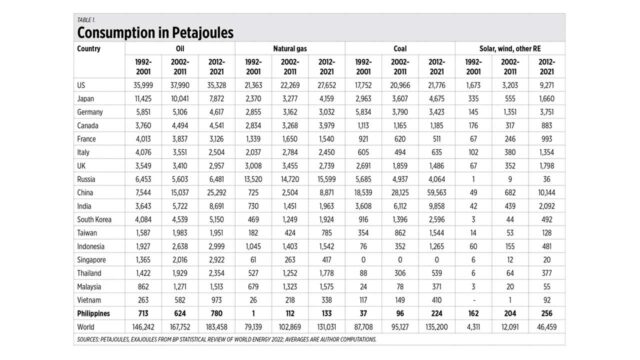
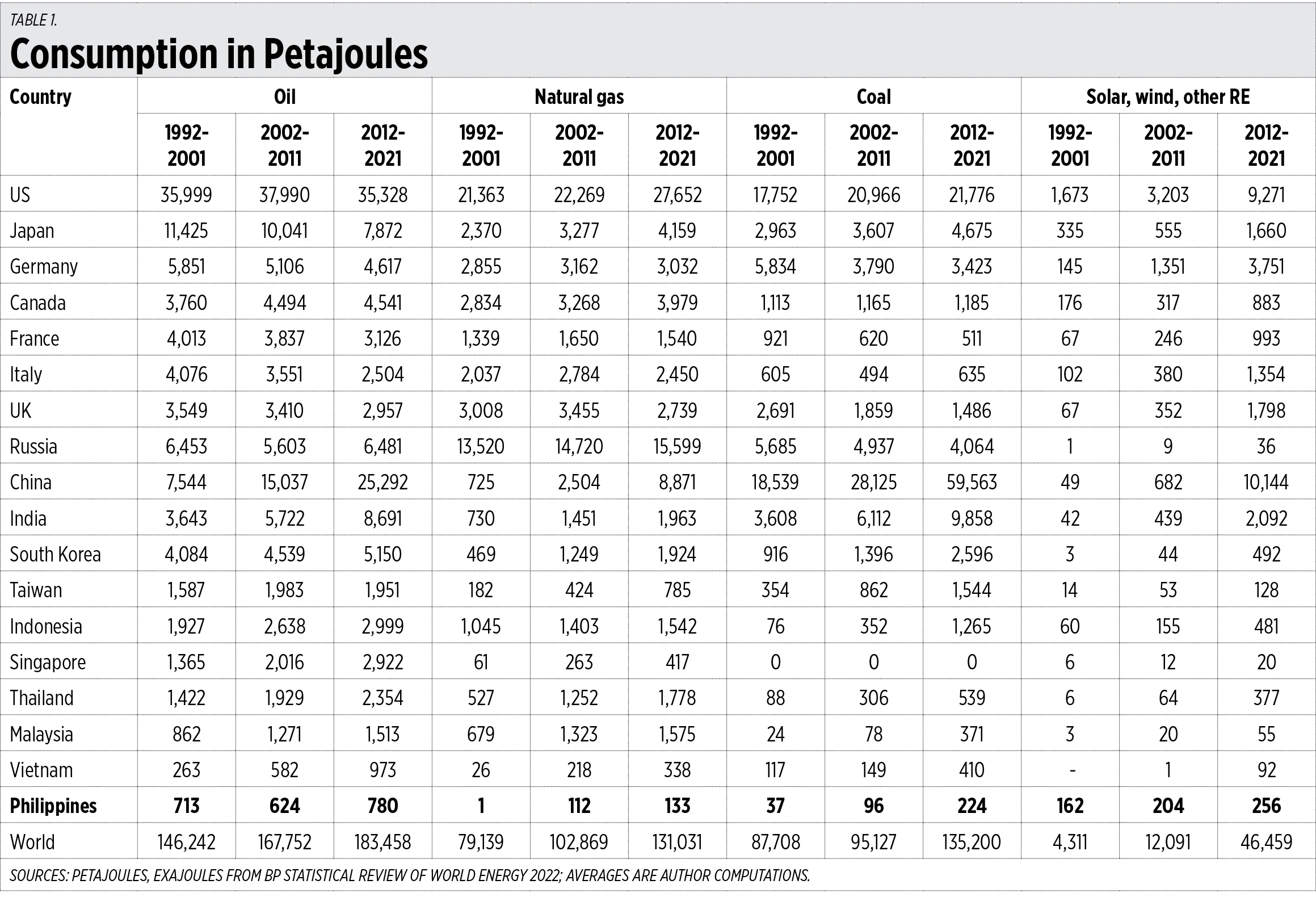
To help answer the first question, I construct a table covering three decades, 1992-2021. Germany has an energiewende or energy transition program with a specific goal of “a carbon- and nuclear-free energy system by 2045.”

The numbers show the following:

One, all the four European countries in the G7 — Germany, the United Kingdom, France, and Italy — have had deliberate, consistent declines in the consumption of fossil fuels (oil, natural gas, coal) and increases in the share of wind, solar, hydro and other RE over the past three decades.

Two, Japan has had a consistent decline in oil use but increased consumption of gas, coal, and RE. The US has seesawed in oil but continued to rise in the use of gas and coal, plus RE. Canada has had a consistent marginal increase in all three fossil fuels and RE.

Three, China, India, South Korea, Taiwan, and the ASEAN-6 have had consistent increases in use of all three fossil fuels, especially coal, also increased RE use. The world total has been on a similar trend. Singapore has zero coal consumption. (See Table 1).

Next question — Is forced energy transition economically viable and rational?

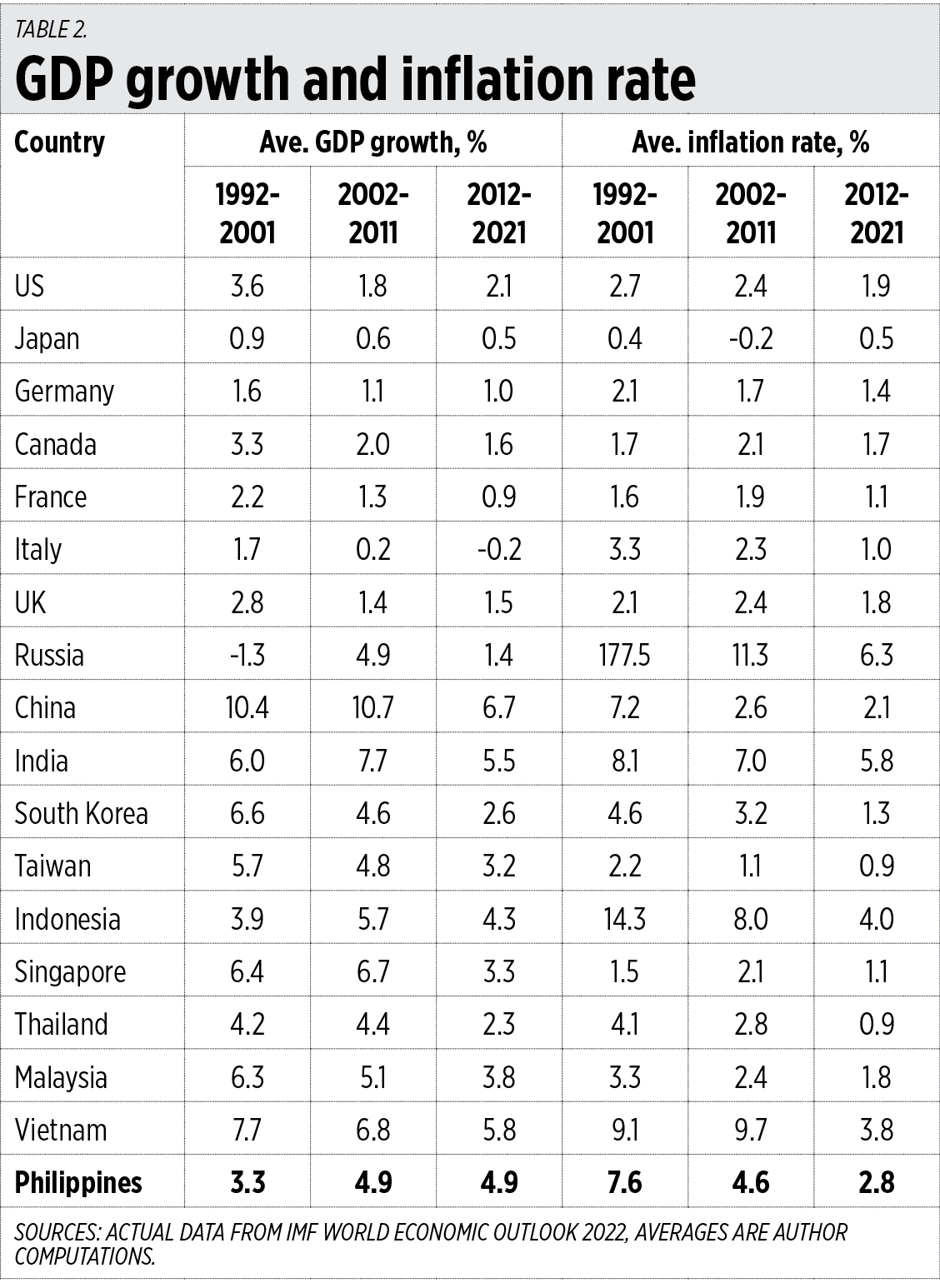
I built another table covering the same countries over the same three-decade period on their economic growth and price stabilization. The numbers show the following:

One, all the G7 countries have had anemic GDP growth of 2.1% or lower in the last two decades and this is the period when the fast rollout of RE happened. Their inflation rates were no different, if not higher in the last two decades than in the 1990s when RE levels were low.

Two, all the Asian economies listed have had growth of 2.3% to 10.7% in the last two decades when they jacked up their fossil fuel use. Their inflation rates were generally lower in the last two decades compared with rates in the 1990s (See Table 2).

So, looking at two decades worth of data, the answers to the two questions are as follows.

1. Technologically, there is NO energy transition happening in Asia and North America. It does not seem technologically feasible. There is only RE addition on top of high fossil fuel use even among G7 countries. For instance, Germany and the UK’s coal consumption in the last decade were 15 times and seven times larger than the Philippines’. Their respective natural gas consumption were 28 times and 21 times larger than the Philippines’.

2. Economically, energy transition as experienced by the G7 countries is not advisable and rational. It contributed to economic distortion, with low, anemic growth while the prices of commodities remained relatively high.

So, Sen. Win, please drop your bill on energy transition in the Senate. The same move should apply at the House of Representatives, the Department of Energy (DoE), ERC, other government agencies and energy business groups and associations. We should focus on fast, sustained growth. Create more businesses and jobs for Filipinos via the availability of stable and ample electricity, from fossil fuels and RE combined, not restricting one and favoring the other.

A compromise for many people who dislike fossil fuels and yet continue to use lots of fossil fuels is to consider nuclear power.

I attended the breakout session on “Relaunching the nuclear energy program in the Philippines.” Former DoE Undersecretary and now Ateneo Law Professor Cyril del Callar made a really fantastic and objective discussion of the Bataan Nuclear Power Plant (BNPP) which was built in 1976 and should have been running by 1985-86. I support his assessment that what killed BNPP was pure politics and unfounded fear of the technology when it could have been a useful, stable, cheap and safe energy source for the country.

DoE Undersecretary Sharon Garin and Philippine Nuclear Research Institute Deputy Director Vallerie Ann Samson also gave good, objective assessments on the potential contribution of nuclear power.

Federation of Philippine Industries Chairman Jesus L. Arranza gave a consumer point of view on energy issues. At the sideline, I asked him if he had big resources as a genco, what would he do. He replied that he would prioritize the island provinces, build more power plants there to attract more investments, businesses, and jobs. I support his simple but rational assessment.


Bienvenido S. Oplas, Jr. is the president of Bienvenido Oplas, Jr. Research Consultancy Services, and Minimal Government Thinkers

minimalgovernment@gmail.com

Customer experience

ELENA KOYCHEVA-UNSPLASH

MARKETING SEMINARS as well as mission statements enshrine the place of the customer in the corporate scheme of things. The customer is queen of the empire. She is always right. She needs to be not just pleased, but also delighted. Companies shrivel and die without her. Praises accorded to the abstract customer verge on idolatry.

Is the customer really the center of the corporate universe?

The rise of online shopping in the internet culture has eroded the compulsion (or even desire) for pampering the customer. E-commerce has left the servicing of customers to a program algorithm. (The voice on the other end may not even be human.) Now, you can buy anything in the net: airline tickets, hotel bookings, theatre seats, dates (not only the ones from trees), and books. The interaction between seller and buyer is a multiple-choice sequence of decisions that leads into a payment method and then actual delivery of the product or service.

It seems the only objective of the seller is to find the right customer. Targeted messaging from data mining seems the holy grail. Once the lifestyle grouping is determined, a granularly targeted message — “this is for you” — closes the circle in customer care. And artificial intelligence and robotic voices can handle the verbal hugs (Good choice, Sir) for the consumer’s benefit.

The whole search and completion of sale is tracked to provide information on a particular customer — you may also like grated cheese with that. This information is an asset that is even sold to other vendors.

The absence of face-to-face interaction in this sales model is becoming too common. (If you want to hear a real human voice with bad grammar, press 16.) The live interaction, whether on the phone with a “customer care attendant” or the live equivalent in a booth at the mall, is on the decline, along with the skills associated with that old-fashioned activity of making the customer feel wanted, if not loved.

On the other side of the live customer interface is a stressed-out salesperson, maybe a contractual hire from a service provider. She has undergone some basic training in the product features and is probably two pages ahead of the customer he is tasked to assist. On the demand side is a discontented, maybe even hostile, customer who feels he has paid for a lemon without any appetite for lemonade. Is it then unlikely that the conversation that ensues is not imbued with professionalism and civility? (Sir/Ma’am, I’m not aware of that product feature you are complaining about.)

In the more traditional fields of service provision, the treatment of the customer as a pest persists.

Are waitresses trained to avoid eye contact? In a busy restaurant, the customer who wants a glass of water, a menu, a person to take his order or present him his bill, and then to follow up his receipt and change can feel ignored. He tries to wave at a uniformed attendant and make eye contact to mime his needs (a tipping of the cupped hand for a glass of water). The waitress has her eyes focused elsewhere, up the ceiling to check on crawling insects that may fall on the soup tureen, the table assignment by the door, and maybe an expectant stare through the walls to await the apparition of a restaurant manager. (He hasn’t dropped by for a while.)

Little in management literature has been written about the right of the sales agent to be grouchy to customers. The protocol for a pleasant customer encounter needs to be spelled out.

The customer should know what she wants. If she can’t make up her mind or doesn’t understand the product and its limitations she should brush up on this first and study the manual. Otherwise, she will be taking up too much time at the counter as the line behind her gets longer.

Still, there are places that make the customer feel special. The regular patron feels special with her favorite table and the regular order she prefers. (The vinaigrette on the salad just needs to be sprinkled.)

The customer experience now seems to be limited to knowing who will buy… and how she will pay for it.


Tony Samson is chairman and CEO of TOUCH xda

ar.samson@yahoo.com

If it matters to you, get it insured

AXA: Acting for human progress by protecting what matters

AXA Philippines: All your Insurance Needs under One Trusted Global Brand

In these challenging and unpredictable times, it is more important than ever to protect everything that is of value to us.

Fortunately, Filipinos have become more mindful in planning for both their short-term and long-term financial goals, and investing in what matters most, which includes insurance. A survey of insurance outlook among Filipino adults published by Statista.com in 2021, showed that 91% of respondents recognized the importance of insurance and 86% planned to buy new and additional insurance in the coming year. Data from the Insurance Commission supports that shift in mindset with a recorded steady increase in average individual insurance spending since 2021. In the third quarter of 2022, the average spending of an individual on insurance jumped by almost 50% to P2,525 from P1,704 for the same period in 2021.

Taking out an insurance can stop adversity from snowballing into unrecoverable financial ruin. Consulting a financial expert to guide you on the best insurance to invest in is highly recommended based on some general principles:

  • The ultimate goal of getting an insurance is to protect what you value. It should have sufficient coverage to sustain the quality of life after a loved one’s passing and to protect those left behind from crippling financial loss.
  • While life and health are top priorities, it is equally important to insure our hard-earned assets such as our homes, businesses, vehicles, and travels.
  • Getting insurance while you are still young allows for a more affordable premium and most optimal coverage.
  • Getting your insurance only from licensed financial experts who could give you the best advise on which policy is best for you.
  • As we go through life, our realities change and so do the things that matter to us the most. Therefore, a regular re-assessment of our financial needs must be done.

Lastly, it is important to trust an insurance company who will be your partner in every step of your life journey. AXA Philippines, a globally recognized insurance brand borne out of the joint-venture partnership between Paris-based AXA Group, Metrobank, and GT Capital, is now the only insurer you need to remember for your life and non-life insurance needs. With the completion of its merger with its former general insurance subsidiary Charter Ping An, AXA Philippines has become one of the biggest insurance companies in the country to be able to offer all kinds of insurance products under one roof: from life insurance, savings and investments, health plans, to car, home, and business insurance, among many others.

For everything that matters most to you, AXA Philippines has it covered. To learn more, go to https://www.axa.com.ph/.


Spotlight is BusinessWorld’s sponsored section that allows advertisers to amplify their brand and connect with BusinessWorld’s audience by enabling them to publish their stories directly on the BusinessWorld Web site. For more information, send an email to online@bworldonline.com.

Join us on Viber at https://bit.ly/3hv6bLA to get more updates and subscribe to BusinessWorld’s titles and get exclusive content through www.bworld-x.com.

TikTok CEO says company at ‘pivotal moment’ as some US lawmakers seek ban

 – Chinese-owned short video app TikTok faces a “pivotal moment” as a growing number of US lawmakers seek to ban the popular app over national security concerns, CEO Shou Zi Chew said.

Mr. Chew said in a video posted on TikTok early on Tuesday that the app now has more than 150 million active monthly US users, representing almost half of the country’s population and up from the 100 million US users it had in 2020.

Mr. Chew, who will testify Thursday before the House Energy and Commerce Committee, noted that some politicians were talking about banning TikTok.

“This comes at a pivotal moment for us,” he said on the video that featured the US Capitol in the background and received more than 3.8 million views since it was posted earlier in the day.

Some politicians have started talking about banning TiktTok. Now this could take TikTok away from all 150 million of you.”

Mr. Chew asked TikTok users to leave comments about what they wanted US lawmakers to know about “what you love about TikTok“, and thousands responded in support.

TikTok‘s critics fear that its US user data could be passed on to China’s government by the app, which is owned by the Chinese tech company ByteDance. TikTok rejects the spying allegations.

Last week, TikTok said the Biden administration demanded that its Chinese owners divest their stake in the app or it could face a US ban.

On Wednesday, TikTok creators and New York Representative Jamaal Bowman, a Democrat, will hold a press conference outside the US Capitol to oppose a TikTok ban.

Mr. Bowman described the push to ban TikTok as “fear mongering” in an interview with Reuters.

He said the United States needed comprehensive “Big Tech regulation” that addressed Facebook, Alphabet’s YouTube, Twitter and others, but singling out TikTok was “unacceptable.”

Banning TikTok “would be another message to younger voters that we don’t care about what you think,” Mr. Bowman said.

Mr. Chew said 5 million US businesses also used TikTok to reach customers.

TikTok also said Tuesday it had updated its community use guidelines and offered more details of its plans to secure the data of US users.

The company said it had started to delete this month US user protected data in data centers in Virginia and Singapore after it started routing new US data to the Oracle Cloud last year.

TikTok, which has said it has spent more than $1.5 billion on rigorous data security efforts, said “if protecting national security is the objective, divestment doesn’t solve the problem: a change in ownership would not impose any new restrictions on data flows or access.”

A growing number of US lawmakers support a ban on TikTok, including House Energy and Commerce Committee Chair Cathy McMorris Rodgers, congressional aides told reporters on a call Monday.

On Friday, six more US senators backed bipartisan legislation to give Mr. Biden new powers to ban TikTok.

On March 1, the US House Foreign Affairs Committee voted along party lines to give President Joe Biden new powers to ban TikTok. – Reuters

Australia’s Latitude at all-time low on more evidence of large-scale data theft

Shares of Latitude Group Holdings slumped to their alltime low on Wednesday after the fintech firm unearthed further evidence of largescale information theft affecting former and current customers across Australia and New Zealand.

Latitude said it was attempting to identify the number of customers affected and the type of personal information stolen by the hacker.

Shares of the Melbourne-based company, which provides consumer finance services to major Australian retailers Harvey Norman and JB Hi-Fi, tumbled as much as 16.2% to a record low of A$1.01 on trading resumption. Latitude‘s stock last traded on March 15, a day before it disclosed the cyberattack.

As of 0202 GMT, shares clawed back some lost ground, trading down 7% at A$1.12.

“Our focus remains firmly on containing this attack, progressing our forensic review of the actions taken by the attacker and restoring operational capability gradually over the coming days,” Latitude said in a statement.

Several Australian firms have reported cyberattacks over the past few months, and experts say this is due to an understaffed cybersecurity industry in the country. Read full story

Last year, some of Australia’s largest companies reported data breaches, prompting authorities to step up efforts to bolster cybersecurity and implement stricter data-sharing rules to prevent breaches in the future.

“The market is clearly losing confidence in the company and it (the cyberattack) is external so it is already out of their control, which makes it more difficult,” said Tony Sycamore, a market analyst at IG Australia.

“Right now they are racing against time. They need to try and restore market confidence.”

Latitude had said last week that personal information of around 328,000 customers, including copies of drivers’ licenses, was stolen. It took its platforms offline on Monday and said the Australian Federal Police and the Australian Cyber Security Centre were looking into the attack. – Reuters

IMF staff reaches agreement with Ukraine for $15.6 bln program

 – The International Monetary Fund said on Tuesday it had reached a staff-level agreement with Ukraine for a four-year financing package worth about $15.6 billion, offering funds the country needs as it continues to defend against Russia’s invasion.

The agreement, which must still be ratified by the IMF‘s board, takes into consideration Ukraine‘s path to accession to the European Union after the war. The fund said its executive board was expected to discuss approval in the coming weeks.

“The overarching goals of the authorities’ program are to sustain economic and financial stability in circumstances of exceptionally high uncertainty, restore debt sustainability, and support Ukraine‘s recovery on the path toward EU accession in the post-war period,” IMF official Gavin Gray said in a statement announcing the agreement.

IMF staff on Tuesday briefed board members on the agreement – which would be Ukraine‘s biggest loan package since Russia’s full-scale invasion on Feb. 24, 2022 – and the board was supportive, a source familiar with the matter said.

The global lender said the agreement was expected to help unleash large-scale financing for Ukraine from international donors and partners, but gave no details. Typically IMF loans unlock support from the World Bank and other lenders.

Calculations have in the past estimated the cost of reconstruction in the hundreds of billions of dollars.

“A gradual economic recovery is expected over the coming quarters, as activity recovers from the severe damage to critical infrastructure, although headwinds persist, including the risk of further escalation in the conflict,” said Gray.

IMF staff currently expected the change in Ukraine‘s real gross domestic product for 2023 to range from -3% to +1%, Gray added.

Ukrainian Prime Minister Denys Shmyhal hailed the agreement and thanked the IMF for its support.

“In conditions of a record budget deficit, this program will help us finance all critical expenditure and ensure macroeconomic stability and strengthen our interaction with other international partners,” he said in a message on Telegram.

US Treasury Secretary Janet Yellen, who paid a surprise visit to Ukraine last month, welcomed the deal after months of pushing for the IMF to move forward with a new financing package for Ukraine.

“An ambitious and appropriately conditioned IMF program is critical to underpin Ukraine‘s reform efforts, including to strengthen good governance and address risks of corruption, and provide much needed financial support,” she said in a statement.

The US is the IMF‘s largest shareholder.

If approved, as expected, the Ukraine program would be the IMF‘s biggest loan to a country involved in an active conflict.

The fund last week changed a rule to allow new loan programs for countries facing “exceptionally high uncertainty”without naming Ukraine. – Reuters

ADVERTISEMENT
ADVERTISEMENT