Home Blog Page 5083

CONVERGENCE, Collabera Digital CIO Summit 2023

A successful inaugural CIO summit in Asia-Pacific by Collabera Digital

Collabera Digital, the leading digital engineering services firm, achieved a successful milestone on March 16, 2023, by conducting its first-ever CIO summit in the Asia-Pacific region, “CONVERGENCE 2023” which took place at Shangri-La The Fort, BGC, Manila.

Distinguished CIOs, CTOs, and C-level executives attended this exclusive summit, to make CONVERGENCE 2023 a platform for collaboration, networking, and exchanging of business strategies to inspire innovative solutions.

Mimi Ong, a well-known business correspondent, brought her exceptional journalism skills to host the summit — making the discussions engaging and captivating.

The event featured exceptional IT pioneers and business leaders who imparted their valuable perspectives on the latest trends and approaches required to successfully navigate the constantly changing landscape of digital transformation. Eminent speakers, subject matter experts and thought leaders from across the Philippines, Malaysia, Singapore, and Australia were present.

Keynote addresses and panel discussions revolved around topics that are relevant in today’s world — Investments Landscape in Philippines, What does the Board Expect from CIOs, the Tech Talent Paradigm, Data-driven CX, the Future of Fintech, and Cloud Adoption and Economics — all of which amalgamated the theme of “CONVERGENCE.”

“Without doubt, technology has become a crucial aspect of both business and everyday life, constantly expanding, and ever evolving. It was a privilege and honor to host CONVERGENCE 2023 and have the best of minds talk about aspects that incessantly impact us. We, at Collabera Digital, will continue to leverage the power of innovation and collaboration to enable our clients as they step into their digital future,” said Mehul Shah, founder & managing director, Collabera Digital.

Manan Mehta, SVP & country head – Philippines, Collabera Digital, said, “We thank all our delegates and distinguished speakers who joined us in our first-ever CIO Summit in Manila. It was truly a humbling experience hosting the best of technology and business leadership across the region. With thought-provoking discussions on a range of topics, including human-centric tech innovation, cybersecurity, and how businesses can be enablers of digital economy, the summit provided an excellent platform for knowledge sharing, networking, and collaboration. Collabera Digital remains committed in its mission to enable future-forward organizations realize their digital dreams.”

About Collabera Digital

Collabera Digital engineers the next generation of solutions to power tech-forward organizations accelerate their digital journeys. Our digital engineering capabilities in data, analytics, cloud, automation, and cybersecurity, coupled with a strong foundation in talent transformation and advisory and architecture, fosters continuous innovation and transformation, helping clients stay ahead in the digital curve. With our client-first and collaborative approach, we deliver solutions that are tailor-made, through speed and agility.

Established in 2010 and with 25 offices in 11+ countries across Asia-Pacific & Europe, we cater to 300+ clients, including Fortune 500 companies. Supported by over 10,000 professionals, we are a team of innovators and thinkers who chase excellence as much in the process as we do in the result.

For more information, visit www.collaberadigital.com.


Spotlight is BusinessWorld’s sponsored section that allows advertisers to amplify their brand and connect with BusinessWorld’s audience by enabling them to publish their stories directly on the BusinessWorld Web site. For more information, send an email to online@bworldonline.com.

Join us on Viber at https://bit.ly/3hv6bLA to get more updates and subscribe to BusinessWorld’s titles and get exclusive content through www.bworld-x.com.

Philippines, China say need to work together over maritime issues

PHILIPPINE COAST GUARD/HANDOUT VIA REUTERS

MANILA – Maritime issues between the Philippines and China play an important part in relations between the countries, senior officials from the countries said on Friday, as both sides pledged to work together to resolve differences.

Tensions between the neighbors have recently flared up over what Manila described as “aggressive activities” by China in the South China Sea.

Beijing, which claims large parts of the South China Sea including some areas in Philippine waters, has also been concerned over an increasing US military presence in the Southeast Asian country.

Maritime differences with Beijing were a “serious concern”, but could be resolved through the “exhaustion of all diplomatic means”, Philippine foreign ministry undersecretary Theresa Lazaro said after talks with Chinese counterparts.

The comments were made during the first in-person meeting this week between senior diplomats from the countries since before the COVID-19 pandemic.

Meanwhile, China’s Vice Foreign Minister Sun Weidong said maritime issue were not “the entirety of its relations” with the Philippines.

The two countries needed to stay committed to deepen cooperation and trust, Sun said. – Reuters

Yellen tries to assuage investor fears as bank stocks slide

US Treasury Secretary Janet Yellen — REUTERS

US Treasury Secretary Janet Yellen sought to reassure jittery investors that American bank deposits were safe and promised policymakers had more firepower to battle any crisis even as bank stocks resumed their slide on Thursday.

Investors have dumped banking stocks globally over the past two weeks, with rapid interest rate hikes to rein in inflation blamed by some as the root cause of the debacle. US bank stocks slid again on Thursday, pushing the S&P 500 banks index down to its lowest close since November 2020.

US lender Silicon Valley Bank’s collapse over bond-related losses tied to a surge in interest rates was the initial trigger for the turmoil, and JPMorgan Chase & Co analysts estimate the “most vulnerable” US banks likely lost a total of about $1 trillion in deposits since last year. Half of the outflows occurred in March after SVB’s collapse, they said.

Policymakers have stressed the turmoil is different from the financial crisis 15 years ago, and Yellen repeated that she was prepared to take more action to protect bank deposits if needed – one of the issues investors are concerned about.

“As I have said, we have used important tools to act quickly to prevent contagion. And they are tools we could use again,” Ms. Yellen said in prepared remarks to the US House of Representatives Appropriations subcommittee hearing.

“The strong actions we have taken ensure that Americans’ deposits are safe. Certainly, we would be prepared to take additional actions if warranted.”


BOE HIKES AGAIN

In Europe, the Bank of England became the latest central bank to hike rates this week.

After its eleventh straight hike, the BoE said it had noted the “large and volatile moves” in financial markets, but that Britain’s banking system remained resilient.

“We have learnt a lot of lessons from the financial crisis. Of course, we keep learning lessons, but I’m confident that the banks in (Britain) are in a much stronger position,” BoE governor Andrew Bailey told broadcasters.

While some of the panic over the fate of banks has abated, investors are now adjusting to more challenging economic and lending conditions ahead.

The index of top European banks fell 2.5%, with German banking giants Deutsche Bank DBKGn.DE and Commerzbank falling 3.2% and 4.1%, respectively. London-headquartered HSBC dropped 2.9%.

US banking shares initially rose on Thursday with traders citing the Fed’s hints that it could soon pause further increases in borrowing costs as a source of some relief, but later turned negative.

Troubled US regional lender First Republic Bank, which is among banks speaking to peers and investment firms about potential deals, closed down 6%. About 90% of the bank’s stock market value has evaporated this month, leaving it with a market capitalization of just over $2 billion.

“Despite the strong efforts to protect, particularly First Republic, the crisis continues and investors are left wondering what is it that I’m not seeing,” said Rick Meckler, partner at Cherry Lane Investments in New Vernon, New Jersey.

Other U.S. banks under the microscope after the demise of SVB and Signature Bank added to recent losses. PacWest Bancorp, Comerica and Zion Bancorp each tumbled more than 8%.

Truist Securities cut its price targets on regional banks including Zions and Comerica, warning of slower growth and higher credit costs.

The S&P 500 banks index, which closed down 1.2%, has now fallen over 40% from its record high in February 2022.


BANK BOND PRESSURE

Earlier on Thursday, the Swiss National Bank raised its benchmark interest rate by 50 basis points and said the takeover of Credit Suisse – the biggest name ensnared by recent turmoil – by its Swiss rival UBS had averted a financial disaster.

To stop investor panic from spreading, the Swiss bank was rushed into the deal on Sunday with UBS Group AG, which along with Swiss authorities is racing to close the takeover within as little as a month, according to two sources with knowledge of the plans.

Spokespeople for UBS and Credit Suisse declined to comment.

“At this moment the focus has to be that we can maintain financial stability and that the closing of the deal is smooth and fast,” SNB Chair Thomas Jordan told a news conference.

Separately, Credit Suisse and UBS are under scrutiny in a US Department of Justice probe into whether financial professionals helped Russian oligarchs evade sanctions, Bloomberg News reported on Thursday.

The rescue of Credit Suisse has ignited broader concerns about investors’ exposure to a fragile banking sector. The decision to prioritise shareholders over Additional Tier 1 (AT1) bondholders rattled the $275 billion AT1 bond market and some Credit Suisse AT1 bondholders were seeking legal advice.

The convertible bonds were designed to be invoked during rescues to prevent the costs of bailouts falling onto taxpayers as it happened during the global financial crisis in 2008.

Politicians are also wary of public perceptions that banks are being bailed out again, after anger over the sector’s costly rescue in 2008. The US Senate Banking Committee called on the former chief executives of SVB and Signature Bank to testify as lawmakers weigh possible action.

Citizens Financial Group Inc. is working on a bid to acquire the private banking business of Silicon Valley Bank, two people familiar with the matter said. The FDIC, which now controls the Silicon Valley Bank assets, and Citizens Financial declined to comment. – Reuters

Singapore push for all-EV future faces a love of crazy, rich combustion

SINGAPORE – Singaporean chip designer Eu Gene Goh is an electric-vehicle evangelist with two Teslas in the garage.

But the car-tech enthusiast is also not ready to give up his S$1.6-million ($1.21 million) McLaren 765LT with a V8 engine capable of hitting 100 km per hour (62 miles per hour) in three seconds.

The city-state’s bid to stop the purchase of combustion-engine cars from 2030 has bumped up against an entrenched love of supercars, ultra-luxury rides and buyers with enough income to keep them in one of the most expensive places in the world to own a car.

Singapore’s target of phasing out combustion car sales by 2030 puts it in a small group of countries with that near-term goal, including Iceland, Sweden and the Netherlands, but sales of electric cars in those markets have picked up faster.

The Singapore government has been pushing electric vehicles (EVs) for two years, offering incentives of up to S$45,000 and expanding the charging network, but take-up by individual buyers will need to vastly accelerate to hit the target.

EV made up almost 12% of all car sales in Singapore last year, up from almost 4% in 2021, according to the Land Transport Authority.

Still, EVs represented just 1% of cars on the road, a Reuters analysis of ownership data found. By comparison, combustion sports cars in a city where the Formula 1 Grand Prix is one of the biggest events of the year made up 1.65% of the almost 653,000 registered vehicles.

In Singapore, a small island with an extensive public transport system, only about 12 cars are owned per 100 people. That compares to 9 per 100 in Hong Kong and 82 in the U.S.

One factor is price: it costs at least S$88,000 for the right to own a small car for a decade, excluding the vehicle’s cost in Singapore, a system that has driven luxury sales.

Over the past decade, the number of Ferraris in Singapore has grown by 67% and Lamborghinis by 38%. The number of McLarens has grown more than five-fold to 180 since 2012, the data shows. There are almost five times more Porsches on the road than Teslas.

“Basically, the entire market has moved upscale,” said Singapore-based transport economist Walter Theseira.

Singapore’s preference for luxury and performance cars was a function of rising wealth among a cohort of residents while lower-income people were priced out car ownership, he added.

HSBC estimates 13% of Singaporeans may be millionaires by 2030, the highest share in the world.

PERFECT SHOWCASE FOR EVS

A charity auction of 100 limited-edition “made in Singapore” Hyundai Ioniq 5s earlier this year managed to sell only half of the special-edition EVs embossed with the city’s Merlion mascot.

Hyundai said it was “encouraged to see the result, considering the unfamiliarity and newness” of the EV, but declined to say how much the auction had raised.

Markus Schuster, managing director at Audi Singapore, believes EVs will constitute the majority of new car sales as early as 2025 or 2026 as more premium models like Audi’s Q8 e-tron and Q4 e-tron hit the market.

“As a showcase for EVs, the city is perfect,” he said.

Singapore drivers average just 30 km a day and do not have the same kind of “range anxiety” as drivers in the US and Europe, Schuster added.

The government plans to build 60,000 charging points by 2030, up from 1,600 now, which Schuster believes will be a tipping point to achieve the 2030 target.

Goh, the McLaren owner, is already an EV convert. He loves that he doesn’t have to keep the engine running on school pick-ups and that the cost for charging his Tesla Model 3 last year was under S$700 for 11,000 km of driving.

“For a daily driver, I wouldn’t go back to a normal petrol car,” he said.

But Goh is keeping his McLaren for now so he can enjoy the car’s performance on a race track he visits in Malaysia.

“I like technology and I find supercars, especially McLarens, it’s like taking technology and art and putting it together,” he said. – Reuters

EU leaders agree to fast-tracked deal on power reforms

STOCK PHOTO | Image by Pexels from Pixabay

BRUSSELS – European Union country leaders agreed on Thursday to fast-track reforms to the bloc’s electricity market meant to tame severe price spikes such as those experienced last year after Russia cut gas supplies to Europe.

Helped by mild weather and a raft of emergency measures to save energy and store gas, the EU is emerging from winter with a better energy security situation than had been feared after Russia slashed gas deliveries following its invasion of Ukraine.

Last week, EU executive European Commission proposed changes to Europe’s electricity market, focusing on expanding use of long-term, fixed-price contracts to make consumers’ bills less tied to volatile fossil fuel prices.

On Thursday, a summit of EU leaders in Brussels agreed the bloc’s electricity market reforms should be adopted “by the end of 2023,” according to their joint decision.

Leaders also discussed how to support the EU’s plans to rapidly scale up green energy and technologies to hit climate change goals.

Speaking at a news conference after the summit, president of the Commission, Ursula von der Leyen, outlined limits to how far nuclear energy can benefit from special EU support meant to help the bloc reduce CO2 emissions and boost renewable energy.

“Nuclear can play a role in our decarbonisation efforts,” she said, adding that the bloc’s strategy to reach net zero emissions by 2050 makes “cutting-edge nuclear” eligible for some simplified rules and incentives.

“But only the net zero technologies that we deem strategic for the future – like solar panels, batteries and elektrolizers – have access to the full advantages and benefits. So the cutting-edge nuclear is in for specific fields but not for all.”

France is leading a push to have fuels based on nuclear energy counted towards the EU’s renewable targets, a move Paris says will support the contribution CO2-free nuclear energy is making towards climate change goals.

Countries such as Denmark, Germany and Spain are opposed, saying integrating nuclear energy into the law would undermine efforts to expand renewable sources like wind and solar. – Reuters

World Bank seeks more private cash as yearly needs balloon to $2.4 trillion

REUTERS

World Bank President David Malpass set out on Thursday a new road map for private sector participation in project financing across emerging and developing economies as yearly financing needs balloon to $2.4 trillion.

The massive financing yearly needs, a new World Bank estimate, could address the effects of climate change, war, and pandemics, and private capital is “essential” for meeting those needs, Mr. Malpass said.

Mr. Malpass announced his resignation to the World Bank in February and the lender expects to select his replacement by early May.

The program is based on three pillars, he added, the first of which aims to help capital flow better by providing macro stability and transparency, while building data banks that support decision making.

“The product of these analytics will focus on actions that countries need to take for a sound investment climate, competitive markets, and a balanced role of the State in the economy,” said Mr. Malpass at an event hosted by the Center for Strategic and International Studies in Washington.

The road map then turns to addressing liquidity issues, while focusing on opportunities for State Owned Enterprises to attract private capital.

Lastly, it aims to create a market of investment-grade securities that would attract institutional investors.

“Our aspiration over time … is to see the creation of a massive, dynamic, investable asset class for infrastructure in developing countries that spans borders and sectors in order to diversify risk and achieve lower financing costs,” Mr. Malpass said.

“The initiative will boost sustainable development that is inclusive and environmentally friendly, reduces carbon, enhances energy access, alleviates poverty and achieves the required pace of global digitalization.” – Reuters

Empowering women, energizing progress

International Women’s Day may be over, but AboitizPower proudly celebrates every day our female team members leading the way in energizing progress and empowering lives. As this month comes to a close, may we all be inspired to help create within our communities a culture of innovation, collaboration, and excellence — not just for women, but for everyone.


Spotlight is BusinessWorld’s sponsored section that allows advertisers to amplify their brand and connect with BusinessWorld’s audience by enabling them to publish their stories directly on the BusinessWorld Web site. For more information, send an email to online@bworldonline.com.

Join us on Viber at https://bit.ly/3hv6bLA to get more updates and subscribe to BusinessWorld’s titles and get exclusive content through www.bworld-x.com.

Philippines’ leading businesswomen on taking the lead

By Chelsey Keith P. Ignacio, Special Features and Content Senior Writer

Business leadership and management are not unfamiliar territories for several women in the Philippines.

The country ranked 4th among 36 economies globally in terms of women representation in leadership roles, according to the professional networking platform LinkedIn in 2022. But among the Asia-Pacific countries studied, it has the highest women leadership representation.

LinkedIn said the number of women hires in leadership roles in the country went up to 43% last year from 2015’s 34%. Still, despite this rise, LinkedIn noted that men are 26% more likely to be promoted to leadership than women.

Looking at Filipino businesswomen, some have worked their way to have a seat on the table, while some created their own as well. And some also provide support for others to have a seat.

Women leaders told BusinessWorld about their journey to the C-suites and boardrooms and taking the lead, as well as empowering and opening doors, for more women to reach the top of the corporate world.

Hard work and support

For some of today’s women leaders, the journey towards leadership is full of hard work while being fortunate enough to have support in male-dominated industries.
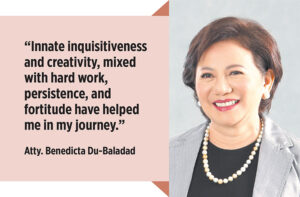
“I have been working hard all my life that I did not have the time to compare how hard men worked compared to mine. I just did the best I can and got to where I am because of that. I was so focused on what I wanted to do that if there were hindrances along the way, I may not have noticed them; or if I did, I may have enjoyed the challenges that came along with it,” said Atty. Benedicta Du-Baladad, president of the Management Association of the Philippines (MAP).

An accountant-lawyer, Atty. Du-Baladad is a renowned subject expert in taxation, which led her to become a leader in government and private organizations. At 48, she set up Du-Baladad and Associates (BDB Law), serving as the law firm’s founding partner and chief executive officer (CEO).

“For the most part, I was genuinely just being myself and enjoying the work and the challenges that come with it,” Atty. Du-Baladad gathered as a Filipina in business leadership. “Innate inquisitiveness and creativity, mixed with hard work, persistence, and fortitude have helped me in my journey.”

Hard work is also among the reasons that led MAP Secretary Karen Batungbacal towards leadership, as well as her role models, mentors, and luck.

Ms. Batungbacal considered her parents as her role models. She recounted that her mother stressed to her and her sisters their need to be educated and be able to work, whether becoming a CEO or secretary. This was because her mother had seen a lot of women dependent on their husbands or other people, but circumstances like a marriage breaking up and a husband passing away could happen.

“There were expectations of us when we were in school to do well. So my sisters and I got into this thing of hard work at school…,” Ms. Batungbacal shared. “And what I think happens, [once] you study hard and work hard, when opportunity knocks, most of the time, you’re prepared. Because people are given lots of opportunities; but if you’re not prepared, then [it will be] very difficult for you to snatch it.”

Also supporting her to rise up were her mentors — her early bosses — who interestingly were men leaders. “They gave me roles that I didn’t think I was capable of, but [they could see that] I was,” she shared.

Ms. Batungbacal used to lead the customer services for the Lopez-run Bayan Telecommunications (BayanTel), Sky Cable, and ABS-CBN. Then in 1999, she started to read about the business process outsourcing (BPO) industry. Having seen the capacity of these companies’ representatives answering phone calls of the customers in the Philippines, she thought, “Why not do the same for such companies in the United States?”

“So I also looked [to] the Lopezes, especially Gabby Lopez for giving me the trust, to set up one of the first Philippine call centers. That’s how I became a CEO,” she said. 

Fast-forward to the present time, Ms. Batungbacal is known as a pioneer of what is now the thriving Philippine BPO industry.

Just like Ms. Batungbacal, Pammy Olivares-Vital recognized that the men she has worked with, as well as her father and her husband, have contributed to her professional career.
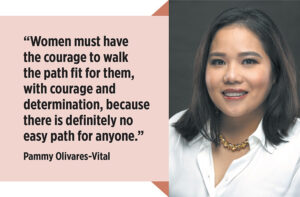
A third-generation entrepreneur and second-generation housing developer, Ms. Olivares-Vital began as a sales coordinator before her role expanded, eventually becoming the president and CEO of Ovialand, Inc.

“When I began working, admittedly in an industry of mostly men, I did not feel that I was treated differently — or maybe I didn’t notice. I just focused on what had to be done and learned to trust my instincts. I know that not all women have had the same fortunate experience as I have — and my positive experience is a testament too of the men around me,” she said.

Hence, in her organization, Ms. Olivares-Vital said they are endeavoring to make certain that women would have similar positive experience and support as well as ensuring the balance of opportunities given to men and women.

The CEO also acknowledged that while some women are able to choose a path for themselves, others are left without a choice.

“Women must have the courage to walk the path fit for them, with courage and determination, because there is definitely no easy path for anyone,” she said, adding that Ovialand is committed to give all its employees a working environment that encourages growth and discovering one’s purpose.

“And as each one finds our path, we must also know our values and use them as guides in what we do. We must lead with purpose and values — and hopefully, help other women along the way,” the Ovialand executive continued.

Empathy and empowering fellow women

Even if they do not face the inequality and struggles in similar gravity as several women underwent in business and becoming leaders, these Filipina leaders are aware of such difficulties and thus working towards empowering fellow women as well.

MAP’s Atty. Du-Baladad admitted that she did not have a personal experience of challenges or issues in having a place on the executive board. But she acknowledged that her experience might not be common, having often heard cases wherein women are at disadvantage or got refused to access opportunities for gender reasons.

But being in leadership, Atty. Du-Baladad understood that this role involves bearing in mind that anything one does could better the chance of next-generation women to access opportunities.

“I was asked once if there were glass ceilings in my profession, the legal profession. I said, ‘There was none. If there was, I would have broken and created a big hole to make it easier for other women to follow,’” she said.

“While there are some women, like us, who have been recognized and appointed as board members, this does not necessarily reflect the reality that we need to have more gender diversity in corporate boards in our country,” said Ma. Aurora “Boots” Garcia. “Thus, I, along with Chit Juan, Baby Nuesa, Sharon Dayoan, and Maricelle Narciso, organized NOWCD (NextGen Organization of Women Corporate Directors) to take advantage of this ‘privilege’ given to us.” 

“We collectively believe that women must be heard. We know that we can do the work necessary to address this imbalance,” the NOWCD chairperson added.

Incorporated almost two years ago, NOWCD has made it its mission to help increase the representation of women in leadership positions of public and private company boards. In particular, the organization targets to increase women representation in boards from 17% to 23% by 2025.

An alumni partner of SGV & Co. and the first female chairperson of the Bases Conversion and Development Authority (BCDA), Ms. Garcia is currently the chairperson and president of Mageo Consulting. Aside from NOWCD, she is the Founding Chairperson and President of the Philippine Women’s Economic Network (PhilWEN) and co-chairperson of the Philippine Business Coalition for Women Empowerment (PBCWE).

Ms. Garcia said she did not have her own ‘sad story’ to tell concerning the disparity between women and men on going up the business. So what drives her to pursue her women’s empowerment advocacy? She stressed that inequalities in the workplace persist, which could not be overlooked, and that women usually “get the short end of the stick” due to their gender as well as unconscious biases and being pressured by social norms that are already behind the times.

“While I am aware that I will not benefit now from my advocacies, I want to ‘pave the way’ and open doors for the future generations of Filipina women and set them up for success. My aspiration is that the younger generations of Filipina business leaders will have an equal chance and an equal playing field to grow and thrive in society,” she said.

The support of women leaders, one could say, has made an impact on Cosette Canilao.
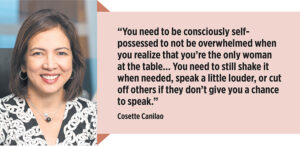
Early on in her career, the Aboitiz InfraCapital president and CEO shared that she did not also face the issue of working twice as hard as men to rise up. Having strong assertive women leaders as her mentors and bosses made a huge difference in her character moving forward. It was also a woman executive who recommended her to take up postgraduate studies.

Ms. Canilao has been in the banking industry, became a partner in an advisory firm, worked in the government, became involved in infrastructure development, and took on a global role in an infrastructure consultancy firm. “The many hats I’ve worn in the course of my professional life have prepared me to take on the leadership role in Aboitiz InfraCapital,” she said.

Now a business leader herself, Ms. Canilao fosters a safe space and an enabling environment for mentoring and continuous learning; institutes a meritocratic framework regardless of gender identity; and formulates programs to wipe out unconscious bias to empower women and uphold gender equality in her organization.

“You need to be consciously self-possessed to not be overwhelmed when you realize that you’re the only woman at the table. You need to muster the courage not to feel grateful that you’ve gotten a place in it,” expressed Ms. Canilao, reflecting on being a woman business leader. “You need to still shake it when needed, speak a little louder or cut off others if they don’t give you a chance to speak. And most of all, always pave the way for other women leaders.”

Diversity and equality in leadership

Having more women — or diversity — in the leadership or the organization itself could be beneficial to the business.
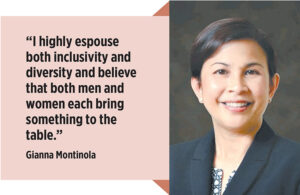
“I highly espouse both inclusivity and diversity and believe that both men and women each bring something to the table,” said Gianna Montinola, co-founder of Hands On Manila Foundation and also one of the esteemed members of NOWCD.

Ms. Montinola has become part of different boards, from publicly listed corporations to not-for-profit organizations, including the boards of Far Eastern University (FEU) and the FEU Public Policy Center.

Like some of her fellow Filipina leaders, Ms. Montinola said she did not have to work twice as hard to compete with men to move up in the business. She also has not personally experienced one’s gender influence getting a place on the board.

“More boards are now conscious about picking women for diversity purposes,” she said. “But while there are quite a number of Filipino companies that are progressive, there are still a lot more who could welcome women leaders.”

Emphasizing further that both women and men contribute in ways of equal importance, Ms. Montinola feels that “diversity in a board brings diversity in thought, experience, and expertise.”

“And all of these impact the way an organization is run and how it can succeed,” she added.


Such success can be seen in internet service provider Converge ICT Solutions, Inc., which is being lead by Co-Founder and President Maria Grace Uy, who is recently recognized by international innovation-as-a-service media company Jumpstart in its list of “5 Women over 50 Who Are Leading the Way in Asia Pacific.” Jumpstart highlighted the contributions of Ms. Uy to drive the growth of Converge, as well as her leadership in the successful debut of Converge in the Philippine Stock Exchange amid the pandemic back in 2020.

The significance of diversity is also highlighted by MAP’s Ms. Batungbacal, who is also among NOWCD’s members, noting that a company’s customers, employees, and the external stakeholder are diverse.

“Usually, nine times out of 10, your employee market and customer market is everyone,” she said. “If you want to understand and attract the right employees, if you want to understand and win the right customers, the makeup of the company and the board has to reflect the employees they hire and the customers they sell to.”

“[It is] very basic that you need to have a diverse set of executives and a board so that you can get diverse ideas,” she added.

More women on the board would also bring diverse opinions and broader perspectives, said NOWCD Chairperson Ms. Garcia, citing that studies have shown it could lead to improved board decision-making and profitability.

“One of the reasons NOWCD was organized is to send a strong and clear message that gender diversity in our corporate boardrooms requires the Philippine business community’s attention and collective action. We hope that our influence, network, and reach will make the business sector realize that diversity is an urgent concern and we all need to act now rather than later,” she said.
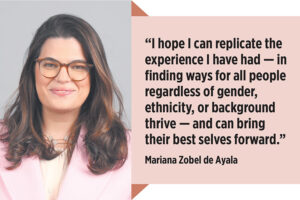
Mariana Zobel de Ayala, another member of NOWCD, also observed that the representation of women on the boards of private organizations is lacking.

“The role of women in Philippine society has always been contradictory — we see strong examples of women leadership — as Presidents, Chairwomen of public institutions, and heads of household, but we also lack representation in certain verticals — such as mid-management, as well as boards of private institutions, as an example,” she said.

Ms. Zobel de Ayala believed that growth potential would remain to be challenged by inequality concerning gender, ethnicity, or background. For her, equality and diversity pertain to “building the most empowered workforce possible.”

“By ensuring equality of opportunity, we work towards building the most capable economy possible for the Philippines, to ensure our collective progress as a nation,” she said.

Currently the senior vice-president for the Bank of the Philippine Islands’ (BPI) Consumer Bank Marketing and Digital Platforms, Ms. Zobel de Ayala had worked for a bank in New York and then went on to work for the residential, offices, and commercial centers of Ayala Land, Inc.

“I have been lucky to count on many wonderful leaders, mentors, and experiences — as a woman — in my professional experiences. I realize, though, that not everyone has had as positive of an experience in their careers. I hope I can replicate the experience I have had — in finding ways for all people regardless of gender, ethnicity, or background thrive — and can bring their best selves forward,” she said.


Present state of women in the workplace

Success in the workplace is measured in different ways, from climbing up the corporate ladder to gaining respect with the people you work with regardless of gender. Today, the corporate world is seeing a great number of female leaders, and this is just the beginning. However, while the world is progressing, it is hard to not notice that the workforce is still lacking in some aspects in terms of achieving gender equality.

For instance, women still experience gender-specific issues in the workforce that can possibly hinder the advancement of their career, thus, women are leaving in record numbers. In positions of leadership, women are already notably underrepresented due to the broken rung at work management, fewer women have been moving up the ranks for the past years and companies are currently having trouble keeping their female leaders, according to global management and consulting firm McKinsey & Company.

Women have been seen to be further seeking leadership positions, but they frequently encounter more obstacles, like microaggression, making it difficult for them to progress. But recently, women leadership is becoming more crucial within organizations that places a high value on diversity, equity, and inclusion.

According to McKinsey’s Workplace 2022 Report, women, particularly women of color, continue to be underrepresented in the corporate workplace despite small advances in representation over the years. Even so, companies are struggling to achieve gender equality in their workplaces.

For example, the “broken rung” is still intact, holding women back in advancing to their respective careers. The survey in the report showed that men outnumbered women in promotion to management positions, and there are not enough women that can be promoted to senior leadership positions.

Also, more women are quitting their jobs for better opportunities, which becomes a problem for most companies. The rate of women quitting their jobs is found to be higher than the rate of male leaders.

Among Philippine workforces, enterprises

With one of the highest levels of gender equality, and ranked 17th place in the World Economic Forum’s (WEF) Global Gender Gap Report in 2021, the Philippines takes pride in observing gender equality across industries. As a country where small and medium-sized businesses (SMEs) are booming, more female-led companies are thriving. Thus, women play a vital role in this sector.


The Australian Government initiative Investing In Women (IW) stated that almost 60% of SMEs are run by women, creating a dynamic environment for gender equity.

“Women in the Philippines are making astounding progress as business leaders and entrepreneurs; we are known to have significantly closed the gender gap in areas such as health and education,” Philippine Women’s Economic Network (PhilWEN)’s Founding Chairperson and President Ma. Aurora D. Geotina-Garcia was quoted as saying in a statement.

However, McKinsey’s and World Bank’s findings showed that the country is still lacking in some aspects — from investing in female-led companies to low labor participation of women in the workforce. Since 2019, the female labor participation is found to have remained low, with an average of 49%; and there has not been much progress in bridging this divide since then, which affects economic growth and prosperity in the Philippines.

In World Bank’s recent report titled Overcoming the Barriers to Women’s Economic Empowerment in the Philippines, findings showed that skills, wage gap, homecare responsibilities, and norms are among the factors that cause barriers on women’s labor market in the country. In addition, female-led businesses encounter difficulties towards accessing capital and networks due to cultural barriers and the occurring gender gaps and stereotypes.

According to the United Nations (UN), in order to address these gender-specific issues, commitment to laws, policies, institutions, and budgets are crucial to boost gender equality in the workforce and achieve social inclusivity.

McKinsey recommends that companies should think about focusing on promoting women leadership positions and keeping the women leaders that have such if they want to make a long-term and sustainable progress of gender equality in the workplaces.

For instance, more practical training to support their teams, and providing flexibility and health benefits to women that will help boost productivity. Following these examples can be advantageous for companies and will help them achieve better results.

Moreover, to solve the broken ladder in the workplace, most companies need to take actions, such as knowing the cause of disparity in promotions among women. They must ensure as well that both men and women are promoted at similar rates and that any forms of bias are eliminated during evaluations.

The World Bank, meanwhile, noted the need for policies and programs that will help increase female labor participation in the Philippines. Among other things, the World Bank stressed promoting policies that will help support flexible work arrangements, addressing gendered social norms limiting women’s access to the labor market, and providing alternatives to in-home childcare.

The multilateral lender added that by increasing women’s labor force participation rate by 0.5% annually, the gross domestic product (GDP) per capita is expected to rise at 6% by 2040 and 10% by 2050.

Initiatives thriving

Nonetheless, the Philippines is seen to be moving forward to become a more enabling environment, especially for female entrepreneurs.

IW, for instance, seeks for female-led businesses and mentors them to make their business stronger and address gender-specific concerns. The network has also helped to fund and invest in female-led companies in the Philippines to boost social impact and economic growth.

Many programs elsewhere were also implemented to support female-led companies.

According to Ms. Garcia, institutions such as the Development Bank of the Philippines (DBP) has established a program called Inclusive Lending for Aspiring Women (ILAW), which made funding requirements to be easily accessed and make the process simpler among micro and small businesses.

“There are also other programs that support female entrepreneurs ranging from training, learning sessions, mentoring programs, and workshops. Social media plays a major role in promoting these programs as the main media channel that the majority of women-led MSMEs can access,” Ms. Garcia said.

Moving forward, the significant force for change and success in both workplaces and businesses is leadership commitment.

“Leaders should proactively promote workplace gender equality through proactive and responsive policies and programs within and outside the organization to accelerate business sustainability, efficiency and innovation,” Ms. Garcia said. — Angela Kiara S. Brillantes

Overcoming the challenges facing women entrepreneurs

Women are still under-represented in the professional world. While this has improved over time, it’s still not where it should be.

In fact, in stating the targets of the fifth Sustainable Development Goal, the United Nations pointed out that it would take another forty years before women can be equally represented in national governments as men.

As of Jan. 1, the global share of women in lower and single houses of national parliaments reached 26.2%, up from 22.4% in 2015. Women’s share is slightly over one-third in local governments, according to data.

Before the pandemic in 2019, women made up 39.4% of the workforce. Women then accounted for roughly 45% of worldwide job losses in 2020.

From 2015 to 2019, the percentage of women in managerial roles climbed from 27.2% to 28.3%. However, from 2019 to 2020, it did not change.

In the business world, at least, many women are taking charge of their own lives. In the United States, women founded over half of start-ups in 2021, according to Gusto, a cloud-based software provider for human resources.

According to the research, this represents a “dramatic leap” from the 28% of women who started new businesses in 2019. The main motivation for women to launch new firms in 2021 was to take advantage of “pandemic-related opportunities.” More than 2,600 new business owners responded to the survey.

This led to a record-breaking number of new businesses in 2021 — more than 5.4 million. The fact that this occurred while the nation was “in the midst of a once-in-a-century pandemic” is particularly astounding, according to Gusto’s 2022 poll of new business owners.

In the United Kingdom (UK), the online domain provider GoDaddy found that women are now running almost 40% of UK microbusinesses, up from 32% before March 2020, in its Venture Ahead research of 2.3 million microbusinesses in the UK.

Even in underdeveloped nations, female entrepreneurship is also on the rise.

According to the World Bank’s Female Entrepreneurship Resource Point, there are between 8 million and 10 million small and medium-sized businesses with at least one female owner throughout the developing world.

One-third of women work for themselves in unorganized jobs outside of agriculture across the globe. This is often small-scale, home-based, and targeted at industries like retail and services.

The prevalence of working from home has done wonders to enable women around the world, who are still expected to bear the burden of housework and childcaring responsibilities. Women who work from home are better able to “satisfy competing demands for their time,” according to the World Bank.

However, there are still many hurdles that women face as entrepreneurs today, including a lack of access to capital, biased hiring practices and even sexual harassment in the workplace. Lack of financial access and legal injustices, such as limitations on property ownership or management, are some of the challenges that women entrepreneurs in underdeveloped nations must overcome.

According to the World Bank, barely one in three enterprises worldwide are held by women.

Women entrepreneurs are less likely to get funding than men, and some studies have shown that this is worsened because there are fewer women investors. Women are also often overlooked for jobs because they do not fit the stereotype of a leader, and they are judged by their appearance rather than their achievements and accomplishments.

They also do not get the same opportunities as men do, which means fewer mentorships or sponsorship opportunities to help them advance in their careers.

Meanwhile, other global data also suggests that women are still more likely than males to be impacted by the pandemic.

The World Economic Forum (WEF) noted in its new Global Gender Gap Report 2022 that women have lost significantly more working hours than men since the pandemic’s height.

The demands of childcare and homeschooling contributed to women’s absence from the workforce. When jobs in industries like hospitality and retail have been lost, women have also been more negatively impacted.

As a result, women’s employment participation has decreased, from 60.1% to 51.7% this year.

Women’s wage equality slightly improved in 2022, due to the fact that women now make 2% more money than they did in 2021, whilst men now make 1.8% less money.

At ‘historic crossroads’

However, the report specified that it will still take 151 years until the gender gap in women’s economic opportunity and attainment is closed globally. The economic difference is far smaller than it was last year, when it was more than 260 years, but it is still far too wide, according to WEF.

Even in social entrepreneurship and nonprofit organizations, female leaders are faced with the challenges of maneuvering an industry heavily dominated by men, are discriminated against based on their appearance, are not listened to nor given decision-making power in group situations, and find that fund raising and networking efforts are easier for their male colleagues. This apparently goes even worse if these women are also discriminated due to race, indigenous background, or are disabled.

“We are at a historic crossroads, managing short-term pressures against medium- and long-term uncertainties. To shape a sustainable and inclusive recovery from the COVID-19 crisis, we need to include the voices of female social entrepreneurs who have decades of experience in changing systems and creating lasting impacts,” the WEF wrote back in 2021.

The Forum emphasized that even as many organizations attempt to achieve gender parity in the social entrepreneurship sector, it appears that there is a lack of a unified and coordinated strategy to address the unique requirements and demands of female social entrepreneurs. This is a systemic issue that requires a systemic response.

“A more gender-balanced system of social entrepreneurship promises not only to be fairer, but will also generate more impact. Systemic social problems can only be solved collaboratively across silos, whether they be sectors, institutions, geographies, classes, or identities. Tackling poverty at a local or regional level, for instance, requires that government, health, education, business, and many other sectors work together,” the Forum wrote.

“A more gender-balanced social innovation ecosystem will lead to more systemic approaches in social entrepreneurship. In such a scenario, not only do female social entrepreneurs thrive, but the world does, too.” — Bjorn Biel M. Beltran

Converge President Grace Uy lands women leading the way in APAC list

Converge Co-Founder and President Maria Grace Uy is recognized as one of the “5 Women over 50 Who Are Leading the Way in Asia Pacific” by international publication, Jumpstart. The recognition highlighted the contributions of Uy to drive the growth of Converge, making it one of the biggest internet service providers in the country. It also noted her leadership in the successful debut of Converge in the Philippine Stock Exchange at the height of the pandemic, making it one of the country’s largest initial public offerings in recent years.

Converge ICT Solutions Inc. Co-Founder and President Maria Grace Uy has once again gained another international recognition after being named as the lone Filipina in the carefully selected list of “5 Women over 50 Who Are Leading the Way in Asia Pacific” who are trailblazing their respective fields in the region.

“Despite progress in gender equality, women over 50 still face a unique set of barriers and challenges in society. Whether it’s in the workplace or social settings, these women are often overlooked and underestimated. In Asia Pacific, however, there are a number of inspiring role models who have broken barriers and achieved incredible success,” according to international innovation as a service media company Jumpstart who released the list recently.

The international publication further said that these five amazing women are “showing the world that age is just a number that won’t stop you from achieving greatness.”

In the article, Jumpstart highlighted the contributions of Uy to drive the growth of Converge, making it one of the biggest internet service providers in the country. It also noted Uy’s leadership in the successful debut of Converge in the Philippine Stock Exchange at the height of the pandemic, making it one of the country’s largest initial public offerings in recent years.

“I am thankful and humbled to have been recognized along with these amazing women who are making waves in their respective fields of expertise. I am proud to represent my fellow Filipinas who continue to push boundaries and strive to succeed in what they do regardless of age,” said Uy.

“This Women’s Month, I would also like to share this recognition with them for working tirelessly to make a positive difference in their own ways. Let us celebrate our contributions as we stand together to do greater things for ourselves, for our community, and for our country,” Uy added.

The article also honored India’s Dr. Sanghamitra Bandyopadhyay for the field of science and engineering, Horizon Ventures’ Co-Founder Chau Hoi Shuen, Securities and Exchange Board of India (SEBI) Chairperson Madhabi Puri Buch, and Vinh Hoan Group Chairwoman Truong Thi Le Khanh from Vietnam.

They are lauded for being shining examples of what can be achieved regardless of age and gender; challenging the status quo and paving the way for other women to achieve success through their determination and unwavering spirit.

As the president and co-founder of Converge, Uy continues to bag international recognition among industry leaders and peers, being the recipient of the Woman in Telecoms Award from the World Communications Awards in 2022.

Aside from that, she also joined other global women trailblazers in Forbes Asia’s list of 50 Over 50 women leaders in APAC, as well as its Power Businesswomen in APAC list in 2022, and 2021, respectively.

Together with her husband Dennis, Maria Grace Uy has been working to bridge the digital divide in the Philippines, fulfilling their mission to serve the unserved and underserved communities through fiber connectivity.

As of September 2022, Converge serves around 1.85 million subscribers, covering 53 percent of households nationwide.


Spotlight is BusinessWorld’s sponsored section that allows advertisers to amplify their brand and connect with BusinessWorld’s audience by enabling them to publish their stories directly on the BusinessWorld Web site. For more information, send an email to online@bworldonline.com.

Join us on Viber at https://bit.ly/3hv6bLA to get more updates and subscribe to BusinessWorld’s titles and get exclusive content through www.bworld-x.com.

BSP downshifts pace of rate hikes

Shoppers are seen in Divisoria, Manila. — PHILIPPINE STAR/WALTER BOLLOZOS

By Keisha B. Ta-asan, Reporter

THE BANGKO SENTRAL ng Pilipinas (BSP) on Thursday slowed its pace of monetary tightening as it raised its benchmark rate by 25 basis points (bps) and signaled a likely pause at its next meeting in May.

The Monetary Board increased the rate on the overnight reverse repurchase facility by 25 bps to 6.25%, as expected by 12 out of 14 analysts in a BusinessWorld poll last week.

Interest rates on the overnight deposit and lending facilities were also hiked by 25 bps to 5.75% and 6.75%, respectively.

Since May 2022, the central bank raised rates by a total of 425 bps, including 50 bps each at its last two meetings.

At 6.25%, this is the highest benchmark rate in nearly 16 years or since the 7.5% print in May 2007.

“With core inflation rising in February despite a modest decline in headline inflation, further monetary policy action was deemed necessary to address broadening price impulses emanating from robust domestic demand and lingering supply-side constraints,” BSP Governor Felipe M. Medalla said at a media briefing.

The central bank trimmed its average inflation forecast for 2023 to 6% from 6.1% previously. Still, this is beyond the BSP’s 2-4% target range, and faster than the 5.8% full-year inflation in 2022.

For 2024, the BSP also lowered its average inflation projection to 2.9% from 3.1% previously.

BSP Deputy Governor Francisco G. Dakila, Jr. said the downward adjustment to the inflation outlook was mainly due to the easing inflation in February and the gloomy global growth outlook.

Headline inflation slowed to 8.6% in February, from the 14-year high 8.7% in January. For the first two months of the year, inflation averaged 8.6%.

Core inflation, which factors out food and fuel volatile prices, jumped to 7.8% in February from 7.4% in January. This is the fastest core inflation print in over 22 years or since 8.2% in December 2000.

Mr. Medalla said risks to the inflation outlook remain heavily on the upside as supply shortages weigh on food prices. Price pressures may also broaden due to higher transport fares, electricity rates, and above-average wage hikes.

“Further policy tightening will also preserve the buffer against external spillovers amid heightened uncertainty and volatility emanating from financial sector distress in advanced economies,” he said.

According to Mr. Medalla, the Monetary Board made the decision to hike by 25 bps even before the US Federal Reserve’s announcement on Thursday morning (Manila time).

“In this particular case, the Fed decisions may be relevant but if we had a very bad turnout of inflation this month, then even if the Fed pauses, we may not,” he said.

The US Federal Reserve hiked the fed funds rate by 25 bps to 4.75-5% on Thursday and signaled that there may be more rate hikes to come. The Fed has now raised 475 bps since March 2022.

Following the BSP’s policy adjustment, the peso closed at P54.27 versus the dollar, up 23 centavos from Wednesday’s P54.50 finish, data from the Bankers Association of the Philippines’ website showed.

PAUSE IN TIGHTENING?
Mr. Medalla said the Monetary Board will be data-dependent moving forward.

“Our action will be almost completely driven by our outlook on inflation… In the absence of new shocks, we think we are already moving in the right direction,” he said.

The BSP chief said if March inflation turns out better than expected and slowed even further than February’s 8.6%, the Monetary Board may no longer raise borrowing costs at its next meeting on May 18.

Also, Mr. Medalla said he expects Philippine economic growth to remain strong this year despite interest rates at a near 16-year high.

“Our own ‘nowcast’ is almost 7% (in the first quarter). On the other hand, our forecast for the year is about 6.5%,” he said. These projections are well-within the government’s 6-7% target for 2023.

“As we pointed out, one of the reasons that inflation spreads relatively quickly to other sectors, is that the other sectors actually are already facing very large demand,” Mr. Medalla said.

“That’s the reason the higher policy rate so far has not really been a major downer on growth. Demand is still quite strong especially in some sectors.”

He added that growth may slow by 2024, as pent-up demand begins to wane.

Pantheon Macroeconomics Chief Emerging Asia Economist Miguel Chanco said the BSP’s rate hike on Thursday may be the last in this cycle.

“Favorable base effects from last year’s price surge will take hold from this month, and we maintain that it’s only a matter of time before the Philippines starts to import the deflation in global food prices,” Mr. Chanco said.

The Monetary Board may cut policy rates by 50 bps as early as the fourth quarter this year if inflation returns to the 2-4% target, he added.

Gareth Leather, senior Asia economist of Capital Economics, said the Monetary Board may still raise interest rates by 25 bps on May 18.

“A key concern for the central bank is uncertainty in global financial markets. Although the peso has held up well so far, the country’s large current account deficit makes the Philippines vulnerable to sudden shifts in global risk aversion,” Mr. Leather said.

ING Bank N.V. Manila Senior Economist Nicholas Antonio T. Mapa said that if inflation sustains its downward trajectory, the central bank may even have room to lower the banks’ reserve requirement ratio (RRR).

The central bank targets to cut the RRR to single-digit levels by the end of the year.

The RRR for big banks is currently at 12%, one of the highest in the region. Reserve requirements for thrift and rural lenders are at 3% and 2%, respectively.

A cut in RRR is a move intended to be an operational adjustment to facilitate the BSP’s shift to market-based instruments for managing liquidity in the financial system, particularly the term deposit facility and the BSP securities.