Home Blog Page 5080

Are you ready for the industry’s first smartphone equipped with an Aura Portrait Algorithm?

Capture studio-quality photo and video output with the vivo V27 Series, The Studio in Your Pocket

As an industry leader in mobile phone innovations, vivo is once again introducing a first-of-its-kind smartphone technology to the Philippine market soon. Just a week after vivo teased its fans about a new smartphone that offers a unique way to level up your mobile photography game, it seems that vivo will not disappoint!

Before the month ends, vivo fans will finally meet another smartphone masterpiece – the #TheAuraPortraitMaster. Known for its impressive smartphone photography technologies, vivo developed the vivo V27 Series as a go-to device for photography enthusiasts and content creators alike.

Here’s what you need to know about the new vivo V27 Series and why it was dubbed as The Studio in Your Pocket.

Light up your Aura with the Aura Portrait Algorithm

Aura is simply the unique quality or energy that a person radiates but most people can barely see. vivo takes this energy to a whole new level as it equipped the vivo V27 Series with the Aura Portrait Algorithm. vivo fans will undoubtedly love this new feature as it enables users to capture their best aura anytime and anywhere.

The Aura Portrait Algorithm is more than just a play of lights but an entire innovation that resulted from vivo’s mastery of the art of photography. From an additional studio-quality light source, a bigger ultra-sensing camera, up to more advanced portrait modes in a compact body, the vivo V27 Series is a true masterpiece designed to capture professional images and videos.

This innovation carries vivo’s full set of portrait algorithms such as color and brightness adjustments and bokeh capabilities for better image processing. Imagine having the same photo quality as your favorite magazine covers only with a smartphone. The vivo V27 Series allows users to take photos with clearer and more natural output, thanks to the Aura Portrait Algorithm’s power to make the skin look more vibrant and facial details more defined.

Power up your smartphone with professional lenses

Known for its partnerships with global photography leaders, it’s no surprise that the vivo V27 Series will possibly carry a professional lens. The vivo V27 Series is expected to also be equipped with Sony IMX 766V for better image quality either in a well-lit scenario or even more in low-light situations – truly making it a Studio in Your Pocket.

Get ready for your vlogger era with superior image mobility

vivo V27 Series already ticked the professional lens and studio-standard lighting and yet it has more of what a Studio in Your Pocket should have.

Motion is as important as the rest in terms of photography and vivo makes sure it covers this feature in its latest flagship device. vivo officially introduces a more advanced OIS+EIS  Dual Ultra Stabilization in its V Series which was previously only available in its X Series. This feature perfectly complements the vivo V27 Series’ camera prowess to perfectly capture in-motion photos and videos for spontaneous and fun photoshoots right in your pocket.

Strut with an impressively unique and stylish device

For many years, many of its fans have referred to vivo as the brand that not only provides high-quality innovations but also visually-appealing designs. This time, the brand will introduce a new and unique color to complement the phone’s distinctive appearance. Because of its cool tone, the new Emerald Green colorway combined with vivo’s very own Photochromic 2.0 Technology delivers a stunning and eye-catching look to the new V27 series. This Studio in Your Pocket is said to have an ultra-thin body and the thinnest 3D curved screen in vivo’s V Series history– all for a comfortable and ergonomic grip.

As exciting as this news is, continue to keep your eyes peeled until vivo announces its official availability on its social media pages. Be sure to follow vivo’s official Facebook, Instagram, Twitter, and YouTube pages to get the most up-to-date information on the new vivo V27 series.


Spotlight is BusinessWorld’s sponsored section that allows advertisers to amplify their brand and connect with BusinessWorld’s audience by enabling them to publish their stories directly on the BusinessWorld Web site. For more information, send an email to online@bworldonline.com.

Join us on Viber at https://bit.ly/3hv6bLA to get more updates and subscribe to BusinessWorld’s titles and get exclusive content through www.bworld-x.com.

PJS Law to combine with Dentons, the world’s largest global law firm

Bringing together two firms that prioritize exceptional client care and are committed to shared values of inclusion and diversity

Philippine law firm, PJS Law, is announcing today its intention to combine with the world’s largest global law firm, Dentons.

PJS Law is a leading full-service law firm established in 1997, widely recognized in the market for Energy and Infrastructure, Projects, Corporate, Mergers and Acquisitions, Banking and Finance, Capital Markets and Dispute Resolution.

Dentons is the world’s largest global law firm with 21,000 professionals in over 200 locations in more than 80 countries. Its polycentric and purpose driven approach, together with its commitment to inclusion, diversity, equity and ESG, has enabled the firm to challenge the status quo and stay focused on what matters most for its clients.

Dentons’ unique polycentric approach has been a differentiator, disrupting the traditional model for providing legal services in ASEAN. Dentons has grown around the world not through mergers or acquisitions, but through the accretive combination of excellent local legal practices who share values, quality standards, client service excellence, and a commitment to being part of Dentons as a local and global law firm. As a combination firm, PJS Law will retain local control of its operations, finances and office leadership.

The combination solidifies a longstanding collaboration between the two firms and represents PJS Law’s investment in fulfilling its mission and ensuring that it constantly embodies the law firm of the future. PJS Law’s outstanding reputation as a leading service provider in the Philippines, coupled with Dentons’ worldwide reach, would enable the combined firm to help clients Grow, Protect, Operate and Finance what is important to them in the Philippines and in 214 locations in 83 countries around the world.

Regina Jacinto-Barrientos, PJS Law CEO

“PJS Law and Dentons share the vision of leading the way for differentiated client service in ASEAN,” said Regina Jacinto-Barrientos, CEO of PJS Law. “Our future combination with Dentons means that we continue to deliver sustainable solutions, first-rate performance and exceptional client care representative of the PJS brand, while our clients also benefit from having access to the latest in legal technology and more than 21,000 professionals around the globe.”

Elliott Portnoy, Dentons Global CEO


“PJS Law’s excellent standing in the marketplace made them the compelling and inspiring combination partner for Dentons in this critical market for our clients,” said Elliott Portnoy, Global CEO of Dentons. “Founding Partners Regina Jacinto-Barrientos and Roy Santos, with their strong leadership team, have built an impressive firm that prioritizes inclusion and diversity and is known for outstanding client service. The combination will allow us to provide clients with local knowledge and global insights across ASEAN and around the world.”

Gerald Singham, Dentons’ ASEAN Region CEO

“Dentons’ strategy is focused on finding firms who share Dentons’ ethos and have the proven ability to offer our clients sophisticated, high-quality legal services and business solutions,” said Gerald Singham, CEO of Dentons’ ASEAN Region. “PJS Law is a leading full-service firm and our combination will continue Dentons’ momentum in ASEAN.”

The combination, following approval by Dentons’ partners, is expected to launch in the coming months.


Spotlight is BusinessWorld’s sponsored section that allows advertisers to amplify their brand and connect with BusinessWorld’s audience by enabling them to publish their stories directly on the BusinessWorld Web site. For more information, send an email to online@bworldonline.com.

Join us on Viber at https://bit.ly/3hv6bLA to get more updates and subscribe to BusinessWorld’s titles and get exclusive content through www.bworld-x.com.

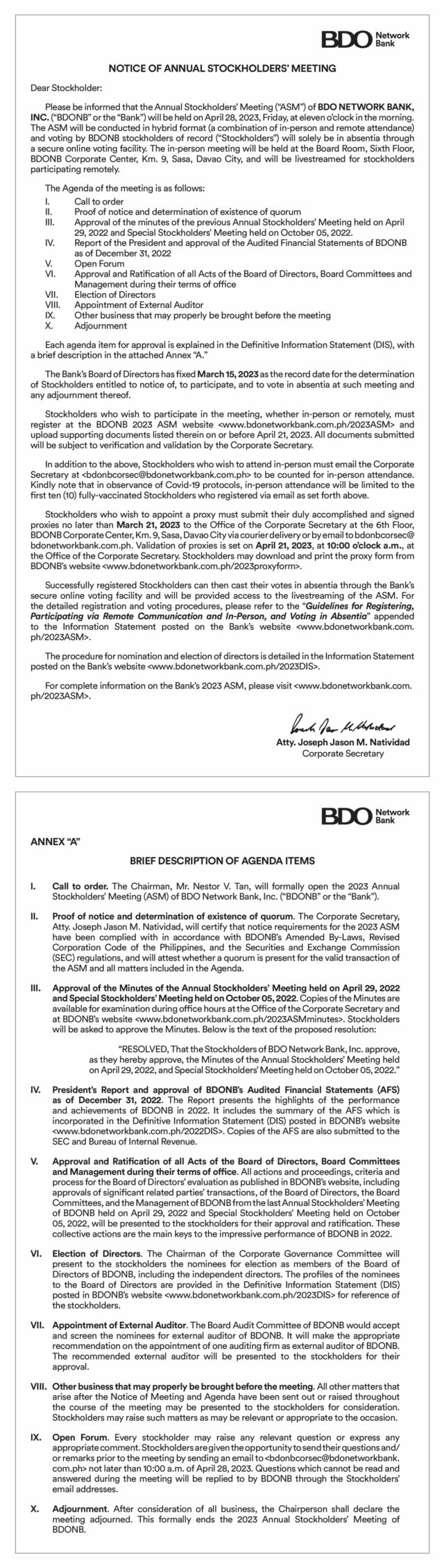
BDO Network Bank, Inc. announces Notice of Annual Stockholders’ Meeting


Spotlight is BusinessWorld’s sponsored section that allows advertisers to amplify their brand and connect with BusinessWorld’s audience by enabling them to publish their stories directly on the BusinessWorld Web site. For more information, send an email to online@bworldonline.com.

Join us on Viber at https://bit.ly/3hv6bLA to get more updates and subscribe to BusinessWorld’s titles and get exclusive content through www.bworld-x.com.

New vehicle sales up 27% in February

Vehicles are seen along Commonwealth Avenue in Quezon City. — PHILIPPINE STAR/MIGUEL DE GUZMAN

NEW VEHICLE SALES rose by 27.2% year on year in February, bolstering the industry’s hopes it can exceed pre-pandemic sales levels this year.

A joint report released by the Chamber of Automotive Manufacturers of the Philippines, Inc. (CAMPI) and Truck Manufacturers Association (TMA) showed vehicle sales reached 30,905 units in February, higher than 24,304 units sold a year earlier.

“The industry demonstrated anew positive sales growth of 27.2% in February 2023 on a year-on-year basis — a clear indicator of a continuously progressing auto industry from the pandemic,” CAMPI President Rommel R. Gutierrez said in a statement. 

Auto SalesMonth on month, February vehicle sales rose by 4.8%.

In February, commercial vehicle sales increased by 29% to 23,716 units, accounting for 76.74% of the industry’s total sales. This was driven by double-digit growth in sales of light commercial vehicles that went up by 20.4% to 18,035 and Asian utility vehicles (AUVs) that rose by 84.1% to 4,896.

Sales of passenger cars jumped by 21.6% to 7,189, which made up 23.26% of total sales in February.

Month on month, sales of commercial vehicles grew by 7.8%, while passenger car sales declined by 4.22%.

For the first two months of the year, vehicle sales went up by 34% year on year to 60,404 units.

Commercial vehicle sales rose by 37% to 45,709, led by strong demand for light commercial vehicles (up by 29% to 34,792) and AUVs (up by 85.5% to 9,483 units).

Passenger car sales jumped by 25.6% to 14,695 in the January-to-February period.

As of end-February, Toyota Motor Philippines Corp. led all car manufacturers in terms of sales with 28,299 units sold, equivalent to a 46.85% market share.

Mitsubishi Motors Philippines Corp. ranked second with 10,656 units sold for a 17.64% market share, followed by Ford Motor Co. Phils., Inc. with 4,171 units (6.91%), Nissan Philippines, Inc. with 3,535 units (5.85%), and Suzuki Phils., Inc. with 2,939 units (4.87%). 

Mr. Gutierrez said CAMPI and TMA members aim to sell 395,000 units this year, 12% higher than the 352,596 units sold in 2022.

“Members of CAMPI and TMA remain optimistic that sales will further grow by 10% to 15%, heading towards the 395,000-unit sales mark this 2023 from the actual sales of 352,596 units recorded last year,” Mr. Gutierrez said. 

“Various economic favorable indicators are prevailing, improving the overall outlook of the economy alongside increasing consumer demand for new motor vehicles,” he added.

If the 2023 sales target is met, it would surpass the 369,941 units sold by CAMPI-TMA members in 2019.

This would also be the second-highest ever sales for CAMPI-TMA, since the 425,673 units sold in 2019 or a year before the implementation of Republic Act No. 10963 or the Tax Reform for Acceleration and Inclusion (TRAIN) law. 

The law increased excise tax rates on automobiles to generate more revenues for the government. However, the law also exempted electric vehicles and pickup trucks.

There are concerns that vehicle sales could take a hit if the government pushes through with the lifting of the excise tax exemption for pickup trucks.

In November, the House of Representatives approved House Bill No. 4339 or the fourth package of the Comprehensive Tax Reform Package program on third and final reading, which includes the removal of the excise tax exemption enjoyed by pickup trucks. 

The exemption on pickup trucks was included in the TRAIN law as part of state efforts to help small business owners and professionals.

Total auto industry sales are forecast to hit 408,300 units this year. These include sales from CAMPI and TMA members, as well as Association of Vehicle Importers and Distributors exclusive members and MG Motors Phils.

The sales projection is 10.4% higher than the 369,981 units sold by the auto industry in 2022. — Revin Mikhael D. Ochave

More Fed hikes may put pressure on peso

The seal for the Board of Governors of the Federal Reserve System is on display in Washington, DC, U.S. on June 14, 2017. — REUTERS/JOSHUA ROBERTS/FILE PHOTO

By Keisha B. Ta-asan, Reporter

FURTHER TIGHTENING by the US Federal Reserve may put pressure on the Philippine peso and cause potential fund outflows in the coming months, analysts said, adding that more rate hikes from the Bangko Sentral ng Pilipinas (BSP) could help cushion the blow.   

US Federal Reserve Chairman Jerome H. Powell last week said the US central bank would likely raise interest rates more than expected to control inflation. This led market players to speculate that the terminal rate might peak at 6% this year. 

“This will likely place pressure on the peso and other currencies. This is because of yield differentials compared with the US,” MUFG Senior Currency Analyst Jeff Ng said in an e-mail.   

He said the US 10-year yields are higher than Malaysia’s and Thailand’s, causing some currency depreciation for both countries in the past weeks. 

“Although we see potential fund outflows in the near term, we eventually expect the Fed to turn neutral. This will help to reverse some dollar strength,” Mr. Ng said.   

The US Federal Reserve has increased the Fed fund rate by 450 basis points (bps) since March last year, bringing rates to 4.5-4.75%. The Fed’s next policy review is scheduled for March 21 and 22.

Further rate increases by the Philippine central bank to tame elevated inflation might help limit the yield differentials between the country and the US, Mr. Ng said.

“Given these, we expect the BSP to hike to at least 6.5% in 2023, with some chance of more rate hikes in the coming months,” Mr. Ng said.   

Last month, the BSP raised its key policy rate by 50 bps to 6% — the highest in nearly 16 years. It has raised rates by 400 bps since May 2022.

Inflation is expected to remain elevated this year, with the BSP projecting a full-year average of 6.1%.

“Our constructive view on the peso against the dollar in the second half of the year has remained premised on the theme of normalization, after imbalances in the previous year,” Mr. Ng said.

He said the local currency might move within the P54-to-P55 against the dollar this year.

China Banking Corp. Chief Economist Domini S. Velasquez said the Fed would likely move up its terminal rate projection.

“However, we currently have a 125-bp rate differential with the Fed, and it will remain sufficient to stabilize the peso,” she said in a Viber message.   

The Fed’s aggressive monetary tightening since last year has caused volatility across foreign exchange markets globally, bringing the peso to its record low of P59 against the dollar in October 2022.   

The peso has since rebounded, closing at P54.93 on Monday, 24 centavos higher than its previous finish, Bankers Association of the Philippines data showed.

Ms. Velasquez said the “sweet spot” in 2022 was a 100-bp rate differential between the BSP and Fed, and investor sentiment has improved since then.   

“This year, at the end of central banks’ tightening cycle, we expect some ‘risk on’ sentiment which will partly mitigate the rise of the dollar. We do not see a return of the P59-a-dollar anymore this year even with a more hawkish Fed,” she said.

However, the country’s foreign exchange market might still experience market volatilities, as the peso is likely to weaken to as low as P57 versus the greenback this year, she added.   

Moody’s Analytics Senior Economist Katrina Ell said the peso has held up relatively well against the strong dollar despite elevated inflation, ensuring the BSP will continue to hike rates for a few more months.

“This comes against a backdrop of some other economies in the region being near or close to the end of their tightening cycles,” Ms. Ell said in an e-mail.

Inflation eased for the first time in six months as it slowed to 8.6% in February from 8.7% in January. For the first two months of the year, inflation averaged 8.6%, higher than the BSP’s 6.1% forecast.   

“The BSP can’t do much unless it follows the interest rate hike of the Fed. Companies that have US debt will be affected since they will be paying higher interest,” Mercantile Securities Corp. Head Trader Jeff Radley C. See said.   

Regina Capital Development Corp. Head of Sales Luis A. Limlingan said there is less pressure for the BSP to raise rates due to the latest inflation report.   

“So long as the peso remains within a reasonable range, the BSP will at most match the Fed, while trying to keep rates from staying elevated for long. Even if inflation control is the primary goal of the BSP, a weaker peso is also linked because this is tied to import costs,” he said.

However, First Metro Investment Corp. Head of Research Cristina S. Ulang said the US central bank is unlikely to remain hawkish amid the sudden collapse of Silicon Valley Bank (SVB).   

Last week, California banking regulators shut down the bank and seized its deposits, marking the largest US banking failure since the 2008 global financial crisis.

This might also prompt slower rate hikes by the Fed if not a pause, Ms. Ulang said.   

“Consequently, the pressure on BSP to hike rates won’t be as much prior to the SVB closure,” she added.

Marcos: Systems vs cyberattacks on energy infrastructure needed 

A broken ethernet cable is seen in front of binary code and words “cyber security” in this illustration taken on March 8, 2022. — REUTERS

THE GOVERNMENT needs to develop systems to deter possible cyberattacks on the Philippines’ energy infrastructure, President Ferdinand R. Marcos, Jr. said on Monday.

“We are continuing to shore up our defenses when it comes to cybersecurity,” Mr. Marcos said in a speech in Malacañang after the National Intelligence Coordinating Agency (NICA) and National Grid Corp. of the Philippines (NGCP) signed a deal to boost cybersecurity.

“Since NGCP is a critical part of our security, of our ability to continue to function as a society, then this is an important day because now we have made more robust the defenses against any possible attacks on our power systems, on any other elements in our everyday lives that require power,” he said.

Under the deal, the NGCP will share “vital information” on energy-related security issues and provide technical advice to the NICA, which is tasked to recommend actions in safeguarding the grid agency’s transmission assets. 

Mr. Marcos said there have been fears that the involvement of any foreign entity in the power transmission system “would present a security threat to the Philippines.”

The partnership between NGCP and NICA is a “very good step towards answering that challenge,” he said.

The State Grid Corp. of China has had a 40% stake in NGCP since 2008, which has raised fears of possible Chinese interference in the country’s energy infrastructure.

In February 2020, Filipino senators expressed concern that the Philippines’ national security might have been compromised after an NGCP official disclosed that their system had been attacked “a hundred times already in just the past few weeks.”

Senator Ana Theresia “Risa” Hontiveros warned at the time that the Chinese could switch off the grid any time. She said China may not even need to hack into the Philippine’s transmission grid to remotely disable it given that the supervisory control and data acquisition network used to control the NGCP’s power transmission facilities is supplied by NARI Group Corp., which is also a Chinese state-owned entity.

Meanwhile, Mr. Marcos compared the conflicts caused by the industrial revolution to the problems that the world faces today due to digital technologies.

“For example, in the early 20th century in the First World War, industry was labor intensive. Hence, trench warfare,” he said. “And in the Second World War, we had industrialized our businesses, and hence, it was machinery and the production of airplanes and tanks that won the war. And now, we do our business through cyberspace.”

Mr. Marcos said the government is now “developing our cyber systems so that we are secure and so that the data that we need to collect and to disseminate are available to us.”

Boosting the country’s cybersecurity systems would also “ensure that we are able to do and handle data in a secure fashion without the risk of it being used somehow against the Philippines.”

“Let this be an example to all the other sectors that could be assessed to be at risk when it comes to cybersecurity,” Mr. Marcos said. “It is a good example for the rest of our infrastructure, and I talk about hard and soft infrastructure.”

The Marcos administration seeks to boost investments in the Philippine energy sector to attract more foreign investors. 

In January, Energy Secretary Raphael P.M. Lotilla told Chinese investors the Philippine government was prioritizing the integration of renewable sources of energy into the country’s power system. — Kyle Aristophere T. Atienza

Foreign chambers push for air transport reform legislation

PHILIPPINE STAR/MIGUEL DE GUZMAN

MEMBERS of the Joint Foreign Chambers (JFC) urged Congress to approve a much needed air transport reform bill, after technical glitches hit the country’s main international gateway earlier this year.

“The members of the JFC — with other industry associations such as the Safe Travel Alliance, Air Carriers Association of the Philippines and the International Air Transport Association — have long advocated for these reforms and we are optimistic that with congressional, executive, and private sector support, we will finally see their enactment in the 19th Congress,” the business groups said in a statement.

The JFC made the statement after the release of Senate Committee Report No. 39 on the air traffic management glitch at the Ninoy Aquino International Airport (NAIA) in January that caused the shutdown of Philippine airspace and the cancellation of hundreds of flights.

The Senate Committee on Public Services recommended amendments to the Civil Aviation Authority of the Philippines (CAAP) charter to strengthen the agency and address its conflicting functions as a regulator, operator and investigator. It also called for the passage of measures creating the Philippine Transportation Safety Board (PTSB) and the Philippine Airports Authority.

“The incident at the NAIA, and the disruption it caused to air transportation throughout the country, is a strong reminder of the need to pass laws to institute structural reforms in the air transport sector,” the JFC said.

Senator Mary Grace S. Poe-Llamanzares, who heads the Senate Public Services Committee, has said sabotage and cyberattacks were not the reasons behind the CAAP glitch that caused flight cancellations and left thousands of Filipinos and foreign tourists stranded. 

“The Jan. 1 systems failure was indeed a confluence of factors and errors. Experts likened it to the planets aligning albeit with an unfortunate consequence. It’s rare but we know it can happen, and it will continue to happen if we don’t do anything about the problems of the air traffic system in the country,” she said in a statement. 

The JFC once again pressed the Senate and House of Representatives to hold public hearings on the proposed creation of the PTSB. 

“Senate and House Bills have already been filed and are pending in both chambers, with Senate Bill No. 1121 creating the PTSB sponsored for plenary approval by Senator Poe on March 7. We urge relevant committees in both chambers to conduct public hearings on the bills pending at the committee level and for the Senate to commence deliberation on Senate Bill No. 1121 at the soonest possible time,” the JFC said.

The JFC statement was approved by the American Chamber of Commerce of the Philippines, Australian-New Zealand Chamber of Commerce of the Philippines, Canadian Chamber of Commerce of the Philippines, European Chamber of Commerce of the Philippines, Japanese Chamber of Commerce and Industry of the Philippines, Inc., Korean Chamber of Commerce of the Philippines, Inc. and Philippine Association of Multinational Companies Regional Headquarters, Inc. — Revin Mikhael D. Ochave

ACEN, US firm BrightNight tie up for energy projects in India

AYALA-LED ACEN Corp. has partnered with US-based renewable power company BrightNight LLC to develop and operate large-scale 1.2-gigawatt (GW) hybrid renewable energy projects in India.

“With this partnership, we are significantly strengthening our foothold in India’s fast-growing market as we shift from pure solar play to multi-technology renewables,” Patrice R. Clausse, chief executive officer of ACEN International, said in a media release on Monday.

The listed energy platform said it is aiming to deploy $250 million equity and related performance guarantees to back up BrightNight’s existing portfolio and future growth.

ACEN said its units, ACEN Renewables International and ACEN International, will help accelerate the construction of BrightNight’s existing 1.2-GW hybrid portfolio in India, including a 100-megawatt (MW) wind-solar project in the Indian state Maharashtra.

“ACEN is one of the largest and most respected renewables investors in Asia Pacific, and we are honored that they have chosen to work with us,” Martin Hermann, chief executive officer of BrightNight, said.

ACEN said the hybrid projects will be operational 24/7, with calibrated use of storage technologies.

“They have demonstrated success in scaling and operating large fleets of renewable assets through strategic partnerships across the region, and we have a shared vision on delivering what the India market requires: dispatchable, reliable, and affordable clean power,” Mr. Hermann added.

ACEN together with its partners owns a solar farm portfolio of 630-MW direct current (MWdc) or 450-MW alternating current (MWac) of operating projects and under-construction assets in India.

“BrightNight, meanwhile, brings its advanced India portfolio, experienced local team, and differentiated capabilities to develop and optimize large-scale, multi-technology hybrid renewable power plants,” ACEN said.

The renewable energy company said working with BrightNight will accelerate the energy transition in India.

BrightNight is said to be developing a 23-GW portfolio across the US and Asia Pacific, including India, Australia, the Philippines, and Bangladesh.

Listed energy company ACEN has been ramping up the expansion of its renewable energy portfolio. Last year, it spent around P50.6 billion as capital expenditure for the construction of 1,300 MW in new solar and wind farms in the Philippines, Australia, and India.

ACEN said it has more than 2,400 MW of projects under construction and that it is expecting around P50 billion to P70 billion in capital spending in 2023 to expand its renewable energy portfolio.

ACEN is targeting to reach a renewable energy capacity of 20 GW by 2030. It now has about 4,000 MW of attributable capacity from projects in the Philippines, Vietnam, Indonesia, India, and Australia. Up to 98% of the installed capacity is renewables.

On Monday, shares in the company slipped by P0.11 or 1.78% to close at P6.08 each on the stock exchange. — Ashley Erika O. Jose

Ginebra San Miguel net income up 9% to P4.5B

SMFB.COM.PH

GINEBRA San Miguel, Inc. (GSMI) has posted a 9% growth in net income to P4.5 billion in 2022 due to a higher volume of sales, the alcoholic beverage manufacturer told the stock exchange on Monday.

In a disclosure, the listed subsidiary of conglomerate San Miguel Corp. described last year’s profit as “a new record,” which it managed to achieve despite global supply chain disruptions, high inflation, and a weak peso.

“GSMI is one of the few companies that continued to grow despite the challenges of the past years. This is genuine proof of the company’s strength and true resiliency,” said Ramon S. Ang, its president and chief executive officer.

Consolidated sales last year grew by 11% to P47.3 billion compared with the level in the previous year because of volume growth and higher selling prices, the company said.

Income from operations reached P6 billion, which is 13% higher than that of the previous year.

“Strong brand equity, relevant campaigns, and a continuous push to expand distribution coverage in new markets enabled GSMI to sustain its volume ascent and remain the market leader in the hard liquor category,” the company said.

Total volume growth went up to 7% across various products, which “boosted the company’s bottom line.”

Its products Ginebra San Miguel, Vino Kulafu, and its Gin offerings also saw substantial growth for the year, the company said.

Meanwhile, the company’s board of directors approved the declaration of P0.75 in regular cash dividends and P1.75 in special cash dividends on common shares for shareholders as of March 24.

GSMI shares on Monday dropped by 3.33% at P5 to close at P145 apiece. — Adrian H. Halili

SEC warns against two unlicensed investment-taking entities

THE Securities and Exchange Commission (SEC) has warned the public against putting money in two investment-taking entities, which have not secured a license to offer shares.

In separate advisories, the SEC identified these entities as S&C Shamai Cloverleaf Group of Companies, Inc. and Camacho Trading.

The advisory stated that S&C Shaimai has been enticing the public on social media and online to invest in the company for a minimum of P10,000, which is said to earn 10% to 25% in interest after 30 to 45 days.

S&C Shaimai is comprised of several entities: Shaimai Best Food Hub, Shaimai Burger, Shaimai Best Pizza, Clover Leaf Realty Development, Clover Leaf Administration of Financial Marketing, Broom Broom Express, and Shaimai Tech Computer Trading.

Additionally, Broom Broom Express, a delivery service, is enticing the public to invest while guaranteeing 25% interest for a minimum amount of P89,000.

Meanwhile, Camacho Trading allegedly deals in supplying Korean newspapers to use as packaging supplies for vegetables, fruits, dried fish, and flowers, among others.

The entity promises investors a 10% return on investment per month. Its online posts claim that an initial investment of P50,000 may net a would-be investor up to P5,000 for the first six months then a return on the initial investment on the seventh.

In its review, the commission stated that both entities are not authorized to solicit investments from the public. — Adrian H. Halili

SM Investments ready to take public shares in 2GO for P5.55 billion

SY-LED SM Investments Corp. has set aside about P5.55 billion to fully accept shares in 2GO Group, Inc. in a tender offer that will begin on March 15, both companies disclosed to the stock market on Monday.

The tender offer shares, priced at P14.64 each, amount to 378,817,279 common shares and account for 15.39% of the issued and outstanding capital stock of 2GO.

The offer price went through an independent third-party fairness opinion by BPI Capital Corp. as the independent third-party valuation provider. BDO Securities Corp. was tapped as the tender offer agent.

SM Investments’ tender offer period is set to start on March 15 at 9:00 a.m. and end at 3:00 p.m. on April 28, unless extended by the company with approval from the Securities and Exchange Commission.

During the tender offer period, tendering stockholders of the company may offer a portion or all their common shares in 2GO to be accepted and sold to SM Investments.

While the period remains open, shareholders who have previously tendered shares are allowed to withdraw their shares at any time.

“Expectation is for many shareholders to partake in tender offer since the price was around double of what it was trading prior to the announcement,” Regina Capital Development Corp. Head of Sales Luis A. Limlingan said in a Viber message.

During the voluntary delisting of 2GO on the main board of the Philippine Stock Exchange, its shares were trading at P14.24 apiece, or higher by 56.5% than the P9.10 closing price before the tender offer announcement.

“Value turnover was rapidly increased as well,” Mr. Limlingan added.

“For sure everyone will be tendering their shares since SM wants to make 2GO private, 15% is the remaining public float. It is just a small chunk that SM can easily buy,” said Mercantile Securities Corp. Head Trader Jeff Radley C. See in a Viber message.

SM Investments has said that the tender offer was meant to delist 2GO shares from the stock exchange’s main board. It currently owns 52.88% of 2GO, while Trident Investments Holdings Pte. Ltd. holds 31.72%.

Mr. See also said that a large number of stakeholders are likely to tender their 2GO shares as these might not be easily sellable once the company becomes private.

On the local bourse on Monday, shares in SM Investments were unchanged at P875 apiece. — Adrian H. Halili

Cebu Pacific aims to boost demand for Singapore travel

CEBUPACIFICAIR.COM

CEBU PACIFIC said on Monday it will add a Clark-Singapore route to its existing Singapore-bound routes from Manila, Cebu and Davao, and boost demand by offering free travel programs in partnership with Singapore Tourism Board (STB).

“In anticipation of summer, peak travel season, we now have four cities with direct accessibility to Singapore. We’re quite optimistic for the market for these flights,” said Michelle Eve A. de Guzman, Cebu Pacific’s marketing director, at a press briefing on Monday.

Starting end of March, flights will increase to four times weekly from Davao and daily from Cebu, while daily flights from Clark will be launched starting April 28.

“The frequency of our Manila-Singapore route, flying three times a day, is almost back to pre-pandemic numbers. This really contributes to the accessibility of Singapore for Filipinos,” Ms. de Guzman added.

To boost demand, STB’s rewards program SingapoRewards will offer one of 40 complimentary itineraries or experiences to every international short-term visitor who arrives by air throughout 2023.

The experiences will take tourists to lesser-known places such as the Brass Lion Distillery and the S.E.A. Aquarium, and unique adventures such as the Bugis, Waterloo, and Kampong Gelam Instagram walking tour.

Juliana Kua, STB’s assistant chief executive, said that Singapore got 6.3 million tourists in 2022, which they aim to increase to 12-14 million this year.

“As for the Philippine market, which has always been a strong one for us, we’re hoping it will at least double for 2023, whether it’s their first time or repeat visits where they discover sides of Singapore they never knew about before,” she told BusinessWorld.

The SingapoRewards program was piloted in Australia, India, and Indonesia from October 2022 to March 2023 and is now available globally.

Because of the budget carrier’s increase in flights and STB’s rewards program, Cebu Pacific is confident that Filipinos can “extract value from the entire Singapore travel experience,” according to Candice Iyog, Cebu Pacific’s customer experience officer.

“When we announce additional capacity, we intend for it to stay that way. It will depend on the market, but we’re optimistic that Filipinos will respond well to these travel opportunities,” she said at the briefing.

SingapoRewards can be redeemed and booked through the VisitSingapore app and website. — Brontë H. Lacsamana