Home Blog Page 5079

Queen and Adam Lambert to bring Rhapsody Tour back to North America

ADAM LAMBERT and Queen during the Rhapsody Tour on July 11, 2022 at the Unipol Arena in Bologna, Italy. —EMMANUELE OLIVI/LIVEMEDIA VIA REUTERS

NEW YORK — British rockers Queen and US singer Adam Lambert are heading out on the road again, bringing their updated and expanded Rhapsody Tour back to North America after four years.

Guitarist Brian May, drummer Roger Taylor and Mr. Lambert announced on Friday they would return this autumn to the region where they first launched the tour in 2019.

The 14-date swing begins on Oct. 4 in Baltimore and wraps up in Los Angeles on Nov. 11.

“It’s evolved, is the way I would say it. I was tempted to call this ‘The revved up Rhapsody tour’ because it’s a little different from the way you saw it last time,” Mr. May told Reuters in a joint interview with Mr. Taylor and Mr. Lambert.

“We’ve been all around the world with it. All kinds of stuff has happened. Different songs, different production. We’re always putting new stuff in. So, now you look at it and it’s hardly recognizable from the way it started out.”

The new dates follow a UK and European tour last year, with a 150-minute set list including Queen classics like “We Will Rock You,” “Don’t Stop Me Now,” and “Somebody To Love” against a backdrop of dazzling special effects.

“We like to try and introduce different songs, so deeper cuts in amongst the big hits, just to keep ourselves fresh and to (give) the show a little bit more depth. It won’t be the same as people saw before,” Mr. Taylor said.

“It’s nice to give a visual context to these songs that people know so well. And… it changes some of the perception of what the song is about or the feeling of the song when you put it next to another one, when the background is a certain environment,” Mr. Lambert added.

In October, Queen released rediscovered song “Face It Alone” featuring late frontman Freddie Mercury, which was originally recorded in the late 1980s during sessions for the band’s chart-topping album The Miracle but didn’t make the cut.

Asked if might be any future such releases featuring Mr. Mercury, May said: “Hard to answer… There are a few little bits and pieces with Freddie on but it’s getting harder and harder to find anything that hasn’t been heard.”

Mr. May, 75, was at Buckingham Palace last week to receive his knighthood for services to music and charity from Britain’s King Charles.

“We’ve had quite a bit of contact with King Charles over the years so it was nice to see him, we had a nice little chat,” Mr. May said, adding the monarch asked him about his knees when he had to bend down as part of the ceremony.

“It was very intimate, (I) had my family there. He put the sword on both sides and asked me about my knees… We talked about this (knees) because we’re of an age. I’m actually a year older than him.” — Reuters
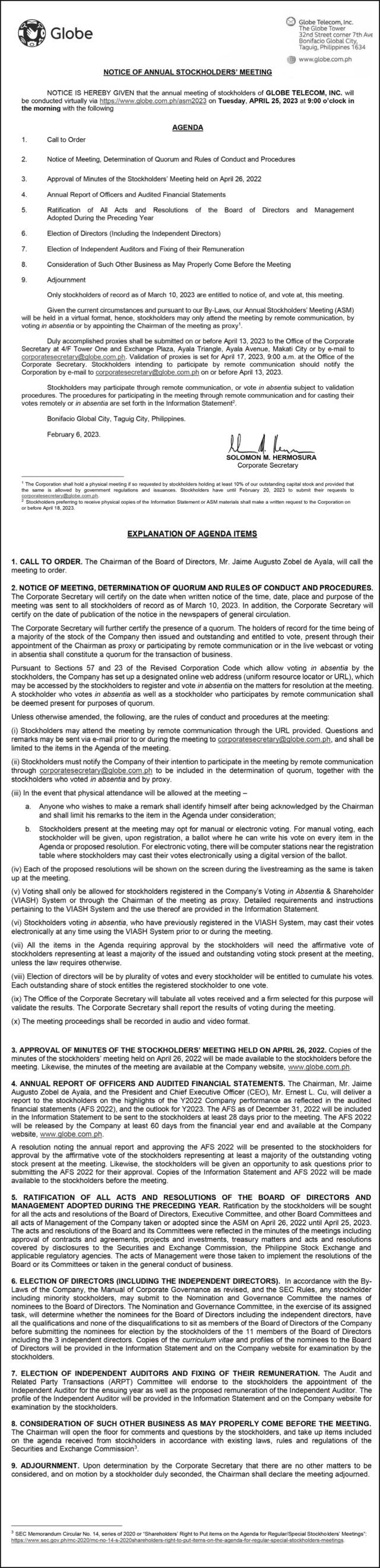
Globe Telecom, Inc. to conduct annual meeting of stockholders virtually on April 25

click to enlarge
click to enlarge

Spotlight is BusinessWorld’s sponsored section that allows advertisers to amplify their brand and connect with BusinessWorld’s audience by enabling them to publish their stories directly on the BusinessWorld Web site. For more information, send an email to online@bworldonline.com.

Join us on Viber at https://bit.ly/3hv6bLA to get more updates and subscribe to BusinessWorld’s titles and get exclusive content through www.bworld-x.com.

Philippines slips a notch in Global Connectedness Index

The Philippines inched down a notch to 56th out of 171 countries despite a slight improvement in its overall score to 54.2 (out of 100) in the 2022 edition of the DHL Global Connectedness Index by Germany-based logistics firm Deutsche Post DHL Group. The latest edition, which had 2021 as the reference period, ranked a country on its depth and breadth to integration with the rest of the world based on four pillars.*

Philippines slips a notch in Global Connectedness Index

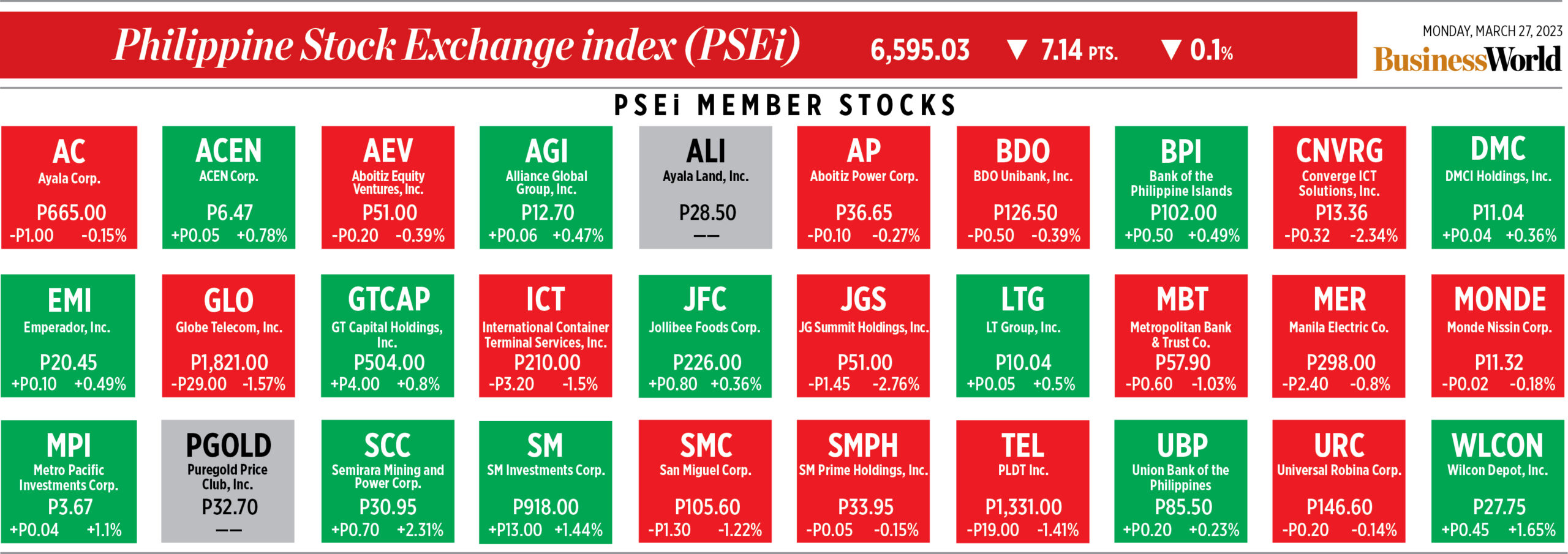
How PSEi member stocks performed — March 27, 2023

Here’s a quick glance at how PSEi stocks fared on Monday, March 27, 2023.


Starry Dungeons & Dragons film brings fantasy game to big screen

A scene from Dungeons & Dragons: Honor Among Thieves

LONDON — The fantasy world of Dungeons & Dragons came to a rainy London’s Leicester Square on Thursday as actors Chris Pine, Rege-Jean Page, and Michelle Rodriguez premiered their new film imagining of the popular role-playing game.

Dungeons & Dragons: Honor Among Thieves hits cinemas from next week hoping to entice a new generation of fans with the game which first came out in 1974.

The film,, distributed in the Philippines by Paramount Pictures through Columbia Pictures, opens in the Philippines on March 29.

In the film, Mr. Pine’s character Edgin brings together a band of adventurers for a mission to retrieve a powerful relic.

“I didn’t really know anything about it but my nephew is… a D&D player… I watched he and his pals play and was really blown over by how much joy there was in it and how much improvisation, it was just like an imagination gym basically,” Mr. Pine told Reuters on the red carpet.

“Hopefully what people get out of our film is that it’s a fun world with interesting characters that requires creativity and imagination and it’s just a wonderful way to spend time.”

Packed with striking visual effects and stunning backdrops, the film is not just for fans of the game, its directors Jonathan Goldstein and John Francis Daley say.

“There’s so much in this game, there’s so much potential that the movie just really skims the surface of all the potential,” Mr. Goldstein said.

“You don’t have to be a fan of the game to enjoy this movie. It really just taps into that spirit (of creativity and imagination) that’s so great about it,” Mr. Daley added.

Ms. Rodriguez, who plays Holga, used to play the game herself.

“When (directors) John and Jonathan introduced me to the script, it all came back to me,” she said. “It made me understand why (Dungeons & Dragons) has been around for 50 years.”

Mr. Page, who plays Xenk, said he played his first Dungeons & Dragons game just before starting filming.

“I wasn’t a player but I had actually watched people play Dungeons & Dragons, which is quite possibly even more involved,” he said. “And so I had a little bit of familiarity with the world but my first game was with this cast.”

The Paramount Pictures film also stars Hugh Grant, Justice Smith, Daisy Head, and Sophia Lillis. — Reuters

Peso climbs on bank fears, BSP rate bets

BW FILE PHOTO

THE PESO appreciated against the dollar on Monday on expectations of weaker global demand due to the ongoing turmoil in the banking sector and following dovish comments from a Monetary Board member.

The local currency closed at P54.29 versus the dollar on Monday, rising by six centavos from Friday’s P54.35 finish, data from the Bankers Association of the Philippines’ website showed.

The peso opened Monday’s session at P54.33 per dollar. It posted an intraday best of P54.26, while its worst showing for the day was at P54.55 versus the greenback.

Dollars traded rose to $1.082 billion on Monday from the $1.036 billion recorded on Friday.

“The peso strengthened amid prospects of weaker global economic activity as market worries on the global banking sector resurfaced following reports of distress concerning Deutsche Bank,” a trader said in an e-mail.

Deutsche Bank, Germany’s largest bank, saw its shares fall by 8.5% on Friday as investors fretted that regulators and central banks have yet to contain the worst shock to the sector since the 2008 global financial crisis, Reuters reported.

The peso was also supported by dovish comments from Finance Secretary Benjamin E. Diokno, a member of the central bank’s policy-setting Monetary Board, Rizal Commercial Banking Corp. Chief Economist Michael L. Ricafort said in a Viber message.

The BSP is likely to pause its tightening cycle in May, Mr. Diokno said on Sunday.

“Contrary to some analysts’ view that the BSP (Bangko Sentral ng Pilipinas) Monetary Board could even push its policy interest rate higher than 6.5%, I think that the BSP is leaning towards a pause in its policy meeting in May,” he said.

“The (rate) adjustment’s full impact has yet to be absorbed by the economy, considering that monetary policy works with a lag, oftentimes a long lag,” Mr. Diokno added.

The Monetary Board last week hiked benchmark interest rates by 25 basis points (bps), bringing its key rate to 6.25%, the highest in nearly 16 years or since the 7.5% in May 2007.

The BSP has raised rates by a total of 425 bps since May 2022 to curb elevated inflation. Its next meeting is on May 18.

For Tuesday, the trader said the peso may strengthen further against the dollar on expectations of similar dovish remarks from US Federal Reserve officials.

The trader sees the peso moving between P54.15 and P54.40 per dollar on Tuesday, while Mr. Ricafort expects it to trade from P54.20 to P54.40. — AMCS with Reuters

Stocks decline in thin trade ahead of key data

BW FILE PHOTO

PHILIPPINE STOCKS dropped on Monday due to thin trading ahead of the month’s close and as investors await the release of economic data later this week and speeches of US Federal Reserve officials.

The bellwether Philippine Stock Exchange index (PSEi) went down by 7.14 points or 0.1% to close at 6,595.03 on Monday, while the broader all shares index declined by 2.65 points or 0.07% to end at 3,514.07.

“Philippine shares began the week quietly as investors begin to brace themselves for the quarter end window dressing this Friday. For the week ahead, many fund managers stateside will digest the core PCE (personal consumption expenditures) report on Friday,” Regina Capital Development Corp. Head of Sales Luis A. Limlingan said in a Viber message.

“Aside from this, there will be several speaking engagements from Fed officials throughout the week, including congressional testimony by Vice-Chair for Supervision Michael Barr on Tuesday and Wednesday and speeches by New York Fed President Williams and Fed Governor Waller on Friday. Back home, the Philippines’ budget balance as well as bank lending data are due out on the latter part of the week,” Mr. Limlingan added.

First Metro Investment Corp. Head of Research Cristina S. Ulang said in a Viber message that the market moved sideways due to a lack of catalysts.

“March inflation is yet to come out, which will decide whether a pause on rate hiking is viable. That will be the catalyst for a rally,” Ms. Ulang said.

Philippine inflation data for March will be released on April 5.

Headline inflation eased to 8.6% in February from the 14-year high of 8.7% in January.

For the first two months of the year, inflation averaged 8.6%, well above the Bangko Sentral ng Pilipinas’ (BSP) 2-4% target and 6% forecast for the year.

The BSP’s policy-setting Monetary Board last week hiked benchmark interest rates by 25 basis points (bps) as inflation remains elevated, bringing its key rate to 6.25%.

Since May 2022, the central bank raised rates by a total of 425 bps. Its next rate-setting meeting is on May 18.

Almost all sectoral indices closed higher on Monday. Mining and oil increased by 36.95 points or 0.35% to 10,711.32; holding firms went up by 14.89 points or 0.23% to 6,436.27; industrials rose by 10.91 points or 0.11% to 9,552.63; and property climbed by 0.38 point or 0.01% to 2,782.40.

Meanwhile, services dropped by 16.67 points or 1.02% to 1,621.78 and financials fell by 2.65 points or 0.15% to end at 1,792.43.

Value turnover declined to P3.63 billion on Monday with 390.14 million shares changing hands from the P4.86 billion with 627.07 million issues traded on Friday.

Decliners narrowly outnumbered advancers, 87 versus 82, while 46 names closed unchanged. — A.H. Halili

DA still validating projections of pork shortage next month

REUTERS

THE Department of Agriculture (DA) said on Monday that it is validating projections of a pork shortage in April, saying it is trying to reconcile government data with input from the hog industry.

DA Deputy Spokesman Rex C. Estoperez said it will have a clearer picture of the supply situation later in March.

“The negative (figures) are cumulative on a month-to-month basis. We have to verify at the end of March together with the data of stakeholders (to) come up with the validated figure,” Mr. Estoperez said in a briefing.

According to data presented by the DA’s National Livestock Program on Thursday, the Philippines is expected to experience a shortfall in the supply of domestic pork in April of at least 56,180 metric tons (MT), against demand of 145, 849 MT.

According to Mr. Estoperez, the projections do not take into account the inventory of imported pork. He said a validated shortage will trigger discussions on the need to import.

“If we have the final figure then we can say (how much volume we need to import). For now, we cannot declare (a shortage) as it is not the final figure,” he said.

Pork Producers Federation of the Philippines, Inc. President Rolando E. Tambago urged the Bureau of Animal Industry to review protocols for mitigating African Swine Fever.

In a statement, Mr. Tambago said that the standard response to an outbreak — culling swine within a 500-meter radius — was “counterproductive” because it also affects healthy pigs.

He said that the method would encourage farmers to dispose of their hogs to traders at a discount, including infected animals.

“They’ve been observing this protocol for more than three years, yet the disease continues to spread,” he said.

According to DA monitoring reports on Monday, the retail price of pork belly (liempo) was between P340 and P420 per kilo, while pork shoulder (kasim) was between P270 and P350. — Sheldeen Joy Talavera

Labor coalition seeks P750 minimum wage for Calabarzon region

PHILSTAR

THE Worker’s Initiative for Wage Increase (Win for Win) on Monday asked the Calabarzon wage board to increase the daily minimum wage in the region to P750 to help workers deal with the rising prices of basic goods.

In a five-page petition, the coalition said it proposed wage hikes of P280, P321, P360 and P400 for what it said were the four wage classes in Calabarzon, which consists of the provinces of Cavite, Laguna, Batangas, Rizal and Quezon.

“Increasing the minimum wage will have a positive impact on the macroeconomy as workers and their families will have increased purchasing power, which will boost consumption and benefit retail businesses,” it said.

Last year, the Calabarzon regional wage board implemented a new daily minimum wage for three categories of worker — of P470 for non-agricultural workers; P429 for agricultural workers; and P350 in retail and service establishments with not more than 10 workers.

Wage boards can only act on petitions a year after a region’s last wage order.

Citing data from think tank IBON Foundation, Win for Win said the minimum living wage in Calabarzon for a family of five should at least be P1,087.

“The workers assert that a substantial increase in minimum wages is urgent, necessary and just,” Win for Win said in a separate statement.

It said rising prices of commodities represent a “supervening event” that justifies higher wages. The labor coalition cited the war between Russia and Ukraine as a factor that continues to elevate fuel prices.

In a separate statement, the Federation of Free Workers (FFW) backed the proposal and urged the Calabarzon wage board to immediately act on Win for Win’s wage petition.

“The proposed wage hike will go a long way in helping these workers cope with the rising cost of living and necessities for their families,” it said.

Inflation in February eased to 8.6%, from a 14-year high of 8.7% a month earlier as prices of food and utilities remained high. The Bangko Sentral ng Pilipinas expects inflation to average 6.1% this year.

Under the Labor Code, wage boards must consider the demand for a living wage, the impact of wage adjustments on the consumer price index, the changes in the cost of living in the region, and the needs of workers and their families, among others.

Last week, the United for Wage Increase Now! filed a petition to bring the current P570 minimum wage in the National Capital Region to P1,110.

Senate President Juan Miguel F. Zubiri has filed a bill seeking to increase the minimum wage for private sector workers by P150 nationwide, which he said could help workers deal with the rising prices of goods and services.

The Makabayan bloc also proposed a wage increase at the House of Representatives, seeking a P750 hike for all private sector workers, those working in special economic zones, freeports and in the agricultural sector.

“The high cost of living coupled with job losses and reduced working hours have made it almost impossible for many to make ends meet,” FFW said.

“This is the reason why FFW joins the call for the government and employers to prioritize the welfare of our workers and ensure that they receive just compensation for their labor. — John Victor D. Ordoñez

Road connectivity named key gov’t priority

PRESIDENT FERDINAND R. MARCOS, JR. FACEBOOK PAGE

PRESIDENT Ferdinand R. Marcos, Jr. said on Monday that he will pursue more projects interconnecting the country’s road networks. 

“We will continue to push for the interconnectivity of major roads and expressways, as well as build even more roads and bridges in strategic places within the archipelago,” he said in a speech at the inauguration of the North Luzon Expressway (NLEX) Connector Project’s first phase. The road is a five-kilometer elevated expressway running from Caloocan’s Circumferential Road 3 (C-3) to España Boulevard in Manila.

The first segment is part of the NLEX-South Luzon Expressway (SLEX) Road Connector Project, an eight-kilometer, four-lane elevated expressway spanning C3 Road, España, the Polytechnic University of the Philippines in Sta. Mesa, Manila and the Metro Manila Skyway Stage 3.

“We will not stop here, and we will continue to develop a highly interconnected road network that will facilitate our country’s rapid, inclusive, and sustained economic growth,” Mr. Marcos said.

The NLEX Connector Caloocan-España section will be a “great relief” to the logistics sector “since there will be an alternative route for truckers who wish to avoid the congestion in the main roads within the metropolis,” Mr. Marcos said.

“(It will) contribute to the ease of movement of cargo and goods from north to south and vice versa, especially those coming from the Port of Manila.”

The NLEX Connector’s first segment is expected to cut travel time between the cities of Manila and Caloocan to five minutes.

The second phase, which will run between España to Magsaysay Boulevard, is expected to be finished by June.

The P23.20-billion NLEX-SLEX Connector Project is a public-private partnership between the Department of Public Works and Highways and Metro Pacific Investments Corp.

“Once completed, it is expected to decongest traffic in Metro Manila by providing an alternative to C-5 Road, Epifanio de los Santos Avenue (EDSA), and other major roads,” the Department of Finance said in a statement.

“It will also cut the travel time between NLEX and SLEX from more than an hour to just 15 to 20 minutes,” it added.

Mr. Marcos urged NLEX Corp. to “remain steadfast” in its commitment to working with the government to improve the infrastructure landscape. — Kyle Aristophere T. Atienza

NLEX connector road segment 2 set to open as early as June

NLEX CORPORATION

THE second segment of Metro Pacific Tollways Corp. (MPTC) unit’s NLEX Connector Road is set to be completed by the end of June if right-of-way acquisitions go as planned, NLEX Corp.’s president said.

NLEX Connector Road, an 8-kilometer expressway linking the Caloocan Interchange on Circumferential Road 3 (C-3) to Magsaysay Interchange at the Polytechnic University of the Philippines, is managed by MPTC unit NLEX Corp.

“Provided that we get all the right of way from the DPWH (Department of Public Works and Highways), we think we will be able to complete (the second section) by the end of June. That’s from España all the way to Magsaysay interchange,” NLEX Corp. President and General Manager Jose Luigi L. Bautista said on the sidelines of the inauguration of the project’s first phase.

“If they are able to deliver all of the remaining right of way by April, we would be able to finish by June.”

To date, Mr. Bautista said that the second segment of the NLEX Connector project has obtained 80% of the right of way to be acquired, while construction is 42% complete.

Mr. Bautista said the remaining right of way to be acquired is in the Magsaysay Boulevard area.

On Monday, MPTC inaugurated the first five-kilometer section of the NLEX Connector Road which is set to be opened to the public as soon as the company is cleared to do so by the Toll Regulatory Board (TRB).

“TRB has a board meeting and one of the things that they will discuss there is the permit to allow us to open. If we get the permit (by early Tuesday), I think by the afternoon (of the same day) we will be able to open,” Mr. Bautista said.

MPTC proposed to the TRB an P84-P85 toll for road users traveling between the Caloocan Interchange and España, according to Mr. Bautista.

“We will see about the results of the board meeting of the TRB. It is possible that we let motorists use it for free for a month, so that they can get comfortable using it,” Mr. Bautista said.

He said any such opening would be in time for the Easter holidays, allowing cars feeding into the North Luzon Expressway (NLEX) to be distributed among Mindanao Avenue, Balintawak and España.

During the week of Easter, Mr. Bautista said NLEX and Subic Clark Tarlac Expressway users are expected to number at least 350,000 a day.

“Our December figure was around 10-15% higher, so it could be around that number,” he said.

MPTC is the tollways unit of Metro Pacific Investments Corp., one of three key Philippine units of Hong Kong-based First Pacific Co. Ltd., the others being Philex Mining Corp. and PLDT, Inc.

Hastings Holdings, Inc., a unit of PLDT Beneficial Trust Fund subsidiary MediaQuest Holdings, Inc., has a majority stake in BusinessWorld through the Philippine Star Group, which it controls. — Justine Irish D. Tabile

OECD cites need to build Southeast Asian resiliency by upskilling workforce

SOUTHEAST ASIA needs to upskill its workers to support productivity growth and improve resiliency against global crises, the Organisation for Economic Co-operation and Development (OECD) said.

“In Southeast Asia, workers are struggling to reskill and upskill quickly enough to adapt to changes in the world of work, and employers who often encounter difficulties in finding the skills they need as productivity becomes a more important driver of the region’s economic growth,” the OECD said in a report.

“To thrive in the world of tomorrow, people in Southeast Asia, especially those from disadvantaged groups, need access to high-quality opportunities to develop and use their skills over the life course, which would help them transition out of informality, boost productivity and promote individual and societal well-being,” it added.

The report said the coronavirus disease 2019 (COVID-19) pandemic, the Russia-Ukraine crisis, and other crises disrupted the economy and increased the risk of inequality in education and labor markets in Southeast Asia. 

The development of skills in the region also “remains highly unequal across groups.” 

“Consistently across all levels of education, access to learning is limited for learners from low-income households, remote areas, ethnic minorities and learners who have disabilities,” it said.

The report said that lack of access to training among workers in Southeast Asia’s sizeable informal economy is one of the region’s “principal policy concerns.” There are about 244 million informal workers throughout the region who do not have access to social security or employment benefits, including employer-sponsored training.

“These megatrends and challenges reinforce the need for Southeast Asia to design forward-looking and dynamic skills policies,” it added.

The OECD cited the potential of global value chains to allow various parts of the production process to be performed in a number of locations.

“Many Southeast Asian countries are now major players in the world market, both as exporters and importers, and have thus attracted significant investment in services, trade, communication and manufacturing sectors,” it said.

“When Southeast Asian countries have a highly skilled workforce, this enables them to participate in the higher end of the global production chain characterized by high-skilled activities. Participation in global value chains can lead to productivity gains, but achieving those gains is dependent on Southeast Asian countries having people with the right sets of skills,” it added.

There is also a need to adopt high-performance workplace practices to facilitate the more extensive use of skills among workers. 

“The low use of skills in Southeast Asia stems from the lack of an enabling environment for intensive skills use in the workplace and limited management capacities among employers,” it said.

Southeast Asian countries can also benefit from policies that promote the demand for the use of higher level skills in innovation and entrepreneurship, according to the report.

“While enrolment in science, technology, engineering and mathematics (STEM) programs has risen in all countries in Southeast Asia over the last decade, countries invest only 0.59% of their gross domestic product on research and development activities, in comparison to 2.57% in OECD countries,” it added.

The OECD also noted how migrants can increase the supply of skills in the country and contribute to economic growth.

In the region, Brunei, Malaysia, Singapore and Thailand have net migrant inflows, while Cambodia, Indonesia, Laos, Myanmar, the Philippines and Vietnam have net migrant outflows.

New technologies and digital infrastructure are spreading rapidly throughout Southeast Asia, the OECD said.

“The region is projected to be one of the world’s fastest-growing data center markets in the next few years, exceeding the growth in North America and the rest of the Asia-Pacific,” the report said.

The report also found that while horizontal and vertical coordination mechanisms for skills policies in Southeast Asia have been established, the implementation remains difficult.

“Countries have established oversight agencies, inter-ministerial bodies and working groups, among other mechanisms, that could serve as platforms to work a common skills agenda across the whole of government. However, Southeast Asia still scores poorly on the Bertelsmann Transformation Index (BTI) indicator on policy coordination, which measures the extent to which governments can coordinate conflicting objectives into a coherent policy,” it added.

The OECD said that outside of government, stakeholder groups can make important contributions to skills policies, but engagement with them remains low in Southeast Asia.

“It is important to coordinate with labor market actors, such as employer organizations, who can help align skills policies with industry demands, as well as with trade unions, who can represent the interests and needs of workers,” it added. — Luisa Maria Jacinta C. Jocson

ADVERTISEMENT
ADVERTISEMENT