Home Blog Page 506

Trump adopts messenger-in-chief role after Charlie Kirk’s death

Candles and flowers are placed near an image of Charlie Kirk, during a vigil at Orem City Center Park, after US right-wing activist and commentator, Charlie Kirk, an ally of U.S. President Donald Trump, was fatally shot during an event at Utah Valley University, in Orem, Utah, US Sept. 11, 2025. — REUTERS/JIM URQUHART

WASHINGTON — Since the US conservative activist Charlie Kirk was shot in a brazen display of violence, President Donald Trump has embraced the role of spokesman in an extraordinary way.

Trump was first to confirm the news to a country in shock that Kirk was dead and first to announce that the latest suspect was in custody. He shared when Kirk’s funeral would take place and said he would attend. Before a suspect was detained, Trump blamed without presenting evidence the “radical left” for Kirk’s murder, with many of his followers repeating the accusation and calling for vengeance amid a wave of right-wing anger.

Kirk, a popular but divisive podcast host and author of a half-dozen books, left behind a wife, prominent friends and legions of followers after being gunned down on a Utah college campus on Wednesday where he was giving a speech.

Yet it is Trump who has taken on a central role in messaging after his political ally’s grisly public death, delivering information that typically would come from law enforcement or local officials rather than the nation’s top leader.

His actions contrast with the more cautious approach of past presidents. But they are very much in line with his penchant for direct communication, defying convention and putting himself in the middle of domestic and international issues.

“The one thing about Donald Trump is he is a very detailed individual,” said Mercedes Schlapp, a senior adviser to Trump in his first term. “Whether he is building the Rose Garden Club or we have this awful tragedy, he wants to be the one to break the news.”

Trump ordered flags to be flown at half-staff, said he would award Kirk the Presidential Medal of Freedom and saw his vice president accompany Kirk’s casket back to his home state on Air Force Two – all fairly unusual ways for the US government to honor a political operative who has never held office or served in the military.

Trump had a personal and political relationship with Kirk, the co-founder and president of the conservative student group Turning Point USA he credits with helping him appeal to young voters.

“Charlie had a magic over the kids,” Trump said on Friday on Fox News’ “Fox and Friends,” recalling how his teenage son Barron was awe-struck by the charismatic 31-year-old activist.

Kirk was also a sharply partisan figure whose combative style and anti-LGBTQ and anti-immigrant rhetoric often brought him to clash with others online and in public. His far-right views on abortion, civil rights and gun control also garnered strong reactions from the groups his comments targeted.

Trump has called for a non-violent response from his supporters but sidestepped reporters’ questions over how to unify the country in the midst of its most sustained surge in political violence since the 1970s. Trump himself was the subject of two assassination attempts last year.

Trump downplayed the extremism from the political right, telling reporters on Thursday that “we just have to beat the hell out of them,” stoking his supporters’ calls for political revenge against the “radical left.”

Twenty-two-year-old Tyler Robinson of Utah was arrested on Thursday night for the shooting. Motives remained unclear, with investigators closely scrutinizing messages engraved into four bullet casings. Experts have said they could reference left- or right-leaning groups.

DEFINING THE NARRATIVE
Schlapp said Trump, a former reality television host, has come to enjoy unstructured exchanges with the press and the bully pulpit that comes with the attention lavished on him.

She noted that his approach to communication has been more aggressive in his second term in office.

“He just really wants to drive the news, and who is better to drive the news than Donald Trump? And his strategy has worked,” she said. “His administration is on offense from a media standpoint like nothing I’ve ever seen. We were getting hit all the time in the first term. It has allowed the president to define a narrative.”

There have been no briefings by Trump’s aides since the shooting. Aides regularly defer to Trump on policy announcements or the administration’s thinking, declining to “get in front of the president.”

Trump’s in-the-moment, off-the-cuff style comes with the risk of influencing a law enforcement process or later being contradicted by a clearer picture of the facts.

“Presidents typically don’t release breaking news like that,” said Yu Ouyang, professor of political science at Purdue University Northwest. “They know the impact that their words would have.”

Critics, including Senator Elizabeth Warren, took Trump to task for his remarks last week ignoring that liberal and Democratic figures have also been the target of political violence in the US Some commentators contrasted Trump’s repeated messaging on Kirk versus his relatively muted response to the assassination of Minnesota Democratic Representative Melissa Hortman earlier this year.

In a video message from the Oval Office on Wednesday, he said “violence and murder are the tragic consequence of demonizing those with whom you disagree” – but then only called out the rhetoric of the left.

“Even though (Trump) is trying to console at times, a lot of his rhetoric has also been very much ramping up – blaming a particular group before we even know who has done this,” said Denise Bostdorff, a College of Wooster communication studies professor who has studied presidential rhetoric.

The White House did not respond for comment. Trump’s staff touts the president’s accessibility, while many of his supporters relish his norm-busting, blunt communication style.

“Ronald Reagan was an orator,” said Barry Bennett, a former Trump campaign adviser, “but Donald Trump understands the speed of news and how to get a story out there.” — Reuters


Kinetix Kids: A play gym and event space with specialized classes to boost children’s development

Kinetix Kids offers a variety of specialized classes led by professionals in their respective fields.

Beyond its play gym experience, Kinetix Kids also features specialized one-on-one and group training programs, creating opportunities for children to grow and for parents to engage in their progress

Found on the fourth floor of The Podium in Ortigas, Kinetix Kids stands out as a leading play gym and activity area. Its lively interior and a prominent, human-sized bust of “Aki the Astronaut” at the entrance make a memorable first impression. Kinetix Kids is unique for a reason. The facility’s mission is rooted in the Power of Play, where children can develop their minds, bodies, and social skills in an expansive play area, but Kinetix Kids goes a step further by providing a range of specialized classes, which are designed to give children a strong developmental foundation.

In-house Occupational Therapy doctor, Dr. Pilar Balboa

Kinetix Kids offers a variety of specialized classes led by professionals in their respective fields. Classes for children with difficulties in motor skills, sensory processing, and emotional regulation are overseen by in-house Occupational Therapy doctor, Dr. Pilar Balboa, who holds a post-professional doctorate from Boston University. Dr. Balboa joined the team to bring her theory-based, evidence-driven practice to a more natural, holistic environment. She notes, “I am always searching for new ways to solve problems that kids and their families face; I am eager to fill in the gaps in theory and applications of occupational therapy.” Dr. Balboa’s work primarily focuses on neurodiverse children of all ages. The facility itself seamlessly blends amusement and instruction. It features a sprawling play area where children can develop through free play, while a separate area is designated for more structured, one-on-one and group classes, creating a perfect balance of engagement and targeted learning.

Early Education Specialist and Associate Manager Dana Macanlalay

Fostering creativity from an early age is a core mission at Kinetix Kids. “We support every part of a child’s growth: physical, emotional, social, and cognitive,” says Early Education Specialist and Associate Manager Dana Macanlalay, who holds a Bachelor of Science in Child Development and Education with a major in Special Education. The programs at Kinetix Kids are designed to be developmentally appropriate and child-centered, meeting each child where they are to help them grow at their own pace. Dana specializes in working with two- to three-year-olds, using visuals, hands-on activities, songs, and gestures to prepare them for their first school experience. She emphasizes the importance of parental involvement, stating, “My goal is to build a partnership with each parent… When parents and teachers work hand in hand, we’re able to support a child in a much deeper, more meaningful way.”

Speech-Language Pathologist Teacher Clarisse Lim

Building vocabulary and expressing language skills is the forte of Teacher Clarisse Lim, Kinetix Kids’ Speech-Language Pathologist. Her inspiration to specialize in speech therapy and language was a combination of personal experience and a fascination with human communication. “Growing up, I had a close family member who struggled with speech, and I saw firsthand how impactful the right support could be. That, paired with a love for language, made it clear this was the field where I could make a real difference,” she shares. Kinetix Kids offers services ranging from one-on-one sessions and classes. One-on-one sessions can focus skills that children may need from an early age like learning to say their first word, up to older and higher skills such as comprehension, reasoning, and integrative thinking skills. Group classes cater to different age ranges, such as “language building classes” for 2- to 4-year-olds, “Little Detectives” for reasoning skills, and “Story Time Yoga” integrating movement with storytelling.

Strength and Conditioning Training

As part of the Kinetix brand, which specializes in strength and conditioning, Kinetix Kids offers classes that introduce children to the joy of Strength and Conditioning Training. Led by coaches with a strong background in sports science, these classes incorporate age-appropriate warm-ups, exercises, and competitive games. The goal is to help children develop foundational fitness skills in a fun and playful environment, promoting a lifelong love for physical fitness and movement.

With a team of professionals, including an occupational therapist, an early education specialist, a speech-language pathologist, and sports science coaches, Kinetix Kids offers a holistic approach to child development. By providing tailored classes and one-on-one sessions that focus on everything from motor skills and emotional regulation to language development and physical fitness, Kinetix Kids creates an environment where children can learn and grow at their own pace, leveraging the Power of Play to build a strong foundation for a child’s development. Ultimately, the facility’s mission is to support every aspect of a child’s growth and to build a partnership with parents to ensure each child thrives in a meaningful way.


To know more about the classes being offered by Kinetix Kids, visit their website at https://kinetixkids.com/. Follow them on Instagram (https://www.instagram.com/kinetixkids/) and Facebook (https://www.facebook.com/kinetixkidsph).


Spotlight is BusinessWorld’s sponsored section that allows advertisers to amplify their brand and connect with BusinessWorld’s audience by publishing their stories on the BusinessWorld Web site. For more information, send an email to online@bworldonline.com.

Join us on Viber at https://bit.ly/3hv6bLA to get more updates and subscribe to BusinessWorld’s titles and get exclusive content through www.bworld-x.com.

Fitch downgrade casts shadow over new French prime minister’s budget battles

A PROTESTER holds a French national flag as people gather to protest against the French far-right Rassemblement National (National Rally - RN) party, at the Place de la Republique following partial results in the first round of the early 2024 legislative elections, in Paris, France, June 30, 2024. — REUTERS

PARIS – Fitch’s downgrade of France’s credit rating has cast a pall over newly installed Prime Minister Sebastien Lecornu as he begins talks to draft a budget, while unions prepare strikes over spending cuts and employers threaten protests against tax hikes.

Citing political instability and rising debt, Fitch cut its rating late Friday to A+ from AA-, giving France its lowest credit score on record just days after President Emmanuel Macron tapped Lecornu to be his fifth prime minister in two years.

Although analysts said it was largely expected, the timing could hardly be worse. Fitch’s downgrade fires the starting gun on a complex sprint to present a first draft of the 2026 budget to parliament by October 7, with a possible extension until October 13.

Lecornu faces a near-impossible task to make the cuts demanded by investors growing impatient with France’s spending, while also winning over three ideologically distinct parliamentary blocs with differing views on how to cut the budget.

He also faces pressure from the streets. Unions have called for nationwide strikes on Thursday to protest against Lecornu’s plans to reduce the budget deficit – the euro zone’s biggest at 5.4% of output this year.

On Saturday, in his first interviews since taking office, Lecornu said he would scrap his predecessor’s unpopular plans to eliminate two public holidays and said he was open to discussing higher taxes on the wealthy.

The Socialists are demanding a wealth tax on the ultra-rich as a condition for not voting to topple his government. The head of the MEDEF employers federation, Patrick Martin, said on Saturday they would mobilize in mass against any such project.

A major tax hike could also alienate the conservative Republicans, whose leader, outgoing Interior Minister Bruno Retailleau, said the Socialists’ demands would “only make matters worse” in already high-tax France.

With France’s borrowing costs rising over concerns about France’s ability to control its deficit, the budget would have to put public finances on a “healthy trajectory”, Lecornu said.

“The future budget may not fully reflect my convictions … In fact, that’s almost certain!” he added, urging “frank and high-level parliamentary discussions” with the Socialists, Greens and Communists.

Lecornu gave few indications of his budget priorities, other than saying he wanted to give local governments more power and cut down on the layers of bureaucracy.

Meanwhile, the far-right National Rally’s Marine Le Pen renewed pressure on Macron to call new parliamentary elections – an idea he has rejected so far. Party leader Jordan Bardella said Lecornu must show a clear break with past policies or face a vote against his government. — Reuters

Trust in technology: Miguel Geronilla, chief information security officer of GCash on strengthening digital finance

The “AFASA in Action: Building a Cyber-Resilient Ecosystem of Trust” panel at the Manila Tech Summit. The panelists are (from left) Salve Ibañez, host and moderator; Arianne Ferrer, head of External Affairs at Tala; Miguel Geronilla, chief information security officer at GCash; Atty. JJ Digini, FinTech Alliance PH trustee; Reginaldo Carriaso, president and chief operating officer at RCBC Commercial Banking Corp.; and Elmore Capule, managing director at Bangko Sentral ng Pilipinas.

Since the start of the pandemic, Filipinos have slowly stayed away from physical or offline banking transactions in favor of online banking and digital finance. For financial brands, this offers a unique opportunity to address people’s needs like never before, while they are challenged to ensure that the public’s trust and money are in safe hands.

Speaking at a panel discussion in the recently concluded Manila Tech Summit, Miguel Geronilla of GCash emphasized the importance of transparency, collaboration, and innovation in creating a safe and inclusive digital ecosystem.

“For me, it’s beyond security. It’s all about trust and transparency to the customer. They know what happens; they know what to do; and they know the recourse that they will take if and when fraud happens,” Mr. Geronilla said.

Organized by FinTech Alliance.Ph, the country’s largest digital industry association representing over 130 companies that drive more than 95% of digital retail transactions, this year’s summit carried the theme “Forging a New Global Order: Risks and Opportunities Redefined.”

With the proliferation of financial fraud, Mr. Geronilla pointed out that quick responses are vital in the fight against fraud, especially in a real-time digital environment where transactions happen constantly.

“With thousands of transactions happening at the same time, we all process these real-time, verifying legitimate transactions and rejecting suspicious activities that may be linked to fraud,” he explained.

He also advocated for a centralized IT infrastructure that enables the industry, and potentially the entire country, to more effectively identify and prevent fraudulent activity.

“If we could have that as an industry or as a country, it would greatly reduce fraud, and those who commit fraud know that they will be identified.”

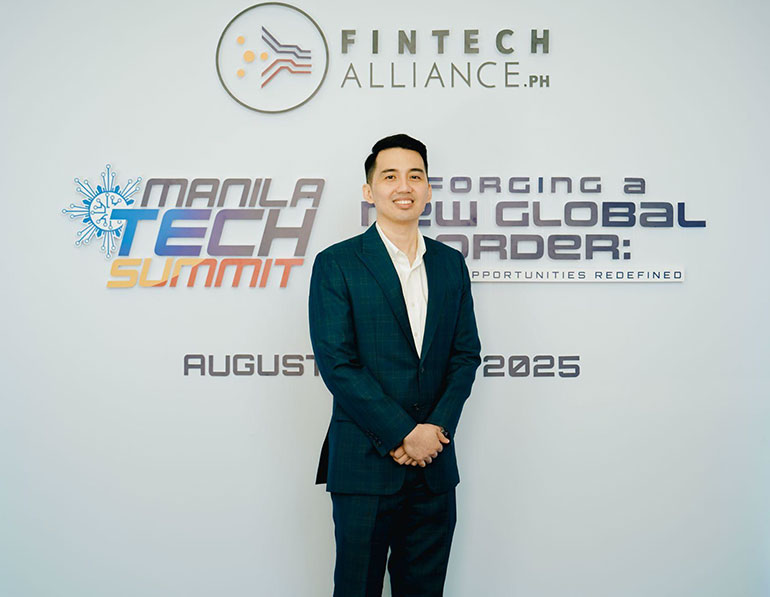
GCash Chief Information Security Officer Miguel Geronilla at the Manila Tech Summit

Building on this, the GCash official believes collective industry action, aligned around common standards, is key to making progress in building trust for Filipinos and digital transformation.

“From a standards perspective, we’re working toward unified trust. As a country, we’re still undergoing digital transformation, but what matters is that we’re moving in the right direction,” he explained.

Events like the Manila Tech Summit are a great example of this unity, according to Mr. Geronilla, because such conferences encourage collaboration across all sectors of the digital finance space and provide a venue where industry leaders can discuss pressing matters.

“This event shows that the fintech industry is united in making sure that in an industry that is getting more digitized, we’re moving forward in trust and security, and that we’re all in this together,” he said.

He added that these conversations are not just for major players, but also for smaller fintech companies, helping them understand the shared path forward and ultimately arrive at the same goal of a secure digital finance space.

“Events like the Manila Tech Summit are important because it helps not just the big players, but also the small players, to understand where we should be going, what we should do, and what are the things that we should aim for,” he expounded.

Mr. Geronilla also acknowledged the ongoing development of the Anti-Financial Account Scamming Act (AFASA), noting that while it still has areas needing clarification, the framework it provides is a critical step in the right direction.

GCash Chief Information Security Officer Miguel Geronilla says that the company is committed to safeguarding customer data and transactions through continuous investments in the latest cybersecurity technologies.

AFASA, or Republic Act. 12010 was enacted last year and recognized the vital role of banks, non-bank financial institutions, other payment service providers, and the general banking public in promoting and maintaining a stable and efficient financial system.

“Specifically with the AFASA, there are still a lot of gray areas that need to be clarified. However, the good thing about AFASA is the fact that it is already here. We have a framework. We have a clear standard that everyone should follow, and with that in place, we can move into action and execution — starting with GCash in the digital space and encouraging others to follow as well,” he encouraged.

Reflecting on the broader shift from physical to digital finance in the Philippines, Mr. Geronilla stressed the importance of making digital platforms safe for all users, not just GCash customers, but the entire financial ecosystem.

“Conversations that we had and are having are really relevant. But what’s most important is that, beyond the relevance of the discussions, we are now working to ensure that this becomes a safe space. Gone are the days of physical payments and transfers; we’re all transitioning to digital payments, and not just for GCash, but for the entire industry. It’s important that we create a safe space for everyone,” he said.

Lastly, Mr. Geronilla highlighted the powerful role that technology, especially AI and biometrics, plays in securing digital experiences, even when customers don’t see it directly.

“We’re doing a lot, and we’re at the forefront of ensuring that everything we do is strengthened by technology — whether through AI, facial recognition, or other safeguards. These protections work seamlessly in the background, so customers simply experience smooth, secure transactions,” he concluded.


Spotlight is BusinessWorld’s sponsored section that allows advertisers to amplify their brand and connect with BusinessWorld’s audience by publishing their stories on the BusinessWorld Web site. For more information, send an email to online@bworldonline.com.

Join us on Viber at https://bit.ly/3hv6bLA to get more updates and subscribe to BusinessWorld’s titles and get exclusive content through www.bworld-x.com.

BPI Foundation launches new Estudyantipid episodes to empower Filipino Youth with financial literacy

In photo (L-R): Marwin Galvez, BPI Central Metro Manila Division Head; Joy Ureta, BPI Ortigas Area Business Director; Richard Santos, Rizal High School Principal IV; Hon. Simon Romulo Tantoco, Pasig City 1st District Councilor; Carmina Marquez, BPI Foundation (BPIF) Executive Director; Rina Lopez, Knowledge Channel Foundation, Inc. (KCFI) President & Executive Director; Hon. Robert “Dodot” Jaworski, Jr., Pasig City Vice-Mayor; Asec. Jerome Buenviaje, Department of Education (DepEd) Assistant Secretary for Learning Systems Strand; Dir. Ebenezer Beloy, DepEd Director for Bureau of Curriculum Development Learning Systems Strand; Ma. Lotuslie Dimagiba, DoST-STII Supervising Science Research Specialist; Sheryll Gayola, Pasig City Schools Division Superintendent; Manolo Nava, BPIF Senior Program Manager; and Edric Calma, KCFI Vice-President

BPI Foundation, the social development arm of the Bank of the Philippine Islands (BPI), continues to champion financial education with the launch of two new episodes of Estudyantipid — an engaging educational series designed to equip Filipino youth with essential money management skills.

The on-ground premiere was held at Rizal High School in Pasig City, where hundreds of junior and senior high school students gathered for an interactive session on financial literacy. Attendees participated in hands-on activities and dynamic discussions, and were given a first look at the new episodes, which tackle timely topics such as scam and fraud awareness, and the difference between gross and net profit in business.

Carmina Marquez, Executive Director of BPI Foundation, highlighted the organization’s ongoing mission to make financial education more accessible and relevant: “At BPI Foundation, we believe that financial education is a cornerstone of empowerment. By equipping young people with practical money skills early on, we’re building a generation that is responsible, resilient, and ready to face the future. Estudyantipid reflects our commitment to making learning both relevant and transformative for Filipino students.”

Hundreds of Rizal High School students in Pasig City took part in an interactive financial literacy session.

Educators also praised the initiative, recognizing the value of integrating financial literacy into the school curriculum — a subject often overlooked in traditional education. Through the Knowledge Channel’s Portable Media Library, schools now have access not only to the new Estudyantipid episodes but also to a broad range of educational content designed to enrich student learning.

The latest episodes of Estudyantipid address topics that resonate strongly with today’s youth. One episode demystifies the concepts of gross profit versus net profit, while the other provides practical tips to help students identify and avoid scams. Presented through relatable storytelling, the series bridges classroom concepts with real-life financial decision-making.

This launch is part of BPI Foundation’s broader FinEd Unboxed initiative, which aims to bring financial education to schools, communities, and organizations across the country.

Estudyantipid airs every Monday, Wednesday, Friday, and Sunday at 1:40 p.m. during the Araling Panlipunan timeslot, on Kapamilya Online Live every Saturday at 7:40 a.m., and on the Kapamilya Channel every Sunday at 8:15 a.m.

To learn more about BPIF’s financial education programs, visit www.bpifoundation.org or follow BPI Foundation on Facebook and Instagram.


Spotlight is BusinessWorld’s sponsored section that allows advertisers to amplify their brand and connect with BusinessWorld’s audience by publishing their stories on the BusinessWorld Web site. For more information, send an email to online@bworldonline.com.

Join us on Viber at https://bit.ly/3hv6bLA to get more updates and subscribe to BusinessWorld’s titles and get exclusive content through www.bworld-x.com.

AMA affirms its role as the ‘Uber-Like of Philippine Education’ with U-Learn 24/7

AMA Education System (AMAES), the country’s pioneer in IT education, has reaffirmed its commitment to redefining the learning landscape with the launch of its groundbreaking U-Learn 24/7 Model. This initiative positions AMA as the “Uber-Like of Philippine Education,” giving students full control over when and  how they learn.

Much like how Uber reshaped commuting by granting riders freedom and flexibility, AMA’s U Learn 24/7 dismantles the rigid structures of traditional schooling. It responds to the realities faced by today’s learners; students in far-flung provinces, working professionals, and parents balancing multiple responsibilities by making education borderless, on-demand, and learner-driven.

Breaking Barriers in Education

With U-Learn 24/7, students are no longer bound by fixed calendars or inflexible schedules. Instead, they can:

  • Enroll any day of the year. Schedules are irrelevant; learners can start anytime. Students may enroll in the 1st trimester during the 2nd semester schedule, or the 2nd semester during the 1st semester schedule. No time is wasted, enabling students to finish earlier and transition immediately into the workforce.
  • Choose their preferred learning style: face-to-face, blended, structured online, or fully self-paced with virtual mentors.
  • Join new cohorts every 10 days, eliminating long waiting periods between terms.
  • Earn microcredentials, shift programs, or enter bootcamps without losing academic progress.
  • Access a seamless system through integrated learning and customer management platforms.
  • Pay tuition with ease via nationwide gateways such as GCash and 7-Eleven counters, ensuring inclusivity for all learners.

“Education should move with the learner, not against them,” AMA management emphasized.

Powered by Global Partnerships

Strengthened by collaborations with global technology leaders such as Microsoft, Cisco, AWS, Oracle, and Pearson VUE, AMA provides students with internationally recognized certifications while studying locally.

Today, AMA stands as:

  • The largest Cisco Academy in the world
  • The biggest AWS education partner in Asia

These partnerships highlight AMA’s commitment to producing globally competitive graduates prepared for the demands of the digital age.

A Legacy of Firsts

The U-Learn 24/7 Model builds upon AMA’s 45-year tradition of innovation. Over the decades, AMA has achieved several milestones:

  • The first IT-focused institution in the Philippines
  • The first to offer degree programs in Artificial Intelligence and Cybersecurity
  • The largest school network in Asia
  • A CHEd-conferred Autonomous Institution, recognized for academic leadership and quality

This track record underscores AMA’s role as a true pioneer in education not following trends, but setting them.

Transforming Lives, Shaping Futures

The model’s impact is already visible in student success stories nationwide. Working parents, career shifters, and learners from rural communities have completed their studies without  sacrificing personal or professional responsibilities. With U-Learn 24/7, AMA empowers students to fit education into their lives instead of forcing them into rigid molds.

Looking Ahead

As AMA celebrates its 45th anniversary, it envisions a future where every Filipino has access to quality, flexible, and globally relevant education — anytime, anywhere.

“The U-Learn 24/7 Model is more than a program; it is a platform that empowers learners to set their pace, choose their path, and shape their future,” AMA management said.

Discover how you can take full control of your education.

For more information, visit www.amaes.edu.ph.


Spotlight is BusinessWorld’s sponsored section that allows advertisers to amplify their brand and connect with BusinessWorld’s audience by publishing their stories on the BusinessWorld Web site. For more information, send an email to online@bworldonline.com.

Join us on Viber at https://bit.ly/3hv6bLA to get more updates and subscribe to BusinessWorld’s titles and get exclusive content through www.bworld-x.com.

Marcos names former Supreme Court Justice Andres Reyes as ICI chief

Marcos names former Supreme Court Justice Andres Reyes as ICI chief

By Chloe Mari A. Hufana, Reporter

President Ferdinand R. Marcos, Jr. on Monday appointed retired Supreme Court Associate Justice Andres B. Reyes, Jr. as chairman of the newly formed Independent Commission for Infrastructure (ICI), which will investigate irregularities in public works projects.

The three-person commission would convene on Monday as part of his administration’s broader anti-corruption drive, the President told a news briefing.

“He has been a… for a very, very long time with a very good record of honesty and fairness and a good record of being able to find justice for those who have been victimized,” he added.

The inquiry was launched after allegations surfaced that funds intended for flood-control infrastructure were misused or siphoned off through questionable projects. The controversy has triggered public anger as recent storms and monsoon rains inundated parts of the country, leaving homes and farms damaged.

“We have to make it nothing less than a turning point in the conduct of governance in the Philippines. We have to make a change, and it is a fundamental change in the way that we do business,” Mr. Marcos said, quoting the ICI chief.

The President created the commission through Executive Order No. 94 to investigate anomalies in flood control and other infrastructure projects, with authority to recommend criminal, civil and administrative charges.

The ad hoc fact-finding body is empowered to subpoena witnesses, access financial records, and gather intelligence reports. It may recommend the filing of criminal, civil, or administrative cases, as well as preventive measures such as suspensions.

Its role is to conduct hearings, gather evidence, and then forward its findings to the appropriate agencies, such as the Ombudsman, the Department of Justice or Civil Service Commission, for further action.

“The power to hold people in contempt, I think, was not necessary (to the ICI) simply because this is not a prosecutorial body—this is an investigative body,” Mr. Marcos said.

The commission is set to meet daily to finalize its organizational matters, including the structure of the secretariat, staffing needs, officer assignments and necessary forms. Whether their meetings will be held privately or publicly will be left to their discretion.

Mr. Reyes, 75, was an appointee of former President Rodrigo R. Duterte and a graduate of the Ateneo de Manila University School of Law. He was a Supreme Court justice from 2017 until his retirement in 2020.

Mr. Reyes earned a master’s degree in public administration from the Philippine Women’s University. He is a “third-generation justice” in the family, according to his profile on the Supreme Court website. His grandfather Alex A. Reyes, Sr. was a justice of the Court of Appeals and Supreme Court.

His father Justice Andres C. Reyes, Sr., was a former presiding justice of the appellate court.

He also taught at the Arellano Law School and College of Law of the Pamantasan ng Lungsod ng Maynila before attaining senior status at the appellate court.

Joining him as members of the fact-finding body are former Public Works Secretary Rogelio L. Singson and Rossana A. Fajardo, former chairperson of the Procurement Policy Board-Technical Support Office and now country managing partner at SGV & Co.

Baguio City Mayor Benjamin B. Magalong is also a special adviser to the committee.

Mr. Marcos cited Mr. Magalong’s credibility and skills as an investigator, recalling how he first came to know him through his seminal report on the Mamasapano incident while serving as the Crime Investigation and Detection Group (CIDG) head.

He added that during an earlier visit to Baguio, Mr. Magalong had already produced another detailed and well-prepared report, showing his dedication to thorough investigative work and his potential to contribute significantly.

Mr. Marcos earlier said that about P100 billion of the total P545 billion in government funds that were allotted for flood control projects since 2022 were cornered by only 15 contractors.

The controversy has already led to the resignation of the Public Works secretary and a leadership change in the Senate, where Vicente C. Sotto III replaced Francis G. Escudero as president of the chamber. Mr. Escudero admitted receiving campaign donations from a contractor but denied influencing contract awards. — with Norman P. Aquino

Pope Leo criticizes high, Musk-style corporate pay packages

Pope Leo XIV leads the Angelus prayer on his 70th birthday, from the window of the Apostolic Palace at the Vatican, Sept. 14, 2025. REUTERS/Vincenzo Livieri

VATICAN CITY – Pope Leo criticized corporate pay packages that offer executives much higher salaries than their employees in excerpts from his first media interview released on Sunday, citing Tesla’s recent $1 trillion compensation plan for CEO Elon Musk.

Leo, originally from Chicago, also spoke about the United Nations, his decades working as a missionary in Peru, how he has been adapting to the role of pope, and his hopes for peace in the bloody, three-year conflict between Ukraine and Russia.

He has shown a more reserved style than his predecessor Pope Francis, who often gave interviews, and prefers to speak from prepared texts. Sunday’s excerpts were released on the Catholic news site Crux.

“CEOs that 60 years ago might have been making four to six times more than what the workers are receiving … 600 times more (now),” Leo said in the interview, conducted at the end of July for a coming biography.

“Yesterday (there was) the news that Elon Musk is going to be the first trillionaire in the world,” he said. “What does that mean and what’s that about? If that is the only thing that has value anymore, then we’re in big trouble.”

Leo, elected the first US pope by the world’s cardinals in May to replace Francis, criticized the UN as no longer being able to foster effective multilateral diplomacy.

“The United Nations should be the place where many … issues are dealt with,” said Leo. “Unfortunately, it seems to be generally recognized that the United Nations, at least at this moment in time, has lost its ability to bring people together on multilateral issues.”

On becoming pope, Leo said he felt more prepared at first to lead the world’s 1.4 billion Catholics on spiritual matters but less prepared to play a major role on the global diplomatic stage.

“The totally new aspect to this job is being thrown onto the level of world leader,” said the pope. “I’m learning a lot and feeling very challenged, but not overwhelmed. On that one I had to jump in on the deep end of the pool very quickly.” — Reuters

PHL external debt jumps to $149B

The Philippines’ outstanding external debt hit $148.87 billion as of end-June. A teller counts US dollar banknotes at a money changer in Jakarta, Indonesia, April 9. — REUTERS/WILLY KURNIAWAN

THE PHILIPPINES’ outstanding external debt jumped to a record $148.87 billion as of end-June amid the weakening of the US dollar, the Bangko Sentral ng Pilipinas (BSP) said.

Central bank data showed the country’s external debt rose by 14.4% from $130.318 billion in the same period last year.

“The increase in external debt was driven primarily by borrowings, which included bond issuances by the National Government amounting to $5.83 billion and external financing tapped by local banks amounting to $3.44 billion,” the BSP said in a statement.

Quarter on quarter, external debt inched up by 1.5% from the $146.74 billion logged at the end of the first quarter.

“The increase in external debt for Q2 (second quarter) 2025 was primarily due to valuation effects from the depreciation of the US dollar,” the BSP said.

External debt accounts for all borrowings by residents from nonresidents.

The BSP said the external debt level remained “sustainable,” equivalent to 31.2% of gross domestic product. This was better than the 31.5% in the previous quarter but higher than the 28.9% a year ago.

The central bank said the weaker greenback increased the US dollar equivalent of borrowings denominated in other currencies by $1.49 billion.

In the April-to-June period, the peso recorded a strong performance against the dollar as it traded between the P55 and P56 level, averaging P56.581 as of end-June.

“The net acquisition of Philippine debt securities amounting to $660.96 million also contributed to the increase (in external debt), while net repayments amounting to $315.67 million partially tempered the increase in the country’s external debt,” the BSP said.

Most of the country’s public sector obligations, amounting to $88.371 billion, were from the National Government while the rest came from the BSP ($3.919 billion) and government banks ($1.81 billion).

Japan remained the Philippines top creditor with loans amounting to $15.599 billion, followed by the United Kingdom with $6.358 billion and Singapore with $4.837 billion.

The borrowing mix was composed mainly of US dollar-denominated debt, followed by debt in Philippine peso and debt in Japanese yen.

As of the second quarter, the country’s short-term external debt based on remaining maturity concept (STRM) was at $28.63 billion. STRM debt is composed of loans with original maturities of one year or less plus amortization on medium and long-term accounts falling due within the next 12 months.

“This level remains well-covered by the country’s gross international reserves (GIR) of $106 billion, providing 3.7 times cover for short-term obligations,” the BSP said.

“The country’s GIR-to-STRM debt ratio remains at par with emerging economy peers.”

Meanwhile, the BSP said resident borrowers’ lower principal and interest payments brought the debt service ratio down to 8.7% during the period from 9.8% a year ago. This ratio measures a country’s capacity to meet its obligations based on its foreign exchange earnings.

“This resulted from lower principal and interest payments by resident borrowers as of the second quarter of 2025,” it said.

BSP data showed the public sector’s external debt went up by 88.2% to $94.801 billion at end-June from $50.36 billion the previous year.

Private sector obligations, on the other hand, declined by 32.3% year on year to $54.072 billion from $79.83 billion a year ago. — Katherine K. Chan

PHL big banks post slower growth in assets, loans in 2nd quarter

Peoples walk past automated teller machines in Makati City, June 23, 2016. — REUTERS

By Abigail Marie P. Yraola, Deputy Research Head

THE GROWTH in combined assets and loans of the country’s biggest lenders eased as of end-June, dragged by weaker economic output in the second quarter despite cheaper borrowing costs and slower inflation.

The latest edition of BusinessWorld’s quarterly banking report showed that the aggregate assets of 44 universal and commercial banks grew by 9.05% year on year to P27.37 trillion in the second quarter from P25.09 trillion a year earlier.

This pace was slower than the 9.51% logged in the first three months of the year and the 10.7% growth in the second quarter of 2024.

Top 10 Biggest Banks by Total Assets

Asset growth during the period was the weakest in five quarters or since the 8.69% expansion recorded in the first quarter of 2024.

Meanwhile, the aggregate loans of the country’s biggest lenders went up by 12.38% year on year to P14.4 trillion in the April-to-June period.

This expansion was slower than the 13.46% recorded in the first quarter and the 14.01% growth in the second quarter of last year.

Lending growth was also the weakest in the five quarters or since the 12.32% observed in the first three months last year.

This modest growth in both assets and loans mirrored economic developments such as slowing economic growth and benign inflation.

In the second quarter, the country’s gross domestic product (GDP) expanded by an annual 5.5%, slower than the 6.5% growth in the same period last year but slightly faster than the 5.4% expansion in the January-to-March period.

This brought GDP growth to 5.4% in the first semester, slowing from 6.2% a year earlier.

Meanwhile, inflation in June picked up to 1.4%, a tad faster than the 1.3% in May. Still, this was slower than the 3.7% in June last year.

For the first half, inflation averaged 1.8%, decelerating from the 3.6% average in the first six months of 2024.

At its June meeting, the Bangko Sentral ng Pilipinas (BSP) delivered a 25-basis-point rate cut to bring its key rate to 5.25% — the lowest level in two and a half years.

Data also showed the share of bad loans to the total loan portfolio, also known as the nonperforming loan ratio, jumped to 3.39% in the second quarter. This was higher than the 3.25% a year earlier and 3.24% in the first quarter.

Loans are considered nonperforming if any principal and/or interest are left unpaid for over 90 days from the contractual due date or accrued interests for more than 90 days have been capitalized, refinanced, or delayed by agreement.    

Meanwhile, the banks’ median return on equity (RoE), which is an indicator of profitability, dipped to 7.69% in the second quarter from 8.93% in the second quarter of 2024. The RoE measures the amount that shareholders make on every peso they invest in a company.

Additionally, the largest banks’ median capital adequacy ratio — which reflects the lender’s ability to absorb losses from risk-weighted assets — stood at 19.18% during the period.

This was higher than the 18.8% recorded in the same period last year but lower than the 19.71% a quarter earlier.   

The ratio remained well above the regulatory minimum of 10% set by the BSP as well as the international minimum standard of 8% under the Basel III framework.

The leverage ratio, which gauges the institution’s ability to absorb shocks by measuring the bank’s capital relative to total exposure, stood at a median of 11.39% as of end-June. The current figure exceeded the central bank’s 5% guideline as well as the international standard of 3%.

Meanwhile, the net interest margin (NIM) of these big banks hit 4.23%, higher than the 3.19% a year earlier.

NIMs are an indicator of banks’ investing efficiency by dividing annualized net interest income by average earning assets.

During the period, the return on assets, which measures the profit generated per peso of an asset, rose to 1.62% from 1.42% in the second quarter of 2024.

In the April-to-June period, BDO Unibank, Inc. (BDO) remained the largest bank in terms of total assets with P5.05 trillion, followed by Metropolitan Bank & Trust Co. (Metrobank) with P3.51 trillion and Bank of the Philippine Islands (BPI) with P3.5 trillion.

In lending, the Sy-led bank also led the industry with P3.41 trillion worth of loans issued, followed by Bank of the Philippine Islands (BPI) with P2.36 trillion and Metrobank with P1.85 trillion.

In terms of deposits, BDO led with P4.03 trillion in deposits, followed by Land Bank of the Philippines (LANDBANK) with P3.06 trillion and BPI with P2.61 trillion.

Among banks with at least P100 billion assets, Security Bank Corp. posted the fastest year-on-year asset growth with 25.6%, followed by Bank of Commerce (17.8%), and The Hongkong & Shanghai Banking Corp. Ltd. (16.6%).   

On the other hand, Asia United Bank was the most aggressive lender with a year-on-year growth of 35.57%, followed by China Banking Corp., with 18.04% and Philippine Trust Co., with 16.31%.

BusinessWorld Research has been tracking the financial performance of the country’s large banks quarterly since the late 1980s using banks’ published statements.

Business groups say independent body can help restore investor confidence in PHL

Ongoing flood-control works continue in Binondo, Manila. — PHILIPPINE STAR/RYAN BALDEMOR

THE PHILIPPINES’ largest business groups on Sunday expressed confidence the newly created Independent Commission on Infrastructure (ICI) could help restore investor confidence in the country’s public works program.

The Philippine Chamber of Commerce and Industry (PCCI) said the commission, tasked with probing anomalies in projects such as flood-control systems, is well positioned to drive systemic reforms that will improve governance and efficiency in big-ticket projects.

“The ICI, as currently composed and empowered, is a strong signal of the President’s political will to address infrastructure anomalies, especially in flood control,” the group said in a statement.

The ICI will be composed of former Public Works and Highways Secretary Rogelio L. Singson and former Chair of the Procurement Policy Board-Technical Support Office, Rossana A. Fajardo. Ms. Fajardo is now the country managing partner at SGV and Co.

Baguio City Mayor Benjamin B. Magalong will also be an adviser.

Mr. Marcos is expected to name the chairman this week.

“This strategically balanced team combines operational, institutional, and investigative strengths that can translate findings into actionable reforms,” the PCCI said.

This comes as the government intensifies efforts to crack down on corruption that led to incomplete and nonexistent flood mitigation projects worth billions of pesos.

“With its strong legal foundation and credible composition, the ICI can become a cornerstone institution for safeguarding public funds and ensuring that infrastructure projects deliver real value to the Filipino people,” the group said.

The PCCI said sustained funding, independence from political influence, and seamless interagency cooperation will determine whether the ICI can close procurement loopholes and reduce corruption risks that have historically delayed infrastructure pipelines.

The Federation of Philippine Industries (FPI) also welcomed the commission’s creation, saying it aligns with its long-standing push for a clean, rules-based market anchored on strict Philippine National Standards compliance.

“The ICI’s work will clean up a decade of flood control anomalies, restore trust in public works, and cut the corruption premium that drives up costs,” FPI Chairperson Elizabeth H. Lee said in a statement on Sunday.

“That means cheaper financing, stronger investor confidence, and a manufacturing sector that wins on standards, integrity, and quality — now and for years to come.”

By dismantling entrenched networks inflating costs and distorting competition, Ms. Lee said the ICI could allow compliant firms to access more affordable financing for capital-intensive upgrades, while attracting higher-quality bidders more likely to source inputs from local manufacturers.

The ICI has the power to issue subpoenas, request financial records and recommend preventive suspensions.

It may also endorse evidence for prosecution and collaborate with technical experts in support of its investigations.

BIR SUPPORT
Meanwhile, the Bureau of Internal Revenue (BIR) has offered its services to the newly formed ICI.

“The entire BIR is ready to help the ICI if necessary, and the BIR will use all its powers granted by law to go after those who seek to use public funds for personal gain or greed,” BIR Commissioner Romeo “Jun” D. Lumagui, Jr. said in a statement.

“As a government agency that collects taxes to fund projects for the Filipino people, we aim for every Filipino to live well through the proper use of taxes,” Mr. Lumagui said.

The BIR earlier said the tax fraud investigation in the first batch of individuals linked to flood control anomalies, such as Cezarah Rowena “Sarah” Discaya and Pacifico “Curlee” F. Discaya II are almost concluded.

The BIR on Sept. 2 served contractors with Letters of Authority, which authorizes a tax audit on those who may have underpaid or evaded taxes.

The BIR warned that it will not issue an updated tax clearance, a document that guarantees that every contractor has no outstanding tax liabilities and has duly filed and paid all applicable taxes.

Unable to present this clearance will result in the suspension of contract settlements and the imposition of a tax lien over the contract amount in favor of the government.

Finance Secretary Ralph G. Recto earlier said corruption related to flood control projects may have cost the Philippines between P42.3 billion and P118.5 billion in average economic losses since 2023. — Chloe Mari A. Hufana and Aubrey Rose A. Inosante

Higher terminal fees take effect at Manila’s main airport

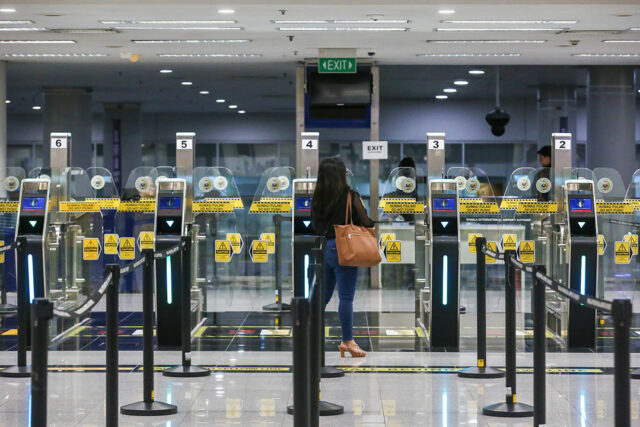
A WOMAN uses the electronic gate at the Ninoy Aquino International Airport Terminal 3. — PHILIPPINE STAR/NOEL B. PABALATE

THE OPERATOR of the Ninoy Aquino International Airport (NAIA) began charging higher terminal fees on Sunday, a year after it took over the country’s main gateway.

In a statement, the New NAIA Infrastructure Corp. (NNIC) said the terminal fees were adjusted for the first time in 20 years to sustain the airport’s operations and upgrades.

“Even with the adjustment — set by government with the Asian Development Bank as adviser — NAIA’s rates will only match other local airports and remain among the lowest in Asia,” the company said.

The passenger service charge (PSC), also known as terminal fee, nearly doubled to P950 from P550 for international departures. The terminal fee for domestic departures was raised to P390 from P200.

Since NNIC took over the operations last year, the company said it has already remitted P48.3 billion to the government, including a P30-billion upfront payment, with 82% of revenues going directly to the state.

NAIA received 51.7 million passengers since Sept. 13, 2024, a 6% increase year on year, and handled 283,771 flights.

“Operational changes such as reconfiguring aircraft parking stands, expanding taxiway movements, and removing abandoned aircraft freed up valuable space for smoother airside operations,” the company said.

NNIC also said it is preparing to introduce a facial recognition system that will allow travelers to “check in, drop bags, clear security and board flights using just their face.”

“Operating an airport the size and scale of NAIA will always be demanding. But what this first year has shown is that with teamwork, discipline, and the dedication of our people, real change is possible… Together with government and our partners, we will sustain these gains and finally deliver a truly world-class NAIA,” NNIC President Ramon S. Ang said.

Last year, the NNIC, formerly the SMC SAP & Co. Consortium, inked a P170.6-billion contract to operate, maintain, and upgrade the country’s primary gateway for 25 years. — Sheldeen Joy Talavera