Home Blog Page 5040

Vista Land signs P10B corporate note facility

VILLAR-LED property developer Vista Land & Lifescapes, Inc. has obtained a three-year corporate note facility of up to P10 billion that it will use to refinance its obligations, the company said on Wednesday.

In a regulatory filing, the listed company said that it had made an initial drawdown of P6 billion at a fixed rate of 7.6139% per annum.

“The proceeds of the corporate notes facility will be used to refinance existing or maturing obligations and for other general corporate purposes,” the company said.

The company has tapped BDO Capital & Investment Corp., China Bank Capital Corp., and SB Capital Investment Corp. as lead arrangers and bookrunners.

China Banking Corp.’s trust and asset management group was also tapped as the facility agent.

Meanwhile, Vista Land subsidiaries Brittany Corp., Crown Asia Properties, Inc., Camella Homes, Inc., Communities Philippines, Inc., Vista Residences, Inc., and Vistamalls, Inc. will act as guarantors.

In February, the company disclosed the issuance of P2.9 billion in additional corporate notes, which are due on Dec. 26, 2025, at a 7.2595% fixed interest per annum.

The proceeds from the corporate notes were also used for refinancing obligating and general corporate purposes. 

On Wednesday, shares in Vista Land declined by a centavo or 0.57% to finish at P1.73 each. — Adrian H. Halili

PEZA’s Panga urges LGUs to embrace opportunities offered by economic zones 

THE Philippine Economic Zone Authority (PEZA) said local government units (LGUs) are welcome to take advantage of the opportunities presented by economic zones in their jurisdictions, including enanced revenue and upgrded human capital.   

“The creation of jobs opens many opportunities for the local government units (LGUs) and its communities, like higher revenue for the LGUs and skills training for the youth and new graduates in the community. PEZA will be committed to actively pursue these as part of its efforts in nation building,” PEZA Director General Tereso O. Panga said in a speech at the PEZA head office in Pasay City on April 3.   

Mr. Panga was appointed to head PEZA by President Ferdinand R. Marcos, Jr. on March 23, after serving a spell as officer-in-charge and deputy director general for policy and planning.   

According to Mr. Panga, PEZA will enter into partnerships with locators and industry associations such as the IT-Business Process Association of the Philippines (IBPAP) and the Semiconductor and Electronics Industries in the Philippines Foundation, Inc. (SEIPI) to generate employment and improve the skills of the workforce in communities around ecozones.   

“PEZA is working closely with SEIPI in preparing human capital readiness for advanced manufacturing and industry 4.0 and with Philippine Ecozones Association (PHILEA) in developing world-class and environment-friendly friendly economic zones in rural and new growth areas to spur countryside development,” Mr. Panga said.   

Meanwhile, Mr. Panga said PEZA will collaborate with Congress to address challenges faced by investors, such as high power and operating costs. 

“We need to be competitive, relevant and top-of-mind among potential foreign investors as the smart and preferred destination,” Mr. Panga said.   

Mr. Panga said tPEZA is also seeking to revisitRepublic Act (RA) No. 11534 or the Corporate Recovery and Tax Incentives for Enterprises (CREATE) Act and amendments to the PEZA Law.   

“It is worth noting that investor interest in our country has jumped 54% with the President’s active promotion in the recent months,” he added.   

Mr. Panga said he hopes to attract technlogy locators to boost; expand ecozones according to the Philippine Development Plan; and improve the regulatory framework to enhance ease of doing business.   

PEZA is targeting 10% investment growth in 2023 after registering P140.7 billion worth of approved investment last year.

For the first quarter, PEZA has approved P12.54 billion worth of investments compared, up from P8.14 billion approved a year earlier. - Revin Mikhael D. Ochave  

Philippine inflation cools to slowest in 6 months

A man arranges tanks of liquefied petroleum gas (LPG) on a truck. — PHILIPPINE STAR/EDD GUMBAN

By Keisha B. Ta-asan, Reporter  

Philippine headline inflation cooled in March to the slowest in six months, amid lower prices of food and transport, the statistics agency said.  

However, core inflation, which excludes volatile food and fuel prices, accelerated to the fastest since December 2000.

Preliminary data from the Philippine Statistics Authority (PSA) showed annual headline inflation eased to 7.6% from 8.6% in February, but much faster than the 4% print a year ago.  
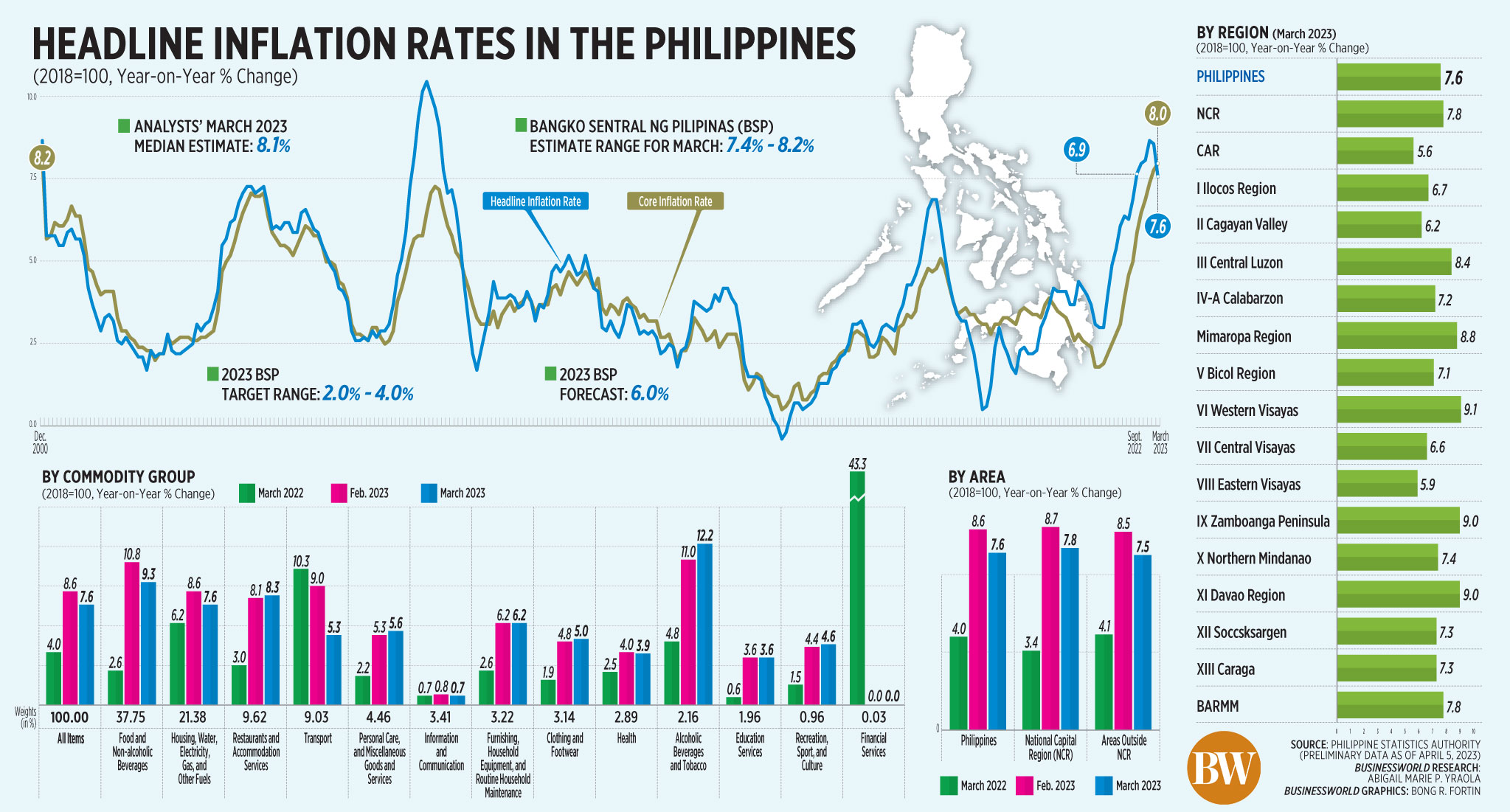
Headline inflation rates in the Philippines

March inflation was the slowest print since the 6.9% print in September 2022. This is also below than the 8.1% median from a BusinessWorld poll conducted last week. 

“The March 2023 inflation outturn of 7.6% is within the BSP’s (Bangko Sentral ng Pilipinas) forecast range of 7.4-8.2%, consistent with the overall assessment that inflation will remain elevated over the near term before gradually decelerating back to target range towards end-2023,” the central bank said in a statement.  

Seasonally adjusted, inflation recorded zero percent monthly rate in March from 0.3% in February.  

For the first quarter, the consumer price index (CPI) averaged 8.3%, higher than the central bank’s full-year forecast of 6% and the 2-4% target band.   

Core inflation, on the other hand, quickened to 8% in March, from 7.8% in February and 2.2% a year ago. This is its highest clip since the 8.2% seen in December 2000.  

At a press briefing, PSA Undersecretary and National Statistician Claire Dennis S. Mapa said food and non-alcoholic beverages were the main source of the deceleration in March inflation.   

The index for food and non-alcoholic beverages eased to 9.3% from 10.8% in the previous month.   

Food inflation alone decelerated to 9.5% in March from the 11.1% in February.   

Mr. Mapa said the downtrend in food inflation was due to slower rise in prices of vegetables, tubers, plantains and cooking bananas (20% in February from 33.1% in February), meat and other parts of slaughtered land animals (4.6% from 6.5%), and sugar, confectionery and desserts (35.2% from 37%).   

Price increases oils and fats, as well as corn, also slowed during the month.  

However, higher annual increases were seen in rice; milk and other dairy products; fruits and nuts; and ready-made food products.  

The PSA also reported prices of housing, water, electricity, gas and other fuels, slowed to 7.6% in March from 8.6% in February.  

Transport inflation also decelerated to 5.3% in March, from 9% in February as pump prices declined. 

For the month, pump price adjustments stood at a net decrease of P0.65 a liter for gasoline, P1.75 a liter for diesel, and P3.25 a liter for kerosene.  

Mr. Mapa said the PSA is currently monitoring global oil prices after the Organization of the Petroleum Exporting Countries and its allies (OPEC+) recently announced an output cut of about 1.16 million barrels per day (bpd). 

“If we look at what happened last year, higher global oil prices affected the prices of gasoline and diesel, which is what we are monitoring. There is a lagged effect on transport, as well as to other commodities being delivered through land,” Mr. Mapa said in Tagalog.   

“It created spillovers to other commodity items, as what we’ve seen during the 2022 round when the price of oil started increasing,” he added. 
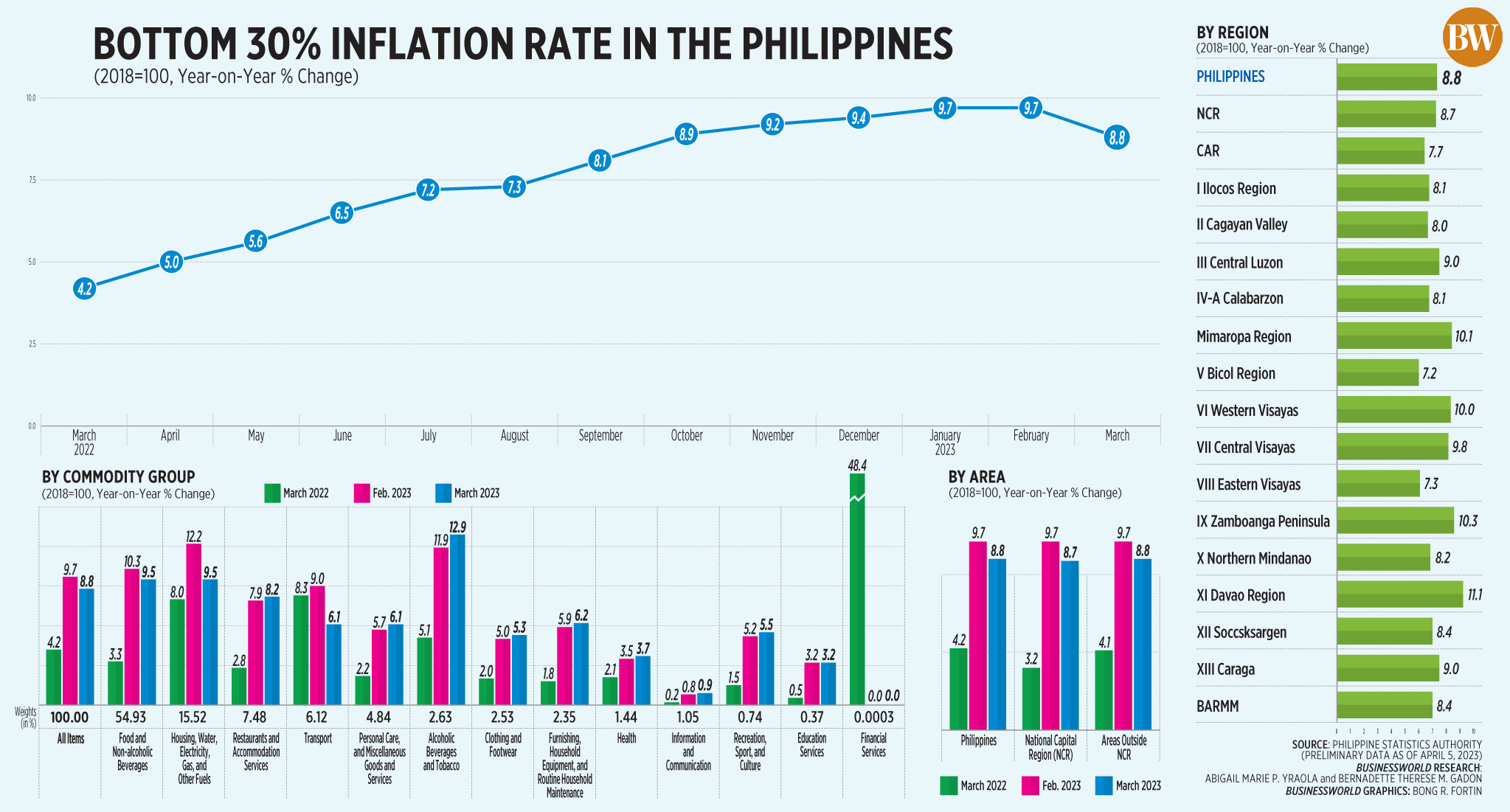
Bottom 30% inflation rate in the Philippines

Meanwhile, the inflation rate for the bottom 30% income households eased to 8.8% in March from 9.7% in February. Still, this is higher than the 4.2% in March 2022.  

Inflation in the National Capital Region also slowed to 7.8% in March, from 8.6% in February. Areas outside of NCR also saw inflation ease to 7.5% in March, from 8.5% in the prior month.  

National Economic and Development Authority (NEDA)  Secretary Arsenio M. Balisacan said inflation must still be monitored and urgently addressed despite its slowdown.   

“Protecting the purchasing power of Filipinos, especially the most vulnerable sectors of the economy, is one of the top priorities of the administration. We are committed to provide policy advice and anticipatory recommendations that are supported by data to manage inflation and protect the Filipino families,” Mr. Balisacan said in a statement.  

Finance Secretary Benjamin E. Diokno said the March inflation number supports his view “that the monetary authorities have done enough to tame inflation with its 425bps policy rate increase.” 

“The focus now should be on the supply side of the equation, of which the national government authorities play a bigger role… We remain focused on treating inflation as an immediate and long-term concern. We continue to monitor  domestic and external developments to make sure that inflation  remains on its downward path and that it eventually falls within the 2% to 4% target range,” Mr. Diokno said. 

PERSISTENT CORE INFLATION
PSA’s Mr. Mapa said headline inflation appears to have peaked in January, when it hit a 14-year high of 8.7%.  

“Of course, we want to bring inflation down further, but the core inflation is higher. Some of the items on the basket seems to be increasing still,” he said.   

In a note on Wednesday, ING Bank N.V. Manila Senior Economist Nicholas Antonio T. Mapa said receding supply side pressures helped slow headline inflation, but second round effects resulted in faster increases for restaurants and personal services.   

Based on PSA data, the index for restaurant and accommodation services rose to 8.3% in March from 8.1% in February. Personal care and services also grew to 5.6% from 5.3% a month prior.   

Bank of the Philippine Islands (BPI) Lead Economist Emilio S. Neri, Jr. said restaurants continued to increase their prices despite the slower rise in food costs.   

“With demand remaining strong, (restaurants) have the space to pass on the cost to consumers. It may take several months for restaurant inflation to go down from 8% to 4%,” Mr. Neri said in a note.   

He also said demand continues to surpass supply in several items of the CPI basket.   

“To add to this, recent developments may contribute to inflation and prevent it from going back to target. One of these is the decision of OPEC+ to cut their oil production. The price of oil has gone up recently because of this, in addition to the reopening of China,” Mr. Neri said.  

“Moreover, cases of African Swine Fever have been recorded in certain parts of the country, particularly in the Visayas. This may complicate further the efforts to fix the agricultural supply chain and to bring down food prices,” he added.

How much did each commodity group contribute to March inflation?

ANOTHER RATE HIKE?
Mr. Neri also noted that the rise in core inflation may prompt another rate hike from the Monetary Board, as additional tightening may hasten the process of bringing down inflation back to the 2-4% target range.   

According to the BSP, upside risks to the inflation outlook for 2023 and 2024 continue to persist.   

“The effect of supply shortages on domestic food prices remains a concern, while the potential impact of higher transport fares, increasing electricity rates, as well as above-average wage adjustments in 2023 point to the broader-based nature of price pressures,” the BSP said.   

“The BSP will continue to adjust its monetary policy stance as necessary to prevent the further broadening of price pressures as well as the emergence of additional second order effects,” it said.   

University of Asia and the Pacific Ronilo M. Balbieran said the BSP can still implement another 25-basis-point (bp) rate hike at its May 18 meeting as a precaution.   

“I think a precautionary move to further hike at least 25 bps will finally seal the deal in terms of making sure that we have that very deliberate path towards 4% inflation by November-December,” Mr. Balbieran told CignalTV’s OneNews.  

The Monetary Board has increased borrowing costs by 425 bps since May last year, bringing the benchmark rate to 6.25% – the highest since 2007.  

Hongkong and Shanghai Banking Corp. economist for the Association of Southeast Asian Nations (ASEAN) Aris Dacanay said there is still room for rate hikes as growth is still intact amid robust consumption.   

“Thus, we expect the BSP to carry out one last 25bp hike in the May Monetary Board meeting before pausing its tightening cycle – and the pause will likely be a hawkish one since inflation, albeit easing, is still well above the BSP target band of 2-4%,” Mr. Dacanay said.   

But the supersized cuts in oil supply abroad are considered as an upside risk to the policy rate outlook, he said. 

“If a rise in domestic fuel prices spills over to core CPI again, then there will be another inflation wave that the BSP will need to deal with,” Mr. Dacanay said. 

ACEN invests more in unit’s Pagudpud wind farm

Ayala-led ACEN Corp. announced on Wednesday that it had agreed to subscribe to shares of Bayog Wind Power Corp. to fund the construction of its unit’s wind project in Ilocos Norte.

Under the subscription agreement, ACEN initially paid P182.72 million for an 8.06% stake or 6.77 million shares in Bayog Wind Power, the listed energy company said in a stock exchange disclosure.

Bayog Wind Power is currently developing the 160-megawatt Pagudpud wind project in barangays Balaoi and Caunayan in Ilocos Norte province’s Pagudpud town.

ACEN said the agreement for its subscription to redeemable preferred D shares, redeemable preferred E shares, and redeemable preferred G shares was priced at P100 per share.

It said the move would bring additional investment in its subsidiary, Bayog Wind Power.

ACEN, the energy company of the Ayala group, is targeting to transition its company’s power generation portfolio to fully renewable energy by 2025.

The company is targeting to reach 20 gigawatts of renewable capacity by 2030. To date, it has 4,000 megawatts of attributable capacity spread across the Philippines, Vietnam, Indonesia, India, and Australia.

At the local bourse on Wednesday, shares in the company gained nine centavos or 1.46% to end at P6.24 apiece. — Ashley Erika O. Jose

MBC to explore Thai telecom, agri opportunities 

CPF-PHIL.COM

THE Makati Business Club (MBC) said it will explore collaboration opportunities with potential Thai partners in telecommunications and agriculture. 

The MBC said in a statement that it recently held talks with the Thai embassy and other officials between March 26 and April 1.

Some of the discussions involved expansion plans of Thai telecom and agriculture businesses, as well as the possibility of direct flights from Phuket to Boracay and Palawan.

The MBC also met with a Thai business delegation consisting of representatives from Charoen Pokphand Foods Philippines Corp., SkyTowers Infra, Bangkok Bank, Italian-Thai Development, SCG Marketing, and Mariwasa Siam Ceramics Inc..

In a separate meeting on March 27, MBC Foreign Programs Manager Trisha Teope met with Federation of Thai Industries Director-General Jumrud Sawangsamud in Bangkok to discuss possible ventures in manufacturing, industry 4.0, agriculture, and the circular economy. - Revin Mikhael D. Ochave 

NGO warns of trade sanctions after suspension of fishing vessel monitoring 

OCEANA Philippines said the Philippines could face international sanctions following the suspension of a system for monitoring the movements of commercial fishing vessels. 

“Are we ready for another yellow card warning and looming threat of losing access to our biggest market for fish and seafood products such as the (European Union)?” Oceana Vice President Gloria E. Ramos said in a statement. 

Oceana has asked President Ferdinand R. Marcos, Jr. to reconsider the decision, calling it “regressive” and warned that it might encourage intrusion by commercial fishing vessels in municipal waters. 

Fisheries Administrative Order (FAO) 266, which requires vessel monitoring mechanisms (VMM) for commercial fishing vessels, was the regulation that had been suspended. 

The EU imposes a number of conditions on trading partners enjoying concessional terms for their exports to the bloc, including the enforcement of regulations against illegal, unreported, and unsustainable (IUU) fishing. It lifted its yellow card warning on the Philippines in 2015 with the signing of Republic Act No. 10654 or the Amended Fisheries Code . 

“With this latest order from Malacañang, we have proven that we have not learned our lessons from the first yellow card warning from the EU,” she said. 

Ms. Ramos said that the suspension order will lead to “overfishing and “depletion of fish stocks,” as well as contribute to the decline of fisheries and marine resources. 

In a statement, the Bureau of Fisheries and Aquatic Resources (BFAR) said the suspension was imposed pending a Supreme Court ruling on the constitutionality of FAO 266. 

“The BFAR, as the lead agency, shall convene the Philippine Committee Against IUU Fishing towards the end of the month,” it said. 

The committee is an inter-agency group tasked with formulating “holistic approaches” against IUU fishing. – Sheldeen Joy Talavera 

Smart ties SIM card registration to 2023 performance

PLDT Inc. wireless unit Smart Communications, Inc. expects the registration of subscriber identity module (SIM) cards to improve its performance in 2023. 

“SIM registration is very important for us. If we want to further grow, we have to be the leader in SIM registration. And from the start, we have always led,” Smart Head of Consumer Wireless Business-Individual Francis E. Flores said in a press release. 

According to Mr. Flores, Smart has been leading in SIM registration with 5 million more registrants compared with its nearest competitor.

“Definitely, the brand or business that will do a better job in SIM registration will have a bigger competitive advantage this year. That is why we have invested a lot of resources in ensuring that we are ahead of our competition when it comes to SIM registration,” he added.

The Department of Information and Communications Technology announced on Tuesday that the total number of SIM registrants reached 58.27 million on April 3. The latest tally is 34.48% of the total 168.98 million subscribers nationwide.

Of the total registered SIMs, 29.42 million are from Smart, 24.4 million from Globe Telecom, Inc., and 4.45 million from DITO Telecommunity Corp. 

In a separate press release, Smart said that it rolled out assisted SIM registration booths at select summer destinations, airports, bus terminals, and gas stations at North Luzon Expressway, South Luzon Expressway, and Subic-Clark-Tarlac Expressway starting April 1.

SIM registration touch-points are also available in select convenience stores nationwide.

“We hope to make SIM registration more convenient for our subscribers by setting up assisted touchpoints at transport hubs and summer spots during this extended break. As many Filipinos take this time to unwind, they can also go to any of the booths accessible to them and register hassle-free with the help of our friendly SIM registration staff,” said Alejandro O. Caeg, senior vice president and head of consumer sales group of Smart.

The booths aim to assist Smart and Talk ‘N Text subscribers in registering their SIMs, especially senior citizens, persons with disabilities, and those using non-data phones.

Hastings Holdings, Inc., a unit of PLDT Beneficial Trust Fund subsidiary MediaQuest Holdings, Inc., has a majority stake in BusinessWorld through the Philippine Star Group, which it controls. — Justine Irish DP. Tabile

Dollar reserves hit $100 billion as of end-March

REUTERS

THE PHILIPPINES’ dollar reserves increased to $100.2 billion as of end-March, reflecting the government’s foreign currency deposits with the central bank and higher prices of gold.  

Preliminary data from the Bangko Sentral ng Pilipinas (BSP) showed gross international reserves (GIR) inched up by 2% as of March from the $98.2 billion seen at end-February.   

However, the end-March level was lower by 6.6% than the $107.31 billion a year ago. 

“The month-on-month increase in the GIR level reflected mainly the National Government’s (NG) net foreign currency deposits with the BSP, the upward revaluation of the BSP’s gold holdings due to the increase in the price of gold in the international market, and net income from the BSP’s investments abroad,” the central bank said. 

Based on BSP data, the value of gold reserves rose by 7.9% to $10.07 billion as of end-March from $9.33 billion as of end-February. This is also 7.1% higher than the $9.4-billion level a year earlier.   

Foreign currency deposits meanwhile more than doubled to $1.44 billion from $520.5 million as of February. Year on year, it declined by 18.6% from $1.77 billion a year ago.   

The end-March GIR level was enough to cover the 7.5 months’ worth of the country’s imports of goods and payments of services and primary income.   

It was also equivalent to about six times the country’s short-term external debt based on original maturity and 4.2 times based on residual maturity.   

Ample foreign exchange buffers protect the country from market volatility and ensure the country is capable of paying its debts in the event of an economic downturn. The country’s GIR reached $96 billion at end-2022.   

The country’s GIR picked up in March after the sustained increase of US dollar inflows such as remittances, business process outsourcing (BPO) revenues, and lower global oil and non-oil commodity prices in recent months, Rizal Commercial Banking Corp. Chief Economist Michael L. Ricafort said.   

According to the BSP, net international reserves increased by 2% to $100.2 billion as of end-March from $98.2 billion in February.    

Net international reserves are the difference between the BSP’s reserve assets (GIR) and reserve liabilities such as short-term foreign debt, and credit and loans from the International Monetary Fund (IMF).   

Broken down, the country’s reserve position in the IMF inched up 2.9% to $808.2 million from $785.7 million a month earlier. It also increased 2.3% from the $790 million a year ago.   

Special drawing rights — or the amount the country can tap from the IMF — was unchanged at $3.75 billion for the second straight month. It slipped by 3.6% from the $3.89 billion as of end-March 2022.   

On the other hand, gains from the BSP’s investments abroad inched up by 0.4% to $84.14 billion from $83.83 billion a month earlier, but was 8% lower from $91.46 billion a year ago.   

ING Bank N.V. Manila Senior Economist Nicholas Antonio T. Mapa said the country’s dollar reserve remained at ample levels despite concerns about its depletion.  

“Despite running a current account deficit, GIR remains relatively stable and should be able to service short term dollar requirements of the economy,” Mr. Mapa said.   

According to central bank data, the current account deficit was at $17.8 billion last year, higher than the $5.9-billion shortfall seen in 2021, amid a wider trade in goods deficit.  

The BSP sees the current account deficit to end the year at $17.1-billion.  

“For the coming months, the country’s GIR could still be supported by the continued growth in the country’s structural inflows from remittances, BPO revenues, exports (though offset by imports), relatively fast recovery in foreign tourism revenues,” Mr. Ricafort said.    

He said that still relatively high GIR at $100.2 billion could strengthen the country’s external position, which is a key pillar of the Philippines’ favorable credit rating.  

The BSP expects the country’s GIR level to reach $93 billion by yearend and $102 billion by end-2024. – Keisha B. Ta-asan   

Cebu Pacific expands north Luzon network to Laoag

CEBUPACIFICAIR.COM

Budget carrier Cebu Pacific launched Manila-Laoag flights which will further expand its network in north Luzon, the airline said on Wednesday.

“We hope that the launch of the Laoag route will encourage more people to travel and experience the Ilocos region,” Cebu Pacific President and Chief Commercial Officer Alexander G. Lao said in a press release.

From May 22, Cebu Pacific will fly daily between Manila and Laoag, which is the 35th domestic destination in its network.

Laoag, the capital of Ilocos Norte, serves as a jump-off point to many popular tourist destinations.

“The city is the perfect destination for nature lovers, history buffs, and thrill seekers,” the low-cost carrier said. 

Among the destinations that tourists can visit are La Paz sand dunes, centuries-old Spanish colonial buildings, and the sinking bell tower of St. William’s Cathedral.

“From Laoag, travelers can also reach other attractions in the Ilocos Region such as the Paoay Church and the white sand beaches of Pagudpud,” the airline added. 

To date, Cebu Pacific flies to 34 domestic and 25 international destinations across Asia, Australia and the Middle East. — Justine Irish DP. Tabile

Villar still the richest among Philippines’ billionaires – Forbes

MANUEL B. VILLAR, JR.

REAL ESTATE tycoon Manuel B. Villar, Jr. is still the richest Filipino on Forbes’ 2023 World’s Billionaires List, as his estimated net worth rose to $8.6 billion.  

This year’s Forbes billionaires list included only 14 Filipinos, six less than the previous list. 

Based on Forbes’ estimates as of April 4, Mr. Villar’s net worth stood at $8.6 billion, 3.6% higher from $8.3 billion a year ago.  

A former politician, he is currently the chairman of listed companies Vista Land & Lifescapes, Inc., Golden MV Holdings, Inc., AllDay Marts, Inc, AllHome Corp. and Vistamalls, Inc. 

Mr. Villar climbed 31 spots to 232nd out of 2,640 billionaires in the global list, which was topped by French luxury goods titan Bernard Arnault. 

Enrique K. Razon, Jr., chairman of port operator International Container Terminal Services, Inc. (ICTSI), ranked 312nd on the Forbes list with an estimated net worth of $7.3 billion. His wealth jumped 9% from $6.7 billion a year ago. 

Ramon S. Ang, president, chief operating officer, and vice-chairman at conglomerate San Miguel Corp. (SMC), rose 661 spots to 852nd place from 1,512th place a year ago. His estimated net worth surged 70% to $3.4 billion, from $2 billion last year. 

Henry Sy, Jr., co-vice chairman of SM Investments Corp., and Andrew L. Tan, chairman of Alliance Global Group, Inc., both ranked 1,217th on the list with a net worth of $2.5 billion each.  

Mr. Sy is the one of the six children of the late Henry Sy, Sr. who were included in the Forbes billionaires list. The founder of the SM Group was the Philippines’ richest man for 11 consecutive years before his death in 2019. 

Hans Sy and Herbert Sy ranked 1,272nd on the list, with an estimated net worth of $2.4 billion each. They dropped 76 spots from last year’s ranking, as their wealth fell 7.7%. 

Also, on 1,272nd spot is LT Group, Inc. Chairman and founder Lucio C. Tan, who doubled his net worth to $2.4 billion. 

Harley Sy and Teresita Sy-Coson shared 1,368th place with $2.2 billion each, followed by Elizabeth Sy who ranked 1575th, with an estimated net worth of $1.9 billion. 

JG Summit President and Chief Executive Officer (CEO) Lance Y. Gokongwei came in at 2,020th spot with a net worth of $1.4 billion, 17% lower than a year ago.  

Jollibee Foods Corp. founder Tony Tan Caktiong landed in 2,259th place with $1.2 billion.  

Inigo Zobel, a board director at SMC, returned to the list as his wealth rose to $1 billion. He ranked 2,540th on the list. Mr. Zobel was previously included in the Forbes’ 2021 World’s Billionaires list.  

According to Forbes, the total number of billionaires around the world dropped to 2,640 from 2,668 last year.  

The total net worth of billionaires declined by 4% to $12.2 trillion this year, from $12.7 trillion a year ago. 

“It’s been another rare down year for the planet’s richest people. Nearly half the list is poorer than they were 12 months ago, but a lucky few are billions, or even tens of billions, of dollars richer,” Forbes Senior Editor for Wealth, Chase Peterson-Withorn said in a statement. 

According to Forbes, Mr. Arnault, chairman and CEO of luxury goods conglomerate LVMH Moët Hennessy Louis Vuitton, is now the world’s richest man. His estimated net worth surged 33.5% to $211 billion, from $158 billion a year ago.  

Mr. Arnault dethroned Elon Musk who fell to second spot after his net worth fell 18% to $180 billion. 

Amazon founder and executive chairman Jeff Bezos ranked third on the list with an estimated net worth of $114 billion, followed by Oracle chairman and co-founder Larry Ellison with $107 billion.  

Berkshire Hathaway CEO Warren Buffett ranked fifth on the Forbes list, with a net worth of $106 billion. 

The list also included 150 newcomers, including LeBron James, Tiger Woods and Tom Ford. 

However, 254 also dropped out of the list, including FTX founder Sam Bankman-Fried and rapper Kanye West. – Adrian H. Halili 

ESCAP sees slower PHL growth this year

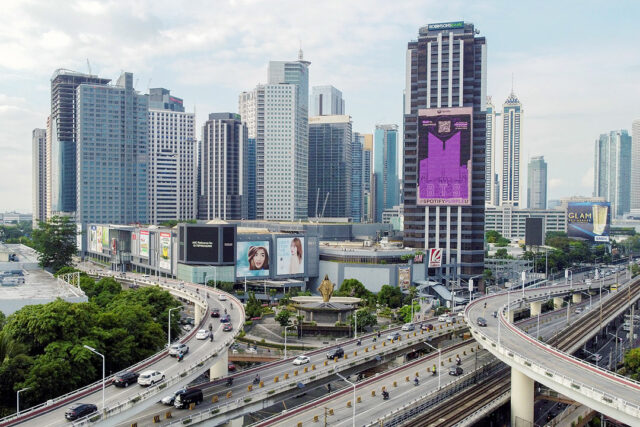
AN AERIAL VIEW shows the Ortigas business district in Pasig City, June 10, 2022. — REUTERS

By Luisa Maria Jacinta C. Jocson, Reporter

The Philippine economic growth is expected to slow to 5.5% this year amid global headwinds and persistently high inflation, the Economic and Social Commission for Asia and the Pacific (ESCAP) said in its latest report. 

“Post-pandemic economic growth in developing Asian and Pacific (APAC) countries weakened considerably in 2022 and is expected to remain weak in 2023, amid the global economic slowdown, unprecedented inflation and uncertainty brought about by the war in Ukraine,” Armida Salsiah Alisjahbana, Under-Secretary-General of United Nations and ESCAP Executive Secretary said in the “Economic and Social Survey of Asia and the Pacific 2023” report. 

ESCAP’s latest estimate is lower than the 6.7% gross domestic product (GDP) growth forecast it gave in April last year. This is also below the government’s 6-7% target and slower than the 7.6% expansion in 2022. 

Based on ESCAP’s estimates, the Philippines will be the second-fastest growing economy in Southeast Asia this year, alongside Cambodia (5.5%) and just behind Vietnam (6.3%). 

“The overall economic performance in developing countries in APAC  is likely to remain weak in 2023 to 2024 amid global economic slowdown, elevated inflation across the board and war-induced uncertainty,” Hamza Ali Malik, ESCAP director of the Macroeconomic Policy and Financing for Development division, said in a virtual briefing discussing the report on Wednesday. 

For 2024, ESCAP sees the Philippine economy expanding by 5.7%, below the 6.5-8% target set by the government. 

Meanwhile, ESCAP sees Philippine inflation at 4.3% this year, higher than its earlier forecast of 3%. It expects inflation to ease to 3% in 2024. 

The central bank forecasts that full-year inflation will average 6% this year, before slowing to 2.9% in 2024. 

“The impact of higher interest rates in controlling the elevated rate of inflation is not expected to materialize fully in 2023. Furthermore, positive economic developments, such as the opening of the Chinese economy in 2023, are likely to keep inflation under pressure; increases in pent-up demand, however, may in turn lead to surges in commodity and energy prices,” ESCAP said. 

The report also cited weakened currencies, higher import costs, and natural disasters, such as frequent typhoons in the Philippines, as drivers of inflation. 

To tame inflation, the BSP raised interest rates by 425 basis points (bps) since May 2022. This brought the policy rate to 6.25%, the highest in nearly 16 years. 

Meanwhile, ESCAP expects growth in developing APAC economies to average 4.2% this year, lower than the 5% estimate it gave earlier.  

“However, this outlook remains fraught with uncertainty and is uneven across the region. In addition to declining exports, the growth prospects are clouded by the extent of expected monetary policy tightening in the major developed economies,” it said. 

ESCAP also sees inflation in the region hitting 5.9% this year, higher than its previous forecast of 4.1%. 

“Inflation is expected to remain at the elevated level of 5.9% in 2023. Although both demand and supply factors are responsible for high inflation in most economies, it is difficult to pin down their relative contribution. Likely upward pressure on wages due to high inflation, and thus inflationary expectations, cannot be ignored either,” the report said. 

It also noted that central banks in the region must “balance the management of expectations about inflation amid supply driven factors while they minimize the adverse impacts of higher interest rates on the prospects for economic recovery.”  

For 2024, ESCAP expects GDP growth in the region to rebound to 4.7%, while inflation is seen to ease to 4.4%. 

DEBT SUSTAINABILITY
Meanwhile, ESCAP said that there is a need to implement better fiscal and debt management amid increasing interest rates and the looming global economic slowdown. 

“As fiscal firepower is shrinking in the APAC region, it is time to rethink the relationship between public debt and development financing. The view that high debt levels are necessarily detrimental to economic growth has been challenged in recent years. On the other hand, development deficits and climate risks, if left unaddressed, will have serious implications for growth and the sustainability of public finance,” ESCAP said. 

According to estimates by ESCAP, APAC developing countries would require an average annual investment of $1.5 trillion, an additional 5% of the region’s 2018 GDP in order to meet the sustainable development goals (SDG) target by 2030. 

“The bulk of this would have to come from public resources. The requirements have certainly increased since then, especially for least developed countries. Climate-related financing needs will also put significant strain on public finances in the region. Importantly, countries most vulnerable to climate change and with the highest development deficits have the most limited fiscal space,” it added. 

ESCAP also cited studies that showed there is no consensus on the “optimal level of public debt.” 

One study showed there was a “significant and positive impact of public debt” on GDP growth in six ASEAN countries from 1995-2015, specifically in Indonesia, Malaysia, the Philippines, Singapore, Thailand and Vietnam. 

ESCAP Economic Affairs Officer Vatcharin Sirimaneetham said that debt can be a “powerful tool for development if used judiciously and with a long-term horizon.” 

Mr. Sirimaneetham said that current methodologies on debt sustainability are often short-term, which leads to the government cutting on spending. This results in unemployment and limited government access to financial resources for SDGs, among others. 

He also cited other ways to boost fiscal space, such as ramping up revenues. 

“Public revenue generation by strengthening tax revenue collection, including through direct taxes. Also raising non-tax revenues and scaling up development transfers now rather than providing debt relief later,” he added. 

The ESCAP report said that “sizable revenue potentials can be realized through the broadening of the tax base and overall improvements in tax administration.” 

“Indeed, modernizing and rationalizing tax systems (Cambodia, Maldives, Myanmar, Nepal, the Philippines), introducing new broad-based taxes (Maldives, Myanmar, Samoa, Tonga), incorporating the informal sector and small and medium-sized enterprises into the formal tax regime (Cambodia), improving tax and customs administration (Armenia, Cambodia, Myanmar, Nepal, the Philippines) and removing excessive tax exemptions (the Philippines) were among the major drivers behind the most impressive country-level revenue increases in recent years. This momentum is likely to continue,” it added. 

In the Philippines, the National Government’s (NG) outstanding debt hit a record-high P13.75 trillion as of end-February. 

The country’s debt-to-GDP ratio stood at 60.9% as of end-December, still slightly above the 60% threshold considered manageable by multilateral lenders for developing economies. 

The government aims to cut the debt-to-GDP ratio to less than 60% by 2025, and further to 51.5% by 2028. 

Globe to pursue climate action strategies

BW FILE PHOTO

Globe Telecom, Inc. said it will continue to implement climate action strategies to support the government’s energy efficiency efforts.

“We are committed to driving energy efficiency in our operations and reducing our carbon footprint through various programs and initiatives. The implementation of intelligent monitoring systems is an important part of this effort, and we are pleased to see the positive impact that they bring to our business and the planet,” said Gerard Ortines, head of Globe’s network solutions and capex management.

Globe has also implemented data center infrastructure management, which automates the monitoring of energy consumption and improves data center design.

The company also vowed to continue working on innovative technology and solutions to help combat climate change as it supported the United Nations’ sustainability agenda, which includes the target to cut greenhouse gas emissions by 50% by 2030 and achieve net zero by 2050.

Meanwhile, Globe said it has retained its score of B in the 2022 CDP assessment, formerly Carbon Disclosure Project.

The company said the score of B indicates that it was able to attain its environmental management processes in addressing relevant risks in its operations, while also reducing its carbon footprint. — Ashley Erika O. Jose