Home Blog Page 503

Vietnam’s GSM weighs overseas IPO, eyes $20 billion market value

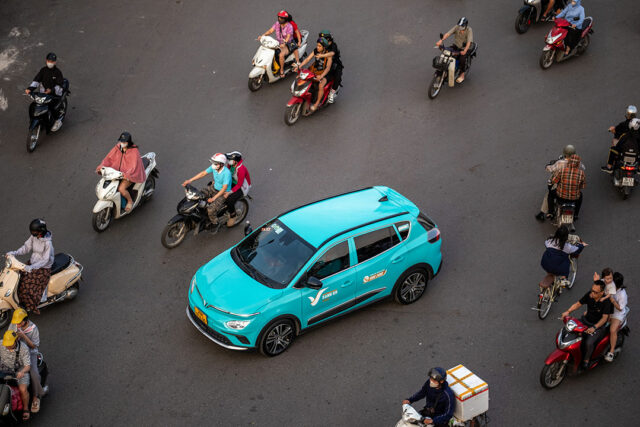
VinFast Auto Ltd. electric vehicle VF e34 model taxi, center, drives along a road in Hanoi, Vietnam, on Friday, May 10, 2024. — LINH PHAM/BLOOMBERG

Vietnamese electric-vehicle taxi operator Green & Smart Mobility JSC, which is owned by the country’s richest man, is weighing an international initial public offering that could value the company at about $20 billion.

The company said it has been working with advisers to assess a “range of perspectives” on the IPO, but emphasized that no listing is planned for 2026. “We have plans for an IPO, but not in 2026,” GSM, as the company is known, said in an emailed statement, where it confirmed the value target.

“Any eventual valuation would depend significantly on the timing and market conditions,” it said, noting that neither the timeframe nor the exchange for a future listing has been determined. GSM did not provide a figure of how much it expects to raise from the IPO.

An overseas listing would be a setback for Vietnam’s domestic stock market, diverting one of the country’s most promising high-growth listings away from local exchanges. While IPO activity has rebounded this year and the pipeline for first-time share sales into 2026 is growing, flagship offerings remain critical to deepening liquidity, drawing foreign investors, and reinforcing confidence in Vietnam’s markets.

Known domestically as Xanh SM, GSM is 95% owned by Vingroup Chairman Pham Nhat Vuong and has quickly emerged as one of Vietnam’s leading ride-hailing operators. The company has begun expanding its model into Laos, Indonesia, and the Philippines, and is expected to enter India, where the Vuong-founded electric vehicle maker VinFast recently opened an EV manufacturing facility.

The taxi company, which was established in 2023, may expand to other Asian countries and into areas such as intercity transport, premium rides, delivery and corporate services, GSM Global Chief Executive Officer Nguyen Van Thanh said previously.

In Vietnam, GSM had a 40% share in the country’s ride-hailing market in the first quarter of 2025, with Grab at 32%, according to Mordor Intelligence. Rakuten Insight, however, said Grab currently holds 55% of the Vietnam market, with GSM at 35%. — Bloomberg

Last bastion for cheap beef fades in latest affordability threat

Dalma Food AB/CC BY 3.0/WIKIMEDIA COMMONS

Cheap beef may soon become further out of reach. Brazil, one of the world’s few remaining sources of abundant cattle, is heading into a period of shrinking supplies that could push global prices higher.

For the past two years, a surge in Brazil’s beef production helped fuel a jump in exports. That’s as ample herds drove cattle prices lower compared to other regions, and ranchers were encouraged to send more animals to slaughter. At the same time, countries such as the US struggled with high food costs, and sought out sources of cheaper beef.

That cycle is turning, with impacts that will ripple through global markets and hamper US President Donald Trump’s efforts to bring down beef prices.

Climbing prices for calves in Brazil are signaling the start of a new phase, in which ranchers start holding back female cattle to rebuild herds. The practice, known as heifer retention, reduces the number of animals sent to slaughter and marks the beginning of a tightening supply cycle.

“We are coming out of the phase of excess, and the phase of scarcity hasn’t even begun,” said César de Castro Alves, manager of agronomic consultancy at Itau BBA bank. Scarcity, he added, is likely to last a few years.

That’s a major reversal for global beef markets, and bad news for consumers as demand for protein remains high. Trump has made lowering beef prices a priority as affordability has become a major issue among US voters. The president has said he would increase imports, and has eased some tariffs on meat.

American consumers are facing sky-high beef prices as US herds are at the lowest in decades after years of drought and high feed costs. In comparison, Brazil’s ample supplies have given local meatpackers a cost advantage over rivals in the US, Australia and elsewhere. That helped the country ramp up exports not only to the US but also to major buyers such as China.

Now, slaughter rates are expected to slow, reducing available beef supplies.

Improved breeding efficiency may soften the downturn compared with previous tightening cycles, said João Otávio de Assis Figueiredo, a commodity analyst at consultancy Datagro. Still, the firm forecasts that Brazil’s cattle slaughter will fall 5.3% next year, following two straight years of growth.

And the issue is aggravated by a downturn in other beef producing countries as well. Cattle supplies in the US are expected to remain tight for at least another year with heifer retention also yet to begin in earnest, while some retention is expected to occur soon in second-largest exporter Australia as well. That’s affecting prices for all, even as countries have different eating habits and some cuts of meat can be cheaper than others.

“Next year will be crucial because all the major countries in the cattle market will be in a scenario of herd recovery,” said Raphael Galo, head of agribusiness at A7 Capital and an independent consultant for feedlots in Brazil.

Analysts at Rabobank expect Brazil’s total beef output to fall between 5% and 6% next year. Yet Brazil should continue as the largest beef exporter, with the bank estimating a record 4.4 million tons in overseas sales. Brazil may even ship more beef to the US in the first months of 2026, following the exemption of 50% tariffs that were effective between August and November.

Still, those shipments will likely be at higher prices, especially considering global consumers’ unflagging desire for proteins.

“Restricted supplies next year can make the market be really firm, because international demand remains strong,” said Paulo Mustefaga, executive director of the nation’s meatpacking association Abrafrigo. — Bloomberg

Soaring prices spark Australia gold rush for new generation of fortune hunters

A shop worker poses holding three gold nuggets at The Gold Centre store, in Maryborough, Australia, Nov. 28, 2025. — REUTERS/HOLLIE ADAMS

MELBOURNE — In the hinterlands of Australia’s historic goldfields, Vicki Plumridge jumps for joy when she digs a small golden nugget out of the earth.

The retired retail worker was learning how to use her new metal detector when it started bleeping by the moss-covered ruins of a building. After Plumridge dug the nugget out of the shallow dirt with a plastic trowel, a guide estimated it was around 0.2 of a gram of gold, worth about A$40 ($26.58).

“But to me, it’s worth a million dollars,” said the 63-year-old, who had bought the detector only a few days before. “My heart is singing.”

Plumridge’s story is becoming more common, as hobbyists flock to Australia’s 9,600 sq km “golden triangle” in the heart of Victoria state, known as one of the world’s most prospective regions for gold nuggets.

Prospectors have been spurred on by record gold prices, social media, the success of TV show Aussie Gold Hunters, and a love for the outdoors, according to Reuters interviews with a dozen gold hunters.

Plumridge’s detector, Minelab’s Gold Monster 2000, which she bought for A$2,999, sold out across the country within weeks of its October 20 launch, according to Leanne Kamp, joint owner of Lucky Strike Gold, a prospecting shop in Geelong.

“It’s a great price point and we have seen a big jump in sales this year, partly because the gold price has got everyone’s interest,” said Kamp, who has led prospecting tours since 2007.

“We get a lot of internationals. Next week we have some Germans coming. Germans love the gold. The Swiss seem to love the gold too. And we have some coming over from the U.S.,” she said.

The chance of finding nuggets on historic sites improves with each iteration of detectors, which is why there is a rush for new models as soon as they are released, she added.

WORLD’S BIGGEST NUGGETS
Hobbyists have flocked to 19th-century gold rush towns like Ballarat, which laid the foundation for Melbourne’s early wealth and helped make Australia one of the world’s top three gold producers.

The region has yielded the world’s biggest nugget, the Welcome Stranger at 72 kg, found in the 1860s, as well as the Hand of Faith, the largest nugget found with a metal detector at 27.2 kg in 1980. As recently as February 2023, an amateur prospector unearthed a 4.6 kg nugget in the region with a detector, according to the state government.

The lure of large nuggets is one of the draws for Damian Duke, 39, who works in construction. Duke used to go prospecting with his father who died three years ago. Now he takes his own son, Ethan.

The 11-year-old inherited his grandfather’s detector, and Duke has recently upgraded his machine, he told Reuters.

“Where prices are now, you do have the chance of striking a life-changing piece of gold,” he said.

Gold XAU= has chalked up successive records this year, surging above$4,500 a troy ounce on Friday. Goldman Sachs expects prices will reach $4,900 by the end of 2026, with further gains likely if private investors continue diversifying their portfolios amid geopolitical and fiscal uncertainty.

In Victoria, fossickers must buy a permit from the state government. The permit allows them to fossick using only hand tools and to keep any gold they find.

Demand for the miner’s right permits, which cost A$28.60 each and last for a decade, has hit all-time highs, at almost 16,000 by November, from nearly 11,000 last year, according to figures from Victoria’s Department of Energy, Environment and Climate Action, supplied exclusively to Reuters.

In total, there are more than 100,000 active miner’s right permits in Victoria.

A dream of riches may drive people to get out, but they stay out because of the psychological benefits that come from the focus on the hunt, being outside in nature, and connecting with others, prospectors said.

“It’s really good for your mental health, being out here. You take it all in, you can’t think about anything else – I love looking at all the wildflowers,” said Kelly Smith, a 50-year-old from the country town of Koondrook, who was prospecting with her partner on a training session organised by The Gold Centre in Maryborough.

“You’re not guaranteed to find anything. But you’re not going to find anything at all if you don’t look.”

GLOBAL PHENOMENON
Victoria’s latest gold rush is part of a broader phenomenon, said Ben Harvey, executive general manager of Minelab at Adelaide-headquartered Codan, which is the world’s largest maker of hand-held metal detectors.

Alongside Codan’s communications division, strong detector sales in its home market of Australia as well as in Africa and the Americas have helped double the firm’s share price this year.

In Africa, demand may be led by artisanal miners working in cooperatives to improve their standard of living, Harvey said. In Latin America, there is also recreational interest from hobbyists searching for coins and other treasure, he told Reuters in an interview.

Behind the success is a push by Codan’s team of engineers to improve technology to cut down on background noise so detectorists can focus on the gold, he said.

“What a prospector is looking for is, when they go out, they want to find gold, and they want to find more gold than they found last time,” he said. — Reuters

Former Malaysian PM Muhyiddin to resign as chair of opposition bloc

REUTERS

KUALA LUMPUR — Former Malaysian Prime Minister Muhyiddin Yassin said on Tuesday he will resign as chairman of the opposition bloc Perikatan Nasional, effective January 1.

Mr. Yassin has served as the coalition’s leader since its inception after a political crisis in 2020 that saw him appointed as the country’s eighth prime minister.

He served just 17 months as premier, resigning the following year amid criticism over his handling of the COVID-19 crisis.

“I would like to thank all the PN leaders who have given me full support during my time leading PN since its establishment five years ago. I wish all the best to the PN leadership and its member parties,” he said in a statement on Tuesday.

His resignation as opposition chair comes amid tensions this month within the Malay Muslim-dominated PN coalition, with popular Islamist party PAS accusing Mr. Yassin’s Bersatu party of initiating a leadership coup in Perlis state, which is governed by the bloc.

It is unclear who will take over leadership of the PN bloc, as Mr. Yassin was one of its few leaders with broad appeal.

Malaysia is a multi-racial, multi-faith country, with ethnic-Malay Muslims accounting for over 60% of the population while ethnic Indians and Chinese form sizeable minorities.

PN made inroads among Malaysia’s majority ethnic-Malay Muslims in 2022’s general election, and its popularity among more traditional Malays and young voters is seen as a threat to Prime Minister Anwar Ibrahim’s progressive, multi-ethnic alliance. — Reuters

Trump warns Iran of possible strike, urges Hamas to disarm after meeting Netanyahu

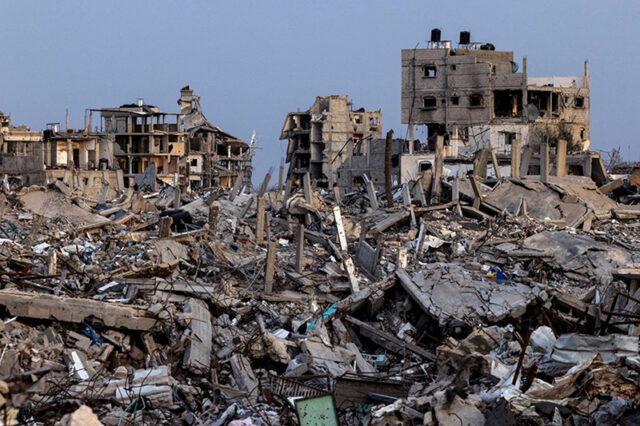
Buildings lie in ruins amidst the rubble in Rafah in the southern Gaza Strip, December 8, 2025. — REUTERS

PALM BEACH, Florida — US President Donald Trump said on Monday the United States could support another major strike on Iran were it to resume rebuilding its ballistic missile or nuclear weapons programs and warned Hamas of severe consequences if it does not disarm.

Speaking beside Israeli Prime Minister Benjamin Netanyahu following a meeting at his Mar-a-Lago estate in Florida, Mr. Trump suggested Tehran may be working to restore its weapons programs after a massive US strike in June.

“I’ve been reading that they’re building up weapons and other things, and if they are, they’re not using the sites we obliterated, but possibly different sites,” Mr. Trump told reporters during a press conference.

“We know exactly where they’re going, what they’re doing, and I hope they’re not doing it because we don’t want to waste fuel on a B-2,” he added, referring to the bomber used in the earlier strike. “It’s a 37-hour trip both ways. I don’t want to waste a lot of fuel.”

Mr. Trump, who has broached a potential nuclear deal with Tehran in recent months, said his talks with Mr. Netanyahu focused on advancing the fragile Gaza peace deal he brokered and addressing Israeli concerns over Iran and over Hezbollah in Lebanon.

Iran, which fought a 12-day war with Israel in June, said last week that it had conducted missile exercises for the second time this month.

Mr. Netanyahu said last week that Israel was not seeking a confrontation with Iran, but was aware of the reports, and said he would raise Tehran’s activities with Mr. Trump.

A SECOND PHASE IN GAZA?
Mr. Trump said he wanted to move to the second phase of the ceasefire deal between Israel and the Palestinian militant group Hamas reached in October after two years of fighting in Gaza, a progression that entails international peacekeeping forces deployed in the Palestinian enclave.

Israel and Hamas accuse each other of major breaches of the deal and look no closer to accepting the much more difficult steps envisaged for the next phase. Hamas, which has refused to disarm, has been reasserting its control as Israeli troops remain entrenched in about half the territory.

Israel has indicated that if Hamas is not disarmed peacefully, it will resume military action to make it do so.

During his Monday comments, Mr. Trump heaped the blame on the militant group for not disarming more promptly, arguing that Israel had lived up to its side of the deal and warning that Hamas was inviting grave consequences.

“There will be hell to pay,” Mr. Trump warned when asked what he will do if Hamas does not lay down its arms. He has made similar statements at previous intervals during the fighting.

Mr. Netanyahu said this month that Mr. Trump had invited him for the talks, as Washington pushes to establish transitional governance for the Palestinian enclave amid Israeli reluctance to move forward.

The deployment of the international security force was mandated by a November 17 UN Security Council resolution.

While Washington has brokered three ceasefires involving its longtime ally – between Israel and Hamas, Israel and Iran, and Israel and Lebanon – Mr. Netanyahu is wary of Israel’s foes rebuilding their forces after they were considerably weakened in multiple wars.

Overall, Mr. Trump’s comments suggested he remains firmly in Mr. Netanyahu’s camp, even as some aides have privately questioned the Israeli leader’s commitment to the Gaza ceasefire. His comments also suggested he is willing to risk additional hostilities related to Gaza and Iran, even as Mr. Trump has taken credit for resolving Israel’s wars in both places.

Mr. Trump struck a warm tone as he greeted Mr. Netanyahu before their meeting, going so far as to say that Israeli President Isaac Herzog had told him he planned to pardon Mr. Netanyahu of corruption-related charges – a conversation Mr. Herzog’s office immediately denied took place.

Mr. Netanyahu reciprocated, telling reporters after the meeting that he was gifting Mr. Trump the country’s Israel Prize, which he said has historically been reserved for Israelis.

NEXT STEPS IN GAZA CEASEFIRE PLAN
Mr. Trump’s plan to end the Gaza war ultimately calls for Israel to withdraw from the Palestinian territory and Hamas to give up its weapons and forgo a governing role.

The first phase of the ceasefire included a partial Israeli withdrawal, an increase in aid and the exchange of hostages for Palestinian detainees and prisoners.

An Israeli official in Mr. Netanyahu’s circle said that the prime minister would demand that the first phase of the ceasefire be completed by Hamas returning the remains of the last Israeli hostage left in Gaza, before moving ahead to the next stages. The family of the deceased hostage, Ran Gvili, joined the prime minister’s visiting entourage.

Israel has yet to open the Rafah crossing between Gaza and Egypt, also a condition of Mr. Trump’s plan, saying it will only do so once Gvili’s remains are returned.

Mr. Trump said that he and Mr. Netanyahu did not agree fully on the issue of the Israeli-occupied West Bank but the Republican leader did not lay out what the disagreement was.

TURKEY, SYRIA ALSO DISCUSSED
Before the meeting, Mr. Trump told reporters he would talk to Mr. Netanyahu about the possibility of stationing Turkish peacekeepers in Gaza. That is a fraught subject – while Mr. Trump has frequently praised Turkish President Tayyip Erdogan, Israel and Turkey have a much more circumspect relationship.

While the fighting in Gaza has abated, it has not stopped entirely. Although the ceasefire officially began in October, Israeli strikes have killed more than 400 Palestinians — most of them civilians, according to Gaza health officials — and Palestinian militants have killed three Israeli soldiers.

Mr. Netanyahu said on Monday that Israel was keen to ensure a peaceful border with Syria, and Mr. Trump said he was sure Israel would get along with President Ahmed al-Sharaa, who took power after longtime strongman Bashar al-Assad was deposed last year.

But Israel has been suspicious of the new leader, who was once a member of al-Qaeda, going so far as to bomb government buildings in Damascus this July. — Reuters

US pledges $2 billion in new UN model for delivery of humanitarian assistance

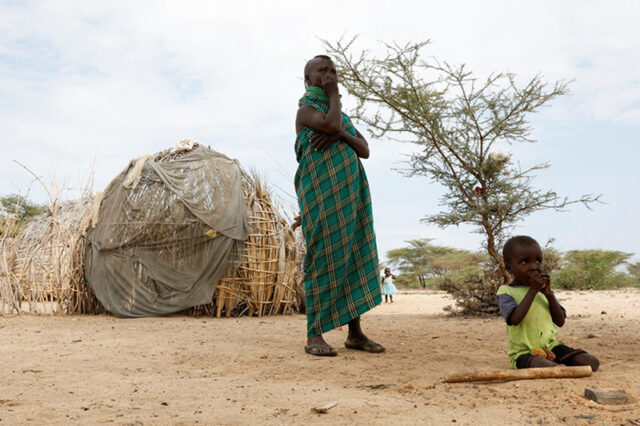
A woman in Turkana County, Kenya stands as her malnourished 4-year-old son eats wild fruits outside their thatch hut, October 29, 2025. — REUTERS

GENEVA/WASHINGTON — The United States on Monday pledged $2 billion in assistance to tens of millions of people facing hunger and disease in more than a dozen countries next year, part of what it said was a new mechanism for the delivery of life-saving assistance following major foreign aid cuts by the Trump administration.

The US slashed its aid spending this year, and leading Western donors such as Germany also pared back assistance as they pivoted to increased defense spending, triggering a severe funding crunch for the United Nations.

The billions of dollars in assistance pledged by Washington on Monday will be overseen by the United Nations Office for the Coordination of Humanitarian Affairs, the State Department said, under what it described as new model of assistance agreed with the UN that aims to make aid funding and delivery more efficient and increase accountability for the spending of funds.

UN data shows total US humanitarian contributions to the UN fell to about $3.38 billion in 2025, equating to about 14.8% of the global sum. This was down sharply from $14.1 billion the prior year, and a peak of $17.2 billion in 2022.

The US and United Nations will sign 17 memorandums of understanding with individual countries identified by the US as priority countries, officials from the State Department and UN said in Geneva.

But some areas that are priorities for the UN, including Yemen, Afghanistan, and Gaza, will not be receiving US funding under the new mechanism, UN aid chief Tom Fletcher said, adding that the UN will seek support from other donors to find funding for those.

Jeremy Lewin, State Department Under Secretary of State for Foreign Assistance, Humanitarian Affairs and Religious Freedom, said further countries would be added as more money is contributed to the mechanism.

“These are some countries where I think our interests overlap … But over time, we will thoughtfully add additional countries,” Mr. Lewin said.

GAZA TO BE HANDLED ON SEPARATE TRACK
A UN spokesperson said Ukraine, Democratic Republic of Congo, Nigeria, and Sudan were among the countries covered in Monday’s package.

But Gaza – where aid agencies have repeatedly said far more aid needs to get into the small, crowded enclave – is not covered in Monday’s announcement and will instead be handled on a separate track, Mr. Lewin said.

He said that the US had approved over $300 million after President Donald Trump’s administration helped broker a Gaza ceasefire “to give pipeline to the UN agencies”, adding that the US will be working to get additional donors for a pooled mechanism under a separate track for Gaza under phase two of the deal.

Mr. Fletcher said that donors would have “specific requirements” around which countries and what type of work should be funded.

“But the humanitarian action at the other end of that must always be neutral and impartial and independent, and nothing in the work that we’re doing together here in this partnership undermines those principles,” he said.

Mr. Lewin said the focus of the funding was on life-saving assistance, while funding for climate-related and other projects that were not a priority for the administration would be cut out.

Earlier in December, the United Nations launched a 2026 aid appeal for $23 billion to reach 87 million people at risk – half the $47 billion sought for 2025, reflecting plunging donor support despite record global needs.

Mr. Fletcher acknowledged it had been a tough year for the UN, following a slew of cuts while humanitarian crises in war-torn countries such as Sudan surged, but said he was optimistic following the US pledge.

“Millions of lives will be saved across 17 countries,” said Mr. Fletcher. — Reuters

BSP sees December inflation between 1.2% and 2.0%

Various clothing items were on sale at a mall in Cubao, Quezon City, Dec. 23. PHOTO BY MIGUEL DE GUZMAN, THE PHILIPINE STAR

By Katherine K. Chan

PHILIPPINE INFLATION likely eased year on year in December as lower electricity prices may have offset costlier food items during the holiday season.

In its month-ahead forecast, the Bangko Sentral ng Pilipinas (BSP) said headline inflation likely fell within the 1.2%-2% range in December, slowing from the 2.9% clip seen a year ago.

At 2% or the upper end of the forecast, inflation may have picked up from 1.5% in November and would be the fastest clip in 10 months or since the 2.1% clip in February. It would likewise mark the first time in 10 months that inflation returned to the central bank’s 2%-4% target.

At the bottom end of the forecast, inflation likely eased to its slowest pace in five months or since the 0.9% in July.

“Upward price pressures may come from increased prices of major food items due to the lingering effects of adverse weather and strong holiday demand, as well as higher LPG (liquefied petroleum gas) and gasoline prices,” the central bank said in a statement on Monday.

This comes despite the Department of Trade and Industry’s imposition of a 60-day price freeze on basic and prime commodities last November, following President Ferdinand R. Marcos, Jr.’s declaration of a state of national calamity.

The Department of Agriculture also implemented a maximum suggested retail price for pork, onions and carrots starting Dec. 1 and is set to last until the end of January.   

However, the central bank said lower prices of electricity, kerosene and diesel during the month may have offset the inflationary pressures from food prices.

In December, the Manila Electric Co. (Meralco) reduced electricity rates by P0.3557 per kilowatt-hour (kWh) to P13.1145 per kWh from P13.4702 per kWh in November.

This is equivalent to a P71 decrease in the monthly electricity bills of households consuming an average of 200 kWh.

Meanwhile, pump price adjustments in December stood at a net increase of P0.80 per liter for gasoline. On the other hand, it posted a net decrease of P3.80 per liter for diesel and P4.40 per liter for kerosene.

The Philippine Statistics Authority is set to release the December inflation data on Jan. 6.

In a separate commentary, Metropolitan Bank & Trust Co. (Metrobank) research officers Maria Kaila Balite and Joaquim Pantanosas said inflation likely settled at 1.4% in December, bringing full-year inflation to an average of 1.6%. 

The bank noted that elevated prices of food such as vegetables, fruits, meat and fish amid increased demand brought inflationary pressures in December.

“Food inflation continues to exert upward pressure to headline inflation this month, with holiday demand providing a push to prices,” it said. “Elevated oil and electricity prices also add to the weight. Metrobank forecasts headline inflation at 1.4% year on year in December.”

Meanwhile, the central bank said it will keep monitoring the country’s inflation and economic growth data in deciding its monetary policy.

“The BSP will continue to monitor domestic and international developments affecting the outlook for inflation and growth in line with its data-dependent approach to monetary policy,” the central bank said.

At its Dec. 11 meeting, the BSP lowered its policy rate by 25 basis points (bps) to an over three-year low of 4.5% as it continues to see subdued inflation and sluggish growth. It has so far delivered a total of 200 bps in cuts since August 2024.

As of November, headline inflation averaged 1.6%, matching the central bank’s full-year forecast.

For 2026, the central bank sees inflation accelerating to 3.2%, before slowing to 3% in 2027.

Mr. Remolona earlier said that the current easing cycle is nearing its end but still left the door open to a final 25-bp reduction next year depending on economic data.

The Monetary Board is scheduled to hold six regular policy meetings in 2026, with the first one set on Feb. 19.

Congress ratifies 2026 national budget

Members of the House of Representatives pose for a group photo after ratifying the bicameral conference committee report on the proposed P6.7-trillion 2026 national budget during a plenary session at the House of Representatives in Quezon City, Dec. 29. — PHILIPPINE STAR/MIGUEL DE GUZMAN

By Adrian H. Halili, Reporter

CONGRESS on Monday ratified the bicameral conference committee report on the P6.793-trillion national budget for 2026, marking the end of contentious deliberations that unfolded against the backdrop of a multibillion-peso corruption scandal.

Senator Sherwin T. Gatchalian, who heads the Senate Finance Committee, said next year’s budget is mainly focused on improving education, health, and agriculture.

“These highlights illustrate our commitment to strengthening the services that carry the most significant impact on the daily lives of our fellow Filipinos — better education for our children, adequate healthcare for those in need, and long-term food security for our communities,” he told plenary before the Senate ratified the report through a voice vote.   

At the same time, the House of Representatives approved the ratification of the 2026 General Appropriations Act (GAA) in under two minutes, also through a voice vote. 

After Congress’ ratification, the GAA will be sent to Malacañang for President Ferdinand R. Marcos, Jr.’s signature.

Mr. Marcos is expected to sign the 2026 national budget on Jan. 5.

Mr. Gatchalian said the bicameral panel had also enforced safeguards that would ensure transparency and accountability during budget process.

“The bicameral conference committee was also very deliberate in ensuring that equal attention was given to protecting the management of public funds — through safeguards that are anchored on transparency and accountability,” he said.

Reforms include the uploading of budget documents online, the livestreaming of bicameral proceedings, and the involvement of civil society in budget deliberations.

This year, several transparency initiatives were implemented during budget deliberations, amid public outrage over congressional insertions and opaque allocations in the 2025 national budget.

Government officials, lawmakers and contractors allegedly colluded to siphon off billions from funds meant for flood control projects.

During deliberations, the bicameral panel raised funding for the education sector to P1.35 trillion, which Mr. Gatchalian said was equivalent to 4.4% of economic output.

The budget of the Department of Education was increased by P47.18 billion to P961.32 billion, which would mainly be used for the construction of 34,000 new classrooms.

Funds would also be used to support the school feeding program with P25.7 billion aimed at covering 180 days and the procurement of textbooks at P19.51 billion.

“There will be clear and meaningful steps to reduce the shortage of classrooms. Millions of malnourished students will benefit from the School-Based Feeding Program. And we will ensure that every student has their own textbook,” Mr. Gatchalian said.

The budget of state universities and colleges was also raised by P6.22 billion to P137.9 billion under the 2026 national spending plan.

Funding under the health sector now stands at P447.6 billion, after lawmakers raised the Department of Health’s budget by P14.68 billion to P297.85 billion.

The budget of the Philippine Health Insurance Corp. (PhilHealth) was increased by P16.52 billion to P129.78 billion as the additional funds were rechanneled from the Public Works department.

Mr. Gatchalian said the panel also hiked funding for Zero-Balance Billing program for government hospitals to P1 billion, and expanded the program to include selected local government units.

The panel had also raised the Agriculture department’s budget by P5.48 billion to P185.77 billion to fund the construction of farm-to-market roads, post-harvest facilities, and support its modernization program.

“Programs that will help our farmers’ income and our country’s food security, such as credit insurance and direct market access, will now be properly funded,” the senator said.

The bicameral committee has slashed the Department of Public Works and Highway’s (DPWH) budget by P94.89 billion to P529.595 billion, mainly from the P52.3-billion cut for foreign-assisted projects.

Unprogrammed allocations are now set at P243.4 billion, close to the P250 billion under the National Expenditure Plan. These include P4.32 billion to support Fiscal Support Arrearages for Comprehensive Automotive Resurgence Strategy Program, and P250 million for the Revitalizing the Automotive Industry for Competitiveness Enhancement Program.

Unprogrammed appropriations are standby funds for pre-planned government projects or emergency contingencies, which are sourced from revenues or new collections.

Adolfo Jose A. Montesa, an adviser for the People’s Budget Coalition, said that delays in the bicameral conference could have been avoided if lawmakers had finalized the funding for infrastructure projects before the start of proceedings.

“The delays could have been avoided if the finalization of the projects of the DPWH, farm-to-market roads, etc. came earlier than the bicam, which it should have,” he said in a Viber message.

Mr. Montesa said there were improvements in the budget process “but there has been a clear crisis of trust in the budget process, which requires more than just piecemeal or incremental reforms.”

“Full transparency is necessary, but not sufficient,” he said. “Declaring that the budget is ‘corruption-proof’ or ‘pork-free’ should be up to the people, not the politicians.”

John Paolo R. Rivera, a senior research fellow at the Philippine Institute for Development Studies, said that delays in the budget proceedings indicated a week institutional capacity and coordination.

“Compared with 2025, the budget process showed greater emphasis on transparency, but the persistence of delays suggests that institutional capacity and coordination still lags,” he said in a Viber message.

He said that transparency measures must translate into timely approval and faster execution that should support growth.

“A reenacted budget in the first week of 2026 would have limited but noticeable short-term effects. Day-to-day government operations continue, but new projects, capital outlays, and program expansions are delayed, which can soften economic momentum early in the year especially for infrastructure, procurement, and employment linked to public spending,” Mr. Rivera said.

“Growth may see a temporary drag in Q1 as agencies wait for authority to release new funds. This can be recovered later if catch-up spending is executed well,” he added.

Peso, PSE index close lower on last trading day of 2025

The Philippine Stock Exchange index (PSEi) closed at 6,052.92 on Dec. 29, the last trading day of 2025. This was 7.3% lower than the end-2024 close of 6,528.79. — IMAGO IMAGES VIA REUTERS CONNECT

By Aaron Michael C. Sy, Reporter

PHILIPPINE financial markets closed lower on the last trading day of 2025 — a year that saw new record lows for the Philippine peso and an over-five-year low for the stock market amid a corruption scandal that hurt investor sentiment.

The peso on Monday closed at P58.79 per dollar, depreciating by eight centavos from its P58.71 finish on Friday.

Year to date, it weakened by 94.5 centavos or by 1.61% from its P57.845 close on Dec. 27, 2024.

“The peso ended the year on a weaker stance as the latest third-quarter US GDP (gross domestic product) growth figures showed the robust performance of the US economy, providing boost for the greenback,” a trader said in a Viber message.

Another trader said in a text message that the peso was one of the weaker performing currencies among the region this year.

“Narrow interest differential vs. the USD, lackluster equities market, gloomy outlook due to corruption scandal all contributed to peso weakness,” the trader said.

The Philippine Stock Exchange index (PSEi) closed at 6,052.92 on Monday, 7.3% lower than the 6,528.79 close on Dec. 27, 2024.

“The PSEi’s decline this year is not just about numbers — it’s about trust and confidence. The corruption scandal, the deteriorating peso and the disappointing GDP performance for the third quarter have clouded our economy’s outlook and triggered persistent selling by foreign investors in the market this year,” PSE President and Chief Executive Officer Ramon S. Monzon said in a statement.

Mr. Monzon said there are “a lot of positives” to look forward to in 2026, as corporates continue to post earnings growth and more listings are expected.

“If our government succeeds in its drive to hold the corrupt accountable and institute real and lasting improvements in transparency and governance, our market should be one of the best-performing markets in the region next year,” he said.

China Bank Capital Corp. Managing Director Juan Paolo E. Colet said there was “too much uncertainty and disruption” that weighed on the local stock market this year.

“For many local equity investors, 2025 is perhaps the most disappointing year since the pandemic crash of 2020,” he said.

He cited US President Donald J. Trump’s tariff policies, the Philippine midterm elections in May and the flood control scandal as factors that affected stock market activity.

Mr. Colet noted the PSEi had underperformed most analysts’ initial base case targets.

“When we started the year, I don’t think a lot of us expected a massive corruption scandal to shake our stock market,” he added.

On Nov. 14, the PSEi plunged to 5,584.35, its weakest close in nearly five and a half years or since the 5,570.22 close on May 28, 2020. Investor confidence further fell after GDP grew by 4% in the third quarter — the slowest in more than four years. This brought the nine-month average to 5%, below the 5.5-6.5% GDP growth target for this year.

“It has been a bearish year for the local market, reflecting the drop in investors’ confidence towards the local economy amid its growth slowdown and dimmed outlook,” Philstocks Financial, Inc. Research Manager Japhet Louis O. Tantiangco said in a Viber message on Monday.

He said net value turnover averaged P5.91 billion per day in 2025, an improvement from P5.15 billion in 2024.

According to Mr. Tantiango, foreigners were net sellers in the local stock market with net outflows reaching P47.13 billion this year, 86.6% up from P25.25-billion net outflows in 2024.

“Well, a lot has certainly happened this year, some of which already started at the end of 2024 from President Trump’s policies, trade uncertainties, and we got macro-shock from lower growth levels, FX (foreign exchange) volatility, monetary policy guidance, and some may attribute geopolitical scandals that weighed on the market,” Regina Capital Development Corp. Head of Sales Luis A. Limlingan said in a Viber message last Tuesday.

Mr. Tantiangco said the local bourse also ranked among the worst performing markets in East and Southeast Asia this year.

AP Securities, Inc. Equity Research Analyst Shawn Ray R. Atienza said that even with solid corporate earnings, the PSEi still lagged due to corruption concerns, trade uncertainties, and weak spending dragging growth and triggering foreign fund outflows.

“Most investors toggled defensive mode on and shelled the entire year, leading to utilities and mining sector thriving and even breaching new highs. While most sector counters dove beneath the red seas as various headwinds affected toplines and eroded margins due to dampened demand, weather disruptions, and volatile commodity prices,” Mr. Atienza said in a Viber message last Monday.

PESO OUTLOOK
The peso was led by the dollar movement throughout 2025, Oikonomia Advisory and Research, Inc. Economist Reinielle Matt M. Erece said in a Viber message.

He said the local unit earlier in the year was dragged by the dollar’s appreciation due to hawkish expectations on the US Federal Reserve as Mr. Trump’s shifting tariff policies caused market jitters.

However, the peso further declined near the end of the year amid the dollar’s recovery and the corruption mess.

“The flood control corruption scandal has soured investor sentiment, causing capital outflows. The flight from Philippine assets caused the Philippine peso’s attractiveness to slip. While strong overseas Filipino worker  remittances offset some of the slippage in USD-PHP exchange rates, it failed to reverse the impact of the corruption issue,” Mr. Erece said.

The peso fell to a new all-time low of P59.22 per dollar on Dec. 9.

“Hitting new lows hurts confidence at the margin, especially for foreign investors, but it is not panic-inducing on its own. What matters more is whether weakness becomes persistent and inflationary. So far, the impact has been contained, but expectations of further slippage can keep positioning cautious,” Philippine Institute for Development Studies Senior Research Fellow John Paolo R. Rivera said in a Viber message.

Mr. Erece said the peso hitting P60-per-dollar levels is a low possibility as it is expected to rebound in 2026, driven by managed inflation, strong business environment, and strong consumer demand.

“If political issues are addressed deliberately and productively, it can definitely help in restoring confidence in the country. Strong capital inflows will result in more demand for Philippine pesos, which can cause the PHP to appreciate.”

Mr. Erece added that economic managers could use the peso’s current weakness and implement strong industrial policies that encourage the selling of high-value goods to foreign countries.

“Strong industrial policy results in higher earnings from foreign countries through trade, which then results in faster economic growth,” he said.

Meanwhile, eManagement for Business and Marketing Services Managing Director Jonathan L. Ravelas said the peso could trade as low as P61 per dollar early next year due to pressure from global uncertainty and Fed rate cuts

“Expect it to trade in the P58- to P61-per-dollar range, with volatility tied to tariff, oil and geopolitical risks,” he said in a Viber message.

“For policy rates, the BSP will keep a cautious stance — maybe one or two cuts in the first half of the year as inflation stays tame. Peso performance matters, but it’s not the sole driver; inflation and growth risks weigh heavier. BSP’s top priority is price stability, not defending a level,” he added.

At its Dec. 11 meeting, the BSP lowered its benchmark rates by 25 bps to bring the policy rate to 4.5%, the lowest level in more than three years.

BSP Governor Eli M. Remolona, Jr. has said that the central bank has room for one more 25-bp cut next year as economic recovery will take longer than expected.

Its first policy meeting for 2026 is scheduled for Feb. 19.

“The (Philippine peso) will be driven by Fed-BSP policy differentials, capital flows, trade balance and remittances, and domestic confidence tied to fiscal execution and governance,” Mr. Rivera said.

The peso is also sensitive to external shocks and oil price movements, he added.

“Yes, (peso) can recover if inflation stays anchored, the Fed eases, and investment inflows improve, the PHP can recover modestly toward the high P58-P59 range. A stronger rebound would require clearer policy signals and faster growth momentum,” Mr. Rivera said.

For the first week of 2026, the trader expects the peso to move from P58.60 to P59 per dollar. — with AGCM

Vista Land secures P13.61-B notes facility to refinance debt

VISTAESTATES.VISTALAND.COM.PH

VILLAR-LED property developer Vista Land & Lifescapes, Inc. has signed a five-year corporate notes facility of up to P13.61 billion to refinance its obligations, the company said.

Vista Land made an initial drawdown of P7.22 billion at a fixed interest rate of 7.8947% per annum, it said in a stock exchange disclosure on Monday.

“The proceeds of the corporate notes facility will be used to refinance existing or maturing obligations of the group and for the other general corporate purposes,” Vista Land said.

The company entered into the corporate notes facility agreement with China Bank Capital Corp. as the sole arranger and bookrunner.

China Banking Corp., through its Trust and Asset Management Group, serves as the facility and paying agent, notes registrar, and security trustee.

Vista Land’s subsidiaries — Brittany Corp., Crown Asia Properties, Inc., Camella Homes, Inc., Communities Philippines, Inc., Vista Residences, Inc., and Vistamalls, Inc. — act as guarantors for the facility.

In a statement last week, Vista Land said it had settled P3.5 billion worth of retail bonds using proceeds from advances provided by its majority shareholders.

The company reported a 4% increase in nine-month net income to P9.5 billion, while rental income for the period rose by 3% to P12.8 billion.

Separately, Villar Land Holdings Corp. announced the election of Manuel B. Villar, Jr. as chairman of the board; Cynthia J. Javarez as president; Estrellita S. Tan as chief financial officer, chief information officer, and investor relations officer; Gemma M. Santos as corporate secretary; Ma. Nalen S.J. Rosero as assistant corporate secretary; and Kate D. Cator as compliance officer.

Ma. Luisa B. Villacorta and Marilou O. Adea were elected as independent directors, replacing Ana Marie V. Pagsibigan and Garth F. Castañeda, who reached the maximum term limit set by the Securities and Exchange Commission.

Villar Land, formerly Golden MV Holdings, Inc., posted a net income of P1.423 billion in 2024, slightly higher than the P1.416 billion recorded a year earlier.

At the local bourse on Monday, Vista Land shares rose by 11.83% or 11 centavos to close at P1.04 apiece, while Villar Land shares ended unchanged at P1,000 each. — Beatriz Marie D. Cruz

What are you doin’ New Year’s Eve?

UNSPLASH/RENE BERNAL

A roundup of celebrations counting down to 2026

WITH 2025 drawing to a close, Metro Manila is set to mount large New Year’s Eve celebrations. Here is a list of countdown events to choose from for a joyful start to the year ahead, ranging from community-based festivities to giant concerts, DJ-led parties, and festive hotel shindigs.

QUEZON CITY’S COUNTDOWN TO 2026
Quezon City is set to rock the New Year’s Eve Countdown at the Quezon Memorial Circle, featuring some of the country’s most iconic bands and artists. Kicking off at 4 p.m. on Dec. 31, the event organizers promise a night filled with music, entertainment, and celebration.

The musical lineup includes Kamikazee, Mayonnaise, Soapdish, The Itchyworms, Lola Amour, Gloc-9, Angeline Quinto, Streetboys, Reese Lansangan, Dilaw, and Mike Levet. The concert will be hosted by Allan K, Pokwang, Super Tekla, Donita Nose, Uma Rojo, and Camil.

This plastic-free celebration encourages attendees to bring their own tumblers to stay hydrated. Admission is free.

MAKATI GOES FULL COLOR
Ely Buendia and Cup of Joe are just some of the many performers in Makati’s New Year’s countdown, titled Makati in Full Color. Aside from the two popular rock acts, the other countdown headliners include acclaimed singer Morissette, hit musician Juan Karlos, singing competition star Sofronio Vasquez III, drag queen trio the Divine Divas, and select cast members from Theater Group Asia’s A Chorus Line.

The celebration will be held at Ayala Avenue starting at 6 p.m. Admission is free but tickets will be sold for VIP seats (with a dedicated lounge, buffet dinner, and prime viewing spots), available via TicketWorld.

As the clock strikes midnight, there will be a spectacular fireworks display accompanied by a Filipino version of Times Square’s ball drop. Guests are then invited to keep the energy going at a street party with beats by DJ Cupcakes and an after party with music by The Studio Dance Club at the Ayala Triangle Gardens.

SB19 HEADLINES COUNTDOWN AT BGC
For a P-Pop takeover, head to Bonifacio Global City’s (BGC) NYE at the 5th in Taguig City on Dec. 31, starting at 7 p.m. The event will be headlined by P-pop boy group SB19. It will also feature performances from OPM acts Apl.de.Ap, Parokya ni Edgar, Jay R, Dionela, and G22, among others.

Aside from the concert at 5th Avenue itself, there will be satellite live streams along the stretch of Bonifacio High Street, including family and senior-friendly viewing areas.

FIREWORKS at BRIDGETOWNE
Over at Pasig City, Bridgetowne Estate’s Where We Shine As One countdown promises an unforgettable New Year’s Eve celebration on Dec. 31, starting at 7 p.m., with performances by Bamboo, Hey June, Rob Deniel, Angela Ken, Imago, and DJ Jimmy Rocon.

There will also be a fireworks display, a light display at The Victor statue, and a drone show above the Bridgetowne skyline. The event — admission is free — will be hosted by Macoy Dubs and MJ Lastimosa.

EASTWOOD’S STAR DROP, FIREWORKS
Eastwood City in Quezon City will hold a New Year Countdown to 2026 featuring live music, star-studded performances, and other festivities starting at 8 p.m. at the Eastwood Mall Open Park. Join Rico Blanco, Klarisse de Guzman, Maki, Ena Mori, and KAIA as they welcome the New Year with the dazzling Star Drop and a grand fireworks display at midnight.

KAPUSO STARS AT MOA’S COUNTDOWN
Stars like Julie Anne San Jose, Rayver Cruz, Christian Bautista, and Rocco Nacino will take the stage at the Kapuso Countdown to 2026 on Dec. 31 at the Mall of Asia (MOA) Seaside Boulevard in Pasay City. Joining the festivities are former housemates from the two recent hit editions of Pinoy Big Brother: Celebrity Collab Edition: Will Ashley, AZ Martinez, Charlie Fleming, Vince Maristela, Marco Masa, Eliza Borromeo, Waynona Collings, and Lee Victor.

Gates open at 6 p.m. for the lantern parade and pre-show featuring international singer Bonnie Bailey. The show itself kicks off at 8:30 p.m., with the live broadcast on GMA and Kapuso Stream starting at 10:30 p.m.

TOP STARS AT SOLAIRE
Celebrate in grand style at Solaire Resort Entertainment City’s Symphony of the Stars, where a special New Year’s Eve awaits featuring world-renowned Broadway legend Lea Salonga and OPM icon Raymond Lauchengco, under the musical direction of Gerard Salonga.

The evening begins with handcrafted cocktails at 7:30 p.m., followed by a dinner buffet at 8 p.m. The celebration continues at 10 p.m. in the Grand Ballroom. Secure a spot at sec.solaireresort.com/symphony-of-the-stars. For reservations and more information, call 8888-8888 or e-mail restaurantevents@solaireresort.com.

MUSIC ICONS AT SOLAIRE RESORT NORTH
International theater performer Rachelle Ann Go, balladeer Martin Nievera, and singer-actress Sharon Cuneta are headlining A Night of Icons, a concert that has Louie Ocampo and Marvin Querido at the helm, at the Grand Ballroom of Solaire Resort North in Quezon City.

The event promises a night of stellar performances, free-flowing drinks, and a party atmosphere starting at 8 p.m. on Dec. 31. Tickets are available at ticketworld.com.ph.

OKADA’s STAR-STUDDED COUNTDOWN
Okada Manila will welcome 2025 with a grand New Year’s Eve celebration featuring top artists like Gary Valenciano, Yeng Constantino, Randy Santiago, Regine Tolentino, Tom Taus, DJ Pretty Dragon, and DJ Sofia Miguel. The Countdown Concert at Cove Manila is ticketed. For those looking to join the celebration for free, there will be live entertainment and a fireworks display at The Fountain, along with a fireworks display at The Garden, which are open to all guests.

To get tickets, visit SM Tickets (okdmnl.ph/StepRightUp2026SMTickets), Ticketnet (okdmnl.ph/StepRightUp2026Ticketnet), or Ticket2Me (okdmnl.ph/StepRightUp2026Ticket2ME).

AN ELEGANT COUNTDOWN AT THE PEN
As the year draws to a close, The Peninsula Manila extends an invitation to mark the arrival of 2026 with world-class dining and celebrations. The Lobby will host a New Year’s Eve dinner and ball with the theme of 1976 Disco for its “Disco Chic New Year’s Eve Gala Ball.” Tickets are priced at P17,888 for adults and P8,888 for children under 12.

For inquiries and restaurant reservations, call 8887-2888, extension 6694. Or visit the official hotel website at peninsula.com/manila/special-offers for more details.

DIAMOND HOTEL RINGS IN 2026
The Diamond Hotel Philippines invites guests to celebrate the arrival of 2026 with their New Year’s Eve Countdown Party to 2026 at the Upper Lobby. It will feature live performances by Project M and High School Playlist. Guests may first enjoy a dinner buffet during the first seating from 5:30 to 7:30 p.m. at P4,050 per person, inclusive of one round of juice. The second seating from 8 p.m. onwards is priced at P4,480 per person with one round of red or white wine.

At the hotel’s Bar27, guests can indulge in a four-course set menu priced at P2,750 per person, complemented by live performances from the Wolfe Band. The New Year’s Countdown Buffet at the second floor mezzanine starts at 8 p.m., with balcony seating available at P3,680 per person and function room seating at P3,250 per person. For reservations, call 8528-3000 or e-mail restaurant_rsvn@diamondhotel.com.

PARTIES AT NEWPORT WORLD RESORTS
As 2025 draws to a close, the Newport World Resorts sets the stage for an unforgettable New Year celebration, with countdown parties and lavish spreads in its various hotels and restaurants.

The Marriott Grand Ballroom will be the venue for The Grand Countdown to 2026 from 7:30 p.m. There will be performances by Jessica Sanchez, Sarah Geronimo, Bamboo, Matteo Guidicelli, Cup of Joe, Amiel Sol, Earl Agustin, Janine Teñoso, GAT, and RAYA, with Billy Crawford hosting the festivities. Limited tickets are available across several tiers, ranging from SVIP (P25,000) to Bronze (P15,000).

The Hilton Manila will host ICONIQ 2026, a poolside countdown party priced at P5,000 net from 8:30 p.m. onwards. To be held at the Vega Pool, the fully outdoor, open-air venue will have illuminated cabanas and immersive lighting for a party under the stars. It includes food stations featuring global street flavors and crowd-favorite dishes, along with selected beverages. Alternating performances by Tirso Cruz IV and The TAC 4 Band and DJ Renee will keep the party going up to 1 a.m.

Dance the night away ‘til the year ends at Marriott Manila’s So Bright We Gotta Party! Countdown to 2026 at The Greatroom. DJs take the deck from 7 p.m. onwards starting with DJ Rocelle, the Retro Rewind Band, and DJ Yuuna.

Celebrate at the SORA Rooftop of Hotel Okura Manila with live music, a DJ, and a buffet meal. The celebration starts at 9:30 p.m. Finally, there will be raffle prizes, DJ sets, and a performance by the Amigo Band at Sheraton Hotel Manila’s Shining Soirée 2026 at the Sheraton Ballroom from 8 p.m. to 1 a.m., priced at P5,500 net per person, inclusive of raffle entries for dining experiences, spa treatments, and overnight stays. — Brontë H. Lacsamana


LANDBANK eyes ‘stable’ start to 2026 on sustained profitability

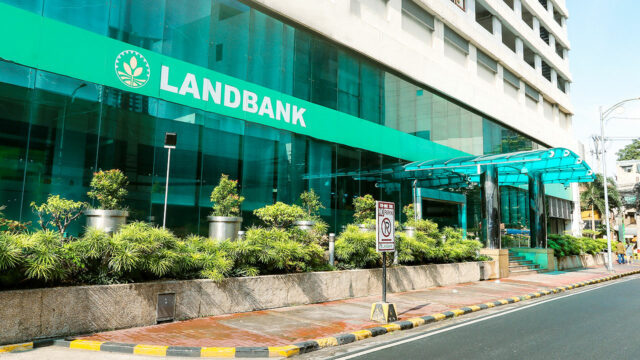
BW FILE PHOTO

STATE-RUN Land Bank of the Philippines (LANDBANK) aims to post steady profits next year, with the lender also having enough safeguards against potential asset quality risks stemming from its transactions with government contractors amid increased scrutiny due to a wide-ranging corruption scandal.

“We expect a stable start to 2026, supported by strong 2025 results,” LANDBANK President and Chief Executive Officer (CEO)Lynette V. Ortiz told BusinessWorld in a text message on Dec. 24.

“We aim to sustain profitability, which we’ve demonstrated through the years while ensuring we continue to have strong risk management controls and capital buffers that can withstand emerging risks.”

Asked about the impact of a possible delay in government contractors’ loan repayments amid a graft scandal involving these entities, Ms. Ortiz said: “We maintain confidence in our loan portfolio’s quality, backed by strong risk controls. However, we are monitoring developments closely and will be proactive in managing risks.”

The bank’s net income surged by 41.79% to P35.64 billion in the nine months ended September from P25.14 billion in the same period last year.   

LANDBANK’s net loans stood at P1.22 trillion, up by 4.87% from P1.16 trillion the previous year. Meanwhile, gross loans reached P1.7 trillion at end-September.

Its loan loss provisions decreased by 46.17% year on year to P7.56 billion in the period.

A wide-ranging scandal linking officials of the Public Works department, lawmakers, and private contractors to corruption in allegedly anomalous flood control projects has resulted in increased scrutiny of state-run banks’ transactions with these entities.

Development Bank of the Philippines President and CEO Michael O. de Jesus said this month that they expect their net income to decline by P1 billion to P2 billion this year due to higher provisioning as the corruption scandal has affected repayments by contractors.

LANDBANK said in September that its handling of government transactions and accounts related to the anomalous infrastructure projects were within Philippine banking laws, adding that the funds it that went through the financial institution were legitimate government disbursements.

Jonathan L. Ravelas, a senior adviser at Reyes Tacandong & Co., said state-run banks could see a slight uptick in their nonperforming loans as the corruption mess is expected to continue stalling government projects and affecting the overall economy, which could affect their lending.

“They’re already setting aside P1-2 billion in provisions, which will trim net income but keep risks contained,” he said.

“The real watchpoint is how fast government spending normalizes — because prolonged delays could tighten lending, especially for MSMEs (micro, small, and medium enterprises).”

Meanwhile, Ms. Ortiz said they are still finalizing their planned sustainability bond issuance, which the bank earlier said could happen by next quarter.

“We are carefully assessing market conditions to ensure timing aligns with investor confidence.”

She earlier said the bank is eyeing to raise over P20 billion from a sustainability bond offering. The papers will be branded as “Asenso bonds” and are expected to have a tenor between one and five years, and could also be issued in multiple tranches. — Aubrey Rose A. Inosante

ADVERTISEMENT
ADVERTISEMENT