Home Blog Page 4926

Brazil’s Lula pledges new minimum wage policy, expanded tax exemption

NATANAELGINTING-FREEPIK

BRASILIA — Brazilian President Luiz Inacio Lula da Silva pledged on Sunday to introduce a new policy of real increases in the minimum wage and announced plans to raise the income tax exemption for lower-income earners.

The remarks, made during a radio and TV broadcast for Labor Day reinforce leftist Lula’s strategy of boosting workers’ disposable income to help spur economic growth.

Mr. Lula said the government would present a bill to Congress to make the annual minimum wage adjustment above inflation a permanent rule.

He also said that the income tax exemption would increase gradually through the end of his term in 2026 for workers earning up to 5,000 reais ($1,003) a month, fulfilling one of his campaign promises.

Currently, workers who earn up to 1,903.98 reais per month do not pay income tax, which has not been updated since 2015, effectively increasing the tax burden on Brazilians with lower wages.

The considerable expansion of the exemption range is viewed as a substantial fiscal challenge since it would entail forfeiting tens of billions of reais.

This could pose difficulties for a government that heavily relies on revenue growth to avoid an increase in the public debt. At present, workers earning above 4,664.68 reais per month are already subject to the highest income tax rate.

In his speech, Mr. Lula officially announced that starting May 1, the income tax exemption will extend to individuals earning up to 2,640 reais per month, and the minimum wage will rise from 1,302 reais to 1,320 reais.

Both measures were widely anticipated by government officials, with the Finance Ministry estimating that the increase in the minimum wage would cost about 5 billion reais this year and the rise in income tax exemption another 3.2 billion reais. — Reuters

French minister expects food price inflation to ease off by September

REUTERS

PARIS — Food price inflation in France — which has been a major concern for consumers — should ease off by September, said government minister Olivia Gregoire on Sunday.

“By the time people come back from their holidays in September, we will have a visible decrease in the prices you see on the shelves and in terms of food price inflation,” Ms. Gregoire, who is a government minister responsible for small-and-medium sized enterprises (SMEs), told France Inter radio.

Ms. Gregoire’s comments echoed those from Bank of France governor and European Central Bank member Francois Villeroy de Galhau, who said earlier this month that he expected food price inflation to start easing in the second half of this year.

Data published on April 28 showed the French economy grew 0.2% in the first quarter, despite strikes against the government’s pension reform bill, but inflation remained stubbornly high.

France’s headline inflation level rose to 5.9% in April from 5.7% in March. The French inflation level stood at 6.9%, as measured by a European Union-harmonized consumer price index. — Reuters

In loving memory of Albert F. del Rosario

PHILIPPINE STAR/KRIZ JOHN ROSALES

On behalf of the Board of Governors and the more than 1,100 members of the Management Association of the Philippines (MAP), I express our sincerest condolences to Gretchen and the entire family of Ambassador Albert F. del Rosario, whom we will greatly miss.

We thank Ambassador del Rosario, who served as MAP President in 2007, for his many contributions to MAP and for introducing many firsts that continue to be nurtured today.

He started the drive to increase and sustain the MAP membership at more than 1,000. Today, we are more than 1,100 and increasing every month. In line with this drive, he initiated a MAP mini-general membership meeting in Cebu in 2007 where he personally inducted about 15 MAP members based in the Visayas. Up to now, we still hold these meetings in Cebu. On May 12, we will hold one and will induct about 20 members.

With a membership base of 1,000, Ambassador del Rosario envisioned MAP to achieve a critical mass to enable a greater exercise of influence and relevance with both the business community and government in the promotion of management excellence. Today, MAP is the organization that Ambassador del Rosario had envisioned.

He also started the weekly MAP Insights column in BusinessWorld every Tuesday.

It was during his term when the “MAP CEO Academy” was institutionalized as the group’s umbrella brand for all management development fora and other learning activities on leadership and management to address the continuing education needs of MAP members and other management practitioners.

He initiated the healthcare coverage of all regular employees of MAP as well as their spouses and children.

MAP conferred the “MAP Management Man of the Year 2014” award on Ambassador del Rosario for raising the standards of economic diplomacy by pursuing an independent and principled foreign policy, and for standing firmly in staunchly defending the Philippine national interest in the global arena.

Ambassador del Rosario has set a leadership example that Filipino professional managers should emulate through his track record of integrity, professional competence and strong leadership in his management career in both public and private sectors.

He will forever be remembered for being a paragon of statesmanship and management excellence for nation-building, and for his overwhelming love of country.

Farewell to an extraordinary leader, an exemplary public servant and a genuine patriot.

We will certainly miss you, Ambassador del Rosario!

(This article was lifted from the eulogy delivered by the author, who is president of MAP, at the MAP-sponsored mass for the late Ambassador Albert F. del Rosario at the Santuario de San Antonio on April 24.)


Benedicta “Dick” Du-Baladad is the founding partner and CEO of Du-Baladad and Associates.

map@map.org.ph

dick.du-baladad@bdblaw.com.ph

Developing life skills through Brazilian jiu-jitsu

EDUARDO DRAPIER-UNSPLASH

“Time’s up!”

Emerging from a contorted position, I got up, smoothened my hair, and fixed my belt that came off. We shook hands, smiled, and mumbled “thank you” while catching our breath. While I lost in that round, I successfully defended a chokehold in the last 30 seconds.

I have been doing Brazilian jiu-jitsu since 2006. It is gradually gaining popularity in a country where basketball is the unofficial national sport. No, it’s not the same as karate; Brazilian jiu-jitsu is a martial art centered on applying chokes and body joint locks (elbow, shoulder, knee, ankle, wrist) to submit to the opponent or to earn points by getting into dominant positions. It is a full-contact sport, with most of the action happening on the ground. But is it all brawl?

On the contrary, this gentle art develops important life skills.

Think of jiu-jitsu as human chess — when you make a move, there will always be a countermove to nullify it. The learning curve can be steep at first, but a good coach will help you clarify your goals so you can focus on moves that build your skills, one step at a time. I had a hard time when I was starting because I had poor body coordination, but my coach guided me well — he gave me many PEP talks after competition loss or when I felt unmotivated. We became good friends, on and off the mats, and he is instrumental to why I am still training, albeit intermittently, 17 years later. In life or at work, we certainly need people who can effectively mentor us so we can maximize our potential, reach our goals and make learning a safe space.

Being on the mat is always a humbling experience. There will always be someone better, stronger or faster. One popular mantra in most Brazilian jiu-jitsu gyms is “leave your ego at the door.” You do not always play to win; sometimes, you play to lose so you can learn. Part of our training is purposely putting ourselves in compromised positions to learn how to get out of it repeatedly, developing our muscle memory. This is the same when we are at work. In developing certain skills, making mistakes helps us learn better because we can scrutinize how and where things went wrong.

In the sport, you are put under pressure, quite literally. Applying submissions requires steady and constant pressure; being in a dominant position requires closing the space through chest-to-chest pressure to control your partner fully. You need to maintain your composure when you are at the receiving end of this. For a new player, this is challenging. It makes you panic, tires you out and leaves you vulnerable to attacks. More seasoned players can control their breathing, adjust their position and wait for opportunities to escape. Maintaining composure helps you clarify your thoughts so you can focus on the task at hand, whether to free yourself or to get through a mountain of tasks at work.

While Brazilian jiu-jitsu is a skill game, it is also a game of strategies. Different players have different techniques, so you need to adjust your game depending on what your partner is doing. Strategizing defines your actions and dictates how the game progresses. Sometimes you get to impose the pace; often, it’s a back-and-forth of moves until a breakthrough happens, and you get to a dominant position or your partner submits. Similarly, we are constantly faced with challenges at work that require us to employ critical thinking to arrive at a sound decision.

The mat is an equalizer. It does not matter if you are a business tycoon, an international celebrity or a working college student. When we are on the mat, we are just a bunch of crazy people passionate about Brazilian jiu-jitsu. When Anthony Bourdain visited the Philippines, I had the chance to share the mat with him. He was then a blue belt. On the mat, he was not a chef or a TV star; he was just a regular guy hanging out with fellows. Nowadays, I train mostly with jiu-jitsu nerds, and we would analyze and criticize our moves so we can polish our game. Anywhere else, building good relationships is crucial to enriching our experiences and advancing our personal development.

Beyond developing technical skills and physical fitness, Brazilian jiu-jitsu is a sport and martial art that enhances mental resilience and life skills. Practiced correctly and with proper guidance, it is a safe sport that people of all ages and sizes can do.


Jonna C. Baquillas is an associate professorial lecturer at the De La Salle University Ramon V. del Rosario College of Business. She is a jiu-jitsu purple belt and trains with Fabricio International Team under Stephen Kamphuis, a multiple-time world champion in Brazilian jiu-jitsu.

jonalyn.baquillas@dlsu.edu.ph

Taxpayers’ burden from uniformed pensions

The pushback against military and uniformed personnel pension reform has come strongly since Finance Secretary Benjamin E. Diokno announced the reforms on March 28. President Ferdinand R. Marcos, Jr. approved the reforms with the concurrence of Defense Secretary Carlito G. Galvez, Jr. and Interior and Local Government Secretary Benhur Abalos.

Under Mr. Diokno’s proposal, the reforms will apply to all active personnel and new entrants. It will remove the automatic indexation of pensions to the salary of active personnel of the same rank. Uniformed personnel will start getting their pensions when they turn 57. Mandatory contributions will be required for active personnel and new entrants, similar to GSIS pensioners.

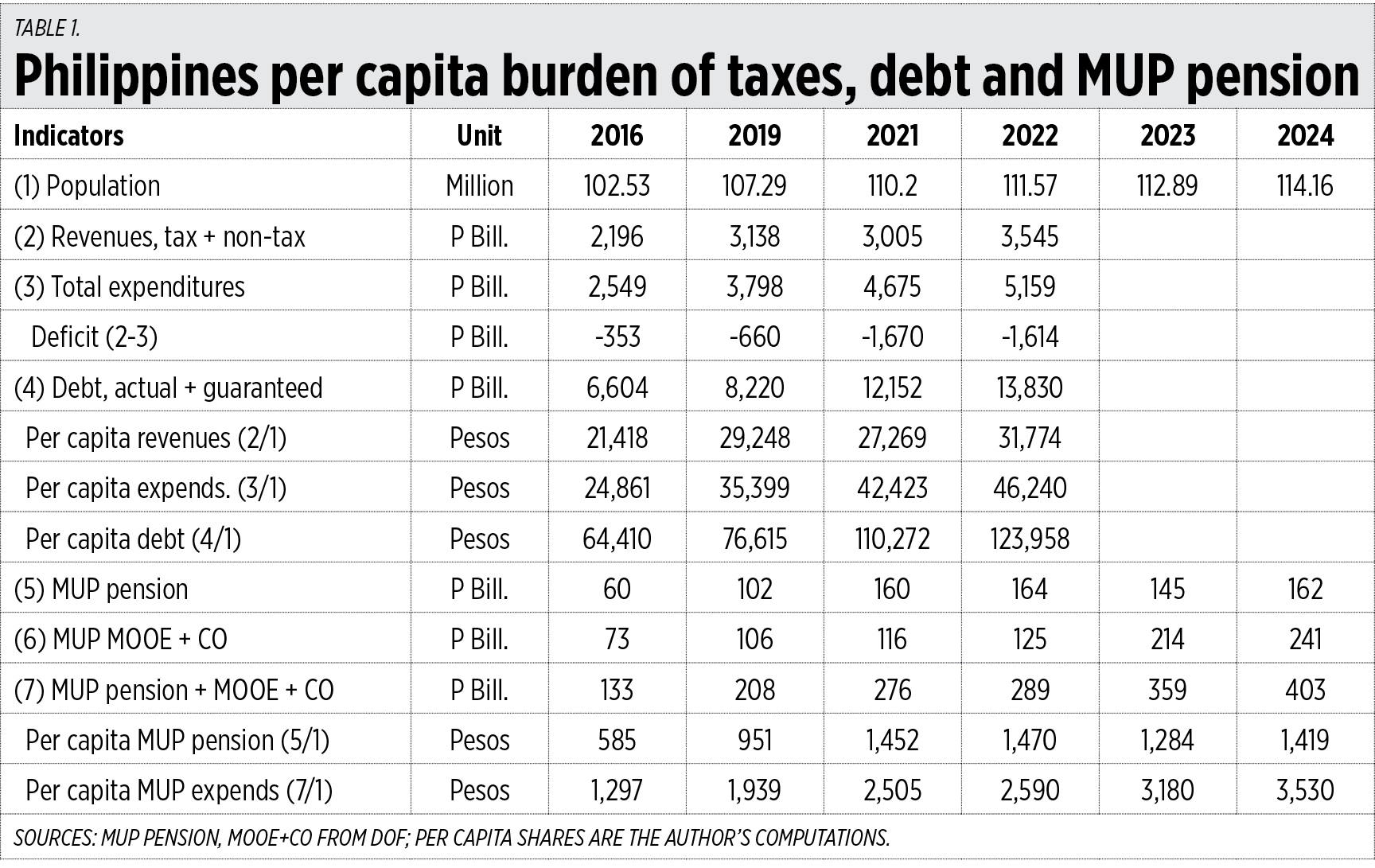
These reforms are necessary to address certain economic distortions. For instance, active personnel contribute zero to their future pensions, the cost of which had reached P160 billion a year and is projected to reach P200+ billion a year by 2023-2024. These pensions are tax-free, indexed to one grade higher, and 75% is passed on to the spouse when the pensioner dies, still tax free. This is even more generous than the US military pension system.

Taxpayers are already burdened with costs such as free education for four years at the Philippine Military Academy and Philippine National Police Academy; high salaries, especially doubling of military pay by former President Rodrigo R. Duterte in 2018; high expenditures for arms, ammunition, trucks, tanks, ships, choppers, planes, training, etc. so that they have superiority over rebels and criminals and their chance of dying is low; and pension upon retirement.

If soldiers and policemen were sent to battle without those heavy equipment in land, sea and air, they are indeed entitled to generous pensions as additional incentive for their service to the country.

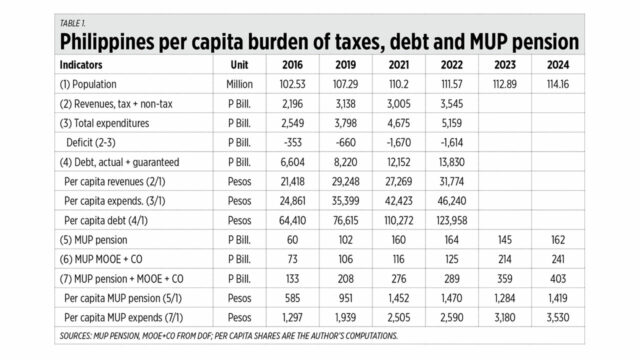
I built this table to have a bigger picture of the fiscal situation. From 2016 to 2022, the tax burden increased from P21,400 to P31,800, while the expenditure burden rose from P24,900 to P46,200. The debt burden increased from P64,400 to P124,000, while the military and police pension burden rose from P585 to P1,470. Their pensions, maintenance and other operating expenditures plus capital outlay burden such as the purchase of new tanks and choppers doubled to P2,600 (Table 1).The fiscal burden on taxpayers keeps rising, not flatlining or decreasing. And the huge military and police pension cost is part of this problem.

So, I ask our soldiers and policemen — active and pensioners — to please do your share. “Serve and protect” the taxpayers too, contribute to the pension fund, end the indexation and support other reforms. Do not limit the “Serve and protect… our taxpayer-funded pension.” Thank you.

Last week, I got data from the DoF on excise tax revenues. Collections from tobacco products are the biggest as the tax rate keeps rising: P35 a pack in 2019, P45 in 2020, P50 in 2021, P55 in 2022, P60 this year and a 5% increase yearly thereafter, or P63 a pack in 2024, P66.15 in 2025 and so on.

Alcohol tax rates are also rising. Sugar-sweetened beverage tax was imposed only in 2018 under the TRAIN law of 2017. Petroleum excise tax is vanishing because all oil players have shifted to imports since 2021, and the small tax collections in 2022 came from the remaining inventory.

One big and noticeable item showed up in the DoF data — revenues from tobacco taxes have declined for the first time, from P179 billion in 2021 to P160 billion in 2022. Then I computed the percent share of tobacco and alcohol, the Budget of Expenditures and Sources of Financing projections in August (or July) of the same year’s share to actual. The DoF has over-projected revenues from tobacco tax — P210 billion versus P160 billion actual, or a ratio of 131% (Table 2).


The big drop in tobacco tax is mainly a result of worsening smuggling and illicit trade in the country. I personally saw cigarettes sold in western Pangasinan early this year at only P40 a pack. These were 100% illicit products because the retail price was lower than the tax at P60 pack, and there were no graphic warnings. And these were openly sold in mom-and-pop stores.

The control of illicit trade, which is economic sabotage, is mainly a function of local governments, DoF agencies and the Philippine National Police and Philippine Coast Guard. They have a huge budget — the police had P190-P192 billion a year in 2021-2023, and the coast guard had P15.4 billion in 2021, P19.3 billion in 2022 and P21.3 billion in 2023.

So this is a case where some uniformed agencies have a huge annual budget, big annual pensions that require higher taxes but are remiss in their function to control smuggling that reduces tax revenues.

Meanwhile, the tax-tax-tax health activists should be happy because their target of reduced smoking is attained. But they may have become unintentional allies of the smugglers, criminals and corrupt enforcers in government because more smokers have shifted to illicit, smuggled tobacco that pay zero tax.


Bienvenido S. Oplas, Jr. is the president of Bienvenido S. Oplas, Jr. Research Consultancy Services, and Minimal Government Thinkers.

minimalgovernment@gmail.com

The oil industry’s unhappy marriage is starting to face facts

JACKSON JOST-J-UNSPLASH

EVEN a marriage heading for its 50th anniversary will sometimes be overcome with bickering.

That’s what happened last week with the oil industry’s most important bodies, the International Energy Agency (IEA) and the Organization of the Petroleum Exporting Countries (OPEC).

OPEC risks weakening the global economy and accelerating the transition away from fossil fuels if its production cuts push crude prices too high, the IEA’s Executive Director Fatih Birol told Bloomberg Television on Wednesday. OPEC’s response was swift and intemperate: The IEA “should be very careful about further undermining oil industry investments,” its Secretary General Haitham Al-Ghais said in a statement on Thursday.

As with many long but unhappy alliances, what’s striking about this row is that the parties share a realistic fatalism about the situation they’re in. The bitterness of last week’s argument doesn’t stem so much from deep disagreements about where oil demand and the energy transition is headed, as from the vanity of small differences.

Both sides have been edging toward an acceptance that oil production will be lower at the end of the decade. Current levels of oil investment will only be sufficient to supply about 80 million barrels a day in 2030, according to projections presented by Saudi Arabian Oil Co., OPEC’s most important stakeholder, compared with the 101.9 mb/d that the IEA projects for this year.

That’s a lowball figure intended to shock the industry into lifting its spending to levels that would pump out about 106 mb/d. But it’s not a million miles from what the IEA sees: Demand will be 93 mb/d if governments meet their climate pledges and 75.3 mb/d on a more aggressive net zero path, according to the agency’s energy outlook last year. In spite of its member states’ record profits and competitive cost positions, OPEC itself is doing very little to remedy the supply problem it points to, preferring to spend the money on real estate, overseas refineries and grand projects instead. Its revealed preference is for a picture little different from the IEA’s energy transition scenarios.

There’s a level of natural antagonism between the two bodies. The IEA was founded in 1974 in the wake of the previous year’s Arab oil embargo to represent the interests of the major petroleum consumers in developed countries. OPEC is 14 years older but rose to prominence at the same time as the IEA, acting for the conflicting interests of the biggest crude exporters. They first held a joint press conference in 2002.

If that adversarial relationship has been blunted for decades, it’s largely because the rise of China and its voracious demand for commodities, combined with the absence (until recently) of any viable alternative to petroleum, meant their common ground of market stability has been more important than their conflicting imperatives of higher prices (for OPEC) and lower ones (for the IEA).

The climate transition is causing a reversion to the earlier paradigm, though. Electric vehicles’ share in new sales jumped from 2% in 2019 to 20% in 2023, the IEA’s Birol said on Wednesday, and will hit 60% in the largest markets of the US, China and Europe by 2030.

That accelerating rate of deployment matters. The lifespan of a conventional oilfield investment is a bit longer than that of a typical car — 15 to 20 years, as opposed to 10 to 15 years — so a faster uptake of electric vehicles increases the risk that current projects end up facing glutted markets toward the end of their lives.

That’s not a problem for the IEA. It’s an energy agency, and its members don’t much care whether their energy comes from fossil fuels or zero-carbon alternatives as long as it’s cheap, clean and secure. OPEC, on the other hand, is a petroleum organization, and naturally sees a shift away from crude as an existential threat.

The IEA wants OPEC to ensure security of supply, so that its members don’t suffer blackouts and queues at the gas station. The oil cartel, on the other hand, is only prepared to promise that if the IEA ensures security of demand, so that its members know their multibillion-dollar investments will still be throwing off cash in the late 2030s. The IEA’s members are unwilling to guarantee that, though. With gasoline demand already in decline, road fuels as a whole facing a near-term peak and Tesla, Inc. slashing prices to tempt buyers, it’s impossible to escape the conclusion that the best years for oil are already in the past.

As the world removes crude oil products from road transportation and even shipping, a growing share of demand will come not from fuel but from petrochemical feedstocks, asphalt, lubricants and waxes — everything except energy, in other words. OPEC is responding as jilted partners often do, with bitterness and recrimination. Both sides have to accept, however, that their marriage of convenience is coming to an end.

BLOOMBERG OPINION

Pope says Vatican involved in secret Ukraine peace mission

The Vatican is involved in a peace mission to try to end the conflict between Russia and Ukraine, Pope Francis said on Sunday, adding that it was also ready to help repatriate Ukrainian children taken to Russia or Russian-occupied land.

“There is a mission in course now but it is not yet public. When it is public, I will reveal it,” the pope told reporters during a flight home after a three-day visit to Hungary.

“I think that peace is always made by opening channels. You can never achieve peace through closure. … This is not easy.”

The pope added that he had spoken about the situation in Ukraine with Hungarian Prime Minister Viktor Orban and with Metropolitan (bishop) Hilarion, a representative of the Russian Orthodox Church in Budapest.

“In these meetings we did not just talk about Little Red Riding Hood. We spoke of all these things. Everyone is interested in the road to peace,” he said.

Since Russia invaded Ukraine in February 2022, Francis has pleaded for peace practically on a weekly basis, and has repeatedly expressed a wish to act as a broker between Kyiv and Moscow. His offer has so far failed to produce any breakthrough.

Pope Francis, 86, has said previously that he wants to visit Kyiv but also Moscow on a peace mission.

Ukraine Prime Minister Denys Shmyhal met the pope at the Vatican on Thursday and said he had discussed a “peace formula” put forward by Ukrainian President Volodymyr Zelenskiy.

Mr. Shmyhal also asked for help in the repatriation of children. Kyiv estimates nearly 19,500 children have been taken to Russia or Russian-occupied Crimea since Moscow invaded in February last year, in what it condemns as illegal deportations.

“The Holy See is willing to do this (help repatriate the children) because it is the right thing,” Pope Francis said on the plane. “All human gestures help but gestures of cruelty don’t help. We have to do all that is humanly possible”.

Pope Francis, who appeared in relatively good condition during the trip, also spoke of his health following his hospitalization in late March for what the Vatican said at the time was bronchitis.

He said he felt a strong pain at the end of his general audience on Wednesday, March 29 and tried to sleep.

“I did not lose consciousness but I had a high fever and at 3pm the doctor took me to the hospital right away,” he said.

“It was a strong and acute pneumonia in the lower section of the lung. Thank God I can talk about it. The body responded well to the treatment, thank God,” he said. He was released on April 1.

A part of one of his lungs was removed when he was a young man in Argentina more than half a century ago.

The pope said there were no changes to plans to go to Lisbon in August for an international youth gathering and then separately to Marseilles and Mongolia. – Reuters

PNC, JPM, Citizens among final bidders in First Republic auction -sources

REUTERS/David 'Dee' Delgado

 – PNC Financial Services Group, JPMorgan Chase & Co. and Citizens Financial Group Inc. were among banks that submitted final bids for First Republic Bank on Sunday in an auction being run by US regulators, sources familiar with the matter said.

The Federal Deposit Insurance Corp had been expected to announce a deal on Sunday night, with the regulator likely to say at the same time that it had seized the lender, three sources previously told Reuters.

As the process dragged into Sunday evening, one source familiar with the situation said the regulators had come back multiple times with requests for bids to be revised and specific criteria to be refined on assets that were being bid. That source said there was a sense a decision was nearing.

US regulators have been trying to clinch a sale of First Republic over the weekend, with roughly half a dozen banks bidding, sources said on Saturday, in what is likely to be the third major US bank to fail in two months. Guggenheim Securities is advising the FDIC, two sources familiar with the matter said on Saturday.

FDIC was not immediately available for comment. Guggenheim, FRC and the banks declined to comment.

A deal for First Republic would come less than two months after Silicon Valley Bank and Signature Bank failed amid a deposit flight from U.S. lenders, forcing the Federal Reserve to step in with emergency measures to stabilize markets.

While markets have since calmed, a deal for First Republic would be closely watched for the amount of support the government needs to provide.

The FDIC officially insures deposits up to $250,000. But fearing further bank runs, regulators took the exceptional step of insuring all deposits at both Silicon Valley Bank and Signature.

It remains to be seen whether regulators would have to do so at First Republic as well. They would need approval by the Treasury secretary, the president and super-majorities of the boards of the Federal Reserve and the FDIC.

In trying to find a buyer before closing the bank, the FDIC is turning to some of the largest US lenders. Large banks had been encouraged to bid for FRC’s assets, one of the sources said.

JPMorgan holds more than 10% of the nation’s total bank deposits. Federal law prevents a large bank from an acquisition that would put it above a threshold of 10% of total deposits, but that could be waived by banking regulators in the event it was buying a failed bank, according to text of the 1994 law and interpretation of the document by a source who is expert on bank failures.


STUNNING FALL

First Republic was founded in 1985 by James “Jim” Herbert, son of a community banker in Ohio. Merrill Lynch acquired the bank in 2007, but it was listed in the stock market again in 2010 after being sold by Merrill’s new owner, Bank of America Corp BAC.N, following the 2008 financial crisis.

For years, First Republic lured high-net-worth customers with preferential rates on mortgages and loans. This strategy made it more vulnerable than regional lenders with less-affluent customers. The bank had a high level of uninsured deposits, amounting to 68% of deposits.

The San Francisco-based lender saw more than $100 billion in deposits fleeing in the first quarter, leaving it scrambling to raise money.

Despite an initial $30 billion lifeline from 11 Wall Street banks in March, the efforts proved futile, in part because buyers balked at the prospect of having to realize large losses on its loan book.

A source familiar with the situation told Reuters on Friday that the FDIC decided the lender’s position had deteriorated and there was no more time to pursue a rescue through the private sector.

By Friday, First Republic‘s market value had hit a low of $557 million, down from its peak of $40 billion in November 2021.

Shares of some other regional banks also fell on Friday, as it became clear that First Republic was headed for an FDIC receivership, with PacWest Bancorp down 2% after the bell and Western Alliance down 0.7%. – Reuters

Subway comes up with $5 billion debt plan to clinch $10 billion-plus sale -sources

Subway Logo

 – The bankers running the sale process for Subway have given the private equity firms vying for the sandwich chain a $5 billion acquisition financing plan, hoping to overcome a challenging environment for leveraged buyouts and fetch the company’s asking price of more than $10 billion, people familiar with the matter said.

Interest rates have been rising and concerns about an economic slowdown have increased since Subway said in February it was exploring a sale, making debt more expensive and less available for buyout firms pursuing deals. This is weighing on how much the private equity firms are offering to buy companies.

So far, bids for Subway have ranged between $8.5 billion and $10 billion, one of the sources said. Subway‘s financial adviser, JPMorgan Chase & Co., is now hoping a $5 billion debt financing package it has put forward will show buyout firms they can borrow enough to structure an attractive deal even at a $10 billionplus valuation, the sources said.

The debt financing is based on a mix of loans and bonds and its size is equivalent to 6.75 times Subway‘s 12-month earnings before interest, taxes, depreciation and amortization of about $750 million, the sources added.

It is possible that this financing will serve only as a temporary solution. This is because a cheaper option for a private-equity buyer of Subway would likely be to finance the acquisition long-term through a so-called whole business securitization (WBS), the sources said. This would involve borrowing using the royalties of restaurant franchises as collateral.

WBS financing requires store-by-store due diligence by ratings agencies which can take more than a year. Bidders would have to rely on JPMorgan’s debt package or arrange their own financing to clinch a deal with Subway, and then refinance through a WBS scheme down the line, the sources said.

Barclays Plc, a major player in the market for WBS financing, is one of the banks in discussions about long-term financing, the sources said.

Milford, Connecticut-based Subway has been revamping its operations to deal with outdated decor and $5 deals on foot-long sandwiches that eroded franchisees’ profits. In 2021, the chain launched a menu overhaul and splashy marketing campaign as it embarked on a turnaround plan that has helped sales grow.

JPMorgan’s financing package also offers the option of a preferred equity component with a roughly 15% interest rate, the sources said. This is a more expensive route that private equity firms may not opt for, three of the sources added.

To be sure, Subway is allowing bidders to use any financing route they want, as long as they can show they can secure committed financing.

Second-round bids for Subway came in last week from more than 10 private-equity firms, one of the sources said, adding that Subway has dropped low bids and is whittling down the pool of final bidders. Bain Capital, TPG Inc., Advent International Corp, TDR Capital, Goldman Sachs Group Inc’s buyout arm and Roark Capital are among the private-equity firms that are participating in the auction, according to the sources.

Subway will soon allow bidders to team up before submitting final offers, and Bain, TPG and Advent have already been in discussions about doing so, the sources added.

The sources requested anonymity because details of the sale process are confidential. Bain, TPG and Advent declined to comment. TDR and Roark did not immediately respond to comment requests. Subway, JPMorgan, Goldman Sachs and Barclays declined to comment.


RESTAURANT RENOVATIONS

Founded in 1965 by 17-year-old Fred DeLuca and family friend Peter Buck, the company has been owned by the founding families since its first restaurant opened as “Pete’s Super Submarines” in Bridgeport, Connecticut.

The chain, which has nearly 37,000 locations globally, is moving away from its traditional reliance on franchisees who own only one or two locations and is instead consolidating locations with fewer and larger, well-capitalized franchisees.

Subway reported earlier this month that global comparable sales were 12.1% higher in the first quarter and that guest visits rose, driven in part by restaurant renovations. It has been facing growing competition from rivals such as Jimmy John’s, Firehouse Subs QSR.TO, Jersey Mike’s Subs and Potbelly Corp PBPB.O.

TPG and Bain were part of a group that owned Burger King when John Chidsey, who is now Subway‘s CEO, headed that burger fast-food restaurant chain. Advent, for its part, has invested in restaurants including Bojangles and café operator First Watch. TDR operates grocery retailer ASDA and gas station conglomerate EG Group. – Reuters

Drone seeding and E-seeds sound exciting, but ecosystem restoration needs practical solutions

STOCK PHOTO | Image by DJI-Agras from Pixabay

SOURCE: THE CONVERSATION

A drone drops a small wooden projectile with three spiral tails and a seed mounted on the tip. It gently lands on the bare ground and sits there, exposed to the elements, until it rains. Then, the moisture penetrates the wood fibers, and the spiral tails start twisting, slowly pushing the seed into the ground, where it will germinate.

The design of this incredible depth-seeking seed carrier, recently published in Nature, was inspired by the self-burying mechanism of a few grass species, such as those of the genus Erodium.

According to the authors, these seed carriers, also known as E-seeds, can be built in various sizes for different species and dropped by airplanes or drones to restore degraded ecosystems.

This bio-inspired engineering marvel has received a vast and well-deserved share of attention and praise.

But, from a restoration practitioner’s point of view, it has logistical issues that can greatly limit its application at scale.

E-seeds are the latest of many technologies presented as restoration “game-changers”.

Numerous private companies have entered the market with revolutionary devices (mostly drones), claiming to restore ecosystems by planting billions of trees. Yet, to date, there is little evidence of their efficacy.

This fascination with shiny technological gadgets might divert scarce resources from practical, on-the-ground solutions that will seriously affect our ability to restore degraded ecosystems globally.

A vast portion of the world’s ecosystem has been damaged or destroyed due to human activities. Global initiatives, such as the UN Decade for Ecosystem Restoration and the Bonn Challenge, promote international cooperation to restore 350 million hectares by 2030.

For decades, scientists and practitioners have been working on solutions to support and accelerate the recovery of degraded ecosystems.

Often, the first step for initiating the natural recovery of terrestrial ecosystems is to establish native vegetation. Tree planting is a common approach, but it can be expensive on a large scale. Direct seeding is faster and cheaper, but also riskier.

For a start, seeds need to reach the right place in the soil to germinate and grow.

If seeds are scattered (seed broadcasting) on the soil surface by hand, tractor or drone, they can be blown off by the wind or eaten by animals. Even if they germinate, the seedling can dry up and die. As a result, most seeds will not become a plant.

This is why seed penetration in the soil is the key to improving a seed’s chance of success. Generally, the bigger a seed is, the deeper it can go. This is often achieved using precision seeders, similar to those used in agriculture. These machines open up the soil, deposit the seed at a precise depth, and cover it. The E-seed can achieve a similar result, ideally making seed broadcasting as effective as precision seeding.

Unfortunately, this approach presents two problems: scalability and logistics. First, it’s unlikely that the multi-step process needed to manufacture E-seeds can be scaled to the many billions of seeds across thousands of species we need to restore entire ecosystems.

Second, the tails of the E-seeds could easily get tangled with each other, either clogging the seed delivery mechanism or being released in clumps. The authors solved this problem by dividing the seeding box into compartments containing a single E-seed. This stopped the seed from clumping but greatly reduced the number of seeds that could be delivered on each drone flight.

This clumping seeds issue is also common when dealing with native species, such as the grasses that inspired the design of the E-seed. A simpler, less technological solution currently used in restoration is to actually remove the tails.

This reduces the seed volume for storage and delivery, and improves the seed flow through seeding equipment. In some cases, the removal of appendages could also improve seed germination.

Such approaches are not as spectacular as E-seeds dropped from drones. Still, in most scenarios, they are the most cost-effective way to reintroduce native vegetation to a degraded site at scale.

Ecological restoration is an incredibly complex activity that goes beyond vegetation establishment.

It must consider the complex and dynamic interactions of organisms and their environment, while accounting for social and economic implications for local communities. Therefore, we must approach ecosystem restoration holistically and not get carried away by the lure of shiny technologies.

Funders with limited appreciation of restoration’s ecological and practical complexities are keen to embrace and invest in charismatic, yet often unproven technologies.

For example, a start-up focused on drone seeding raised a A$200 million investment, double the amount the Australian federal government has dedicated to the environmental restoration fund over four years. But science is yet to demonstrate if drone seeding can work at scale to rebuild Australia’s degraded landscapes and ecosystems.

We should welcome any attempt to improve the success of ecological restoration, and promote the implementation of novel technologies.

But new technologies must prove their worth and practicality. We should focus on the most effective ways to restore native ecosystems, not the most flamboyant. – Reuters

Power outage cancels flights at Manila’s international airport

PHILSTAR FILE PHOTO

The international airport at the Philippines’ capital Manila experienced a power outage on Monday in one of its terminals which led to about forty flights being canceled, the airport said.

“Flight delays are expected due to the outage“, the Ninoy Aquino International Airport said in a statement posted on Facebook. – Reuters

Filipino talent as the pillar of economic growth

It does not take an expert to see how important Filipino talent is to the nation’s economy. Remittances from overseas Filipino workers make up a significant share of the country’s gross domestic product, as much as 8.9%, or around $36.14 billion sent home from abroad, in 2022.

The Philippines has also become one of the world’s leading destinations for offshore business process outsourcing firms due to the country’s young, technically skilled, and English-proficient population.

This is why in a report published by the World Bank research on employment last March, the international organization urged the Philippines to create more and better opportunities for young people in order to restore the robust labor market it enjoyed before the coronavirus disease 2019 (COVID-19) pandemic and bolster economic recovery and long-term growth.

The report, titled The Philippine Jobs Report: Shaping a Better Future for the Filipino Workforce, found that before the pandemic, the country’s economy grew at an annual pace of above 6% on average, and that faster growth in higher-paying occupations and higher real wage growth both contributed to a decrease in poverty in the Philippines.

Some of this progress had been put to a halt in 2020, however, as high-productivity jobs were abandoned and low-paying ones were filled as a result of the pandemic. The research found that indicators of employment have seemingly recovered to their pre-pandemic levels along with the economy’s rapid recovery, but the quality of available jobs continues to be a cause for concern, especially among the young.

“The youth group was disproportionately affected by the pandemic shock on the labor market, and the scarring effect may stay long after the economic activities return,” said Ndiamé Diop, World Bank’s country director for Brunei, Malaysia, Thailand, and the Philippines.

“While conducive business environment policies will encourage quality job creation in the private sector, more targeted approaches to address youth challenges are urgently needed,” he added.

Before the pandemic, the working poverty rate was already higher among the country’s youth (ages 15-24), with over 60% of them not participating in the labor force. Despite a return to pre-pandemic levels across the board in the labor market in 2022, young employment remained dismal.

Investment in skills in growing green and digital sectors, as well as reforming labor legislation, are all mentioned as possible means to increase youth employment in the research.

“Active labor market programs including measures like skills training, job search assistance, wage subsidies, public works programs, and entrepreneurship promotion should be further strengthened,” said Yoonyoung Cho, senior economist at World Bank’s Social Protection and Jobs Global Practice.

“These can be complemented by modernizing labor regulations through simplifying labor rules and providing guidance on flexible forms of work arrangement; expanding social insurance; and modernizing inspection and compliance verification systems through digital tools.”

For their part, the National Economic and Development Authority (NEDA) says that the government will continue its efforts to improve working conditions and encourage the creation of good jobs moving forward.

Recent numbers

The Philippine Statistics Authority recently reported that the number of employed Filipinos rose to 48.8 million in February 2023, an increase of 3.32 million over the 45.48 million figure reported in the same month in 2022.

The unemployment rate in the country has also dropped, from 6.4% in February 2022 to 4.8% currently.

“The most recent data on the country’s workforce suggests that the Philippine labor market is steadily recovering. The lifting of various restrictions that previously impeded employment opportunities has resulted in an increase in job prospects for Filipino workers,” NEDA Secretary Arsenio M. Balisacan said.

More encouragingly, the young unemployment rate, which covers people aged 15 to 24, has dropped dramatically, from 14.2% in February 2022 to 9.1% this year.

The labor force participation rate in the country increased from the previous year’s February (63.8%) to the current year’s February (66.6%). An additional 2.7 million Filipinos, including an additional 1.9 million women, have entered the labor field in the past year. There were large upticks in both the number of people who had completed at least until the eighth grade (+1.1 million) and the number of people who had completed high school (+1.6 million).

Improving the job market

Mr. Balisacan noted that although the labor market may be doing better, but there are still obstacles to enhancing the quality of jobs in all fields. Policy makers should keep making it easier for businesses to create high-quality jobs (on the demand side) and easier for employees to acquire new skills (on the supply side).

“On the demand side, the strategy to create high-quality job opportunities begins with attracting more investments especially in infrastructure and in improving the regulatory environment. These interventions will improve the competitiveness of the entire economy and result in greater investor interest in other industries. Our participation in the Regional Comprehensive Economic Partnership and the amendments to the Public Service Act pave the way for more high-paying job opportunities being made available to Filipinos,” Mr. Balisacan said.

“NEDA has recently published the Implementing Rules and Regulations of the amended Public Service Act. The next step is for the regulatory agencies to revise their regulatory processes accordingly,” he added.

In addition, he promised that the government will do more to inform workers of available resources for professional development.

Micro-credentialing, ladderized programs, and three-year diploma programs are all available now through the Technical Education and Skills Development Authority (TESDA).

Meanwhile, the Department of Information and Communications Technology (DICT) has formed alliances with a number of IT and Business Process Management (IT-BPM) firms with the aim of improving the skills of the workforce to meet the demands of the IT sector.

“On the supply side, there is a need to improve the dissemination of information and awareness campaigns to encourage workers to utilize the existing resources for upskilling and retooling,” said Mr. Balisacan.

“As we continue thriving towards a fully operational economy, the DoLE (Department of Labor and Employment) further intensifies its efforts to constantly initiate convergence with public and private stakeholders in enhancing access to labor market information, and improving service delivery, especially for programs that benefit the youth and other vulnerable sectors. Hence, we are rolling out our consultations for the finalization of the National Labor and Employment Plan,” DoLE Secretary Bienvenido E. Laguesma said in a statement in January.

“With the current and emerging challenges in the labor market, the government, in keeping with the Philippine Development Plan 2023-2028, is committed to strengthen its efforts to raise the quality of human resources and ensure that the current and future workforce can adapt to the changing demands of the labor market.”

“These efforts shall achieve our desired outcomes in terms of employment and mobility, and better respond to economic opportunities, which includes prioritization of upskilling and reskilling of the workforce to equip them with higher competencies by expanding lifelong learning opportunities,” he added. — Bjorn Biel M. Beltran


ADVERTISEMENT
ADVERTISEMENT