Home Blog Page 4919

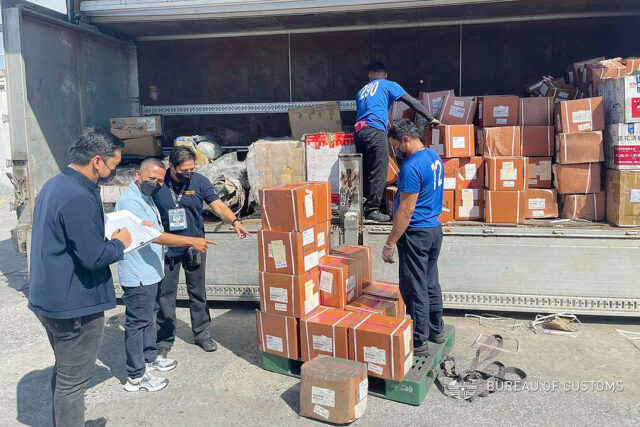
SRA considering supermarket sales of smuggled sugar

BUREAU OF CUSTOMS FACEBOOK PAGE

THE Sugar Regulatory Administration (SRA) said on Tuesday that low-priced sugar sold at government-supported Kadiwa stores, including shipments seized from smugglers, could be distributed to supermarkets to broaden access to the commodity.

“As we continue to apprehend more smuggled sugar, this will grow. We need to grow the selling side and the distribution network of Kadiwa,” SRA Acting Administrator and Chief Executive Officer Pablo Luis S. Azcona told reporters via Zoom.

The Palace has approved the donation of smuggled sugar seized by the Bureau of Customs to the Department of Agriculture (DA) for sale at Kadiwa stores.

According to Mr. Azcona, major supermarket chains have offered space for Kadiwa goods, broadening their distribution.

Mr. Azcona has said that seized sugar may be sold at P70 per kilogram.

“Our first priority is really the wet markets, then supermarkets and the big chains (will come) after that. We will first satisfy the needs of markets and LGUs (local government units),” he said.

Mr. Azcona said that about 181,500 metric tons (MT) of refined sugar have landed in the Philippines. These shipments form part of 440,000 MT authorized for import by Sugar Order No. 6. 

At least 116,350 MT have been reclassified and earmarked for release onto the markets.

“We’re trying our best to follow the directives to lower the retail price, so we’re converting the imported sugar to domestic as fast as we can, as fast as the importer’s logistics and our inspectors will allow,” he said.

In a statement, National Federation of Sugar Workers Chairperson John Milton Lozande called for continued Senate investigations into what he called “government-sponsored smuggling.”

He cited the “bloated prices” of refined sugar in supermarkets, which he estimated at P136 per kilo despite “recent floods of imports.”

Mr. Azcona said that the farmgate price of raw sugar has been stable at P60 for the last two or three months while supply has improved compared to last year.

“Only the profit margin of wholesalers, retailers, or traders increases, while that of farmers decreases,” he said.

“That’s the part we want to fix as well with the DA, hoping that it won’t be like that because if retail prices are too high, government regulation and price control will kick in, which could lower the farmgate price,” he added.

Mr. Azcona said consultations have concluded and the DA will announce a suggested retail price for refined sugar.

According to DA price monitors, the prevailing market price of refined sugar in Metro Manila as of Tuesday was between P86 and P110, washed sugar P80-P95, and brown sugar P35-P95. — Sheldeen Joy Talavera

IMI electric motorcycle deal expected to add momentum to PHL EV manufacturing

THE deal signed by Ayala-controlled Integrated Micro-Electronics, Inc. (IMI) and Zero Motorcycles has the potential to boost the Philippines’ status as an electric vehicle (EV) manufacturing hub, the Department of Trade and Industry (DTI) said.

Zero Motorcycles, a California company, and IMI signed their agreement in the US on May 1, which covers the production of electric motorcycles and battery and motor assemblies. The signing was carried out during an official visit by President Ferdinand R. Marcos, Jr. to the US.  

“With this investment, we will be better positioned as an export manufacturing hub for electric batteries and vehicles in the region. This partnership… is a testament to the expertise and capabilities of our manufacturing sector,” Trade Secretary Alfredo E. Pascual said in a statement on Tuesday.

“We thank Zero Motorcycles for their trust. This is considered a historic agreement because it is a pioneering activity involving high-end electric batteries, motors and motorcycle assembly,” he added.

Under the agreement, Zero Motorcycles will subcontract its production operations and electric motorcycle and battery and motor assembly to IMI. The project is expected to generate $65 million in annual revenue and $250 million worth of investment over the next five years. The partnership is also expected to result in the creation of at least 200 new jobs.

IMI and Zero Motorcycles are expected to begin mass production by June 2023 at an assembly facility in Laguna for export to Europe, Asia, and other markets.

“IMI is expected to provide the needed manufacturing facility in the Philippines. Currently, IMI’s headquarters is located in Biñan, Laguna, where they operate as an original equipment manufacturer (OEM) facility in (industries like) automotive, industrial, medical, telecommunications infrastructure, storage devices, and consumer electronics,” the DTI said.

The DTI said it aims to reduce the cost gap between internal combustion engine vehicles and EVs to grow the market following the passage of Republic Act No. 11697 or the EV Industry Development Act.

“The law provides for the creation of the Electric Vehicle Incentive Strategy (EVIS) that will provide more incentives for EV-related investment to help establish an enabling environment for the sector,” the DTI said.

In a disclosure to the stock exchange, IMI said it narrowed its attributable net loss to $749,000 in the first quarter, compared to a loss of $1.97 million a year earlier.

The company posted a 4% increase in revenue to $346.83 million in the first quarter on the back of rising prices.

“We will be launching the production of multiple EV-related projects over the next two years and we continue to look for opportunities to secure market share in the EV space through our robust sales pipeline. We believe that our partnership with Zero Motorcycles, a market leader in electric motorcycles based in California, will solidify our position as a partner of choice in this emerging technology,” IMI President Jerome S. Tan said.

The EV Association of the Philippines (EVAP) said in a statement on Tuesday that it supports zero tariffs on electric motorcycles, but not e-jeeps and e-trikes, which have local manufacturers and assemblers.

EVAP President Edmund A. Araga clarified that the group supports the removal of tariffs for e-motorcycles as it would make EVs more affordable, as well as help lower greenhouse gas emissions.

The group added that zero tariffs on e-motorcycles would create a more sustainable transportation system.

The EVAP clarified its position following a statement from Mr. Pascual on April 24 that the EVAP and the Motorcycle Development Program Participants Association had sought the omission of e-jeepneys, e-tricycles, and e-motorcycles from the zero-tariff rules.

Under Executive Order (EO) No. 12 signed by Mr. Marcos in January, tariffs for certain EVs were reduced to zero for five years.

The EO covers cars, buses, vans, trucks, kick scooters, self-balancing cycles, bicycles, and pocket motorcycles with power not exceeding 250 watts and with a maximum speed of 25 kilometers per hour. Product lines excluded from the EO such as electric motorcycles are still subject to the 30% tariff rate. — Revin Mikhael D. Ochave

AmCham bats for US FTA with narrower scope

REUTERS

THE American Chamber of Commerce of the Philippines, Inc. (AmCham) said any prospective free trade agreement (FTA) between the Philippines and the US needs to be narrower in scope and tailored to both countries’ needs.

It said a less ambitious FTA compared to typical trade deals will keep the momentum for free trade going as President Ferdinand R. Marcos, Jr. visits the US, and after the US Trade Representative recently downplayed the prospects for an FTA.

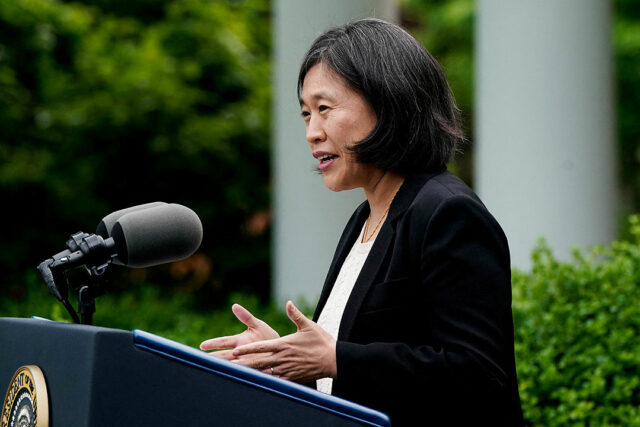
“AmCham Philippines continues to lobby for an FTA between the two countries in spite of the recent comments by US Trade Representative Katherine Tai here in the Philippines,” AmCham Executive Director Ebb Hinchliffe told BusinessWorld via Viber.  

“An FTA that is specific to a win-win for both countries. Shorter and more specific than that of the usual wide-range FTA agenda,” he added.

Mr. Hinchliffe said AmCham hopes FTA talks will move forward during the US visit of Mr. Marcos, which runs until May 4.

Last month, Ms. Tai said in Manila that a bilateral FTA between the Philippines and the US is not currently in the pipeline for the Biden administration.

“In terms of a more traditional FTA, we are not currently negotiating any such agreements with our trading partners because we do not see that traditional program being appropriate for the types of challenges and opportunities that we are facing right now,” Ms. Tai said.  

“When I talk about a traditional FTA, it is not whether it is bilateral or with more countries. It’s really what is inside the FTA. They always are working to create incentives for economic participants to maximize efficiency. So this is part of the incentive structure that has created the kind of vulnerabilities that we see in supply chains today. That is an important reason why we are not doing the traditional FTA,” she added.  

The Department of Trade and Industry (DTI) has said that a prospective FTA will help assure market access for the two countries’ exporters.

Mr. Hinchliffe said AmCham also supports an agreement on minerals with the US to improve the environment for incoming investment.

The Philippines has been touted as one of the most mineral-rich countries in the world.

“We also hope that they discuss a minerals agreement similar to the one that China and Japan have with the Philippines,” he said, adding that also on the wish list is increased involvement by specific manufacturing industries like pharmaceuticals or agricultural products.

“Another would be renewable energy and energy storage,” Mr. Hinchliffe said.

“It is excellent that the two leaders are meeting again. The fact they have met twice in less than a year shows the importance of our relationship with each other,” he added.

In January, the US Ambassador to the Philippines MaryKay Carlson said that bilateral trade between the two countries could have exceeded $33 billion in 2022, with over $21 billion consisting of Philippine exports to the US. — Revin Mikhael D. Ochave

SSS implements service fees for in-person, online transactions

BW FILE PHOTO

THE Social Security System (SSS) said it started collecting service fees on Monday for both over-the-counter (OTC) and online transactions.

According to a circular dated April 26, the SSS said it now charges a maximum of P10 for every OTC transaction and P8 for online transactions.

The charges exclude fees for payments made via credit, debit, and prepaid cards, which charge market-based rates.

SSS said that the fees apply to self-employed and voluntary members, employed members, overseas Filipino workers, farmers and fishermen, non-working spouses, and transactions involving the workers investment and savings program.

The circular was approved by SSS President and Chief Executive Officer Rolando L. Macasaet under Resolution No. 140-s. 2023 dated March 29. — Aaron Michael C. Sy

PHL GDP growth estimated at 4.8% in Q1 on slowdown in consumption

STOCK PHOTO | Image Dmitry Berdnyk from Unsplash

GROSS domestic product (GDP) growth is estimated to have slowed to 4.8% in the first quarter as private consumption eased, Pantheon Macroeconomics said on Tuesday.

“Our current GDP forecast for the first quarter sees a sharp slowdown in growth, to 4.8% from 7.2% in the fourth quarter, with a moderation in consumption growth accounting for 70% of this drop,” Pantheon Macroeconomics Chief Emerging Asia Economist Miguel Chanco and Senior Asia Economist Moorthy Krshnan said in a report.

The 4.8% estimate is well behind the pace of the government’s growth target of 6-7% for this year, and represents a significant drop from the 7.6% expansion in 2022.

Pantheon also noted that the percentage of households with savings in the Philippines made “little visible progress” in the first quarter.

According to the central bank’s consumer expectations survey, the percentage of households with savings rose to 32.9% in the first quarter from 30.5% in the fourth quarter.

“But this appears mainly to have been a seasonal rise, prone to an immediate reversal. Indeed, the share was unchanged at 31.3% in Q1 on our adjustment, still well below the pre-pandemic peak of 39% in mid-2019,” Pantheon Macroeconomics said.

“Persistently strong private consumption growth at the 8%-plus average rates seen last year is unsustainable with household balance sheets still this fragile. And we’re already starting to see a clear evaporation in momentum,” it added.  

Domestic consumption growth rose 7% in the fourth quarter, bringing full-year household consumption growth to 8.3%. 

Consumers were less pessimistic in the first quarter, the central bank has said, as reflected in the 10.4% decline in the consumer confidence index in the first three months, as against the 14.6% drop in the previous quarter.

The erosion of consumer confidence was, however, in its 11th consecutive quarter, following the 54.5% drop in the third quarter of 2020.

The Philippine Statistics Authority is scheduled to release first-quarter GDP data on May 11. — Keisha B. Ta-asan

April inflation poised for third straight decline — DBS

CONSUMER price inflation in April is estimated to have slowed for a third straight month due to base effects, easing food and energy prices, and aggressive monetary tightening by the central bank, DBS Bank Ltd. said.

In a May 2 report, DBS Bank Chief Economist Taimur Baig and Senior Economist Ma Tieying said inflation will likely slow to 6.8% year on year in April, lower than the 7.6% in March.

“Factors behind the year-on-year deceleration include continued feed-through of favorable base effects, alongside easing of global commodity prices and spill-over to food and energy inflation, and the impact from the aggressive monetary tightening over the past year,” it said.

The bank’s inflation estimate for April is lower than the 7% median estimate of 14 analysts in a BusinessWorld poll last week.

It is also within the 6.3-7.1% forecast range issued by the Bangko Sentral ng Pilipinas (BSP) for the month.

The inflation rate in April 2022 was 4.9%.

If the April 2023 reading comes in as projected, it would mark the 13th consecutive month of inflation exceeding the BSP’s 2-4% target range.  

To tame inflation, the BSP raised borrowing costs by 425 basis points (bps) since May 2022, bringing the key policy rate to 6.25%, its highest level in nearly 16 years.

BSP Governor Felipe M. Medalla has said that the Monetary Board will consider keeping policy rates at 6.25% at its meeting this month if inflation further slows in April.

“Our view for a higher terminal rate, therefore, faces downside risk,” the bank said.

DBS expects Philippine benchmark interest rates to peak at 6.75% this year, suggesting that they have a further 50 bps to rise.

It also expects the BSP to cut the key policy rate to 5.75% in third quarter next year and further to 5.25% in the fourth quarter of 2024.

“We will also be closely watching the month-on-month print, given (Mr.) Medalla’s April 10 comments that a ‘zero or negative (month-on-month) inflation’ may also support the case for a rate pause,” the bank said.

DBS Bank projects inflation to average 5.8% this year, before easing to 3.2% in 2024.

The 2023 projection is lower than the BSP’s full-year inflation forecast of 6%, while the estimate for 2024 is higher than the central bank’s 2.9%. 

Mr. Medalla has said inflation will return to the 2-4% target range by the fourth quarter.

The April inflation report will be released on May 5. The Monetary Board is scheduled to meet for the third time this year on May 18. — Keisha B. Ta-asan

PEZA touts PHL return to US GSP status as supportive of recovery

THE Philippine Economic Zone Authority (PEZA) said the reauthorization of the Philippines’ participation in a US preferential trading scheme will add impetus to the economic recovery.

“We are hoping that the (President’s US) visit will reopen talks on the US Generalized System of Preference (GSP) program and the implementation of the US Indo-Pacific Economic Framework for Prosperity (IPEF), which should benefit the Philippine economy in general and put us (in line) with other allied and forward thinking economies joining the multilateral economic cooperation,” PEZA Director General Tereso O. Panga told reporters via Viber.

President Ferdinand R. Marcos, Jr. is currently in the US for an official visit until May 4.

The Philippines has been pushing for the renewal of its GSP eligibility, which expired in 2020. The GSP allows the duty-free entry of selected Philippine products into the US.

The top Philippine exports under the GSP included handbags, insulated electric conductors, new pneumatic rubber tires, and nonalcoholic beverages. In 2020, the Philippines posted a 74% GSP utilization rate, with exports valued at $1.56 billion.

Participants in the IPEF, launched in May 2022, include Australia, Brunei, Fiji, India, Indonesia, Japan, South Korea, Malaysia, New Zealand, the Philippines, Singapore, Thailand, and Vietnam.

Aside from the GSP and IPEF, Mr. Panga said the Philippines is a possible location for US companies seeking to diversify their manufacturing locations.

“While President Biden’s policy is to reshore all manufacturing activities for American companies, we hope that the much improved bilateral relations with US will allow the Philippines to benefit from that policy, making the country an alternative location for US companies to offshore manufacturing activities,” Mr. Panga said.

“The Philippines could be a viable site for US-based companies or shifting out production from their existing locations to take advantage of the country’s growing domestic market, huge pool of world-class and quality-oriented workers, and as a production and distribution hub in the region,” he added.

According to Mr. Panga, some of the industries that US investors should consider include manufacturing, electric vehicles, renewable energy, mineral processing, regenerative agriculture, and frontier technologies like digital health, financial technology, the blockchain, artificial intelligence, and big data.

“The government is serious in attracting productivity-enhancing investments and strategic industries including infrastructure development through business-to-business engagements and public-private partnerships,” Mr. Panga said. — Revin Mikhael D. Ochave

Industry lobby estimates VAT revenue foregone due to smuggling at P250B

BUREAU OF CUSTOMS

THE PHILIPPINES loses P250 billion worth of value-added tax (VAT) revenue from smuggling, the Federation of Philippine Industries (FPI) told the Senate on Tuesday.

Speaking before the Senate Committee on Justice and Human Rights, FPI Chairman Jesus L. Arranza said, “We are losing, the last time we made a study, P250 billion in value-added tax and downsizing of companies.”

The committee is deliberating Senate Bill No. 1963, which seeks to address the smuggling of agricultural commodities. One of the proposals is to create a specialist court that will exclusively handle all such cases.

Under the measure, all violations of Republic Act No. 10845 or the Anti-Agricultural Smuggling Act will fall under the jurisdiction of the proposed court.

Rosendo O. So, chairman of Samahang Industriya ng Agrikultura, said that the Ports of Manila, Subic, and Batangas are common entry points for smuggled products.

Florina C. Agtarap, State Counsel at the Justice department, told the committee that from 2016 to February 2023, 48% or 76 of the 159 cases it received from the Customs bureau and the Agriculture department were dismissed due to lack of documentation.

She said only nine cases have been filed in court in seven years, all of which are ongoing.

Mr. Arranza noted that the proposed court should also specify industry standards for manufactured products.

“The special court should focus on (industry standards). There’s standards for glass manufacturing… two courts have issued injunctions. It’s been three and a half years, (yet) there’s still no standard. Who will be held accountable when earthquakes happen and people die?” he told the panel.

“The problem is if (products are) smuggled, then (they do not conform to any) standard,” the Committee Chairman, Senator Francis N. Tolentino, said.

Judge Danilo S. Cruz, president of the Philippine Judges Association (PJA), proposed to establish anti-agricultural smuggling courts in various regions, to be classified at the same level of regional trial courts.

“There is no need to create a special body,” Mr. Cruz told senators.

PJA Vice-President-Administration Gener M. Gito, also a judge, added: “Instead of actually creating a court, another division may be added to the Court of Tax Appeals (CTA), which will be designated to hear and decide smuggling cases.”

The CTA has exclusive jurisdiction over criminal cases involving violations of the Tariff and Customs Code, Mr. Gito said.

Noting the low number of smuggling cases filed with the court, “building another set of courts might be a waste of money for the government,” Pia Cristina B. Bersamin-Embuscado, PJA Public Relations officer and also a judge, told the panel.

A technical working group has been formed to fine-tune the bill. — Beatriz Marie D. Cruz

Financing gap for sustainability projects demands ‘innovative’ response, ADB says

BW FILE PHOTO

THE inability of Asian banks to fund their countries’ sustainability projects requires a resort to “innovative” means like blended finance, securitization, crowd financing, debt-for-nature swaps, and carbon credit markets, the Asian Development Bank (ADB) said.

“Asian banks are largely risk averse to infrastructure projects because of the tightening regulations on credit lending, including credit risk measurement. In the absence of venture capital or its inadequacy and limited government funding, it is difficult to finance capital intensive infrastructure projects,” the ADB said in a report.

“As a consequence, there is heavy reliance on credit intermediated forms of financing. This is both an inefficient and expensive modality for infrastructure financing. In the case of green energy projects, it is even more difficult to obtain financing; this serves as a disincentive for parties that wish to undertake projects that seek to advance the expansion of green renewable energy,” it added.

Citing one of its studies from 2017, the ADB said that developing Asia will need to invest $13.8 trillion or $1.7 trillion in infrastructure annually from 2023 to 2030 to “sustain economic growth, reduce poverty, and respond to climate change.”

Other innovative financing channels include asset recycling, convertible debt, municipal bonds, green bonds, and government green funds, it said.

Since 2000, more than 40% of climate-related disasters have occurred in Asia and the Pacific.

The ADB also cited the World Risk Report, which ranks six ASEAN countries in the top 35 most vulnerable and high-risk nations. The Philippines is first on the list.

“With the increase in intensity and frequency of extreme weather events, disaster risk reduction measures need to be adopted in conjunction with developing resilient infrastructure,” the bank said.

The ADB added: “The financial sector in the ASEAN+3 region is narrow, being largely dominated by banks. Therefore, banks are more often than not the main source of finance for projects and businesses. Since banks can provide only short-term financing as they are constrained by their liabilities (deposits), any allocation to long-term investments leads to a maturity mismatch,” the ADB added.

“(Blended finance and asset securitization) help to mitigate and better allocate risks between the public and private sector. Green bonds and government green funds can help to attract funding from the private sector to support infrastructure investments that are environmentally sustainable,” it said.

“Debt-for-nature swaps could provide some relief to foreign debt-stressed economies while ensuring that their natural resource conservation and environmental programs are adequately funded,” it added.

The ADB also cited the Energy Transition Mechanism, which was piloted in Indonesia and the Philippines.

“The Energy Transition Mechanism is designed to leverage the power of blended finance to accelerate retiring or repurposing coal-fired power plants, helping support a country’s transition to a green economy. ADB hopes this will become the model for retiring coal plants across the region and massively reducing carbon dioxide emissions,” it added. — Luisa Maria Jacinta C. Jocson

US donates four patrol vessels and three aircraft to Philippines

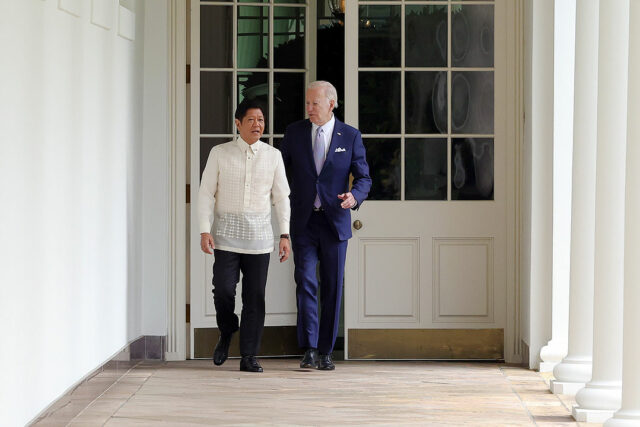
US PRESIDENT Joe Biden (right) with President Ferdinand R. Marcos, Jr. before the bilateral meeting in White House in Washington DC on May 1, 2023. — PHILIPPINE STAR/KRIZ JOHN ROSALES

By Kyle Aristophere T. Atienza, Reporter

THE UNITED STATES will donate at least four patrol vessels and three C-130H aircraft to the Philippines, the White House said on Monday, amid China’s increasing assertiveness in the South China Sea.

The two Island-class and Patrol-class vessels would boost the capability of the Philippine Armed Forces, the office of US President Joseph R. Biden said in a statement posted on the White House website.

The transfer would undergo “applicable congressional notification requirements,” it said.

The US had given the Philippines two Cyclone-class coastal patrol vessels last month and were en route to Manila, it added.

“These transfers will support the Armed Forces of the Philippines’ modernization program by enhancing its maritime and tactical lift capabilities,” the White House said.

“Let us hope that these most recent donations of coastal patrol vessels and cargo aircraft are not the usual discarded run-down supplies of the US military establishment,” Temario C. Rivera, a retired professor of international politics at the University of the Philippines, said in a Facebook Messenger chat.

These resources should be under the full operational control of the Philippine government and not used simply to support American strategic security interests in the region, he added.

“Finally, this should not detract us from looking for peaceful political solutions to the conflict in the West Philippine Sea,” he added, referring to parts of the South China Sea within the Philippines’ exclusive economic zone.

“An immediate focus of such diplomacy is to work out an unimpeded access by our fisherfolk to our maritime entitlements in the West Philippine Sea.”

The donation was expected since the Philippine defense sector “has historically been aligned with the US,” Michael Henry Ll. Yusingco, a policy analyst, said.

“The assistance we are receiving seems substantial, but this shouldn’t be seen as a big leap necessarily,” he said in a Messenger chat. “We shouldn’t use this alliance as a reason not to boost our defense capabilities through other means such as forging similar alliances with other states.”

Mr. Yusingco said the Philippines should boost its defense capabilities through its own efforts.

“We mustn’t simply rely on the US to help us when the need arises,” he said. “This is easier said than done of course. But this is a challenge that the president and Congress must face.”

Boosting “our national defense capabilities without the aid of external forces demands the cooperation of both branches of government.”

“While we can find some comfort with our alliance with the US, this cannot be our long-term defense policy,” he added. “Moving forward we need to have a robust defense capability of our own. We must not allow our political leaders to forget this goal.”

SOVEREIGN RIGHTS
Mr. Biden and President Ferdinand R. Marcos, Jr. met at the White House on Monday, during which the US leader reaffirmed his country’s “ironclad alliance commitments to the Philippines.”

The two leaders agreed to adopt bilateral defense guidelines that would institutionalize key bilateral priorities, mechanisms and processes “to deepen alliance cooperation and interoperability across land, sea, air, space and cyber-space,” the White House said. 

“The guidelines support the continued modernization of the alliance and ongoing efforts to adapt alliance coordination to respond to the evolving security environment,” it added.

Under the guidelines, Washington and Manila will advance efforts to deepen interoperability, particularly through enhanced bilateral planning, information-sharing, accelerated defense capability development and collaboration on emerging security challenges.

The two countries also eye establishing separate “trilateral modes of cooperation” with Japan and Australia, the Philippines and US said in a separate joint statement posted on the White House website.

“The leaders welcome cooperation with partners that share the US and the Philippines’ commitment to international law and mutual respect,” Mr. Biden and Mr. Marcos said in the statement, hours after their meeting.

“In that spirit, they reaffirm their strong support for ASEAN (Association of Southeast Asian Nations) centrality and the ASEAN outlook on the Indo-Pacific.”

Manila and Washington also welcomed efforts by a quadrilateral alliance among the US, Australia, India and Japan “to support a peaceful and stable, rules-based region with ASEAN at the center.”

China, an important Philippine trade partner, has viewed the quad as a US attempt to counter its influence in the region. Wang Yi, China’s Foreign minister, has called the US-led informal grouping an “Indo-Pacific NATO.”

The leaders said they have an “unwavering commitment” to freedom of navigation and overflight in the South China Sea, which is being claimed by China almost in its entirety.

Mr. Marcos and Mr. Biden also reiterated the importance of respecting the sovereign rights of states within their exclusive economic zones consistent with international law, citing a 2016 arbitral ruling that voided China’s sweeping claims over the waterway.

“The leaders support the right and ability of Filipino fisherfolk to pursue their traditional livelihoods.”

The two leaders also affirmed the importance of maintaining peace and stability across the Taiwan Strait “as an indispensable element of global security and prosperity.”

“The leaders convey support for Ukraine’s sovereignty, independence and territorial integrity within its internationally recognized borders, noting that the conflict has adversely affected food and energy security in the Indo-Pacific,” according to the joint statement.

Mr. Biden reiterated that an armed attack on Philippine armed forces, public vessels or aircraft in the Pacific, including the South China Sea, would invoke US mutual defense commitments under the 1951 US-Philippines Mutual Defense Treaty.

In February, Mr. Marcos announced the expansion of the Philippines’ 2014 Enhanced Defense Cooperation Agreement with the US, giving Washington access to four more military bases on top of the five existing sites.

The EDCA expansion would boost Philippine security and support the Armed Forces of the Philippines’ modernization goals, while driving US investments to local communities across the Philippines “and improving our shared ability to rapidly deliver humanitarian assistance and disaster relief,” according to the joint statement.

China has criticized the EDCA expansion, accusing Washington of endangering regional peace and stability. EDCA banks on the 1999 visiting forces agreement and the Mutual Defense Treaty.

In September 1991, Filipino senators voted to end a military base treaty that ended a century of US military presence in the Philippines.


Philippines likely to have El Niño in three months

REDCHARLIE-UNSPLASH

By Ashley Erika O. Jose, Reporter

THE PHILIPPINES’ state weather bureau on Tuesday said El Niño would likely develop in the next three months and might last until the first quarter of next year.

“Recent conditions and model forecasts indicate that El Niño may emerge in the coming season (June-July-August) at 80% probability and may persist until the first quarter of 2024,” the Philippine Atmospheric, Geophysical and Astronomical Services Administration (PAGASA) said on its website.

It said El Niño would likely result in below-normal rainfall conditions, a dry spell and drought in some parts of the country.

An El Niño alert is issued when there is a 70% chance for it to happen within the year, while an El Niño watch is issued when there is at least a 55% chance for it to happen in the next six months.

Leonor C. Cleofas, administrator of the Metropolitan Waterworks and Sewerage System (MWSS) said water supply would be sufficient.

“We have mitigating measures,” she said by telephone. “PAGASA has said that rains would still come. We still have time for rains to come and refill the dams.”

As of 6 a.m. on Tuesday, the water level in Angat Dam had declined to 194.88 meters from 195.08 meters on Monday.

Angat Dam supplies about 90% of the water needs of Metro Manila and nearby provinces. The dam has a minimum operating level of 180 meters and a normal high-water level of 212 meters. The latter is considered the ideal level, with adequate safety margins during the dry months.

“All concerned government agencies and the general public are encouraged to keep on monitoring and take precautionary measures against the impending impacts of El Niño,” PAGASA said.

Last week, both Maynilad Water Services, Inc. and Manila Water Co., Inc. said they were fast-tracking their supply augmentation measures in preparation for El Niño.

Ms. Cleofas noted that by 2024, there would have been new water plants coming online. “Maynilad has given their assurance that by the end of the year, we will get 50 million liters per day from the Poblacion Water Treatment Plant, but our problem really is Maynilad’s Putatan,” she said.

Maynilad has said some areas in Cavite would have no water while its Putatan Water Treatment Plant undergoes maintenance.

“On the part of MWSS, we are already taking action,” Ms. Cleofas said. “The National Water Agency of Singapore is dispatching experts to have third-party assistance at Putatan. So, we will be able to have the right solution. Hopefully within two weeks, they will be here.”

Philippines’ daily COVID average rose by 42% week on week — DoH

UNSPLASH

THE PHILIPPINES posted 4,456 coronavirus infections last week, with a daily average of 637, according to Health authorities.

The daily average from April 24 to 30 rose by 42% from a week earlier, the Department of Health (DoH) said in a bulletin on Tuesday.

There were 22 severe and critical cases, accounting for 0.49% of the total. There were no reported deaths during the period.

DoH said 303 of 2,021 intensive care unit (ICU) beds had been used as of April 30, while 3,157 out of 17,480 non-ICU beds were occupied.  There were 351 severe and critical admissions, it added.

OCTA Research fellow Fredegusto P. David tweeted that COVID-19 positivity rates in many areas as of April 29 had increased to double digits.

The positivity rate in Metro Manila rose to 17.2% on April 29 from 10.2% on April 22, he said.

Camarines Sur province had the highest infection rate at 39.7% from 32.1%, followed by Rizal with 28.5% from 21.7%, Cavite with 28.1% from 11.1% and Laguna with 21.2% from 13.2%.

The World Health Organization (WHO) has set a 5% threshold for the positivity rate.

Mr. David earlier cited the detection of Omicron subvariant XB.1.16 as a possible reason for the significant increase in COVID-19 cases in the country.

Also called Arcturus, the subvariant comes from XBB, a recombinant of two BA.2 descendent lineages. The Health department has said XB.1.16, which is more contagious, could evade immunity.

The WHO has labeled XBB.1.16 a variant of interest.

DoH on April 25 reported the Philippines’ first XBB.1.16 patient, a Filipino from Iloilo province in central Philippines. The patient was asymptomatic and had since recovered, the agency said on April 26. 

Health officer-in-charge Maria Rosario S. Vergeire at a briefing streamed live on Facebook said the increase in COVID-19 cases could not be compared to the numbers recorded at the height of the pandemic in 2020 and 2021.

“We need to raise the level of our risk tolerance to COVID-19. The increase in cases did not translate to more hospital admissions, and it did not translate to more severe and critical cases and even deaths,” she said.

The Philippines’ health use rate remained at low risk “because of the wall of immunity due to vaccination,” she added.

President Ferdinand R. Marcos, Jr. on Sunday said the government would boost vaccination efforts amid rising COVID-19 cases in the Philippines.

Mr. Marcos said the government might reimpose mandatory face mask rules amid rising infections.

But Ms. Vergeire said there was no need to revive the face mask mandate.

“We have already recommended to the Office of the President, based on the agreements coming from the Inter-Agency Task Force discussions, that there is no need to return the mandate,” she said. “We need to shift the mindset of our countrymen.”

She said COVID-19 cases in the Philippines would increase and decrease “because the virus is here, it will not disappear.” “The virus will mutate and produce variants every now and then.”

Filipinos should learn how to protect themselves and their family by choosing to wear a mask when going to high-risk places, she said. — Kyle Aristophere T. Atienza

ADVERTISEMENT
ADVERTISEMENT