Home Blog Page 4902

Marcos told to protect journalists as Philippines remains ‘difficult’ country

PHILIPPINE STAR/MIGUEL DE GUZMAN

By John Victor D. Ordoñez, Reporter

THE GOVERNMENT of President Ferdinand R. Marcos, Jr. should enforce more measures to protect journalists from baseless lawsuits and red-tagging after the Philippines remained a “difficult” country for media, based on the World Press Freedom Index, according to experts.

“While there have been improvements, libel remains a crime and there are attempts to penalize fake news, which we have seen being used by governments across Southeast Asia to clamp down on dissent, freedom of expression and of the press,” Jonathan de Santos, who heads the National Union of Journalists of the Philippines (NUJP), said in a Viber message at the weekend.   

The president should  do something about the practice of accusing journalists as  communists, he added.

Carol Claudio, executive assistant of Presidential Communications Office chief Cheloy Velicaria-Garafil, did not immediately reply to a Viber message seeking comment.

The Philippines placed 132nd out of 180 countries in the Reporters Without Borders’ 2023 World Press Freedom Index released on May 3. It was the country’s best ranking in six years.

“The Philippine media are extremely vibrant despite the government’s targeted attacks and constant harassment, since 2016, of journalists and media outlets that are too critical,” Reporters Without Borders said on its website.

The improved ranking is just a numerical gain, Arjan P. Aguirre, who teaches political science at the Ateneo de Manila University, said, citing the need for the government to do something about violence and killings of journalists.

“The situation in the Philippines remains to be something that is appalling and alarming,” he said in a Facebook Messenger chat. “Apart from the spate of killings of journalists these past years, we can still see a pattern of institutional harassment of journalists who are critical of the government’s policies.”

The NUJP has said there had been 60 reported cases of harassment, red-tagging and other cases of censorship against media practitioners in the Philippines as of April 30.

The Philippines remained the seventh worst country in the world where journalist killers get away with murder, the New York-based watchdog Committee to Protect Journalists said in November.

The global watchdog said at least 85 Filipino journalists were killed between 1992 and 2022, 14 cases of which were still unsolved.

Jose Dominic F. Calvano IV, spokesman for the Justice department, has said the country’s task force for media security would partner with law enforcement agencies to probe media killings. The task force was formed in 2016 under ex-President Rodrigo R. Duterte.

“Marcos should deliver justice to the slain journalists, stop the practice of red-tagging and make the decriminalization of libel a priority,” Ronalyn V. Olea, secretary-general of the NUJP, said in an e-mail.

Alternative news websites were still being blocked in the country, she said, citing the case of journalist Frenchie Mae Cumpio, who was detained over charges of illegal gun possession.

The Philippines has accepted 200 recommendations from the United Nations Human Rights Council, including protecting journalists and investigating extralegal killings.

The Foreign Correspondents Association of the Philippines (FOCAP) has urged the government to bolster efforts to guarantee press freedom.

The Council for People’s Development has said impunity in the Philippines impedes freedom of expression and people’s right to access reliable information.

“While the president himself isn’t hostile to the press, the practice of labeling dissent and critical reporting as being anti-government or subversive or destabilizing has persisted,” Mr. De Santos said.
Hontiveros calls for policy, governance review before pursuing NAIA privatization 

PHILIPPINE STAR/ MIGUEL DE GUZMAN

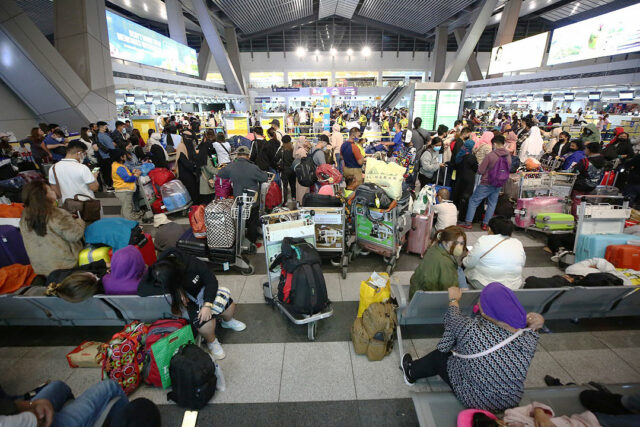
A SENATOR on Sunday said the government should not rush into the proposed privatization of the countrys main airport without first reviewing existing policies and governance systems for public transport services.   

Privatization is not a silver bullet to the worsening problems and poor services of our airports, opposition Senator Ana Theresia RisaN. Hontiveros-Baraquel said in a statement.   

Calls to privatize the Ninoy Aquino International Airport (NAIA) in Manila have received support from several lawmakers, especially after the latest power outage on May 1 that affected up to 48 flights and over 9,000 passengers.  

A glitch in the countrys air traffic management system on Jan. 1 paralyzed all airports nationwide and affected over 65,000 passengers.  

This is an issue of performance and accountability. The services of NAIA will not improve even with the private sector running it if there are no reforms in the supervision of the NAIA and other airports in the country,she said in Filipino.  

She noted how other privatized and deregulated sectors such as water, power, and rail have become costly for consumers and continue to suffer problems in service delivery.  

Instead of rushing towards privatization and deregulation, Malacañang, and the Department of Transportation and its attached agencies should work towards ensuring clear lines of accountability and responsibility in relation to airport operations,Ms. Hontiveros said.  

We should demand more from our public officials and not encourage further complacency in the bureaucracy by bringing in the private sector every time our public officials are unable or unwilling to do their jobs,she said. Beatriz Marie D. Cruz 

NWRB keeps additional water allocation for Metro Manila until end-May

PHILIPPINE STAR/MIGUEL DE GUZMAN

THE ADDITIONAL water allocation given to concessionaire Maynilad Water Services, Inc. will be extended until the end of May, according to the Metropolitan Waterworks and Sewerage System (MWSS).  

Last month, the National Water Resources Board (NWRB) approved an additional water allocation to regulator MWSS at 52 CMS for the April 16-30 period.  

The added supply in the second half of April followed the NWRBs decision to temporarily raise the allocation for MWSS to 50 CMS between April 1 and 15. 

The MWSS normally draws 48 CMS from Angat.  

“Yes, up to May 31. The two cubic meters per second will be devoted to Maynilad, MWSS Administrator Leonor C. Cleofas said in a Viber message.  

Earlier, Ms. Cleofas said the extra allocation given to Maynilad is expected to boost the companys available supply, adding that the NWRB set a condition that Maynilad should suspend its water interruptions in its areas.  

“There are currently no service interruptions in the portion of our concession that is served with water from Angat Dam, thanks to the additional 2 CMS allocation given by NWRB until end of May,” Jennifer C. Rufo, head of Maynilad corporate communications, said in a Viber message.  

She added that they are also in constant communication with the Angat technical working group as part of the company’s preparations following the announcement of state weather bureau PAGASA that El Niño would likely develop in the next three months.  

Besides facilitating our supply augmentation measures, among the measures being considered is cloud seeding,” Ms. Rufo said.  

Maynilad serves the cities of Manila, except portions of San Andres and Sta. Ana. It also operates in Quezon City, Makati, Caloocan, Pasay, Parañaque, Las Piñas, Muntinlupa, Valenzuela, Navotas, and Malabon. It also supplies the cities of Cavite, Bacoor, and Imus, and the towns of Kawit, Noveleta, and Rosario, all in Cavite province. Ashley Erika O. Jose

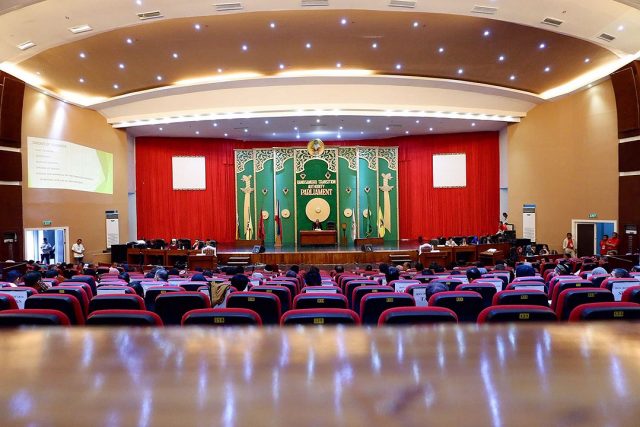
Business sector, mayors back transfer of Bangsamoro political capital to Parang

BW FILE PHOTO/ TSBASMAN

THE BUSINESS community and a cluster of mayors in Maguindanao are backing the proposed transfer of the Bangsamoro political capital to the town of Parang, citing opportunities for increased trade and last weeks signing of a local peace accord to protect economic development initiatives.     

We support the proposal to establish a new BARMM (Bangsamoro Autonomous Region in Muslim Mindanao) regional government center in the municipality of Parang,Bangsamoro Business Council Ronald Hallid D. Torres said in an interview on Saturday.  

He said the move will open opportunities for entrepreneurs and traders to expand their businesses in the coastal municipality, which is just less than 30 kilometers away from Cotabato City, currently the political and commercial center.  

Most importantly, it will improve the investment climate in Parang and towns around that are still recovering from the adverse effects of decades of secessionist strife,Mr. Torres said.   

Mohammad O. Pasigan, chairman of the Bangsamoro Regional Board of Investments, said building a multi-billion government complex in Parang will entice more investors to fund agricultural ventures in Maguindanao del Nortes adjoining towns of Parang, Sultan Kudarat, Sultan Mastura, Matanog, Barira and Buldon.  

We are sure of that,Mr. Pasigan said on Saturday. 

IRANUN CORRIDOR
The towns are located within what is called the Iranun Corridor, home to the Iranun indigenous group whose ancestors include the 16th century Muslim leader Sultan Kudarat and other local chiefs who fought against Spanish, American and Japanese presence.  

On May 4, the mayors of Parang, Sultan Mastura, Buldon, Barira and Matanog held a ceremonial signing of a covenant establishing the Iranun Corridor for Economic, Environment and Public Safety Council.  

The pact, a result of a focus group discussion led by local organization TASBIKKA, Inc., lays out a uniform policy to prevent violent conflict in the area and aims to enhance support to reconciliation and unification efforts.   

Maguindanao del Norte Gov. Abdulrauf A. Macacua said he and mayors in his province are in favor of the transfer of the BARMM capitol. 

It will have a good effect on the economy of the municipalities of the Iranuns in Maguindanao del Norte and the Maranaos in Lanao del Sur,he said.  

Bangsamoro Transportation and Communications Minister Paisalin P. Tago said Parang also has the advantage of being the site of Polloc Port, which can be used for domestic and international shipping services.  

The setting up of a new BARMM capitol in Parang will benefit my province, Lanao del Sur, too,” Mr. Tago, also a member of the 80-seat Parliament, said on Saturday.  

The establishment of a new regional center in Parang was recently filed before the BARMM Parliament under Bill No. 43. John M. Unson  

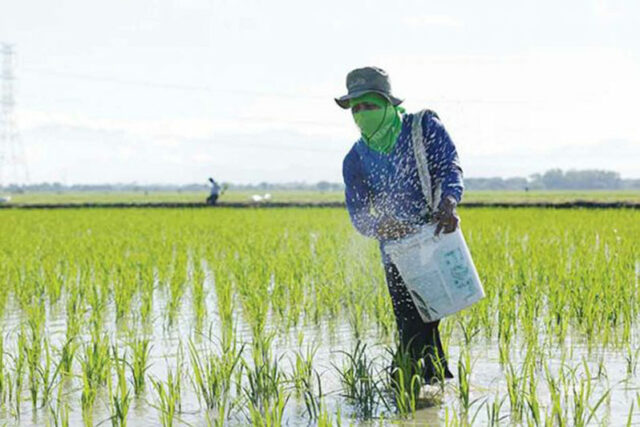
Farmers’ group wants DA to revoke biofertilizer program

DA.GOV.PH

FARMERSgroup Samahang Industriya ng Agrikultura (SINAG) on Sunday urged the Agriculture department to revoke the biofertilizer program, citing flaweddistribution guidelines based on prevailing fertilizer rates.  

In a statement, SINAG Chairman Rosendo O. So said the basis of the program, Department of Agriculture (DA) Memorandum Order No. 32 dated April 27, is inconsistent with current fertilizer prices.  

The memo sets the guidelines on the distribution and use of biofertilizers this year to improve rice output.   

The program is intended to help farmers save input cost by distributing biofertilizers equivalent to at least two bags of inorganic urea fertilizer.   

The Palace has said that President Ferdinand R. Marcos, Jr., who also heads the DA, wants to increase the use of biofertilizers to reduce dependence on imported fertilizers.  

However, Mr. So said the memos price basis is not in line with the actual cost of urea at P1,00 per bag.  

“At least two bags per hectare, the cost of urea is only P2,200 per hectare, contrary to the claim of MO 32 of P4,000 per hectare,” he said.  

He added that their group is also opposed to the “savings” referred to in the memo as the DA’s official bidding price for urea was at P1,230 per bag.  

We are disturbed by the arbitrary insistence of biofertilizers, premised on the false claim of high urea prices. Biofertilizers have yet to be proven, in commercial scale, of a higher yield or as being more cost-efficient to our rice farmers,said Mr. So.  

“If the objective is to lower production cost, pushing for biofertilizer is not the solution.”  

Mr. So said the DA must instead encourage the use of compost chicken waste which is at P170 per kilogram. 

“We are worried that another scandal that could approximate the fertilizer scam of the previous years may resurface,” he said.   

In February 2009, the Senate Blue Ribbon Committee concluded based on its investigation that “massive corruption” has been involved in the procurement and distribution of fertilizers in the Philippines.  

In letters dated May 4 addressed to Mr. Marcos and Senator Cynthia A. Villar, chair of the committee on agriculture and food, sought “immediate intervention to revoke MO 32.” Sheldeen Joy Talavera

BI warns vs trafficking schemes using job offers to Malta 

THE BUREAU of Immigration (BI) on Sunday warned the public against human trafficking schemes promising employment in Malta and other Mediterranean countries, citing a recent increase of victims bound for Malta. 

“We call on the public to exercise caution in dealing with recruiters,” Immigration Commissioner Norman G. Tansingco said in a statement. 

“Several investigations have shown the exploitation of domestic and foreign victims in the Mediterranean, and this has long been a cause of concern.”  

The BI said it intercepted two human trafficking victims bound for Malta on April 29, who posed as friends traveling as tourists bound for Bangkok, Thailand.   

They were unaware that their supposed working visas for Malta had been canceled before leaving the Philippines.  

The victims were turned over to the country’s council against human trafficking for assistance in filing criminal charges against their recruiters. 

Last month, the inter-agency council against human trafficking said it would enhance its cooperation with partner government agencies to apprehend more human traffickers.  

The council is composed of the Department of Justice (DoJ), the Department of Social Welfare and Development (DSWD), and the Commission on Filipino Overseas.    

In the first two months of the year, 57 departures from the countrys international airports were tagged as possible cases of human trafficking, based on data from the Bureau of Immigration.    

“The BI understands being enticed by greener pastures abroad, but by not going through the correct process, aspiring migrant workers risk getting abused overseas,it said. John Victor D. Ordoñez

Mindoro company pitches land bank to developers

ORIENTAL Mindoro-based Bernardo Creative Ventures, Inc. (BCVI) has opened several properties in the province for possible joint ventures with developers for residential, commercial and tourism-related projects.  

“We believe that Oriental Mindoro has a lot to offer, especially in mass housing and tourism,said BCVI head Romel F. Bernardo in a statement.  

The province, which is about to reach the one million population mark soon, particularly our town of Pinamalayan, is ready for big-ticket development projects not only because of our strategic location but also because of the vibrant trade activities in our area,said Mr. Bernardo, who previously worked in the TV industry and produced video content for the country’s leading property developers.  

He went back to his hometown and set up the six-year-old company, which has been involved in construction and fuel distribution.   

Pinamalayan is considered the trade center in the eastern part of Mindoro, which is a major producer of rice and fruits.    

The town also has an emerging banana chips industry with four factories producing goods for export to North America, the Middle East, China, Japan, South Korea and Australia.   

The municipality also has a small airport and domestic seaports.  

BCVI said its properties being offered for development includes a 15-hectare fruit farm in a rolling ridge with a view of the Tablas Strait, flat land beside the town’s airport, a five-hectare banana farm and two adjacent prime commercial properties located along the national highway.  

Mr. Bernardo said Mindoros economic potential has been boosted by the recent announcement of San Miguel Corp. of possibly investing in the construction of a bridge connecting the island to mainland Luzon. MSJ

Why an oil tanker ablaze in the S.China Sea is a global problem

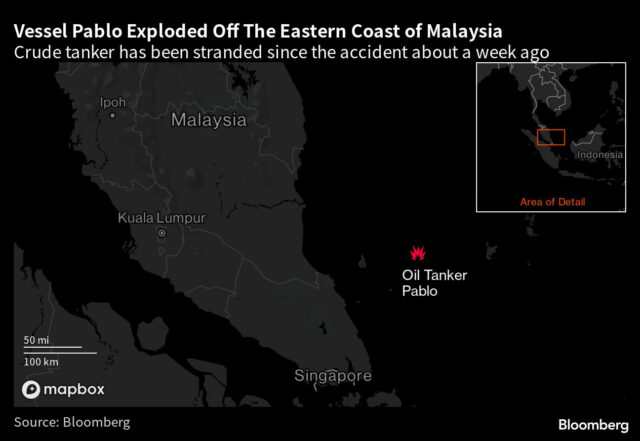
OFF the coast of Malaysia, in one of the world’s busiest shipping channels, an explosion on board the aging oil tanker Pablo ripped off its deck like a sardine can and began a fire that sent dark plumes of smoke into the sky.

It was a tragic accident that could have been a much larger catastrophe. The Gabon-registered ship, capable of carrying some 700,000 barrels of crude oil, was coming through the South China Sea after offloading a cargo in China — and so was nearly empty. Out of its international crew of 28, officials report that 25 were rescued by passing vessels. The blast happened just beyond Singapore’s congested waters.

But for nearby maritime authorities, the headache has just begun. There is little evidence of the owner, a Marshall Islands-registered company whose fleet contains no other ships, and no trace of insurance. Both are vital for a clean-up to begin.

An Aframax-class crude oil tanker observed in Iranian waters last year, the Pablo underlines the risks that come with the expansion of a dark fleet of aging vessels moving sanctioned oil around the globe. Since the wave of sanctions that followed Russia’s invasion of Ukraine — including the price caps imposed by the Group of Seven, intended to limit oil cash going back to the Kremlin — observers in the oil trading community have reported the purchase of hundreds of old tankers by undisclosed buyers.

With limited details on who is responsible for this vessel, there has been no one to hold to account as it burned just 40 nautical miles off Malaysia’s Pulau Tinggi island. Oil, potentially from the wreck, has been reported washing up on Indonesia’s coast.

“The Pablo casualty is tragic, and a stark reminder of what we have been saying all along: the shadow fleet poses a serious threat both to people’s lives and to the marine environment,” said Rolf Thore Roppestad, chief executive officer of Gard AS, the largest of the protection and indemnity clubs that insure much of the world’s fleet against risks such as oil spills.

“What worries me is that there are ships like these passing through high-traffic straits every day,” he added. “So the likelihood of more accidents like this happening is actually quite high.”

The cause of the fire is still unclear, though it’s possible vapors from the remains of the oil cargo played a part. Regardless, when ships like the Pablo explode, the process of cleaning up the mess gets more difficult. Often, insurance companies, salvage businesses and various intermediaries begin dealing with the situation within a few hours of its happening.

But almost a week after this explosion, there is little sign of the insurer to get the process moving. The Pablo is not listed in an industry database of insured vessels, and the Malaysian Maritime Enforcement Agency did not answer questions on insurance.

In instances where shipowners are unknown, local authorities will often press the crew for more information as they are one of the few people who know where a vessel’s orders are coming from. It is unclear whether that has been possible.

If the owner can’t be contacted, local authorities can seize the ship and try to cover what costs they can, according to Oon Thian Seng, founding partner of Singapore law firm Oon & Bazul LLP and at its associated Malaysian office, TS Oon & Partners LLP. However, it’s highly unlikely that selling what’s left of the charred Pablo would cover the costs of removal.

The dangers the Pablo, and others like it, are clear from its history. The tanker was flying the flag of Gabon, which is a very small destination for vessel registration and falls outside of something called the Paris MoU, set up to promote safe shipping. It was built in 1997, meaning it’s far beyond the age at which most tankers are sold as scrap.

Further, had the Pablo been laden with its most recent cargo, that would have been a major spill of oil sanctioned by the US.

The tanker spent two months at a shipyard near Shanghai, but before that its last two voyages were to deliver crude to Chinese ports in Shandong province, ship tracking data monitored by Bloomberg show. Data analytics firm Vortexa identifies both cargoes as Iranian heavy crude, which is sanctioned.

For authorities in Singapore, one of the world’s busiest shipping hubs, the question is how to keep legitimate oil cargoes moving — while avoiding accidents like this one. The Maritime and Port Authority said it had requested the assistance of 20 vessels in the region to report any sighting of Pablo’s three missing crew, and reported no disruption to traffic. Officials did not comment further.

Malaysian authorities said they suspended search operations on Friday evening as efforts haven’t turned up any sign of the crewmen. The explosion has made the ship unsafe to board, leaving it stuck off the country’s coastline for the time being.  

The longer it stays there, the longer it remains a visible reminder of the risks that come with an expanding shadow fleet.

“Sadly, it’s the crew, their families, and the coastal communities that are paying the price,” Roppestad said. — Bloomberg

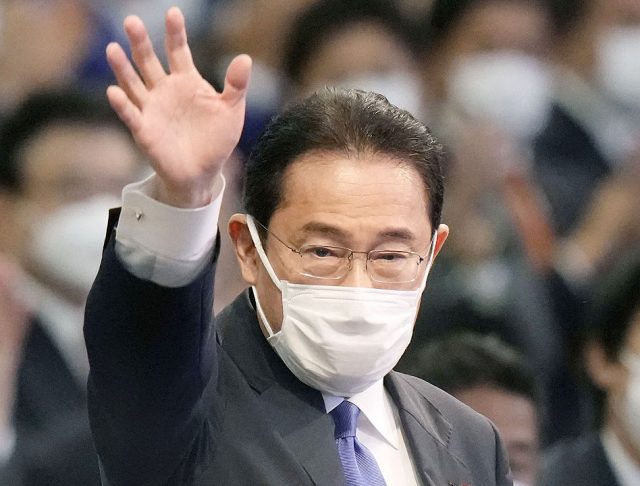
Japan PM Kishida visits Seoul to forge closer ties amid N. Korea threats

Japanese Prime Minister Fumio Kishida — KYODO/VIA REUTERS

TOKYO/SEOUL — Japan’s Prime Minister (PM) Fumio Kishida arrived in Seoul on Sunday to meet South Korean President Yoon Suk Yeol, facing a skeptical public there as the leaders seek deeper ties amid nuclear threats from North Korea and China’s increasing assertiveness.

Mr. Kishida’s bilateral visit, the first by a Japanese leader to Seoul in 12 years, returns the trip Mr. Yoon made to Tokyo in March, where they sought to close a chapter on the historical disputes that have dominated Japan-South Korea relations for years.

Before departing, Mr. Kishida told reporters he hoped to have “an open discussion based on a relationship of trust” with Mr. Yoon, without elaborating on specific issues.

Mr. Yoon is facing criticism at home that he has given more than he’s received in his efforts to improve relations with Japan, including by proposing that South Korean businesses — not Japanese companies as ordered by a court — compensate victims of wartime labor during Japan’s 1910-1945 colonial occupation.

South Korean officials are hopeful that Mr. Kishida will make some kind of gesture in return and offer some political support, although few observers expect any further formal apology for historical wrongs. Mr. Yoon himself has signaled he doesn’t believe that is necessary.

The focus of the summit instead will likely revolve around security cooperation in the face of North Korea’s nuclear threats, said Shin-wha Lee, a professor of international relations at Seoul-based Korea University.

“Within the framework of the ‘Washington Declaration,’ which outlines plans to strengthen extended deterrence, Korea will explore ways to enhance the collaborative efforts with Japan,” she added.

“We have a lot of opportunities to cooperate when it comes to addressing the threat of North Korea” and securing a free and open Indo-Pacific, a Japanese foreign ministry official said.

Tensions have simmered between Washington and Beijing as China becomes more assertive in its territorial claims over Taiwan and in the South China Sea, while the US shores up alliances across the Asia-Pacific.

But the historical differences between South Korea and Japan also threaten to cast a shadow over the blossoming ties between its two leaders.

The majority of South Koreans believe Japan hasn’t apologized sufficiently for atrocities during Japan’s 1910-1945 occupation of Korea, Ms. Lee said. “They think that Prime Minister Kishida should show sincerity during his visit to South Korea, such as mentioning historical issues and expressing apologies,” she added.

On the other hand, Japan is taking it slow, said Daniel Russel, former US assistant secretary of state for East Asia and the Pacific.

“Kishida is being careful not to go faster than his domestic politics permit,” he added, pointing to the unilateral abrogation by the previous Korean government of a settlement on ‘comfort women’ as a source of Japan’s wariness.

In 2015, South Korea and Japan reached a settlement under which Tokyo issued an official apology to “comfort women” who say they were enslaved in wartime brothels and provided 1 billion yen ($9.23 million) to a fund to help the victims. 

But then-South Korean President Moon Jae-in decided to dissolve the fund in 2018, effectively scrapping the agreement as he said it did not do enough to consider victims’ concerns.

Still, South Korea is an “important neighbor that we must cooperate with on various global issues,” Japan’s foreign ministry has said.

Mr. Kishida has invited Mr. Yoon to the Group of Seven summit set for later this month in Japan and will hold trilateral talks with the US on the sidelines.

Mr. Kishida will also urge for trilateral talks with China as early as this year, Kyodo reported on Friday, citing multiple unnamed diplomatic sources. — Reuters

At least 8 people killed by gunman at Texas mall; shooter killed by police

JANNOON028 — FREEPIK

A GUNMAN shot and killed eight people and wounded at least seven others at a busy mall north of Dallas on Saturday, police said.

The gunman, whom authorities said they think acted alone and whose motive was not yet known, was killed by a police officer after he began firing outside of the Allen Premium Outlets mall in Allen, Texas, the city’s police chief Brian Harvey said at a press conference.

Allen fire department chief Jon Boyd told the same press conference that his department took at least nine victims with gunshot wounds to area hospitals.

Two of those people died at the hospital, Boyd said at a second press conference Saturday night. Three of the victims were in critical condition and four others were stable.

Medical City Healthcare, which runs 16 hospitals in the area, said in a statement that its trauma centers were treating eight of the wounded victims, who ranged in age from 5 to 61.

Collin County Judge Chris Hill, the top elected official in the county where Allen sits, praised police and other first responders at a press conference, but expressed deep anger with “those that would do evil in our community, in our backyard.”

Separately, police in the nearby city of Frisco, Texas, said they had evacuated the Stonebriar mall late Saturday after receiving reports of shots fired there. It was not yet clear if a shooting had actually taken place.

TV aerial images showed hundreds of people calmly walking out of the mall, located about 25 miles (40 km) northeast of Dallas, after the violence unfolded, many with their hands up as scores of police stood guard.

One unidentified eyewitness told local ABC affiliate WFAA TV that the gunman was “walking down the sidewalk just … shooting his gun outside,” and that “he was just shooting his gun everywhere for the most part.”

Blood could be seen on the sidewalks outside the mall and white sheets covering what appeared to be bodies.

Texas Governor Greg Abbott, calling the shooting an “unspeakable tragedy,” said in a statement that the state was prepared to offer any assistance local authorities may need.

Allen, Texas, is a community of about 100,000 people.

Mass shootings have become commonplace in the United States, with at least 198 so far in 2023, the most at this point in the year since at least 2016, according to the Gun Violence Archive. The nonprofit group defines a mass shooting as any in which four or more people are wounded or killed, not including the shooter. — Reuters

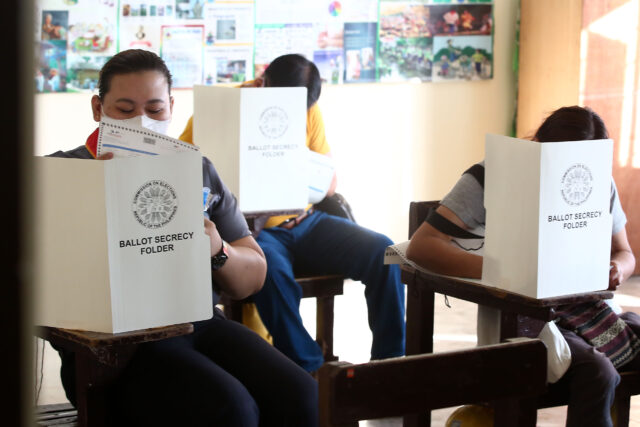
Thai voters cast early ballots one week before election

REUTERS

BANGKOK — Many Thais lined up on Sunday in long queues to vote early in parliamentary elections scheduled for May 14.

More than 2 million Thais had registered for early voting out of 52 million eligible voters who are aged 18 and above, according to the country’s election commission.

“I wish to see change and improvement in management,” said 51-year-old Gosol Pungtaku, one of the 800,000 Bangkok residents who registered for one-day-only early voting in the capital.

Another voter, 34-year-old Siriporn Namphet, said she voted for change.

“It’s like having seen what the previous government has done and now hoping for a new administration to take over and govern more effectively,” she told Reuters.

The election could upset the status quo after more than eight years of a conservative pro-military government led by former army chief Prayuth Chanocha.

Prayuth, 69, who first seized power in a 2014 coup and remained prime minister after the 2019 election that critics said was rigged to favour the junta leader, a charge the government denied, is trailing far behind opposition parties in recent opinion polls.

Opposition Pheu Thai Party, a populist group that won five general elections before 2019 and was ousted by Prayuth in the coup, is leading in most polls followed by the progressive Move Forward Party.

The election is for the 500-seat House of Representatives. — Reuters

A reflection: A year after the 2022 presidential election

PHILIPPINE STAR/MIGUEL DE GUZMAN

It has been a year since the May 9, 2022 presidential election. Although the campaign was intense and exciting, the outcome saddened me. My candidate, the candidate of many friends and relatives, lost. Our candidate Leni Robredo lost by a wide margin to Ferdinand Marcos, Jr.

We knew nevertheless from the outset that we faced an uphill climb. The Leni campaign started late in the game. Marcos Jr. enjoyed an overwhelming advantage in terms of financial resources, political networks, and party organization. The self-declared Statement of Contributions and Expenditures (SOCE) indeed showed that Leni’s campaign spending was about three-fifths of Marcos Jr.’s spending. Marcos Jr. also benefited from the votes of supporters of then President Rodrigo Duterte.

These big disadvantages were not easy to overcome. Thus, during the miting de avance, or the final campaign rally, Leni urged her supporters to keep the faith. She said: “Natutunan natin, walang imposible.” (“We learned, nothing is impossible.”)

Leni’s walang imposible was more about a krusada (crusade) that does not end regardless of the election outcome. Leni’s krusada is about reforming if not overhauling the system, about a future with dignity, about practicing radikal na pagmamahal (radial love).

A year ago, too, on the eve of the May 9, 2022 elections, I wrote a BusinessWorld column titled “Walang impossible.” I took the cue from Leni’s miting de avance speech. I wrote:

“What we have is a big, spontaneous movement. It is the 21st century edition of People Power…

“It is this explosion of people power, including youth power. That makes me say that Leni, as well as the movement she leads, has won.”

My interpretation of Leni’s walang imposible went something like this: The 2022 presidential election was almost impossible for Leni to win. The writing was on the wall. Independent, trusted, and scientific surveys said so. (And shame on those who disparaged Pulse Asia and labeled it “False Asia.”).

But win or lose the election, we carry on. People power being alive gives us the energy and impetus to advance a longer-term krusada that Leni has initiated.

We did not attain victory in the 2022 presidential election, but we have secured solid gains on other fronts. The revival of people power, the reawakening of the youth, the sense of decency, the renewal of hope, the practice of radikal na pagmamahal.

A year after the 2022 elections, I remember that period positively, despite Leni’s loss. Contemplation makes me see the joy and triumph of the pink movement that Leni inspired.

Why joy and triumph? On a personal level, the experience of campaigning tirelessly and passionately for Leni and being with like-minded citizens voluntarily driven by a mission is a happy moment in my life. Simply precious.

On a more abstract level, I ask: Should the election campaign be measured only in terms of a win?

Of course, we and Leni wanted to win. But winning the election is not the only metric of success. Here, we expand our time horizon. Social, political, and economic reform is a long game. A loss at a particular time does not end the game.

The time was not propitious for reformers or progressives to win in 2022. The conditions simply did not favor us — the global rise of right-wing populism and authoritarianism, the spread of disinformation that was not easy to counter, the people’s disenchantment with a liberal order that exacerbated inequality, to name a few.

But there’s a time for everything. The baby boomers are familiar with The Byrds and their song “Turn! Turn! Turn!” The song’s lyrics come from the book of Ecclesiastes, King James version of the Bible. I quote part of the lyrics:

To everything (turn, turn, turn)/There is a season (turn, turn, turn)/And a time to every purpose, under heaven.

A time to build up, a time to break down/A time to dance, a time to mourn/A time to cast away stones, a time to gather stones together.

In May 2022, we mourned Leni’s electoral defeat. Losses along the way can nevertheless bring us closer to strategic victory. Lessons are learned.

There’s “a time to every purpose.”

Leni’s campaign served another purpose. It ignited a massive and spontaneous movement for reforms, for decency, and for radikal na pagmamahal. This movement — and the challenge is to gather stones together — is a significant step towards future wins.

A quote from Albert Einstein should give us pause for thought: “Failure is success in progress.” Remember that the Leni campaign is a krusada. It’s a long game.

The brand of people power that the Leni campaign generated will not vanish. It will be part of a national consciousness that will reawaken citizens. It has contributed to the revitalization of a civic culture. This movement will likewise strengthen over time and contribute to rousing democratic sentiments and enhancing civil norms.

And so, a year after the 2022 elections, like Leni, we strive to have happiness, ease, and serenity.


Filomeno S. Sta. Ana III coordinates the Action for Economic Reforms.

www.aer.ph

ADVERTISEMENT
ADVERTISEMENT