Home Blog Page 4885

PHL ‘on track’ to become an upper middle-income country, says WB

An aerial view of Metro Manila. — PHILIPPINE STAR/WALTER BOLLOZOS

By Luisa Maria Jacinta C. Jocson, Reporter

THE PHILIPPINES is on track to becoming an upper middle-income country in the next few years, the World Bank (WB) said.

“With continued recovery and reform efforts, the country is getting back on track on its way from a lower middle-income country with a gross national income (GNI) per capita of $3,640 in 2021 to an upper middle-income country in the short term,” the multilateral lender said on its website.

According to the World Bank, an upper middle-income country has a per capita income range of $4,256-$13,205.

The Philippines is currently classified as a lower middle-income country by the World Bank, with a GNI per capita at $3,640 or about P202,000 in 2021.

A lower middle-income status means having a GNI per capita from $1,086 to $4,255.

The World Bank has yet to release the latest country classification ranking for 2022.

The Philippines has been classified as a lower middle-income country since 1987, which is the earliest available data from the World Bank.

The Marcos administration is targeting to reach upper middle-income status by 2025.

“The Philippines has been one of the most dynamic economies in the East Asia and Pacific region. With increasing urbanization, a growing middle class, and a large and young population, the Philippines’ economic dynamism is rooted in strong consumer demand supported by a vibrant labor market and robust remittances,” the World Bank added.

The Philippine economy grew by 7.6% in 2022 from 5.6% in 2021.

Economic managers are targeting 6-7% gross domestic product (GDP) expansion this year.

SLOW POVERTY REDUCTION
In a separate report, the World Bank said the Philippines is struggling to reduce poverty.

“Despite over a decade of progress in inequality reduction, the Philippines has one of the highest Gini coefficients in East Asia and the Pacific,” the multilateral lender said in its latest Poverty and Equity Brief.

In 2021, the Philippines’ Gini coefficient was at 40.7.

The Gini coefficient is used to measure income distribution, where a coefficient of zero means that wealth is perfectly distributed, while a higher number indicates inequality.

According to the World Bank, the coronavirus disease 2019 (COVID-19) pandemic “interrupted” over 30 years of poverty reduction progress in the country.

“While inequality did not seem to have increased in the immediate aftermath of COVID-19, the longer-lasting effects of the crisis on human capital development, food insecurity and shifts to less productive jobs and sectors, which disproportionately affected poor and vulnerable households, may widen inequality in coming years,” it added.

However, the World Bank did note the improvement in labor force participation, low unemployment, and the surge in home-based or flexible work arrangements which it said will also help accelerate poverty reduction.

Data from the local statistics authority showed that poverty incidence among individuals jumped to 18.1% in 2021, from 16.7% in 2018. In 2021, the number of Filipinos living in poverty rose by 2.322 million to 19.992 million.

In its latest Macro Poverty Outlook, the World Bank noted that economic and labor market recovery will support poverty reduction efforts in the Philippines.

“Poverty incidence (in the Philippines) using the World Bank’s poverty line for lower middle-income countries of $3.65 a day, 2017 purchasing power parity (PPP) is projected to decrease from 17.8% in 2021 to 13.8% in 2023 and further decrease through 2025,” it said.

“However, these projections could be tempered by higher-than-expected inflation. The increase in household incomes brought by the gains in the labor market are offset by the persistent high prices particularly of food and energy, especially among poor households,” it added.

The government is aiming to reduce the poverty incidence rate to 16.4% this year, 13.2% by 2025, and 9% by 2028.

BSP has room for one more rate hike — S&P

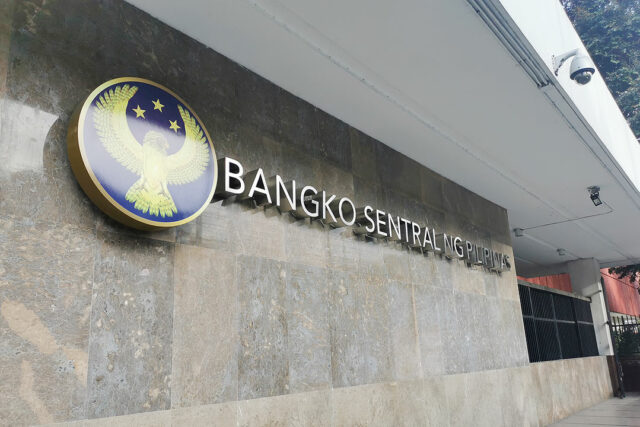
Bangko Sentral ng Pilipinas main office in Manila. — BW FILE PHOTO

By Keisha B. Ta-asan, Reporter

THE BANGKO SENTRAL ng Pilipinas (BSP) still has room for one more rate hike at its meeting later this month to quell persistently elevated core inflation, before keeping rates on hold for the rest of the year, S&P Global Ratings said on Tuesday.   

“We think there’s space for at least one more rate hike, and then a prolonged hold for the rest of the year from the BSP, given that the core inflation is still very high,” S&P Senior Economist and Associate Director for Credit Market Research Vincent Conti said at an online webinar.

Mr. Conti said the BSP may only start cutting interest rates by next year, in line with their policy forecasts for the US Federal Reserve. The Fed has raised rates by 500 basis points (bps) to 5-5.25% since last year.

For its part, the BSP has hiked the benchmark interest rate by 425 basis points (bps) to 6.25%, the highest in nearly 16 years.

While headline inflation eased to 6.6% in April, core inflation remains stubbornly high. Core inflation, which discounts volatile prices of food and fuel, slowed to 7.9% in April from 8% in March. Year to date, core inflation averaged 7.8%.   

Mr. Conti said the negative impact of higher borrowing costs on economic growth will linger if the BSP further tightens its policy settings.   

“The pass-through of interest rates to the growth rate of the economy tends to have long and variable lags, especially for the Philippines,” he said.   

The credit watcher currently projects the Philippine economy to expand by 5.8% this year, lower than the government’s 6-7% growth target. In 2022, the economy grew by 7.6%.

Mr. Conti said pent-up demand may start to wane this year as elevated inflation and high interest rates dampen household consumption.

Inflation averaged 7.9% in the first four months of the year, still above the BSP’s 6% full-year target for 2023.   

On the other hand, high interest rates and slower economic growth may help stabilize the foreign exchange (FX) rate.

“Holding down domestic growth rates helps control the size of the current account deficit. Not having that much of a difference in yield differential between the US will also help stabilize the FX rate,” Mr. Conti said.   

Based on BSP data, the current account deficit was at $17.8 billion last year, significantly wider than the $5.9-billion shortfall in 2021. 

The peso closed at P55.76 versus the dollar on Tuesday, down by 51 centavos from Monday’s P55.25 finish, data from the Bankers Association of the Philippines’ website showed.

BANKING OUTLOOK
Meanwhile, Philippine bank lending growth may slow down to 7-9% this year from the 12% growth in 2022 due to high interest rates, S&P Global Ratings said.     

At the same online webinar, S&P Associate Director Nikita Anand said consumer loans, which make up 20% of total loans, are vulnerable to high borrowing costs.   

“The high inflation and high interest rates really erode household savings, putting a strain on low-income households. Credit cards, and unsecured personal loans could be most at risk,” he said.

Central bank data showed outstanding loans by big banks rose by 10.1% to $10.762 trillion in March from $9.77 trillion a year earlier. This was the fastest growth in bank lending in two months and ended three straight months of slower credit growth.

Elevated inflation and interest rates will also weigh on banks’ asset quality, according to Ms. Anand. But the deterioration is likely to be only marginal and limited to consumers and small businesses. 

“We expect NPLs (nonperforming loans) and performing restructured loans in combination will stay under 6% of total sector loans. Bank profitability could continue to improve with return on assets of about 1.5%,” Ms. Anand said.   

The banking industry’s NPL ratio went up to 3.31% in January from 3.28% a month earlier.

Data from the BSP showed that bad loans reached P411.186 billion in February, up by 1.5% from P405.138 billion in January.   

“Although funding costs will increase, we believe the pass through of a higher policy rate is likely to widen net interest margins by about 20 basis points. So net interest margin improvements will in a way mitigate the impact of lower loan growth,” Ms. Anand said.

She cited some risks to S&P’s banking sector outlook, such as a sharper than expected economic slowdown in the Philippines, persistently high inflation, and future stresses in the corporate sector.

Manufacturing growth eases to 9-month low

A worker is seen inside a manufacturing plant in Sto. Tomas, Batangas, March 1, 2023. — PHILIPPINE STAR/KRIZ JOHN ROSALES

FACTORY OUTPUT grew at its slowest pace in nine months in March, as elevated inflation and high interest rates dampened demand for manufactured goods, analysts said.

Preliminary results of the latest Monthly Integrated Survey of Selected Industries (MISSI) by the Philippine Statistics Authority (PSA) reported on Tuesday showed manufacturing output, measured by the volume of production index (VoPI), grew by 2.2% year on year in March.

This was slower compared with the revised 5.2% growth in February, and the 346.2% growth in the same month last year.

March also marked the slowest pace of manufacturing growth since the 0.005% decline in June last year.

On a monthly basis, the manufacturing sector’s VoPI increased by 2.3% in March, recovering from the 2.9% contraction the previous month. But stripping out the seasonality factors, VoPI dipped by 1.1% from the 2.8% fall in February.

For the first quarter of the year, factory output grew by 5.7%, decelerating from 76.8% growth in the same period in 2022.

In comparison, IHS Markit’s Philippines Manufacturing Purchasing Managers’ index (PMI) eased to 52.5 in March from 52.7 in February. A reading above 50 marks improvement for the manufacturing sector while anything below indicates deterioration.

In a Viber call interview, Ser Percival K. Peña-Reyes, director at the Ateneo Center for Economic Research and Development, said that base effects are at play given the higher base last year. He also noted that elevated inflation and high interest rates also impacted manufacturing output.

Inflation eased to 7.6% in March, from 8.6% in February.

To curb inflation, the Philippine central bank has raised borrowing costs by 425 basis points since May last year, bringing the key policy rate to 6.25%.

HSBC Association of Southeast Asian Nations economist Aris Dacanay said March’s VoPI was in line with the falling exports and moderating PMI figures as the manufacturing sector was hurt by softer domestic demand.

“This also reflects the general expectation that GDP (gross domestic product) growth continued to ease in the first quarter of the year and may continue to do so in the quarters ahead,” he said in an e-mail note.

A BusinessWorld poll last week yielded a median of 6.1% for the first-quarter GDP of the Philippines. If realized, this will be slower than the 7.1% in the previous quarter, and 8% in the first quarter of 2022.

While slower manufacturing growth was mainly due to the decline in exports, Mr. Dacanay said it was also affected by softer demand for manufactured products.

“High inflation and high interest rates likely took a toll on overall domestic demand, but we also saw demand shift from consuming goods to services such as restaurants and travel when the economy reopened since consumers couldn’t enjoy these kinds of services as much when pandemic-related restrictions were in place,” he said.

According to the PSA, the slowdown in VoPI in March was brought by the following sectors: beverages (4.9% from 20.9% in February); chemical and chemical products (-25.5% from -7.8%); and basic metals (18.6% from 28.1%).

Out of 22 industry divisions, 12 posted annual declines, led by manufacture of wearing apparels (-40.2% in March from -24.3% in February); furniture (-26.8% from -23.6%); and tobacco products (-25.3% from -13%)

Meanwhile, 10 divisions registered growth in March. Transport equipment led with 25.3% increase that month. However, this was slower than the 29% uptick in February. Coke and refined petroleum grew by 8.2% in March from 2.4% the previous month.

The capacity utilization rate averaged 73% in March, up from 72.7% in February and 70.8% in the same month a year ago. All 22 sectors had an average capacity utilization rate of at least 50%.

HSBC’s Mr. Dacanay said that he sees weaker demand in the coming months as the impact of Fed rate hikes started to be felt.

“Domestic demand should also moderate with the Philippine economy going through a tightening cycle of its own,” he added. — B.T.M.Gadon

Alliance Global sets P70-B capex, maps expansion

ALLIANCE Global Group, Inc. has allotted a P70-billion capital expenditure (capex) budget this year, up from P60 billion the prior year, to further expand its main business units, an official of the Andrew L. Tan-led firm said on Tuesday.

The bulk of the capex has been set aside for Megaworld Corp., which cornered P55 billion, as it plans to launch about P60 billion worth of projects in 2023.

“This should help generate target reservation sales of about P130 billion this year,” Alliance Global Vice-President for Investor Relations Caroline L. Kabigting said during the Philippine Stock Exchange’s Strengthening Access and Reach or STAR investor day.

The property developer also plans to launch three new townships this year, which are likely to be located in Luzon and Mindanao provinces.

The company is aiming to expand its office gross leasable area (GLA) by 207,200 square meters (sq.m.) and its mall GLA by 159,500 sq.m. from 2023 to 2026, and hotel keys by an additional 3,159 from this year until 2028, according to Ms. Kabigting.

Emperador, Inc. is allocated P7 billion, which will mainly be used to fund its international operations as it plans to expand its overseas market to account for 50% of its business by 2025 from the 35% reported in 2022.

“It envisions its international operation to contribute at least 50% to the business by 2025,” Ms. Kabigting said. “To hit this target, Emperador intends to double its branded single malt sales and achieve a high single-digit growth in brandy sales.”

Meanwhile, Travellers International Hotel Group, Inc. and Golden Arches Development Corp. will each receive P4 billion in capex for the year.

The Newport World Resorts operator plans to expand its gaming segment by rebuilding its premium mass operation to improve mass gross gaming revenues to 50% from the 40% recorded the prior year.

“It is also looking at further expanding its VIP business to increase junket operations and improve foot traffic at the [Newport Complex],” Ms. Kabigting said.

Additionally, Golden Arches will use its allocated capital spending budget to open 50 new McDonald’s stores throughout the country.

Alliance Global is the parent company of Megaworld, Travellers International Hotel Group, Emperador, and Golden Arches.

The company reported its attributable net income for 2022 rose by 6% to P25 billion from P23.8 billion previously reported on the back of recovering business segments due to the country’s reopening.

Alliance Global shares rose 0.15% or P0.02 to finish at P13.62 on Tuesday. — Adrian H. Halili

SMFB income up 8% as business units post volume growth

SAN MIGUEL Food and Beverage, Inc. (SMFB) posted a consolidated net income of P9.9 billion in the first quarter, up 8% from the same period the previous year.

“Despite the challenging environment, our brands remain top-of-mind of consumers and we intend to sustain this momentum by investing further in brand-building efforts and innovation to further drive growth,” Ramon S. Ang, SMFB president and chief executive officer, said in a statement on Tuesday.

“We are also focused on optimizing our resources and processes for better efficiency to sustainably manage our current businesses for long-term profitability,” Mr. Ang added.

The company’s consolidated revenues increased by 12% to P93.2 billion in the three-month period, driven by strong volume growth from its key businesses.

Its beer business, San Miguel Brewery, Inc., reported a 38% rise in net income to P6.8 billion after recording higher revenues for the quarter. Its top line increased by 29% to P38.3 billion from P29.7 billion previously.

“Both its domestic and international operations posted positive sales performances with the easing of COVID-19 restrictions in markets where it operates,” the company said.

Sales from its domestic operations went up by 29% to P34 billion due to higher sales volume, which grew by 26% due to new brand campaigns and offtake-generating programs.

The beer unit’s international business, likewise, jumped by 27% on the back of stronger volumes, particularly from exports to Hong Kong, South China, Thailand, and Vietnam.

Ginebra San Miguel, Inc. recorded its net earnings for the period ending March went up by 81% to 2.5 billion, while its revenues amounted to P12.9 billion, up 3% from the same period last year.

Meanwhile, San Miguel Foods, Inc.’s sales improved by 3% to P41.9 billion due to strategic pricing across all its segments.

It said demand for branded business products remained steady as it benefited from the continued normalization of economic activities after the pandemic.

The unit’s consolidated earnings before interest, taxes, depreciation, and amortization amounted to P3.5 billion, which was pulled down by higher commodity prices.

SMFB shares closed unchanged at P47.5 apiece on Tuesday. — Adrian H. Halili

GCash says ‘no hacking occurred’ on customers’ reported deductions

ELECTRONIC payment firm GCash said that it had found no evidence of hacking in relation to the wallet deductions customers experienced on Monday.

“As [said] in our official statement. No hacking occurred and our customers’ funds are intact,” GCash responded in a follow-up inquiry.

In an interview with TeleRadyo, GCash Vice-President for Corporate Communications Gilda Patricia Maquilan confirmed that the company received complaints from its customers yesterday on wallet deductions.

Naka-receive nga po kami ng mga complaints sa ating mga customers kahapon. At ang ginawa po namin, immediately tinignan namin. Nagconduct kami ng investigation. In fact, until now, we are still coordinating with our partner banks,” Ms. Maquilan said.

(We received complaints about this yesterday. And what we did immediately, we conducted an investigation.)

“In fact, until now, we are still coordinating with our partner banks,” she added.

GCash said in a statement on Tuesday that any deduction from a GCash account will be adjusted before 3 p.m.

“As of today, we have assisted all concerned customers and are able to adjust their accounts to reflect the correct balance,” it said.

Ms. Maquilan said that GCash has coordinated with partner banks East West Banking Corp. (EastWest Bank) and Asia United Bank Corp. (AUB) for the investigation.

The e-wallet company is yet to disclose the results of its investigation but ruled out a system hack. It reminded users to never share their one-time pins (OTP) and mobile banking personal identification numbers (MPIN).

“Actually, we experience what we call ‘account takeover.’ This happens during times when we accidentally share our OTP and MPIN, which gives other people a chance to access our funds,” said Ms. Maquilan.

Meanwhile, public policy think tank Infrawatch PH Convenor Terry L. Ridon said that GCash users must hold the firm accountable for the adjustments in their funds.

“This incident should be a wake-up call to GCash to make their platform more secure, particularly because a vast majority of the public are now dependent on the platform for their day-to-day activities,” said Mr. Ridon.

He said that the e-wallet company should ensure that similar incidents will not happen again, “as a broader system failure may prevent GCash from making a similar commitment in the future.”

Mr. Ridon said that he is confident that GCash will be able to ensure this as it is the market leader in the electronic money issuer segment.

“However, regulators such as the Bangko Sentral ng Pilipinas and the National Privacy Commission should work with GCash to avoid further incidents in the future,” he added.

BANKS COOPERATING
Meanwhile, AUB and EastWest Bank said that they are cooperating with the investigation being undertaken amid the downtime experienced by GCash users Tuesday.

AUB said in a statement that it put the suspected account on hold after the lender was alerted by GCash that the account was involved in a transfer of funds via Instapay from GCash.

“Be assured that we at AUB are extending our utmost cooperation with GCash on the matter and assisting GCash in so far as looking into the said AUB account,”  Legal Services Head and Data Privacy Officer Emma T. Cabochan said.

EastWest Bank likewise said in a statement that it is launching an internal investigation after being made aware of the fund transfers.

On top of this, the Gotianun-led bank said that it is also cooperating with the investigation being conducted by regulators.

“We are working towards the immediate resolution of this matter,” EastWest Bank said.

Meanwhile, GCash said in a statement at 4:00 p.m. after GCash had been operational again that no funds had been lost and assured customers that the e-wallet can be safely used again.

“Our proactive cybersecurity policies are in place to protect our customers as the safety and security of your account is our top priority,” GCash said.

It also reminded users that GCash will never send e-mails or messages with links or call and contact their customers through other messaging platforms.

EastWest Bank’s shares went up by six centavos or 0.84% to close at P7.20 apiece on Tuesday.

Meanwhile, AUB shares closed at P43.50 apiece on Tuesday, up 50 centavos or 1.16% from the previous day’s finish. — Justine Irish D. Tabile with Aaron Michael C. Sy

First Gen’s natural gas, RE platforms boost earnings

LOPEZ-LED First Gen Corp. posted a first-quarter net income of $89 million, 50.8% higher than $59 million a year ago, as its natural gas and renewable energy subsidiaries delivered higher earnings.

“2023 is off to a promising start for First Gen as the portfolio benefits from the strong performance of almost all of its platforms,” Francis Giles B. Puno, president and chief operating officer of First Gen, said in a media release.

In the first quarter, First Gen’s revenues hit $652 million, up by 14.4% from $570 million in the same period last year. The company attributed the rise to elevated fuel and spot market prices.

First Gen said its natural gas portfolio accounted for the majority of its consolidated revenues or about 61%. Up to 35% came from Energy Development Corp.’s (EDC) geothermal, wind, and solar plants, while 4% came from the company’s hydropower plants.

For the January-to-March period, First Gen said its natural gas platform reported an 18.4% increase in recurring earnings to $45 million from $38 million year on year.

It said that all four of the company’s natural gas power plants delivered higher operating income due to high dispatch amid the lack of power supply in the grid.

First Gen also said its 420-megawatt (MW) San Gabriel power plant and 97-MW Avion power plant enjoyed better recurring earnings with their full availability in the first quarter.

“In 2022, San Gabriel suffered from a de-rated capacity due to gas restrictions and Avion had equipment issues. Strong dispatch and lower administrative expenses offset increases in interest expenses resulting from the high interest rate environment,” First Gen said.

The company said the geothermal power plants under its renewable energy arm, EDC, also recorded higher sales and operating income because of higher sales at the wholesale electricity spot market and higher electricity prices from new contracts.

“The operation of the LNG (liquefied natural gas) terminal should be beneficial not just for our portfolio, but for the grid in general as we will no longer be solely reliant on Malampaya gas for our operations,” Mr. Puno said.

The company’s hydro platform registered recurring earnings of $7 million for the first quarter, 30% lower than the $10 million a year ago, as revenues slipped due to the reduced volume of electricity sold after the transfer of its power supply contract.

At the local bourse on Tuesday, shares in the company fell by 70 centavos or 3.83% to end at P17.60 apiece. — Ashley Erika O. Jose

Pandemic project turns into albums, concert

THE MEMBERS of Tribu came together during the pandemic.

Kundiman finds a surprising new audience

IT BEGAN as a pandemic project meant to keep themselves entertained during the darkest moments of the lockdowns. But as performing artists with a deep desire to share their gifts, a request for a new arrangement of kundiman songs led to two albums and has now become a concert.

THE MEMBERS of Tribu came together during the pandemic.

Klasical, a musical show featuring classic Filipino music, is the Ephesus Teatron Group, Inc.’s first major production in three years. It also marks the return of Tribu to the stage. Led by coloratura soprano Sweet Samaniego-Buchanan, the singing group members include lyric soprano Marga Roco, tenor Terence Guillermo, baritone Onyl Torres, and tenor Nazer Salcedo. The scoring and arrangements for the concert were done by Pipo Cifra.

It began with a phone call, said Mr. Cifra. Ms. Buchanan reached out to him for a re-arrangement of kundiman songs — an update of the classics without sacrificing the identity of the music. He gladly took on the challenge and even asked his professor, conductor and composer Herminigildo Ranera, if it was okay to make the changes he had in mind.

“Sure, as long as you won’t ruin it!” was the supportive but mildly threatening reply. He took this to heart and made sure to do the classics justice. But given that he was working with seasoned performers, he found the audacity to create arrangements that would challenge all of them.

“I made a lot of transpositions and modulations because I was fearless kasi alam ko na kaya nila (because I knew they could do it),” he said. “I know that they can sing it.”

The result was Klasical: A Collection of Immortal Filipino Songs — an album of 14 songs featuring the likes of Nicanor Abelardo’s “Bituing Marikit,” Francisco Santiago’s “Pakiusap,” and Constancio De Guzman’s “Pamaypay ng Maynila” among others.

It was Ms. Buchanan’s dream project come true and she was able to perform it in New York in October last year. She brought with her copies of the album that, in the beginning, did not seem to catch the interest of the audience. Apparently, they assumed that she was selling CDs and many of them no longer had the equipment to play it. But upon opening the packaging, it was revealed that it contained a g-clef-shaped USB drive that could be played on any computer. Sales improved immediately, proving to her that kundiman will always have a market.

This was reinforced when they were undertaking the final mixing of the second album, Klasical Tribu, which contained more folksongs and kundimans but this time including the other members of Tribu. The person handling the mixing was a 23-year-old graduate of St. Benilde and, while listening to the music, he became curious about it.

Ms. Buchanan laughingly disclosed that he thought “Bahay Kubo” sounded familiar. And upon listening to the rest of the album, he was all praises for it.

“‘Ang ganda ng arrangement! Narinig ko na nga ang mga iyan!’ (The arrangement is so beautiful! I’ve heard this before!),” she said, sharing the young man’s reaction. “So na ca-catch namin iyung tenga nila sa ganitong klaseng arrangement. Hindi porque’t kundiman ay passé na (So we can catch their ear with this kind of arrangement. Just because it’s kundiman it doesn’t mean that it’s passé),” she said of appealing to the young.

“This new generation, they never grew up with Sylvia La Torre, Aawitan Kita. This is all brand new!” added Ms. Roco. “Even as is, they’re reaction is, ‘Oooh! What’s this?’ It is different. And we package it a little closer to what they know, there’s already an appreciation. Pinoy na Pinoy ang spirit. It’s there. We all recognize it. You can go to YouTube and you will see Americans singing kundiman. And they have no introduction at all! So this is our gift to the world!”

Indeed, the music is the gift that keeps on giving. And for these performers who were isolated from their audiences during the lockdown, the opportunity to learn, record, and eventually perform these songs was lifesaving for them too.

Mr. Guillermo was teaching at different schools during the lockdowns — a herculean effort that eventually took its toll on his creativity.

Pag nagtuturo ka, ikaw iyung nawawalan ng boses (When you teach, you’re that one who ends up losing your voice),” he explained. “I’m very grateful to Sweet for giving me this opportunity to perform. Musical theater actors kaming lahat pero patay iyung theater during the pandemic. So wala. May boses pa ba ko? Hindi ko alam kung nag co-contribute pa ba ako. Pero itong Tribu, nailabas ko ulit. May identity pa pala iyung boses ko (We are all musical theater actors but theater was dead during the pandemic. There was nothing. Did I still have a voice? I didn’t know if I was still contributing. But here in Tribu, I was able to express myself. My voice still had an identity).”

Mr. Salcedo agreed. The last of the group to join Tribu, music was truly his solace.

“During the pandemic, I found comfort in singing, in music. When all the world was panicking, hindi nila alam kung ano ang mangyayari, I kept on singing, kahit sa kuwarto, kahit madaling araw. Sabi ko nga sa mga neighbors ko, magdusa kayo diyan kasi may singer dito. Hindi ako tumigil kumanta (they didn’t know what was going to happen, I kept on singing even just in my room, in the middle of the night. I told my neighbors, you just have to suffer through this because there’s a singer here. I didn’t stop singing)!” he laughingly shared.

But music came to hold a new meaning for Mr. Torres.

“Personally, I feel blessed to be a part of this show,” he said. “I have not been singing or performing for a long time. Then the pandemic hit and, on a personal level, grabe iyung impact sa akin (it had a huge impact on me). Tribu actually helped me recover from what I was going through because we were always messaging each other, and we would produce music during the time! Anong mangyayari sa atin (what will happen to us)? Now, when I sing a certain song, nag-iiba na iyung meaning niya (the meaning has changed). Empowering na siya for me (It’s empowering for me). After the pandemic, this concert is a celebration of life — a celebration of us surviving everything.”

Klasical will be performed on June 10, at the OnStage Theatre, Greenbelt 1, Makati at 7:30 p.m. For tickets, log on to www.ticket2me.net.

Globe raises P1.9B from 160 towers

GLOBE Telecom, Inc. has closed a deal for an additional 160 towers to be acquired by MIESCOR Infrastructure Development Corp. (MIDC) for approximately P1.9 billion, the company announced on Tuesday.

“Globe and MIDC are one in getting this partnership up to speed with the latest batch’s closing, and we undertake to turn over more in the coming months,” Chief Finance Officer Rosemarie Maniego-Eala said in a press release.

“I am delighted that our tower initiatives continue to provide enormous support in our corporate financing and in the acceleration of our network expansion, which are essential as we digitally enable Filipinos one innovation at a time,” she said.

The transaction brought Globe’s closed tower deals to 1,020 out of 2,180 telecommunication towers and related infrastructure to be acquired by MIDC.

The sale dates back to Aug. 11, 2022 when Globe signed agreements with MIDC and Frontier Tower Associates Philippines, Inc. for the sale of 5,709 telecommunication towers for P71 billion.

On Oct. 14, Globe and MIDC closed 701 towers for P8.4 billion, which was followed on Dec. 16, 2022 wherein they closed 159 towers for P1.9 billion.

“There will be multiple closing dates which will happen as and when closing conditions are met. We will continue to provide updates on the relevant development of the disposal of tower assets in due course,” Globe said.

Globe has already completed 44% of the sale or a total of 3,280 towers out of 7,506 have been transferred to the tower companies.

“We are dedicated to supporting network operators in meeting the evolving needs of business and consumers in this rapidly evolving digital age. Our shared goal is to transform the Philippine digital landscape and enable greater access to digital services for all Filipinos,” MIDC President and Chief Executive Officer (CEO) Helen Grace T. Marquez said.

“We are certain that our partnership with MIDC reinforces this objective and are excited to see what we can accomplish together,” said Ernest L. Cu, president and CEO of Globe.

Meanwhile, credit analyst CreditSights said that Globe’s tower sales proceeds will provide a greater financial buffer for capital expenditure.

“We expect Globe to receive approximately P52.4 billion of tower sales proceeds through 2023, which would provide a greater financial buffer for capex and potential mild deleveraging,” it said.

The company has signed a total of P96.6 billion tower sales to date, which CreditSights said comprise the three previously announced tranches totaling P91.2 billion and the newly announced P5.4-billion deal which first close is expected by the third quarter this year.

For the next three quarters, CreditSights is expecting the company to deliver better credit metrics on the back of earnings growth and the inflow of tower sale proceeds.

“We expect full-year 2023 revenues and earnings before interest, taxes, depreciation, and amortization to grow in the low-to-mid single digits percentage year-on-year, as gradual average revenue per user recovery and resilient subscriber demand mitigate hot domestic inflation and strong competition,” it said.

CreditSights said that Globe continues to lead in the mobile market space, but noted that it has a weaker presence in the broadband space compared with PLDT Inc. — at 30% market subscriber market share versus 40%.

“We also remain wary of new mobile entrant DITO Telecommunity Corp.’s rapid expansion pace, where its strong backing from major shareholder China Telecom and plans for a follow-on equity offering in 2023 by the parent company DITO CME Holdings Corp. could ease its tight liquidity and pose a stiffer challenge to incumbents Globe and PLDT,” it said. — Justine Irish DP. Tabile

Gov’t makes full award of reissued 10-year bonds

BW FILE PHOTO

THE GOVERNMENT made a full award of the reissued 10-year Treasury bonds (T-bonds) it auctioned off on Tuesday as its average rate dropped amid bets of monetary easing by the Bangko Sentral ng Pilipinas after inflation slowed in April.

The Bureau of the Treasury (BTr) raised P25 billion as planned from the reissued 10-year bonds it offered on Tuesday as total bids reached P66.719 billion, or more than twice the amount on the auction block.

The bonds, which have a remaining life of nine years and four months, were awarded at an average rate of 5.732%, with accepted yields ranging from 5.65% to 5.76%.

The average rate of the reissued bonds was 41 basis points (bps) lower than the 6.142% quoted when they were last offered on April 12 and 101.80 bps below the 6.75% coupon for the series.

This was likewise 11.30 bps lower than the 5.845% quoted for the nine-year bond and 7.50 bps below the 5.807% seen for the same bond series at the secondary market prior to Wednesday’s auction, based on PHP Bloomberg Valuation Service Reference Rates data provided by the Treasury.

“The Auction Committee fully awarded the reissued 10-year Treasury Bonds (FXTN 10-69) at today’s auction. With 9 years and 4 months to maturity, the security fetched an average rate of 5.732%, lower than the previous auction rate of 6.142% when it was reissued last April as well as prevailing secondary market benchmark rates,” the BTr said in a statement after the auction.

“The bonds were 2.7 times oversubscribed, attracting P66.7 billion in total tenders compared to the P25-billion offering. With its decision, the committee was able to raise the full program of P25 billion, bringing the total outstanding volume for the series to P190 billion,” it added.

The bonds fetched lower rates following slower headline inflation in April, a trader said in a Viber message.

“Investors… think that the BSP will be able to cut rates sooner,” the trader said.

Inflation eased to 6.6% in April, the slowest in eight months or since the 6.3% print in August 2022, the Philippine Statistics Authority reported last week. This was also slower than the 7.6% in March.

For the first four months, inflation averaged at 7.9%, well above the central bank’s 2-4% target and 6% forecast for the year.

BSP Governor Felipe M. Medalla last month said the Monetary Board could consider holding rates steady at their May 18 meeting if inflation eased further in April.

However, Mr. Medalla has said it would be “dangerous” to cut benchmark rates faster than the US Federal Reserve’s easing as it might cause the peso to further depreciate against the dollar.

The central bank has raised benchmark interest rates by 425 bps since May 2022 to help bring down elevated inflation, with its policy rate now at a 16-year high of 6.25%.

Rizal Commercial Banking Corp. Chief Economist Michael L. Ricafort added in a Viber message that the average yield on the bonds eased on market expectations of a pause in the Fed’s rate hike cycle.

The US central bank last week raised the fed funds rate by 25 bps to a range between 5% and 5.25%.

Since March 2022, the Fed has hiked borrowing costs by a total of 500 bps.

The BTr wants to raise P175 billion from the domestic market this month, or P75 billion via Treasury bills and P100 billion via T-bonds. — A.M.C. Sy

German artist nearing 100,000 cobblestones to mark victims of Nazis

STUMBLING stones (Stolpersteine) artist Gunter Demnig is surrounded by relatives of Holocaust victims and pupils of the Deutzer Gymnasium Schaurtestrasse during a stone laying ceremony for a former teacher and a former pupil of the school in Cologne, Germany, March 8. —REUTERS

COLOGNE, Germany — A German artist who is preparing to lay the 100,000th cobblestone commemorating a person who was deported and killed by the Nazis has no intention of giving up making the brass-capped blocks, saying demand is higher than ever.

By placing Stolpersteine (“stumble stones”) outside the victims’ last known address, 75-year-old Gunter Demnig aims to draw attention to the fate of individuals in the Holocaust.

The project started about three decades ago when Mr. Demnig laid the first stones in Berlin and Cologne.

Nearly 100,000 cobblestones later, they can be found in 30 countries across Europe, from Finland to Italy, Hungary, Russia and Ukraine.

“I never dreamed of this,” Mr. Demnig said, saying he had expected a few hundred or maybe 1,000 stones.

“I was naive enough to believe that it would have to decrease at some point … but it’s the other way around: interest is getting greater and greater.”

He expects to lay his 100,000th stone this year.

In his workshop, Mr. Demnig embosses the name and date of birth and circumstances of death by hand. He lays most of the stones, which can be requested by anyone, himself, with the costs paid by donations and sponsorship from private individuals as well as companies or institutions.

“People ask why I don’t have it done in a factory? I say Auschwitz was a murder factory. That’s why it’s important to me that the writing is hammered into the plaques by hand,” he said.

Inspired by the Talmud — a compendium of Jewish thought and commentary — which says a person is only forgotten when his or her name is forgotten, the stones in front of the buildings revive the memory of the people who lived there.

They commemorate all groups of the Nazis’ victims, including Jews, Sinti and Roma, political opponents, gay people and “antisocial elements,” or criminals.

They have become an integral part of cities across Germany, especially Berlin, where locals and tourists stop to inspect the stones, which shine on grey pavements and sometimes have flowers strewn across them.

“Here we have a mother who has been stigmatized for ‘antisocial.’ The child was placed in a children’s home. Both were murdered,” said Mr. Demnig as prepares to lay two stones outside the house in Cologne where they lived.

While determined to continue his work, Mr. Demnig is resigned to eventually delegating to colleagues. “As long as my knees are still okay, I’ll keep going,” he said. — Reuters

ADVERTISEMENT
ADVERTISEMENT