Home Blog Page 4883

Ubas runs away with men’s long jump on his first try

PHNOM PENH — In just one giant jump, Janry Ubas shed off the “heartbreak kid” tag he has carried unwillingly since the 2015 Southeast Asian Games and reaped the fruit of his long labor.

Still feeling it after jumping a whopping 8.08 meters in decathlon last Monday, Mr. Ubas turned on his A-game anew and recorded 7.850 meters on his first try to run away with the men’s long jump crown.

“First gold,” he said upon ending a long, arduous journey highlighted by silver medals in his pet event in 2019 and 2021 and bronze in 2017.

The pride of Misamis Oriental made his milestone stint here a success as sweet as grapes when he made a medal upgrade in the men’s decathlon. After a pair of third place finishes, Mr. Ubas took runner-up honors after piling up 6,924 points behind Thai winner Suttisak Singkhon, who won in 7468.

With his gold-silver collection, Mr. Ubas earned the distinction as the winningest in the track and field team here so far. — Olmin Leyba

De Bruyne stunner earns Man City 1-1 draw at Real Madrid

MADRID — Kevin De Bruyne netted a stunning equalizer with a rasping low strike to give Manchester City a 1-1 draw against Real Madrid in their Champions League semi-final first leg on Tuesday on a night of glorious goals in the Spanish capital.

The City midfielder powered home from distance in 67th minute after Vinicius Jr. had opened the scoring in the first half with an equally sumptuous strike.

City dominated the match in the early stages but it was Real who took the lead as Mr. Vinicius netted a brilliant curling effort from the edge of the area that flew into the top-right corner with Real’s first shot on target in the 36th minute.

The holders got back on top in the second half and took control, but it was City who scored after they won possession high up the pitch and worked the ball to Mr. De Bruyne who drilled in with the outside of his boot to leave the tie poised ahead of next Wednesday’s second leg.

It was a frantic encounter at a sold-out Santiago Bernabeu with the home fans spending the first half hour of the match on the edge of their seats as City started strongly.

Real struggled with City’s relentless pressure and the visitors dominated proceedings early and maintained control as the first half progressed.

Pep Guardiola’s team enjoyed a staggering 75% ball possession for a large part of the first half and by the halfway point of the opening period City had recorded six attempts, with four on target, compared to none from Real.

But the hosts slowly started to get a foothold in midfield and started to test City on the counter, with Mr. Vinicius moving to a more central position, luring markers away from touchline and creating space for Eduardo Camavinga.

After Mr. Camavinga and Mr. Vinicius combined to create two half-chances, they nailed a textbook counter attack.

Mr. Camavinga burst down the left touchline and passed to Mr. Vinicius, who let fly with a missile from outside the area that shot into the corner of the net.

Real got on top in the second half and almost scored early on when Karim Benzema fired wide.

The France striker seemed off the pace, making uncharacteristic errors and misfiring with several attempts on goal.

It was after a poor pass from Benzema that Man City stopped another Real counter and, after recovering the ball high up the pitch after a poor attempt at a clearance by Mr. Camavinga, that Mr. De Bruyne netted the equaliser.

City keeper Mr. Ederson made two critical saves to keep the scores level ahead of next week’s return encounter.

“The tie remains open… we played a good game. They had possession early, yes, but no real chances… Too bad about the goal, we had more chances than they had,” Luka Modric told Movistar Plus.

“I don’t think anyone goes to the second leg with a mental edge. It’s an open tie, we already knew that this wasn’t going to end here at Santiago Bernabeu, that nobody was going to take an advantage to kill it today.

“The tie, before this game, was 50-50. And now, it’s still the same.” — Reuters

Nuggets lean on Nikola Jokic to grab 3-2 series lead versus Suns

NIKOLA Jokic had 29 points, 13 rebounds and 12 assists, Bruce Brown scored 25 points off the bench and the host Denver Nuggets beat the Phoenix Suns 118-102 in Game 5 of their Western Conference semifinal series on Tuesday night.

Michael Porter Jr. and Jamal Murray each scored 19 points and Aaron Gordon finished with 10 for the Nuggets, who lead the best-of-seven series 3-2.

Kevin Durant had 26 points and 11 rebounds, Devin Booker scored 28 points and Deandre Ayton added 14 points and nine rebounds for the Suns.

After a close first half, Denver took control in a chippy third quarter. The Nuggets went ahead 69-53 with a 17-4 run to open the second half and kept increasing their advantage. Two free throws by Mr. Murray and a floater in the lane and a finger roll by Mr. Jokic made it 77-57 with 4:46 left in the period.

The Suns got within 17 and had a chance to cut the deficit further, but a Murray steal led to a 6-2 run and an 89-68 lead late in the third.

Things got heated with 37.6 seconds left in the third when Mr. Brown and Mr. Jokic were hovering near the Phoenix huddle and Mr. Durant elbowed Mr. Jokic, who flailed back. Mr. Brown and Mr. Durant were each assessed a technical foul.

Denver took a 91-74 lead into the fourth quarter, and then went on an immediate run to essentially put the game away.

Mr. Brown hit a 3-pointer and split a pair of free throws and Mr. Murray drained a 28-foot trey to put the Nuggets ahead 98-74. The Suns scored six straight points to get back within 18, but Mr. Brown hit two free throws, Mr. Murray banked in a 12-footer and Christian Braun had a steal and a dunk to make it 104-80 with 7:48 left. — Reuters

Spending in PHL altered by supply chain disruptions, price hikes, and labor shortages — study

PHILIPPINE STAR/RUSSELL PALMA

Recent supply chain disruptions, price hikes, and labor shortages in the Philippines, Malaysia, Indonesia, and Singapore (SG) have caused shifts in consumer spending patterns, according to a report by food processing and packaging company Tetra Pak with market research firm Ipsos.

This indicates that businesses must now employ more innovative approaches to entice customers, Billie Ing, global head of trends and foresight at Ipsos Strategy3, said in an e-mailed statement on Tuesday.

According to the Trendipedia 2023 report on consumer behavior, the Philippines and nearby countries have witnessed the emergence of two important consumer trends: “flexi-shopping” and “eatertainment.” 

Flexi-shopping refers to consumers’ flexible attitude — cutting back where needed but treating themselves occasionally, especially where there are perceived additional benefits around health or sustainability, the report said.

“Despite rising inflation, Southeast Asian (SEA) consumers said that health benefits and natural ingredients are more important factors than price in determining if the food or beverage is of good value,” John Jose, marketing director of Tetra Pak MSPI, said during a virtual briefing on Tuesday. 

Moreover, 88% of Filipino consumers said that they are saving less for the future to maintain their current standard of living. 

According to the latest survey of the country’s national bank, the percentage of Filipino adults with savings fell to 37% in 2021 from 53% in 2019, equivalent to 9.7 million fewer savers. 

Coming out of a relatively longer coronavirus lockdown for SEA, more consumers are getting into revenge shopping—withheld purchases and restaurant dining if the lockdown had not happened, said Mr. Jose. 

Meanwhile, eatertainment combines consumers’ inclination for social media entertainment and discovery of new flavors, recipes, and trends. 

“Social platforms such as TikTok have become a source of recipe inspiration for consumers to discover, experiment and share their food experiences,” Mr. Jose said. 

“Social influencers and content creators play a key role in spreading information about the latest food trends,” he added. 

Consumers in Malaysia, Singapore, Philippines, and Indonesia (MSPI) have grown to be experimental in food and beverage consumption, given a worrying awareness of socioeconomic challenges, according to Mr. Jose.

Inflation is the leading global worry for the tenth month in a row, with 40% of respondents choosing it as an issue affecting their country, the report noted. 

Poverty and social inequality followed the list with 31%, unemployment with 27%, crime and violence with 26%, and financial or political corruption at 24%.

These macro-level changes have resulted in supply chain disruptions, pricing increases from inflation, and labor shortages that have caused businesses to scale back services, the report added. 

Furthermore, the report also noted “in control” as another key trend where consumers are also using the way they eat and drink to bring a feeling of control in their lives in response to the growing socioeconomic crises and limited spending capacity. 

Other major trends indicated in the report were “life hacks,” “replenish and repair,” “climatarianism,” “green clarity,” “un-masking identities,” and “evolving spaces.” — Miguel Hanz L. Antivola

Planning for more power

PHILIPPINE STAR/MICHAEL VARCAS

Various parts of Metro Manila suffered from power outages on Monday after five power plants shut down unexpectedly, while three others operated below capacity. The shutdowns were for various reasons, including a “balancing problem,” a “boiler tube leak,” and “generator vibration.” In the case of one hydrothermal plant, the forced outage was due to “low reservoir elevation.”

In the last three months I have written several columns on why consumers should start expecting more unscheduled and rotating power outages, or “brownouts” as they are known locally, this summer. Demand is obviously up, while supply has been unstable. Reserves are thin. And it takes only a handful of power plants conking out at the same time for outages to occur.

I have been critical of the government’s seeming lack of planning and foresight, and how we might soon find ourselves back in the “dark ages” of the early 1990s when a power shortage crippled the economy. Government has been pushing for “conservation,” while it has been talking up the “nuclear” option.

But obviously, nuclear power plants don’t get built overnight. For that matter, no major power plant can be put up quickly. Thus, any decision now to build new power generation facilities, whether running on coal or gas or renewables, will take much time to translate to actual power supply flowing through the grid. And the longer we wait, the bigger the problem becomes.

In late 2020, the Department of Energy (DoE) under the Duterte Administration said it would no longer give permits for the construction of new coal-fired power plants. At the same time, it said it would allow foreign investors to fully own big geothermal plant projects. Coal and oil are to be booted out by clean energy sources such as solar, wind, and other renewables.

As I had noted in a previous column, I totally agree with the plan to favor renewables over coal. I also consider nuclear an option. But the ban on coal might have to be reconsidered in the meantime, just to boost power reserves, and while the nuclear option is under study. Rising food and energy prices are the biggest contributors to inflation, which has been a lingering problem.

We should increase the share of renewables in the power supply mix and meet the government target of 50% by 2040. But power supply should also be stable, sustainable, and affordable. After all, lower energy prices benefit both consumers and producers, and drive economic growth. But the present ban on coal power plants may be preventing us from ensuring energy security.

We need solutions now, and urgently. Last month, Occidental Mindoro was placed under a state of calamity after it was hit by power interruptions that lasted as long as 20 hours a day. Soon, other parts of the country may start experiencing the same. Conservation can go only so far. We need to ramp up power supply, and fast.

As I had written in the past, the 1990s energy crisis was resolved not by conservation, as there was nothing to conserve at that point. It was actually fixed by a Congress that agreed to give the President emergency powers under the 1991 Energy Crisis Act to negotiate contracts for power generation. While the government put in imperfect solutions, they were sufficient at the time.

More than 30 years since, we again seem to find ourselves facing another power shortage. Even as the economy seems to be finally getting past the repercussions of the COVID pandemic, yet another problem looms to drag growth. We have been slow in addressing the issue, knowing fully well that lasting solutions to the power crisis take a lot of time and resources.

It is bad enough that consumers are now suffering from power outages. The unkinder cut is the fact that despite the outages, power prices are about to go up. Meralco said the rates in its franchise areas were likely to rise this month on higher generation charge, with higher demand driving up prices in the electricity spot market.

Average electricity prices for Luzon and the Visayas in the electricity spot market rose to P7.68 per kilowatt-hour as of April 23 from P6.57 per kwh in the March billing period. Meralco also pointed to the peso’s depreciation, the last installment of deferred costs, and an increase in the Universal Charge for Missionary Electrification, as ordered by the Energy Regulatory Commission, as factors contributing to the price hike.

The Philippine Nuclear Research Institute is of the mind that renewable energy would not be enough, and the country’s power supply mix must be complemented with nuclear power. The Malampaya gas field, for one, which is the only indigenous commercial source of natural gas, will be commercially depleted by 2024. In consideration now are small modular reactor (SMR) facilities particularly for islands like Occidental Mindoro and Palawan.

Should we go all out on nuclear now, or should we reconsider meantime suspended coal-fired power projects? Semirara Mining and Power Corp. (SMPC), for one, is reportedly considering restarting its San Raphael coal-fired power project in Batangas, which was suspended in 2020 just as the pandemic took a turn for the worse. This project’s advantage is that Semirara mines its own coal.

A number of proposals have been voiced by stakeholders, including allowing electric cooperatives to generate their own power or through joint ventures, rather than just buying from private suppliers. Also proposed was allowing the national and local governments to generate power on their own, rather than leaving everything to the private sector.

There have been calls as well for the regulation of power generation, noting that a deregulated generation sector has been resulting in an imbalance in the power industry, and stymie or impede efforts to bring down electricity cost. To date, distribution utilities such as electric cooperatives buy power from generation companies or the spot market and pass on the cost – even if high – to consumers and charge VAT on top of that. Of these proposals, it doesn’t seem like anything is in the works. Why?

NEDA Secretary Arsenio Balisacan reported previously that economic growth was hobbled by high prices of goods and services, including fuel and power. He emphasized the need to temper increases in food and energy prices. But how can we do that if supply, in the case of both food and energy, is always short and insufficient to meet demand?


Marvin Tort is a former managing editor of BusinessWorld, and a former chairman of the Philippine Press Council

matort@yahoo.com

Keeping the lights on is about to get less deadly

FREEPIK

HERE’S an arresting thought: 2022 may have been the year carbon emissions from the global electricity sector peaked for good. Yet the energy technologies that got us there face a growing thicket of restraints just at the wrong moment.

The prospect of an emissions peak is raised in a recent review of global electricity data published by Ember, a UK-based think tank that advocates for clean energy. This would be an epochal event: Electricity generation is the single biggest source of energy-related carbon dioxide emissions, accounting for 42% last year. If transitions are all about replacing one set of technologies with another, that process begins with the older system peaking and then declining.

For all the complexities that involves, the math is straightforward: If global electricity demand rises by X watt-hours and non-emitting generation rises by X+1 watt-hours then, by definition, electricity from carbon-emitting sources like coal and natural gas declined.

Last year, non-fossil fuel sources — including wind, solar, nuclear, hydro, and biofuels — met 74% of the increase in electricity demand, on Ember’s numbers. The figure is 80% for wind and solar alone, reflecting an unusual drop in other non-emitting output, mainly due to French nuclear outages and closures in Germany. All-told, this brought emissions intensity for the global power sector to an all-time low.

With a few basic assumptions, non-emitting generation’s share of the growth in demand could plausibly push past 100% this year, meaning electricity from fossil fuels would drop slightly. Assume demand for electricity grows by 2.5%, wind and solar output by 18.6%, and generation from other non-emitting sources by 1.7% (these are all 10-year averages through 2022). On that basis, the world would consume an extra 726 terawatt-hours — and non-emitting sources would provide all that and more, with an extra 773 terawatt-hours.

Before you write obituaries for coal and natural gas, remember the old adage that some models are useful but all are wrong. Plus, that mooted drop in fossil-fuel generation in 2023 is tiny and we’ve seen such drops before this century, including in 2019 (the other two, 2009 and 2020, had some extenuating circumstances, you may recall). Tweak the assumptions on 2023 to using five-year averages instead, and fossil-fuel generation would increase slightly.*

Nonetheless, the math is so finely balanced that incumbent generators, after many decades of dominance and assured growth, face a new and more challenging future. The sustained double-digit growth in renewables’ output looks bound to overwhelm the low, linear growth in electricity demand — thereby capping and ultimately reducing fossil-fuel generation’s share — soon, even if not this year. Solar and wind power are by far the biggest reason for that. Last year’s increase in wind and solar generation alone was equivalent to Germany’s entire electricity consumption.

Even just a decade ago, solar and wind power were relatively rare, producing 3% of the world’s electricity. Outside of California, spotting rooftop panels in the US was liable to provoke a double-take. Since then, the cost of wind power has fallen by about half; solar by about 80%. Together, they now generate 12% of the world’s electricity, overtaking nuclear power. What was unfamiliar and cutting-edge has become mainstream; a bit boring, even.

There’s a risk in that for wind and solar power in this moment, however. Their meteoric rise — with output growing more than 100-fold since 2000 — is owed chiefly to a mix of supportive climate policy in multiple jurisdictions and supportive industrial policy, especially in China. The former put a high value on their avoided emissions while the latter ground down their cost.

We are now seeing reversals, or attempted reversals, on both fronts. That may sound strange given that the share of the world’s emissions from nations without a net-zero target has dropped from 70% to 9% in the space of just three years, according to figures compiled by Bloomberg NEF. In those same three years, however, Russia’s war in Ukraine and a broader fragmentation in trading relationships have arisen to challenge such targets, which were ambitious enough already.

A renewed focus on energy security can work in renewables’ favor since they help to diversify away from imported fossil fuels. But it can also cut the other way, encouraging use and development of domestic fossil fuels and thermal generation sources as an alternative or even just a backup system. Witness China’s plans to build a large number of new coal-fired plants, adding to a coal fleet that already produces more electricity than the entire US grid.

In the US, the politics surrounding clean tech have changed dramatically in the past year with the passage of the Inflation Reduction Act, mostly for the better in terms of encouraging more demand. Yet the IRA’s heavy domestic content elements, coming in the context of deteriorating relations with China, mean at least some of the extra subsidies will go on meeting the higher costs of disrupted supply chains. Congress’ recent vote trying to force the White House to reimpose sanctions on solar panels from several countries in Asia will almost certainly be vetoed by the president. But the wider protectionist tendencies that threaten to reverse the cost declines underpinning the boom in solar and wind power, at least for some years, remain. They are integral to the president’s own plans, even if they exist in tension.

That is in part because, at the other extreme, many Republican legislators have adopted an instinctive hostility to clean energy, no matter how beneficial it might be to their own districts. Texas has emerged as a champion of sorts, with state senators seemingly ready to crush its own booming renewables sector — and a swath of landowners — just to prove … something. Irrational as that is, it dovetails to some degree with growing opposition to utility-scale renewable energy projects by some local communities in the US and Europe. In a way, that’s another sign of success: All energy projects ruffle someone’s feathers as they dot more of the landscape. It’s a problem, nonetheless.

We have a habit in the US of burdening our energy markets with oblique objectives, be it the various social surcharges layered into Californian utility bills or attempts to boost one type of politically favored energy over another (thanks again, Texas.) I don’t count emissions-related charges or subsidies here because, however imperfect they may be, they address an externality intrinsic to the energy system. Still, using energy policy to achieve geopolitical or labor goals (or just to scratch some inflamed ideological itch) inherently risks distorting or derailing the energy goals.

Solar and wind power have achieved a great deal so far and may be on the cusp of forcing the first big peak in emissions. Yet to maintain momentum, policy must remain supportive rather than distracting or constraining. The public good they engender — lower emissions — remains too nebulously valued in much of the world to assume they have achieved escape velocity. Moreover, overcoming their limitations of variability means fostering further enormous advancements in the related killer apps of energy storage and sophisticated demand management. These also need targeted, single-minded policy support and electricity market reform to flourish fully.

Wind and solar power’s graduation from the exotic to the humdrum is to be celebrated. For any technology, boring is good. Boring means it is so safe, reliable and affordable that we don’t really have to worry about it. Just don’t let that breed complacency.

BLOOMBERG OPINION

*This outcome would see global electricity demand rise a bit faster, at 2.6%, while generation from solar and wind and other non-emitting sources would increase at a slower pace, 16.9% and 1.3% respectively. The upshot would be an extra 753 terawatt-hours of demand met by 721 terawatt-hours of extra non-emitting generation, leaving a small amount to be picked up by extra fossil-fuel generation.

The NGCP wall: Transmission problem blamed as generation problem

Consider these three instances of good news and bad news in the Philippine economy.

Last Monday morning, May 8, the good news came when employment data for March 2023 was released by the Philippine Statistics Authority (PSA): the labor force participation rate remained high at 66% vs. 65.4% in March 2022, 63.3% in 2021 full year; unemployment and underemployment rates remained low at 4.7% and 11.2% respectively, vs. 5.8% and 15.8% in March 2022, and 7.8% and 15.9% in 2021. See this report in BusinessWorld, “Underemployment rate at 18-year low” (May 9). These numbers are good news for investors, they will come, stay and possibly expand here because people have jobs, have money to buy.

Then, on the afternoon of that day, the bad news came when there were wide-ranging red and yellow alerts — the National Grid Corp. of the Philippines (NGCP) transmission line in Zambales tripped, leading to the Masinloc power plants tripping, leading in turn to rotating blackouts in some cities and provinces in Luzon. This sort of event will scare investors because their machines, appliances etc. can be damaged by power outages and fluctuation. Running their gensets for hours will mean higher operational costs.

Yesterday morning, May 9, there was another piece of good news, also from BusinessWorld: “PHL ‘on track’ to become an upper middle-income country, says WB” (May 10). The target of the economic team is for the Philippines to attain this level, per capita income of $4,256-$13,205 a year, by 2025. Good target.

Then yesterday afternoon, another piece of bad news: NGCP’s Duhat-Hermosa 230-kV transmission line in Bataan tripped. This affected three power plants — GNPower, Mariveles, and Limay. There were a few hours of yellow alert and Meralco had to use automatic load dropping (ALD) to avoid blackouts.

And on the morning of April 27, the PSA released the gross regional domestic product with this headline, “All Economies of 17 Regions Continue to Record Positive Growths in 2022; Western Visayas was the Fastest Growing Region at 9.3 Percent.” I am from Negros Occidental, my wife is from Iloilo, our folks in both provinces and the region have micro businesses there so this is good news.

Then, on the afternoon of the same day this news from Sunstar: “NGCP reports Visayas grid disturbance; red alert raised for potential power outages.” There was a related story from BusinessWorld, “Unstable power on Panay could persist indefinitely” (April 30).

Blackouts, potential or actual, are anti-business, anti-consumer, anti-economic growth. Philippine businesses and the government economic team are working hard to have sustained fast growth for the country. And the NGCP, the only remaining private monopoly nationwide, earning tens of billions of pesos in profit yearly, has become the growth-dampener, and in some instances, business-spoiler.

Yesterday I attended the press conference of the Department of Energy (DoE) about the large-scale red alert last Monday. DoE Secretary Raphael P.M. Lotilla said in his opening statement: “In the Luzon, Cebu-Negros-Panay, and Mindanao-Visayas transmission projects, we extended assistance together with other agencies to NGCP, the private concessionaire, to fast-track the completion of long-delayed transmission projects and free up stranded power supply. Notwithstanding these efforts, these projects still have not been completed. The recent prolonged power outages in Panay and Negros, and the power interruption experienced yesterday have been traced principally to inadequacies in the transmission system.”

Amen to that, Secretary Lotilla.

From the succeeding DoE presentation by Undersecretary Rowena Guevarra, this is the sequence of events last Monday, May 8:

1. NGCP’s Bolo-Masinloc 230-kV transmission line 2 tripped at 1 p.m.

2. Masinloc power plant units 1 and 2 immediately tripped, also at 1 p.m.; 659 MW of power supply was available but there was no “highway” or line to deliver it to distribution utilities (DUs) like Meralco and electric cooperatives (ECs).

3. The NGCP issued red alerts (2-4 p.m., 7-8 p.m.) and a yellow alert (5-6 p.m.) for the Luzon grid, a yellow alert for the Visayas grid. The NGCP restored transmission line 2 within 19 minutes but the damage had been done to the Masinloc plants — unit 1 was restored by 4:30 p.m., unit 2 was restored by 3:26 a.m. of May 9.

Other power plants also had outages, but these were not related to NGCP line 2 tripping: a forced outage of 310 MW (Calaca unit 1, 1590 bunker station 1) plus derated capacity of 255 MW (Sual unit 1, Calaca unit 2, and SNAP Binga hydro). Sub-total: 565 MW.

4. Affected by the red alert with rotating blackouts that afternoon were: Meralco, Zambales (Zameco), La Union (Lueco), Pangasinan (Cenpelco), Dagupan (Decorp), Nueva Ecija (Neeco), Isabela (Iselco), Quezon (Quezelco), Batangas (Batelec), Laguna (Fleco), and Camarines Sur (Casureco).

So the root or main cause of the red alert and rotating blackouts in many cities and provinces in Luzon that afternoon was NGCP’s Bolo-Masinloc line 2. It was mainly a transmission problem, not a power generation problem.

But in most news headlines that followed, there was a distortion of the story: the power plants were blamed. See these reports for instance: “Power outages hit Luzon grid as five power plants conk out,” “5 power plants conk out,” “Luzon grid on red alert over plant shutdowns, low power production — NGCP,” “NGCP places Luzon grid on red alert amid lack of supply.”

I would like to think that NGCP has a shrewd team of PR guys, turning the table, shifting the blame away from the monopolist, by constantly and repeatedly arguing that whenever red alerts happen, the power plants and lack of power supply are to blame.

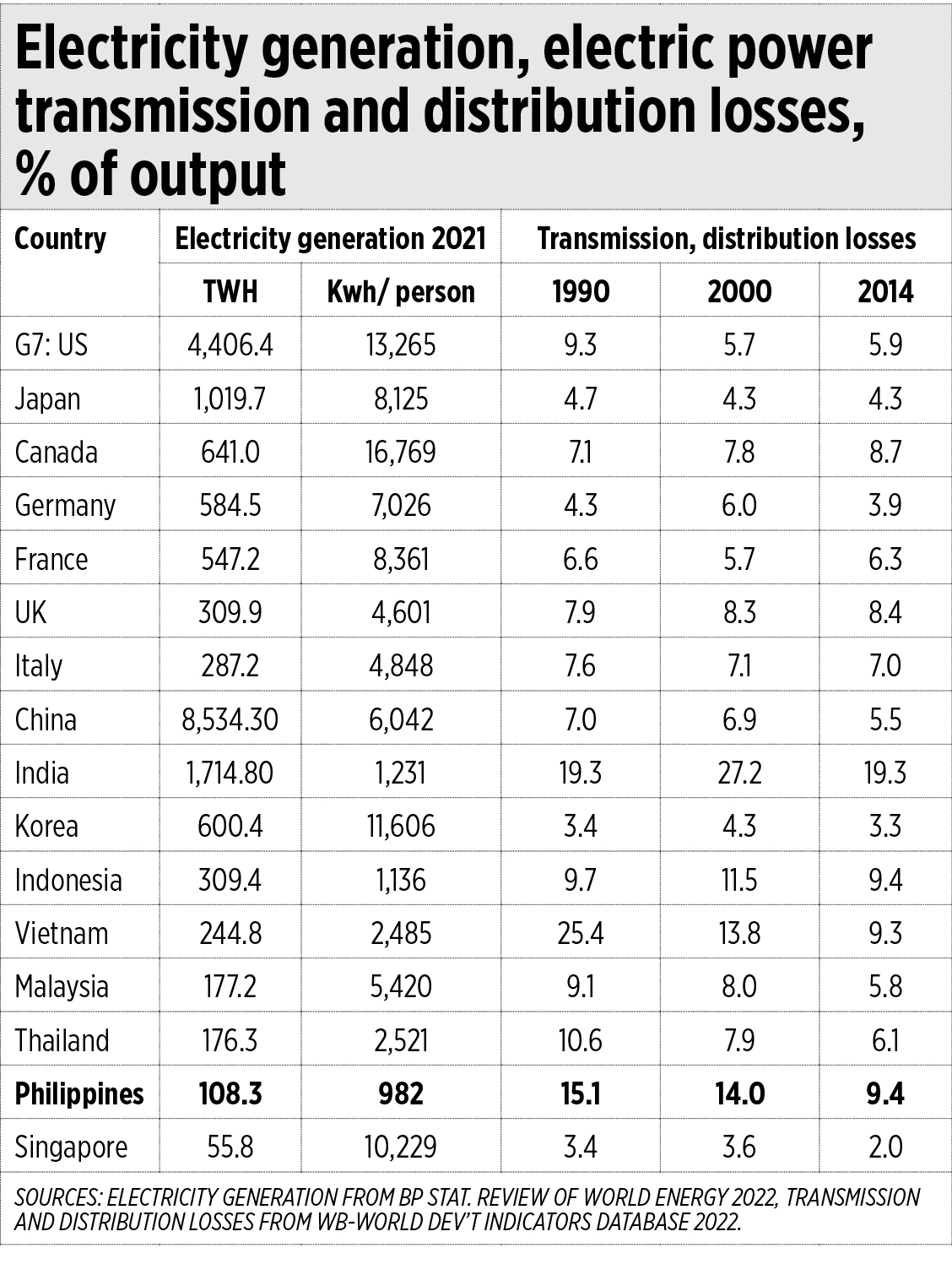
Somehow this is true. The Philippines has the lowest power generation in both total terawatt-hours (TWH) and kwh per capita in major economies of East Asia. I saw data from the World Bank — the Philippines has high transmission and distribution losses, 9.4% of total electricity output in 2014, the latest data available by the WB (see table).
But it is possible also that some power generation companies are discouraged from expanding capacity because an expanded supply killed or restricted by transmission line tripping would mean immediate power plant tripping, business losses, and they will be blamed after even if the fault does not lie in them.

What needs to be done?

Let me start with these direct no-nonsense proposals from an industry insider (he gave me permission to use this): 1.) Have enough reliable reserves, 2.) Strengthen the transmission backbone, ensure solid ancillary services (AS), 3.) DoE to compel all sectors to cooperate — this is not just NGCP, this is symptomatic of an industry wide problem —, and, 4.) Include inefficient ECs in the inventory and help off-grid areas.

Amen to that.

Plus, there are these two as reported in BusinessWorld: “NGCP warned red alerts may ultimately go before Congress” (May 9), “Palawan, Mindoro called ideal sites for nuclear reactor facilities” (May 8).

Yes, the NGCP franchise monopoly came from Congress, not from the DoE or the Energy Regulatory Commission or Malacañang. With this serious problem of frequent yellow-red alerts in the country, 33 years after the big blackouts of 1990-1991, Congress should now assert its oversight function on private corporations which got franchise monopolies from them.

And for the off-grid islands that run practically on 100% fossil fuels via big gensets from the National Power Corp. and private power companies, the subsidy given to them via the universal charge for missionary electrification (UC-ME) — now at P0.178/kwh and soon to become P0.33/kwh — should end. Small modular reactors (SMRs) will greatly help the off-grid islands and provinces to end frequent blackouts and dependence on subsidies from on-grid consumers, from Cagayan to Zamboanga.


Bienvenido S. Oplas, Jr. is the president of Bienvenido S. Oplas, Jr. Research Consultancy Services, and Minimal Government Thinkers

minimalgovernment@gmail.com

Is there a hidden agenda?

FREEPIK

THE “agenda” is part of corporate protocol. Its root word comes from the Latin “agere,” in its gerundive form “agendum” — things to do. Invitations to attend business meetings are accompanied by an agenda which lists the topics to be taken up. There is no indication of how long each topic will take, depending as this does on the one presenting (How many slides does he need?) as well as the inquisitors at hand. Certain committee members take pride in prolonging the discussion by asking irrelevant questions just to show off their cluelessness — what is the middle name of Thomas Edison?

Even socially, an invitation for lunch, unless it’s with a regular group, is prefaced by a query as the available time is coordinated — What do you want to talk about? A noncommittal response of just catching up on each other’s activities is likely to raise the suspicion of some ulterior motive. Is there a hidden agenda?

Something out of the ordinary in an organization is bound to arouse suspicion of some other activity going on. If a long-retired executive, known to be a corporate “hit man,” is called back to interview key executives regarding a recent crisis in the company, the question arises on where this process is headed. What is the real agenda here?

Political moves like the promotion of a constitutional review always invite questions of motives and the real intention of the self-appointed legislative crusader, better known for his role in movies. Is the constitutional review intended to promote economic development? Sometimes, the personality involved doesn’t always give a clue on his true agenda — is he promoting autarky as an economic policy?

Even with an agenda for a meeting, there is a last item marked “other matters.” No further details are given on this ambiguous heading. This surprise number can be anything from a list of redundant executives to be given an exit package to the scheduling of a thanksgiving party for being voted “the best company to work for.”

“Other matters” as a category is the last item before adjournment. There is nothing else on the plate, and this non-item serves as a signal for the rush to the rest room. The chair looks around the table and intones — There, being no other matters for consideration, do I hear a motion to adjourn?

The undisclosed matters prevent attendees from leaving after their own presentations. The possibility that this hidden agenda may involve an absent party (Where did he go?) keeps everyone in his seat. The unidentified topic forestalls a slow erosion of participants. It projects the same allure of a raffle prize available only to those who are still around when their names are called — and the three-night free stay at a deluxe hotel in Boracay goes to…

Other matters can also be prefaced by a call for an “executive session” which requires certain attendees to be excused from further participating on the subject to be taken up. This could be the announcement of a new CEO to be joining the company in another month.

There is no substitute for preparedness for hidden agendas.

Even innocent-sounding queries from colleagues may have some significance. (Where were you when the brown matter hit the ceiling fan?) Taking a moment to understand the question may save your career. Another question as a response is a good delaying tactic; it also offers an opportunity to peel away the covers of the real query — what do you mean?

Of course, being always on the lookout for ulterior motives can make one look too guarded, even insecure. To always be suspicious of even the most innocent greeting can create the image of paranoia. Someone asking how your weekend went may indeed just be making small talk. A beady expression of guilt (Why do you want to know?) can only invite suspicions of mental instability. Such defensive behavior projects insecurity, even having something to hide. Can a request for a medical check-up be far behind? (Please include an interview with a psychiatrist.)

Only in hindsight do the once hidden agendas come to light. The motives behind the innocent invitations to dinner and team-building exercises out of town are confirmed. Of course, by the time the real agenda is revealed… it’s too late to do anything about it.


Tony Samson is chairman and CEO of TOUCH xda

ar.samson@yahoo.com

Donald Trump sexually abused writer E. Jean Carroll, jury says

E. JEAN CARROLL departs from the Manhattan Federal Court following the verdict in the civil rape accusation case against former US President Donald Trump, in New York City, US, May 9, 2023. — REUTERS

NEW YORK — Donald Trump must pay $5 million in damages for sexually abusing magazine writer E. Jean Carroll in the 1990s and then defaming her by branding her a liar, a jury decided on Tuesday.

“Today, the world finally knows the truth,” Ms. Carroll said in a statement. “This victory is not just for me but for every woman who has suffered because she was not believed.”

The former US president, campaigning to retake the White House in 2024, will appeal, his lawyer Joseph Tacopina told reporters outside the Manhattan federal courthouse.

Ms. Carroll, 79, testified during the civil trial that Mr. Trump, 76, raped her in a Bergdorf Goodman department store dressing room in Manhattan in either 1995 or 1996, then harmed her reputation by writing in an October 2022 post on his Truth Social platform that her claims were a “complete con job,” “a hoax” and “a lie.”

Mr. Trump was absent throughout the trial which began on April 25. In a post on his Truth Social platform, Mr. Trump called the verdict a “disgrace” and said, “I have absolutely no idea who this woman is.” Because it was a civil case, Mr. Trump faces no criminal consequences and, as such, there was never a threat of prison.

The jury, required to reach a unanimous verdict, deliberated for just under three hours. Its six men and three women awarded Ms. Carroll $5 million in compensatory and punitive damages, but Trump will not have to pay as long as the case is on appeal.

In April, Mr. Trump gave election regulators only the rough estimates of his wealth that are required in financial disclosures, listing over a dozen properties as worth “over $50 million” each.

‘CORE PRO-TRUMP VOTERS ARE NOT GOING TO CHANGE’
President from 2017 to 2021, Mr. Trump is the front-runner in opinion polls for the Republican presidential nomination and has shown an uncanny ability to weather controversies that might sink other politicians.

It seems unlikely in America’s polarized political climate that the civil verdict will have an impact on Mr. Trump’s core supporters, who view his legal woes as part of a concerted effort by opponents to undermine him.

“The folks that are anti-Trump are going to remain that way, the core pro-Trump voters are not going to change, and the ambivalent ones I just don’t think are going to be moved by this type of thing,” said Charlie Gerow, a Republican strategist in Pennsylvania.

Any negative impact is likely to be small and limited to suburban women and moderate Republicans, Mr. Gerow said.

Mr. Trump has cited the Carroll trial in campaign fundraising emails as evidence of what he portrays as a Democratic plot. He has said Ms. Carroll, a former Elle magazine columnist and a registered Democrat, made up the allegations to try to increase sales of her 2019 memoir and to hurt him politically.

His poll numbers improved after he was charged last month with falsifying business records over a hush money payment to a porn star before his victory in the 2016 presidential election.

The first US president past or present to be criminally charged, Mr. Trump has pleaded not guilty and said the charges are politically motivated.

Lis Smith, a Democratic strategist, said it remained to be seen whether the verdict in Carroll’s case would make Trump “unpalatable” to Republican voters beyond his base, prompting them to coalesce around another candidate.

The trial featured testimony from former People magazine reporter Natasha Stoynoff, who told jurors that Mr. Trump cornered her at his Mar-a-Lago club in Florida in 2005 and forcibly kissed her for a “few minutes.” Another woman, Jessica Leeds, testified that Mr. Trump kissed her, groped her and put his hand up her skirt on a flight in 1979.

Jurors also heard excerpts from a 2005 Access Hollywood video in which Mr. Trump says women let him “grab ‘em by the pussy.”

“Historically, that’s true, with stars … if you look over the last million years,” Mr. Trump said in an October 2022 video deposition played in court. He has repeatedly denied allegations of sexual misconduct.

TRUMP MISTAKES CARROLL FOR EX-WIFE
Carroll testified that she bumped into Mr. Trump at Bergdorf’s and agreed to help him pick out a gift for another woman. The two looked at lingerie before he coaxed her into a dressing room, slammed her head into a wall, pulled down her tights and penetrated her, she testified. Ms. Carroll said she could not remember the precise date or year the alleged rape occurred.

Jurors were tasked with deciding whether Mr. Trump raped, sexually abused or forcibly touched Ms. Carroll, and were separately asked if Mr. Trump defamed Ms. Carroll. The jurors found Mr. Trump sexually abused her but not that he raped her.

Before the jurors began deliberating, Judge Lewis Kaplan defined rape for them as non-consensual “sexual intercourse” through “forcible compulsion.” He described sexual abuse as non-consensual “sexual contact” through forcible compulsion.

Jurors awarded Carroll $2 million in compensatory damages and $20,000 in punitive damages for her battery claim, and $2.7 million in compensatory and $280,000 in punitive damages for her defamation claim.

Mr. Trump’s legal team attacked the plausibility of Ms. Carroll’s account including why she had never reported the matter to police or screamed during the alleged incident.

Two of Ms. Carroll’s friends said that she told them about the alleged rape at the time but swore them to secrecy because she feared that Mr. Trump would use his fame and wealth to retaliate if she came forward.

Ms. Carroll told jurors she decided to break her silence in 2017 after rape allegations against Hollywood producer Harvey Weinstein prompted scores of women to come forward with accounts of sexual violence by powerful men. She went public with her account while Mr. Trump was president.

She said Mr. Trump’s public denials wrecked her career and instigated a campaign of vicious online harassment by his supporters.

While Mr. Trump did not testify at the trial, a video clip from the October 2022 deposition showed him mistaking Ms. Carroll for one of his former wives in a black-and-white photo among several people at an event.

“It’s Marla,” Mr. Trump said in the deposition, referring to his second wife Marla Maples. Previously Mr. Trump had said he could not have raped Ms. Carroll because she was “not my type.” — Reuters

Treasury advisers warn of ‘seismic’ impact from US debt payment delays

REUTERS

WASHINGTON — Wall Street executives who have advised the US Treasury’s debt operations for the past 25 years warned on Tuesday they are “deeply concerned” about the debt limit impasse that has markets worried about a US default on payment obligations.

The 18 current and former chairs and vice chairs of the Treasury Borrowing Advisory Committee (TBAC) since 1998 said in a letter to Treasury Secretary Janet Yellen, “Any delay in making an interest or principal payment by Treasury would be an event of seismic proportions, not only for financial markets but also the real economy.”

The advisers said the standoff between Republicans and Democrats in Congress and the White House has already raised taxpayer borrowing costs through weak Treasury auctions and high yields for short-dated Treasury Bills, while ratings agencies are already publishing analyses of potential US ratings downgrades.

“There will be a direct impact on any issuer whose credit relies on backing from the US government,” such as mortgage entities Fannie Mae and Freddie Mac, municipal issuers or Amtrak and the Tennessee Valley Authority. “A US government downgrade or default would surge broadly throughout the real economy.”

They said the Treasury market’s role as the backbone of the entire financial system would be called into question, leaving the debt market without a benchmark pricing firm and causing investors to pull back from fixed-income and equity markets.

“The validity of Treasuries as eligible collateral for margin would be called into question, with devastating consequences for interest rate derivative, commodity, and mortgage markets,” wrote the chairs, led by current TBAC chair Beth Hammack of Goldman Sachs GS.N and vice chair Deirdre Dunn of Citigroup C.N.

Their letter was distributed after President Joseph R. Biden met with Republican House of Representatives Speaker Kevin McCarthy at the White House with no signs of softening their positions, though they agreed to continue talks.

The advisers said that following the banking turmoil that started in March, the debate over raising the debt limit is “reckless and irresponsible.”

A protracted negotiation would have short-term costs, but a default is an “unthinkable” event, the executives said. “The magnitude of adverse consequences from a prolonged negotiation, or a default, is unquantifiable, with both the American taxpayer and the U.S. economy bearing the burden,” they wrote. — Reuters

Facebook is wrong to say news lacks economic value, says Canada PM Trudeau

BYCGZR-FREEPIK AND RAWPIXEL.COM-FREEPIK

OTTAWA — Canadian Prime Minister (PM) Justin Trudeau on Tuesday said Meta Platforms, Inc’s opposition to proposed legislation that would compel payment by its Facebook unit and other internet companies for journalistic content was based on a flawed argument that news has no economic value.

Speaking to a parliamentary committee about the Trudeau government’s legislation on Monday, a Meta official said news has a social value, but not an economic value to the company.

“If we are being asked to compensate these publishers for material that has no economic value to us, that’s where the problem is,” Meta’s head of public policy in Canada, Rachel Curran, told the committee.

Mr. Trudeau on Tuesday said, “that argument that the internet giants are putting forward is not just flawed, it’s dangerous to our democracy, to our economy.”

Facebook’s stance against paying news content “shows how deeply irresponsible and out of touch they are,” Mr. Trudeau told reporters in Ottawa.

The legislation, bill C-18 or the “Online News Act,” proposes rules to force platforms like Facebook and Alphabet’s Google to negotiate commercial deals and pay news publishers for their content, a move similar to a ground-breaking law passed in Australia in 2021.

Both Google and Meta have warned they would withdraw access to news articles on their platforms in Canada if the bill were passed into law without amendments. Their main objection is paying for links to news articles posted on their websites that they say would be unsustainable for their businesses.

Facebook says links to news articles make up less than 3% of the content on its users’ feed, and that journalists benefit from posting their work on the social media platform.

“Someone reporting on the horrors in Bucha (in Ukraine) is not trying to get likes on their Facebook page,” Mr. Trudeau said. — Reuters

Women should get regular mammograms starting at age 40 — US panel

FREEPIK

WOMEN at average risk for breast cancer should get screening mammograms every other year starting at age 40, according to a proposed guideline update from the US Preventive Services Task Force (USPSTF), reflecting improved diagnostic technology and treatment.

The update reverses a controversial recommendation made by the panel in 2009, when it advised against routine mammograms for women in their 40s and said biennial screening should start at age 50, unless women and their doctors decided earlier screening was appropriate.

At that time, the net benefit of mammography screening for women in their 40s, minus the potential harms, was small, said Dr. Carol Mangione, the immediate past chair of the USPSTF.

“A lot of things have changed since then,” she said.

Breast cancer rates in younger women have been rising, digital mammography advances have improved their accuracy, and better treatments are resulting in improved survival, she said.

As a result, new computer models suggest that if biennial screening started at age 40 instead of age 50, and if everyone who is eligible got a mammogram, breast cancer mortality in the United States would be reduced by 20%, said Ms. Mangione, who chairs the department of medicine at the David Geffen School of Medicine at the University of California.

The benefit would be even greater for Black women, who generally have more aggressive breast cancers and poorer survival, the panel said.

The Task Force recommendation applies to cisgender women and people assigned female at birth who are at average risk of breast cancer, including those with a family history of breast cancer and certain other risk factors, such as having dense breasts.

The recommendation does not apply to people with a personal history of breast cancer, a very high risk due to certain genetic predisposition or a history of high-dose radiation therapy to their chest at a young age, or a lesion on previous biopsies. These people should consult their healthcare professional for individualized guidance about screening.

The new recommendation does not change what is covered by insurance, because insurance companies in the US are legally required to fully cover mammograms every year for women over age 40 who want them, the panel said.

The USPSTF also said there is not enough evidence to assess the balance of benefits and harms of mammography in women over age 75 or of using ultrasonography or magnetic resonance imaging in women with dense breasts who have normal mammography results.

The potential harms of screening include false-positive results that lead to unnecessary biopsies and sometimes to mistaken diagnoses of breast cancer, research has shown.

The panel’s 2009 recommendation that women in their 40s decide for themselves whether to get mammograms was controversial.

The American Cancer Society (ACS) applauds the return in USPSTF recommendations to begin screening at age 40, Chief Scientific Officer Dr. William Dahut said in a statement.

However, he added, the ACS recommends annual mammograms because “current evidence indicates that biennial screening in (women under age 55) is associated with a diagnosis of more advanced disease.”

American College of Obstetricians and Gynecologists (ACOG) spokesperson Dr. Christopher M. Zahn said in a statement, “ACOG has long asserted that regular screening via mammography starting at 40 years reduces breast cancer mortality in those without additional risk factors.”

“Recognizing that Black women are more likely to die of breast cancer than white women, (the earlier start to screening) could help make a meaningful difference in ensuring that more Black women are diagnosed earlier,” Mr. Zahn added.

The draft recommendation will be available for public comment until June 5, 2023. — Reuters

ADVERTISEMENT
ADVERTISEMENT