Home Blog Page 4852

UBS flags $17 billion hit from Credit Suisse takeover

REUTERS

UBS Group AG expects a financial hit of about $17 billion from thetakeover of Credit Suisse Group AG, the bank said in a regulatory presentation as it prepares to complete the rescue of its struggling Swiss rival.

UBS estimates a negative impact of $13 billion from fair value adjustments of the combined group’s assets and liabilities. It also sees $4 billion in potential litigation and regulatory costs stemming from outflows.

UBS, however, also estimated it would book a one-off gain stemming from the so-called “negative goodwill” of $34.8 billion by buying Credit Suisse for a fraction of its book value.

The financial cushion will help absorb potential losses and could result in a boost to the lender’s second-quarter profit if UBS closes the transaction next month as planned.

UBS said the estimates were preliminary and the numbers could change materially later on. It also said it might book restructuring provisions after that, but offered no numbers.

“The financial information lacks an estimate of restructuring provisions as these will be booked after the transaction closes,” Vontobel analyst Andreas Venditti said in a note.

Analysts at Jefferies have estimated restructuring costs, litigation provisions and the planned winding down of the non-core unit could total $28 billion.

Meanwhile, UBS has implemented a number of restrictions on Credit Suisse while thetakeover is underway.

In certain cases, Credit Suisse cannot grant a new credit facility or credit line exceeding 100 million Swiss francs ($113 million) to investment-grade borrowers or more than 50 million francs to non-investment-grade borrowers, a UBS filing showed.

Credit Suisse obviously found itself in a problem because of lapses in its risk controls and I think just setting these parameters on the ability or standards to lend out is not very unreasonable,” said Benjamin Quinlan, Hong Kong-based chief executive of financial consultancy firm Quinlan & Associates

“Ultimately, from UBS‘ perspective, they will have to wear these risks on their books.”

Credit Suisse also cannot undertake capital expenses of more than 10 million francs as part of the restrictions or enter into certain contracts worth more than 3 million francs per year.

The filing shows Credit Suisse cannot order any “material amendments” to its employee terms and conditions, including remuneration and pension entitlements, till deal closure.

The restrictions “will cause certain clients to leave Credit Suisse” but may not accelerate the pace of outflows already seen, said Quinlan, following UBS‘ statement last week that Credit Suisse had already stemmed asset outflows.


RUSHED INTO DEAL

UBS said it was rushed into the deal and had less than four days to complete due diligence given the ’emergency circumstances’ as Credit Suisse‘s financial health worsened.

UBS agreed in March to buy Credit Suisse for 3 billion Swiss francs ($3.4 billion) in stock and to assume up to 5 billion francs in losses that would stem from winding down part of the business, in a shotgun merger engineered by Swiss authorities over a weekend amid a global banking turmoil.

The deal, the first rescue of a global bank since the 2008 financial crisis, will create a wealth manager with more than $5 trillion in invested assets and over 120,000 employees globally.

The Swiss state is backing the deal with up to 250 billion Swiss francs in public funds.

Switzerland’s government is providing a guarantee of up to 9 billion francs for further potential losses on a clearly defined part of Credit Suisse portfolio.

UBS signaled no quick turnaround for the 167-year-old Credit Suisse, which came to the brink of collapse during the recent banking sector turmoil after years of scandals and losses.

It said it expected both the Credit Suisse group and its investment bank to report substantial pre-tax losses in the second quarter and the whole of this year.

Following the legal closing of the transaction, UBS Group AG plans to manage two separate parent companies – UBS AG and Credit Suisse AG, UBS said last week. It has said the integration process could take three to four years.

During that time, each institution will continue to have its own subsidiaries and branches, serve its clients and deal with counterparties. – Reuters


Trudeau says Canada ready to partner with South Korea on critical minerals, security

PHILIPPINE STAR/KRIZ JOHN ROSALES

 – Canadian Prime Minister Justin Trudeau said on Wednesday his country is ready to partner with South Korea on critical minerals and clean energy projects, and to fend off North Korea‘s nuclear and missile threats.

Addressing South Korea‘s parliament, Trudeau said Canada was committed to increase military engagement to mitigate threats to regional security, while working together with Seoul to denuclearise North Korea.

Canada is ready to strengthen our partnership with friends like Korea on everything fromcritical minerals to high-tech innovation to clean energy solutions,” Trudeau said.

He said the issues will be “at the core” of a summit with South Korean President Yoon Suk Yeol set for later on Wednesday, which will be followed by a press conference and official dinner.

Trudeau arrived in Seoul on Tuesday in the first visit in nine years by a Canadian leader as the two countries seek to boost cooperation on security and critical minerals used in electric vehicles (EVs).

Yoon and Trudeau will sign an agreement on key mineral supply chains, clean energy conversion and energy security cooperation, a South Korean government official has said.

The two countries, whose relations mark the 60th anniversary this year, are also exploring ways to expand security ties including intelligence sharing, while navigating a rivalry between the United States and China.

Trudeau said stability in the Indo Pacific and the North Pacific is essential to global security, and urged North Korea to abandon its weapons programmes and reopen denuclearisation talks.

Canada is committed to increase not just our trade, but also our military engagement as a means of mitigating threats to regional security,” Trudeau said.

“We will continue to call on North Korea to return to dialogue and diplomacy,” he added, vowing support for efforts to build “a denuclearised, peaceful and prosperous Korean Peninsula.” – Reuters

China’s Baidu confident its AI chatbot won’t make mistakes on ‘sensitive topics’

STOCK PHOTO | Image by Gerd Altmann from Pixabay

 – Baidu Inc’s experience in tailoring its search engine to Chinese regulatory requirements makes it confident its AI-driven chatbot won’t make mistakes on “important and sensitive topics”, the company said on Tuesday.

On a call with analysts, Baidu CEO Robin Li said the company was waiting for government approval before launching its ChatGPT-like Ernie bot, which Reuters tests have found refuses to answer a wide range of questions on politics, particularly those pertaining to Chinese government leaders.

“For important and sensitive topics, we have to make sure artificial intelligence will not hallucinate,” Mr. Li said, using the industry term for when AI models generate outputs different from what is expected.

“Given that LLM (large-language model) is more or less a probabilistic model, this task is not trivial at all,” he added, referring to the model used by many AI chatbots, such as ChatGPT and Ernie bot.

Mr. Li said industry regulation was not final yet, and the company would continue to update its strategy as it evolves.

Baidu has been operating search in China for more than 20 years and has extensive experience with Chinese culture and the regulatory environment,” he said.

“Conversely, companies which do not have extensive experience in providing appropriate online content or lacking a track record of working closely with regulators will face significant challenges.”

China’s cyberspace regulator last month unveiled draft measures to manage services driven by generative AI, like Ernie bot, saying that content generated by this frontier technology had to be in line with the country’s core socialist values.

Mr. Li said these measures would benefit Baidu.

“We believe that regulators’ active engagement in generative AI in the early stage will raise the bar to entry, and we are well positioned for that,” he said. – Reuters

Ayala poaches Credit Suisse Philippines head Uy for M&A, sources say

Credit Suisse Group AG’s head of the Philippines Mark Robert Uy is leaving the bank and joining Ayala Corp. in August.

Uy will help with mergers and acquisitions at the Philippine conglomerate, a person familiar with the matter said, asking not to be identified as the information isn’t public.

A spokesperson for Ayala confirmed Uy will join the company in August, and said the firm will disclose his role in due course. A representative for Credit Suisse declined to comment.

Uy has been with Credit Suisse for close to four years, according to his LinkedIn profile. The banker joined JPMorgan Chase & Co. after graduating from Ateneo de Manila University in 2007. He spent nearly 13 years with the US firm, of which more than nine were spent in Singapore, before leaving for Credit Suisse in 2019, the profile shows.

The Philippines has seen about $2.3 billion of deals announced so far this year, led by the $877 million Metro Pacific Investments Corp. acquisition by a consortium headed by Mitsui & Co., according to data compiled by Bloomberg.

Numerous staffers have departed Credit Suisse after UBS Group AG acquired its Swiss rival in a $3.2 billion rescue orchestrated by the country’s central bank. In Asia, Credit Suisse’s former mergers and acquisitions head for Southeast Asia Lim Zi-Kuan, head of financial institutions group in the region Nick Thursby and managing director Rui Wang are also among those leaving the bank, Bloomberg News has reported.

Ayala, which traces its roots back to 1834 when its founding partners invested in a distillery in the Philippines, has interests in sectors such as real estate, banking, water and telecommunications, according to its website. The conglomerate is the largest shareholder in several listed companies including Ayala Land Inc., Bank of the Philippine Islands and renewable energy firm Acen Corp. It also has a 30.7% stake in Globe Telecom Inc.

Shares of Ayala have fallen about 2% this year, giving it a market value of about $7.5 billion.

The conglomerate last month said it’s allocating about half of P19 billion ($339 million) at the parent level to further scale up its emerging businesses: logistics and health care. It’s also setting aside P264 billion for capital spending this year, driven by sustained investment in its property, bank and telecom units. — Bloomberg

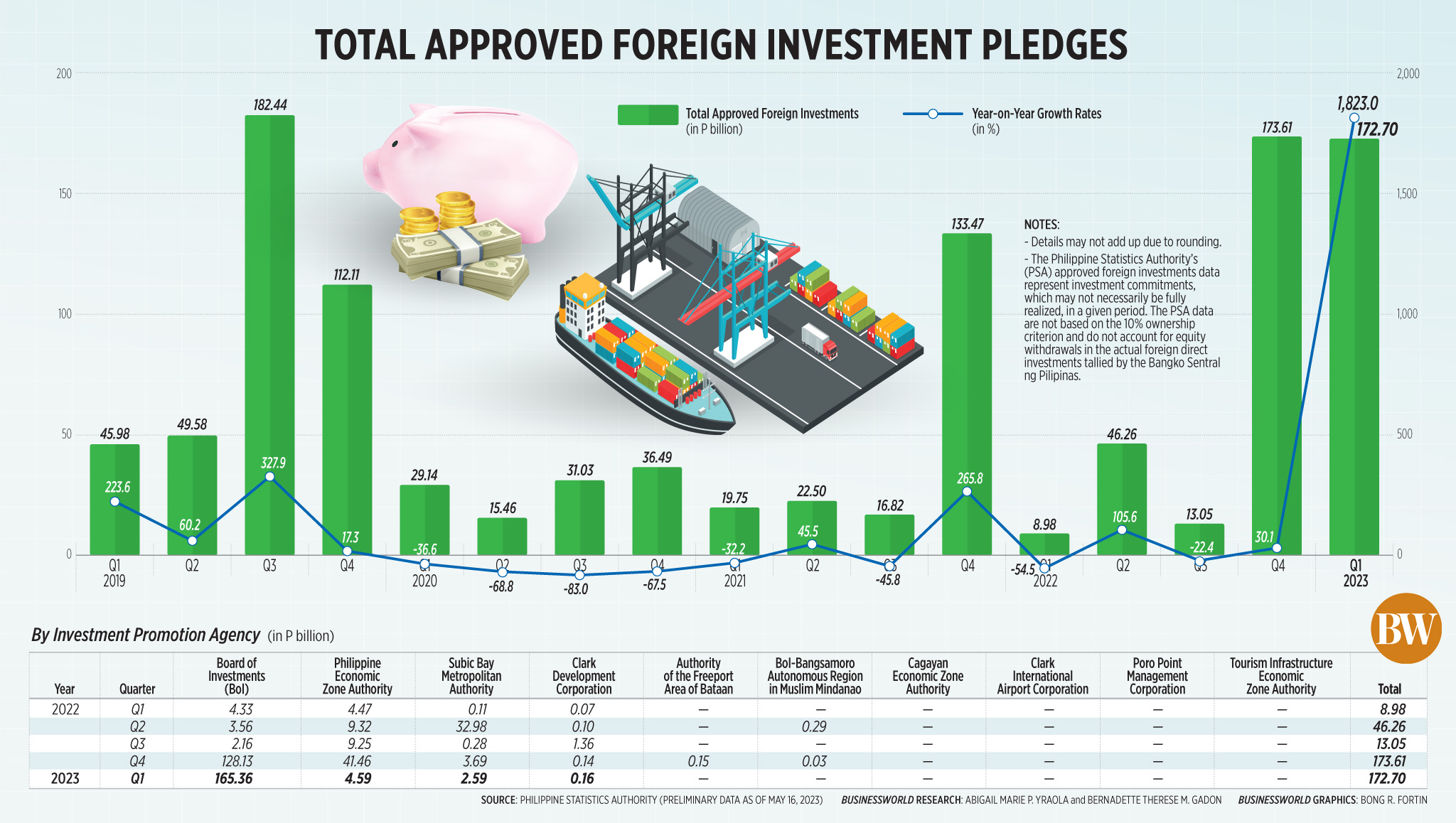
Q1 investment pledges hit P172.7B

Philippine flags are displayed along the streets, June 3, 2022. — PHILIPPINE STAR/EDD GUMBAN
APPROVED foreign investment pledges reached P172.7 billion in the first quarter, the statistics agency said. — PHILIPPINE STAR/EDD GUMBAN

By Abigail Marie P. Yraola, Researcher

FOREIGN INVESTMENT pledges surged in the first quarter, amid the Marcos administration’s efforts to boost the country’s profile as an attractive investment destination, analysts said.

The value of foreign commitments approved by the country’s investment promotion agencies soared to P172.7 billion in January to March, preliminary data from the Philippine Statistics Authority (PSA) showed.

This was nearly 20 times higher than P8.98 billion in the first quarter of 2022, but slightly lower than the P173.61 billion in the previous quarter.

Total approved foreign investment pledges

Germany was the biggest source of approved investment pledges at P156.96 billion (90.9% share), followed by Japan and the Netherlands with commitments worth P3.82 billion (2.2%) and P2.65 billion (1.5%), respectively.

“The Philippines is viewed as one of the most attractive investment destinations in the region, with growth projections expected to outperform if not be the one on top, due to a number of factors, including the country’s strong economic fundamentals and its competitive labor costs,” Robert Dan J. Roces, chief economist at Security Bank Corp., said.

Recent economic reforms, coupled with the economic managers’ international roadshows, have also helped attract new investments, he added.

Structural reforms pushed by the previous and current administrations are now yielding tangible results, said Domini S. Velasquez, chief economist at China Banking Corp.

These include the passage of the Corporate Recovery and Tax Incentives for Enterprises (CREATE) Act, as well as amendments to the Retail Trade Liberalization Act, Public Service Act and Foreign Investment Act.

In a Viber message, Ms. Velasquez said these reforms would continue to drive investments into the country.

“When the amendment to the Public Service Act finally gains traction, we expect investments to improve even further,” she said.

Four agencies, namely the Board of Investments (BoI), Clark Development Corp. (CDC), Philippine Economic Zone Authority (PEZA) and Subic Bay Metropolitan Authority (SBMA), approved the investment pledges in the first quarter.

The BoI accounted for 95.7% of total foreign investment pledges with P165.36 billion.

The PEZA approved P4.59 billion worth of commitments, accounting for 2.7% of the total. SBMA and CDC approved P2.59 billion and P161 million worth of pledges.

About 90.9% or P156.96 billion of the approved foreign investments will go to the energy industry, while P10.49 billion will go to the manufacturing sector. The administrative and support service sector will get P3.59 billion worth of pledges.

More than half (68%) of the foreign investment commitments or P117.38 billion will be for projects in Western Visayas.

Calabarzon (Cavite, Laguna, Batangas, Rizal, Quezon) will get P47.47 billion worth of investment commitments, while Central Luzon cornered P3.28 billion.

Should these foreign commitments materialize, these projects are expected to generate 19,412 jobs, double the 9,655 projected jobs a year earlier.

Meanwhile, total investment commitments from foreign and Filipino nationals soared by 141.8% to P480.36 billion in January to March.

Investment pledges by Filipinos stood at P307.66 billion in the first quarter, accounting for 64% of the total.

The Authority of the Freeport Area of Bataan, BoI-Bangsamoro Autonomous Region in Muslim Mindanao, Cagayan Economic Zone Authority, Poro Point Management Corp., Tourism Infrastructure and Enterprise Zone Authority, and Clark International Airport Corp. did not approve any investment pledges during the period.

“Timely monetary policy, prudent fiscal policy and sound macroeconomic management will provide the necessary assurance to investors that their investments will thrive in the Philippines,” Ms. Velasquez said.

Mr. Roces also kept a positive outlook for foreign investment pledges for the second quarter, citing expectations of strong economic growth.

“However, there are some risks to the outlook, such as the global economic slowdown, geopolitical tension and El Niño feeding into inflation, which could sour sentiment,” he said.

The Philippine economy expanded by 6.4% in the first quarter, the slowest growth rate since the 3.8% contraction in the first quarter of 2021. The government is targeting 6-7% growth this year.

PSA data on foreign investment commitments, which may materialize in the near future, differ from actual foreign direct investments (FDI) tracked by the Bangko Sentral ng Pilipinas (BSP) for the balance of payments. The central bank’s monitoring goes beyond the projects and includes other items such as reinvested earnings and lending to Philippine units via their debt instruments.

Instead of rate cuts, BSP may reduce banks’ RRR

Bangko Sentral ng Pilipinas main office in Manila. — BW FILE PHOTO

MACTAN, Cebu — The Bangko Sentral ng Pilipinas (BSP) might reduce banks’ reserve requirement ratio (RRR) as an alternative to loosening monetary policy, its governor said on Tuesday.

As inflation settles within the 2-4% target by January next year, BSP Governor Felipe M. Medalla said market players might now wonder when the central bank would begin slashing policy rates.

“My answer is, how can we cut if the policy rate difference between us and in the US is already very low?” he said during a financial stability conference. “We must have other ways of loosening monetary conditions even if we cannot cut rates. The easiest thing to do is to cut back the reserve requirements.”

Mr. Medalla said it would be dangerous to cut policy rates faster than the US Federal Reserve because the peso might further depreciate against the dollar.

The US Federal Reserve has hiked borrowing costs by 500 basis points since March last year, bringing the Fed funds rate to 5-5.25%. Market players are expecting the Fed to start keeping rates on hold at its next meeting on June 13-14.

The Philippine central bank has raised the key policy rate by 425 bps to 6.25%, a 100- to 125-bp interest rate difference with the US Fed.

A cut in banks’ reserve requirement is a move intended to be an operational adjustment to facilitate the BSP’s shift to market-based instruments for managing liquidity in the financial system, particularly the term deposit facility and the BSP securities.

The BSP earlier committed to bring down the ratio for big banks to single digits by this year.  The ratio for big banks is 12%, one of the highest in the region. Reserve requirements for thrift and rural lenders are 3% and 2%, respectively.

“We have been waiting for the RRR cut as it improves cost effectiveness for banks,” China Banking Corp. Chief Economist Domini S. Velasquez said.

In March 2020, the central bank cut the RRR, or the percentage of deposits and deposit substitutes banks must keep with the BSP, by 200 bps to 12% to cushion the impact of the coronavirus pandemic.

“We understand that there are timing issues under a monetary tightening environment when delaying the RRR cut. When it happens, possibly in the third or fourth quarter, it will provide liquidity to boost the economy,” Ms. Velasquez said.

A cut in banks’ reserve requirment is very likely to happen this year, Bank of the Philippine Islands (BPI) Lead Economist Emilio S. Neri, Jr. said in an interview.

He noted that the BSP might shore up its reserves before cutting policy rates.

“If the US starts cutting, then portfolio flows will reverse towards emerging markets. This is the best time to rebuild your buffers,” Mr. Neri said.

Gross international reserves (GIR) stood at $101.51 billion in April from $101.55 billion in March, based on preliminary data from the BSP.

The GIR is the amount of all foreign exchange flowing into the country. Having an ample level of foreign exchange buffers safeguards an economy from market volatility and is an assurance of the country’s capability for debt repayment in the event of an economic downturn.

“It’s hard to rebuild your buffers if you cut policy rates. The direction of capital flows will reverse if you cut immediately. Just keep it there,” Mr. Neri said. 

The Monetary Board is widely expected to pause its tightening cycle on Thursday as inflation slowed in recent months. 

A BusinessWorld poll last week showed 13 of 18 analysts expect the Monetary Board to keep rates on hold on May 18. This could be the first time the BSP will leave interest rates untouched since it began hiking in May last year.

Aside from the interest rate differential between the Philippines and the US, the country’s current account deficit might also continue to affect the movement of the peso against the dollar, Mr. Neri said.

The current account deficit was $17.8 billion last year, higher than the $5.9-billion shortfall in 2021, amid a wider trade in goods deficit.

“Imagine, commodities are much cheaper right now, but our current account deficit continues to widen,” he said, adding that this is a challenge for the government.

The current account deficit is seen to end the year at a $17.1-billion deficit, equivalent to -4% of gross domestic product. Current account transactions cover transactions involving goods, services and income. — Keisha B. Ta-asan

Up to 100,000 PHL jobs may become obsolete in next 3-4 years

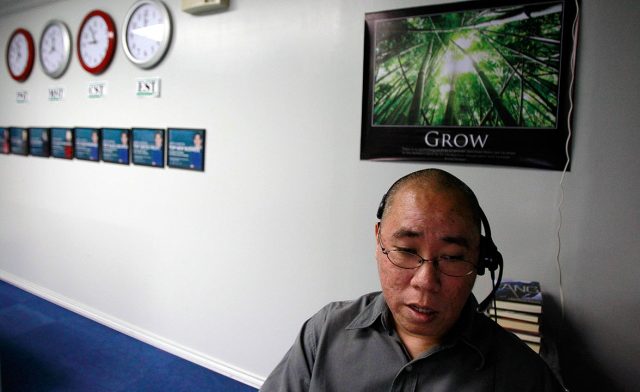
A call center agent talks to a client at an office in Makati City. — REUTERS

AS MANY AS 100,000 jobs in the Philippines might be at risk and could become obsolete amid “rapid global digitalization,” according to management consulting firm Kearney.

“We have done a study on this and there’s a percentage of jobs that will probably become obsolete in the next three to four years. When we were calculating, it came out to about 50,000 to 100,000 jobs that were being netted off,” Kearney Philippines Country Head Marco de la Rosa said during a media roundtable in Taguig City on Tuesday.

Among those that could become obsolete are retail and back-office roles.

“Retail is typically going to be badly hit… Also, any back-office roles that require your traditional data entry, more manual type processes, are going to be impacted as well. That cuts across all sectors and we’re already seeing the impact of that in financial institutions, telecommunications, and the like,” Mr. De la Rosa said.

In a statement, Kearney said the Philippine business process outsourcing (BPO) industry is particularly vulnerable to changing employment trends.

“The Philippines currently has 10-15% of the global BPO workforce, and this industry will be hard-hit by the change in employment trends. If the country wants to retain its spot in the BPO global market, it needs to re-strategize its overall approach,” Kearney said.

As of end-2022, the Philippines’ information technology and business process management (IT-BPM) sector had 1.57 million full-time employees. It generated $32.5 billion in revenues last year, 10% higher than  $29.5 billion in 2021.

Mr. De la Rosa said there is a need to upskill and reskill Filipino workers whose jobs are at risk of becoming obsolete.

“Complex problem solving will still be needed. You’re going to need basic reading comprehension because if you’re going to use a bot, you need to still be able to understand intent. Another need is customer centricity. It’s also a skill that matters because at the end of the day, that human element won’t really go away,” he added.

The Kearney executive noted talent retention is another challenge for Philippine companies.

“We did a study of the most attractive jobs, particularly in the digital space. Philippine wages are about a 10th of developed countries and within even our neighboring countries like Vietnam and Malaysia, it’s about a third of those countries,” he said.

“If you’ve got a highly skilled individual here with the right set of skills, where do you go? You go outside the Philippines. We need to fix that. We’ve got talent here to retain. We need to make sure people come back here.”

While some jobs will become obsolete, Mr. De la Rosa said new roles related to sustainability and digitalization would also be created.

“The new jobs that are going to be created are around designers, more design thinking type roles. Sustainability specialists are also going to be quite important. Any roles that touch on artificial intelligence (AI) and machine learning are going to be important,” he said.

Mr. De la Rosa said there might be some friction in the transition of obsolete jobs to new roles.

“We’ve seen that in other markets as well. We, as a nation, need to be prepared for that period of transition as we go from one type of job to another,” he added.

Kearney said the Philippine government and academics should improve and recalibrate its educational foundation to meet the needs of global talent demand. Companies, on the other hand, have to re-strategize operations and their hiring approach.

“The government also needs to provide incentives and create an attractive working environment to increase sector attractiveness, leverage private-public partnerships to develop future talent, and leverage key success factors from other leading countries on upskilling its workforce,” it added. — Revin Mikhael D. Ochave

Rising credit card usage may lead to spike in household debt

REUTERS
GROSS CREDIT CARD billings surged by 47% to P410 billion in the first quarter, data from the Credit Card Association of the Philippines showed. — REUTERS

By Keisha B. Ta-asan, Reporter

MACTAN, Cebu — A recent surge in credit card usage by Filipinos amid elevated inflation and interest rates could lead to a spike in household debt and pose a risk to financial stability, analysts said.

ING Bank N.V. Manila Senior Economist Nicholas Antonio T. Mapa said rising credit card usage is not a “danger” yet, but could be an issue.

“We’re seeing high credit card usage, some people are saying it’s because of high inflation and high [interest] rates. That is one risk I see, the buildup of household debt,” Mr. Mapa said on the sidelines of a financial stability forum of the Bangko Sentral ng Pilipinas (BSP) and International Monetary Fund (IMF) in Cebu.

Outstanding loans by big banks rose by 10.1% to $10.762 trillion in March, data from the BSP showed. Household borrowings expanded by 21.3% in March year on year. Credit card loans grew by 27.9%, while salary-based general purpose consumption loans rose by 67%.

Data from the Credit Card Association of the Philippines showed gross credit card billings surged by 47% to P410 billion in the first quarter. This was the fastest growth since the coronavirus pandemic started in 2020.

Mr. Mapa noted that consumer credit is normally used for big-ticket items such as household appliances.

“Unfortunately, because of high inflation, (Filipinos) had to use it for consumables,” he added.

Inflation has remained elevated since last year, prompting the BSP to hike borrowing costs by 425 basis points (bps). This brought the key policy rate to a near 16-year high of 6.25%

Bank of the Philippine Islands (BPI) Lead Economist Emilio S. Neri, Jr. said persistent inflation had pushed consumers to borrow more.

“Consumers’ budget is not enough, so they are forced to make do and use a credit line,” he said in mixed English and Filipino.

Mr. Neri said high credit usage could “potentially be a source of risk” but noted that this is manageable.

“Because of the reopening and the strong growth of the economy, it’s really manageable. Compared with the region, our household debt-to-gross domestic product (GDP)  is one of the lowest,” he said.

The Philippine economy grew by 6.4% in the first quarter. This was within the 6-7% growth target of the government, but slower than 7.1 a quarter earlier.

Mr. Neri said geopolitical tensions and financial uncertainties in the United States are risks to the country’s financial stability.

“We’re not sure if US inflation is already controlled. And with the labor markets so strong, who knows, they may still be hiking later this year. We don’t know if their problem is over,” he added.

The US Federal Reserve has raised key policy rates by 500 bps since March last year, bringing the Fed fund rate to 5-5.25%.

But Rizal Commercial Banking Corp. Chief Economist Michael L. Ricafort said higher credit usage could signal improving economic conditions.

“It may also be a measure of greater confidence to borrow on better economic and employment prospects, such as to finance purchases of homes, vehicles and other big-ticket items,” he said in a Viber message.

Mr. Ricafort added that household debt has been about 10% of GDP, which is lower than other Asian countries who “have at least two to three times more than the Philippines.”

Meanwhile, BSP Senior Assistant Governor Johnny Noe E. Ravalo said the central bank is continually monitoring possible and emergent risks to financial stability.

“All data series that the market is worried about needs to be monitored. In our line of area, the risk behaviors that we monitor are not necessarily so obvious from the aggregate data, and we need to study these very carefully,” he said in an interview.

Business units drive GT Capital’s 52% profit rise

GT CAPITAL Holdings, Inc. booked a consolidated net income of P6.64 billion in the first quarter, up 52% from P4.4 billion a year ago, driven by contributions from its business units, it said on Tuesday.

“Our first-quarter financial results show all our operating companies sustaining the high growth momentum of the previous year,” GT Capital President Carmelo Maria Luza Bautista said in a statement.

“With expectations of a more stable macroeconomic environment, less value chain disruptions, and resurgent consumption, our outlook remains positive for the rest of the year,” he added.

The company’s banking unit Metropolitan Bank & Trust Co. (Metrobank) saw its net income jump by 31.3% to P10.5 billion, translating to a 13.1% return on equity, higher than the 10.3% last year. Net interest income rose by 28.8% to P24.9 billion on the back of a 12.5% increase in loans and a 54-basis-point hike in net interest margin to 3.9%.

“Metrobank’s solid performance in the first three months of the year reflects our continued efforts to capture opportunities of a growing economy while we strive to keep our balance sheet strong against risks of volatile market conditions,” Metrobank President Fabian S. Dee said.

Toyota Motor Philippines Corp. (TMP) more than doubled its consolidated net income for the quarter to P4.5 billion from P2.1 billion in the same period last year. Consolidated revenues jumped 28% to P53.7 billion from P42.1 billion previously.

In the first quarter, TMP’s retail vehicle sales increased by 21% to 45,205 units. Although lower than the market growth of 27% to 95,270 units, the company cornered an overall market share of 47.4%.

“TMP has clearly shown a strong performance for the first quarter. The continuing normalization of supply chains has seen the market and Toyota sales volumes expand,” GT Capital Auto and Mobility Holdings, Inc. Chairman, Vince S. Socco said. “Demand for motor vehicles remains robust in line with the sustained high levels of economic recovery. As well, the return of consumer loan financing is further spurring vehicle purchases.”

GT Capital’s property unit Federal Land, Inc. saw its first-quarter consolidated net income decline by 8% to P286 million from P311 million the prior year, while revenues fell by 7.1% to P2.6 million from P2.8 million in the same period last year.

Reservation sales rose by 71% to P6.2 billion due to sales from The Seasons Residences and the Grand Hyatt Residences in Bonifacio Global City, Taguig.

The company’s associate Metro Pacific Investments Corp. (MPIC) booked a consolidated core net income of P4.3 billion in the first quarter, up 38% from P3.1 billion a year ago, after its business holdings recorded better results.

Manila Electric Co. contributed P4.2 billion or 75% of MPIC’s net operating income for the quarter, followed by Metro Pacific Tollways Corp. with a share of P1.3 billion or 23%, and Maynilad Water Services, Inc. with P1.1 billion or 19%.

GT Capital’s other businesses — light rail, healthcare, agribusiness, real estate, and fuel storage — incurred a total net loss of P967 million.

A consortium of companies, which includes GT Capital, had recently submitted a tender offer to buy out the 36.6% minority shares in MPIC amounting to a tender offer price of P4.63 per share.

The company would spend about $70 million for an additional 2.9% stake in MPIC. If realized, its stake in MPIC would increase to 20%.

Meanwhile, AXA Philippines recorded a consolidated net income of P708 million, up 66% from P426 million the prior year, driven by improved margins and net investment income.

Its consolidated life and general insurance gross premiums fell by 23.2% to P6.3 billion from P8.2 billion last year, as investors remain cautious due to market uncertainties.

On Tuesday, GT Capital shares surged 4.21% or P20 to close at P495 each. — Adrian H. Halili

FDC posts ‘solid recovery’ as businesses’ earnings surge

FILINVEST Development Corp. (FDC) on Tuesday reported a surge in attributable net income to P2.2 billion in the first quarter from P874.2 million due to the robust performances from all its businesses.

“We are pleased with the solid recovery of FDC having seen an acceleration in earnings across all the business units,” said FDC President and Chief Executive Officer Lourdes Josephine Gotianun-Yap.

“We expect to sustain this momentum moving forward given the continuous improvement in business activity in the country despite some macroeconomic headwinds. The consistently high domestic demand driven by strong household consumption should bode well for our businesses that are strongly focused on the middle market,” Ms. Gotianun-Yap added.

FDC’s consolidated revenues for the quarter grew by 34%to P20.7 billion, while cost and expenses rose by 27% to P17.3 billion.

Banking and financial services unit East West Banking Corp. tripled its net income for the period to P1.5 billion. Its net interest income rose by 17% to P6.1 billion, fuelled by a 19% expansion in lending activities led by credit cards along with auto and key salary loan segments. Its noninterest income more than doubled to P1.7 billion during the January-to-March period.

The company’s real estate segments Filinvest Land, Inc. and Filinvest Alabang, Inc. reported a total net income of P1 billion, up 10% from P920.6 million in the same period last year. This was propelled by a 20% growth in mall and rental revenues to P1.8 billion.

Residential revenues reached P2.9 billion, up 4% due to construction progress, while office leasing inched up by 2% to P1.1 billion during the quarter.

FDC Utilities, Inc. booked a 25% increase in net income for the period to P614.3 million as its revenues grew by 25% to P3.3 billion. Higher pass-through fuel costs from an increase in power rates resulted in the revenue growth.

“[FDC Utilities] operates an aggregate 405-megawatt clean coal plant located in Misamis Oriental in Mindanao that services a diverse customer base composed of 16 mostly triple A distribution cooperatives and one directly connected customer from the region,” FDC said. 

Filinvest Hospitality Corp. saw its net income more than double in the three-month period to P685.9 million because of an increase in occupancy and room rates for its operations.

Filinvest Hospitality’s portfolio has approximately 1,800 rooms across seven hotels in seven cities and five regions under the Crimson and Quest brands. It had recently acquired Timberland Highlands Resort in Rizal.

Meanwhile, the company said that it is allocating P35 billion for capital expenditures this year, half of which will be earmarked for its real estate and hospitality units.

The balance will be set aside for “investments in new ventures such as renewables, water and other urban solutions.”

FDC shares on Tuesday slipped by 0.69% or P0.04 to end at P5.74 apiece. — Adrian H. Halili


This story has been updated to reflect the changes in the company’s amended press release.

Sia-led DoubleDragon, MerryMart book double-digit income growth

TWO LISTED companies led by Edgar J. Sia II reported double-digit income growth for the first quarter while his listed real estate investment trust (REIT) posted a profit decline.

In a regulatory filing on Tuesday, DoubleDragon Corp. disclosed a 10.8% growth in consolidated net income for the three-month period to P520.09 million. Its consolidated revenues inched up to P1.72 billion.

“DoubleDragon continues to strengthen its position in preparation for the upcoming shift of tide to a fresh new cycle of economic boom years that should naturally follow after a major economic crisis,” Mr. Sia said in a statement.

In a separate filing, listed retailer MerryMart Consumer Corp. recorded a 53% surge in net income during the January-to-March period to P18.98 million. Its revenues reached P1.75 billion during the quarter, up 46.1% from the same period last year.

The company said that it aims to generate about P120 billion in system-wide recurring consumer sales revenue from 1,200 branches nationwide by 2030. Its units are MerryMart Express, MerryMart Market, MerryMart Grocery, and MerryMart Wholesale.

“MerryMart’s subsidiary MM Consumer Technologies Corp. with MBOX Smart Lockers is the first in its consumer technology portfolio that is expected to add and complement to the ecosystem of the MerryMart Group,” the company said.

Meanwhile, DDMP REIT, Inc. saw a 17.5% decline in its net income during the first quarter to P461.13 million from P558.9 million in the same period last year. Its top line declined 13.5% to P553.11 million from P639.37 million the prior year.

Mr. Sia said the group believes that companies showing their ability “to navigate very well the series of major economic crises, such as what we have all experienced, will be in a unique position to capture the extraordinary opportunities” that will present themselves “after all the chaos and once the fire has cleared and the smoke has settled.”

On Tuesday, DoubleDragon shares rose 3% to P7.21 each, while MerryMart shares rose 0.82% to P1.23 apiece. DDMP REIT shares were unchanged at P1.30 each. — Adrian H. Halili

PetroEnergy unit to acquire two existing solar projects in Luzon

YUCHENGCO-LED PetroEnergy Resources Corp. said its renewable energy arm PetroGreen Energy Corp. is set to acquire two existing solar power projects in Luzon.

In a regulatory filing on Tuesday, the company said that PetroGreen will take over the San Jose solar project in Nueva Ecija and the San Pablo solar project in Limbauan, Isabela.

Louie Mark R. Limcolioc, assistant vice-president for legal and corporate of PetroGreen, said the term sheets for the acquisition were signed separately on April 19 with VMARS Solar Energy Corp. and BKS Green Energy Corp.

Mr. Limcolioc said that the transaction will be finalized in the coming weeks.

Maria Victoria M. Olivar, vice-president for commercial operations of PetroGreen, said the San Jose project covers about 17.1 hectares while the San Pablo service contract covers 29.8 hectares.

“Thus, together the two projects can add as much as 60 MWdc (megawatts of direct current) capacity to [PetroGreen’s] solar portfolio when they are fully operational which we target by 2025,” Ms. Olivar said.

PetroGreen, through its subsidiary PetroSolar Corp., is the operator of the 50-MWdc and the 20-MWdc Tarlac-2 solar power facilities in Central Technopark, Tarlac City.

Currently, PetroGreen is developing the 27-MWdc Dagohoy solar project in Bohol and the 25-MWdc Bugallon solar project in Pangasinan.

PetroGreen has a 65% stake in Maibarara Geothermal, Inc., which operates the 32-MW Maibarara geothermal facility in Batangas; the 36-MW Nabas1 wind power project in Aklan under 40%-owned PetroWind Energy, Inc.; and the 70-MWdc Tarlac solar power facility under 56%-owned PetroSolar.

In 2021, the Department of Energy awarded PetroGreen with service contracts for Buhawind Energy Northern Luzon, Buhawind Energy Northern Mindoro, and Buhawind Energy East Panay for a total capacity of about 4 gigawatts.

PetroEnergy shares fell by 6.4% or P0.32 to P4.68 each on Tuesday. — A.E.O. Jose

ADVERTISEMENT
ADVERTISEMENT