Home Blog Page 4851

Nuggets ride Jokic’s triple-double to Game One win over LA Lakers

NIKOLA Jokic had 34 points, 21 rebounds and 14 assists, Jamal Murray scored 31 points and the host Denver Nuggets beat the Los Angeles Lakers 132-126 in Game 1 of the Western Conference finals on Tuesday night.

Kentavious Caldwell-Pope contributed 21 points, Bruce Brown had 16, Michael Porter Jr. added 15 points and 10 rebounds and Aaron Gordon finished with 12 points for the Nuggets.

Game 2 of the best-of-seven series is Thursday night in Denver.

Anthony Davis had 40 points and 10 rebounds, LeBron James finished with 26 points, 12 rebounds and nine assists, Austin Reaves scored 23 points and Rui Hachimura put up 17 points for the Lakers.

Los Angeles trailed by 21 in the third quarter but chipped away at the deficit, getting within three points three times in the final four minutes. Denver responded by scoring the next points each time.

The Lakers opened the fourth on an 8-2 run to pull within 108-100 with 10:10 left.

Porter and Jeff Green hit corner 3-pointers and Murray scored on consecutive possessions to make it 118-104.

Los Angeles got within 124-118 with 3:53 left, and a Nuggets turnover led to a Reaves 3-pointer that made it a three-point game. Denver got the margin back to six, but another Reaves 3-pointer made it 127-124 with 2:18 left.

James had a chance to tie with 45 seconds left but missed a 3-point attempt, and Jokic closed it out at the line.

Denver used a 36-13 edge in rebounding to take a 72-54 lead into halftime. Jokic had 12 rebounds in the first quarter and finished with 16 for the half to go along with 19 points and seven assists.

Murray hit a pair of 3-pointers at the start of the third, giving the Nuggets a 78-58 lead. Jokic notched his triple-double when he fed Caldwell-Pope for a floating jumper midway through the third quarter. It is his 12th postseason triple-double, the most by a center in NBA history.

Jokic put the Nuggets ahead 93-72 with a 3-pointer and fed Caldwell-Pope for another before Los Angeles closed the third strong. The Lakers went on a 16-7 run, but Jokic drained a 28-footer at the quarter buzzer to make it a 14-point game entering the fourth. — Reuters

Spurs win NBA draft lottery; Victor Wembanyama on the way

THE SAN ANTONIO SPURS may have lost 60 games this season, but they were huge winners Tuesday night in Chicago when they prevailed in the Victor Wembanyama sweepstakes.

The Spurs were one of three teams with a 14 percent chance of landing the top pick in the NBA draft lottery and now will surely use the pick on Mr. Wembanyama, the 19-year-old French sensation, in the June 22 draft.

San Antonio has landed big-time stars with the No. 1 overall choice in the past, selecting David Robinson first in 1987 and Tim Duncan 10 years later.

“It’s a really special moment that I will remember for the rest of my life,” Wembanyama said from Paris on ESPN. “… I’m trying to win a ring ASAP.”

The 7-foot-4 Mr. Wembanyama is considered the best NBA prospect since LeBron James went No. 1 overall in 2003.

“I might faint, I’m so excited,” Spurs managing partner Peter J. Holt said on ESPN’s broadcast. “The city of San Antonio, our fans, we just have so many people that love the Spurs. We’re pumped.”

The Charlotte Hornets will select second, followed by the Portland Trail Blazers and Houston Rockets. Houston also had a 14 percent chance of winning the lottery.

The Detroit Pistons, the third team with a 14 percent chance of landing the first pick, will choose fifth.

Scoot Henderson of G League Ignite and Alabama’s Brandon Miller are the leading candidates to be the No. 2 and 3 picks.

Wembanyama played his final regular-season game in France on Tuesday and scored 22 points as Boulogne-Levallois recorded a 93-85 win over Paris Basketball. He scored 14 of his points in the fourth quarter for the Metropolitans 92.

“He’s 19 and his life is going to totally change,” Metropolitans 92 coach Vincent Collet told reporters afterward.

Wembanyama will have to adjust to living in a foreign country as well as playing against the best men in the world. Though if he lands with the Spurs, he will be coached by legendary Hall of Famer Gregg Popovich.

Only time will tell whether the Spurs hit the No. 1 overall pick jackpot again.

Robinson and Duncan are both members of the NBA’s 75th anniversary all-time team and have been inducted into the Naismith Memorial Basketball Hall of Fame. They both were the key figures of numerous championship teams, with Mr. Duncan earning five title rings and Mr. Robinson winning two.

Spurs general manager Brian Wright, who was in the drawing room in Chicago, immediately felt the impact of winning the lottery.

“I’m excited for the city, for the franchise,” Mr. Wright told reporters. “Tonight was a great start. It’s the beginning, not the end. There is still a lot of work to do.”

San Antonio has missed the playoffs in four straight campaigns and the 22-60 record this season was the third-worst in franchise history.

The Orlando Magic own the sixth and 11th picks, the latter coming from the Chicago Bulls as part of the package for acquiring Nikola Vucevic in 2021.

The Indiana Pacers will pick seventh, followed by the Washington Wizards, Utah Jazz and Dallas Mavericks. Dallas landing the 10th pick was crucial for the franchise: If the pick had been 11th or lower, it would have gone to the New York Knicks as part of the 2019 deal for Kristaps Porzingis.

The Oklahoma City Thunder will select 12th, followed by the Toronto Raptors and New Orleans Pelicans. — Reuters

Health, good conscience and shelter

TIRACHARDZ-FREEPIK

“A comfortable home is a great source of happiness. It ranks immediately after health and a good conscience.” — Sydney Smith

The above quote from Smith perhaps captures one of the rights of a citizen that the State should provide, shelter, aside from health, water, education, and food security. These rights are to be guaranteed by a State as part of its covenant with its citizens, the people it is supposed to serve. The citizens, for their part, are to conduct their business in a legitimate way — the state provides the environment, the justice system and law and order so that citizens can create viable enterprises that will allow them to pay the taxes that the State needs to provide these essential services with a minimum level of quality. That is basically the two-way covenant, and for it to survive, the State needs to create a vigorous middle class. A strong and participative citizenry conscious of its civic obligations is therefore essential to the survival of a democracy, if not civilization itself.

Smith captures the role of housing/shelter in a human being’s life and how it promotes good order in society. Smith was regarded as one of the foremost English preachers from the late 1770s to the time of his death in 1845. He was also known as a wit and moral philosopher whose father was an equally popular preacher. He had obliged Sydney to become a cleric rather than pursue a career in law. Sydney studied chemistry and medicine and was known to have performed community work. Proof of his credibility was the huge, standing-room-only audiences he attracted.

How relevant is this quote from Smith and tidbits from his life to our present situation as a country? Especially with respect to having a comfortable home which Smith believed “ranks immediately after health and a good conscience”?

Secretary Jose Rizalino Acuzar of the resuscitated Department of Human Settlements and Urban Development (DHSUD) has, with the approval of the Philippines’ top chief executive, Ferdinand Marcos, Jr., and with the support of Congress and the Local Government Units (LGUs), has come up with the long-delayed but ambitious housing program called the Pambansang Pabahay Para sa Pilipino Housing (4PH) Program. The aim of 4PH, a brainchild of Acuzar which he took up with Marcos Jr. as early as the 2022 presidential campaign period, aims to bridge the country’s housing backlog, pegged at more than 6.5 million units as of the end of 2022. This will hopefully be achieved by building one million houses per year for the next six years, or up to 2028.

Some housing advocates and lawmakers have described 4PH as “innovative and out-of-the box” because they claim that it “is unlike the traditional housing program that depends solely on government funding in the implementation of housing projects.” Data shows that if the same traditional approach is adopted, the country’s housing backlog could balloon to about 11 million units by 2028, according to DHSUD.

The brains behind 4PH state that the program’s strength is that it addresses the two main bottlenecks in the housing sector — affordability and access to funds. Taking a different tack, the program focuses on the provision of interest support (estimated at P35 billion a year) to beneficiaries.

Reflecting on the innate multiplier effect of housing programs, the DHSUD asserts that full blast construction could trigger economic activities to 80 allied industries like cement, steel, lumber, etc., and create job opportunities for 1.7 million workers a year.

The program taps investible funds from government financial institutions and the private sector by promoting public-private partnerships and joint venture agreements in the housing sector.

In a recent update, DHSUD emphasized that the Pag-IBIG Fund has allocated P250 billion for 4PH while both the Land Bank of the Philippines (a financial institution created to support the agrarian reform program) and the Development Bank of the Philippines (DBP) have expressed willingness to support it. We, however, wonder how the proposed merger of the two banks or the rumored absorption by LANDBANK of the DBP could affect these well laid out plans of Acuzar.

At the operating level, the 4PH strategy is to prioritize vertical housing and mixed-use development, obviously to maximize land use where the topography of the area will allow full development of vertical housing. Part of the 4PH strategy is to focus on informal-settler families and low-income earners.

What are the respective roles of employers and LGUs whose support in any national program is essential? The LGUs are involved in the project conceptualization, identification of beneficiaries, and the sustainability of the program. One aspect worth seriously examining is to what extent, if any, will aspects of the program be devolved to LGUs? In general — and this may be a sweeping statement — the National Government has not been too effective in implementing national programs.

How has the 4PH progressed since its high profile launch several months ago, shortly after Acuzar was confirmed by the Commission on Appointments?

The DHSUD reports that 142 Memorandums of Understanding (MOUs) were signed with LGUs and 25 ground-breaking ceremonies completed. In addition to soliciting the support of LGUs, the DHSUD is relentlessly engaging other stakeholders, most recently with the urban poor and Overseas Filipino Workers (OFW) groups.

The stakeholders are, of course, the lawmakers, LGUs, key shelter agencies, private developers, civic organizations, and other groups which have been keenly interested in housing as a key growth area.

After a few months on the job, Acuzar, who ought to know what he’s talking about having earned his spurs at the National Housing Authority (NHA) in the 1970s, proclaims that the program is inclusive and sustainable “so no one will be left behind.” He says he has engaged various cause-oriented groups, the urban poor, and even our OFWs to get their input and align their respective programs to 4PH.

Acuzar adds that “for some, building one million homes per year is ambitious, if not impossible. But I strongly believe that it can be done if we work together and synchronize efforts of all stakeholders in the housing sector, both public and private.”

Acuzar insists that 4PH has a twin goal of producing decent and affordable shelters and establishing sustainable and inclusive housing communities. The chief executive of the DHSUD, which is the lead agency in the management of housing and human settlements, says that in every housing project, “he espouses township development to ensure the livability of every family that will occupy these dwelling places.”

By township projects, Acuzar means “mixed-use development to provide the inhabitants easy access to sources of livelihood and basic services within their communities.” The program is also guided by the very definition of transit-oriented development to maximize the amount of residential, commercial and leisure spaces within walking distance or easy access to public transportation.

Solving the housing shortage is obviously a gargantuan task, and problems of this magnitude will always require, with no exception, an inter-agency, multi-disciplinary approach, bearing in mind that the problem of the mushrooming of communities of informal settlers appears to be, at first glance, a housing problem, and to a great extent, a livelihood problem. People go where money is to be made whether it is in vending cigarettes, washing cars, or doing other people’s laundry, or engaging in petty theft and street crime.


Philip Ella Juico’s areas of interest include the protection and promotion of democracy, free markets, sustainable development, social responsibility and sports as a tool for social development. He obtained his doctorate in business at De La Salle University. Dr. Juico served as secretary of Agrarian Reform during the Corazon C. Aquino administration.


Solar roads

SOLAROAD.NL

As far back as eight years ago, in 2015, South Korea and the Netherlands both incorporated solar panels in road construction. In particular, both countries have built solar bicycle lanes where dedicated roads for cyclists are lined with solar panels. In the case of Korea, the panels went on top. But in the Netherlands, the panels went to the bottom.

In South Korea, the panels work as a solar-powered roof that shelter cyclists from the sun and rain. At the same time, they generate electricity to power lighting and vehicle charging stations along a 32-kilometer highway with three lanes on each side. The bicycle lane is at the center island of the highway, protected by steel crash barriers. Cyclists use underground tunnels to enter and exit the bike lane.

The six-lane highway runs between Daejeon and Sejong. Although online publication road.cc reports that “it isn’t clear how much cyclists are protected from the noise, pollution, and turbulence by the [solar] pavilion.” Daejeon is South Korea’s fifth largest metropolis, while Sejong is the de facto administrative capital.

The website Interesting Engineering reports that the highway connects Daejon and Sejong “in a much more efficient and safer manner.” But the bike lane has its “drawbacks,” such as “the noise of the highway, potential health issues related to breathing in vehicular fumes and emissions of the fast-moving cars and trucks, and the possibility of a driver hitting the barriers at some point.”

“Therefore, public opinion on the [bike] lane is divided: While some think that it’s a fantastic idea that represents the first move toward making similar commuting-style bike lanes in the future, some think the side of the road would be a better placement,” it adds. “Still, this highlights the potential our cement roads hold.”

The Netherlands, on the other hand, opted to use the solar panels as the bike lane itself, rather than its roof. Website Science Alert refers to the lane as the “energy-harvesting bike path.” It reports, “engineers say the system is working even better than expected, with the 70-meter test bike path generating 3,000 kWh, or enough electricity to power a small household for a year.”

Science Alert notes that the Netherlands was the first country to put the solar road idea into “practice” with the bike path in Krommenie, a town north of Amsterdam. “The solar panels used on the Dutch bike path are sandwiched between glass, silicon rubber, and concrete, and are strong enough to support 12-ton fire trucks without any damage. Each individual panel connects to smart meters, which optimize their output and feed their electricity straight into street lighting, or the grid,” Science Alert reports.

But the project took a lot of work, with engineers reportedly spending five years “creating the system to be durable.” And then more than 150,000 cyclists were asked to test the solar panels by riding ride over them. The panels were said to have been designed to take in as much sunlight as possible, and to also match the life of rooftop solar panels.

And while the Koreans and the Dutch have taken the lead, the Chinese are not far behind. China has constructed a one-kilometer “solar” road in the Shandong province capital city of Jinan. Website Solar.com reports that the road spans 5,875 square meters and covers it with “a top clear concrete layer, a middle solar panel, and a bottom layer of insulation.”

The road is said to generate an estimated one million kWh of electricity annually — which is reportedly enough to provide basic electricity needs to about 800 residences. Website NS Energy reports that the “Chinese government plans to use the electricity created by its solar highway to power streetlights, billboards, and CCTV cameras, as well as to heat the roads surface to melt any snow that gathers on it.”

NS Energy adds, the road “comprises a protective surface layer made of transparent concrete, which can reportedly handle 10-times the pressure of standard asphalt. Beneath that is a middle layer of solar-powered batteries, which generates the road’s electricity, above a waterproof insulation layer to prevent any dampness from the ground below. It’s estimated that roughly 40,000 cars will be able to drive over the solar highway every day, with two lanes to choose from in addition to an emergency lane to help ease congestion.”

Cost, however, is a factor to consider. The China solar highway reportedly costs 90 times more than a regular highway. “Solar roads do have a greater upfront cost than traditional roads,” Solar.com reports. “However, project designers hope that solar roads’ durability will make repaving projects — which are traditionally required every couple of years — unnecessary.”

And, as far as vehicle traction issues go, Solar.com notes that experts believe solar roads are safe since “the surface layer uses a plastic-like substance that actually has more friction than traditional roads.” But solar roads are “less efficient than optimally positioned panels, with only about half of traditional output, due to cars blocking out sunlight.”

And this is where the Korean project, I believe, presents a more compelling example of how to incorporate solar panels in road and highway design. By using the panels on top, as shade or a roof, rather than as the road itself, the panels are optimally positioned to catch sunlight for longer periods. Moreover, regular panels can be used, instead of special panels designed to carry heavy loads.

We are now embarking on a major project to rehabilitate our railways. The work will involve new tracks, trains, and stations. Imagine the potential of that project to make use of as many solar panels as possible at stations, along the side of the tracks, and on train tops. India is already using a solar-powered train, with panels on top, while China’s largest train station, at 68 hectares, got a solar roof.

In the Makati Central Business District, there is a kilometer-long elevated walkway along Dela Rosa St. that is constantly exposed to the sun. And there are lots of building rooftops as well as pedestrian walks and waiting sheds that can be roofed with solar panels. Even large open parking spaces can be roofed or shaded with solar panels.

Solar technology is now available to everybody. The Koreans, the Dutch, and the Chinese showed the way as early as eight years ago. Our policymakers and investors should consider lining roadways or pedestrian walks with solar panels. After all, the Philippines has more sunshine than those countries. More important, that sunshine is free.


Marvin Tort is a former managing editor of BusinessWorld, and a former chairman of the Philippine Press Council

matort@yahoo.com

Climate cycle, climate loans, and the PPP Act

With endless “climate crisis” or “climate catastrophe” narratives that we hear and read, we have been led to embrace more wasteful, bottomless climate loans and climate bureaucracies.

See how the multilaterals like the Asian Development Bank (ADB) and World Bank (WB) lobby in stories published in BusinessWorld this month alone: “ODA, loans not enough for climate goals — ADB” (May 4), “PHL to host Asia-Pacific conference on disaster risk reduction” (May 8), “Gov’t seeks $500-million climate risk loan from WB” (May 11), “ETM seen helping PHL accelerate transition to clean energy” (May 16).

The Energy Transition Mechanism (ETM) is an economically dangerous and blackout-friendly climate loan scheme concocted by the ADB to fast-track the transition from fossil fuels to renewables, especially wind-solar. Buy out then kill via early retirement of coal plants and invest more in wind-solar. As of the first quarter of 2023, coal contributed 61% of total electricity generation in the Philippines, while wind and solar combined contributed only 4%. See how blackout-prone the Philippines will be if such a dangerous and economically suicidal policy is enforced.

THE CLINTEL REPORT
Last week, on May 9, the Climate Intelligence Foundation (Clintel), an Amsterdam-based independent think tank founded in 2019 by emeritus professor of geophysics Guus Berkhout and science journalist Marcel Crok, released its new report: “The Frozen Climate Views of the IPCC: An analysis of AR6.”

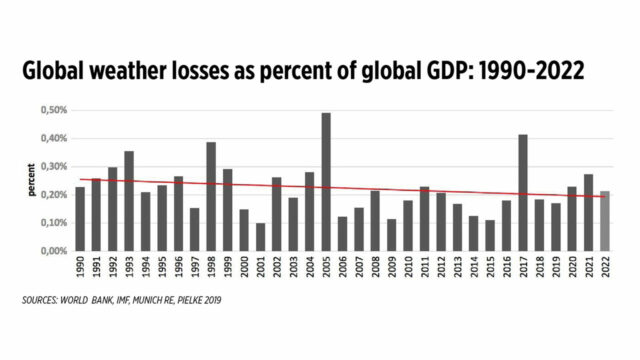
It is a 180-page date-heavy report that tears into the UN Intergovernmental Panel on Climate Change’s (IPCC) recently published 6th Assessment Report (AR6). Simply put, the Clintel Report showed in many charts and graphs that the IPCC AR6 is focused on “dangerous anthropogenic climate change,” ignores natural climate change, leans on extreme emissions scenarios, and cherry picks the time periods and the literature to make climate change appear “dangerous.”

Among the important data of the report is this chart showing that weather-related losses as share of global GDP is actually falling, not rising.

The report can be downloaded free at https://clintel.org/download-ipcc-book-report-2023/.

THE PPP ACT
The Public-Private Partnership (PPP) Act was passed in the House of Representatives last December: House Bill 6527, “An Act Providing for the Enabling Environment to Foster the Growth of Public-Private Partnerships for Infrastructure and Other Development Projects.”

There are six versions of the PPP bill in the Senate, and on April 18, the Senate Committee on Public Works conducted a public hearing on the subject.

The PPP Act is a quick win for the government and the public because it will expand infrastructure projects around the country at little or no cost to taxpayers because the private sector proponents will shoulder the bulk of financial, technical, and engineering costs.

The President will deliver his second State of the Nation Address (SONA) in two months. In his first SONA last July, President Ferdinand Marcos, Jr. mentioned that the PPP Act aims to address three things: ambiguities in the existing law, bottlenecks and challenges affecting the implementation of the PPP Program, and lack of a competitive and enabling environment for PPPs.

So, the PPP Act, when enacted as a law, will unify the fragmented legal framework and improve governance of PPPs to improve doing business and protect the consumers. Currently, there are different legal frameworks for PPPs, each with their own requirements and processes: the Build-Operate-Transfer (BOT) Law, the Joint Venture (JV) guidelines of the National Economic and Development Authority (better known as NEDA), local PPP and JV ordinances, and guidelines issued by other agencies with special charters.

The proposed PPP Act will address bottlenecks in the PPP process. The approval thresholds of the current BOT Law have not been amended since 1994, so the PPP Act will increase the approval threshold for national PPP projects, making the approval process streamlined and more efficient. The proposed approval thresholds for national PPP Projects are seen in the table in this story.

The autonomy of local government units (LGUs) in the approval of local PPP projects is recognized and preserved by the PPP Act. Some mechanisms should be ready to ensure coordination in investment programming between the National Government and LGUs. These include cases where: 1.) there are proposed National Government undertakings for approval by NEDA’s Investment Coordination Committee, or, 2.) the local PPP project affects national development or master plans and projects, so an endorsement from the National Government through local development councils shall be required.

The tight fiscal condition of the National Government at a time when public demand for more modern, bigger infrastructure projects keeps rising should help the Senate in fast-tracking the enactment of this bill into a law.


Bienvenido S. Oplas, Jr. is the president of Bienvenido S. Oplas, Jr. Research Consultancy Services, and Minimal Government Thinkers

minimalgovernment@gmail.com

Letters to a financial adviser

TIRACHARDZ-FREEPIK

Dear Financial Adviser:

I was asked by the company I’ve worked in for 10 years now to take early retirement. How can I maintain my lifestyle with the retirement package I hope to get? What’s a good rule of thumb to follow?
Getting Worried

Dear GW,

You did not indicate your age, so I have no idea of how many more productive years you have ahead of you. Not all who retire nowadays are necessarily entitled to a senior citizen’s card as even “loss of confidence” or “redundant position” in the corporate world can strike both young and old alike.

You are now jobless and maybe unemployable, depending on how your recent exit is perceived. Of course, you can find another job, even if this pays less. Does status bother you? It’s good to put that aside for now.

I presume you already got your retirement pay, whether enhanced or not. You take this amount and then divide this by the annual cost of your existing lifestyle level. The numerator (your retirement pay) is hopefully bigger than your denominator (your living expenses for one year) and then you will come out with a number hopefully higher than one. The resulting dividend (in the arithmetic sense) represents the number of years you can enjoy your current lifestyle without further revenue enhancements.

Of course, lifestyle choices can be cut back to just meals and commuting to the mall for the aircon. This will increase the number of years maintaining your subsistence level. Remember that eating out is no longer chargeable to representation expense — lunch with client with flawless skin?

This simple formula is flexible too. You may sell some assets like properties, art works, and cars, if you have them. Your nest egg may also be earning money from investments in fixed-income securities or extending high-interest loans to small bakeries to cover daily expenses. Then it is only the uncovered residue that must be re-computed. All these calculations are premised on the amount of retirement and savings you have at the start of your retired status.

Anyway, try to get a new job, maybe as consultant on corporate retrenchment.

******

Dear FA:

My husband and I separated recently. We have two kids in schools abroad. It was my idea to send them overseas to broaden their perspective. Should I then be the one to shoulder their tuition and living expenses?
Single Mom

Dear SM,

Part of your problem is legal and probably covered by the terms of your separation. I can only address the financial side of your question. Nowhere in conjugal economics was there ever a rule that said — if it was your idea, you should shoulder the cost. Women’s ideas, say a trip to Madrid or a Birkin bag, are often turned into reality by the breadwinner, who may or may not be a professional boxer.

Even as feminists have pushed for equal wages in the workplace or in broadcasting, they get fuzzy when it comes to who pays the bill for their wants and needs. Women’s rights advocates always pick up their own share.

I am presuming that the kids in question are biologically linked to your former partner. If so, he should shoulder part if not all the schooling cost. This is either covered by your terms of separation or not. The matter of paying the bill also depends on the emotional terms of the separation. Do you and your “ex” still share a cup of coffee, without throwing the hot stuff in each other’s faces, when still un-sipped?

If the ability to pay is asymmetrical, the one with the higher residual net worth may take up more of the cost. You also have the choice of bringing the kids home to study in local schools.

As a parting advice, try not to involve the new partner of either party in this discussion.

******

Dear FA:

I’m a woman gifted with good looks. Unfortunately, I am always short of money. Are there services you require to improve my revenue stream?
Care Giver

Dear CG,

I think you are not looking for financial advice but a job. It’s best to address your letter to a recruitment agency. You didn’t mention your age and the quality of care you provide. This will be helpful in your job application.


Tony Samson is chairman and CEO of TOUCH xda

ar.samson@yahoo.com

Taiwan speaker hails PHL, Japan and South Korea for ‘crescent of defense’

CHESS PIECES are seen in front of displayed China and Taiwan’s flags in this illustration taken Jan. 25, 2022. — REUTERS

WASHINGTON — The speaker of Taiwan’s parliament praised Japan, South Korea and the Philippines on Tuesday for helping to create a “crescent of defense” with Taiwan and the US against China’s ambitions in the Indo-Pacific region.

Speaking in Washington, You Si-kun told the Hudson Institute think tank that China’s ruling Communist Party (CCP) and leader Xi Jinping saw Taiwan as just a “stepping stone” to global hegemony.

“The CCP wants to see the East rise and the West to decline,” Mr. You said. “We can say that protecting Taiwan equates to defending both Europe and the United States.”

Mr. You belongs to Taiwan’s ruling Democratic Progressive Party but does not speak for President Tsai Ing-wen.

Mr. You praised Japanese Prime Minister Fumio Kishida and South Korean President Yoon Suk Yeol for calling Taiwan a global issue and opposing a change to the status quo by force. He said this had “offset” remarks by French President Emmanuel Macron that a conflict in the Taiwan Strait had nothing to do with Europe.

Mr. You said Philippine President Ferdinand Marcos, Jr. had also said that granting the US access to Philippine military bases was a defensive measure that would be useful if China were to attack Taiwan.

“The crescent of defense formed by Korea, Japan, Taiwan and the Philippines will, with American support, be a key stabilizer of peace and security in the Indo-Pacific region,” he added.

The staunch support democracies have provided Ukraine should act as a deterrent to Mr. Xi “to prevent him from taking any reckless action so that he will not become a second Putin,” Mr. You said.

“To ensure Taiwan’s security is to ensure the global public interest,” he added. “If we do not take China’s threats seriously, a dark future awaits all of mankind.”

China has been stepping up its military activities around Taiwan to try and force the democratically governed island to accept Beijing’s sovereignty. It has never renounced the use of force to bring Taiwan under its control. — Reuters

Vietnam bets big on LNG, South China Sea gas fields amid risks

A VIETNAM DONG note is seen in this illustration photo May 31, 2017. — REUTERS

HANOI — Vietnam’s plan to quadruple by 2030 its gas processing capacity, turning it into its first source of energy, marks a big bet on imported liquefied natural gas (LNG) and its reserves in the South China Sea, despite supply and geopolitical risks.

The plan, which was approved by the government late on Monday, would turn the Southeast Asian nation from a very small player in the gas market into one of the largest users in the region.

LNG imports are projected to jump from zero now to volumes that would cover nearly 15% of the country’s booming energy needs by the end of the decade, according to the government’s adopted targets published on Tuesday.

Locally produced gas would be given priority over LNG, the government said, with output expected to jump by about 65% to 15 gigawatts (GW) by 2030 — but its share in the country’s power mix is set to drop to 10% from 13% in 2020.

Both targets face major hurdles, as LNG imports may be expensive amid high global demand, experts warned, whereas Vietnam’s gas production is often exposed to pressure from China which opposes extraction in large parts of the South China Sea which it claims.

To process the additional energy input Vietnam would build 15 LNG power plants by 2035, at least two LNG terminals and nearly a dozen new plants fired with domestic gas, which would switch to green hydrogen over the next decades.

The plan does not indicate the estimated cost of LNG imports. Prices rose quickly last year as European Union countries sought to replace Russian gas, a trend that is expected to continue, warned the Institute for Energy Economics and Financial Analysis (IEEFA).

“Vietnam could be entirely exposed to the spot market and price shocks because they do not have long-term LNG sale and purchase agreements,” said San Naing, senior gas analyst at BMI, a research firm.

“If they did not contract LNG sufficiently, then it’s natural for them to shift back to coal to mitigate paying such high prices for LNG,” said Alex Siow from ICIS, a consultancy, noting however that LNG prices were expected to fall after 2025.

State-owned PetroVietnam Gas did not reply to requests for comments about possible long-term contracts.

SOUTH CHINA SEA
Betting on local natural gas is also risky. Vietnam currently produces it in blocks in the South China Sea, some of which are close to where Chinese coast guard ships and research vessels frequently sail causing confrontations.

The additional output would come from blocks that are closer to Vietnam’s coast, including the Blue Whale field operated by U.S. giant ExxonMobil and a smaller deposit managed by Russia’s Gazprom with more gas possibly from fields operated by Italy’s ENI, the plan said.

None of the companies replied to requests for comments.

The plan did not mention imports from Indonesia’s Tuna block in the South China Sea, which Jakarta has said would export gas to Vietnam from 2026, although the government projects that imports of unspecified energy to cover 3.3% of the country’s needs by 2030. — Reuters

China shuts 100,000 fake news social media accounts

VECTORJUICE-FREEPIK

CHINA has intensified efforts to clean up the internet from false news and rumors, closing more than 100,000 online accounts over the past month that misrepresented news anchors and media agencies, its cyberspace regulator said.

The Cyberspace Administration of China (CAC) launched a special campaign to clean up online information, focusing on social media accounts that disseminate “fake news” and impersonate state-controlled media.

The regulator said it had wiped 107,000 accounts of counterfeit news units and news anchors and 835,000 pieces of fake news information since April 6.

The cleanup comes as China and countries across the globe grapple with an onslaught of fake news coverage online, with many implementing laws to punish culprits.

News dissemination on Chinese social media, however, is already heavily controlled, with platforms like the Twitter-like Weibo favoring topic hashtags produced by state media, while censoring hashtags on issues or incidents considered sensitive by Beijing, even if they go viral.

The CAC said its review found accounts that had disguised themselves as authoritative news media by falsifying news studio scenes and imitating professional news presenters, using artificial intelligence (AI) to create anchors to mislead the public.

Fake news identified covered hot topics such as social incidents and international current affairs, according to a statement the CAC posted on Monday on its website.

“(The CAC) will guide online platforms … to safeguard the legitimate rights and interests of the majority of internet users to obtain authoritative and real news,” the regulator said, adding it encouraged users to provide leads on counterfeit news and anchors.

China’s government has regularly ordered sweeping measures to scrub the internet of material and language it deemed inappropriate, offensive and a threat to the public and businesses.

Recently, the CAC vowed to crack down on malicious online comments that damage the reputation of businesses and entrepreneurs.

Nascent generative AI technology like ChatGPT has introduced another layer of caution. China recently arrested a man in Gansu province for allegedly using ChatGPT to generate a fake story about a train crash. — Reuters

Theranos founder loses bid to stay out of jail

THERANOS FOUNDER ELIZABETH HOLMES — EN.WIKIPEDIA.ORG

THERANOS founder Elizabeth Holmes and former CEO Ramesh “Sunny” Balwani were on Tuesday ordered to pay $452 million to victims of the blood-testing startup’s fraud, and an appeals court also denied Ms. Holmes’ request to remain out of prison while challenging her conviction.

Ms. Holmes, who rose to fame after claiming Theranos’ small machines could run an array of diagnostic tests with just a few drops of blood, was convicted last year of misrepresenting the startup’s technology and finances. She was sentenced to 11 years and three months in prison.

Under the restitution order made by Judge Edward Davila in San Jose, California, who also oversaw Ms. Holmes’ trial and sentencing, both Ms. Holmes and Mr. Balwani are equally responsible for the full amount.

Mr. Davila rejected their argument that intervening events contributed to Theranos investors’ losses.

“The victims’ losses occurred at the moment they exchanged their money for Theranos shares,” the judge said.

Ms. Holmes had asked the 9th US Circuit Court of Appeals to pause her sentence on April 25, two days before she was to report to prison.

The court rejected her argument that the appeal is likely to result in a new trial, the threshold for her to remain free on bail. The denial of bail on Tuesday means Mr. Davila will now set a new date for her to go to prison.

During the trial, Ms. Holmes testified in her own defense, saying she believed her statements were accurate at the time. On appeal, Ms. Holmes is challenging several of the judge’s rulings, including his allowance of evidence about Theranos’ test accuracy that postdated her statements to investors.

Mr. Balwani was convicted of defrauding Theranos investors and patients at a separate trial and sentenced to 12 years and 11 months in prison. He began serving the sentence on April 20, after Mr. Davila and the 9th Circuit rejected his requests to remain free on bail during his appeal.

Forbes dubbed Ms. Holmes the world’s youngest female self-made billionaire in 2014, when she was 30 and her stake in Theranos was worth $4.5 billion. Theranos, once valued at $9 billion, collapsed after a series of Wall Street Journal articles in 2015 questioned its technology. — Reuters

‘Losing our best’: Activists killed in war seen as blow to Ukraine’s future

Army soldier figurines are displayed in front of the Ukrainian and Russian flag colors background in this illustration taken, Feb. 13, 2022. — REUTERS/DADO RUVIC/ILLUSTRATION

KYIV — Investigative journalist Oleksandr Tsakhniv spent much of his professional life trying to uncover corruption in Ukraine’s eastern hinterlands where he lived and worked.

He was killed in March, aged 37, fighting Russian forces near Bakhmut. Now, his employer says his death could have an impact on the local fight against graft — and on Ukraine’s broader efforts to prepare for a future more closely aligned to Europe.

“I understand it’s a civic duty to defend your country, and so they go,” said Maria Davydenko, director of the online outlet Vchasno where Mr. Tsakhniv worked, referring to activists and other members of civil society. “But we really are losing our best.”

A growing number of civic activists and community leaders, who might be expected to drive Ukraine’s ambitions to build a modern democracy, are among the thousands of Ukrainians from all walks of life killed fighting since Russia’s full-scale invasion in February 2022.

The European Union offered Kyiv candidate status last year and made improving governance and fighting corruption key requirements for membership negotiations.

Among the first activists to fall was well-known environmental campaigner Roman Ratushnyi, who famously tackled illegal construction in a woodland in Kyiv. He was killed fighting near Izium in the east of the county last June aged 24.

Another was 28-year-old Mykhailo Alekseyenko, a star political science graduate from Karazin University in Kharkiv. He was killed last month near Kreminna.

The pro-European Maidan revolution in 2014 that ousted a pro-Russian leader inspired young Ukrainians like Mr. Alekseyenko, who before the war helped rebuild homes and took part in youth education programmes after receiving a Masters degree in 2017.

“Misha was definitely another type of activist, who was ready to act in many different ways,” said professor Yuliya Bidenko, who taught Mr. Alekseyenko political science. Misha is shorthand for his first name.

In different circumstances, Ms. Bidenko believes Mr. Alekseyenko could have sought a political career. His death, and those of other young idealists, could undermine the country’s drive toward greater self-rule across its regions, she said.

Decentralization was a key post-Maidan reform to empower local administrations.

The mass flight of millions of refugees after Russia’s invasion has also dealt a blow to Ukraine’s potential political class, Ms. Bidenko added.

‘EXTREMELY NECESSARY’
In some cases, the war may also be forging future leaders, especially among the military and humanitarian volunteer organizations that are now trusted by 88% of Ukrainians, according to the Razumkov Centre think-tank in Kyiv.

Away from Kyiv, in far-flung places like Pokrovsk, about an hour’s drive west of the besieged city of Bakhmut, people like Tsakhniv, the journalist, will be missed.

There, in 2018, he investigated an allegedly rigged tender process involving more than $10 million of European Investment Bank money to rebuild local schools and hospitals damaged after Russia’s previous, covert, invasion of 2014.

His report led to a review by the United Nations Development Programme (UNDP), which scrapped the tenders, said colleague Davydenko. The UNDP confirmed to Reuters that new tenders were held and contracts awarded to different builders.

“People like this are just extremely necessary for us after the war,” Ms. Davydenko said of Mr. Tsakhniv. — Reuters

US IRS to launch free tax e-file pilot program in 2024

 – The Internal Revenue Service said on Tuesday it wouldlaunch a free, government-provided direct tax filing option next year, which could lead to the full-scale launch of an IRS filing system that would compete with private tax preparers.

The IRS said in an exploratory report to Congress that 72% of American taxpayers surveyed said they were “very interested in” or “somewhat interested in” using a government tool to electronically file their tax returns.

The agency estimated that a new direct filing system would cost between $64.3 million and $248.9 million a year to operate, depending on the complexity of returns accepted and the number of taxpayers using the system.

The size, scope and complexity of the pilot program, to be available in the 2024 tax filing season, has yet to be determined, IRS Commissioner Danny Werfel told reporters, adding that Treasury Secretary Janet Yellen directed the IRS to launch the pilot after reviewing the report.

The $15 million study was mandated by the climate-focused Inflation Reduction Act, which was backed by only Democratic lawmakers and provided $80 billion over 10 years for the IRS to beef up enforcement, modernize its technology, improve customer service and rebuild its workforce.


PREPARER, FILER, AUDITOR

Plans for a free filing system have been criticized by Republicans in Congress as redundant because of free options for filing simple returns provided by private firms, including H&R Block HRB.N and TurboTax software maker Intuit Inc INTU.O.

Republicans have sought to rescind the $80 billion in IRS investments as part of debt ceiling negotiations.

House of Representatives Ways and Means Committee Chair Jason Smith, a Republican, blasted the e-filing study as another step in the Biden administration’s efforts to “supercharge” the IRS to harass taxpayers.

“Americans will be powerless when the IRS completely controls the tax filing process from start to finish,” Smith said in a statement.

But Laurel Blatchford, the Treasury’s chief implementation officer for the Inflation Reduction Act, said a free direct filing option could “potentially save taxpayers billions of dollars annually,” because it may cost the IRS less than $10 per tax return filed, compared with about $40 now paid by taxpayers for simple returns handled by private firms.

Shares of H&R Block closed down 3.1% and Intuit ended down 1.1% on Tuesday.

“With more than 30 organizations already offering free tax preparation, this pilot is unnecessary and faces significant barriers to providing comprehensive tax preparation services,” H&R Block said in a statement, adding that the plan was “a solution without a problem.”

Werfel noted that all filing options would continue, including free e-file options from private firms and non-profit tax advocacy services, paid filing by tax preparers, and free paper filing to the IRS.

Funding for a full-scale IRS direct file system would need to be determined by the Treasury and Congress, Werfel said, but could come from the portion of the $80 billion that is designated for systems modernization. – Reuters

ADVERTISEMENT
ADVERTISEMENT