Home Blog Page 4845

Central Asia leaders converge in China as Xi touts ‘enduring’ friendship

REUTERS

 – Central Asian heads of state converged in China‘s historic city of Xian on Thursday for one-on-ones with Chinese leader Xi Jinping to seal pledges of “enduring” friendship, and paving the way for a summit expected to result in a regional pact with Beijing.

The bilateral talks will set the stage for a group meeting on Friday, the first in-person gathering of the six leaders, where Xi will deliver an “important” speech and an “important” political document will be signed, China‘s foreign ministry has said.

Across the Silk Road city of Xian, banners, billboards and even taxi signs were set up to promote the summit, with some in both Chinese and Russian.

A large contingent of foreign journalists was also present to cover the event, including reporters from Africa where China is similarly seeking to assert and expand its economic and political clout.

The president of energy-rich Turkmenistan, the most distant of the Central Asian states from China, was the last of the five leaders to arrive, landing in Xian in the early hours of the morning on Thursday.

The first to land was President Kassym-Jomart Tokayev of Kazakhstan – China‘s largest trading partner in Central Asia – with his face-to-face meeting with Mr. Xi on Wednesday ending with a deal to build “enduring friendship” and share “weal and woe”.

“We have a common goal – to intensify bilateral relations,” Mr. Tokayev told Mr. Xi.

“We are also united by the desire to strengthen regional and international security and cooperation.”

The two sides agreed to take measures to ensure the safe and stable operation of the Kazakh section of the ChinaCentral Asia natural gas pipeline. They also agreed to deepen cooperation in oil and uranium.

Mr. Tokayev’s deal with Mr. Xi will set the tone for the other bilateral meetings, where China will seek deeper cooperation with other Central Asia states in its quest to achieve greater food, energy and national security.

Two-way trade between China and Central Asia hit a record $70 billion last year, with Kazakhstan leading with $31 billion. Kyrgyzstan followed with $15.5 billion, Turkmenistan with $11.2 billion, Uzbekistan with $9.8 billion and Tajikistan with $2 billion.

Mr. Xi‘s summit with the Central Asian leaders will conspicuously overlap with a meeting of the Group of Seven leaders in Japan starting Friday, where Beijing’s use of “economic coercion” in its dealings abroad is expected to be on the agenda. – Reuters

In Mexico, new non-binary passport can now sidestep male or female box

 – Mexicans applying for a passport can now avoid having to check the box for male or female in a new travel document policy announced on Wednesday and hailed by the country’s top diplomat as historic progress for those who identify as nonbinary.

The new nonbinary passport was unveiled at an event hosted by Foreign Minister Marcelo Ebrard, but it came under immediate criticism by some nonbinary activists as confusing gender with sex.

Under the new passport policy, nonbinary Mexicans who do not identify as either a man or a woman, which are gender categories, can now respond with an “X” on paperwork that asks applicants to choose between male or female, which are biological sex categories.

“People applying will be able to choose the marker “X” for the box designating sex on their passport, and in that way they omit the need to specify gender,” the foreign ministry explained in a statement announcing the new policy.

Mexican passports did not previously ask applicants to select gender, only sex.

Ebrard, who is seeking the presidential nomination of the leftist Morena party for next year’s election, touted the policy as “a quantum leap” for Mexico.

But nonbinary Mexican activist Alex Orue argued that Ebrard mostly flubbed the attempt at progressive inclusion by blurring the difference between gender and sex.

“It’s counterproductive because it confuses the concepts and reinforces a stigma against our community,” said Orue, deputy director of global programming for LGBTQ+ rights non-profit It Gets Better.

Orue questioned whether those who identify as nonbinary were consulted on the new policy, adding it would be better to give applicants on official identification documents the option to select “NB” on a question specifying gender.

“It could seem like a minor detail, but it’s stigmatizing for nonbinary people and it becomes a matter of inspection of genitalia,” added Orue, since gender identities do not always match bodily attributes of biological sex. – Reuters

Why does the US want to ban TikTok? The allegations against it

SOLEN FEYISSA-UNSPLASH

WASHINGTON – Montana Governor Greg Gianforte on Wednesday signed legislation to ban Chinese-owned TikTok from operating in the state to “protect Montanans” from alleged Chinese surveillance, making it the first US state to ban the popular short video app.

Here is a detailed list of US allegations against the company and its parent, Bytedance.


  • TikTok management is beholden to the Chinese government

FBI Director Chris Wray said in November that TikTok poses a national security risk, adding that Chinese companies are required to essentially “do whatever the Chinese government wants them to in terms of sharing information or serving as a tool of the Chinese government.”

Members of Congress in March complained that the Chinese government has a “golden share” in ByteDance, giving it power over TikTok. TikTok has said “an entity affiliated with the Chinese government owns 1% of a ByteDance subsidiary, Douyin Information Service,” and says the holding “has no bearing on ByteDance’s global operations outside of China, including TikTok.”


  • TikTok could be used to influence Americans

The FBI’s Wray has also said US operations of TikTok raise national security concerns because the Chinese government could harness the video-sharing app to influence users or control their devices.

Risks include “the possibility that the Chinese government could use [TikTok] to control data collection on millions of users or control the recommendation algorithm, which could be used for influence operations,” Wray told US lawmakers.

National Security Agency Director Paul Nakasone said in March he was worried about the data TikTok collects, the algorithm used to disperse information to users, and “the control of who has the algorithm.”

He asserted the TikTok platform could enable sweeping influence operations because TikTok could proactively influence users and could also “turn off the message.”

TikTok says it “does not permit any government to influence or change its recommendation model.”


  • TikTok will hand American’s data over to Chinese government officials

Lawmakers have alleged that the Chinese government, under a 2017 National Intelligence law, can force ByteDance to share TikTok user data. TikTok argues that because it is incorporated in California and Delaware, it is subject to US laws and regulations.

TikTok’s chief executive has said the company has never, and would never, share U.S. user data with the Chinese government


  • TikTok use harms children’s mental health

In March 2022 eight states, including California and Massachusetts, launched a probe into whether TikTok causes physical or mental health harm to young people and what the company knew about its role in those harms.

The investigation focuses on how TikTok boosts young user engagement, including allegedly increasing the duration of time spent on the platform and how often it is used.

TikTok says it has taken numerous steps “to help ensure that teens under 18 have a safe and enjoyable experience on the app, and many of these measures impose restrictions that don’t exist on comparable platforms.”


  • TikTok spies on journalists

In December, ByteDance said some employees improperly accessed TikTok user data of two journalists. ByteDance employees accessed the data as part of an unsuccessful effort to investigate leaks of company information earlier this year, and were aiming to identify potential connections between two journalists, a former BuzzFeed reporter and a Financial Times reporter, and company employees.

A person briefed on the matter told Reuters that four ByteDance employees who were involved in the incident were fired, including two in China and two in the United States. Company officials said they were taking additional steps to protect user data. – Reuters

Gov’t may retake control of NGCP

PHILIPPINE STAR/MICHAEL VARCAS
President Ferdinand R. Marcos, Jr. is open to the possibility of the government regaining control of the National Grid Corp. of the Philippines (NGCP). — PHILIPPINE STAR/MICHAEL VARCAS

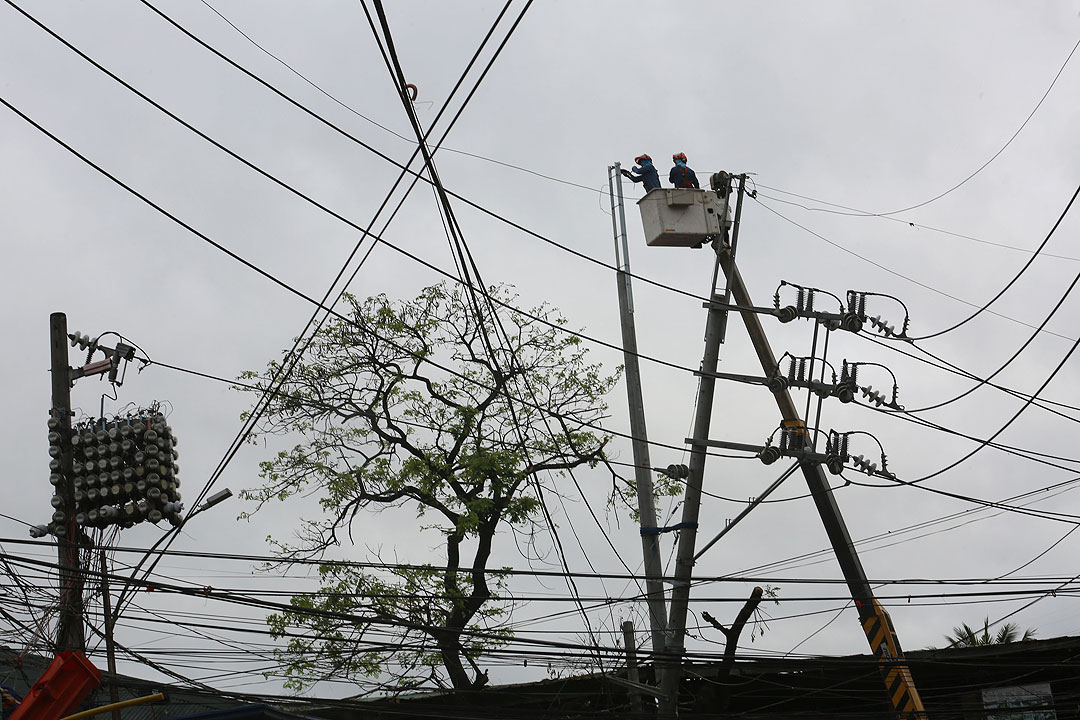
THE PHILIPPINE government may retake control of the National Grid Corp. of the Philippines (NGCP), which is partially owned by a Chinese state-owned company, if needed, the Palace said on Wednesday.

Senator Rafael “Raffy” T. Tulfo, who chairs the Senate energy panel, told President Ferdinand R. Marcos, Jr. at a Monday meeting that he wants to “assess the performance of the NGCP,” the Presidential Communications Office (PCO) said in a statement.

In particular, Mr. Tulfo wants to look into NGCP’s ownership and assess how this may pose a threat to national security, the PCO said.

“The President agreed with the Senator’s proposal to conduct a comprehensive study or hold hearings to determine the actual situation. If necessary, the government will take back control of the entity,” the PCO said.

NGCP holds the sole and exclusive concession and franchise for the operation of the country’s power transmission network, which links power generators and distribution utilities to deliver electricity nationwide.

A consortium led by tycoons Henry Sy, Jr. and Robert Coyiuto, Jr. won the 25-year concession to run the country’s power transmission network in December 2007. State Grid Corp. of China (SGCC) owns a 40% stake in NGCP.

In a separate statement, Mr. Tulfo said he met with the President “to get the cooperation of different government agencies to swiftly address the issue with NGCP.”

The senator proposed to return the systems operation of the country’s transmission grid to Philippine state-owned National Transmission Corp. and leave its maintenance to the NGCP.

Senator Francis Joseph “Chiz” G. Escudero has opposed his colleague’s proposal to re-nationalize the NGCP, saying “it might discourage foreign investors” from doing business in the country.

“The renationalization of formerly owned sold state assets is a policy that the National Government should be very careful about or should be more circumspect about as it might send a wrong signal to existing and potential investors,” Mr. Escudero said in a statement.

“I don’t support it… [The] policy U-turns can be destabilizing and surely expensive.”

Calls to investigate NGCP’s operations have resurfaced amid increasing tensions between Manila and Beijing, which has been conducting expansive activities in Philippine territories in the South China Sea.

Mr. Tulfo, in his meeting with Mr. Marcos, said China’s stake in the NGCP may pose national security threats.

Citing an intelligence report, he said China has the capability to remotely access the country’s national grid and sabotage it. He noted all the instructions posted in NGCP plants about operations of sensitive equipment, including manuals, are written in Chinese characters.

At the Senate Energy Committee hearing on Wednesday, Ronald Dylan P. Concepcion, NGCP assistant corporate secretary, said only Filipino citizens are manning its substations, not Chinese nationals.

“The only Chinese that are in the country that are connected to NGCP are three, and these are the members of the board [who] represent shareholdings of SGCC,” he said.

Mr. Concepcion explained that the Chinese instructions on NGCP equipment are due to the fact that these were provided by a Chinese company. “The instructions to the system were in Chinese originally but also they have English translation [for our] Filipino engineers,” he said.

However, Senator Ana Theresia “Risa” N. Hontiveros-Baraquel said it could be possible for a state-owned enterprise to use its powers to collect intelligence about a country.

“It’s not easy to say that there’s no national security threat [when there’s] another country [with a] state-owned enterprise that has an obligation to collect information or intelligence to give to their government in Beijing about our country and even our government,” she told the hearing.

Ms. Hontiveros-Baraquel noted that China “has not been treating us as a friend” amid heightened tensions over the West Philippine Sea.

Mr. Tulfo said the Joint Congressional Energy Commission, once it convenes, will investigate the possible revocation of the NGCP’s franchise.

CAUSE OF CONCERN
Terry L. Ridon, a public investment analyst and convenor of InfraWatch PH, said the fact that a Chinese state-owned firm has a stake in the NGCP will always be a cause of concern because of the country’s ongoing dispute with China.

To allay fears over possible Chinese control over the grid, Mr. Ridon said authorities should determine if the NGCP engineers operating the grid are mostly Filipinos.

“If Chinese nationals are doing work other than technical advice, this will certainly be a cause of concern,” he said in a Facebook Messenger chat.

Mr. Ridon said the country’s energy infrastructure can be vulnerable to attacks, citing the cyberattacks against Ukraine that caused a shutdown of its power systems that resulted in significant economic losses.”

“The same can happen in the Philippines if left unchecked, particularly if the government fails to determine the breadth of control of a Chinese state firm over the national grid,” he added.

Chester B. Cabalza, founding president of the International Development and Security Cooperation, said SGCC’s stake in NGCP is “more of a moral question than a legal one since Philippine authorities have suspicions and doubts over a Chinese business partnership on a critical energy infrastructure, which may impede the course of our national security.”

To ensure the security of the national grid, personnel and officials from energy infrastructure “must also be trained on national security framework aside from its regular safety protocols,” Mr. Cabalza said in Facebook Messenger chat.

“There should be a strong coordination with the defense and security sector since it entails the protection of the basic needs of the people and the country,” he added.

Mr. Cabalza also called for stronger domestic laws against espionage. — Kyle Aristophere T. Atienza and Beatriz Marie D. Cruz

BSP to be on guard against cryptocurrency issues

Bitcoin cryptocurrency representation is pictured on a keyboard in front of binary code in this illustration taken Sept. 24, 2021. — REUTERS

THE PHILIPPINES should be on guard for issues involving cryptocurrencies as it could affect financial stability, the Bangko Sentral ng Pilipinas (BSP) said. 

BSP Governor Felipe M. Medalla said there should be regulations for cryptocurrency in order to combat money laundering and to protect the investing public.

“The point where crypto gets changed into pesos or bank accounts, that’s the time where all regulations come in. Whether its crypto or regular banking, the entire world is afraid that cross-border movements of money could be financing things that are quite destructive,” Mr. Medalla said at a press briefing following the Financial Stability Board (FSB) Regional Consultative Group for Asia (RCGA) meeting in Mactan, Cebu.

Cryptocurrencies in the Philippines are classified as digital or virtual assets.

Since the Philippines is under the Financial Action Task Force’s (FATF) “gray list,” Mr. Medalla said regulators cannot afford to have more cases of money laundering.

“Indeed, our big problem is the Philippines is on the gray list, which has possible consequences,” he said. 

Global financial crime watchdog FATF put the country on its list of jurisdictions under increased monitoring for “dirty money” risks in June 2021. The BSP hopes to exit the gray list by January 2024. 

“Crypto for the Philippines is not a financial stability issue because it doesn’t involve too many people in that aspect, but it is an issue that may call the attention of the government one way or another,” he said. 

Mr. Medalla noted informal lenders are now closely tied with e-money issuers, taking advantage of how Filipino households tend to have low access to formal lending.

“These are potentially great improvements in consumer welfare, we should be open to it, but at the same time, as in any opportunity, there are dangers. And this is where we’re looking at it as regulators,” Mr. Medalla said.

FSB Chair and De Nederlandsche Bank President Klaas Knot said the board will be putting in various forms of investor protection when regulating the crypto assets space.

“We have money laundering issues. Whether we like it or not, in some criminal investigations, crypto comes to the fore more often than we would’ve liked in cases like text fraud and also outright trafficking of drugs, money laundering, tax evasions, etc,” he said.

If countries are not willing to comply with the standards set by the FSB, Mr. Knot said the jurisdictions will have to face “supervisory scrutiny.”

“If we have individual holdouts, individual countries that are not willing to implement the standards, you will very quickly see all the crypto asset activity that migrate to jurisdictions like that,” Mr. Knot said.

Countries are expected to implement a global regulatory framework for crypto assets by 2024 to 2025.

Mr. Knot said they are currently working on high-level recommendations for the global regulatory framework to be submitted during the Group of 20 (G20) meeting in July.

“Today’s meeting of the RCGA reflects the recognition of the close interconnections within our financial system and also between our economies, and indeed recent developments have once again showed a light on the truly global nature of the financial system,” Mr. Knot said.

“The full, timely, and consistent implementation of international financial standards remains key to bolstering global financial stability,” he added.

Established in 2009, the FSB is a body that monitors and makes recommendations about the global financial system.

In a statement on Wednesday, the FSB said its members discussed how to address the vulnerabilities and enhance the resilience of the nonbank financial intermediation (NBFI) sector in Asia.

Members also shared experiences and developments in regulating crypto assets, NBFIs, and financial markets in their jurisdictions and recognized the need to mitigate the risks that may arise from them.

“They acknowledged the FSB’s recommendations for the regulation, supervision and oversight of crypto-assets and markets and its recommendations targeted at global stablecoin arrangements,” the FSB said.

The FSB RCG Asia is co-chaired by Mr. Medalla and M. Rajeshwar Rao, deputy governor of the Reserve Bank of India.

The RCG Asia comprises financial authorities from Australia, Brunei Darussalam, Cambodia, China, Hong Kong SAR, India, Indonesia, Japan, Korea, Malaysia, New Zealand, Pakistan, the Philippines, Singapore, Sri Lanka, Thailand and Vietnam. — K.B. Ta-asan

Philippine restaurants try to cut corners as inflation takes a bite

A WOMAN prepares to cook at a restaurant in Quezon City, Metro Manila, Jan. 26, 2023. — REUTERS

By Joseph L. Garcia, Senior Reporter

THIRTY-ONE-YEAR-OLD Filipino entrepreneur Pirkko Alcantara had gripes about the sisig he had for lunch recently. “The serving size used to be one cup, but now it feels like one spoonful spread thinly,” he said in Filipino.

Running a successful restaurant isn’t even about a few pesos; it’s all about the centavos — margins are slim, costs are high, and you don’t have to be an expert to know that many eateries don’t survive past their first or second year.

Successful restaurants are always looking for creative ways to protect the bottom line without giving the impression that quality is going down with it.

“Without dropping names, restaurants with multiple franchises in premium locations whether malls or high-traffic areas seem to be cutting costs in creative ways,” Mr. Alcantara said in a Facebook Messenger chat.

Some keep their prices but use smaller utensils to serve food, while others use a wide array of chemicals such as food coloring or enhancers to save on raw ingredients but present the same food customers have known, he added.

Philippine inflation slowed for a third straight month in April, as prices of food, transport, and utilities continued to ease.

Consumer prices rose by 6.6% from 7.6% in March but faster than 4.9% a year ago, according to the local statistics agency.

April marked the 13th straight month that inflation breached the central bank’s 2-4% target.

Prices of food and nonalcoholic beverages rose by 7.9%, easing from 9.3% in March though still above 3.8% in April 2022.

As price volatility continues, food and beverage establishments continue to adjust to changing prices to make money while serving their customers well.

Gabriel Tolentino took over his family’s catering company Tarlaqueña Catering last year amid a coronavirus pandemic. One of their business units is a small eatery in Quezon City near the Philippine capital.

“It’s difficult to make price adjustments,” he said by telephone in mixed English and Filipino.

Some of the dishes they offer at their carinderia cost P60. “If we raise prices on those, people will complain and many will look for cheaper food, even if it isn’t as good.”

“Small and independently run restaurants who put no regard in brand equity, much less know what the word equity means, do their best to give their clients and their patrons their money’s worth,” Mr. Alcantara said.

Joey Garcia, chief executive officer at Eight-8-Ate Holdings, Inc., a unit of Udenna Corp. that operates branches of Conti’s and the franchise of Wendy’s in the Philippines, was also reluctant to raise prices.

“We have to,” he said in an interview with BusinessWorld, while noting that they have only raised prices twice in the past year, compared with rivals who have increased prices four times.

“If your supplier increases prices by 10% or 20%, you can’t immediately pass that cost over because customers will shun you.”

‘DANGEROUS’
Mr. Tolentino said they could raise prices for their more luxurious catering operations as long as he and his clients could agree on a budget. “For a small business owner, quality and customer retention is more important. I have customers now that order almost every week because I can give the price and quality that they want.”

Both Mr. Tolentino and Mr. Garcia have recalibrated their supply chain and commissary to keep prices low.

Mr. Tolentino has started ordering frozen meats in bulk instead of shopping fresh from the market to save money.

The quality of the frozen meats he uses is sometimes better than those at his local market. He insists on using the same brands for his other ingredients because the prices of the cheaper ingredients he could buy were not that much lower, he said. “Everything’s a little bit expensive.”

Meanwhile, Mr. Garcia improved productivity and efficiency over at his commissary, while cutting costs including on utilities. They cut energy costs by as much as 20% after shifting to a different power supplier.

Their commissary has cut down workdays from seven to five days a week. “We’re using the same number of people but producing the same quantity in fewer days,” he said.

They also now buy supplies early. “Others buy when the price is high. We do forward-buying.”

“Once you get those efficiencies and cost management, you don’t have to push hard on your pricing,” Mr. Garcia said. “It’s very important for business leaders, especially in our industry, not to pass costs immediately to the customer.”

Neither entrepreneur thinks about cutting corners in their food.

“We’re more known for our food, instead of our event setups,” Mr. Tolentino said. “Food is what our clients return to.”

Instead, Mr. Tolentino cuts costs in some floral arrangements — with the client’s consent — at some of their catering events to stay on budget and keep the product quality.

They also save on electricity when they can, but don’t want to cut down on employee bonuses: “It’s hard to lower their pay as a form of cost cutting.”

“Your regular customers know exactly that you’ve done something, cut some recipes, or reduce something in your products,” Mr. Garcia said. “This is very dangerous for a food brand. I’ve always believed that your brand stands with the product that you serve… your priority is to keep the quality of the product.”

“When you cut corners, you will see a long-term impact. You might have small savings, but eventually, you’ll lose your customers.”

PHL eyes contingency plans for farmers ahead of El Niño

PHILSTAR FILE PHOTO

THE GOVERNMENT is working on contingency plans ahead of the El Niño weather pattern that is likely to develop later this year.

In a statement on Wednesday, the National Economic and Development Authority (NEDA) said that the recently created Economic Development Group (EDG) met to discuss issues that “could potentially affect the trajectory of the Philippine economy,” such as the El Niño.

The state weather bureau forecasted that El Niño may occur in the next three months at 80% probability and may last until the first quarter of next year.

“The Department of Agriculture, along with NEDA, proposed preparatory activities to adequately equip, prepare, and assist farmers in coping with the looming El Niño phenomenon,” the NEDA said.

It cited initiatives such as “retooling and strengthening the government’s disaster response, conducting weekly monitoring of local field conditions, conducting regional assessments, ensuring adequate buffer stocks, and promoting early planting for the dry season in water deficit areas.”

In March, President Ferdinand R. Marcos, Jr. approved the creation of the EDG to make recommendations to “ensure the country’s rapid, inclusive, and sustained growth.”

The group is co-chaired by the Department of Finance (DoF) and the NEDA.

“The Economic Development Group remains committed to ensuring that the country stays on track to meet its medium-term socioeconomic goals, despite domestic challenges and constraints and a weaker global growth outlook,” NEDA Secretary Arsenio M. Balisacan said.

Meanwhile, the group said it is also working on a monitoring system for the country’s infrastructure flagship projects (IFPs).

“NEDA is currently developing a public dashboard for the IFPs to enhance transparency and accountability among implementing agencies. The dashboard will also help in identifying and addressing bottlenecks and constraints that may hinder the timely implementation of the projects,” it said.

In March, the NEDA Board announced that it approved 194 infrastructure flagship projects worth P9 trillion.

The government is also working on dashboards to show relevant statistics to aid in providing “timely recommendations and policies related to importation and measures to address high food inflation in the country.”

“The dashboards shall serve as a ‘single source of truth’ to expedite data processing in government and to foster harmonization of initiatives across agencies,” it added. — Luisa Maria Jacinta C. Jocson

First Gen sets $1-B capex, plans Casecnan upgrade

First Gen Corporation board members, led by its Chairman and CEO Federico R. Lopez (fifth from left), pose for a group photo after they were re-elected for another term during the company’s annual stockholders’ meeting and elections on May 17. -- Company handout

By Ashley Erika O. Jose, Reporter

FIRST GEN CORP. is setting aside $1.1 billion for this year’s capital expenditure (capex), which includes funds to optimize the Casecnan hydroelectric power plant that the Lopez-led company offered to buy for $526 million, the top bid in a government sale.

This year’s spending comes as the company completed the bulk of its capex for a liquefied natural gas (LNG) terminal, which it expects to take in its first imported fuel shipment by September this year.

Emmanuel Antonio P. Singson, senior vice-president, chief financial officer, and treasurer, said in a briefing on Wednesday that the biggest chunk of the capex, or more than $400 million, will be for renewable energy arm Energy Development Corp. (EDC). About $90 million is allotted for the LNG project, and $50 million for the Aya pump storage project, with the rest going to the firm’s gas power plants.

First Gen’s capex this year is about double last year’s $550 million.

In a stock exchange disclosure on Wednesday, First Gen said that its wholly owned subsidiary Fresh River Lakes Corp. had been declared the highest bidder of the 165-megawatt Casecnan hydroelectric power plant in Nueva Ecija, which state-led Power Sector Assets and Liabilities Management Corp. (PSALM) proposed to sell.

Casecnan, a run-of-river type of power facility with limited water impounding, attracted eight qualified bidders, as announced recently by PSALM.

“We are quite encouraged with the way we’ve shifted the portfolio, including the purchase of Casecnan, because assets like that are very hard to replicate and they’re all in tune [with] where the world is headed with regards to a decarbonized energy system,” Federico R. Lopez, chief executive officer of First Gen, told reporters on Wednesday.

Francis Giles B. Puno, president and chief operating officer, said the Casecnan plant could supplement First Gen’s Pantabangan-Masiway hydropower plant and its Aya project.

“Right now, when you look at Casecnan, fundamentally it’s a very important asset for us because we obviously have Pantabangan-Masiway there. We have the plans for Project Aya, which is there,” Mr. Puno said.

First Gen’s 132-MW Pantabangan-Masiway hydroelectric power plant complex is located in Nueva Ecija and is operated by First Gen Hydro Power Corp. while Project Aya is located in Pantabangan, Nueva Ecija.

“Casecnan is upstream and to the extent that we could supplement even more supply coming from the upstream side of Casecnan, then that will help Pantabangan-Masiway and Project Aya,” Mr. Puno said.

Separately, the Department of Energy (DoE) said in a statement that Fresh River Lakes would undergo a thorough post-qualification assessment to verify the authenticity and eligibility of the bid and other relevant documents it submitted.

Energy Secretary Raphael P.M. Lotilla noted that the successful privatization of Casecnan would help strengthen the country’s energy security.

“With the private sector injecting the necessary efficiency and capital for energy expansion, we can ensure a reliable and resilient energy sector for our nation’s future,” Mr. Lotilla said.

LNG DELIVERY
Jonathan C. Russell, the company’s executive vice president and commercial officer, said the construction of First Gen’s LNG terminal was completed in March.

“We achieved practical completion. And we just recently filed our application for a permit to operate and maintain with DoE. We are now in what we call the dry commissioning phase,” Mr. Russell told reporters.

First Gen, through its subsidiary FGEN LNG Corp., is one of seven proponents of LNG projects in the Philippines.

Mr. Russell said the company expects the commissioning of its floating storage regasification unit (FSRU) by September.

“We will be doing the wet commissioning phase, which involves the receipt, storage and regasification of LNG, and then we’ll use that in our power plants to commission the power plants and LNG for the first time. So it is a natural progression,” he said.

In line with this, First Gen is also about to issue a tender in the next two weeks for an LNG spot cargo of about 160,000 cubic meters, Mr. Russell said.

“That cargo will then be used for wet commissioning and then the first supply to power plants’ electricity using LNG,” he added.

Mr. Russell said the cargo delivery is also expected in September.

“We are in parallel discussions for medium- to long-term supply. Those are ongoing with different entities. For now, we are prioritizing the spot tender, so we can get the project in operation, then the medium- to long-term contract will then follow. We anticipate those will start by 2024 at the earliest,” he added.

RENEWABLE ENERGY EXPANSION
First Gen is also committed to expanding its clean energy portfolio to up to 13 gigawatts of new clean and renewable energy by 2030.

“The reason we are putting it as a 2030 target is we’re aligning it with the DoE’s forecasted demand. If the government is saying this is the demand growth, then we’ll have to keep up with that demand growth. It is aligned with that,” Mr. Puno said.

To achieve this, the company will need about $20 billion in capex.

The company’s target growth will mainly consist of wind energy or about 5,100 MW, followed by gas at 2,000 MW, solar at 1,500, geothermal at 700 MW, hydropower at 300 MW, and battery energy storage system at 40 MW.

“Our efforts remain focused largely on helping to reduce the carbon intensity of the electricity grid and then ultimately to decarbonize it. We’re making it our mission to shepherd the energy transition to net zero,” Mr. Lopez said.

On Wednesday, First Gen shares surged 6.84% or P1.28 to close at P19.98 each.

Jollibee eyes 150 stores in China

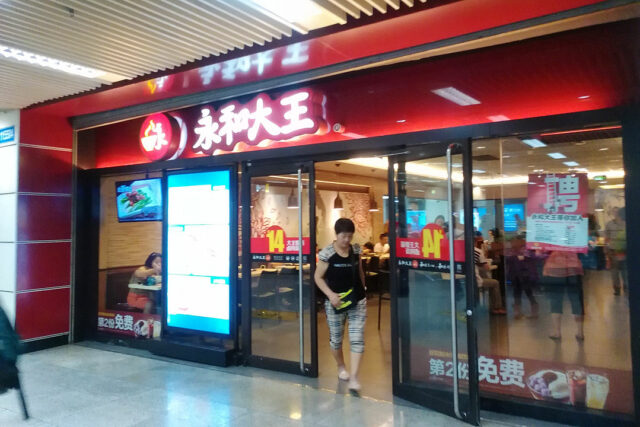
JOLLIBEE Foods Corp. would build upon its existing brands in China, the biggest of which is its Yonghe King quick service restaurants (QSR).

JOLLIBEE Foods Corp. plans to open about 150 new stores in China as it further expands its international operations in the country, the company’s finance chief said on Wednesday.

“Our strategy starting from this year is to elevate [our] base through significant store openings,” Jollibee Chief Financial Officer Richard Chong Woo Shin said during a virtual press briefing. “We are looking at around 100 to 150 new stores in China for this calendar year.”

Mr. Shin said the company would build upon its existing brands in China, the biggest of which is its Yonghe King quick service restaurants (QSR).

“We’ve now more or less covered all the tier-one cities and it’s a combination of company-owned stores with a sprinkle of franchised stores,” he added.

The company will now focus on neighboring tier-two cities in China by using capital-light franchising options to expand its store network.

“QSR is a significantly important segment in China, and we believe that our three brands have upside mobility and gain,” he said.

Aside from Yonghe King, the company’s two other brands in China are Tim Ho Wan, and Hong Zhuang Yuan.

Meanwhile, Mr. Shin said that the company will build on the “premiumness” of the Michelin-starred Tim Ho Wan casual dining brand.

“We are not looking at a large footprint expansion but rather building off of the 18 stores that we have, and we’ll be adding five new stores this year,”

It will focus its Tim Ho Wan operations by going to key geographic cities where the company could take on “above QSR levels.”

During the first quarter, Jollibee grew its network to 505 stores in China, opening about 21 stores during the three-month period.

In the first three months of this year, the company recorded a nearly 11% decrease in attributable net income to P2.06 billion from P2.31 billion in the previous year despite strong revenue growth.

Its consolidated revenues for the quarter grew by 28.5% to P55.09 billion from the P42.86 billion recorded in the same quarter last year.

System-wide sales — which measure all sales to consumers, both from company-owned and franchised stores — rose by 31.1% to P78.64 billion from P59.98 billion.

For the Philippines, system-wide sales increased by 36.7% while same-store sales went up by 31.6%. Outside the country, system-wide sales jumped by 23.3%, while same-store sales rose by 8.8%.

As of end-March, the company has operated 6,542 stores worldwide with 3,281 in the Philippines and 3,261 in its international business.

Jollibee shares went up by 1.42% or P3.20 to close at P229.20 per share on Wednesday. — Adrian H. Halili

The House That Beef Built

Peter Zwiener talks of the steakhouse that was his fatherWolfgang’s dream

WAITERS have the extraordinary privilege and duty of knowing the back and front of the house. Especially skilled ones can master every area of the restaurant, giving them all the tools for the food business. One such former waiter fulfilled his own American dream by opening his own restaurant.

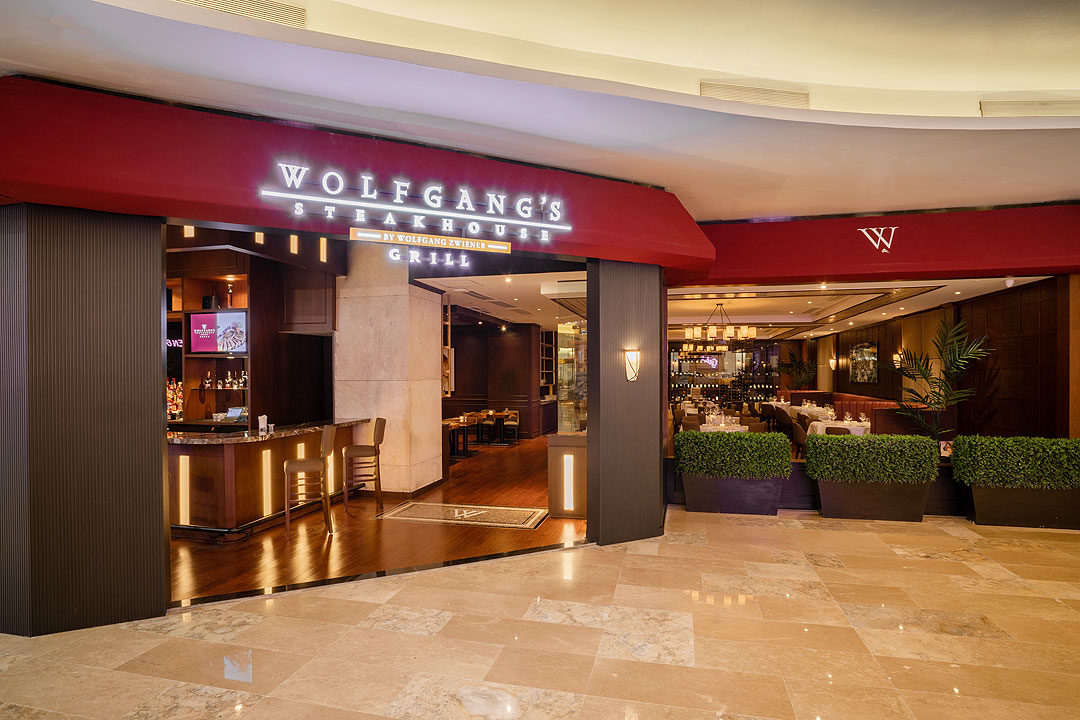
Wolfgang Zwiener was the head waiter for 40 years at a storied New York steakhouse, the Peter Luger Steakhouse. Upon his retirement, he opened his own, named after himself, Wolfgang’s. That American dream has expanded beyond the shores of the United States, bringing it across Asia. Wolfgang’s Steakhouse now has over 30 locations worldwide, across Japan, Korea, China, and the Philippines.

This week, Wolfgang’s opened its fourth branch in the Philippines at the City of Dreams. Other branches in the country are in Newport World Resorts, The Podium, and in BGC. Two others are being planned, with one in Araneta City in Quezon City.

Peter Zwiener, President and Co-founder (and Wolfgang’s son), was present at the City of Dreams branch’s opening on May 16.

HOW IT STARTED
“It’s really myself who convinced him to do it,” said the younger Zwiener of his father. “We always talked about opening a restaurant when he was a waiter. He was working at Peter Luger even before I was born.” They finally opened their first restaurant in 2004 in New York City’s Park Avenue. By then the younger Mr. Zwiener had become an investment banker.

His father, a German immigrant, learned about service in trade schools in Germany before moving to the US. “He’s trained in service, knowing about the kitchen — he’s trained in everything,” said Mr. Zwiener. “Working there for 40 years, you’re going to learn everything.”

It may be harsh to say this, but it seems that Wolfgang’s star has already surpassed where he came from. Peter Luger received a zero-star review in the New York Times from restaurant critic Pete Wells in 2019 (“Peter Luger Used to Sizzle. Now It Sputters”), while it had been stripped of its Michelin star in 2022. Meanwhile, Wolfgang’s is opening more locations in Indonesia, Seoul, Bangkok, and China this year.

“I respect Peter Luger because that’s how my dad made a living and he was able to support me, and my mother, and my brother,” said Mr. Zwiener. He points out though that the actual Peter Luger had died in the 1940s, with the business being taken over by his son, and then auctioned off to another family. According to Mr. Zwiener, it’s now being run by a grandson of one of the new owners. “Little by little, the passion wasn’t anymore there. It was just someone who was given a brand,” he said. “I have feelings for Peter Luger the brand because that was where my father made his career. It really lost its soul, because there’s really no more soul in Peter Luger. It’s just a name that people are just passing on to other people,” he noted.

“Whereas in Wolfgang’s, the founders — myself, my dad, and some other partners that are with us — we’re still very much involved, and we care about everything about the brand, and we’re still very eager to grow the brand.”

THE GOOD BEEF
Mr. Zwiener moved on to talk about what determines very good beef, the type that gets served sizzling on their tables.

In the US, beef is graded from Prime, Choice, to Select, and then Non-Rated. Only 2% of all beef in the US is graded Prime, rated through the level of fat in the intermuscular tissue. “You don’t want too much fat, that is globs of fat,” said Mr. Zwiener. “You have to make sure that the lines of the fat, the amount is perfect in that piece of beef.” They have a purveyor from which they select a short loin, a sub-primal cut that would include their trademark porterhouse, striploin, and rib eye. After that, the meat is aged for about 28 days.

Asked where else he eats steak aside from their own restaurant, he laughed and said, “I don’t.”

“If I go to another restaurant, I’ll eat another type of food. Maybe something meat-related, but I’m not going to think about what type of steak it is.”

Just as well, since he visits all the Wolfgang’s branches in the world quite regularly — he counts that he eats at a Wolfgang’s about 200 to 250 times a year. “Those days that I don’t eat at Wolfgang’s, I’m not going to eat another steak. I may have a steak when I enter a new country, just to see what’s out there. But now I’ve done it so many times I don’t really have to eat and know what the other steak is, because I know essentially what the competition is.”

As mentioned above, they’re expanding in Asia. “The Asian market is growing so rapidly. I think it’s important to be in all the premier countries in there… there’s so much potential in this market,” he said.

MEDIUM-WELL
On a lighter note, when asked about a memorable celebrity guest, he said, “We have so many.”

After about a moment, he said, “Donald Trump,” the former president of the United States, currently facing legal problems, and rumored to consume his steak well-done, with ketchup. According to Mr. Zwiener, when Mr. Trump dines at Wolfgang’s, he orders his steak medium-well.

At the heart of it all is a story about a loving relationship. Asked about the advantage of the father-son relationship that propped up this steak empire, Mr. Zwiener said, “There’s an inherent love between son and father. We get along very well. There were many years when I was doing my own thing, and he was doing his own thing. When we came together, we wanted that, to develop that relationship again,” he said.

“It’s a benefit because we trust each other implicitly, and we work well together.”

Asked about the things he learned from his father, he said, “It’s all about quality. Not quantity.” But that’s only about what the senior Zwiener taught about the kitchen. “Outside of the kitchen, be honest, faithful, loyal — and keep to your word.”

Wolfgang’s City of Dreams is open daily from 11 a.m. to midnight. For reservations, contact 8536-9287 via landline, 0956-794-0075 via mobile, or reservations@wolfgangssteakhouse.ph via e-mail. — Joseph L. Garcia

Up close and personal with Ignacio Arzuaga

Bodegas Arzuaga Navarro is one of the more recognizable brands from the Spanish DO of Ribera del Duero.

Ribera del Duero — which literally means Duero Riverbank — is located in northwestern Spain, and is at the heart of Castilla y León, the country’s largest autonomy state. As the name suggests, the region benefits from the influence of the water of the Duero River which also passes through the nearby DOs of Toro and Rueda.

To me, quality and reputation-wise, Ribera del Duero DO is up there with the two DOCa (Ca for Calificada) regions of Rioja and Priorat.

Among the most renowned brands from this region are the iconic Vega Sicilia, the pioneering Tinto Pesquera (by the late Ribera del Duero legend Alejandro Fernandez), Bodegas Alion (from same owner as Vega Sicilia), and cult-wine Dominio de Pingus.

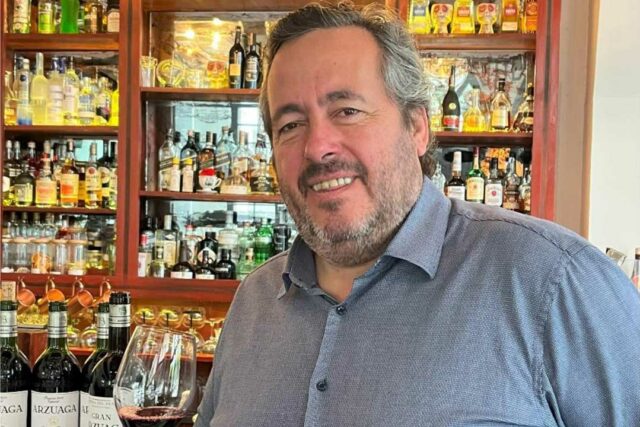
I had discovered Arzuaga wines way back in the 2000s and had always admired its style of both power and finesse. So, when 2nd generation owner Ignacio Arzuaga was in Manila, and the hardworking General Manager of Happy Living Corp., Julian Gagliardi, invited me to the Arzuaga meet and greet event, I did not hesitate at all. After all, I also found out from Julian that aside from the chance to converse with Seńor Arzuaga, there would be a wine tasting featuring their latest vintages and some added surprise wines.

A LOOK AT THE RIBERA DEL DUERO DO

Back in 2008, there was a strong buzz that the Ribera del Duero DO would be joining the highest wine classification in Spain, the DOCa (Denominación de Origen Calificada), joining the ranks of Rioja, which was the first to achieve this classification in 1991, and Priorat, which got it in 2000. But then this fizzled out.

The Spanish Government’s Agriculture department has been extremely stingy in adding to this classification. The additional word “Calificada” means “qualified.” The equivalent of this in neighboring Italy is their DOCG (Denominazione d’Origine Controllata e Garantita), with Garantita meaning “guaranteed,” which is their upgrade from the DOC (Denominazione d’Origine Controllata) classification similar to the Spanish DO. Italy currently has 76 DOCGs and 332 DOCs compared to Spain’s measly two DOCa and 69 DO wine regions. To think that Spain has the world’s largest vineyard area, and Italy is only 3rd after France!

But Spain obviously made up for this with its unique VdP or Vinos de Pago classification — their single estate classification that is closely patterned after the French Burgundy Grands Crus classification. There are now 21 VdPs, since this classification started in 2003 — I will write about VdPs in a future column as this is extremely fascinating to me.

Ribera del Duero’s difference from other regions also stems from its oak-aging. It followed Rioja in terms of its Crianza requirements.

Most Spanish regions follow the six-months minimum oak-aging rule on Crianza, with another 18 months minimum of bottle aging, so that is two years before commercial release of a vintage. But Ribera del Duero follows the same requirements as the Rioja DOCa region when it comes to Crianza oak-aging. Like Rioja, Ribera del Duero requires a minimum of 12 months oak-aging, and another 12 months of bottle-aging before commercial release.

This makes sense because most of the Tempranillo in this region needs oak-aging to tame its rustic tannins. Also, the minimum yield per hectare in Ribera del Duero is 7,000 kgs of grapes, very close to Rioja’s 6,500 kgs/hectare and Priorat’s 6,000 kgs/hectare. In contrast, in a DO region like La Mancha, the yield is over 10,000 kgs/hectare. Bodegas Arzuaga averages around 5,000 kgs/hectare — way below the DO yield requirement.

A CONVERSATION WITH IGNACIO ARZUAGA

Q: How important is the Philippines to your business? How big is Asia in terms of its contribution to the Arzuaga export sales?

Ignacio: Well, the Philippines to me is going to be an important market for us moving forward. I believe that wine is becoming part of the Philippine culture as when I was here around 15 years ago, I did not see what I am witnessing now with more Filipinos drinking wines. Asia in general is pretty important for us, as it ranks 3rd after our European and our United States markets. Japan and China are our top two volume generators in Asia.

Q: What do you think is the signature style of a good Ribera del Duero wine as differentiated from other wine regions?

Ignacio: To know the Ribera del Duero style is to understand the terroir, the soil, the climate. There is contrast in soil and temperature that adds to the complexity of our wines. The region has rich soil in the valley — that is not good for vines — and it has poor soil on the slope — that is very good for vines.

And there is the huge contrast in temperature between summer and winter, and even between day and night. Most important of which is during the harvest months of August and September where ripeness needs to be achieved. Day and night difference could go up to as high as 30Cº, with 25Cº difference being quite often. Therefore, the region gives the grapes the right acidity and the optimum ripeness that helps create well balanced wines Ribera del Duero is known for.

Q: What is your take on the Bordeaux varietals being added to Tempranillo in Ribera del Duero?

Ignacio: The rule in Ribera del Duero is still for Tempranillo (also known locally as Tinto de Pais) to be the majority varietal at a minimum of 75% of the DO’s red wine. The Bordeaux varietals of Cabernet Sauvignon, Merlot, and Malbec are allowed up to 25%, while Garnacha (or Grenache in France) is allowed up to 15%, and local white varietal Albillo, is allowed up to 5% for a Ribera del Duero red wine. This is actually a good thing because of the flexibility these varietals allow us. But it really depends on the vintage, as sometimes our winemakers decide on which other varietal can complement our Tempranillo.

We have planted 5.7 hectares of Malbec in 2020 as we are starting to experiment more with this varietal. We also planted some Grenache as we feel Grenache can make our wines more approachable in its youth at lesser alcohol and higher acidity. But Tempranillo, as you can see from our Arzuaga red wines, is still by far the majority, being in the high 90% of our red blends.

Me: What is your take on the Vinos de Pago since your family also owns Pago de Florentino? And what to you is the justification of having this classification? And when did Pago de Florentino get the VdP classification?

Ignacio: The Vinos de Pago was born in 2003 because the regions where these estates come from, like DOs La Mancha, Navarra, or Valencia, are not recognized for quality wines. So, when some of these estates do special things and create very good quality wines, they are given the VdP classification, above and beyond the DO they belong to. You will not see this with popular regions like Rioja and Ribera del Duero as both these DOs are already well-recognized.

Our first vintage in Pago Florentino was 2001. We got our VdP classification in 2009 with our 2007 vintage. At that time in 2009, there were only nine VdPs including Pago de Florentino, but now this list is over 20.

Q: Finally, as a wine drinker, not an owner of a bodega, what is your favorite wine to drink?

Ignacio: I travel the world and appreciate different wines, but my preferred style of wine is still Ribera del Duero. Whether for everyday drinking or for special occasions, I still like Ribera del Duero.

CUSTOMARY TASTING NOTES

Arzuaga Rosae 2021 — 100% Tempranillo; “red rose nose, notes of fresh strawberries, sour cherries, dry, lively acids, flinty and refreshing floral finish’’

Pago Mota Chardonnay 2021 VdP — 100% Chardonnay; “lemon rind nose, peaches, clean and crisp, dry with lively citrus tones, and fresh vegetal finish”

Arzuaga Crianza 2019 — 94% Tempranillo, 6% Cabernet Sauvignon; “nose of dried plums, violets, mocha, very silky on the body, nice soft tannins, well-balanced with enough grit and finesse for a delicious drink from whiff to finish”

Arzuaga Reserva 2019 — 96% Tempranillo, 3% Cabernet Sauvignon, 1% Merlot: “fragrant, notes of tobacco leaves, dried berries, cinnamon, very supple with juicy bitter-sweet tannins, lengthy in flavors and delectable at the end”

Arzuaga Reserva Especial 2014 (Limited Edition) — one of two surprise wines, it is not presently available for sale in the country, and came from Ignacio Arzuaga’s personal cellar; 95% Tempranillo, 3% Merlot, 2% Albillo; “dark and inky, fruit-forward, very alluring nose that keeps adding flavors, from black currant, cocoa, to earthy notes, silky on the palate with friendly tannins, toasty, and long peppery finish”

Gran Arzuaga 2014 (Limited Edition, less than 700 bottles made on this vintage) — the second surprise wine of the day; a blend with minimum 75% Tempranillo, Cabernet Sauvignon, and Albillo; “captivating complex nose, chocolate-mint, herbal, dried berries, amazing depth of flavors, full-bodied, meaty yet soft enough to savor the ripeness of the fruit, lovely lingering grainy finish”

These Bodegas Arzuaga Navarro reds we tasted were all amazing, ranging from an everyday go-to Crianza, which in my experience can beat Reserva wines from other Ribera del Duero producers, the ever-reliable Reserva, to the surreal limited-edition wines.

Bodegas Arzuaga had actually gone through a couple of Philippine importers in the past, but since 2021, the winery has found a good home in Happy Living Corp. For interest or inquiries on the Arzuaga wines, contact Happy Living at 8895-6507 or 8896-0336.

The author is the first Filipino wine writer to be a member of both the Bordeaux based Federation Internationale des Journalists et Ecrivains du Vin et des Spiritueux (FIJEV) and the UK-based Circle of Wine Writers (CWW). For comments, inquiries, wine event coverage, wine consultancy, and other wine related concerns, e-mail the author at wineprotege@gmail.com, or check his wine training website https://thewinetrainingcamp.wordpress.com/services/


Emperador allocates bulk of P7-B capex to boost whisky business

EMPERADOR, Inc. on Wednesday said that it is allocating P6 billion in capital expenditures (capex) for its whisky segment out of this year’s P7-billion spending budget, as it gears up for overseas expansion.

“As we continue our internationalization journey and expand our market reach, we are investing in more and better capacity to ensure that we can supply the growing demand for our high-end premium brands,” Emperador President Winston S. Co said in a statement.

The P6 billion in capital spending for whisky will be used to upgrade the company’s five facilities in Scotland. The company currently operates four malt distilleries in the area, namely: The Dalmore, Fettercairn, Jura, and Tamnavulin, which produce the company’s single malts of the same names, and a grain distillery.

The move to allocate the bulk of the capex to the whisky business was due to its revenues’ 18% compound annual growth rate from 2020 to 2022, the company said.

The company reported that its whisky segment performed well last year due to increased sales of its single malt whiskies in major global markets, particularly in Asia, North America, and Europe. The recovery of travel retail also contributed to the segment’s performance.

Meanwhile, the remaining P1 billion was earmarked for Emperador’s brandy business, which aims to improve production facilities in the Philippines, Spain, and Mexico.

“To keep up with its fast-growing business, the company is investing in capital expenditures to expand operations, and upgrade machinery and facilities,” the company said.

The company aims to expand its international operations by 2025 to account for about 50% of its business by doubling its branded single malt sales and achieving high single-digit growth in brandy sales.

Emperador is a global spirits conglomerate focused on brandy and whisky. It owns Whyte and Mackay and other brands including Fundador Brandy, The Dalmore, Jura, and Tamnavulin single malt Scotch whiskies.

The company is listed on the Philippine Stock Exchange and Singapore Securities Exchange.

Emperador shares rose by 0.48% to P0.10 to end at P21.05 apiece. — Adrian H. Halili

ADVERTISEMENT
ADVERTISEMENT