Home Blog Page 4838

PVL resets Invitational tourney to June 29 to give way to AVC Challenge

PVL.PH

THE PREMIER Volleyball League  (PVL) has reset its Invitational Conference from June 6 to June 29 to give way for the country’s participation in the Asian Volleyball Confederation (AVC) Challenge Cup slated June 18-25 in Gresik in East Java, Indonesia.

“We will give in to the national team participating in the AVC Challenge Cup,” league commissioner Tonyboy Liao yesterday told The STAR.

While the Philippine National Volleyball Federation has yet to announce if it will retain the same team that finished fourth in the recently concluded Phnom Penh Southeast Asian Games or form a new one, there were expectations the squad will still be an all-PVL crew.

The weeklong biennial event is a tournament for bottom senior national women’s team members of the AVC.

The last edition, held in Nakhon Pathom, Thailand, was topped by Hong Kong a year ago.

Meanwhile, the Invitational will have 12 teams including defending champion Creamline, foreign teams from Japan and Australia and new clubs Gerflor, which will be coached by Jerry Yee and composed mostly of players from reigning NCAA titlist St. Benilde and Farm Fresh.

Creamline was bracketed in Pool A alongside PLDT, Chery Tiggo, Akari and Gerflor while Pool B is composed of Petro Gazz, F2, Cignal, Choco Mucho and Farm Fresh.

Army has begged off.

Mr. Liao said the tournament format would be a single-round robin in the group stages as well as the semis — top two from each group — and knockout finals and battle for third place. — Joey Villar

Bacolod and NU advance to Final Four of Shakey’s Girls Volleyball

BACOLOD Tay Tung High School and National University-Nazareth School (NU-NS) extend their perfect runs with hard-earned victories against gritty counterparts to barge into the Final Four of the 2023 Shakey’s Girls Volleyball Invitational League (GVIL) Sunday at the San Andres Gym in Manila.

Bacolod needed everything it got to tame University of Santo Tomas (UST), 25-22, 25-23, as NU-NS hacked out a 25-15-25-18 win over Far Eastern University-Diliman in the first set of the quarterfinal pairings.

Both squads were dominant in the sweep of their respective groups but met strong resistance this time in the knockout playoffs of the 16-team GVIL backed by Shakey’s Pizza Parlor, Potato Corner, Peri-Peri and R&B Tea with the City of Manila as government cooperation partner.

Bacolod spikers encountered the bigger challenge as they trailed in both sets against the raging Junior Golden Tigresses before showing steely resolve behind Alexia Marie Montoro’s 11 points.

Jothea Marie Ramos and Mary Bontia contributed nine markers each as Bacolod, which topped Pool B, erased a 10-16 deficit in the second set to fend off UST, the No. 2 seed from Pool D.

Earlier, Yesha Noceja and Celine Marsh hammered 12 and 10 points, respectively, as the Lady Bullpups shrugged off a shaky start to live up to expectations so far as the team to beat in the tourney also powered by Mikasa, Team Rebel Sports, Toby’s Sports, Genius Sports and SM Tickets.

Kianne Louise Olango, who spearheaded their blowout wins in Pool A against University of Perpetual Help System Dalta, La Salle Lipa and Gracel Christian College Foundation, added six for the reigning UAAP juniors champion.

NU-NS will face the winner between Pool C leader California Academy and Pool B second seed Adamson while Bacolod clashes against either Pool D pacer Naga College Foundation or Pool A’s No. 2 team in De La Salle University Lipa.

The said four teams were still playing as of press time in their own quarterfinal duels to complete the Final Four cast.

All games of Shakey’s GVIL, in partnership with Athletic Events and Sports Management, Inc., (ACES), will be broadcasted live and on-demand through all social media platforms courtesy of Plus Network with CNN Philippines, Solar Sports and Tap Sports as TV partners. — John Bryan Ulanday

Manila Chooks! bow out of contention in FIBA 3×3 Manila Masters

HOME bet Manila Chooks! ran out of steam in the clutch against Utsunomiya BREX EXE, 22-18, to bow out of contention in 2023 Chooks-to-Go FIBA 3×3 World Tour Manila Masters over the weekend at the Glorietta Activity Center in Makati.

The local ball club erased an early deficit with a staggering 9-3 rally to steal the driver seat at 14-12 only to fall short to the steady closeout of the Japanese visitors.

Manila Chooks! finished at 0-2 in Pool A for a foiled playoff bid in front of home fans after also suffering a 21-9 loss against world No. 1 Ub Huishan NE of Serbia.

Mac Tallo, the country’s top 3×3 player, and Sierra Leonean anchor Tosh Sesay led Manila’s galland stand with Dennis Santos and Paul Desiderio chipping in solid support.

Manila Chooks! and Cebu Chooks as the country’s bets made it to the quarterfinals last year in the Manila Masters, which was won by Ub.

Making it to the quarterfinals were Utsunomiya , Ub Huishan NE of Serbia, Riga of Latvia, San Juan of Puerto Rico, Amsterdam HiPRO of the Netherlands, Futian and Beijing of China, and Sansar MMC Energy of Mongolia. — John Bryan Ulanday

Manchester City win Premier League title as Arsenal lose

LONDON — Manchester City were confirmed as Premier League champions for the fifth time in six seasons on Saturday without even having to kick a ball after second-placed Arsenal’s challenge ended in defeat away at Nottingham Forest.

Arsenal, who enjoyed an eight-point lead over Manchester City as recently as mid-March, needed at least a point to stay mathematically in the hunt, but went down 1-0.

City, who host Chelsea on Sunday after which they will be presented with the trophy, have 85 points with three games to play, while Arsenal are on 81 with one game left.

It is City’s seventh Premier League title since they were bought by Abu Dhabi’s Sheikh Mansour bin Zayed Al Nahyan in 2008 and they are now just two wins away from completing a treble only previously achieve by Manchester United in 1999.

City face Manchester United in the FA Cup final on June 3 and a week later take on Inter Milan in the Champions League final — starting big favorites in both games.

Manager Pep Guardiola has now won a total of 12 trophies since being hired by City in 2016.

While Arsenal have threatened to knock City off their perch this season, it all proved an illusion in the end as Mr. Guardiola’s side again proved relentless in the run-in.

Since losing to Tottenham Hotspur on Feb. 5 they have taken 40 points from the next 42 on offer and have 11 successive league games, beating Arsenal comprehensively home and away.

If City win their last three games they will reach 94 points, not as many as the totals they achieved in 2017-18 and 2018-19, Mr. Guardiola’s first two league titles.

City have now joined an elite group of clubs to win three successive English top-flight titles, with Huddersfield Town, Arsenal, Liverpool and Manchester United the only others.

The club’s website featured animated tickertape flittering down the screen with a live video showing an enormous banner being unfurled down the side of the Etihad Stadium stating “Three in a Row”. — Reuters

Superior Nuggets

The Lakers remained confident after their close-but-no-cigar loss in Game Two of the West Finals. Even as they turned victory into defeat following a glaring inability to protect what looked to be a safe lead in the fourth quarter, they looked forward to doing battle with the Nuggets at home. There was, perhaps, cause for confidence; after all, they boasted of an undefeated record at crypto.com Arena throughout the playoffs to date. And, given the familiar confines with which they could rest between matches, they figured to be rejuvenated for Game Three.

As things turned out, the Lakers could do no better even in front of the packed 18,997-strong partisan crowd. When the battlesmoke cleared yesterday, they emerged with the short end of the stick yet again. Not that they didn’t scratch and claw throughout the set-to; they did their best, and left nothing in the tank. By the time the final buzzer sounded, stalwarts LeBron James and Anthony Davis had north of 40 minutes to their name. They were needed for every one in order to keep up with the Nuggets, but, once more, they came up short.

The bottom line is clear: The Nuggets are superior in every way. It isn’t simply that they have two-time Most Valuable Player awardee Nikola Jokic and postseason sensation Jamal Murray leading the charge. It’s that they have more able warm bodies around them. In short, they’re just too deep, too stacked, too everything, to be beaten by the flawed Lakers. James has been exposed as old and injured, Davis as maddeningly inconsistent, and the rest of the purple and gold as overmatched — hence the outcome. The deafening silence at the end yesterday notwithstanding, no one should have been surprised by the final score, and by the status of the series.

And so the Lakers are down zero and three to the likely champions, with the inevitable as clear as day: The Nuggets will be the conference titleholders. What’s still up in the air is if they can avoid the broom. Respect can be had in coming close, just as respect can still be earned by playing for pride. What’s more, they may yet display their finest while free of pressure. Game Four beckons, and the watch continues.


Anthony L. Cuaycong has been writing Courtside since BusinessWorld introduced a Sports section in 1994. He is a consultant on strategic planning, oprerations and Human Resources management, corporate communications, and business development.

G7 leaders offer Ukraine long-term support

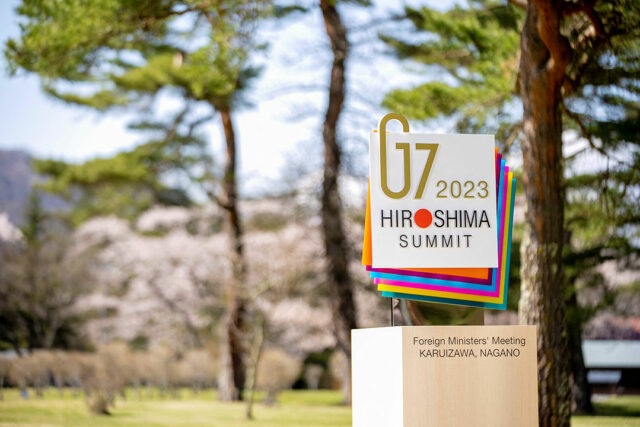
THE LOGO for the G7 is visible at the G7 Foreign Ministers’ Meeting at The Prince Karuizawa hotel in Karuizawa, Japan April 17, 2023. — ANDREW HARNIK/POOL VIA REUTERS

HIROSHIMA — Leaders of the world’s richest democracies said on Sunday they would not back down from supporting Ukraine, in a warning to Russian President Vladimir Putin as he claimed to have taken the eastern city of Bakhmut, something Kyiv denied.

The Group of Seven (G7) summit in the Japanese city of Hiroshima was electrified this weekend by the arrival of Ukrainian President Volodymyr Zelensky, who arrived on a French government plane to canvass for greater support against Russia’s invasion.

Mr. Zelensky told reporters on the sidelines of the summit that the battered eastern city of Bakhmut, the focus of fighting in recent months, was destroyed.

“It is tragedy,” Mr. Zelensky said. “There is nothing on this place” — what remained was “a lot of dead Russians.”

There was confusion over whether he had been asked if the city was still in Kyiv’s hands or Russian forces had taken Bakhmut, but a Zelensky spokesperson said the comments were a denial the city had fallen.

Mr. Zelensky later made his way to Hiroshima’s peace memorial, where he laid flowers at the cenotaph for victims of the world’s first nuclear bombing. He is also expected to give a speech in a nation that has seen an outpouring of support for Kyiv’s fight.

During the final day of the three-day G7 summit, US President Joseph R. Biden announced a $375-million package of military aid, including artillery and armored vehicles, for Ukraine.

He told Mr. Zelensky the United States was doing all it could to strengthen Ukraine’s defense against Russia.

“Together with the entire G7 we have Ukraine’s back and I promise we’re not going anywhere,” Mr. Biden said.

Mr. Putin hailed what he said was a victory for his forces, describing it as the “liberation” of Bakhmut in a statement on the Kremlin’s website.

The assault on the largely levelled city was led by troops from the Wagner Group of mercenaries, whose leader Yevgeny Prigozhin said his troops had finally pushed the Ukrainians out of the last built-up area inside the city.

NO ‘FROZEN CONFLICT’
Other leaders of the G7 — the United States, Japan, Germany, Britain, France, Italy and Canada — echoed Mr. Biden’s sentiments.

Canadian Prime Minister Justin Trudeau promised that his country would support Ukraine for as long and as much as necessary.

Mr. Biden told G7 leaders Washington supports joint allied training programs for Ukrainian pilots on F-16s warplanes, although Kyiv has not won commitments for delivery of the fighter jets.

The potential for such training on US-made F-16s was a message to Russia that it should not expect to succeed in its invasion by prolonging conflict, German Chancellor Olaf Scholz said.

British Prime Minister Rishi Sunak said training would start this summer and Ukraine would get the air force it needed for the future.

It was “significant” that the G7 nations showed solidarity in their intention to uphold international law and order during a summit attended by Mr. Zelensky as a guest, said the prime minister of host nation Japan, Fumio Kishida.

Mr. Scholz said that while the immediate priority was supporting Ukraine’s defense, security guarantees for Ukraine needed to be established once the war was over.

Both Mr. Scholz and French President Emmanuel Macron appeared to stand with Ukraine in opposing any notion of the war becoming a “frozen conflict,” or any proposal for peace talks without Russian troops withdrawing.

As Moscow’s 15-month-old invasion has dragged on, several analysts and diplomats have floated the idea that it could become frozen like the conflict on the Korean Peninsula. North and South Korea remain technically at war as their 1950-53 conflict ended with a ceasefire.

“Peace should not make Ukraine a frozen conflict because that would lead to a war in the future. It needs to resolve the problem,” Mr. Macron said.

The Hiroshima summit also gave Mr. Zelensky a chance to lobby for support from other attendees, like Indian Prime Minister Narendra Modi and Brazil’s Brazilian President Luiz Inacio Lula da Silva, who have remained uncommitted. 

‘DE-RISK’ FROM CHINA
While determination to help Ukraine repel Russia’s invasion was a key message from the G7 summit, the other was distrust of China as a trading partner.

Mr. Biden met with the leaders of Japan and South Korea on Sunday to discuss military interoperability and the economic coercion they face from China, a US official said.

A day earlier, the G7 leaders outlined a shared approach towards China, looking to “de-risk, not decouple” economic engagement with a country regarded as the factory of the world.

In a statement the G7 also reaffirmed the importance of peace and stability across the Taiwan Strait, where Chinese military exercises have raised concerns over the security of Taiwan, the democratic, self-governed island that China regards as part of its territory.

China’s foreign ministry issued a complaint to Japan expressing firm opposition to the G7 statement, saying it disregarded China’s concerns, had attacked it and interfered in its internal affairs, including Taiwan. — Reuters

S. Korea’s Yoon praises Japan’s Kishida for his efforts to mend ties

A view of South Korean and Japanese national flags on the airplane carrying South Korea’s President Yoon Suk Yeol and his wife Kim Keon-hee, at Tokyo International Airport (Haneda Airport) in Tokyo, Japan March 16, 2023. — REUTERS/ISSEI KATO

HIROSHIMA — South Korean President Yoon Suk Yeol said on Sunday that Japanese Prime Minister Fumio Kishida’s expression of compassion for those who suffered as forced laborers under Japan’s colonial rule had resonated with many South Koreans.

Mr. Yoon, meeting Mr. Kishida on the sidelines of the Group of Seven (G7) summit in the Japanese city of Hiroshima, praised his leadership in seeking to respond to global challenges in security and the economy.

In Seoul earlier this month, Mr. Kishida said, “For me personally, my heart hurts when I think of the many people who endured terrible suffering and grief under the difficult circumstances of the time.”

Sunday’s meeting was the third between the two this year, marking a thaw in years of icy relations between the Asian neighbors. South Korea announced in early March a plan for its companies to compensate victims of forced labor under Japan’s 1910-1945 colonization of the Korean Peninsula.

Before their meeting on Sunday, Mr. Yoon and Mr. Kishida visited the Hiroshima Memorial Peace Park to pay their respects at a memorial for Koreans who died in the US atomic bombings of Japan in 1945.

“I feel that our visit was important for both Japan and South Korean relations, as well as for us to pray for world peace,” Mr. Kishida told Mr. Yoon of the first visit to the memorial by the leaders of both countries together. The joint visit symbolizes efforts by both leaders to face the painful past and heal from it, Mr. Yoon’s spokesperson Lee Do-woon told a briefing.

“It also means the two countries, along with their ally the US, will collectively respond to nuclear threats in the northeast Asia region and the world,” Mr. Lee said.

As many as 100,000 Koreans suffered in the bombings of Hiroshima and Nagasaki, half of them dying that year. About 43,000 returned to South Korea and 2,000 went to the North, according to the Korea Atomic Bombs Victim Association. — Reuters

Sick of sewage, thousands of Britons protest at water companies’ pollution

REUTERS

BRIGHTON, England — Thousands of Britons took to the sea and rivers on Saturday to demand an end to sewage pollution by water companies, highlighting a topic that is likely to be an issue at the next general election.

A national “paddle-out” at 12 locations across the United Kingdom, including Brighton in the south, Windermere in the Lake District, Plymouth in the southwest and Edinburgh in Scotland, was organized by campaign groups Surfers Against Sewage and Ocean Activists.

About 200 paddleboarders protested off the coast of the southern English resort of Brighton.

To the beat of a drumming band and waving placards, the protestors called on Britain’s water companies to do more to prevent sewage discharges.

“We are sick of this sewage and they need to take action,” Izzy Ross, Surfers Against Sewage’s campaign manager told Reuters.

“We need to see an end to sewage discharges into bathing waters by 2030, and we need to see a 90% reduction in sewage discharges across the country,” she said.

The protest was held as water companies face the biggest wave of public criticism over the dumping of raw sewage and the poor quality of rivers and beaches since the industry was privatized by the then Conservative government in 1989.

Public anger has been fueled by the payment of dividends to investors and large salaries and bonuses to water industry executives.

The release of sewage into waterways is only supposed to happen during exceptional rainfall to stop it backing up into homes.

However, in 2022, water companies in England alone released raw sewage into rivers and the sea 301,091 times, an average of 825 times a day, according to data from the Environment Agency.

Campaigners say water companies are discharging much more often than they should, including when there has been no rain.

The situation has been blamed on decades of underinvestment in infrastructure.

On Thursday, Water UK, the trade body representing the UK water industry, apologized, said the public was right to be upset, and said more should have been done to address the issue of spillages sooner.

It said the industry would invest 10 billion pounds ($12.6 billion) in “the biggest modernization of sewers since the Victorian era” to cut waste outflows.

But its pledge was dismissed by campaigners, who said it still had to be signed off by regulator Ofwat, while the investment would ultimately be paid for by customers.

Campaigners also highlighted that the sum was significantly less than the 56 billion pounds of investment the government has said is needed to end the routine release of sewage into waterways. — Reuters

Where do we go from the power rut?

JUNIOR FERREIRA-UNSPLASH

The Philippines is a very small power market by ASEAN standards, with market demand peaking at 15 gigawatts (GW) compared to Thailand’s with 30 GW and Indonesia with 45 GW. This small market is also very fragmented with three major grids, the Luzon grid (12.3 GW as of May), the Visayas grid (2.2 GW) and the Mindanao grid (2.3 GW) being barely connected. The Visayas and Luzon grids are weakly connected via the Bicol-Samar (250 MW) submarine cable. The Mindanao grid was isolated until the Mindanao-Visayas Interconnection Project (MVIP) was energized in May with a starting carrying capacity of a measly 22.5 megawatts (MW). Because of this fragmentation, the Philippines has three Wholesale Electricity Spot Markets (WESM) which many people will say are two too many.

A wholesale electricity market works best if the market is deep with many producers and many consumers on each side of the ledger; markets with few producers means substantial market power and is subject to collusion and price manipulation. Such is the shallowness of the market that one Energy Secretary once bemusedly narrated that one of his duties in the summer months when the power reserve is running low is to call and beg power suppliers for more juice to avoid the politically disastrous brownouts. Such direct contacts between the power authorities and market players is unseemly, even illegal, in a properly functioning market as it facilitates anti-consumer collusion! Which is why many countries in Asia opted to have state-owned and administered rather than competitive power markets. Only the Philippines and Singapore have WESMs in the ASEAN. The plan to properly enable a One Philippine Grid has been in the books since the 1980s.

The story goes that the plan to connect the Mindanao grid to the rest of the country goes very far back but was continuously frustrated by Mindanao politicians and constituencies who opposed the sharing of the then cheap hydropower-generated Mindanao power, back when rainwater was abundant, with the rest of the country (see Boo Chanco’s must read column piece, “Power Failure,” in the Philippine Star on May 19). And the central government — whose duty it was to unbind precisely such conflicts for the common good — could not or would not prevail upon Mindanao to relent; recall this was still under Marcos’ martial law. It was climate change, rainwater scarcity, and a growing frequency of power outages in the island that persuaded the Mindanao constituency to finally relent to the interconnection.

As a panelist at the May 11 Power Module of the Aboitiz Data Institute-sponsored AI Philippines Summit at the Marriot Hotel, in Newport World Resorts we were welcomed by an episode of flickering lights and temporary darkness, but this happily ended a few anxious seconds later. Was it due to a tripping in the National Grid Corp. of the Philippines’ (NGCP) grid which was quickly enough covered by Marriot’s own backup generator (if so, surely fossil fuel-fired) or to some local electrical tripping fortunately covered by Marriot’s own built-in system redundancy? I could not help fearing rolling brownouts because a few days before, on May 6, a Monday, a rolling brownout episode was declared to the dismay of the affected public. And the NGCP reported that the red alert status will continue till June! Why, only on May 3, the Department of Energy (DoE) announced that no red alerts were forthcoming this summer. The red alert and accompanying rolling brownouts were due to several causes: the unplanned electrical problems of coal-fired Calaca units 1 and 2 (equipment malfunction in the complicated fossil-fired units), a tripping incident in the NGCP grid which cut off Masinloc (the NGCP, which seems to prefer its profits going to dividends and not enough to redundancy investment, may be accountable) and force majeure due to a water level deficit in Binga dam (credited to climate change) which stopped power from the Aboitiz Power’s Binga hydro facility. All in all, 1,354 MW was lost to the grid. Energy authorities quickly blamed the non-delivery of power from some gas fired plants and the delay in the delivery of full capacity (450 MW) of the MVIP connecting Mindanao and Visayas. The recently energized MVIP can deliver only 22.5 MW of power of its planned 450 MW full capacity, which the NGCP promises will be realized in December 2023. But wasn’t the MVIP supposed to be delivered even before the pandemic?

These events surprised no one, except the DoE. Every year, in the summer we have, as if by clockwork, red alerts; every year we have congressional hearings to address the problem; every year we continue to host red alerts. Plus ça change, plus c’est la même chose (the more things change, the more they stay the same) seems to be the middle name of this nation in power (but not just).

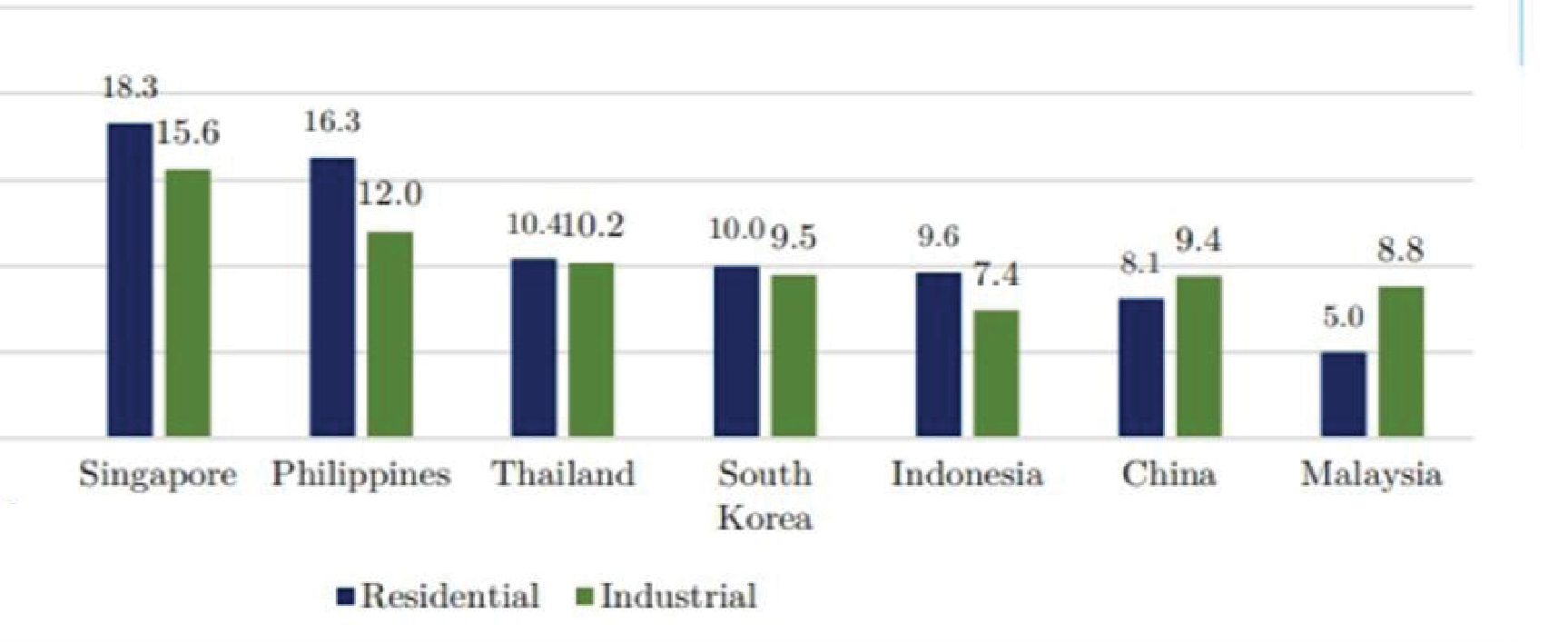
Why is power cost and stability so crucial? Why is the investment rate so low in the Philippines? Power cost is one area where the Philippines leads the ASEAN, barring Singapore. Electricity cost (USc/kWh as of December 2021) charged captive customers by major utilities (from Ravago, 2020) is reflected in the first chart.

Notable are the following:

• The price of power in the Philippines for large business establishment was highest in the ASEAN in 2021 apart from Singapore. But if power supply instability is costed in, stable power “could be more costly” in the Philippines.

• In Malaysia and China, households pay more for electricity than industries!

As a nation we have decided that large businesses subsidize (pay higher than) poor households. The better alternative would have been to use the state treasury to subsidize the poor according to the John Stuart Mill rule: don’t distort the market in pursuit of public welfare goals. Power costs for large establishments are top of mind among investors especially in Manufacturing and export platform investment. The Philippines is kulelat (the far last) as a Manufacturing investment destination in the ASEAN. Better than the Maharlika or constitutional change is the lowering of power costs for business to improve the investment ecology.

The current darling idea for increasing power capacity is nuclear power. Despite the terrible experience with nuclear power (with the Bataan Nuclear Power Plant or BNPP) four decades ago, perhaps we can try it again. Nuclear technology is not static and is now making a comeback with Small Nuclear Reactors (SMRs). Nuclear power has a smaller carbon footprint than even solar and wind. SMRs reactors mounted on ships will have less NIMBY (not in my back yard) problems, and will add resilience to the system better suiting the archipelagic character of the country. A nuclear plant today will boost our power supply. But will it lower power costs? Not if the cost of that additional power is prohibitive. Table 2 shows the cost of electricity (Ravago, 2023) by fuel use.

Worse, the cost of nuclear power has been increasing (up 33%) between 2009 and 2021 while those of renewables have been decreasing (down 90%). Lifespan favors nuclear: nuclear plants last 40 years, solar photovoltaic (PV) panels (30 years), wind turbines (25 years). Renewables are lower on fixed cost and much lower in turnaround time: a decade for nuclear vs 0.5 years for solar. Still, if the private capital decides to wager on nuclear plants with its own resources, go ahead.

There is a segment of solar renewables that is even more attractive: solar panels on idle rooftops. No NIMBY problems, no land use displacement issue; no environmental assessment hurdles, quick turnaround time (solar power starts to flow in six months). Furthermore, rooftop solar electricity will not be burdened by grid and local distribution cost; no universal, feed-in, and stranded asset levees; and can help shave demand. When matched with battery storage it can help stabilize the grid. Renewable power is the un-paralleled low-lying fruit we must optimize in this decade.

Policy Recommendations:

1. Existing large establishments could be required to gradually replace fossil fuel backup generators with grid-scale batteries.

2. New establishments could be required to acquire battery storage-based backup in lieu of fossil fuel fired back-up.

3. Add as a permitting requirement for new buildings a rooftop solar panel installation.

4. Make solarized residences the default option for residential buyers (“opt out” if you don’t want to be “solarized”).

5. Contingent idle rooftop tax: an x% tax on idle rooftops (per square meter of roof) for all top 500+ corporations; “contingent” because the tax is automatically lifted once the firm generates in situ y% of total consumption through rooftop solar PV generation.

6. Slowly shift the household subsidy burden from Manufacturing to Services and the national treasury.

Let’s put our renewable power program on speed dial.


Raul V. Fabella is a retired professor of the UP School of Economics, a member of the National Academy of Science and Technology, and an honorary professor of the Asian Institute of Management. He gets his dopamine fix from tending flowers with wife Teena, pedal-powering a bicycle, and assiduously, if with meager success, courting the guitar.

Learning from Batanes’ public health systems

DANIELE D ANDRETI-UNSPLASH

Long before the Universal Health Care Act (Republic Act 11223) was signed into law in 2019, the province of Batanes had already internalized the concept of universal healthcare.

Batanes, despite its geographic isolation and limited resources, serves as a good case study for the effectiveness of primary healthcare. Primary healthcare is a whole-of-society approach to health, which shifts the focus from systems designed around diseases to systems designed for people. It has a strong focus on equity and interventions that encompass a person’s entire lifespan. It emphasizes one’s needs as early as possible, from health promotion up to treatment.

Several factors can explain Batanes’ success: the development-oriented approach of local chief executives who consistently make health a priority, the innate health consciousness and collective action of Ivatans, and the presence of healthcare workers who advocate primary healthcare.

Successful partnerships with non-government organizations also explain Batanes’ exemplary local healthcare financing system. The province’s voluntary social health insurance scheme, Kapanidungan sa Kalusugan (KsK) dates back more than two decades. Under KsK, families are classified into income brackets, which determine their monthly premium for outpatient and inpatient services. Initiated by the non-government organization HealthDev Institute, the fund survives to this day even if most members are also covered by PhilHealth. Thanks to KsK and financial programs from politicians for hospitalization, most Ivatans need not shell out money for their healthcare within the province.

Dr. Roel Nicolas, Batanes’ former Provincial Health Officer, notes that Ivatans are generally health conscious and usually immediately report any sign of illness to their community health workers, partially because out-of-pocket expenditure is minimal.

Barangay health workers (BHWs) are the main providers of primary healthcare and the first points of contact in Batanes’ health system. As the province with the smallest population size in the Philippines (18,831 as of 2021), Batanes is one of the provinces with the least BHWs, with 137 BHWs distributed among the six municipalities. But the small BHW population in Batanes is dynamic and motivated to work. They are given importance by the local government, reflected in their relatively high level of honorarium which they receive from the provincial government, municipal government, and barangay.

The Batanes local government unit (LGU) understands the pillars of primary healthcare, internalizing the notion that prevention is better than cure. The LGU focuses on health promotion and disease prevention within the community precisely because they are cognizant of the difficulties of their location. Complex cases need to be airlifted to hospitals with specialists and more sophisticated equipment in Cagayan Valley or Metro Manila. Medicines and supplies are limited. And insufficient Information and Communications Technology (ICT) infrastructure hinders connectivity and coordination.

The COVID-19 pandemic tested the strength of Batanes’ health systems. The LGU knew that although their health system was functioning well, due to their location, an outbreak would overwhelm them. The lack of testing facilities meant that swab samples needed to be sent to the mainland and would delay results. Supplies and equipment came sporadically, and few ventilators are available on the island for critical cases.

The local government believed that prioritizing health would eventually result in less economic scarring. The province remained the only COVID-free province for almost the entire first year of the pandemic, and cases remain low to this day. The LGU acted fast, activating the barangay health teams and implementing border control measures even before the National Government announced community quarantine in Metro Manila.

Although Batanes was completely closed to tourists, the government provided support to those who lost their livelihoods. “Ang pera ay kikitain pero ’pag nawalan ng buhay, hindi mo na ’yan maibabalik (Money can be earned but losing a life, you cannot get that back),” Batanes Governor Marilou Cayco told GMA News in an interview in 2020.

Batanes’ number one problem within its healthcare system is also arguably the biggest problem in the Philippine healthcare system: the lack of human resources for health). Although there are many Ivatan doctors, they only usually return to the islands for limited periods of time. While the beauty of Batanes attracts many visiting doctors, the lack of financial reward is the reason why only around five doctors are permanently stationed there. The World Health Organization’s “SDG index threshold,” or the estimated number of skilled health workers needed to reach the minimum proportion of the population for achievement of high coverage, is 4.45 healthcare workers for every 1,000 people. That means Batanes would need 80 doctors to reach this target.

Batanes’ health system is one to marvel at: It proves to us that a small, geographically isolated set of islands can very well become a leader and innovator in good governance for health, with the right focus on inclusivity, and with leaders who possess the political will to make sure that their constituents live healthy and comfortable lives.


Pia Rodrigo heads the health policy team of Action for Economic Reforms.

Building back biodiversity

BETH MACDONALD -UNSPLASH

THIS YEAR’s International Day for Biodiversity is a strong call for all of us to walk the talk when it comes to protecting our biodiversity areas. It’s theme, “From Agreement to Action: Build Back Biodiversity,” holds meaning as it prompts us to rejuvenate our passion, commitment, and hope for the future generation with the adoption of the Kunming-Montreal Global Biodiversity Framework at COP 15. While there have been significant biodiversity-related interventions when we launched the 2030 Agenda and development partners have publicly committed their resources for nature and climate, we still have quite a long way to go. At the brink of what is considered a Planetary Emergency, the cost of inaction in the face of a deteriorating planet is severe. The World is on track to breach a critical warming threshold in the next five years.

The Philippines is known as one of the world’s 18 megadiverse countries. It is home to two-thirds of the Earth’s biodiversity, and between 70% and 80% of the world’s plant and animal species. The country also ranks fifth in the number of plant species and maintains 5% of the world’s flora.

The Philippines has over 50,000 plant species, including over 3,000 endemic species. Moreover, it has over 100,000 animal species, including over 500 endemic species. The country’s over 7,000 islands are home to a variety of rainforests, mangrove forests, coral reefs, and other ecosystems.

The Philippines’ biodiversity is a valuable resource that provides many benefits to the country and the world. Biodiversity provides food, water, medicine, and other resources. It also helps to regulate the climate and protect our people against natural disasters.

However, only 37.47% of the country’s Key Biodiversity Areas are protected by law. Given the Department of Environment and Natural Resources (DENR) Biodiversity Management Bureau’s roadmap, protection coverage of terrestrial areas needs to increase from what is currently 4.54 million hectares to 5.55 million hectares. On coastal areas, there is a need to increase protection from 3.14 million hectares to 35.03 million hectares.

These numbers can only be achieved through our collaborative action. Together, we can build the resilience of our treasured ecosystems, local governments, and communities.

To support the DENR, the United Nations Development Program (UNDP) and other development partners have committed to move and mobilize action to achieve the Philippines’ biodiversity targets outlined in the Philippines Biodiversity Strategy and Action Plan (PBSAP). The support of the Global Environment Facility (GEF) through UNDP have been pivotal contributions to natural resources management and biodiversity conservation through the engagement with local communities. Not only that, soon, with support from the GEF, we will be supporting the Biodiversity Management Bureau with the updating of their PBSAP and drafting of their 7th National Report.

The government’s commitment and evident partnership-building work has enabled the broadened and improved biodiversity management interventions through the biodiversity corridor approach, improved capacities of Local Government Units (LGUs) and the empowerment of Civil Society Organizations (CSOs), increased biodiversity financing and wealth creation through fair and equitable access and benefit sharing mechanisms, and the development of innovative local nature-based solutions for climate.

Recognizing nature-based solutions to improve biodiversity management and the participation of different stakeholders are critical to ensuring that biodiversity targets are met. For this, we will need the strong support of the private sector, whose existing and potential contributions to biodiversity cannot be underestimated. There is an urgent need for the government and development partners to work with the private sector in establishing the business case for biodiversity management interventions, and in ensuring that green and climate considerations are integrated in business models, both during project development and implementation stages.

It also bears noting that our communities, both indigenous and local communities, should be at the very heart of our biodiversity management interventions. They are the real voices and stewards of our rich biodiversity. It is through them that we are able to benefit from our resources.

We believe that through our collaborative efforts, we are building the resilience of our treasured ecosystems, local governments, and communities.

The World Health Organization has declared that we are transitioning to the long-term management of COVID-19. Now, we can establish a more robust build back better strategy and concrete actions for resilience-building. We have survived a pandemic — now it’s time to Build Back Biodiversity beyond the agreements and through action. As the adage goes, there is no Planet B.


Dr. Selva Ramachandran is the resident representative of UNDP Philippines.

Kanya-kanya, tayo-tayo, atbp.

DUY PHAM-UNSPLASH

What would Felipe Landa Jocano say?

He would deign to meet with me, a lowly neophyte professor (a “lecturer,” as non-tenured or part-time professors were called then) at the University of the Philippines Diliman (UP) College of Business Administration. Dr. F. Landa Jocano, Professor Emeritus, taught at UP for nearly half a century. He served as Chairman of the UP Department of Anthropology, Director of the Philippine Studies Program at the UP Asian Center, Dean of the UP Institute of Philippine Studies, and Head of Asian Center Museum Laboratory. He was the country’s foremost anthropologist at that time. (Prof. Jocano passed away in 2013.)

On some Saturday mornings, I would catch “Prof” (as he preferred to be called), at the UP Bahay Alumni, having brunch on the veranda overlooking the serene campus grounds, far from the hustle and bustle of the characteristically hyper young UP students. I consulted with him on the subject that I taught, “Human Behavior in Organizations” (HBO). His books — Filipino Value System (1997), Management by Culture (1999), and Work Values of Successful Filipinos (2000) — were required reading for the MBA classes that I taught in.

Prof, would you say that there is a noticeable “kanya-kanya” (to each his own) syndrome in our society today, I might ask.

He would probably stop me right there. Are you implying some negative value, a character flaw, or wrong behavior, he might accost me, still in his gentle Ilonggo tone. He would not allow “Filipino bashing.” In his book, Filipino Value System, he said, “there are no negative Filipino values, as some writers aver. There are only wrong uses of the values because our models for value-analysis are western — particularly those used by former colonizers and foreign observers.”

Jocano identifies two models of the Filipino value system. The first is the exogenous model or the foreign model, while the second is the indigenous model or the traditional model. The foreign model is described as a “legal and formal” model. The indigenous model is described as a “traditional and non-formal” model or guide, but one that is deeply embedded in the subconscious of the Filipinos. The foreign model was inherited by Filipinos from Western cultures, particularly from the Spaniards and the Americans. An example of a foreign or exogenous influence is the bureaucracy exhibited in the government of the Philippines.

But Jocano does not say that foreign influence is necessarily bad. “We do not advocate the total rejection of these foreign-derived institutions, like the bureaucracy, which has already become part of our social system. This will isolate us from the modern world. It will also lead to parochialism, which is inimical to progress” (Jocano, Filipino Values System, op. cit.).

But more than the ambiguous gift of the “bureaucracy” and its disciplines (or lack of it), foreign cultures have affected and perhaps changed Filipino values and mores. Attitudes and behaviors have evolved with the day-to-day reinforcement of what works and what does not work in coping with the changing world and its environment.

Jocano was one of the first scholars to suggest alternatives to H. Otley Beyer’s Wave Migration Theory of migration to the Philippines. His Core Population Theory proposed that there were no clear discrete waves of migration, but rather a long process of cultural evolution and movement of people. The theory suggests that “early inhabitants of Southeast Asia were once of the same ethnic group with similar culture, but eventually — through a gradual process driven by environmental factors — differentiated themselves from one another” (Halili, Maria Christine N. [2004]. Philippine History).

There you go! People change. The world has changed drastically in the last two decades. Globalization has worked swiftly to equalize the coping and compromise of peoples in order to survive and prosper, aided by the dizzying speed of high technology. Ah, yes, technology has impersonalized relationships, as competition has done. And values are all about relationships — the “kapwa” (the neighbor or fellowman) is the objective of core Filipino values.

In his book, Management by Culture, Jocano cites “three core elements of social organization that provide Filipinos with proper contexts for organizing their ideas, defining their needs, interpreting their experiences, passing judgments and guiding their behavior whether they are operating within the formal environment of the organization or the community, namely, personalism, paternalism, and familialism.”

All three elements play on the Filipino’s “strong desire to be counted, to be part of a collectivity,” Jocano says. This need to “belong” raises expectant dependency — manifested in negative behavior like the entrenched patronage system, the ubiquitous “pakikisama” (obligatory support), or the endless gratitude of “utang na loob.”

“Filipinos, by social orientation, are ‘groupists,’ not ‘individualists.’ The popular trait (‘to each his own’) is an urban coping mechanism that developed in response to the entrepreneurial demands of city life. It is also the result of modern education, which emphasizes individualism as an ideal trait. However, the principle of groupism continues to prevail as an ideal trait,” Jocano says.

But how much longer will the ideal of collective strength survive over the empirical evidence of growing individualism, in the challenges of voracious, cannibalistic modern life? “To each his own” seems now the lighter way to move around obstacles.

The forced individualism chiseled into minds and hearts in the isolation and restrictions of the three-year COVID-19 pandemic may have precariously threatened to create a paradigm shift in social values, not just in the Philippines but around the world. The most terrifying obvious manifestation of this is the political unrest in the world, with hapless Ukraine being mercilessly attacked by Russia in the midst of the pandemic. Where are the human values of family and togetherness, support, and love, in brother fighting brother — for the peoples of Russia and Ukraine are of the same ethnic origins and share a socio-political history. Countries such as Afghanistan, the Central African Republic, Ethiopia, Libya, Mali, Somalia, South Sudan, and Syria are all currently experiencing civil wars, resulting in significant casualties and displacement. Drug wars are another form of conflict that can result in significant violence and unrest.

In our country, disenchantment is palpable over the old values that Prof. Jocano so idealized. In little everyday experiences, one is often not so subtly reminded to “fight your own battle,” and not to expect to be bailed out of your troubles by relatives or friends. “Scratch your own galis (itch); eat your own kamatis (tomato)” is a form of derision chanted by little children at play to the loser in the game.

But does not the prevalent the patronage system from perversely justify itself as the savior of those in trouble, by the forced allegiance these “padrinos” (godfathers) exact from those who come to them for dependable redemption? And so, corruption and injustice thrive and flourish in our country. “Pakikisama” (companionship) and “awa” (mercy) can have ambiguous meanings.

So can “kanya-kanya” and “tayo-tayo” (just us) be good or bad — depending on the meaning and purpose in one’s heart.


Amelia H. C. Ylagan is a doctor of Business Administration from the University of the Philippines.

ahcylagan@yahoo.com

ADVERTISEMENT
ADVERTISEMENT