Home Blog Page 4805

The US-Philippine Economic Partnership

PAT WHELEN-UNSPLASH

President Ferdinand “Bongbong” Marcos, Jr. has made his administration’s pivot to the United States a major plank of his presidency. He has offered to host additional military sites in the country for US forces and forged a stronger military alliance and cooperation, a stance that has angered China. The question is, aside from a stronger security posture against China, what will the Philippines get out of it?

Newspaper reports quoted unnamed government officials as having expressed disappointment that the US could not, or would not, offer a free trade agreement with the Philippines in exchange for the closer military alliance. After all, the US has a free trade agreement with Vietnam, its former enemy, and has more investments and trade with Vietnam than the Philippines.

US Trade Representative Katherine Tai came and went to the Philippines and dismissed any talk of a free trade deal.

However, the unnamed government officials in the report should not have been surprised. The US has been veering away from free trade for years now. Former US President Donald Trump pulled the US out of the Transpacific Partnership, a free trade bloc that what supposed to be an economic counterweight against China and which the Obama administration had pushed. Free trade is being perceived in the US as being inimical to the interests of US workers and US security, as manufacturing had shifted to lower-cost countries, costing jobs in the US and making its supply chain vulnerable. In particular, the Democratic Joe Biden administration is very likely not to take any action that may anger US Organized Labor, one of its major supporters.

Government officials are hoping that the US at least renews GSP (Generalized System of Preferences) privileges to the Philippines. The GSP scheme allows the duty-free entry of some 3,500 eligible products into the US, but this expired in 2020. The problem with the GSP scheme is that the Philippines still must compete with other countries, as many have been given GSP privileges. Also, the US Congress must approve the renewal of the Philippine’s GSP privileges and there has been no action on that front.

Instead, the US has been offering an Indo-Pacific Economic Framework (IPEF), a grouping of about a dozen countries that include the Philippines, Australia, Japan, Australia, Vietnam, Malaysia, and others.

The problem with the IPEF is that presently, it’s more about meeting standards on anti-corruption, anti-money laundering, tax compliance, labor, and the environment than it is about trade. No trade concessions have been offered under the IPEF when trade is the strongest glue for an economic partnership.

The US may eventually offer some trade concessions, concessional loans and financing, and investment directives under a “friend-shoring program,” that is, building resilient and dependable supply chains among IPEF members. For example, it may encourage or incentivize US investments in renewable energy and minerals processing in the Philippines that could be part of a supply chain developing the EV car market in the US. However, there are still no details in the IPEF to celebrate yet.

During forums discussing the US-Philippine economic partnership, I have raised the point that while US investments have been benefitting the country, the US has also been doing some economic harm by way of draining our medical professionals and, to a certain extent, our talented teachers, from the country. It’s a well-known fact that Philippine hospitals have been suffering from a high turnover of nurses and other medical professionals because they are being offered lucrative jobs and fast visa processing in the US and other countries like Canada, the UK, Australia, and New Zealand. This has led to a deterioration in healthcare in the Philippines.

However, that is just a fact of life: we can’t prevent our nurses and teachers from seeking better opportunities abroad. The US and other Western nations must recognize that they are doing harm by encouraging this talent drain and must seek to compensate the Philippines in some form, such as by offering grants or educational assistance to help the Philippines replenish its supply of nurses.

One way that the US could help in this area is by allowing US Medicare to be offered through Philippine hospitals. It will be a win-win situation. The US health system will benefit from the lower cost of medical care in the Philippines while Filipino-Americans or retired Americans residing here can avail of US Medicare without having to go to Guam or the mainland US to get medical care. More importantly, Philippine hospitals can generate additional revenue to be able to hire and train new nurses.

Another idea that I raised during a forum was for the US to help the Philippines build its defense industries. The United States and its defense allies are raising their defense spending. Japan will double its military spending to 2% of GDP over the next five years. In the face of the Ukraine war, Germany has shed its relatively pacifist stance and will increase its military spending to more than 2% of its GDP or about €60 billion annually. The entire EU will be dramatically increasing military spending.

The Philippines can help supply some of the defense needs of the US and its military allies, from backpacks to light armor to electronics that power drones. It’s also a democracy, unlike Vietnam, and is therefore a natural partner in the military supply chain of Western democracies.

As a start, the government should start seriously developing the Defense Industrial Estate in the Freeport Area of Mariveles, Bataan not only to supply the defense needs of our military under the AFP Modernization Program, but to export.

However, to maximize its security engagement with the United States and the West, the Philippines must continue to be open to foreign investments, improve infrastructure and the rule of law, and undertake economic reforms. Fortunately, the Philippines, under former President Rodrigo Duterte, passed the Public Service Act Amendment which opened the telecoms and transport sectors to 100% foreign investment. Consequently, American firms like Starlink have entered the local broadband market.

However, more needs to be done. Philippine procurement laws have a dysfunctional and erroneous Filipino First policy: the government is mandated to buy from Filipino firms even if the Filipino firm bids 20% more than foreign ones. This will bar state-owned defense industries from developing and accessing the most competitive and affordable technologies.

The US is also very keen on “green investments” under the Indo-Pacific Economic Framework. However, foreigners are not allowed to invest in tree plantations on state-owned lands under our current laws. So, why not pass the Tree Planting bill that would redefine trees as personal property, rather than part of the land, so foreigners can invest?

The US can help us with food security but RA 3018 bars foreigners from investing in the rice and corn trade and PD 194 mandated foreign companies who have invested, to divest in 30 years.

President Ferdinand Marcos, Jr. has said that changing the economic provisions of the Constitution isn’t a priority, but the US can do more to help the country if those restrictive economic provisions are liberalized. For example, in the Joint Seismic Memorandum of Undertaking case, the Supreme Court ruled that under the Constitution, 100% foreign-owned corporations cannot participate in the exploration of the country’s natural resources. How can the US help us with energy security when mere exploration is off-limits to foreign-owned corporations?

We must learn to take advantage of historical junctures, and the revival of Great Power rivalry and the rise in military spending is one of them. Japan’s economy was able to take advantage of the South Korean War because its firms were able to supply the UN forces fighting North Korea. Thailand took advantage of the Plaza Accord and the revaluation of the yen to attract Japanese companies to set up manufacturing plants there. So far, the US-China decoupling has led to factories being relocated to Vietnam, India, and Indonesia. Our lack of infrastructure, labor rigidities, and uncertain power outlook have caused investors to bypass the Philippines.

It’s about time we wake up. How much we can get from our economic partnership with the US will also depend on what we do. It’s good that President Bongbong Marcos has an international outlook and is seeking to engage the world through his visits. But there’s also homework to be done. I’m looking for President Bongbong Marcos to be doing homework as he enters his second year in office.


Calixto V. Chikiamco is a member of the board of IDEA (Institute for Development and Econometric Analysis).


totivchiki@yahoo.com

Hyundai Bacoor set to open by Q2 2024

PHOTO FROM HYUNDAI MOTOR PHILIPPINES

A new Hyundai dealership is set to open next year as Hyundai Motor Philippines, Inc. (HMPH) welcomes the Borromeo Motoring Group to its network of dealers through Hyundai Bacoor. A ground-breaking ceremony was held recently, led by (in photo from left): HMPH Managing Director Cecil Capacete, HMPH Chief Financial Officer Hong Shik Chin, HMPH President Dong Wook Lee, Borromeo Motoring Group President Paolo Borromeo, and Dearborn Motors Co. President and Director Max O. Borromeo. “Today, we are breaking ground not just for the soon-to-rise outlet here in Bacoor, but also for the start of a fruitful partnership between HMPH and the Borromeo Group,” said Mr. Lee. “We look forward to giving Caviteños closer access to our innovative and sustainable products.” The 2,129-sq.m. outlet at Molino Boulevard in Barangay Mambong is expected to be operational by the second quarter of 2024. It will feature the new Hyundai Global Dealership Space Identity (GDSI) 2.0.

Style (05/29/23)


Edsa Shangri-La holds wedding fair

FROM venue styling, couture, featured musical acts, to menu du jour, engaged couples are spoilt for choice as they walk into halls transformed into mood boards of inspiration for the big day with seasoned specialists to take them through a memorable journey. Edsa Shangri-La, Manila in partnership with Wedding Treasures and Fashion Pulis brings featured industry talents, animations, keynote speakers, and musical acts in Unveil 2023: Upcycled Shades of Weddings by Edsa Shangri-La on June 3 and 4 at the Isla Ballroom. Part of the fair are fashion shows with Val Taguba headlining along with Hannah Kong, Haydee Garcia, Merri Chan, Morato Dapper, Steph Tan, Studio Ceremonie and Zandra Lim. Seasoned events specialists and our team of masterful chefs are on the ready to guide couples. Register for free at bit.ly/Unveil2023 for a weekend of styling, design, talks from some of the industry’s finest, and a chance to enjoy a three-day and two-night stay at Shangri-La Boracay.


Uniqlo says thank you with deals and more

JAPANESE global apparel retailer Uniqlo is holding its Thank You Festival from May 26 to June 1 to show appreciation to its customers who have supported the brand throughout the years. For the celebration, customers can find LifeWear items on limited offer, shop new designs of UT and 2023 UT Grand Prix (UTGP) Magic For All Collection, avail of special novelty items, and contribute to a community. Uniqlo has limited offers on selected LifeWear items including Women’s Linen Blend Open Collar Short Sleeve Shirt and Women’s Linen Cotton Shorts for P990 from P1,290, Men’s Linen Stand Collar Short Sleeve Shirt that will be P990 from P1,490, and Men’s and Women’s Dry Color Crew Neck Short Sleeve T-Shirts for P290 from P390, among many others. Customers will also be treated with snacks from Jack and Jill and one Hope in a Bottle if they make a purchase during the first two hours of the store opening in any stores nationwide from May 26 to June 1. In line with the Thank You Festival, there will be a new UTme! designs customers can choose from. UTme! is a service that lets customers design their own T-shirts or tote bags. They can choose from the Thank You Festival UTme! designs that will be available only in Uniqlo Manila Global Flagship Store in Glorietta 5, Makati City. These new designs come from local brands and artists such as — Crosta Pizza, Messy Bessy, Sip & Gogh, Hope in a Bottle, and 2023 UTGP Finalist and Filipino artist Regine Bague. All Uniqlo stores nationwide now carry the 2023 UTGP: Magic For All collection with themes designed inspired by Disney, Marvel, Pixar, and Star Wars. For this year, Uniqlo partnered with HOPE: for every purchase at any Uniqlo store nationwide and Click and Collect via UNIQLO.com, customers will receive one Hope in a Bottle with their orders. All proceeds will go towards the organizations’ efforts to improve education and build classrooms around the country. Learn more about the UNIQLO Thank You Festival by visiting its special page — https://www.uniqlo.com/ph/en/special-feature/thank-you-festival.


Criselda Lontok holds salon show

CRISELDA Lontok, the homegrown Rustan’s brand saturated its signature sophisticated womenswear with modern shapes and vivid images of nature at the Criselda Lontok Boutique at the 2nd level of Rustan’s Makati on May 18. The salon-style fashion show featured soft, light, and breezy fabrics such as jersey, chiffon, georgette, silk, organza, and a Criselda Lontok staple, Mikado with prints of flowers, leaves, and summer gardens, tastefully contrasted with curves, stripes, and geometry. The spring/summer 2023 collection of Criselda Lontok is now available at all branches of Rustan’s Department Store.


Michael Kors partners with SNVMC for pride

MICHAEL Kors announced a partnership with the Stonewall National Monument Visitor Center (SNMVC), along with a celebratory Pride event in collaboration with Interview Magazine and editor-in-chief Mel Ottenberg this June. The brand also released its Pride 2023 product capsule, consisting of three pieces: the Slater sling pack and Elliot backpack, both in sleek black with a rainbow-hued chain strap for a pop of Pride color, and a sparkling, limited-edition Raquel pavé watch, complete with kaleidoscopic rainbow trim around the dial. Designer Michael Kors will be joining Interview Magazine editor-in-chief Mel Ottenberg for an intimate conversation at The Stonewall Inn in the West Village at the end of June, with a party to follow. Michael Kors has partnership with the SNMVC through an initial charitable donation and a co-branded tote that will remain on sale throughout the year. The mission of SNMVC, of which designer Michael Kors is a founding supporter, is to preserve, advance and celebrate the legacy of the Stonewall Rebellion and the struggle for LGBTQ+ rights. The black canvas tote will feature a rainbow MK charm on the outside, with the SNMVC logo on the interior. One hundred percent of the profits from the sale of the tote in the US through Michael Kors retail stores and MichaelKors.com will benefit the SNMVC. The tote will launch on June 20 at select Michael Kors stores and on michaelkors.com, as well as on the SNMVC website. In the Philippines, Michael Kors is exclusively distributed by Stores Specialists, Inc., and has branches at Central Square in Bonifacio High Street Central, Greenbelt 5, Newport Mall, Power Plant Mall, Rustan’s Makati, and Shangri-La Plaza Mall and online at Trunc.ph and Rustans.com.

Appellate court upholds P101-M tax refund for First Philippine Utilities

CTA.JUDICIARY.GOV.PH

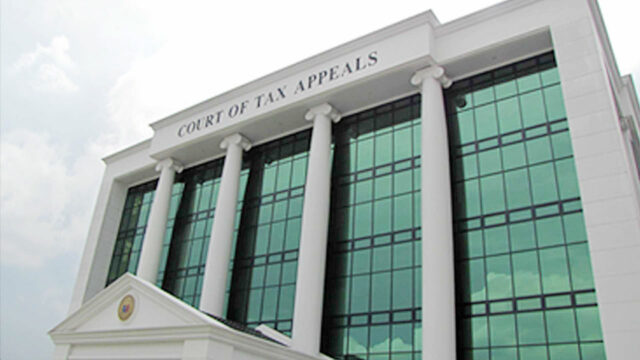
THE Court of Tax Appeals (CTA) has stood by its decision to grant First Philippine Utilities Corp.’s refund claim worth P100.88 million representing its tax liabilities for the year 2012.

In a 16-page decision on May 24 and made public on May 26, the CTA full court said its Third Division did not commit an error when it ruled the firm’s investments on money market placements to various banks were not subject to regular corporate income tax.

“Interest income earned from any money market placement and bank deposit is considered as passive income subject to final withholding tax pursuant to section 24 (B) (1) of the National Internal Revenue Code,” CTA Associate Justice Roman G. Del Rosario said in the ruling.

The court said the commissioner of internal revenue (CIR) made a mistake when it subjected the taxes to the same corporate income tax at the rate of 30% under another provision of the Tax Code, instead of a final withholding tax subject to a 20% rate.

It also enjoined the CIR or anyone representing the official from enforcing the collection of the 2012 tax assessment.

“All told, the court en banc finds no justifiable reason to reverse or set aside the assailed Decision and assailed Resolution of the court in division,” the tribunal said.

It noted that the CIR changed its argument as it claimed that First Philippines Utilities failed to prove that it was passive income subject to final withholding tax.

The tax court disagreed, saying the official effectively “admitted that the said interest income was passive income” when it supplied this argument.

“When a party deliberately adopts a certain theory and the case is decided upon that theory in the court below, he will not be permitted to change the same on appeal… because it would be unfair to the adverse party,” it added.

The CTA also affirmed the division’s cancellation of the firm’s deficiency value-added tax (VAT) as it said there was no basis for the CIR to do so. It also upheld the canceled minimum corporate income tax and deducted net operating losses.

“There is nothing on record which would show that First Philippine Utilities is a lending company that earned aforesaid interest income in the ordinary course of business, thus there is no basis to assess the deficiency VAT on the aforesaid interest income,” according to the ruling.

The tribunal acknowledged the firm as validly claiming its net operating loss as a deduction from its gross income.

“Truth to tell, it is not [the] respondent’s (First Philippine Utilities) duty to pay the final withholding tax,” the CTA said. — John Victor D. Ordoñez

How to properly use that plastic

PJCOMP-FREEPIK

APPLYING for a credit card is confusing but more questions come once you own one. Luckily, Ms. Salve I. Duplito, president and chief executive officer of Empower and Transform, gave tips from applying to owning a credit card.

THINGS TO CONSIDER WHEN APPLYING FOR A CREDIT CARD:
Budget. Don’t get the kind of cards that charge you P12,000 annual fee and be careful that you only get the ones that fit your budget.

Know the reward system. There are many options, and you have to be careful that you know which ones you really need and where you will maximize all of these benefits (e.g., cashback rewards, gas rebates, miles points, etc.).

Convenience. Think of the worst-case scenario and make sure that your credit card company is convenient to you in case of that emergency.

Good security feature. Make sure that the company has the resources to cutting-edge technology that they can protect you from hacks.

Good customer service and flexibility.

TIPS FOR NEW CREDIT CARD OWNERS:
• A credit card is not an emergency fund.

• For beginners, don’t get more than two credit cards.

• Teach yourself to pay your credit card bill in full three days before the due date.

• Know your credit card cycle.

• Maximize your credit card rewards.

ADVICE FOR LONGTIME CREDIT CARD OWNERS:
• Make use of your credit card cycles to get longer days of free money before the bank charges you.

• Maximize your rewards. Know when it’s better to swipe than pay in cash because rewards are like money for those who know how to use their cards wisely.

• Be very careful of cash advance. The moment you get the cash, you start paying interest.

• For those affected during the pandemic, check for debt relief programs with your credit card company to help you pay off your debts.

FIVE THINGS YOU SHOULD HAVE OR BE BEFORE APPLYING FOR A CREDIT CARD: • You need to have a proof of billing under your name.

• Have your own income to pay for your bill.

• You need to be financially educated to know how credit card works.

• Make sure that you don’t have some existing unsustainable debt.

• You need your own identification cards and signature.

ON LATE PAYMENT FEE AND INTEREST:
Both are types of payment for your unpaid credit card bill, Ms. Duplito said. Late payment fees apply when you couldn’t pay a single peso after your due date. Meanwhile, interest comes in when you don’t fully pay your bill upon the due date and whatever is left (called a rollover) will be charged an additional 2% interest per month. The catch is, the next month you roll over, you will be paying 2% interest on whatever’s unpaid plus the interest it accumulated (also called compound interest). — Bernadette Therese M. Gadon

For more tips, check Ms. Duplito’s Money University by SalveSays on Facebook, and follow @SalveSays on Facebook, Twitter, Instagram, Kumu, and TikTok.

World No Tobacco Day and smuggling

SHAUN MEINTJES-UNSPLASH

May 31 is World No Tobacco Day. This year, the theme of the celebration is “We need food, not tobacco.” The 2023 global campaign aims to shed light on how tobacco farmers can shift to alternative sustainable crops amidst the global food crisis.

Food shortages experienced globally due to the Russia-Ukraine conflict are exacerbated in the Philippines because of misguided food policy, poor resource allocation, subpar infrastructure, extreme weather events like typhoons, and corrupt importers and smugglers. Basic goods are becoming inaccessible to ordinary Filipinos — an October 2022 World Food Program survey showed that one out of 10 Filipino households are food insecure.

Given the struggles of our local farmers, this year’s World No Tobacco Day emphasizes the need to shift away from farming tobacco, one of the main crops in the northern regions of the Philippines.

Tobacco farming is unsustainable and traps our farmers in a cycle of debt and poverty. In an interview conducted by Action for Economic Reforms with tobacco farmers in Bacnotan, La Union, in 2021, farmers said that they are left with no choice but to farm tobacco despite the toll it takes on their health. The lack of access to water in their province makes it difficult for them to shift to planting rice.

In the 2021 interview, the farmers pledged support for now-President Bongbong Marcos. “’Yung sinasabi nila na si Marcos daw ay tutulungan niya ’yung mga magsasaka. ’Yun ang gusto namin (They say that Marcos will help the farmers. That’s what we want),” they said.

More than a year after the interview, Marcos has not only won the election but also sits as the Secretary of Agriculture. Unfortunately, he has been largely unsuccessful in alleviating the issues of the agriculture sector, as manifested by the sugar importation scandal and onion fiasco happening within the span of a few months.

Worse, high inflation persists, mainly because of high food prices arising from tight supply.

Smuggling contributes to our agriculture crisis. Our law against smuggling is weak, and enforcement is also weak. It is therefore crucial that our policymakers make the necessary reforms to curb the rampant smuggling of goods.

On May 2, the Senate Committee on Agriculture led by Senator Cynthia Villar held a hearing for Senate Bill 1962, amending the Anti Agricultural Smuggling Act of 2016.

However, a bill passed in the House (House Bill 3917 filed by Congressman Sandro Marcos) and pending in the Senate (Senate Bill 1812 filed by Senator Lito Lapid) taken up in the same committee hearing takes advantage of the issue of smuggling of essential agricultural goods to propose the inclusion of tobacco smuggling in the new bill. The bill raises penalties on the smuggling of tobacco, including raw tobacco, heated tobacco products, and manufactured cigarettes.

Tobacco smuggling, and illicit trade of tobacco as a whole, is a serious issue, mainly because it erodes the revenue the government should be receiving through tobacco taxes. The Bureau of Internal Revenue (BIR) Commissioner Romeo Lumagui said that for the first four months of 2023, the government’s excise tax collection had a shortfall of 20%. Tobacco products are among the commodities that are subject to excise taxes. The BIR Commissioner also said tobacco illicit trade “is a large part of that shortfall.”

A 2021 policy paper written by Myrna S. Austria and Alyssa Cyrielle B. Villanueva from the School of Economics, De La Salle University, using methods drawn from other studies, “provided strong evidence of illicit trade in the country during 2009-2017.” Austria and Villanueva nevertheless pointed out: “Non-price factors are considered more important determinants of illicit trade. These include corruption, the presence of informal distribution networks, and weak regulatory frameworks.”

Further, growing illicit trade dampens the effect of health policies put in place to lower tobacco consumption such as sin taxes. Hence illicit trade is a barrier to reducing the number of diseases and deaths associated with smoking.

However, the tobacco smuggling bill approved by the House of Representatives and the counterpart bill in the Senate filed by Senator Lito Lapid (Senate Bill 1812), though claiming to address illicit tobacco trade, are weak. Simply raising the penalties for smuggling tobacco products does not sufficiently address tobacco smuggling.

Senate Bill 1812’s provisions focus solely on penalties without addressing the enforcement of said penalties. Penalties are only as effective as the probability of perpetrators to get caught, which can only be increased through improvements in enforcement. Worse, simply raising the penalties could have the unintended consequence of encouraging bribery and collusion among smugglers and enforcers.

If the bill seeks to curb the growth of illicit tobacco trade in the country, it needs to focus on improving the quality of enforcement and governance, as these factors are what truly affect the pervasiveness of tobacco smuggling.

A case study which shows that enforcement is a vital tool in curbing illicit trade is the successful case filed against Mighty Corp., then one of the two largest domestic players in the tobacco industry in the country, for tax evasion through the usage of fake tax stamps. Thanks to the efforts of the BIR, Bureau of Customs (BoC), and the Department of Finance (DoF), Mighty was shut down, P30 billion was collected as its tax settlement, and it was later acquired by Japan Tobacco, Inc. Mighty’s shutdown signaled that companies would less likely engage in illicit trade if they felt threatened by a higher probability of being caught, which would come at a monetary and reputational cost.

It is also legally unusual that SB 1812 lumps products in their finished form, such as heated tobacco products and manufactured cigarettes, with raw, unmanufactured agricultural goods. Tobacco products, although derived from an agricultural product, obviously deviate from the Anti-Agricultural Smuggling Act’s original intention, which is to stabilize prices and ensure food security.

The issue of tobacco smuggling, while salient, is not one that can be appropriately tackled by simply amending the Anti-Agricultural Smuggling Act to raise penalties for smuggling tobacco. The way to strengthen any anti-illicit trade measure, whether for tobacco or staple food products, is by ensuring that enforcement is strengthened. For Senate Bill 1812 this can be done by introducing a more exhaustive system of labeling, tracking, and tracing tobacco products in the Philippines, as well as reporting contraband or counterfeit goods, all integrated into a public database. The effectiveness of this system is also contingent on the constant and quick coordination between enforcers in the BIR, BoC, and local government units, to ensure that smugglers are apprehended and punished accordingly.

In this regard, the Austria and Villanueva study cited above can guide our legislators. To quote Austria and Villanueva: “The study recommends that the increase in illicit trade should not be an excuse not to increase the excise tax on cigarettes. Instead, the ongoing tax policy reforms should be part of a comprehensive program to lower cigarette consumption and must be accompanied by the following: a.) strengthening tax administration and enforcement should be given priority so that the required taxes are paid and collected prior to the release of the cigarettes from the place of production and ports; b.) government institutions involved in the entire system should be strengthened to prevent corruption, informal distribution channels, and organized crime networks; c.) a coordinated approach in combating illicit trade with the country’s neighbors, particularly China, Vietnam, and Indonesia, should be pursued; and, d.) the rehabilitation of smokers who are struggling to quit smoking should be given equal importance.”

So be it.


Pia Rodrigo heads the health policy team of Action for Economic Reforms.

Volvo’s electric push part of safety, sustainability commitment

Volvo’s electrified range — PHOTO FROM VOLVO PHILIPPINES

SINCE 1927, the Volvo Car Group has been known as a world leader in safety technology and innovation. The company’s driving principle behind its operations is safety — for people inside and outside its vehicles and the world around them. Along with safety is a commitment to sustainability — which itself dates back to the 1940s. “Sustainability is fundamental to how Volvo Cars does its business. This ambition has always been to lead by example; today, it is stronger than ever,” said Volvo Philippines in a release.

Volvo Cars was the first established car maker to commit to all-out electrification in 2017. As a result, the premium car maker has been recognized by the United Nations (UN) and other global environmental nonprofit groups for its ground-breaking electrification strategy. The UN announcement was a watershed moment in the industry, and Volvo Cars’ example has been followed since by other car makers who have made similar announcements.

The company is also a founding member of the UN Global Compact, the world’s largest corporate sustainability initiative. The UN also recognizes the Swedish car company as a LEAD member, a group of the most committed, engaged, and ambitious companies within the Global Compact, which Volvo is a founding member of.

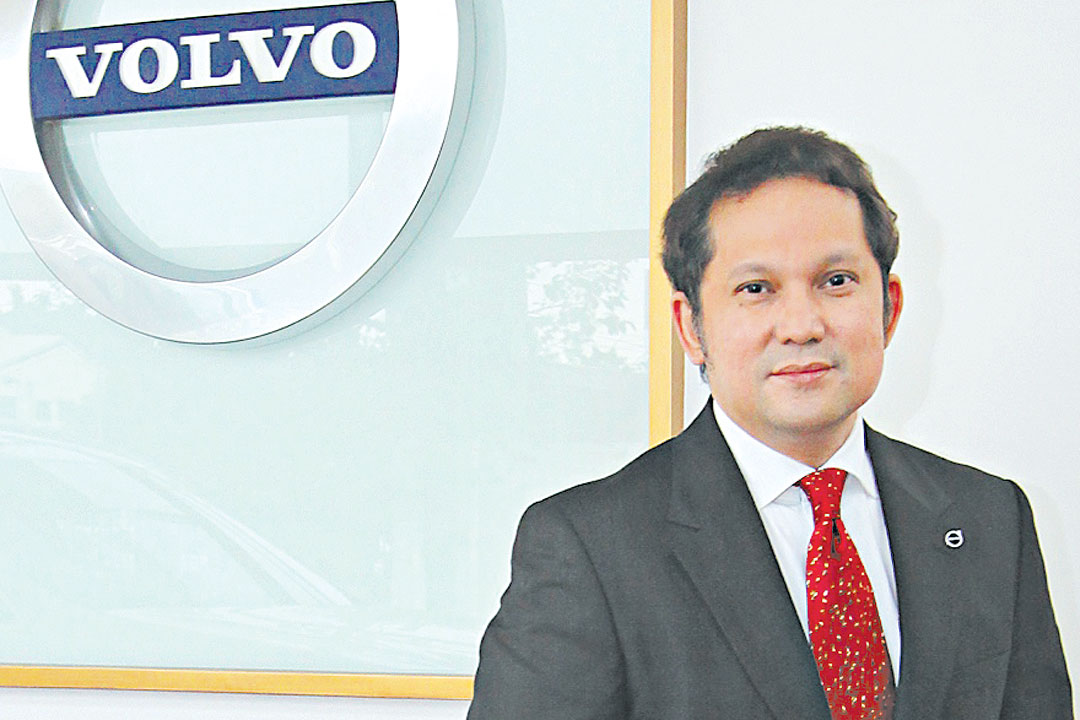
Even before sustainability became trendy in the automotive sphere, Volvo was already at the forefront, leading the pack in its efforts to curb its carbon footprint. Recognizing that cars are part of the ecological problem, Volvo, very early on, owned up to its responsibility and started its journey to becoming climate neutral. “We recognize that we, as a mobility provider, are part of the climate change problem. However, we at Volvo also know that we can do our share and be part of the solution,” said Volvo Philippines President and CEO Atty. Alberto B. Arcilla.

Volvo Cars is adapting to this reality by making sustainable business an integral part of its corporate strategy. As part of its sustainability program, the company has identified nine commitments directly supporting the UN Sustainability Development Goals (SDGs) agreed upon by all UN member states in 2015. The company believes these commitments will contribute to its sustainable profitability and growth. It has committed to having up to one million electrified Volvos on the road by 2025, and aims to have climate-neutral manufacturing operations that same year. It has also stated the most ambitious safety vision in the industry that by 2020, no one should be killed or seriously injured in a new Volvo.

Pandemic notwithstanding, Volvo globally launched its first electric vehicle, the XC40 Recharge. In 2021, the company introduced the C40, the first Volvo designed as pure electric only. Locally, Volvo Philippines supported this global effort with a range of boost hybrids introduced in the Volvo XC40, XC60, XC90, and S90 models last year, making it the first luxury car brand in the country to transition to an all-electrified offering. The new, fully electric EX90 launched toward the end of 2022 also signaled a new era for Volvo Cars. This year, Volvo Philippines is set to introduce two pure-electric vehicles to boost its electrified lineup further.

“It is good that the automotive industry is following Volvo’s lead in making significant steps to address current mobility concerns. Volvo Cars is acknowledged for our industry-leading commitment to an electric future. In line with this, locally, we will once again move the brand forward towards its vision by introducing two pure electric vehicles in the second half of 2023,” added Atty. Arcilla.

WB approves $100-M loan to boost farming productivity on Mindanao ancestral land

REUTERS

THE World Bank (WB) said it approved a $100-million loan to enhance the productivity of agriculture in Mindanao ancestral domains.

“Around 120,000 farmers and fisherfolk in selected ancestral domains in Mindanao are set to benefit from the Mindanao Inclusive Agriculture Development Project (MIADP),” the World Bank said in a press release.

The project aims to “increase agricultural productivity, resilience, and services while also protecting the natural resources of these ancestral domains,” which are claimed by indigenous peoples.

Mindanao accounts for around 33.4% of the Philippines’ agricultural output.

“A considerable amount of agricultural land in ancestral domains remains unused or under subsistence cultivation by indigenous peoples. Several barriers hinder development in ancestral domains, including inadequate road infrastructure, frequent landslides causing extended periods of isolation, and limited access to technical services, markets, finance, electricity, internet, and telephone services,” the World Bank said.

The development project will fund the rehabilitation and restoration of roads and bridges, the installation of agricultural tramline systems, and the construction of small-scale and solar-powered irrigation systems. 

“In addition, the project will provide potable water systems and post-harvest facilities such as storage units and trading posts,” it added.

It also aims to support the development of agri-enterprises in ancestral domains, integrate natural resource management and climate-smart practices, among other initiatives.

The project will be managed and implemented by the Department of Agriculture. It will also involve the National Commission on Indigenous Peoples as an implementing partner. — Luisa Maria Jacinta C. Jocson

France’s Triet becomes third female director to win Cannes’ top prize

REUTERS

CANNES — French director Justine Triet became the third female director to win the Cannes Film Festival’s Palme d’Or on Saturday, beating out 20 other films in competition for the top prize with her film, Anatomy of a Fall.

Ms. Triet called being only the third woman to win “surprising” and said the decision was encouraging for the future. “We’re at the dawn of deep-seated changes in this respect,” she said after winning.

Ms. Triet used her award speech to criticize how the protest against pension reforms in France “has been denied and repressed in a shocking way” and said more space needed to be made for young filmmakers to be able to make mistakes and start over.

Ms. Triet, who had previously been nominated for Sibyl in 2019, won the prize over veteran directors like Hirokazu Kore-eda, Ken Loach, and Wim Wenders, all of whom have at least one Palme d’Or under their belts.

She joins New Zealand’s Jane Campion and France’s Julia Ducournau as only the third woman to have won the competition that this year included a record seven female directors.

Jane Fonda, who introduced the award, said that one day it would be normal for women to win, not historic.

“We have a long way to go. But still, we have to celebrate change when it happens,” said the film icon and activist.

The Grand Prix, the second-highest prize after the Palme d’Or, went to British director Jonathan Glazer’s Zone of Interest, about a family living next to Auschwitz.

“It’s so important that the film goes out into the world and hopefully has an effect and gets people talking about the themes that are in the film,” Mr. Glazer said after winning.

Starring in both winning films is German actress Sandra Hueller. In Anatomy of a Fall she stars as a writer who is the main suspect in her husband’s death, while in Zone of Interest she is the wife of the commandant of the Auschwitz death camp.

However, the award for best female actress went to Merve Dizdar, who plays a teacher in an isolated village in Turkey in Turkish director Nuri Bilge Ceylan’s About Dry Grasses.

Best actor went to Japan’s renowned Koji Yakusho, who plays a toilet cleaner in Tokyo who is content to just read books and listen to music in German director Wim Wenders’ Perfect Days.

Fallen Leaves by Finland’s Aki Kaurismaki, who was back in the competition after more than a decade, took the jury prize.

The award was accepted on his behalf by the two main stars of the tragicomedy that follows a budding romance between a quiet young woman and a heavy-drinking sandblaster.

French-Vietnamese director Tran Anh Hung took home best director for The Pot-au-Feu, a food-obsessed French film starring Juliette Binoche and Benoit Magimel as a couple.

While introducing best screenplay, John C. Reilly showed his support for striking Hollywood writers with roughly a minute of wordless mimicry before saying: “What we just experienced is what a movie would be like without screenwriters.”

That prize went to Yuji Sakamoto for the Japanese entry Monster, directed by Kore-eda, which follows a series of misunderstandings surrounding two schoolboys’ friendship.

On Friday, Anatomy of a Fall also won the top prize at the Palm Dog awards for border collie Messi’s performance as Snoop in what organizers said was the toughest competition yet.

This year’s closing movie was Pixar’s Elemental, an animated feature about a city where the four elements live together, featuring the voices of Leah Lewis and Mamoudou Athie. — Reuters

Opensignal: 5G arrival, DITO entry boost telco investments

BW FILE PHOTO

THE entry of DITO Telecommunity Corp., the introduction of 5G, and pressure from the government pushed telecommunications companies’ investments in their networks, said Opensignal.

“However, such programs take place over a number of years and it can take time for the competitive landscape to shift,” Opensignal said, as it looked across published mobile network experience reports to show how each operator’s position has changed over time.

It said DITO has been making its presence felt as it won four awards in the analytics company’s latest report, namely: upload speed experience, availability, excellent consistent quality, and core consistent quality.

In the same report, Globe Telecom, Inc. has won seven awards, including six in experiential categories.

“However, it is DITO, not Globe, that is giving Smart Communications, Inc. reason for concern in the Download Speed Experience category, despite Smart having won this award outright for the past 12 reports in a row,” said Opensignal.

The analytics company said its last report showed that DITO is only 2.6 megabytes per second (Mbps) behind Smart in terms of download speed. Smart led the download speed experience at 25.3 Mbps, followed by DITO at 22.8 Mbps, and Globe at 16.2 Mbps.

Meanwhile, Globe was said to have made significant gains in games experience after it won the award with a score of 58.8 points, or higher by 1.2 points than Smart’s 57.6 points.

“One factor that has played a role in Globe’s recent success is that it made its largest-ever annual investment in its mobile and fixed networks in 2022,” Opensignal said.

In 2022, Globe claimed to have activated a total of 1,702 new cell sites, upgraded around 13,600 to 4G, and installed 2,267 new 5G sites nationwide.

“However, Globe is now looking to spend 30% less on capital expenditure (capex) in 2023 at $1.3 billion with the goal of reducing it further in 2024,” Opensignal said, adding that this is similar to Smart’s parent firm PLDT Inc., which is reducing capex to P85 billion in 2023.

“Meanwhile, DITO expects to spend P27 billion or $487 million on its network this year, which would take its total network spend to around P230 billion by the end of the year,” it said. — Justine Irish D. Tabile

T-bill, bond rates to track secondary market levels

BW FILE PHOTO

RATES of Treasury bills (T-bills) and bonds (T-bonds) on offer this week could track secondary market movements on expectations that benchmark borrowing costs will be held steady here and in the United States in the near term.

The Bureau of the Treasury (BTr) will auction off P15 billion in T-bills on Monday, or P5 billion each in 91-, 182-, and 364-day papers.

On Tuesday, it will offer P25 billion in reissued 10-year T-bonds that have a remaining life of nine years and three months.

T-bill rates could track the week-on-week declines seen at the secondary market amid expectations that the US Federal Reserve will pause its rate hike cycle at its June 13-14 review, which could be matched by the Bangko Sentral ng Pilipinas (BSP) when it meets on June 22, Rizal Commercial Banking Corp. Chief Economist Michael L. Ricafort said in a Viber message.

At the secondary market on Friday, the 91-, 182-, and 364- day T-bills went down by 3.3 basis points (bps), 4.3 bps, and 5.53 bps week on week to end at ​5.79%, 5.8632%, and 5.8961% respectively, based on the PHP Bloomberg Valuation Service Reference Rates data published on the Philippine Dealing System’s website.

The US central bank has raised rates by 500 bps since March 2022, bringing the fed funds rate to 5%-5.25%. Its latest move was a 25-bp hike at its May 2-3 review.

For its part, the BSP on May 18 paused its tightening cycle and signaled that borrowing costs could remain unchanged at its next two to three meetings.

The Monetary Board on Thursday kept its policy rate unchanged at 6.25%. Interest rates on the overnight deposit and lending facilities were also maintained at 5.75% and 6.75%, respectively.

This is the first time the BSP left rates untouched after nine meetings. Since it began its aggressive monetary tightening cycle in May 2022, the central bank had raised borrowing costs by 425 bps.

Meanwhile, the 10-year papers saw its yield rise by 15 bps week on week to 5.9397% at the secondary market due to a possible cut in banks’ reserve requirement ratio (RRR) next month, Mr. Ricafort noted, which could likewise lead to an increase in the average rate of this week’s T-bond offer.

BSP Governor Felipe M. Medalla earlier said they could cut banks’ reserve ratios next month. The RRR for big banks is currently at 12%, while the ratios for thrift and rural lenders are at 3% and 2%, respectively.

Union Bank of the Philippines, Inc. Chief Economist Ruben Carlo O. Asuncion likewise said in a report that the T-bond rates could climb following the expected rise in the benchmark US 10-year bond rate due to pressure from the sell-off in US T-bills, which are vulnerable to default risk if debt ceiling negotiations are not settled.

“Lacking any breakthrough, our traders sense the market will just stay defensive with yields gradually probing higher in sync with the US treasuries. For the BTr’s nine-year bond auction, the early bid rate indication is in the range of 5.875%-6%,” he said.

Last week, the BTr raised P15 billion as planned from the T-bills as the offer was more than four times oversubscribed, with total bids reaching P60.67 billion.

Broken down, the Treasury borrowed P5 billion as planned via the 91-day T-bills, with tenders reaching P14.062 billion. The average rate of the three-month papers went down by 9.7 bps to 5.777%, with accepted rates ranging from 5.75% to 5.8%.

The government also made a full P5-billion award of the 182-day securities as bids reached P20.08 billion. The six-month tenor was quoted at an average rate of 5.898%, down by 9.3 bps, with accepted rates from 5.88% to 5.918%.

Lastly, the BTr raised the programmed P5 billion from the 364-day debt papers as demand for the tenor reached P26.528 billion. The average rate of the one-year T-bill fell by 8.3 bps to 5.945%. Accepted yields were from 5.928% to 5.95%.

Meanwhile, the reissued 10-year T-bonds to be auctioned off on Tuesday were last offered on May 9, where the government raised the programmed P25 billion at an average rate of 5.732%. Accepted yields ranged from 5.65% to 5.76%.

The Treasury wants to raise P185 billion from the domestic market this month, or P60 billion via T-bills and P125 billion via T-bonds.

The government borrows from local and foreign sources to help fund its budget deficit, which is capped at 6.1% of gross domestic product this year. — A.M.C. Sy

LANDBANK-DBP merger: Philippines’ boon or bane?

By Abigail Marie P. Yraola, Researcher

THE PROPOSED MERGER of the Land Bank of the Philippines (LANDBANK) and Development Bank of the Philippines (DBP) has once again come to light in the first quarter of 2023 despite time running out from previous administrations and differences in mandates.

LANDBANK primarily caters to developing the Philippines’ agricultural sector and provides support for the agrarian reform program while DBP provides banking services for the medium- and long-term needs of small and medium enterprises (SMEs) in the agricultural and industrial sector.

These two banks have two very different functions, varying corporate objectives and mandates, thus, sparking debates and critics against those who oppose the merger.

As far back as 2006 during the Arroyo administration, the marriage between the two state-owned lenders have been put forward.

The plan was then revived in March this year, after President Ferdinand R. Marcos, Jr. approved the groundwork of the two largest state-owned banks’ union, after a discussion with his economic managers.

LANDBANK will be the surviving entity with larger assets, capital stock and even having more branches compared with DBP.

The Department of Finance (DoF) said in a press release that the merger can generate an amount of P975 million in savings per year through the consolidation of the banks’ branch operations.

DoF also disclosed that the consolidated bank would have an estimated asset size reaching P4.2 trillion and deposit base amounting P3.6 trillion, potentially making LANDBANK the largest bank in the country.

Finance Secretary Benjamin E. Diokno’s push for the said merger “is meant to create a bigger, stronger, and more resilient bank that can better serve the country’s development needs.”

“The current administration is pushing for the merger to allow the merged bank to better withstand economic shocks,” Mr. Diokno said in a Viber message.

He also added that the union of these banks will boost retail and wholesale banking operations compared when they function as separate banks.

The merger is expected to be finalized in November this year.

PAVING THE WAY FOR MAHARLIKA?
The country’s proposed first sovereign wealth fund (SWF), the Maharlika Investment Fund (MIF), is aimed to promote economic development by making strategic and profitable investments in key sectors, Mr. Diokno said in late February.

An SWF is a state-owned investment fund from money generated by the government, which is often sourced from a country’s surplus reserves.

The proposed SWF aims to get its seed capital partially from LANDBANK and DBP, giving P50 billion and P25 billion, respectively. The merger of these two state banks may pave the way for the MIF.

“If after the merger LANDBANK will still be asked for a contribution, then the performance of the SWF would influence the bank’s profits,” said Japhet Louis O. Tantiangco, senior research analyst at Philstocks Financial, Inc., in an e-mail.

If the bank’s contribution to the wealth fund would be a significant portion of its investable funds, it would be risky not just for the bank but for the financial system and if it posts losses then it would have a detrimental effect, he said.

“The merger itself is not important [and] uncalled for. It is basically a political move,” Pablito Malabanan Villegas, former LANDBANK vice-president and the current president of Villegas Organic and Hobby Eco-Tourism Farm Corp. and an independent director of ECCOBank (A Rural Bank), Inc., said in a phone call interview.

For him, the result of the merger will be a “further neglect and even abandonment of the respective mission as mandated by law.”

But for Mr. Diokno, it is a misnomer to say that the two banks have different mandates.

“The fact is that both are universal banks — what one bank can do, the other bank can do also.”

“The corporate action would further solidify the surviving bank’s footing in the banking industry,” said Luis A. Limlingan, head of sales at Regina Capital Development Corp., in an e-mail.

He also added that even if the two banks were merged, it would remain to be relatively smaller than some of its counterparts in the region.

Additionally, the proposal seems a bit rushed for some.

A merged LANDBANK and DBP is “not a good move,” Mr. Villegas said. And the rush for this merger will openly compete with the well-managed and profit-seeking banking sector, he added.

For Mr. Tantiangco, he said the proposed merger should further be studied, noting that while there may be benefits, there are also concerns which needs to be resolved.

“Will all sectors be given ample attention despite them being handled by one entity moving forward? Also, the merger will lead to displaced workers. Where will these workers go?” he said.

WHAT’S IN IT FOR THE BANKS?
Mr. Tantiangco said that after the merger, LANDBANK will pose as an even bigger competitor in the universal banking space.

The merger will lead to higher capitalization for LANDBANK, with the increase in its capital base, the state-led bank will have more cushion against financial shocks, added Mr. Tantiangco.

“The merger is also expected to result in higher productivity, [and] will be a sort of expansion for LANDBANK which may then result in economies of scale,” he said.

Meanwhile, the Finance chief said that the Philippines will likely benefit in the said merger, which will “eliminate redundancy and inefficiency in operations.”

But the planned merger raised concerns more as to who and how will it affect, rather than outlining its benefits. The push for the merger will likely result to layoffs and the banks involved will lose it core mandates and its areas of expertise.

For DBP, there is no clear direction or defined program for the merger at its early stages.

“But as in any merger and acquisition, an incentive will be provided to personnel in view of redundant positions. If and when, the approach may also change depending on the direction the surviving entity will take,” DBP said.

It reiterated that the function of both banks is equally important, and that the expertise of these banks are needed so that no marginalized sector will be disenfranchised.

‘SUPER MONOPOLY’
Some senators has voiced their concerns on the said merger, citing that if these state-led banks’ union is realized, it will create a large financial institution, a “too big to fail” or a “super monopoly.”

Mr. Tantiangco affirmed this, saying that due to the resulting size in its deposit base it is likely a financial giant and comes with attached risk.

“If ever the bank collapses, this would create a very significant dent on the Philippine financial sector and eventually on the overall economy, both confidence and real-wise,” he said.

The bank’s improved capital base resulting from the merger, he added, is seen to mitigate the said risk.

But he noted, that despite this, universal banks in the private sector are seen to be strong and competitive and in turn will prevent the merger from creating a super monopoly.

On DBP’s side, drawbacks of the merger entail identity crisis and mission dilution, industry limits and anti-competition environment contrary to a liberalized economy envisioned by the Philippine Competition Act.

“The merger may result in an institution with consolidated financing programs with no mastery in the administration of the same, unlike in the current set-up,” the infrastructure bank said.

They also said the merged entity is claimed to be stronger, bigger and better and while there may be truths to it, overall, these do not reduce benefits.

“Mergers may be advantageous for private banks where size is critical for scale and market dominance, but this does not hold true for [state] banks with specific mandates, where priority should be towards the effectivity in performing and delivering their respective public missions,” DBP said.

For Mr. Villegas, he sees two possible risks. One is mismanagement, which he said is currently happening in LANDBANK, and two, is the non-fulfillment or the abandonment of these banks’ mandate.

“The banks tend to continue to ignore or marginalize the sector they are mandated to serve, socially and economically, thus [the latter] continue to suffer in poverty and hopelessness,” he said.

He also added that contrary to what Mr. Diokno said, the biggest banks in some countries are owned by the private sectors and not the state.

“Having a state-owned bank as the largest bank usually spells for better performance of the banking industry… State banks can fulfill functions that private banks don’t do, as well as offer countercyclical lending,” Mr. Limlingan said.

SNAGS?
The government watchdogs are mum about the LANDBANK-DBP deal as the merger is still in the works.

“In the case of the LANDBANK-DBP merger, the transaction has not yet reached the Commission, therefore the PCC defers any comment lest it preempts future developments,” the Philippine Competition Commission (PCC) said in an e-mail.

The PCC is mandated to review proposed mergers and acquisitions and prohibit those that will substantially prevent, restrict, or lessen competition in the relevant market.

The Bangko Sentral ng Pilipinas (BSP) was not able to share its comments on the proposed merger as of press time last Friday.

The Governance Commission for GOCCs (GCG), for its part, said in a statement last April that the banks’ merger does not need a new law for them to combine as a single entity.

It conducted a study on the issues concerning the proposed union of the said banks and found that these banks can be combined even though they both received their charters from the Congress.

This was reiterated by former Senate President Franklin M. Drilon, saying that there is an existing law that empowers the president to direct the merger.

The Republic Act (RA) 10149 or the GOCC Governance Act of 2011 authorizes the President to effect the merger without waiting for Congress to file and pass related bills.

However, this is contrary to DBP and some experts.

Mr. Villegas said that the merger requires joint-congressional action, saying that the specific mandates of the respective banks cannot be amended by general law and the GOCC law is a general law.

But DBP remains firm on their position that the proposed merger requires congressional action.

It said there is no provision in Section 5 of RA 10149 and that there is no mention of the power to decide on or to approve of a merger which belongs to the Congress.

“This gave the law the appearance of unlimited power to merge and abolish GOCCs, which is highly prone to abuse and can be whimsically and capriciously exercised,” said DBP.

“This unbridled power of the GCG is dangerous, particularly if the proposed merger does not adhere to the set conditions or exclusive standards,” it added.

EFFECT
For Mr. Diokno, if the merger materializes, the local banking industry will continue to be sound and adequately capitalized and the central bank has one less bank to supervise.

The agricultural lender’s comparative advantage in its digitalization journey can be applied more widely, he added.

Mr. Tantiangco, on the other hand, said that once the merger pushes through, somehow it is expected to help the government in its saving efforts as it pursues fiscal consolidation.

“If the synergy brought by this merger is maximized, it is expected to greatly help in the economic development of the country via financing, primarily in the rural areas,” he said.

Mr. Tantiangco added that the proposed merger is seen to have a positive effect in the field of agriculture, infrastructure development, and small- and medium-scale businesses.

Once the merger is executed, Mr. Villegas said, it will be disastrous to the agricultural economy, and perhaps the economy itself.

“Merging them will not only be too risky but will result in [a] financial and socioeconomic disaster given their already miserable failure to do their mandates, much more their inability to compete with the more efficient and effective management of privately managed universal and commercial banks,” he said.