Home Blog Page 4761

Roxas and Company, Inc. to conduct 2023 Annual Meeting of Stockholders on June 28


Spotlight is BusinessWorld’s sponsored section that allows advertisers to amplify their brand and connect with BusinessWorld’s audience by enabling them to publish their stories directly on the BusinessWorld website. For more information, send an email to online@bworldonline.com.

Join us on Viber at https://bit.ly/3hv6bLA to get more updates and subscribe to BusinessWorld’s titles and get exclusive content through www.bworld-x.com.

Declining inflation and Germany’s energiewende

On Tuesday, the Philippine Statistics Authority reported that the country’s inflation for May was 6.1% — still high, but it is the fourth month of consistent decline from 8.7% last January. So it is good news.

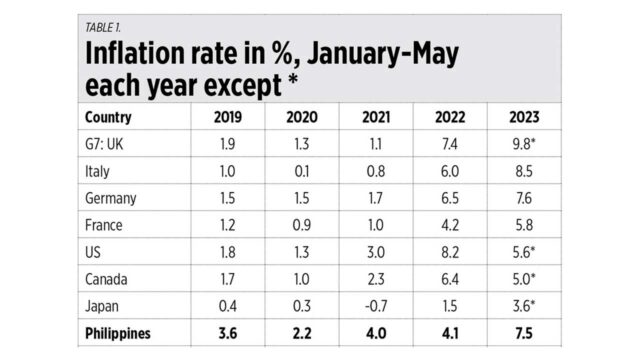
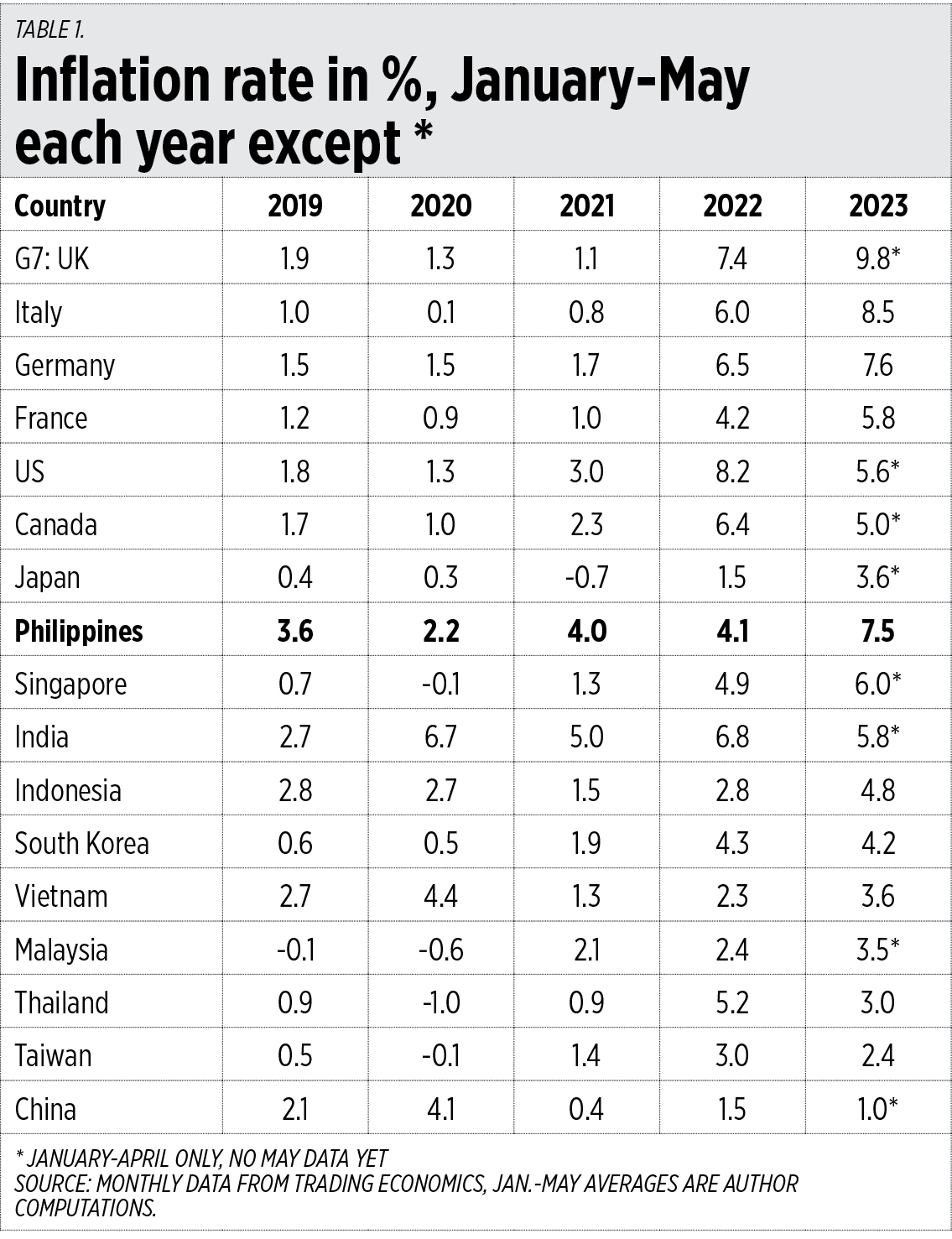
Compared to other Asian economies over January to May, the Philippines has had the highest inflation rate, at the same level as Germany. Over the same months in 2022, India and Singapore had the highest inflation rates in Asia (see Table 1).
The main areas pulling up inflation in May were: 1.) Alcoholic beverages and tobacco, 12.3%, 2.) Restaurants and accommodation services, 8.3%, and, 3.) Food and non-alcoholic beverages, 7.4%. The first two show that people are drinking, smoking, and partying more; that people are going out more to eat and party in restaurants and hotels, and going to provincial hotels and resorts.

I think GDP growth in 2nd quarter could be high. Household consumption is 75% of GDP, so high consumption there can pull up the overall GDP level and growth.

ERRATUM
I would like to apologize to the readers for the error in transposition in headings in Table 1 of my column last week, “NGCP, low power generation, and the Maharlika Fund” (June 1). The table’s column on Population should have been for Power generation and vice versa. Sorry for that mistake and the confusion it created. Nonetheless, the column and computed kWh/person remains valid and correct. Also, the numbers on average growth in power generation and GDP remain valid and correct.

Meanwhile, here are some points about the National Grid Corp. of the Philippines (NGCP) that I did not include in my column last week.

One, the Energy Regulatory Commission (ERC) in previous administrations had issued a lot of show cause orders with penalties to private distribution utilities (DUs) and generation companies (gencos), but when it comes to the NGCP, only one has been issued, last year, with a penalty of P5 million for non-compliance with a Department of Energy circular.

Two, show cause orders for DUs and gencos have high penalties and even come with customer refunds amounting to billions of pesos. Maybe this is because the ERC does not have a group monitoring transmission, only groups for monitoring DUs and gencos. The ERC should consider having a group for monitoring transmission performance.

MORE RENEWABLES, MORE EXPENSIVE ELECTRICITY, THE CASE OF GERMANY
Germany is the biggest economy in Europe although in power generation, it is second only to Russia. But Germany is the powerhouse in renewables, the biggest in installed capacity for wind and solar — it adopted early the “energiewende” or energy transition from fossil fuels to renewables, starting around 2000. Among the policies is the imposition of EEG or Feed-in Tariff (FiT) like in the Philippines, with guaranteed high prices for intermittent renewables for 20 years.

I saw data from the German Association of Energy and Water Industries (BDEW), listing electricity prices for household/residential and industrial. The trend in prices is horribly anti-consumer and anti-business. Among the culprits are: a.) high procurement for generation as Germany bought more gas from the US, Middle East, and Africa because they avoided cheap Russian gas; b.) a high EEG surcharge, which had been temporarily discontinued last year and this year as prices are almost double the 2012 level; and, c.) rising Grid fees as adding more intermittent power sources to the grid will require more costs to stabilize the grid.

Then I checked Germany’s energiewende, they added lots of wind and solar capacity — installed power in 2021 was twice the 2012 level. Power generation by wind and solar more than doubled, from 12.5% of total in 2012 to 31.5% in 2020. Meanwhile, power generation from coal plus nuclear decreased from 60% in 2012 to only 35% in 2020.

Germany saw its mistake and, in 2021, they slowly and silently raised their coal plus nuclear generation to 40% of the total (see Table 2).
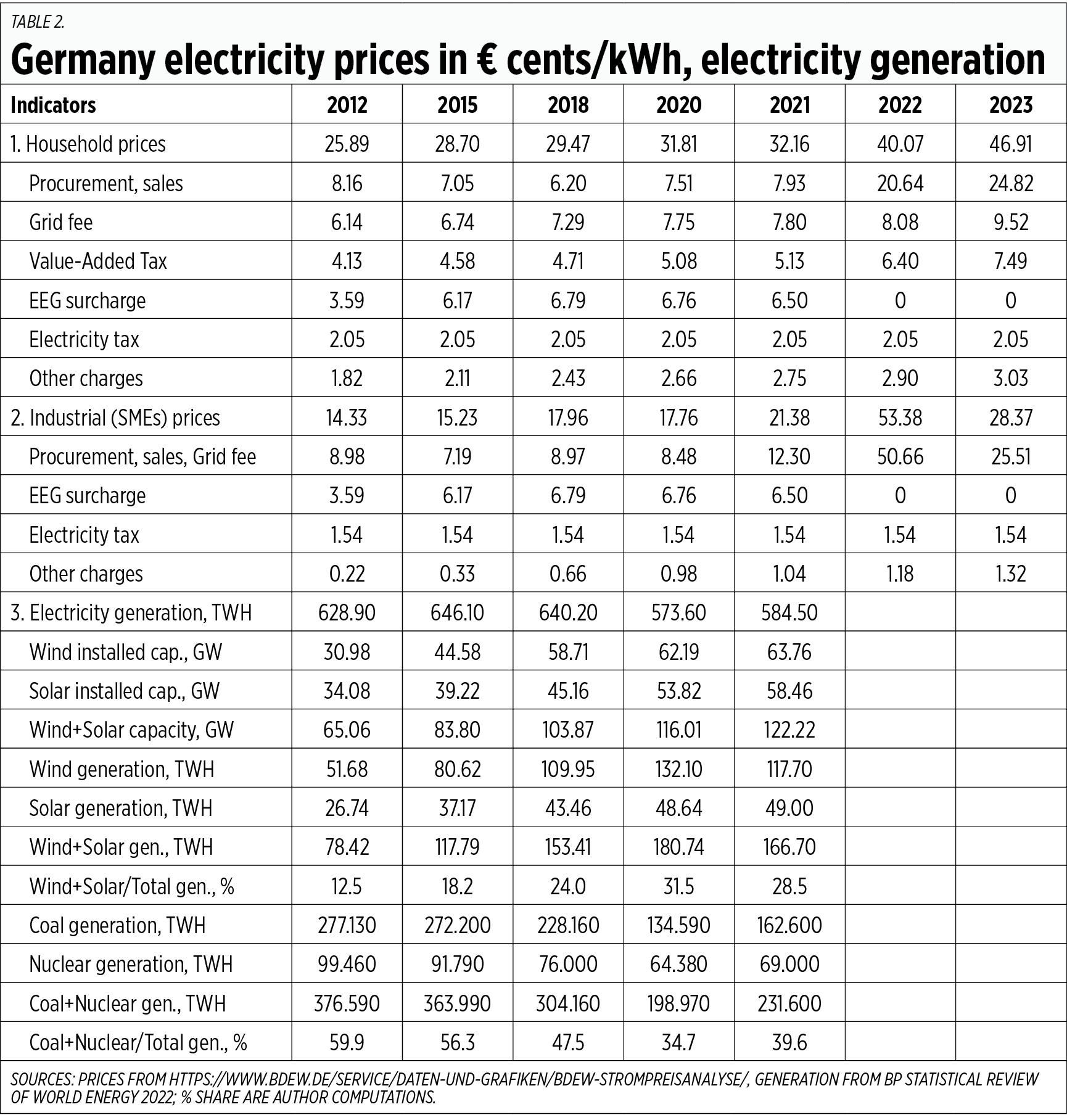
There are important lesson for the Philippines and many developing countries — having more intermittent renewables and less conventional power like coal and nuclear will lead to more expensive electricity, a higher overall inflation rate, and even deindustrialization and degrowth economics.

The main reason is that intermittent sources will always require huge backup power. When the wind does not blow, when it is night, or a cloudy or rainy day and solar output is very low, backup power from fossil fuels and nuclear must be available to avoid blackouts — and this is not cheap. Consumers will have to pay double, first for intermittent sources with high prices (EEG/FiT surcharge, ancillary power for grid stability), and second, for the cost of backup power.

We should avoid deindustrialization and degrowth economics. We should focus on sustained fast growth for our people and businesses. We should stay the course of using more fossil fuels in power generation. Add nuclear power too — revive the Bataan Nuclear Power Plant (BNPP) plus add small modular reactors (SMRs) for off-grid islands and provinces.

When the Maharlika Fund is finally established, I wish that among its big-ticket projects are: getting majority control of the NGCP, doing more offshore oil-gas exploration and development, buying out many inefficient and wasteful electric cooperatives in many provinces, and going into nuclear power generation via the revival of the BNPP and setting up many SMRs in off-grid islands and provinces.


Bienvenido S. Oplas, Jr. is the president of Bienvenido S. Oplas, Jr. Research Consultancy Services, and Minimal Government Thinkers

minimalgovernment@gmail.com

OpenAI CEO has no initial public offering plan due to ‘strange’ company structure

TRUSTPAIR.COM

STOCKHOLM — Microsoft-backed OpenAI, the company behind ChatGPT, has no plans to go public any time soon, Chief Executive Officer (CEO) Sam Altman said at a conference in Abu Dhabi.

“When we develop super intelligence, we are likely to make some decisions that most investors would look at very strangely,” Mr. Altman said.

“I don’t want to be sued by… public market, Wall Street etc, so no, not that interested,” he said in response to a question on whether he will take OpenAI public.

OpenAI has so far raised $10 billion from Microsoft at a valuation of almost $30 billion as it invests more on building computing capacity.

“We have a very strange structure. We have this cap to profit thing,” he said.

OpenAI started off as a nonprofit organization but later created a hybrid “capped-profit” company, that allowed it to raise external funds with a promise that the original non-profit operation still benefits.

While building their artificial intelligence capacities, Mr. Altman and many prominent scientists involved with creating and marketing the technology have warned of the threat it poses, particularly content-creating generative AI such as ChatGPT, with some equating it to extinction-level risk. They have demanded regulation.

Mr. Altman is on a whirlwind tour across the world, meeting heads of states of several countries, and was in the United Arab Emirates on Tuesday. He plans to travel next to Qatar, India, and South Korea.

EU CONTROVERSY
While in Europe he got into controversy for saying OpenAI may leave the region if it becomes too hard to comply with planned laws on AI, inviting criticism from several lawmakers, including EU industry chief Thierry Breton. OpenAI later reversed the stance.

“We did not threaten to leave the EU,” Mr. Altman said on Tuesday. “We expect to be able to comply. There’s still more clarity we are waiting for on the EU AI Act, but we are very excited to operate in Europe.”

The EU is working on a set of laws to govern AI, including proposals that would force any company using tools like ChatGPT to disclose copyrighted material used to train its systems.

OpenAI does not disclose that data on its latest AI model, GPT 4.

Mr. Altman, however, found support from EU tech chief Margrethe Vestager, who said she did not perceive Altman’s comments as a threat but as a promise to do his best. 

“The number one thing about this technology that people don’t understand is that in a few years GPT 4 is going to look like a little toy that was not that impressive,” Altman said referring to the growth of AI.

“There will be images, audio, video, text, computer programming, all together.”

Many experts have cited a potential threat to jobs being replaced by AI including in sectors such as transport and logistics, office support and administration, production, services and retail.

The jobs of the future would look “super different than many of the jobs of today”, Altman said, adding that there would be opportunities too. — Reuters

Jollibee Foods Corp. sets 2023 annual meeting of stockholders on June 30


Spotlight is BusinessWorld’s sponsored section that allows advertisers to amplify their brand and connect with BusinessWorld’s audience by enabling them to publish their stories directly on the BusinessWorld website. For more information, send an email to online@bworldonline.com.

Join us on Viber at https://bit.ly/3hv6bLA to get more updates and subscribe to BusinessWorld’s titles and get exclusive content through www.bworld-x.com.

Rediscount window untapped in May

BANKS left the rediscount facility of the Bangko Sentral ng Pilipinas (BSP) untouched in May amid excess liquidity in the financial system.

The BSP said on Wednesday that its peso rediscount window was untapped last month, marking the seventh straight month that the rediscount facility was not used by lenders.

Last year, the rediscount window was only tapped in April, June, and October, with loans reaching P15.3 billion, more than double the P6.12 billion in 2021.

There were likewise no availments made under the Exporters’ Dollar and Yen Rediscount Facility (EDYRF) last month.

The last time the EDYRF was tapped was for a dollar rediscounting loan in 2016.

The BSP’s rediscount facility gives banks access to additional money supply by posting their collectibles from clients as collateral.

In turn, banks may use the cash — denominated in peso, dollar or yen — to extend more loans to their corporate or retail clients and service unexpected withdrawals.

“The continued excess liquidity in the financial system provided banks with options/alternatives for funding sources other than tapping the BSP rediscounting facilities,” Rizal Commercial Banking Corp. Chief Economist Michael L. Ricafort said in a Viber message.

Domestic liquidity rose by 6.6% annually to P16.3 trillion in April, faster than the revised 6.2% expansion in March.

Mr. Ricafort added that banks have the option to raise short-term funding through deposits, interbank loans, and swaps markets, while for longer-term funding, they may tap the capital markets.

Lenders did not borrow from the BSP’s rediscount facility as their overall nonperforming loan (NPL) ratio is still among the lowest since the pandemic, he said.

The banking industry’s soured loans dropped by 9.9% year on year to P414.612 billion in March from P460.458 in the same month last year.

However, this is 0.8% higher than the P411.186 billion in February, based on the latest data from the central bank.

This brought the banking system’s NPL ratio to a four-month high of 3.33% in March, up from 3.31% a month prior but easing from 4.08% in March 2022, BSP data showed.

“Higher interest rates or borrowing costs since last year somewhat slowed down the demand for loans and correspondingly reduced the need for some banks to finance new loan releases,” Mr. Ricafort added.

The Monetary Board had hiked benchmark interest rates by 425 bps from May 2022 to March this year before pausing last month, with the key rate now at 6.25%.

“Improved profitability and capitalization of banks also reduced the need for banks to tap the BSP rediscounting facilities,” Mr. Ricafort said.

JUNE RATES
For June, the applicable rate for peso rediscount loans will be at 7.3605% for 90 loan maturity days and at 7.471% for 91-180 days.

Meanwhile, dollar borrowings will be priced at 7.74050% (1-90 days), 7.76350% (91-180 days), and 7.76350% (181-360 days).

Yen-dominated borrowings will be priced at 2.06000% (1-90 days), 2.07375% (91-180 days), and 2.10300% (181-360 days). — Keisha B. Ta-asan

‘Girl from Ipanema’ singer Astrud Gilberto, 83

BRAZILIAN SINGER Astrud Gilberto performing in Amsterdam, 1966 — EN.WIKIPEDIA.ORG

BRASILIA -— Brazilian singer Astrud Gilberto, the voice of Bossa Nova whose soft and dreamy version of “The Girl from Ipanema” was an international success in the 1960s, has died at the age of 83, her family said.

Ms. Gilberto died on Monday at her home in Philadelphia, her granddaughter Sofia Gilberto said on social media.

“Life is beautiful, as the song says, but I bring the sad news that my grandmother became a star today and is next to my grandfather Joao Gilberto,” the granddaughter wrote. Guitarist Joao Gilberto, who died in 2019, was Astrud’s former husband and the pioneer composer and songwriter of Bossa Nova, which mixed Brazilian samba music with “cool jazz” in the late 1950s.

He collaborated with US saxophonist Stan Getz in 1963 on the album Getz/Gilberto that popularized the new Brazilian sound worldwide.

Astrud performed the vocals in English, including the duet “The Girl from Ipanema” which became the album’s major hit. Getz/Gilberto won three Grammy Awards including Album of the Year, the first time a jazz album received the accolade.

“The Girl from Ipanema” was the first song the 22-year-old Astrud recorded and launched her career almost by accident. In later interviews, she said she was in the New York studio where Getz and her then-husband were recording and he suggested she do the song as he did not sing in English.

She later moved to the United States, where she toured with Getz, singing Bossa Nova and American jazz standards.

Astrud Weinert was born on March 29, 1940, in Salvador, in the northeastern state of Bahia, to a musical family that moved to Rio de Janeiro when she was a child.

Her first solo album was The Astrud Gilberto Album, released in 1965 and featuring Antonio Carlos Jobim, the Brazilian musician who had written “The Girl from Ipanema” with poet Vinicius de Moraes and played the piano on the Getz/Gilberto original.

She recorded her own compositions in the 1970s in Portuguese, English, Spanish, Italian, French, German, and Japanese.

American guitarist Steve Van Zandt said in a tweet in tribute that Ms. Gilberto’s “beautiful, natural, untrained vocal genius and unplanned career” influenced other singers from Sade to Lana Del Rey.

Brazilian performer and songwriter Ivan Lins said: “She was one of the main voices of Bossa Nova, the one that was most heard abroad. It had a unique, mellow timbre.”

“The Girl from Ipanema” is one of the most recorded songs in history and has been interpreted by many singers, from Frank Sinatra and Nat King Cole to Madonna and Amy Winehouse. — Reuters

ICTSI unit at Port of Karachi offers Pakistan-Australia link

LISTED port developer and operator International Container Terminal Services, Inc. (ICTSI) said its unit operating at the Port of Karachi has tied up with a Singaporean shipping line to create a direct service between Pakistan and Australia.

In a press release on Tuesday, ICTSI said its subsidiary Pakistan International Container Terminal Ltd. (PICT) and Singapore’s SeaLand forged the partnership to provide an “easy and efficient” connection between markets in South Asia and Australia.

“We look to provide unmatched supply chain solutions to local and global trade stakeholders. Through our partnership with SeaLead, customers in both Pakistani and Australian markets will benefit through direct port linkages that enable economies to grow,” said PICT Chief Executive Officer Khurram Aziz Khan.

The direct service will be calling at regional ports across Malaysia, Australia, and Pakistan, ICTSI said.

“PICT will remain resilient in its efforts to make this collaboration a successful venture for all stakeholders,” Mr. Khan said.

The service at the Port of Karachi is expected to boost “trade patronage with global customers and cater to growing trade demands,” PICT said.

Its arrival is also seen to help importers and exporters via a speedy and more cost-efficient route, “and eventually allow new businesses and growth areas to emerge within the associated economies.”

The new service will handle shipper-owned and carrier-owned containers, ICTSI said, adding that it is also seen to provide the trade allies of PICT with an industrial edge.

“With Pakistan as a commercial hub connecting several geographical regions, the PICT-SeaLead partnership will boost the country’s foreign trade through the enhanced and efficient access to and from Australian markets,” it said.

ICTSI has a portfolio of terminals and projects in developed and emerging market economies in Asia Pacific, the Americas, Europe, the Middle East, and Africa.

Putting out fires

NIJWAM SWARGIARY-UNSPLASH

PUTTING OUT wildfires serves to teach lessons on how to handle their metaphorical counterpart in media. Forest fires like those that break out in California are doused with thousands of gallons of water, first from fire trucks and then helicopters from above. When already too widespread, fire is fought with fire. The direction of the blaze is computed and the path it will take is intentionally put to the torch to deprive the fiery beast of its fuel, and then just burn itself out.

Damage control in the practice of “reputation management” (formerly just referred to as PR) applies to saving brands and personalities from being scorched. Here are some fire-fighting techniques usually employed.

Deprive the room of oxygen. A reputational attack requires the target to change the subject or make the issue too complicated to follow. For a scandal spreading like wildfire, one strategy then is to confuse the issue and try to put boring material in front of the hungry beast. Just the clarifications alone can turn away the firebrands — are you referring to “primus inter pares”?

Start other fires. This diversionary tactic, like the above involves reeling in more personalities rather than issues. This allows the original group to get some breathing space as the media frenzy feeds on new targets. The intended reaction to more personalities in the picture is a conclusion that the whole forest (maybe even the whole country) is on fire. The differentiation between good and evil becomes blurred as everyone on the front page is tarred with some sort of scandal — she was the go-between in the transaction.

Deny, deny, deny. Politicians, or celebrities for that matter, panic when they are in the crosshairs of a public scandal. Their first reaction is denial — you know who I am. I am not capable of this scam I’m being accused of. This denial strategy of “this will all go away” is the default option when the crisis is just starting. It seldom works.

Denial does not stay passive as it evolves into aggression. The aggressive version turns the table on the accusers and questions their motives. The scandal is thrown back to the accuser, hinting at guilt for similar anomalies being eventually tagged as an even bigger violator. This is notable in dealing with drug pushers — there are bigger syndicates out there.

Appoint a spokesperson not involved in the mess. As reputational attacks now involve legal messes, lawyers are now increasingly employed to serve as human shields. They no longer limit themselves to their clients’ protestations of innocence, they too climb the bandwagon of obfuscation whose aim is to confuse the issue, trying their best to put the accusers on trial by publicity. They are masters of delaying tactics — we are awaiting the decision of the court on the evidence presented. This is a variation of “no comment.”

While a decade ago, the preferred method of attack and counterattack was the use of privilege speeches in the legislative halls or the employment of defenders (and attackers) among traditional media (including radio), the preferred channel nowadays is social media. “Troll farms” don’t grow vegetables but turn people into them.

“Influencers” are the new opinion makers. They even consider celebrities passé. If we ask you to name the top three influencers, you would not be able to summon even a single name. This was not true for the old-style columnists, especially those with a daily pulpit in a mass-circulation broadsheet or tabloid. Not even talk shows now are utilized for firefighting. Remember those contentious debate-style formats with a moderator to reduce the saliva sprays?

The effectivity of firefighting is measured in terms of the targets getting fewer media mentions as former accusers loom larger as culprits themselves, with their holier-than-thou stance fraying as their online defenders abandon them.

Dousing fires relies on running out of fuel. The news items change with the usual foreign incursions of ships in Philippine waters and the hosing of fishermen, or the coming of a super typhoon. With all the noise generated by both accusers and accused (changing places now and then) the social media frenzy just loses momentum. The fire can just burn itself out with the absence of fuel.

Reputational risk is a major concern of fire-fighters as well as those who start fires for personal profit. This used to be called extortion. Now it’s just the stuff of social media and online tabloids.


Tony Samson is chairman and CEO of TOUCH xda

ar.samson@yahoo.com

Google’s AI to power virtual travel agent from Priceline

TRUSTPAIR.COM

WANT a New York hotel near a Christmas market, a vegan restaurant, or another attraction?

Look no further than artificial intelligence (AI) from Google at Priceline as early as this summer, the companies told Reuters.

The online travel agency, part of Booking Holdings, aims to debut a more sophisticated chatbot for planning trips, as well as hotel suggestions that are like “a personal concierge” tailored to users, said Martin Brodbeck, Priceline’s chief technology officer.

“You can easily find out that in Bryant Park there’s a Christmas market that runs from early November all the way through the beginning of January when you’re actually booking your hotel,” he said.

New tools from Google’s cloud division give Priceline access to generative AI, like the technology behind ChatGPT that can draft text as if a human wrote it. The tools also extract information such as hotel prices from existing data to ensure accuracy.

For Google, drawing business through AI represents a potential way to close the gap with rivals Amazon and Microsoft, as it has long been a distant No. 3 provider of cloud services like data storage.

For Priceline, the embrace of novel technology on its website may help it vie with myriad platforms that market travel options, some of which are exploring how consumers react to AI.

Its rival Expedia Group said ChatGPT would power conversations on a smartphone app. That is giving travelers “inspiration on places to go” and booking options, said Rathi Murthy, its chief technology officer.

Both Expedia and Kayak, another site owned by Booking Holdings, have integrated their travel suggestions through features in the standalone ChatGPT program as well.

And Google itself has long represented competition for Priceline, though Mr. Brodbeck said its cloud capabilities were what led to the partnership.

The ability to build applications atop generative-AI that Google pioneered has attracted recent business, said Thomas Kurian, Google Cloud’s CEO. 

“There is a kind of a Cambrian moment happening now where there’s an explosion of this technology,” Kurian told Reuters, referring to the extraordinary prehistoric period when a wide array of new species emerged.

He declined to answer how free corporate previews were affecting Google Cloud’s profitability.

Google’s AI will generate coding suggestions for hundreds of software developers at Priceline, said Brodbeck. Priceline will adopt Google’s search capabilities for employee intranets. And Google’s AI will speed up marketing for trending destinations.

“You could have it create images like a beautiful beach, and you could marry that with great generative-AI copy,” Brodbeck said. — Reuters

UK set to have highest inflation among big economies this year, OECD says

LONDON — Britain will have the highest inflation of any leading economy in 2023, according to forecasts from the Organisation for Economic Co-operation and Development (OECD) which show Prime Minister Rishi Sunak will miss his promise to halve price growth this year.

Britain’s headline inflation rate was set to be 6.9% in 2023, higher than Germany’s 6.3% and France’s 6.1% and the OECD average of 6.6%, the group said in a new set of projections on its members’ economies published on Wednesday.

If correct, the forecast would mean Mr. Sunak will miss his target of halving inflation this year, one of the priorities he set out for voters before a national election expected in 2024. However, the OECD said it expected British inflation to slow to 2.8% in 2024, lower than in France and Germany.

Britain’s stubbornly high inflation rate has intensified expectations that the Bank of England will continue to increase borrowing costs, potentially pushing the economy into a recession which it has so far dodged.

Finance Minister Jeremy Hunt pointed to improved forecasts from the OECD for the economy which it now expected to grow by 0.3% in 2023 and 1.0% in 2024.

Previously the OECD had expected the economy to shrink by 0.2% this year and grow by 0.9% next year. — Reuters

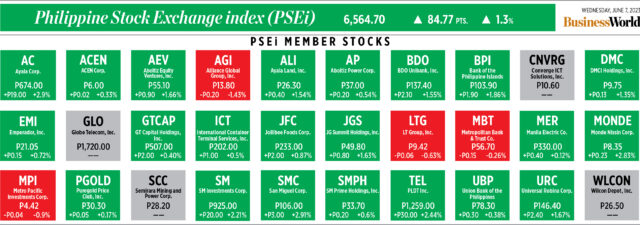
How PSEi member stocks performed — June 7, 2023

Here’s a quick glance at how PSEi stocks fared on Wednesday, June 7, 2023.


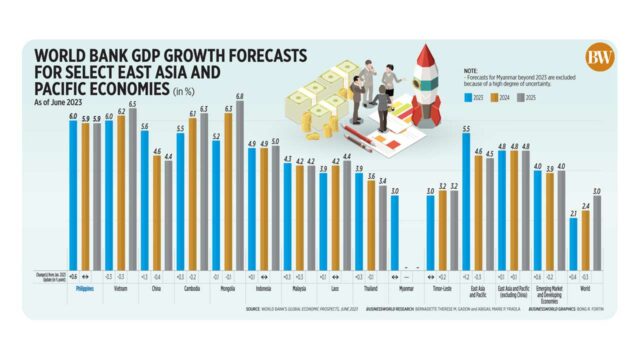
World Bank GDP growth forecasts for select East Asia and Pacific economies

THE PHILIPPINE ECONOMY is likely to grow by 6% this year amid strong domestic demand and despite elevated inflation, the World Bank said, raising its forecast from 5.4% in January. Read the full story.

World Bank GDP growth forecasts for select East Asia and Pacific economies

ADVERTISEMENT
ADVERTISEMENT