Home Blog Page 4751

India rail crash probe is focusing on manual bypass of track signal

REUTERS

BAHANAGA/NEW DELHI — An official probe into India’s rail crash is focusing on suspected manual bypassing of an automated signaling system that guides train movement — an action that investigators believe sent a packed express train into a stationary freight train, three Indian Railways sources told Reuters.

The Commission of Railway Safety (CRS) investigators suspect the bypass was done by railway workers to get around signaling hurdles that arose from a malfunctioning barrier used to stop road traffic at a nearby rail-road intersection, two of the three sources said.

The sources did not want to be identified as they are not authorized to speak to the media.

The June 2 crash at Bahanaga Bazar station, in the Balasore district of the eastern Indian state of Odisha, killed at least 288 people and injured more than 1,000. It was India’s worst rail crash in two decades.

Indian and international media have previously reported that a possible malfunction in the automated signaling system may have led to the crash.

However, details of the frequent malfunctions at the nearby rail-road barrier and its possible connection to a manual bypass of the signaling system are reported by Reuters for the first time.

The CRS, which is India’s rail safety authority, did not respond to a request for comment.

‘ERRATIC BARRIER’
Indian Railways, the fourth largest train network in the world, is a state monopoly run by the Railway Board. The board reports to the Railways Ministry.

A spokesman for Indian Railways said “repair works keep happening as per requirements” but tampering with the automated system is not allowed. He declined to elaborate further on the causes of the crash, saying: “the investigation is on”.

Amitabh Sharma, chief information officer at the Railways Ministry, said the cause of the accident was still under investigation. Asked about investigators’ suspicions that the electronic system may have been manually bypassed, Sharma said: “These are all speculations which we cannot confirm at this juncture.”

A spokesman for the federal police’s Central Bureau of Investigation (CBI), which has opened a separate probe into possible criminal negligence, did not respond to a request for comment.

Reuters spoke to five residents of Bahanaga village who said the barrier at the railway crossing had been faulty for nearly three months and had been repaired frequently.

When there was a fault, the barrier would remain stuck in the closed position and had to be manually opened by railway workers, the residents said.

If the barrier was open, the automated signal system would not allow a train to go past the rail-road crossing, one retired Indian Railways official said. The official did not want to be identified due to the sensitivity of the crash investigation.

“The electric barrier would sometimes go up and sometimes it wouldn’t,” said Soubhagya Ranjan Sarangi, 25, a pharmacist with a shop close to the railway crossing.

Niranjan Sarangi, a 66-year-old retired schoolteacher who spends many evenings sitting near the crossing with friends, was there at the time of the crash. He said the barrier seemed to be functioning fine at the time.

“The barrier would malfunction sometimes. People from the department would come and fix it,” he said.

SYSTEM ‘CHANGED MANUALLY’
One of the three Indian Railways sources — all of whom had knowledge of the ongoing CRS probe — said initial investigation suggests the automatic electronic signaling system was “changed manually, for which the software has to be tampered with”.

“(Indian) Railways believes the system was tampered with,” said the second source, who has access to briefings on the investigation. “It is yet to be ascertained whether the intervention was intentional or by mistake or whether due to ongoing work near the signal.”

The third source said the preliminary probe suggested that the signaling system was bypassed because the repair workers were trying to fix the malfunctioning barrier.

India’s rail network is undergoing a $30-billion transformation with gleaming new trains and modern stations under Prime Minister Narendra Modi’s push to boost infrastructure and connectivity.

The June 2 crash has raised questions about whether safety is getting enough attention. The government has said safety indicators have improved over the years, accident rates have fallen, and safety is getting adequate funds.

The crash happened when the Coromandel Express, heading to the southern city of Chennai from the eastern city of Kolkata, wrongly entered a sidetrack of the station at a speed of 128 kph (80 mph), and rammed into a stationary iron ore freight train.

The Coromandel Express jumped off the tracks and toppled after impact. Some of its coaches hit another express train passing on a parallel track in the opposite direction, causing that one to also jump off the tracks and result in a massive wreck.

Two days after the crash, Jaya Varma Sinha, a Railway Board member, told reporters that it appeared that the electronic signaling system, called the “interlocking system,” had sent the Coromandel Express on the wrong track by giving it a green signal.

The CRS findings now suggest that the system, which Sinha said is supposed to be “fail-safe,” had been compromised by workers trying to find a workaround, the third Indian Railways source said.

Sinha did not respond to a Reuters request for an update on the investigation.

Sandeep Mathur, Indian Railways’ principal executive director for signaling, the top official responsible for signaling, did not respond to Reuters requests for information about the supplier of the interlocking system.

Reuters could not independently establish the identity of the supplier or verify Sinha’s claim that it is fail-safe.

‘MANUAL INTERFERENCE NOT UNUSUAL’
The interlocking system coordinates between the signal, track route and track occupancy, and ensures they all work in tandem to take a train safely through a station, Mr. Mathur told reporters two days after the crash.

He did not respond to Reuters’ subsequent requests for more details.

The third railways source, as well as a retired railways official and a senior police officer who worked in the railway police in Odisha, told Reuters that railway workers sometimes manually interfere with the system to change the signal so that rail traffic is not slowed or stopped while they do any repair and maintenance work, especially on busy routes.

The retired official and the police officer did not want to be identified due to the sensitivity of the crash investigation.

The manual workaround is allowed under railway protocols if it is authorized by an empowered senior official and all precautions are in place, said Sudhanshu Mishra, another retired railway official who worked in the safety department.

The Indian Railways spokesman did not directly address the authorization issue and only said it is not allowed under Indian Railways rules.

Reuters could not independently determine if the suspected workaround on the evening of the crash was authorized or not.

A June 8 Railway Board circular on “safety of track” sent to all general managers of Indian Railways, seen by Reuters, said workers “should be counseled and guided for not adopting any shortcuts while carrying out the work”.

Controls of the interlocking system are located inside a small railway building at the Bahanaga Bazar station and access is restricted to authorized railways workers and officials.

The second source said records showed that the Bahanaga system control room had been accessed two times that evening, the first time for authorized operational work, while the reason for the second visit is yet to be established.

Reuters was unable to access those records.

All railway employees at the station, including those involved in the barrier repair work, have been questioned by the railways investigators and will also be questioned by the CBI, the second and the third source said.

They declined to name them as this is an ongoing investigation. Reuters could not independently establish how many workers are under investigation or their identities. — Reuters
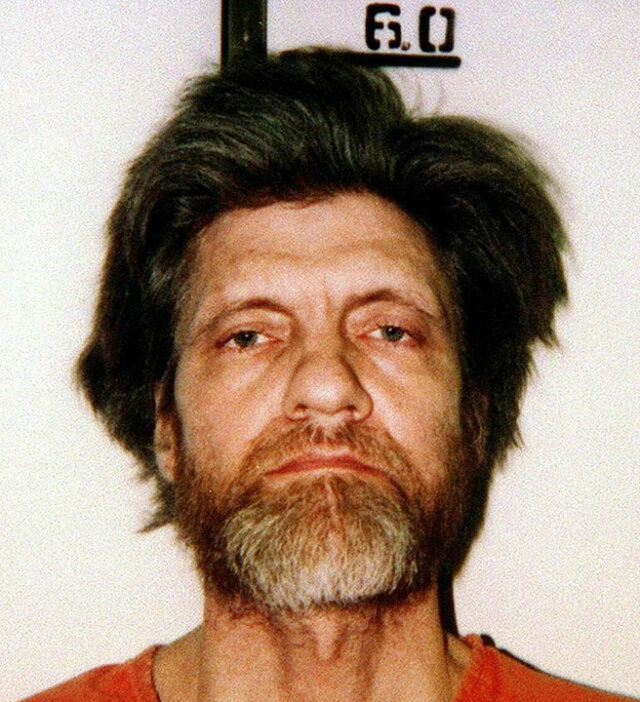
Convicted ‘Unabomber’ Ted Kaczynski dead at 81

WIKIPEDIA

Ted Kaczynski, former math professor and “twisted genius” who came to be known as the Unabomber when he carried out a 17-year spree of mysterious bombings that killed three people and baffled the FBI, died on Saturday at the age of 81.

Mr. Kaczynski, who made and sent many of his bombs while living in a primitive cabin with no running water in rural Montana, was found unresponsive early Saturday morning at the Federal Medical Center Butner, a facility for prisoners with special health needs, in Butner, North Carolina, and pronounced dead at a local hospital.

“He is dead,” Kristie Breshears, a spokesperson for the Federal Bureau of Prisons, told Reuters.

The Harvard University graduate, a loner since childhood, targeted academics, scientists and computer store owners and even tried to blow up a commercial airliner in a one-man terror campaign from 1978 to 1995 against what he believed were the evils of modern technology.

For years, he frustrated police who, with no solid clues to the killer’s identity, dubbed his case UNABOM, for University and Airline Bombings. A breakthrough came when Mr. Kaczynski released a rambling, 35,000-word manifesto entitled “Industrial Society and Its Future” that was published in the media in September 1995.

Mr. Kaczynski’s younger brother, David, tipped off police that the author’s ideas sounded like those of Ted. Agents arrested the disheveled Unabomber at his cabin in April 1996.

After rejecting his lawyers’ attempts to have him plead insanity, Mr. Kaczynski pleaded guilty to all federal charges relating to the bombings in 1998 and a California court sentenced him to four life terms plus 30 years in prison.

Described by the FBI as “a twisted genius who aspires to be the perfect, anonymous killer,” Mr. Kaczynski was sent to ADX Florence, a “supermax” prison in Florence, Colorado. He was transferred to the North Carolina facility in 2021.

Theodore John Kaczynski was born on May 22, 1942, in Chicago to working class Polish-American parents. He was a bright, quiet child who graduated from high school aged 15 and won a scholarship to Harvard University where he studied mathematics.

“He wasn’t exactly gregarious, but he was extremely articulate,” Dale Eickelman, Mr. Kaczynski’s friend in his early high school years, told the Daily Southtown newspaper in Chicago after Mr. Kaczynski’s arrest.

“I remember Ted was very good at chemistry … I remember Ted had the know-how of putting together things like batteries, wire leads, potassium nitrate and whatever, and creating explosions” at the age of 12 and 13, Mr. Eickelman said.

While it is not known exactly what caused Mr. Kaczynski to channel his natural talent toward evil, his participation in an infamous science experiment at Harvard may have been one reason.

There, psychologists subjected volunteer students, including Mr. Kaczynski, to hours of extreme verbal and emotional abuse as part of an attempt to measure how people handled stress. The experiment, now regarded as unethical, lasted three years. 

Others have cited a period in Mr. Kaczynski’s childhood when he spent long periods in isolation due to a severe outbreak of hives.

Mr. Kaczynski earned a doctoral degree in mathematics in 1967 at the University of Michigan before he got a job as an assistant mathematics professor at the University of California at Berkeley.

He resigned his post and moved to Montana in 1971 where he bought land and built himself a tar-paper cabin near Lincoln, a town of under 1,000 people in winter. Mr. Kaczynski became upset by the destruction of the surrounding forests by development.

The cabin served as the main base for his homemade bombing campaign, which began in 1978 when he left a package for an engineering professor at Chicago’s Northwestern University. The package exploded, lightly wounding a police officer. A graduate student at the college became the second victim when a small bomb went off in his hands, giving him superficial burns.

Mr. Kaczynski then took aim at a bigger target, placing a bomb in 1979 in the cargo hold of an American Airlines plane that gave off smoke during a domestic flight, forcing an emergency landing at Dulles International Airport near Washington.

That attack caught the attention of the FBI and agents would spend years trying to catch a bomber who left no clear demands and little forensic evidence. A six-year period between 1987 and 1993 in which no bombs were sent further confused investigators.

In 1980, Mr. Kaczynski sent a package bomb that exploded and injured United Airlines President Percy Wood at his Illinois home.

His first fatal victim was computer store owner Hugh Scrutton, 38, who died when a bomb loaded with nails and splinters went off in the parking lot of his store in Sacramento, California in 1985.

As his bombs became more sophisticated, Mr. Kaczynski also killed New Jersey advertising executive Thomas Mosser, who had worked on improving the public image of oil major Exxon, with a mail bomb in 1994.

He then murdered Gilbert Brent Murray, head of a California timber industry lobbying group, with a mail bomb in 1995.

In all, the Unabomber set off 17 bombs, injuring around 25 people, some of whom lost vision, hearing or fingers.

Mr. Kaczynski triggered his own downfall in 1995 when he sent letters to media organizations demanding that they publish a 35,000-word essay of his about the perils of industrialization.

“The Industrial Revolution and its consequences have been a disaster for the human race,” the essay began. Mr. Kaczynski detailed how modernization has destabilized society, subjected humans to indignities and “inflicted severe damage on the natural world.”

Still short on leads, the FBI and then US Attorney General Janet Reno approved the publication of the manifesto in The Washington Post in the hope that someone would recognize it.

The move paid off when the bomber’s brother David recognized phrases and topics in the essay and told police he believed it was written by Ted. — Reuters

Zelenskiy says counteroffensive actions ‘taking place’ in Ukraine 

PRESIDENT OF UKRAINE, Volodymyr Zelensky, at the annual session of the NATO Parliamentary Assembly — PRESIDENT.GOV.UA

KYIV — President Volodymyr Zelensky acknowledged on Saturday that his military was engaged in “counteroffensive and defensive operations” a day after Kremlin leader Vladimir Putin said Kyiv’s long-vaunted drive to retake territory was well under way.

But the Ukrainian leader disclosed no details, telling reporters to pass on to Mr. Putin that his generals were optimistic.

Sporting his trademark khaki fatigues, Mr. Zelensky shrugged at a press conference when asked about Mr. Putin’s comments on Friday that Kyiv had begun its counteroffensive but made no progress.

“Counteroffensive and defensive actions are taking place in Ukraine, but I will not say in detail what stage they are at,” Mr. Zelensky said, listing Ukraine’s top military brass by name.

“They (the generals) are all in a positive mood. Pass that on to Putin,” he said with a smile, standing alongside visiting Canadian Prime Minister Justin Trudeau.

He said Mr. Putin’s comments on the counteroffensive were “interesting…It is important that Russia always feels this: That they do not have long left, in my opinion.”

Russia’s Defense Ministry on Saturday said Ukrainian forces had in the past 24 hours made “unsuccessful” attempts to attack in the southern Donetsk and Zaporizhzhia regions — two areas subject to heavy fighting.

The ministry also mentioned Bakhmut, the eastern town Moscow says it captured last month after 10 months of fierce battles.

Reuters was not able to independently verify the situation on the battlefield.

In his nightly video address, Mr. Zelensky again provided few details while urging troops to keep fighting.

“Thank you to all those who hold their positions and those who advance,” he said, citing the eastern and southern fronts, where fighting is heaviest.

Ukraine’s general staff said its forces had repelled enemy attacks around Bakhmut and the long-besieged town of Maryinka. Russian forces, it said, “continue to suffer heavy losses which they are trying to conceal”.

General Oleksander Syrskyi, commander of ground forces who is in operational control of the counteroffensive, posted a picture on social media of an explosion that he said was a group of Russian soldiers being destroyed near Bakhmut.

Ukrainian military spokesman Serhiy Cherevatyi reported new gains near Bakhmut.

“We’re trying…to conduct strikes on the enemy, we are counterattacking. We’ve managed to advance up to 1,400 meters (0.87 mile) on various sections of the front,” Cherevatyi said.

Ukraine has said for months it plans a major counteroffensive. But it has denied the main operation had begun.

With scant independent reporting from the front lines, it has been difficult to assess the state of the fighting.

Britain’s Ministry of Defense said Ukraine had conducted “significant” operations in several eastern and southern parts in the last 48 hours, with Russian defenses breached in places.

SOME PROGRESS: BRITISH MINISTRY
“In some areas, Ukrainian forces have likely made good progress and penetrated the first line of Russian defenses. In others, Ukrainian progress has been slower,” it said, also characterizing the Russian military’s performance as mixed.

“Some (Russian) units are likely conducting credible maneuver defense operations while others have pulled back in some disorder, amid increased reports of Russian casualties as they withdraw through their own minefields.”

Ukraine’s counteroffensive is expected to use thousands of troops that have been trained and equipped by the West, but Russia has built huge fortifications in occupied territory to prepare, while Kyiv also lacks air supremacy.

The south is seen as a key strategic priority for a Ukrainian push that could aim to recapture Europe’s biggest nuclear plant and cut the Russian land bridge to the occupied Black Sea peninsula of Crimea, dividing Russian forces.

Ukrainian military analyst Oleksiy Hetman told NV Radio the events of recent days were only initial steps.

“What is happening now could be called ‘reconnaissance in battle’ — the first stage of the offensive,” Hetman said. “It was impossible to make progress in depth. The goal was to check the enemy’s defenses. Let’s wait a few days and see.” — Reuters

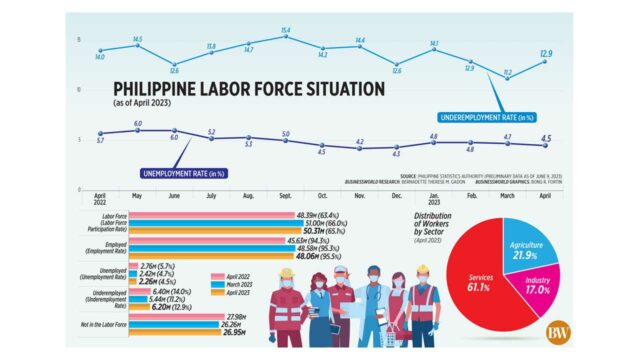
Philippine Labor Force Situation

The country’s unemployment rate fell to its lowest in four months in April, but the quality of jobs slightly deteriorated, the Philippine Statistics Authority reported on Friday. Read the full story.

Philippine Labor Force Situation

Obiena joins the 6-meter club

EJ OBIENA — PHILIPPINE STAR/JUN MENDOZA

IT WAS just a matter of time before EJ Obiena could accomplish what no other Asian before him has done.

It came one sunny Saturday in Bergen, Norway where the Filipino World Championship bronze medalist reached the Mount Everest of men’s pole vault by breaching the six-meter plateau in an exhilarating performance in the Sparebanken Vest Bergen Jump Challenge.

In one fell swoop, Mr. Obiena leapfrogged to 6.0 meters that set new national and Asian records and buried the old one at 5.94m that he registered a year ago when he snared a historic bronze at the Worlds in Portland, Oregon.

It also sealed the unchallenged Southeast Asian Games gold winner the crown as Americans KC Lightfoot, who had an identical 6.0m but got it only on the second attempt, and Sam Kendricks, who had a 5.88m, wound up second and third, respectively.

And because of it, Mr. Obiena can now breathe the same rarified air that only 27 others could, including Hall of Famer Sergey Bubka, who had a 6.15m, and the sport’s demigod in the almighty Armand Duplantis, who owns the world record at 6.22m.

It was made more impressive by the fact that Mr. Obiena was the only Asian to ever achieve such a feat.

“It all started with a dream to jump over 5m and set the national record to now be the 28th person all-time to go over the 6m barrier and the first ever Asian/Filipino,” said Mr. Obiena.

“It took a few moments to sink in. But when it did, tears began to fall, there was no greater shoulder to cry on than my coach, Vitaly (Petrov). Couldn’t have done it without him.”

“Still a lot of work ahead and still a long season. Just happy and proud to be part of the 6m Club,” he added.

After it had all sank in, Mr. Obiena, who is chasing a spot in next year’s Paris Games, may have realized he had sent a clear message that for sure Mr. Duplantis and the rest of the world could read — He is coming for all of them. — Joey Villar

Gilas out to spring surprises in Women’s Asia Cup

DUKE UNIVERSITY ace Vanessa de Jesus joins the Gilas core. — GODUKE.COM

GILAS Pilipinas will not troop to Australia only to play and participate in the FIBA Women’s Asia Cup.

Tired of mere participation, the Filipinas are out to spring surprises and make some noise as per the marching orders of head coach Pat Aquino for the regional showpiece on June 26 to July 3 in Sydney.

“We really have to wake up. We’ve been here for the longest time. We can’t just play here. We need to improve,” Mr. Aquino, also the concurrent program director, told The STAR ahead of the team’s departure this week.

Gilas, since its promotion in 2017, has been settling for seventh-place finishes in order to stay in the elite Division A featuring eight of the Asia’s best women teams.

The Nationals are bracketed in the stacked Group B with five-time champion Japan, host Australia and Chinese Taipei this time but Mr. Aquino is undeterred in a bid to reach new heights, especially with the event serving as a Paris Olympics qualifier.

“We have to come out and play our game and show them who we are and why we’re here. We were not there just to play,” he added, also mentioning their SEA Games’ silver medal finish as added motivation.

“Most of the time, iyun ang tendency. There’s always a chance if we play our game well and we play together, and who knows, we can make suprises.”

Gilas is leaving no stone unturned to achieve that goal with a series of tune-up games against UAAP juniors runner-up Adamson boys team and Azusa Pacific University from the United States before holding a week-long camp in Melbourne starting Saturday.

In Melbourne where Duke University ace Vanessa de Jesus will join the SEA Games’ Gilas core, the team will play two to three friendlies against Australian clubs before flying to Sydney. — John Bryan Ulanday

Ardina slips to joint 13th going to Shoprite Classic final round

AFTER an opening four-under 67, Dottie Ardina slowed down with a 70 and slipped to joint 13th going to the final round of the Shoprite LPGA Classic Saturday at the Seaview Bay Course in Galloway, New Jersey.

The Filipina ace produced a birdie and two bogeys in the first 11 holes but gained shots in the 12th and 13th and went bogey-free the rest of the way to ensure an under-par card.

From three down in Round 1, Ms. Ardina now faces a six-shot deficit in the last 18 holes of the $1.75-million event with her 36-hole tally of 137.

Swedish leader Dani Holmqvist, with her second-round 67, stayed on top with 131 with Korean Hyo Joo Kim (132 after a 65) breathing down her neck.

South African Ashleigh Buhai (65) sat at solo third at 134 followed by a big group sharing fourth — American Brianna Do (64), Thai Atthaya Thitikul (67), German Chiara Noja (67), Finnish Matilda Castren (67), Chinese Yan Liu (70) and Korean Jenny Shin (70) at 135.

Japanese Ayaka Furue (68), Korean Soo Bon Joo (70) and Swedish Anna Nordqvist (70) occupied 10th to 12th at 136, one-up on Ardina, Korean Jeongeun Lee6 (68) and English Georgia Hall (71).

Bianca Pagdanganan matched Ms. Ardina’s 70 to jack up her standing to joint 43rd after starting the day at No. 53.

Ms. Pagdanganan had two bogeys against a birdie in her first nine holes but closed her round with a three-birdie, one-bogey card to improve on her first-round 71. — Olmin Leyba

Jubilant Man City overcome Inter to complete the treble

FINAL JOY WITH A TROPHY — Manchester City winning the UEFA Champions League Final after beating Inter Milan (1-) at Ataturk Olympic Stadium on June 10, 2023 in Istanbul, Turkey. — REUTERS/ MAURIZIO BORSARI/AFLO

ISTANBUL — Manchester City finally expanded their domestic domination across the continent as they beat Inter Milan 1-0 with a second-half Rodri goal to win the Champions League for the first time and complete a rare treble on a nervous Saturday evening.

Pre-match talk of a stroll to European soccer’s most-cherished crown was off the mark, however, and it took a precise Rodri finish after 68 minutes to crack Inter’s resistance.

Even then City’s massed ranks had their heads in their hands as Inter threatened to drag a cagey final into extra time with goalkeeper Ederson making two superb late saves.

An eruption of joy greeted the final whistle with Man City’s players sprinting towards their fans in the Ataturk Stadium.

City not only won their first European trophy since claiming the now-defunct European Cup Winners’ Cup in 1970, they also became only the second English team to win a treble of Premier League, FA Cup and Champions League, matching Manchester United’s sweep in 1999 when City were in the third tier.

Inter, bidding to lift the trophy for a fourth time, stifled Mr. Guardiola’s side with a superbly-executed display of traditional Italian catenaccio, especially in the first half in which City’s Kevin De Bruyne went off injured.

Even Man City’s Norwegian goal-machine Erling Haaland found himself shackled, but in the end Spanish midfielder Rodri, starting his 52nd game of the season, came to the rescue.

City have now won 17 trophies since the 2008 takeover, although there is a cloud on the horizon with the club faced with more than 100 charges of alleged breaches of Premier League financial regulations dating back to 2009.

On Saturday alongside the Bosphorous, that was the last thing City’s joyous fans cared about as they serenaded their side with club anthem Blue Moon a collection of hits by Oasis, whose brothers Noel and Liam Gallagher are staunch Manchester City fans.

In finally guiding City to the European Holy Grail after gut-wrenching near misses, Mr. Guardiola became the first manager to achieve two trebles in European football, having done the Spanish equivalent with Barcelona in 2009.

He has delivered 12 major trophies for City since 2016 and, with the Champions League jinx broken, any sense of inferiority they may have felt to established European royalty like Real Madrid, Bayern Munich and Liverpool has been swept away.

Mr. Haaland had an effort superbly saved by Andre Onana, but Mr. Guardiola fretted on the touchline — even more so when Mr. De Bruyne was forced off in the 36th minute.

City were sloppy at times with passes going astray, one of which by Manuel Akanji playing in Lautaro Martinez who selfishly failed to pick out substitute Romelu Lukaku.

Mr. Lukaku went even closer when his point-blank header was somehow kept out by Ederson’s shin and the Brazilian made another save from Francesco Acerbi.

It was City’s night, and the celebrations will be long and loud, while for Inter there was no repeat of their surprise 2010 win over Bayern Munich. — Reuters

Defending champion Iga Swiatek reigns supreme at French Open

PARIS — Poland’s Iga Swiatek continued her dominance on Parisian clay with a third French Open crown in the last four years, defeating unseeded Czech Karolina Muchova 6-2 5-7 6-4 in a thrilling final to capture her fourth Grand Slam title on Saturday.

Ms. Swiatek has now lost only two out of 26 Grand Slam matches since moving to world number one in April last year and the 22-year-old became the youngest woman to bag consecutive trophies at Roland Garros since Monica Seles, who won from 1990-92.

The US Open champion also joined Seles and Naomi Osaka as the only women in the Open Era to emerge victorious in each of their first four major finals, but she was made to work for it by a determined Ms. Muchova.

“First of all congratulations to Karolina,” said Ms. Swiatek, who became the first woman to successfully defend the Roland Garros women’s singles title since Justine Henin in 2007.

“I knew it would be a tough match. I hope you’re going to have many more finals. Congratulations to your team. I know how much teams are important I wouldn’t be here without my team.

“To my team, sorry for being such a pain in the… I’ll try to do better. I know we won this tournament, but it’s not easy. Being on tour for two weeks, it’s tough. Thank you to my family as well; so many came from Poland and I feel the love.

“It’s not just about the performance, I really love being here it’s my favourite place on the tour.”

Ms. Swiatek worked the angles superbly from the baseline and blazed ahead 3-0 on a warm and windy afternoon on Court Philippe Chatrier before world number 43 Ms. Muchova settled the nerves, got on the board and threatened to break back.

Ms. Muchova had chances in the fifth game of the first set but the 26-year-old struggled to finish them off and found herself in more trouble in the next, before bailing herself out with a tight hold thanks to a delicate drop shot and backhand winner.

Ms. Muchova, who prevailed the only time the pair faced off in Prague in 2019, launched herself into Swiatek’s second serve but the Czech sprayed far too many errors and allowed her opponent to go up a set in 44 minutes with another break.

Ms. Swiatek continued to benefit from Ms. Muchova’s mistakes from the baseline and at the net to build a commanding 3-0 lead in the second set but the Czech fired a rocket of a forehand to break back and then level at 3-3.

Ms. Muchova began to grow in confidence and attacked with more accuracy to heap pressure on Ms. Swiatek, who hit a double fault to gift her opponent the opportunity to even things up in the next game but there was yet another twist in the tale.

After breaking back to make it 5-5, Ms. Swiatek surrendered her serve again but saved two set points before Ms. Muchova pulled off a magical volley at full stretch to set up another and finally forced a decider.

Ms. Muchova was brimming with self-belief, having edged Aryna Sabalenka in a three-setter in the semifinals, and went ahead in the final set, but Ms. Swiatek shrugged off the early break and wrestled back the momentum by winning three straight games.

The top seed dropped serve in the seventh game but broke back instantly and produced a tight hold to inch closer to the title, which she wrapped up when Ms. Muchova double faulted.

That sparked emotional scenes on center court as Ms. Swiatek shed tears of joy before joining her family in the crowd for a celebration.

In a moment that set social media alight later, she dropped the lid of the cup as she waved the trophy in the air.

For Ms. Muchova, it was a first defeat against a player ranked in the top three in six meetings.

“I’ll keep it short because it’s bit emotional,” she said, with tears flowing and the crowd chanting her name. “It was so close yet so far but I played one of the best, Iga. I want to congratulate you out loud again and your team.

Ms. Swiatek’s third win in Paris put her level with modern day three-time champions Serena Williams, Monica Seles and Arantxa Sanchez Vicario.

Tournament director Amelie Mauresmo said of the Pole: “She’s getting this special relationship with Roland Garros over the years. She’s still young … and we can imagine she will lift the trophy many more times here.” — Reuters

Wasted opportunity

Hardly anybody gave Karolina Muchova any chance when she faced Iga Swiatek for the women’s singles championship at the French Open last Saturday. It wasn’t simply that she carried a largely undistinguished record in 10 years as a pro to her first Grand Slam final; she reached her highest world ranking in 2021, and, since then, endured a roller-coaster ride that had her 24 spots lower to 43rd heading into the title clash. It was that she faced the clear-cut World Number One and reigning queen of Roland Garros, whose relatively easy journey to the set-to included four bagels and no loss of sets.

Still, it would have been foolhardy to contend that Muchova was not prepared for the challenge. She had a harder time en route, but if there was anything she showed throughout, it was that she made up for in resolve what she lacked in talent. In fact, she was likewise highly motivated, having proven her worth with a hard-fought victory against second seed Aryna Sabelanka in the semifinal round; the three-set triumph featured two tiebreakers and 12 games in the decider. Which is to say the confidence she bore across the net from Swiatek was far from irrational.

In the end, though, Muchova finished just a little short of her objective. Considering how her bridesmaid finish was crafted, she could well be tempted to note the wasted opportunity. Indeed, she led 2-0 and 4-3 in the third set, providing fodder for myriad What Ifs and Could Have Beens. Nonetheless, to engage in regret would be tantamount to wallowing in pity — and, certainly, there is no shame in her effort. And, in retrospect, she gains what she hitherto did not have: experience. No doubt, she will do better the next time around.

True, tennis is such an exacting sport that Muchova cannot be sure of getting another opportunity. Not even Swiatek, with a perfect 4-0 slate in major finals, has that luxury. All the same, the best that she can do is do her best. Which she did, and which she will. And the next time she finds herself under the klieg lights, she can rely on institutional memory to guide her. This is what she bought with her accomplishment — a priceless perk into the realm of royalty, and a lasting longing that should motivate her to exceed herself anew.


Anthony L. Cuaycong has been writing Courtside since BusinessWorld introduced a Sports section in 1994. He is a consultant on strategic planning, operations and human resources management, corporate communications, and business development.

Elevate your gaming experience to the next level with this vivo smartphone

Attention to all the gamers out there: vivo‘s got the smartphone for you! Whether it’s Mobile Legends or Call of Duty, the vivo Y35 will give you the next-level mobile gaming experience that you deserve!

Since the inception of high-powered mobile devices that can perform heavyweight jobs, playing games on mobile phones has become a popular activity for Filipino gen z and millennials! Packed with powerhouse components, the Y35 offers the technology that is considered to be the absolute best to fulfill the Filipino gamers’ expectations!

Need more convincing? Whether you consider yourself a casual gamer or a competitive player, these are the solid reasons you have to get a hold of the vivo Y35:

Scale up your storage to meet your gaming needs

Got a strong craving for different mobile games but don’t have enough space? For true-blue gamers, this smartphone’s astounding 256GB ROM & 8GB RAM, plus up to 8GB extended RAM gives you access to a massive storage, letting you download and keep multiple heavy-duty gaming apps at will. To add, it speeds up the loading time with the bigger and faster RAM that comes along with it!

Get rid of lags in all of your intense gameplays

No more slowdown! A great gaming experience heavily relies on the processing power of the smartphone that is in your hands! Presenting, the smartphone equipped with Snapdragon 680: the processor of your dreams. This allows you to run large-scale apps easily and smoothly, ensuring no lags!

Aim for bigger gaming goals with bigger screen

Increase your gaming potential with a larger and higher-resolution screen. The vivo Y35 boasts 6.58″ LCD FHD+ Display with 1080P Resolution, offering you a larger display so you can take advantage of being able to play your games more immersively versus your other opponents. Plus, the clearer and better display guarantees you a totally improved gameplay!

If that’s not enough, with its 90Hz Refresh Rate, you can truly enjoy a more responsive and adaptive experience, whether you’re diving your enemies’ towers in ML or pushing rivals on COD. Matched with its Esports Mode and Do Not Disturb feature, you’ll be at the top of your game without any distraction!

Enjoy gaming for longer periods of time

Gaming can be a high-intensity activity that can turn into a long-running session! So if you consider yourself a passionate gamer, you’ll opt for a device that can support extended gaming hours! Equipped with 5000 mAh battery, the Y35 allows you to play your games for 7.05 hours without any anxiety! At the same time, it offers faster charging speed with its 44W FlashCharge component that permits you to achieve 70% of power in just 34 minutes, instead of hours!

If you’re on the hunt for a powerful smartphone so you can enhance your gaming skills and bring your A-game to the table, the vivo Y35 is the one for you!

Buy this vivo phone at the vivo official website, Shopee, Lazada and TikTok. You can also visit any vivo kiosks and concept stores nationwide to get a unit for yourself ASAP!


Spotlight is BusinessWorld’s sponsored section that allows advertisers to amplify their brand and connect with BusinessWorld’s audience by enabling them to publish their stories directly on the BusinessWorld website. For more information, send an email to online@bworldonline.com.

Join us on Viber at https://bit.ly/3hv6bLA to get more updates and subscribe to BusinessWorld’s titles and get exclusive content through www.bworld-x.com.

As Puregold Channel’s Ang Lalaki sa Likod ng Profile hits more than a million of views; Episode 8 gives a captivating blend of relatability and kilig

Fans applaud Angge and Bryce’s undeniable chemistry, and wait for their interactions in each Ang Lalaki sa Likod ng Profile episode.

Since its premiere seven weeks ago, Puregold Channel’s Ang Lalaki sa Likod ng Profile has accumulated more than a million views across its teasers and episodes—and spawned a ravenous fanbase around Bryce (Wilbert Ross) and Angge (Yukii Takahashi).

The digits say it all. Each Ang Lalaki sa Likod ng Profile episode has garnered from 90,000 to 171,000 views; trailers have collectively reaped 160,000 to 186,000 views. These add up to 12.3 million views across Facebook and YouTube, to date. To top it all, the #anglalakisalikodngprofile hashtag has had over 12 million views on TikTok. Goes to show that nothing trumps the power of relatable love stories, and the delightful dose of kilig they bring.

Viewers will find out if Bryce and Angge will realize more of their feelings for each other in the upcoming episodes.

The release of each episode on Saturday nights has become a highly anticipated event for viewers who eagerly await the unfolding of the enthralling story.

Ang Lalaki sa Likod ng Profile resonates with its audience by touching on both traditional Filipino values and modern concerns such as online dating. The beautiful storytelling—a delightful blend of humor, fun, and kilig—has sent viewers immersing in the lead characters’ struggles and joys, making them yearn for more.

Comments that pour in from engaged viewers highlight the series’ impact and appeal.

On episode 7, where Bryce and Angge finally meet, Lavender Gurl said, “Grabe, sobrang kilig ko na nagkita na sila! Love love love it to the max over! Sana matagal pa matapos. Ang ganda ng songs at ang linis ng quality ng video. Bagay talaga sila.

Grande Sorella Vlog added, “Finalmente! Nagkita rin sila. I love it! Thanks Ninang Puregold. Naku, ituloy niyo na po ang kilig ha. Huwag na kayong maging bitter, char! Waiting for the next episode.

Jamil De Torres looks forward to the next episode. “Excited na sa episode 8. Nagkita na sila, grabe. Kapana-panabik naman ang story, paganda nang paganda!

Dorothy Joy Emiliano says it with humor. “Mas excited pa ako dito sa series na ito kaysa sa sahod ko, promise.

Puregold believes that the overwhelming views and comments received by Ang Lalaki sa Likod ng Profile attest to its top-notch content.

Ivy Piedad, Puregold Marketing Manager, affirms, “We are proud of the impact the series has had on viewers. This is a true reflection of Puregold Channel’s dedication to provide quality retailtainment. Our stories are relatable and relevant to Filipino audiences, and we are thrilled to witness such a positive response.”

In the upcoming episode, Angge and Bryce finally move from the digital platform to the real world. Will sparks fly? Will their friendship morph into something more? Will past issues resurface and pose a challenge to their blooming relationship?

To find out, tune in to Episode 8 on June 10, 7 p.m., when it airs on Puregold’s official YouTube Channel.

Do you want FREE entertainment? Subscribe now to Puregold Channel on YouTube. For more updates, like @puregold.shopping on Facebook, follow @puregold_ph on Instagram and Twitter, and @puregoldph on TikTok.


Spotlight is BusinessWorld’s sponsored section that allows advertisers to amplify their brand and connect with BusinessWorld’s audience by enabling them to publish their stories directly on the BusinessWorld website. For more information, send an email to online@bworldonline.com.

Join us on Viber at https://bit.ly/3hv6bLA to get more updates and subscribe to BusinessWorld’s titles and get exclusive content through www.bworld-x.com.

ADVERTISEMENT
ADVERTISEMENT