Home Blog Page 4743

Locad to build more warehouses in Manila, VisMin

ELEVATE-UNSPLASH

By Justine Irish D. Tabile, Reporter

LOGISTICS COMPANY Locad is looking to expand its warehouse footprint in the Philippines to further ramp up its capacity and provide cheaper services in the Visayas-Mindanao (VisMin) region.

“So, in the Philippines, we currently have eight [warehouses] and we’re looking at a couple of additional warehouses, both in Metro Manila to further ramp up our capacity, and potentially in one or two provincial cities,” Locad Chief Executive and Co-Founder Constantin Robertz told reporters on the sidelines of the Philippine Global E-commerce Summit.

“We are looking at cities, especially in VisMin where we have a lot of demand and where currently the lead times and the cost of shipping are proportionally high because they’re further away from existing warehouses,” he added.

Mr. Robertz said it is unfair that people in Metro Manila get their shipments faster and cheaper, while people in the provinces have to wait longer and pay higher for their items.

“Why would I pay three times for shipping and why wait four times as long? That’s not a good experience. And for a brand or a merchant, it’s too hard to open all these warehouses all over the country yourself,” he said. “The only ones who manage that are the biggest global FMCG (fast-moving consumer goods) brands.”

“So, we want to expand that network and make it open for anyone, so merchants can just leverage on our warehousing network — place their stock in any of our warehouses and pay only for the items that are in the warehouse at no fixed cost,” he added.

Locad currently has 20 warehouses in its portfolio distributed across the Philippines, Southeast Asia, and Australia.

“What we’ve ultimately done and what we are doing with the funds we raised is to continuously expand the platform on the technology side and also add new warehouses in the region,” Mr. Robertz said, referring to the $11 million the company raised early this year.

“We expect to double our footprint of warehouses in the next year and make that available to more and more brands and provide that scalable backend infrastructure for commerce that is available plug and play for any brand-new merchant,” he added.

The Philippines is still the biggest market of Locad, followed by Australia and Singapore. Meanwhile, it expects growth in Thailand, Indonesia, and Malaysia.

“The Philippines is still what we consider our home market, because it’s where we have the biggest team and when we first launched, and it continues to be our biggest market to date, followed by Australia and Singapore,” said Mr. Robertz.

“We’re seeing good growth in our newest markets, which is Thailand, Indonesia and Malaysia. But of course, they’re still slower because they just opened more recently,” he added.

Despite growth in other countries, Mr. Robertz said the Philippines will continue be one of Locad’s top markets.

“We are seeing good growth here, with Philippine e-commerce growing about 15% this year to $16 billion to $17 billion. So, we definitely still see a lot more growth potential here, and we have the deepest market penetration — the strongest presence — in the Philippines,” he said.

“But of course, as other markets like Indonesia and Australia are getting more mature, given the size of these markets… But the Philippines is our largest market to date and will definitely remain one of our most important markets over time,”  Mr. Robertz added.

T-bill, bond rates could rise with expected Fed tightening pause 

BW FILE PHOTO

TREASURY BILL and bond rates on auction this week could rise as traders look to the US Federal Reserve’s next monetary policy move, which could be matched locally.

The Bureau of the Treasury (BTr) will auction off P15 billion in T-bills on Tuesday, or P5 billion each in 91-, 182- and 364-day debt.

On Wednesday, it will offer P25 billion in reissued 20-year T-bonds with a remaining life of 14 years and eight months.

Rates of the government securities might track the rise seen at the secondary market as investors expect the Fed to pause its monetary tightening cycle this week, which could be matched by the Bangko Sentral ng Pilipinas (BSP), Michael L. Ricafort, chief economist at Rizal Commercial Banking Corp., said in a Viber message.

The 91-and 364-day T-bills went up by 9.74 basis points (bps), and 1.68 bps week on week at the secondary market to end at 5.8631% and 5.9482%, respectively, on Friday, based on the PHP Bloomberg Valuation (BVAL) Reference Rates published on the Philippine Dealing System’s website. The 182-day T-bills fell by 6.21 bps to 5.9009%.

“The upcoming 15-year Treasury bond auction yields could be similar to the comparable 15-year PHP BVAL yield at 5.96% as of June 9,” Mr. Ricafort said.

Meanwhile, the 20-year T-bonds rose by 6.92 bps week on week to end at 5.9437%.

“As a result, the markets are now anticipating a possible pause on Fed rates on June 14, and also a pause on local policy rates on June 22,” he added.

The US central bank raised borrowing costs by 25 bps last month, bringing the Fed fund rate to 5-5.25%. It has increased borrowing costs by 500 bps since March 2022.

The Federal Open Market Committee will review policy on June 13-14.

The Bangko Sentral ng Pilipinas (BSP) paused its aggressive monetary tightening last month and signaled it would put the key rate on hold at its next two to three meetings.

The BSP raised policy rates by 425 bps from May 2022 to March 2023. The Monetary Board will review policy on June 22.

Mr. Ricafort also attributed the higher rates to volatile global crude oil prices after Saudi Arabia pledged to cut its oil output by a million barrels per day starting July.

Oil prices declined on Monday ahead of the US Federal Reserve meeting as investors tried to gauge the central bank’s appetite for further rate hikes, while concerns about China’s fuel demand growth and rising Russian crude supply weighed on the market, Reuters reported.

Brent crude futures fell by 1.3% or 97 cents to $73.82 a barrel by 4:37 a.m. GMT. US West Texas Intermediate (WTI) crude was at $69.24 a barrel, also down by 1.3%.

The Treasury bureau raised P15 billion from T-bills it auctioned off on Monday, with total bids hitting P27.653 billion — almost twice the amount on offer.

The Treasury borrowed P5 billion as planned via the 91-day T-bills, with tenders reaching P6.589 billion. The average rate of the three-month debt went up by 4.4 bps to 5.827%, with accepted rates ranging from 5.67% to 5.9%.

The government fully awarded P5 billion in 182-day securities as bids for the tenor reached P11.07 billion. The six-month T-bill was quoted at an average rate of 5.891%, up by 1.2 bps from the previous week, with accepted rates from 5.74% to 5.95%.

The bureau raised the programmed P5 billion from the 364-day debt as demand hit P9.994 billion. The average rate of the one-year T-bill rose by 3.2 bps to 5.98%. Accepted yields were 5.81% to 6%.

Reissued 20-year T-bonds to be auctioned off on Wednesday were last offered on July 31, 2018, when the government rejected all bids.

The Treasury seeks to raise P185 billion from the domestic market this month, or P60 billion via T-bills and P125 billion via T-bonds.

The government borrows from local and foreign sources to help fund its budget deficit, which is capped at 6.1% of economic output this year. — Aaron Michael C. Sy

CTA affirms ruling on Maersk’s refund claim

CTA.JUDICIARY.GOV.PH

THE COURT of Tax Appeals (CTA) has upheld its ruling that granted part of Maersk Global Services Centers (Philippines), Ltd.’s refund claim in the amount of P32.52 million representing its excess input value-added tax traced to its zero-rated sales for the year 2016.

In a 12-page decision dated June 7 and made public on June 8, the CTA sitting en banc said the firm belatedly filed its judicial claim with the CTA Third Division, which did not allow the court to have jurisdiction over the appeal.

“The Supreme Court has also stated that any claim filed in a period less than or beyond then 120+30 [now 90+30] days provided by the NIRC is outside the jurisdiction of the CTA,” Associate Justice Catherine T. Manahan said in the ruling.

Under the Tax Code and as amended by the Tax Reform for Acceleration and Inclusion Law, the commissioner of internal revenue (CIR) has 90 days to act on an administrative claim for refund, while the taxpayer may appeal the claim with the CTA within 30 days.

Maersk primarily engages in providing corporate and administrative services for the ocean transportation business of its affiliate, A.P. Moller-Maersk Line A/S, a nonresident foreign corporation based in Denmark.

The firm initially sought a P38.68-million refund and argued that the CTA Third Division made an error when it disallowed some of the sales of the services it made to and paid for by its client, Maersk Line A/S.

Maersk said the documents it submitted had been examined by the court-approved independent certified public accountant, which affirmed that the sales had been paid for.

The CTA full court disagreed with its Third Division’s finding and said the legal claims were timely filed. It said while the was a denial letter from the CIR received by Maersk, it was already beyond the mandated period.

It said the firm filed its petition on July 27, two days after the deadline.

In a separate dissenting opinion, Associate Justice Roman G. Del Rosario said the CTA Third Division had jurisdiction over the case and voted for the CTA en banc to resolve the case on its merits.

He argued that Maersk’s petition was timely filed, within the period prescribed under the law, which he said was before August 25.

In a concurring opinion, Associate Justice Marian Ivy F. Reyes-Fajardo agreed with the full court’s ruling, saying the firm had only up to July 25 to file its appeal.

“Maersk had until July 25, 2018, to seek judicial recourse,” she said.

“Ergo, the late filing of its Petition for Review on July 27, 2018, resulted in the Court in Division’s non-acquisition of jurisdiction over the case.” — John Victor D. Ordoñez

Boy George says he still wants to startle people ‘a little bit’

SINGER-songwriter Boy George poses for a photo in an unknown location in this undated handout image. — REUTERS

LONDON — More than 40 years after bursting onto the music scene and making headlines, Culture Club frontman Boy George says he still wants to startle people “a little bit”.

The singer and songwriter shot to meteoric fame in the early 1980s with his distinctive voice and androgynous look as the band topped charts with songs like “Do You Really Want to Hurt Me?” and “Karma Chameleon”.

“When I first stepped on the stage, there was absolute horror about what I looked like and the fact that I really looked feminine,” the 61-year-old George, whose real name is George O’Dowd, told Reuters in an interview.

“The amount of times I bump into people that say ‘When I first saw you on TV I thought you were a girl’… they were having arguments at school (over his appearance) but in a way that’s what I wanted,” Mr. George said.

“I wanted people to get upset, I wanted them to be a little bit startled. And I still want that in a way and I still get that.”
Culture Club formed in 1981 before splitting up five years later. Mixing pop, soul, British new wave and reggae, the group is considered one of the most influential of the ‘80s.

In the years since, Mr. George, who has struggled with drug problems and had brushes with the law, has enjoyed a successful solo career amid reunion tours.

Now, he is about to hit the road again with two of his band mates — opening for veteran Rod Stewart in Britain later this month before kicking off The Letting It Go Show tour in July in the United States, where Culture Club has a loyal fan base.

“We were lucky to sort of hit it off there instantly … I love America, I love being there. I love playing there … There’s a positivity,” Mr. George said.

“I’m a cynical Brit, so I go to America and I’m allowed to be fabulous, which I like, I don’t have to keep apologizing for who I am in America. In America, it’s like ‘enjoy it’ and I think that’s good advice.”

Asked how it feels to perform the band’s songs now, Mr. George said: “I used to perform everything with a grump, now I’m like, fabulous.”

“In those days, I thought it was my right to be annoyed and I felt going on stage in a bad mood was artistic integrity… And now, well, I don’t get in those sorts of moods anymore.”

“And if I do, I deal with them in the minute,” said George. “The difference between then and now is I really enjoy it now.” — Reuters

India needs to restore faith in the ‘World’s Pharmacy’

TOWFIQU BARBHUIYA-UNSPLASH

INDIANS have long been proud of their pharmaceutical sector. It’s a big exports earner in a country that can’t have too many. It boasts a number of well-regarded, profitable companies. And its exports to other developing countries allow us to think of ourselves as benefactors, and therefore leaders, of the Global South. Our success exporting generic medicines in particular has led us to take a dim view of modern patent protections — and we have soaked up the approval of anti-Big Pharma activists in the West.

We ought to be a little less self-satisfied and a little angrier. For more than a decade, it has been clear that too many medicine makers in India have not been doing their duty by their customers, here and abroad. That’s bad in any industry — and outright infuriating when it comes to medicines.

Last year, local investigators linked Indian-origin medicines to multiple deaths of children in Africa and Central Asia. Bloomberg News reported recently that the US Food and Drug Administration (FDA) has sent out dozens of notices to Indian pharmaceutical companies as it restarts its on-site inspections post-pandemic. Many of these firms are accused not only of negligence, but of deliberately ignoring warnings. The Pentagon is so worried about the quality of generics that it’s independently testing medicines meant for US soldiers and their families.

Doubts about Indian drugs will have dangerous ripple effects. Without Indian-made generics, pharmacies across the world would be much emptier. The FDA, for instance, has banned drugs produced by Intas Pharmaceuticals Ltd. from being imported into the US. That will hurt the millions of patients who rely on the company’s generic version of the cholesterol drug Lipitor. Indeed, US regulators have had to make exceptions for some of Intas’ cancer drugs, which are already in very short supply.

There’s a distinct possibility economic nationalists in the US could seize on examples such as Intas to force the onshoring of medicine production, even of generics that can and should be made cheaply and efficiently elsewhere. That would raise prices and reduce supply for everyone.

This is hardly a new problem. More than a decade ago, Ranbaxy Laboratories Ltd. — then considered the jewel of India’s pharma sector — had to recall tens of thousands of bottles of its generic version of Lipitor for fear that they contained tiny fragments of glass. That was just the beginning of a series of revelations about the quality of Ranbaxy’s medicines — oil specks in some tablets, falsified trial data, adulteration — that eventually caused the company to fold in 2014. The saga left neither India’s pharma sector nor its regulators looking very good.

Apparently, they haven’t improved much. Sure, part of the problem is that the FDA limited inspections of manufacturing facilities in India during the Covid pandemic. The agency needs to staff up its overseas offices, including the one in New Delhi.

But what were Indian regulators doing? Why did it take a few small teams of foreign regulators to uncover this level of wrongdoing? India’s drug regulators — whose authority is divided between the federal and state governments — need to work harder to raise their standards to those prevailing in the western world.

Too often, Indian regulators respond to reports of sub-standard exports by going into a defensive crouch. After cough syrup exported from one north Indian firm apparently caused the death of 70 children in the Gambia late last year, Indian regulators wrote to the World Health Organization insisting the factory had “complied with specifications.”

India’s muddled pharma regulation is emblematic of a broader failure to upgrade state capacity sufficiently to build trust in Indian products. The industry has 36 different regulators, allowing for unscrupulous fly-by-night operators to shop around for the most pliable jurisdiction.

Fixing this isn’t rocket science. We have to consolidate all these regulators into one, make sure that inspection records and reviews of drug applications are made public, and put all generics manufacturers through the same tests as companies making new drugs.

Until that happens, kids across the world will continue to die — and, eventually, mistrust of Indian products will grow so intense that countries will stop buying from us. You cannot be part of global value chains if you don’t build up a reputation for transparency and regulatory energy at home.

While multiple sectors need attention, it would be smart to start with one whose decisions are literally life-or-death. India’s leaders sometimes like to claim that we are the “pharmacy of the world.” If so, we need to take that responsibility more seriously.

BLOOMBERG OPINION 

World’s slum populations set to surge as housing crisis bites, UN-Habitat says

JORDAN OPEL-UNSPLASH

NAIROBI — Beatrice Oriyo laughed out loud when asked if there was a playground where her three children could play near her home in Kibera, Nairobi’s biggest informal settlement.

“There’s nothing like that here,” the 34-year-old Ms. Oriyo told the Thomson Reuters Foundation by phone from the one-roomed corrugated iron home that she rents for 6,000 Kenyan Shillings ($43.18) a month.

“We don’t even have our own toilet — we have to pay each time to use the public toilets. We bathe in the same room that is our kitchen, living room and bedroom. The idea of a playground here is like a joke,” she said.

More than one billion people globally reside in overcrowded urban slums such as Kibera, where they live a precarious existence, struggling to access basic amenities such as adequate housing, water, sanitation, power and waste collection, said the United Nations’ agency for urban development, UN-Habitat.

This figure is projected to reach three billion people by 2050 — as populations grow and more people migrate to cities in search of better opportunities — presenting a major challenge for many governments across the world.

UN-Habitat forecasts that 50% of this growth in slum populations will be concentrated in eight countries: Nigeria, the Philippines, Ethiopia, Tanzania, India, the Democratic Republic of Congo, Egypt and Pakistan.

“Our future is urban,” UN-Habitat Executive Director Maimunah Mohd Sharif told reporters on the sidelines of the UN-Habitat Assembly, a five-day conference bringing together ministers, senior officials and civil society groups to strengthen commitments to develop more sustainable cities.

“More than half of the world’s population lives in cities and towns. That population is going to increase to 70% by 2050. So, tackling urban poverty and inequality is more urgent than ever before,” she said.

NO PRIVACY, NO SAFETY
More than half of Kenya’s urban population lives in unplanned overcrowded settlements like Kibera, the World Bank says. The warren of narrow dirt-paved alleys is home to at least 250,000 people — most living cheek-by-jowl in windowless one-room shacks.

Most residents are migrants from rural areas and earn less than $2 a day in low-income jobs as motorbike taxi drivers, security guards, domestic workers or casual laborers. They are unable to afford decent housing in Nairobi.

Toilets are shared pit latrines which often overflow during the rainy season, there is little piped water so residents rely on expensive and irregular private water tankers to fill their buckets and containers daily.

Poor drainage and garbage collection mean floods are common — not only destroying homes and possessions, but also contaminating drinking water and even causing deaths through building collapses, electrocution and drowning.

With high levels of poverty and youth unemployment, crimes such as mugging, robbery and sexual violence against women are rife.

Residents in informal settlements are also at risk of forced evictions by authorities, and instances of bulldozers moving in to demolish people’s homes are common.

“It’s not easy to live here,” Mercy Achieng, a 41-year-old single mother, who earns 500 shillings weekly washing laundry, said by phone from Kibera, only a 30-minute drive from the scenic 140-acre manicured grounds of UN conference in a green, upmarket part of the capital.

“It is a good community and we all know and help one another, but there is no privacy, no safety and no security. The landlord can kick us out, or the bulldozers can come.”

SLUM-UPGRADING
UN-Habitat officials said that while lack of housing was previously seen as a problem faced by developing countries, it had become a global crisis with many rich countries such as the United States, Britain and Germany all facing shortages.

“The global housing crisis is present in all world regions today,” said Edlam Yemeru, head of the Knowledge and Innovation Branch of UN-Habitat.

“Although the manifestations differ, almost all countries are grappling with the urgency to ensure that their citizens have access to adequate housing.”

Data from the Organisation for Economic Co-operation and Development shows that costs of housing have risen faster than earnings and inflation in many member states in recent years.

Kenyan President William Ruto, who came to power last year, has made affordable housing a centerpiece of his government’s development agenda and announced plans to construct 250,000 houses annually for low income-earners, including those in informal settlements like Kibera.

“Realizing that more than half of Kenya’s population will live in urban areas by 2050, we have integrated universal housing as a critical pillar of the national bottom-up economic transformation agenda,” Mr. Ruto told delegates at the UN-Habitat Assembly on Monday last week.

He said this would include green buildings, green spaces, adoption of low carbon energy, including low carbon transport solutions, as well as urban agriculture and effective waste management.

But the financing of the affordable housing program — which would impose a 3% levy on employee salaries with employers contributing the same amount — has been heavily criticized by the opposition and sparked protests by labor unions.

Joseph Muturi, chair of Slum Dwellers International — a network of the urban poor from more than 18 countries — said governments needed to focus on upgrading slums, rather than relocating slum dwellers to housing projects outside cities.

Previous examples of moving families from slums to poorly serviced new housing schemes on the fringes of cities had left them isolated with few job options and forcing them to eventually move back to the slums, he said.

“You can’t relocate slum dwellers far from the cities. They have the right to participate as citizens of these cities just like everyone else,” said Mr. Muturi.

“When you relocate people, you are also killing the social fabric that these communities have woven over decades — the best solution is in-situ upgrading of slums. You have to engage with slum dwellers, provide secure tenure and the amenities they need.” — Thomson Reuters Foundation

Dollar slides as Federal Reserve pause eyed in busy week for central banks all over the world

BW FILE PHOTO

LONDON — The dollar edged lower on Monday as traders stayed on guard ahead of policy decisions this week from several central banks — including the US Federal Reserve — that are expected to keep interest rates on hold for the first time since January 2022.

Monetary policy meetings of the Fed, the European Central Bank (ECB) and the Bank of Japan (BoJ) will set the tone for the week as markets seek clues from policy makers on the future path of interest rates.

US May inflation data is also out on Tuesday as the Fed kicks off its two-day meeting.

“FX (foreign exchange) markets should be subdued today because of the important meetings from the Fed and ECB on Wednesday and Thursday,” said Niels Christensen, chief analyst at Nordea.

Money markets are leaning towards a pause from the Fed when it announces its interest rate decision on Wednesday, according to the CME FedWatch tool, expectations that sent world stocks surging to a 13-month high on Friday as risk sentiment improved.

Conversely, a clear majority of economists polled by Reuters expect the ECB to hike its key interest rate by 25 basis points (bps) this week and again in July, before pausing for the rest of the year as inflation remains sticky.

“We are pretty much with consensus, expecting the Fed to stay put this week and a 25-bp hike from the ECB,” Nordea’s Mr. Christensen said. 

“When we get through the summer, however, the market would be very focused on when the Fed will start cutting rates and that could leave the dollar a little bit vulnerable going forward,” Mr. Christensen added.

The US dollar index clocked a loss of nearly 0.5% last week, its worst weekly drop since mid-April, and was last down 0.1% at 103.39.

The euro rose 0.2% to $1.0772 in early London trade, having risen 0.4% last week, its first weekly gain in roughly a month.

Elsewhere, the Japanese yen slipped to 139.49 per US dollar, before the BoJ, who are expected to maintain ultra-loose monetary policy and a forecast for a moderate economic recovery, as robust corporate and household spending cushion the blow from slowing overseas demand, sources told Reuters.

“Our economists have been expecting the BoJ to keep policy unchanged next week, before most likely tweaking YCC in July alongside an upgrade to the Bank’s inflation outlook,” Goldman Sachs analysts said.

“If that proves correct, we think tactical JPY weakness can extend versus USD and on crosses, particularly given our view that we should continue to be in a backdrop of higher US rates and supportive risk sentiment.”

The Reserve Bank of New Zealand last month signaled it was done tightening after raising rates to the highest in more than 14 years at 5.5%, ending its most aggressive hiking cycle since 1999. That sent the kiwi tumbling 2.7% in May.

The kiwi was last 0.1% higher at $0.6135, not too far from an over two-week high of $0.6138 hit on Friday, sterling rose by 0.1% and the Aussie increased by 0.3% to $0.6763, with a holiday in most of Australia making for thinned trade.

China’s offshore yuan extended losses to trade at its lowest level since November last year as recent soft data has raised expectations for monetary easing from the People’s Bank of China this year.  — Reuters

SPNEC plans private placement to resume trading

SP NEW ENERGY Corp. (SPNEC) is set to conduct a private placement of shares valued at about P3 billion to lift its trading suspension at the Philippine Stock Exchange (PSE).

“We are finalizing the arrangements for the private placement that will get our public float back above 20%,” said SPNEC President and Chief Executive Officer Leandro Antonio L. Leviste in a media briefing last week.

Mr. Leviste said that the company will list about 2.12 billion shares to comply with the minimum 20% public float set by the PSE for newly listed companies.

“We are working to increase our public float as soon as possible, and we are hopeful that we can resume trading even prior to achieving the [minimum public float],” he said.

He added that the company had identified a buyer for the shares, but would need to finalize arrangements and documentation for the sale.

Mr. Leviste said the private placement will be conducted as soon as possible, without giving a specific date.

The move after the PSE suspended the trading of SPNEC shares after the company’s public float fell below the required 20%.

On June 2, the company said in a regulatory filing that the Securities and Exchange Commission had approved the increase in SPNEC’s authorized capital stock to P5 billion, divided into 50 billion common shares with a par value of P0.10 per share, from P1 billion.

The capital hike is in line with the company’s move to acquire other solar projects and fund its portfolio expansion. — Adrian H. Halili

Netflix, Amazon, Disney-backed group protests India’s tobacco rules — letter

NEW DELHI — An Indian group representing Netflix, Amazon and Disney has told the government its new tobacco warning rules are impossible to implement for streaming giants and will impinge on content creators’ freedom of expression, a letter seen by Reuters showed.

As part of India’s anti-tobacco drive, the health ministry last month ordered streaming platforms to insert static health warnings during smoking scenes within three months. Also, India wants at least 50 seconds of anti-tobacco disclaimers, including an audio-visual, at the start and in the middle of each program.

The three companies, and Indian billionaire Mukesh Ambani’s streaming platform JioCinema, were recently part of a privately held discussion to consider pushback options, including a legal challenge, as executives worried that the rules would require editing of millions of hours of Indian and Hollywood content.

The amount of multilingual content on platforms “is very high … there is a practical impossibility associated with including such warnings across content,” the letter by the Internet and Mobile Association of India (IAMAI) stated.

IAMAI asked the health ministry to revisit the “onerous” rules, saying a survey had shown viewers were indifferent to depictions of smoking on streaming platforms, the letter said.

Netflix declined to comment, while IAMAI and the other companies did not immediately respond. The health ministry also did not respond.

Beyond Hollywood content, streaming companies Netflix, Amazon, Disney and JioCinema have become increasingly popular in India. Popular Hindi content starring Bollywood actors on such platforms have smoking scenes.

Activists have welcomed India’s new rules, saying it would discourage smoking in a country where tobacco kills 1.3 million people each year.

The companies believe content descriptors — which warn users with a label “smoking” in a video alongside its title at the start — were more effective, IAMAI said.

The “disruptions” caused by warnings, the group said, were “problematic for creators that put in considerable investments.”

All smoking and alcohol drinking scenes in movies in India’s cinemas and on TV, under law, require health warnings, but there were so far no regulations for the streaming giants.

In 2013, Woody Allen stopped his film, Blue Jasmine, from being screened in India after learning that mandatory anti-tobacco warnings would be inserted into its smoking scenes.

Sanjay Seth of non-profit Sambandh Health Foundation said there should be no difference in how smoking is discouraged in cinema, and on digital platforms.

“They must implement this. It will save lives,” Mr. Seth said. — Reuters


Big Byte Index: Philippines’ monthly internet cost 66th cheapest in the world

The Philippines placed 66th out of 165 countries in World Data Lab’s inaugural Big Byte Index after scoring 45.8 out of 100. This means that the country’s internet price at $11.7 a month is just nearly half of the United States’ monthly internet price of $25.5. The Philippines had the seventh cheapest internet price compared with its peers in the East and Southeast Asian region.

Big Byte Index: Philippines’ monthly internet cost 66<sup>th</sup> cheapest in the world

Shares may move sideways on bargain hunting

BW FILE PHOTO

By Adrian H. Halili

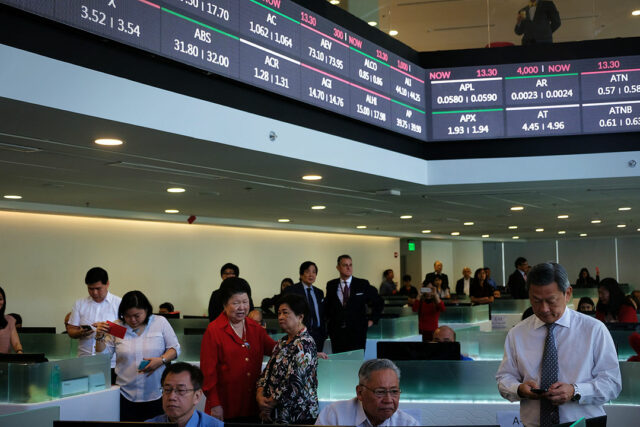
PHILIPPINE stocks may move sideways this week amid bargain hunting as investors await the US Federal Reserve’s monetary policy ruling.

“Local equities remained mostly listless last week, as positive inflation headlines failed to deliver any strong upward momentum for the local market,” online brokerage 2TradeAsia.com said in a note.

The benchmark Philippine Stock Exchange index (PSEi) fell by 0.49% or 32.21 points to close at 6,507.15 on Friday. The broader all-share index slid by 0.24% or 8.53 points to end at 3,476.18.

The PSEi slid by 0.07% or 4.86 points from a week earlier.

Inflation eased to 6.1% in May from 6.6% in April, the slowest in a year. It has averaged 7.5% for the first five months, still above the Bangko Sentral ng Pilipinas’ 2-4% target and 5.5% forecast for the year.

Japhet Louis O. Tantiangco, senior research analyst at Philstocks Financial, Inc. expects bargain hunting this week due to recent weekly declines and attractive levels.

“Investors are also expected to look toward the Federal Reserve’s policy meeting,” he said in a Viber message. “A further rise in their policy rate is seen to weigh on the market, while a pause in tightening may boost sentiment. For cues on the Federal Reserve’s move, investors are also expected to watch out for the US’ upcoming May inflation report.”

The US news might largely influence this week’s stock price movements, particularly May inflation data and the Federal Reserve’s policy rate decision, said Juan Paolo E. Colet, managing director at China Bank Capital Corp.

“Many analysts expect a US rate hike pause this month, but it is the Fed’s interest rate outlook that will be most keenly watched,” he said. “Any hawkishness will weigh down on our market, so traders are hoping for a dovish tone.”

The US Fed raised it benchmark overnight interest rates by 25 basis points (bps) at its policy meeting last month.

The US central bank has raised fund rates to 5%-5.25%. It has increased rates by 500 bps since March 2022. Its next policy meeting is on June 13-14.

“On the domestic front, investors will pay attention to overseas Filipino workers’ personal remittance data for April,” Mr. Colet said. “Given the large contribution of such flows to our economy, a slowdown will weigh on market sentiment.”

Mr. Colet and Mr. Tantiangco placed the PSEi’s immediate support at 6,400 and resistance at 6,600 points this week. 2TradeAsia.com put support at 6,450 and resistance at 6,650 to 6,700. 

Philippine peso may breach P59 a dollar level in short term, says FBS

BW FILE PHOTO

THE PHILIPPINE PESO would probably breach its weakest level of P59 a dollar hit in October last year if it continues to weaken to P56.50 in the short term, according to foreign exchange brokerage FBS.

“In the less likely scenario that the price breaks and holds above the level of P56.50, the price may move to a historical high of P59.20,” it said in an e-mailed reply to questions.

On the other hand, the peso could appreciate further if its P50 to P52 a dollar, FBS said.

The peso has not hit P56.50 a dollar since its P56.56 close on Nov. 29. It closed at an all-time low of P59 a dollar on Oct. 17.

The local currency closed at P56.05 a dollar on Friday, six centavos stronger than a day earlier, data from the Bankers Association of the Philippines’ website showed.

Week on week, the peso declined by 16 centavos from its P55.89 finish on June 2.

FBS market analysts expect the peso at P56.40 to P56.45 against the dollar, based on inflation and policy decisions of the Philippine central bank.

Inflation slowed to 6.1% in May from 6.6% print in April, but still faster than 5.4% a year earlier. It was within the central bank’s 5.8-6.6% estimate for the month.

It was also the 14th straight month that the rate breached the central bank’s 2-4% target for the year.

For the first five months, inflation averaged 7.5%, still above the BSP’s 5.5% forecast for the year.

The Bangko Sentral ng Pilipinas (BSP) paused its aggressive monetary tightening last month and signaled it would put the key rate on hold at its next two to three meetings.

The central bank raised policy rates by 425 bps from May 2022 to March 2023.

The Monetary Board will review policy on June 22. — Aaron Michael C. Sy

ADVERTISEMENT
ADVERTISEMENT