Home Blog Page 469

Auctions announced for Tacloban, Camiguin, Virac airport projects

FACEBOOK.COM/CAAPHILIPPINES

THE Department of Transportation (DoTr) said it invited interested parties to participate in three airport upgrade projects budgeted for up to P895.12 million combined.

In bid notices issued on Thursday, the DoTr invited potential bidders for the P455.90-million Tacloban Airport development project, the P174.60-million Camiguin Airport development project, and the rebidding of P264.62-million Virac Airport development project.

Proposals will be accepted until Jan. 29, the DoTr said. A pre-bid conference is scheduled for Jan. 16.

The winning contractor for the Tacloban airport project will be given 600 calendar days to complete the works, while the contractors for Camiguin and Virac airports will have 180 and 720 days, respectively.

The Tacloban project covers the construction and upgrade of landside and airside facilities, according to the bid documents. The Camiguin project covers the construction of an initial runway centerline. The Virac project covers the site development as well as the construction of a control tower.

The DoTr has said that the Tacloban airport is due for upgrading, with a new terminal expected to be operational by September, and the runway expansion and reclamation expected to be ready by the second quarter. — Ashley Erika O. Jose

Aurora ecozone hoping to bring in US defense-logistics locator within the quarter

ANGLICOTECH.COM

THE Aurora Pacific Economic Zone and Freeport Authority (APECO) said it hopes to bring in a key US defense-logistics locator within the first quarter following a key meeting scheduled soon in the US.

“I really want more defense manufacturing in APECO. That’s why we’re going back to Washington, DC and Virginia,” APECO President Gil G. Taway IV told reporters in a briefing.

The meeting in the DC area will involve Anglicotech LLC, which optimizes supply chains for defense-industry contractors.

APECO first met with defense-focused companies in the US through an Economic and Security Forum in 2024, during which it met around 30 companies.

“That is where we met Anglicotech. So we want to go back to Virginia and Washington so we can talk with them again,” he said.

“We are actually planning an anchor event in Washington, DC, and Virginia where we will gather defense companies big and small,” he added.

“In March, we are also planning to go to… Los Angeles kasi gusto namin ligawan ’yong mga nasa Burbank, ’yong mga film studios (we would like to pitch to the Hollywood movie companies in Burbank),” he said.

“We are also going to Texas for follow-up discussions,” he added.

According to Mr. Taway, APECO is hoping to benefit from a government initiative to make the Philippines more self-reliant on defense.

“The demand is basically (stemming from) our SRDP, or Self-Reliant Defense Posture. And I think Anglicotech also sees other markets that they can supply to in Asia and even Europe,” he added.

APECO is also meeting with retirement companies in Japan, including Long Life Corp., which specializes in retirement communities. — Justine Irish D. Tabile

CARS firms deserve perks after boosting PHL — CAMPI

USERTRMK-FREEPIK

THE Chamber of Automotive Manufacturers of the Philippines, Inc. (CAMPI) said participants in the Comprehensive Automotive Resurgence Strategy (CARS) program should receive their incentives after having delivered results that have boosted the economy.

“Recent developments have raised serious concerns on the funding for the financial incentive commitments granted under the CARS Program,” CAMPI said in a statement on Thursday.

“The participants should be able to receive their incentives based on their actual performance that already generated economic benefits,” it added.

President Ferdinand R. Marcos, Jr. vetoed unprogrammed appropriations worth P92.5 billion on Monday, which included fiscal support for the CARS program worth P4.32 billion.

The vetoed CARS budget items were meant to fulfill government commitments under the program, including a still-being-evaluated application from one of the participants.

Mr. Marcos also vetoed P250,000 in funding for the Revitalizing the Automotive Industry for Competitiveness Enhancement (RACE) program.

According to CAMPI, the government should implement the RACE program soon.

“Both CARS and RACE are fundamental programs that contribute to overall industrial development. We fully trust and support efforts of key government agencies in urgently resolving these important matters,” it added.

Immediately after the veto, Trade Undersecretary and Board of Investments Managing Head Ceferino S. Rodolfo said that the agency is actively working with other government agencies to ensure payment of CARS participants.

“CAMPI believes in the importance of collaboration between government and industry in securing the future viability of the Philippine automotive manufacturing sector,” it said.

“Such is crucial in creating a positive environment for future investments and help develop a more robust local automotive parts manufacturing industry,” it added. — Justine Irish D. Tabile

BoI touts PHL prospects as herbal-medicine hub

PCHRD.DOST.GOV.PH

THE GOVERNMENT is hoping to position the Philippines as an emerging hub for herbal medicine manufacturing in response to burgeoning global demand, the Board of Investments (BoI) said.

BoI Supervising Investments Specialist Morinaella Jeusine M. Torgo said the developing natural and sustainable health solutions market presents a strategic opportunity for the Philippines.

“With its rich biodiversity and long-standing herbal medicine practices, the country is well-positioned to lead in the rapidly growing natural health products markets,” she said.

“However, challenges such as low production capacity and inconsistent quality standards persist,” she added.

The BoI and partner agencies organized a three-day training session in Antipolo last month to introduce methods for transforming herbal products into high-value items, thereby helping participants diversify livelihoods and raise incomes.

The natural health products and herbal medicine industry is among BoI’s strategic priorities for promotion and development.

“The timing couldn’t be better. The investment window for herbal medicine and natural health products in the Philippines is wide open,” she said.

“Backed by the Philippine Herbal Medicine Development Plan and strong government support, we are ready to drive health innovation, create rural jobs, and deliver inclusive growth,” she added.

BoI Resource-Based Industries Service Acting Director Francis M. Peñaflor said that developing the industry requires multi-sectoral and multi-agency collaboration.

“Although the training in Rizal province is only a pilot, participants expressed a strong commitment to work closely with anchor firms such as Pascual Laboratories and other herbal processing companies from the Chamber of Herbal Industries of the Philippines, Inc. to increase the supply of high-quality herbal raw materials,” he said.

According to the roadmap, the government aims to integrate herbal medicine into universal healthcare, strengthen value chains, and promote sustainable livelihoods.

BoI-registered herbal medicine manufacturing projects are eligible for income tax holidays, special corporate income tax rates, enhanced deductions for research and development, training and domestic inputs, and value-added tax and duty exemptions. — Justine Irish D. Tabile

Portal to make farm road projects trackable

PHILSTAR FILE PHOTO

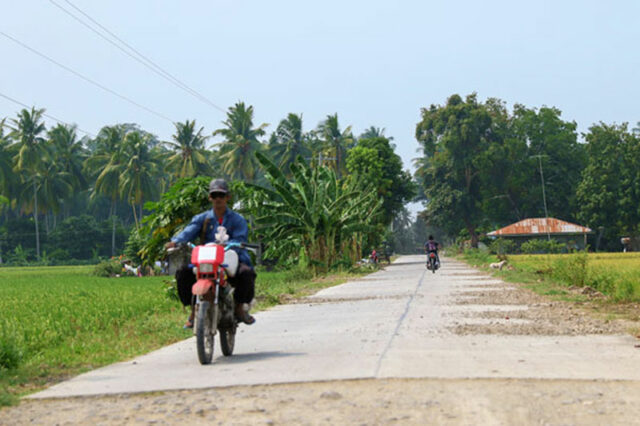
A PORTAL will be launched in February to facilitate the monitoring of farm-to-market road (FMR) projects, the Department of Agriculture (DA) said.

The platform, known as FMR Watch, was developed by the DA’s Bureau of Agricultural and Fisheries Engineering (BAFE) and will allow the public to track the status, progress, and timelines of FMR projects.

BAFE Director Cristy Cecilia P. Polido told reporters at a briefing that the portal will provide detailed information on each project, including budget, exact location, technical specifications and contractors. Geotagged photos documenting construction progress will also be uploaded.

“The portal can be accessed by all stakeholders: the public, our citizens, local government units (LGUs) and everybody interested in knowing the progress of our implementation of FMRs,” Ms. Polido said.

She said the platform will also feature data on completed projects, the total length of roads constructed, the number of farmers reached, and the volume of agricultural produce transported.

The DA added that it is planning to integrate livestreams of project auctions into the portal and upload all procurement and bid-related documents.

FMR Watch will also allow the public to submit complaints related to FMR projects. Users will be allowed to submit photos and videos to support their reports. 

Ms. Polido said responses to complaints can be received as early as 24 hours.

The DA is taking over FMR projects from the Department of Public Works and Highways this year.

The FMR program has been allocated P33 billion in this year’s budget, which will fund the construction of over 1,600 roads. The funding will also address more than 1,000 FMRs approved from 2021 to 2025 that have yet to be completed, according to BAFE.

With the takeover, the DA said it expects to accelerate construction, reduce costs, and lower the previous estimated price of P15 million per kilometer for a five-meter-wide FMR.

“Our initial figure is P12 million (per kilometer). Of course, that does not include the contractor’s profit, but the indirect and direct costs could be as low as P12 million,” Ms. Polido said.

In some areas, three-meter-wide FMRs may be built if traffic volume does not merit a wider road, she said. — Vonn Andrei E. Villamiel

BIR ‘optimistic’ of rebound in 2026 after missing 2025 revenue target

BW FILE PHOTO

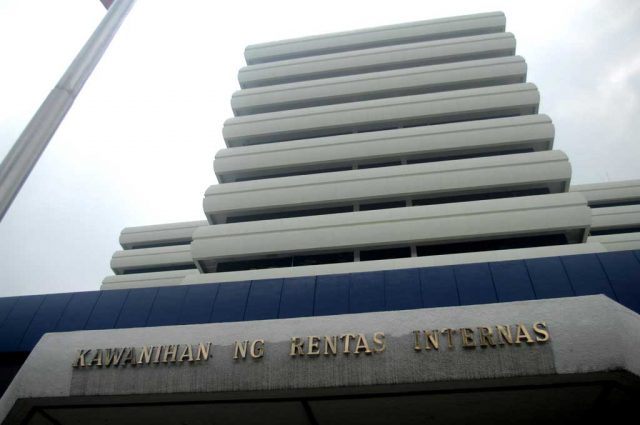
THE Bureau of Internal Revenue (BIR) said it remains optimistic about a revenue rebound in 2026 after missing its target with a 2025 performance of P3.105 trillion.

BIR Commissioner Charlito Martin R. Mendoza said via Viber on Thursday that the preliminary figure for 2025 is net of refunds.

The total came in 3.56% below the full-year target but exceeded the 2024 collection total of P2.85 trillion.

“During the second half, starting July, when the flood control investigations started, our revenue collection efforts were really significantly affected, primarily because of the slowdown in spending,” he told reporters on Thursday.

Mr. Mendoza said he remains “very optimistic” that momentum will build following a 7.5% increase in December revenue.

“We will do our best to hit the target. The government needs it. We have many projects that need funding,” he said.

The BIR suspended field audit operations in December in the face of allegations the audit process is being used for extortion.

For 2026, the BIR is tasked to collect P3.58 trillion, 11.19% higher than its 2025 target.

Mr. Mendoza added that the BIR is moving towards a streamlined, consolidated LoA framework.

“We’re looking at the possibility of having just one level of authority per taxpayer per taxable year, covering all internal revenue taxes,” he said.

The BIR is also reducing the number of offices that can issue these documents and implement risk-based norms for authorizing audits.

Mr. Mendoza said proposed measures in Congress to cut the value-added tax rate will significantly impact collections.

“It’s a policy decision that belongs to Congress. What we do is tax administration. We do our best to maximize collections (by being) efficient… but fair,” he added.

Legislators have proposed to reduce the 12% VAT rate to 10%. — Aubrey Rose A. Inosante

Wholesale rice prices fall in December

PHILIPPINE STAR/KRIZ JOHN ROSALES

THE wholesale price of rice declined sharply year on year in December, according to preliminary data from the Philippine Statistics Authority (PSA).

The PSA said the national average wholesale price of well-milled rice declined 9.7% to P42.94. The biggest decline in the well-milled rice wholesale price was logged in Central Luzon, where it fell 16.5% year on year to P40.10 per kilo.

Wholesale prices of well-milled rice in the National Capital Region rose 10.1% from a year earlier to P51.58 per kilo.

The average wholesale price of regular-milled rice in December fell 13.2% year on year to P37.83 per kilo.

The Cagayan Valley posted the biggest decline in the wholesale price of regular-milled rice, with the regional average falling 23.1% year on year to P31.24 per kilo.

The wholesale price of regular-milled rice in the National Capital Region fell 2.3% year on year to P43.15 per kilo.

Premium and special rice also posted wholesale price declines, with their national averages falling 5.5% and 3.2%, respectively.

Meanwhile, the national average wholesale price of yellow corn grains in December fell 1.8% year on year to P23.87 per kilo. The corresponding price for white corn grains rose 37.1% to P25.34 per kilo.

The wholesale price of yellow corn grits in December was little changed, while the price of white corn grits rose 10.2% year on year. — Vonn Andrei E. Villamiel

Wholesale price growth accelerates in November

PHILIPPINE STAR/ MICHAEL VARCAS

WHOLESALE PRICE growth hit two-month high of 2.7% as food costs inched up in November, the Philippine Statistics Authority (PSA) reported on Thursday.

Citing preliminary data, the PSA said the general wholesale price index (GWPI) reading of 2.7% picked up from the 2.6% posted in October and the year-earlier level of 2.3%.

The November reading was the highest since the 2.9% reported in September.

The national GWPI averaged 3.1% during the first 11 months, against the year-earlier 2.5% reading.

“The uptrend in the annual growth rate of the GWPI was mainly caused by the faster annual increase in the index of food at 2.2% in November 2025 from 1.9% in the previous month,” the PSA said in a report.

The food subindex accounted for more than a third of the GWPI.

Michael L. Ricafort, chief economist at Rizal Commercial Banking Corp., said that damage caused by the typhoons Tino and Uwan in November likely led to a pickup in prices following supply-chain disruptions in hard-hit areas.

The combined damage and losses incurred for typhoons Tino and Uwan amounted to P5.16 billion, the Department of Agriculture Disaster Risk Reduction and Management Operations Center said in December.

“However, this is offset by lower global commodity prices in recent months to their lowest in three to five years, with global crude oil prices lingering near five-month lows recently,” Mr. Ricafort said in an e-mail. — Pierce Oel A. Montalvo

Q3 domestic trade in goods valued at P561.14B

PHILIPPINE STAR/EDD GUMBAN

DOMESTIC TRADE in goods came in at P561.14 billion in the third quarter of 2025, the Philippine Statistics Authority (PSA) said.

In its Commodity Flow in the Philippines report, the PSA, citing preliminary data, said the third-quarter total declined from the P996.16 billion posted a quarter earlier.

By volume, domestic trade hit 11.89 million tons, down from 17.77 million a quarter earlier.

Commodities traded by road amounted to P318.20 billion. This was followed by goods transported by water (P242.54 billion), and air (P402.15 million).

Domestic trade by value is the outflow value of commodities transported from the place of origin to the destination.

The PSA noted that domestic trade by volume and value in the third quarter was not comparable to the year-earlier data due to the inclusion of fresh road-transport system data starting in the first three months of 2025.

The decrease in domestic trade can be attributed to weaker-than-expected economic growth in the third quarter, Marco Antonio C. Agonia, an economist at the University of Asia and the Pacific, said in an e-mail.

“Households and businesses likely scaled back purchases and production following the government spending freeze due to the corruption scandal and weather disturbances, which both led to the downbeat Q3 (gross domestic product) reading,” he said.

The economy expanded 4% in the third quarter, decelerating from 5.5% growth in the three months to June and the 5.2% posed a year earlier.

Mr. Agonia noted that though trade flows mostly slowed, some regions posted outflow growth “which may be due to some agricultural harvests, stockpiling activity for the Q4 holiday season, and export-oriented interregional value chains picking up.”

He expects fourth quarter domestic trade to improve slightly.

“The Q4 holiday season likely encouraged households and businesses to ramp up activity, facilitating further domestic trade flows,” he said.

Across regions, the National Capital Region posted an outflow of P138.57 billion, accounting for 24.7% of total domestic trade.

The region also recorded the largest inflow value at P135.68 billion or 24.2% share.

Calabarzon accounted for 20.9% of domestic trade, with traded goods of P117.34 billion and inflow valued at P79.01 billion.

Central Luzon domestic trade came in at P79.80 billion, with inflows of P30.91 billion. The region accounted for 14.2% of domestic trade.

Central Luzon also posted the largest trade balance — the difference between outflow value and inflow value — with P48.89 billion. Calabarzon and Negros Island Region followed with P38.32 billion and P18.46 billion, respectively. — Isa Jane D. Acabal

Philippine stocks rebound as players buy the dip

BW FILE PHOTO

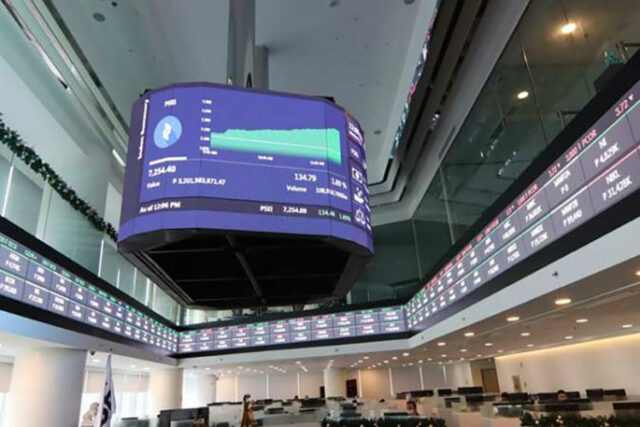
PHILIPPINE STOCKS rebounded on Thursday, with the index returning above the 6,300 line and logging a new five-month high, as investors bought bargains following Wednesday’s drop.

The Philippine Stock Exchange index (PSEi) went up by 0.45% or 28.58 points to end at 6,320.67, while the broader all shares index increased by 0.37% or 13.46 points to 3,607.65.

This was the main index’s best finish in nearly five months or since it ended at 6,325.09 on Aug. 13.

“The PSEi ended higher as investors bought at lower prices after yesterday’s (Wednesday) decline, taking advantage of market dip,” Regina Capital Development Corp. Head of Sales Luis A. Limlingan said in a Viber message. The index closed lower at 6,292.09 on Wednesday on profit taking after a three-day rally.

“Buying pressure remained intact despite unemployment data and the peso hitting an all-time low against the US dollar. Investors remained cautious but optimistic amid softer economic data.”

The Philippines’ unemployment rate rose to 4.4% in November from 3.2% a year earlier, according to the preliminary results of the labor force survey released on Wednesday. However, this was lower than 5% in October.

This translated to about 2.25 million jobless Filipinos, compared with 1.66 million in November 2024 and 2.54 million in the previous month.

Meanwhile, on Wednesday, the peso plunged to a new record low of P59.355. It recovered to P59.17 on Thursday.

“The local market rose as investors resumed their bargain hunting, with hopes pinned on another possible rate cut by the Bangko Sentral ng Pilipinas (BSP) in their February meeting,” Philstocks Financial, Inc. Research Manager Japhet Louis O. Tantiangco said in a Viber message.

BSP Governor Eli M. Remolona, Jr. said on Tuesday that they could consider another cut at next month’s meeting, but noted that the current policy rate is already “very close” to where they want it to be, signaling that their easing cycle is about to end.

The BSP has cut rates by a cumulative 200 basis points since August 2024.

Sectoral closed mixed on Thursday. Mining and oil sank by 1.24% or 203.27 points to 16,186.65; financials dropped by 1.15% or 24.72 points to 2,119.63; and industrials fell by 0.39% or 35.89 points to 9,081.48.

Meanwhile, services jumped by 2.96% or 72.78 points to 2,528.68; holding firms went up by 0.29% or 14.75 points to 4,972.14; and property climbed by 0.28% or 6.50 points to 2,316.56.

Advancers beat decliners, 118 to 94, while 49 names closed unchanged.

Value turnover went down to P6.22 billion on Thursday with 1.11 billion shares traded from the P7.29 billion with 772.34 million issues that changed hands on Wednesday.

Net foreign buying dropped to P56.24 million from P201.88 million. — Alexandria Grace C. Magno

Plaintiffs challenge P150.9-billion unprogrammed funds at high court

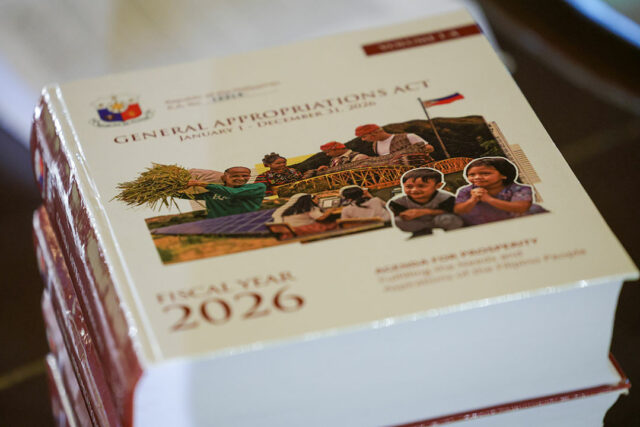
PRESIDENT Ferdinand R. Marcos, Jr. signed the General Appropriations Act for Fiscal Year 2026 during a ceremony at Malacañan Palace on Jan. 5. — NOEL B. PABALATE/PPA POOL

By Erika Mae P. Sinaking

HOUSE MINORITY lawmakers on Thursday asked the Supreme Court (SC) to nullify the P150.9-billion unprogrammed appropriations in the 2026 national budget over constitutionality questions, arguing its inclusion amounted to a grave abuse of discretion.

The petition for certiorari and prohibition was filed by Caloocan Rep. Edgar R. Erice and Party-list Rep. Leila M. de Lima, seeking to nullify the unprogrammed funds under the 2026 General Appropriations Act (GAA), which President Ferdinand R. Marcos, Jr. signed into law on Jan. 5.

“There is already a ripe and actual justiciable controversy because the budget has been approved and signed into law. It can always be implemented anytime by the Executive,” Ms. de Lima told reporters in mixed English and Filipino.

“That’s why we filed a petition for certiorari and prohibition. Certiorari because there’s a grave abuse of discretion and prohibition to stop the Executive, particularly the Executive secretary and the Budget secretary, from implementing the unprogrammed funds.”

The lawmakers asked the SC to issue a temporary restraining order to stop the implementation of the questioned appropriations, which they claimed to be unconstitutional.

Unprogrammed appropriations were “standby” funds that may only be released if specific fiscal conditions are met.

The Department of Budget and Management (DBM) has said these funds are intended to support priority programs and projects that cannot yet be fully programmed due to uncertainties in revenue inflows.

These typically include budgetary support for social protection programs, infrastructure projects, debt management, and other government obligations that may require supplemental funding should additional resources become available during the fiscal year.

However, the petitioners argued that the continued inclusion of such funds gives the Executive excessive flexibility in spending, undermining Congress’ constitutional “power of the purse.”

During the filing, Ms. De Lima said the structure of unprogrammed appropriations weakens legislative oversight because Congress is asked to authorize spending without full details on the projects and financing sources.

“Instead of clearly laying out the budget expenditures and the sources of financing, the process is reversed,” Ms. De Lima said. “There is a general program, but there are no specific projects and no definite sources of financing yet.”

“Congress is supposed to authorize spending, but how can it do so if it does not see the specific items under the unprogrammed appropriations? This undermines the entire budget process,” Ms. De Lima said.

She added that if certain expenditures are truly necessary, they should already be included in the programmed appropriations.

“Unprogrammed appropriations are inherently questionable. If these projects are really needed, they should be placed under the programmed appropriations where the projects are clearly identified,” she said. “If excess revenues later materialize, there should be a special appropriations measure so Congress can scrutinize them again, instead of leaving them to executive discretion.”

Mr. Erice, for his part, warned that the financing sources for unprogrammed funds pose significant fiscal risks.

“The most dangerous part is the source of financing. Once these are placed under unprogrammed funds, the government can find ways to source funding — from where?”

He said that the funds could be sourced from asset sales, excessive borrowing that the government may no longer be able to repay, or the imposition of additional taxes.

“These do not pass through Congress because they are already programmed. That is completely wrong,” Mr. Erice added.

In a statement, the DBM maintained that the unprogrammed appropriations under the 2026 GAA are constitutional and consistent with existing jurisprudence.

The agency said the Supreme Court has repeatedly upheld unprogrammed funds as valid “standby appropriations” that are not automatically available for use and may only be released upon the occurrence of clearly defined fiscal conditions, subject to strict validation and control mechanisms.

“It is not a lump-sum fund nor a blank check for spending,” the DBM said.

The DBM also noted that the P150.9-billion unprogrammed appropriations for 2026 represent the lowest level since 2019, reflecting what it described as stronger fiscal discipline and tighter safeguards in budget execution.

“The DBM remains committed to upholding the Constitution, respecting the authority of the courts, and ensuring that the national budget is implemented in a prudent, transparent, and accountable manner,” it said.

The agency added that upon receipt of the petition, it would transmit the case to the Office of the Solicitor General, the government’s statutory counsel.


Year-long state of calamity raises need for greater gov’t spending oversight

DEBRIS from damage caused by Typhoon Kalmaegi, locally called Tino, covers the ground in Talisay, Cebu. — REUTERS/ELOISA LOPEZ

By Kenneth Christiane L. Basilio, Reporter

A LAWMAKER urged tighter scrutiny of government spending amid the year-long state of national calamity, pushing for greater congressional oversight on disbursements on agencies prone to corruption.

Having tighter supervision and greater public participation in bidding processes would help ensure contracts are awarded properly to curb wasteful spending and fund malversation, Party-list Rep. Terry L. Ridon, who heads the House Public Accounts Committee, said on Wednesday.

President Ferdinand R. Marcos, Jr. placed the Philippines under a year-long state of national calamity after two successive typhoons in November left hundreds dead and caused billions in damage. This declaration allows authorities to bypass regular bidding and directly negotiate with suppliers.

“We need to be vigilant about it,” he told BusinessWorld in an interview. “That’s really our safeguard against agencies and officers who will try to take shortcuts and engage in corrupt practices.”

His statement comes as lawmakers ahead of a joint oversight committee Congress will convene to scrutinize public disbursements amid a widening multibillion peso corruption scandal that has implicated officials, politicians and private contractors.

“All agencies are susceptible to corruption,” said Mr. Ridon. “But of course, there are certain agencies that are notorious for this — basically infrastructure agencies with kickbacks, substandard projects, and ghost budgets.”

“That’s why they really need to be closely monitored,” he added.

He had said the House Public Accounts panel would examine bidding and project implementation in the Public Works, Health and Education departments to crack down on corruption, noting that infrastructure projects have traditionally been prone to kickbacks.

“It is important that the materials reflect the market prices,” Mr. Ridon said. “Also a big part of it lies in the actual implementation, which is why the committee is exercising its oversight functions to ensure it is carried out properly.”

He said that oversight would include going to the offices of the agencies under monitoring.

“This means looking at how meetings are conducted in the Public Works department at the district level, what those meetings look like at the central office, and how bidding is really carried out there,” he said.

Ederson DT. Tapia, a political science professor at the University of Makati, said opening state spending to public monitoring is a vital step toward improving accountability.

“Opening state spending to public monitoring sends a clear signal that accountability should not be confined to closed rooms or technical committees,” he said, but warned that the system should be “user-friendly” for the transparency thrust to be effective.

“Public access should not mean simply placing large volumes of raw data online. If information is difficult to locate, poorly organized, or highly technical, participation becomes superficial and limited to a few specialists,” said Mr. Tapia. “Public monitoring can strengthen accountability, but only if it is designed with the public in mind and not merely to satisfy disclosure requirements.”

Granting the public greater access to monitoring state spending could strengthen efforts to prevent corruption, Joy G. Aceron, convenor-director of transparency group G-Watch, said.

“It can be a deterrent, and it adds to the dynamism of governance with more diverse actors involved checking and balancing each other,” she said in a Facebook Messenger chat. “There are many ways the public can monitor governance, and one that has been proven effective in several studies is through multi-level civil society monitoring and advocacy.”

She said there needs to be a “shared leadership and balanced collaboration between government and civil society,” including state efforts to strengthen nongovernment organizations to bolster checks and balances.

ADVERTISEMENT
ADVERTISEMENT