Home Blog Page 4657

Isn’t it personal, anyway?

ARLINGTON-RESEARCH-UNSPLASH

Within the workplace, there is a familiar and oft-repeated Filipino expression: Walang personalan, trabaho lang (nothing personal, it’s just the job). It has been used to emphasize that workplace — business and management — decisions are all objective and intended for the betterment of the enterprise and that there was no intention to hurt the people who fall as collateral damage. Its sister saying would be, Huwag dalhin sa opisina ang problema sa bahay (Don’t bring household problems to work). On the other hand, this suggests that one should not let personal and home issues affect the quality of one’s work and deliverables. These statements are deeply entrenched in workplace cultures; one can almost not help but accept them as management wisdom. But is it?

Last month, I had the privilege of facilitating an important corporate communication: cascading and translating a large distribution company’s recently revisited vision, mission, and core values (VMV). This was one of the initial steps in a strategic business planning process the organization was embarking on, particularly in the aftermath of the COVID-19 pandemic. In the workshops, the CEO described the kind of business and organization he hopes to create within the next three to seven years. He extended the invitation to the different layers of management, offering the opportunity and seeking their commitment to helping him make the future a reality.

The entire premise of the session was inspired in some part by the Drexler-Sibbet Team Performance Model. We argued that in as much as members have their sense of purpose, meaning, and direction, each of them will only be able to commit to a team or organization — and achieve and sustain a superior level of performance — if and only if they find that doing so fulfills their own personal aspirations.

This was an important cornerstone of the entire workshop. One cannot argue that employees must divest themselves of personal concerns and issues before coming to work when for all practical purposes, most of their waking hours are spent because of work. On a regular day, waking up early directly results from the need to come to work. They endure an hour or two of traffic to get to work, spend eight to 10 hours in the office, warehouse, or plant, and endure another hour or two to get home. Some are even expected to be on call at night and on weekends.

No one goes to work and leaves a “personal” version of themselves by their threshold. We all bring to the workplace our complete selves: our talents, motivations, passions, problems, subconscious issues, competencies, attitudes, feelings, values, and faith. Overworked and exposed to risk, one does not wear down or kill an “employee.” One wears down and kills a person.

Work is personal, and is perhaps a very deeply personal dimension of our human existence: it is an expression of everything we are good and poor at, of our genius and our folly, and we get compensated for it to sustain our human existence — not only materially, but in its entirety.

The implication of our collective reflection during those sessions was clear: leadership matters. It matters because it is that function of management that seeks to influence, inspire, empower, and engage. For all that to happen, it behooves the leader to seek to know, understand, and align their team members’ aspirations with the organization’s. The leader can no longer be completely utilitarian — to pay to be served. You do that, and you find your team members working only for money and willing to be sold out to the next highest bidder, especially — and it often is — when the work and the workplace are no longer a happy and growth place.

So, yes, work is personal, and working for you — whoever you are — is a personal choice with personal implications.

As a postscript, I found this true for them when I shared these thoughts with some young — millennial, if you will — friends. If all that matters is financial performance, they will give you the money if you show them the money. But if what matters is a greater purpose, and the work has their name on it, they will give you more.


Denver Bingski Daradar is an assistant professorial lecturer and doctoral candidate at the Ramon V. Del Rosario College of Business of De La Salle University.

denver.darada@dlsu.edu.ph

The Seasons Residences to add ‘winter’ tower

FEDERAL Land, Inc. is launching the fourth and final tower of Japanese-inspired The Seasons Residences in Bonifacio Global City (BGC).

The fourth tower is called Fuyu, which means winter in Japanese. This follows the first three towers of The Seasons Residences, namely, Haru (spring), Natsu (summer), and Aki (autumn).

“Aside from Japan’s trailblazing technologies, world-famous cuisine, and its four seasons, Filipinos are drawn to Japanese architecture for its functionality and elegance that lies in its simplicity. The Seasons Residences, the country’s first Japanese-inspired residential project, is a case in point,” Federal Land Sales Group Head Margarita Saenz-Resurreccion said in a statement.

The Seasons Residences is a mixed-use development by Federal Land in collaboration with its partners Nomura Real Estate Development Co. Ltd. and Isetan Mitsukoshi Holdings Ltd.

The Fuyu tower will feature “innovative spaces and curated amenities reminiscent of Japan’s winters,” the company said. Units will reflect the Japanese lifestyle from the design efficiency of its unique storage systems, below-floor drainage system for easier pipe maintenance and repairs, to the damping technology that can withstand earthquakes and typhoons experienced by both the Philippines and Japan.

The Seasons Residences is within Grand Central Park, Federal Land’s master planned community in BGC.

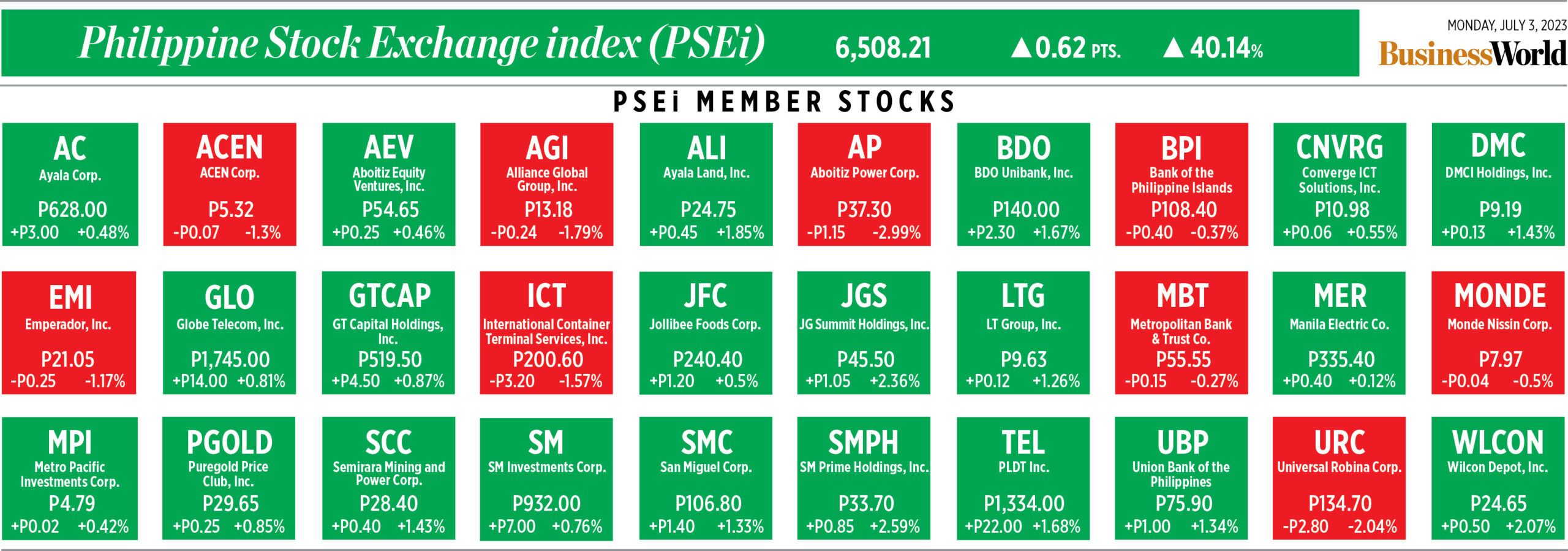
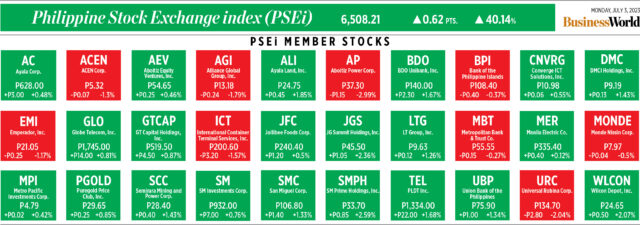
How PSEi member stocks performed — July 3, 2023

Here’s a quick glance at how PSEi stocks fared on Monday, July 3, 2023.


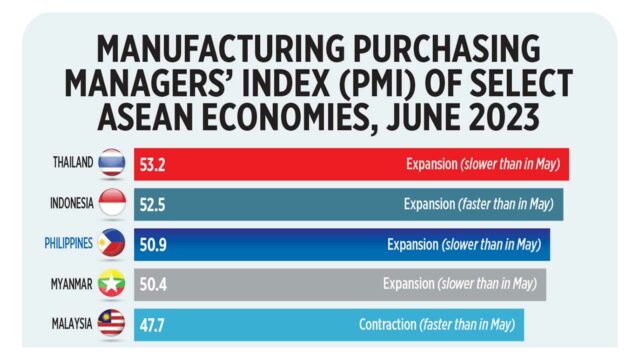
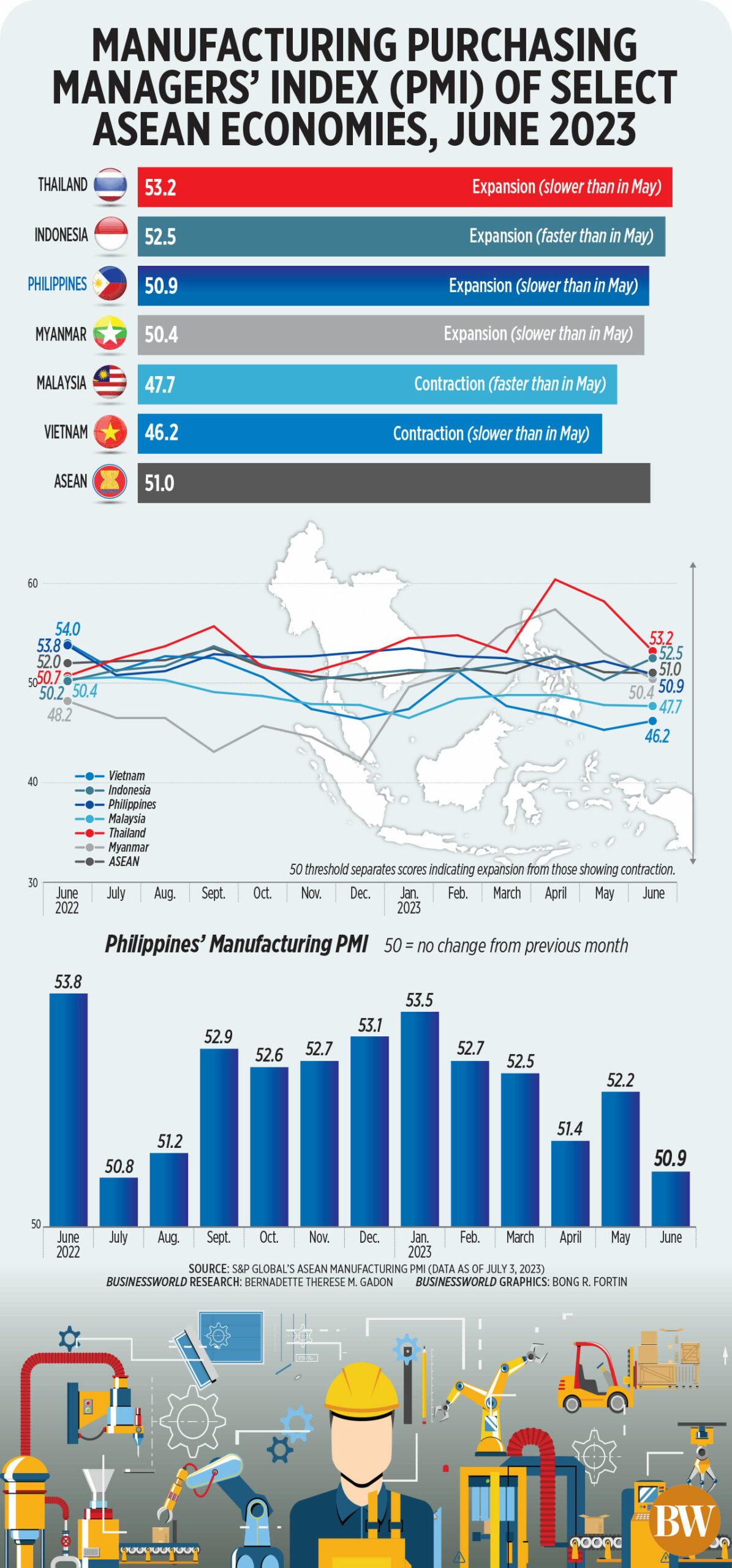
Manufacturing Purchasing Managers’ Index (PMI) of select ASEAN economies, June 2023

PHILIPPINE FACTORY ACTIVITY lost momentum in June, with output expanding to its slowest pace in 11 months, S&P Global said on Monday. Read the full story.

EV charging station accreditation assigned to bureau of Energy dep’t

The Shell Recharge bay at Shell Mamplasan — PHOTO BY KAP MACEDA AGUILA

THE Department of Energy (DoE) said on Monday that it placed one of its bureaus in charge of registering electric vehicle charging stations (EVCS) and accrediting suppliers.

In an advisory dated June 23, the Energy department said EVCS provider accreditation and equipment registration applications will be taken by the Energy Utilization Management Bureau. 

The registration rules require that the EVCS be “interconnected with the same electrical branch circuit system, located in the same unit building/floor and bounded by the same building, (otherwise) separate applications will be required,” the DoE said.

It said multiple EVCS points will be considered one registration if on the same floor; within the same facility and connected to one electrical branch circuit.

However, the DoE said that only DoE-accredited “own-use charging stations” and “commercial-use charging stations” will be allowed to register.

The DoE said the accreditation of EVCS suppliers will help accelerate the adoption of EVs.

The DoE has set an EV rollout target of 10% of all vehicle fleets, double the 5% required by Republic Act No. 11697, or the Electric Vehicle Industry Development Act.

It said that for 2023-2028, the EV fleet target is 2.45 million cars, tricycles, motorcycles, and buses, and 65,000 EV charging stations.

For the 2029-2034 period, the DoE said it will target an additional 1.85 million EVs and 42,000 charging stations.

At the end of 2021, the DoE had registered about 9,000 EVs, of which 378 were public utility vehicles, as well as 327 charging stations. — Ashley Erika O. Jose

Ground broken on final three commuter rail projects

PHILIPPINE STAR/EDD GUMBAN

THE Department of Transportation (DoTr) said on Monday that initial work has started on the last three segments of the South Commuter Railway (SCR), with the segments valued at P73.25 billion.

“This groundbreaking for three contract packages of the South Commuter Railway is another major milestone of the mother project, the North South Commuter Railway (NSCR),” Transport Secretary Jaime J. Bautista said at the groundbreaking ceremony.

“We hope these three contract packages of the SCR will (lead to) the timely completion of the NSCR and open the gates for the renaissance of the railway industry in the Philippines,” he added.

The last three segments traversing Alabang to Calamba, Laguna, are part of a 146.26-kilometer line that will link Clark in Central Luzon to Calamba.

The three civil contract packages consist of railway viaduct structures and elevated stations.

Contract packages S-04, S-05, and S-06 had been awarded to the joint venture of Hyundai Engineering & Construction Co. Ltd. and Dong-Ah Geological Engineering Co. Ltd.

Contract package S-04 covers works in Alabang and Muntinlupa, S-05 the San Pedro, Pacita, Biñan, and Sta. Rosa, Laguna stations, and S-06 the Cabuyao, Banlic and Calamba, Laguna stations.

The SCR project aims to reduce travel time from Metro Manila to neighboring provinces to less than two hours from up to four and a half hours, transforming transportation in the Southern Tagalog region.

The full line will ultimately have 35 stations and be serviced by 51 commuter train sets and seven express train sets. It is expected to serve 600,000 passengers daily when full operations commence.

According to Ahn Meg Adonis, project manager of the NSCR, the entire line is expected to be fully operational by the second quarter of 2029.

“The project that commenced officially on June 30 in the segment Cabuyao to Calamba with a total length of 8.75 kilometers will be open by the second quarter of 2028 and the entire NSCR system is expected to be fully operational by the second quarter of 2029,” Ms. Adonis said.

On June 9, the DoTr awarded CP S-03a of the NSCR project to the joint venture of Leighton Contractors (Asia) Ltd. and First Balfour, Inc. It awarded CP S-03c to the joint venture of PT Adhi Karya (Persero) Tbk. and PT PP (Persero) Tbk.

CP S-03a, which has a total contract price of P21.39 billion and $19.42 million, covers the civil engineering works for the 7.9-kilometer at grade and viaduct railway track structure at Buendia, EDSA and Senate stations.

Meanwhile, CP S-03c, which has a total contract price of P15.75 billion and $49.52 million, covers the civil engineering works for the 5.8-kilometer at grade and viaduct railway track structure at Bicutan and Sucat. — Justine Irish D. Tabile

NGCP grid plan aligns with gov’t RE targets

PHILIPPINE STAR/MICHAEL VARCAS

THE National Grid Corp. of the Philippines (NGCP) said its Transmission Development Plan (TDP) is compliant with the Department of Energy’s (DoE) renewable energy (RE) target of 50% RE integrated with the grid by 2040.

In a statement on Monday, the NGCP said its TDP incorporates developments in the variable renewable energy (VRE) industry, in anticipation of committed renewable energy plants which are due to be connected to the grid in the next few years.

“The annual TDP prepared by NGCP and presented to stakeholders in public consultations is aligned with the Department of Energy’s National Renewable Energy Program 2020-2040. This targets 50% integration of renewables in the grid’s installed capacity by 2040,” the NGCP said.

The NGCP added that integrating additional RE into the grid will also require “reinforcement in both policy and support infrastructure.”

“The entry of more conventional, nonvariable generation and energy storage systems to support VRE installations must be planned simultaneously,” the NGCP said.

The company said the State Grid Corp. of China (SGCC) which owns a 40% stake in NGCP, can deploy grid technologies that can support green and sustainable power grids.

“With its access to SGCC’s technology, NGCP is more than capable of accommodating increasing integration of renewable energy into the grid for a more sustainable energy mix,” the NGCP said.

NGCP capital expenditure (capex) requires the approval of the Energy Regulatory Commission (ERC) under Republic Act No. 9136, or the Electric Power Industry Reform Act.

“The ERC, among all agencies, will be centrally crucial to the success of all this. The DoE itself has recognized that transmission projects to support their recent offshore wind projects have not been included in NGCP’s 5th regulatory period application with the ERC,” it added.

ERC Chairperson and Chief Executive Officer Monalisa C. Dimalanta said the Commission defers to the DoE for the design and implementation of offshore wind (OSW) projects.

“Once the DoE clears the plan and tasks of the building of transmission projects for OSW projects, we shall evaluate the applications filed for such network enhancements without delay,” Ms. Dimalanta said in a Viber message. 

The NGCP said access to funding was not an issue. However, it cited regulatory constraints like capex approvals, the protracted permit process at local government unit level, and right-of-way issues as the “main roadblocks” to completing the company’s projects.

“If the ERC will allow us to spend the capital needed to support this laudable push towards green energy, we are very confident that NGCP will be able to deliver,” the NGCP said.

“We hope for the government and regulator’s support in drafting policies and allowing NGCP to have enough capex to fund the required projects to support RE. This move towards a greener and more sustainable grid requires a holistic approach and we hope for synergy among all the energy players to ensure the fruition of these efforts,” it added. — Ashley Erika O. Jose

Few takers for second round of Green Energy Auction

REUTERS

THE Department of Energy (DoE) said the second round of the Green Energy Auction (GEA) resulted in successful applications amounting to less than a third of the 11,600 megawatts (MW) in renewable energy (RE) capacity on offer.

The successful bids were equivalent to 3,580.76 MW of RE capacity, or 30.9% of the capacity up for grabs.

“We will review, and we will also have discussions with the auction participants. We will decide on the unsubscribed capacity after our discussions with the auction participants,” Energy Undersecretary Rowena Cristina L. Guevara said in a Viber message.

The DoE said the GEA second round resulted in successful applications for 1,968.98 MW worth of ground-mounted solar for the 2024 to 2026 period.

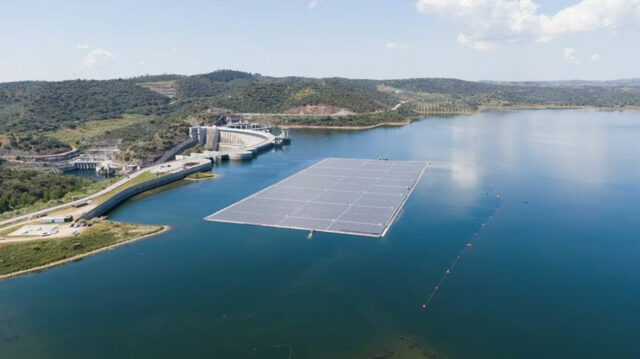
About 9.39 MW was committed in the rooftop solar industry for 2024 and 2025, while 90 MW was committed in the floating solar segment in 2026. Some 1,512.38 MW was committed in the onshore wind segment between 2025 and 2026. 

Biomass and waste-to-energy projects attracted no commitments, the DoE said.

In June the Energy Regulatory Commission (ERC) issued the final green energy auction reserve (GEAR) price for the second round at P4.40 per kilowatt-hour (kWh) for ground-mounted solar; P4.87 per KWh for rooftop solar; P5.39 per kWh for floating solar; P5.85 per kWh for onshore wind; P5.40 for biomass and P6.27 per kWh for biomass waste-to-energy.

The Philippine Solar and Storage Energy Alliance had asked the ERC to raise the GEAR price for floating solar to P7.37 per kWh, considering differences in the segment’s “ecosystem” compared to ground-mounted solar.

The DoE will release the list of winning bidders on July 12.

“These winning bids were ranked based on offers from the lowest to highest bid prices and stacked corresponding to the respective RE technology per grid,” the DoE said.

The notice of award will also be issued on July 12, while the certificate of award will be released to the winning bidders upon the submission of post-auction requirements within a 60-day period. These include a performance bond; affidavit of undertaking to deliver the committed capacity; and a statement that the RE contract has been executed for non-holders of contracts prior to GEA-2 registration.

Failure to comply with the requirements set for GEA-2 will result in forfeiture of the award and of the bid bond, the DoE said.

The GEA program aims to promote RE as a primary source of energy through competitive selection.

“As the GEA will be conducted on a yearly basis, the DoE encourages RE developers that were not able to win in the 2nd auction round, and those that were not able to submit offers, to participate in subsequent auction rounds,” the DoE said. — Ashley Erika O. Jose

Price growth for farm products slows in Q1

TIM MOSSHOLDER-UNSPLASH

PRICE GROWTH in farm produce and fisheries products slowed in the first quarter, according to indices released by the Philippine Statistics Authority (PSA).

In a report, the PSA said that the producer price index (PPI) for agriculture rose 21.7% in the three months to March, retreating from the 24.7% posted in the fourth quarter of 2022. On a year-on-year basis, the growth rate in the fourth quarter remains significantly higher than the 5.6% reported for year-earlier period.

The PPI for crops showed a deceleration in price growth to 28.5% from 32.3% a quarter earlier.

Slower year-on-year price increases were noted in cereals (7% from 9%), root crops (12.1% from 18.1%), fruit vegetables (3.3% from 3.5%), leafy vegetables (26.5% from 29.4%) and commercial crops (51.6% from 60.4%).

On the other hand, growth rates accelerated in beans and legumes (23.6% from 17%) and fruit (7.1% from 3.9%).

Condiments posted year-on-year price growth of 52.2%, reversing a 24.9% decline in the fourth quarter.

The PSA said growth in fisheries prices was 12.6%, accelerating from 5.4% previously, led by aquaculture products and commercial fish where price growth was 20% and 21.1%, respectively.

Slower year-on-year growth rates was noted in marine municipal fisheries (1.5%), while prices declined 1.6% for inland municipal fisheries. — Sheldeen Joy Talavera

Businesses now required to start using new BIR notice for receipts, invoices

BIR

THE Bureau of Internal Revenue (BIR) said businesses are now required to use the new format for the Notice to Issue Receipt/Invoice (NIRI).

“Starting on July 1, 2023, all sellers, including online sellers, engaged in the sale of goods or provision of services, are required by the Bureau to display prominently in their respective establishments/websites/social media accounts the NIRI, which (began to be) issued on a staggered basis by the revenue district offices and large taxpayers divisions, to their registered business taxpayers since October 2022,” the BIR said on Monday.

The NIRI will replace the previous “Ask for Receipt” Notice (ARN), which expired on June 30.

“With the display of the NIRI in business establishments, all sellers are reminded of their obligation to automatically issue receipt/invoice for each service rendered/sale of goods without waiting for the buyer to ask for it,” Commissioner Romeo D. Lumagui, Jr. said.

“Failure to comply… will result in the imposition of penalties or other legal consequences provided under the Tax Code, as amended,” he added.

The notice must be “prominently displayed” within the shop or place of businesses, including branches and mobile stores.

Businesses applying for the NIRI are required to update their registration information.

The shift to the new format of notice was ordered by former Finance Secretary Carlos G. Dominguez in 2019. The government said it aims to improve revenue collection through the mandatory issuance of receipts and invoices. — Luisa Maria Jacinta C. Jocson

Cordillera region caps margin for procured fertilizer at 6%

DA.GOV.PH

THE Department of Agriculture (DA) in the Cordillera Administrative Region (CAR) said it has capped the margins of fertilizer traders supplying a program for rice farmers at 6%.

In a memorandum order dated June 27, DA Regional Executive Director Cameron P. Odsey announced the pricing policy for procuring fertilizer intended for the DA’s National Rice Program starting in the 2023 crop seasons.

“The prevailing price as monitored by the Fertilizer and Pesticide Authority (FPA) at the time the merchant ordered the stocks from his or her distributor shall be used as base price,” according to the memo.

“The merchant may add not more than 6% of the prevailing or base price for profit margin and other incidental costs,” it added.

The memo noted that the prevailing price should be based on the FPA price monitor’s finding not more than 14 days prior to the date of distribution set by the DA’s CAR office.

Merchants may add a delivery fee “not more than 50% of actual prevailing delivery cost being charged by public utility vehicles” if the fertilizer is not to be collected at the warehouse.

Mr. Odsey also set the minimum requirements for the venue of the caravan where vouchers will be distributed, including accessibility, ventilation, and security of the fertilizer.

Under Memorandum Circular No. 14, series of 2023, registered farmer-beneficiaries are to receive fertilizer vouchers which they may claim with their preferred merchants within the region, or from stocks in DA field offices directly procured by the department.

The fertilizer voucher is valued at P4,000 per hectare or the equivalent value for a fraction of a hectare, with various fertilizer grades registered under FPA eligible for claiming. — Sheldeen Joy Talavera

Gov’t asked to go beyond condonation of ARB debt

THE GOVERNMENT has been asked to do more to help agrarian reform beneficiaries (ARBs) beyond debt condonation, with a peasant organization calling for continuing land distribution.

“While these may offer some relief to around 610,000 (ARBs), this is no substitute for a new, thoroughgoing, and redistributive agrarian reform program,” Danilo H. Ramos, national chairman of Kilusang Magbubukid ng Pilipinas, said in a Viber message.

Agrarian Reform Secretary Conrado M. Estrella III has said that President Ferdinand R. Marcos, Jr. — who is also the Secretary of Agriculture — will sign the New Agrarian Emancipation Act on July 7.

The House of Representatives passed House Bill No. 6336, its version of the measure, in December while the Senate approved Senate Bill No. 1850 in March.

Both chambers separately ratified the measures in bicameral conference and sent the report to the President before the legislative recess on March 25.

“The loans to be condoned are unpaid amortization, interest payments, surcharges, and penalties of existing loans of ARBs secured under CARP (Comprehensive Agrarian Reform Program) or other agrarian reform programs or laws,” he said on June 25.

Mr. Ramos said the government can “resolve the land problem” by pushing free land distribution, breaking monopolies, providing support services to ARBs, and building rural industry.

“Such a program addresses the peasantry’s historical plight for social justice, provide rural jobs and livelihoods, build food self-sufficiency, and protects the environment, among others,” he said.

Sonny A. Africa, executive director of think tank Ibon Foundation, said the pending measure is “long overdue.”

“The bill is important in partially correcting the long-standing problem that agrarian reform beneficiaries are burdened with amortization, but its benefits shouldn’t be overstated,” he told BusinessWorld in a Viber chat.

Mr. Africa said that most ARBs that are making debt payments may “not feel any practical difference” when the law passes as they are unable to pay to begin with.

“We recall how some 70-80% of ARBs on (Land Bank of the Philippines)-compensable land are considered non-paying or without payment yet with only the balance roughly equally distributed between partially paid and fully paid ARBs,” Mr. Africa said.

“For the fraction of farmers relieved of amortization but also for the many others who haven’t been able to pay anyway, the question remains what government support there really is in terms of making the land they till productive and food affordable for Filipinos,” he said.

He noted that the increase in the agriculture budget for 2023 “doesn’t seem to have been reflected in increased earnings for farmers nor cheaper food for consumers.”

Leonardo Q. Montemayor, a former agriculture secretary and chairman of the Federation of Free Farmers, said that the measure also needs to condone realty taxes.

“It’s good legislation for ARBs, who will each save an average of about P95,000 in payments of principal and interest/charges,” he said in a Viber message.

“I hope that a companion measure/law that will condone unpaid realty taxes and charges on land awarded to ARBs will also be forthcoming,” he added. — Sheldeen Joy Talavera