Home Blog Page 4624

Merger between LANDBANK, DBP may be completed by the first half of 2024

THE MERGER between state-run lenders Land Bank of the Philippines (LANDBANK) and Development Bank of the Philippines (DBP) will likely be completed by the first of half of next year, Finance Secretary Benjamin E. Diokno said last week.

“We have submitted the executive order (EO) to the Office of the President. It’s going through what’s called a complete staff work. We expect that to be approved soon. We feel that by around the fourth quarter, it will be with the Bangko Sentral ng Pilipinas (BSP). I think it will be approved by the BSP before the end of the year,” Mr. Diokno said in a press chat in Pasay City on Friday.

“But that isn’t even finished yet. It has to go through a process, so around the middle of next year will be the full completion. That’s a reasonable timetable. By the first half of the year,” he added.

In March, President Ferdinand R. Marcos, Jr. ordered the merger of the two lenders. It was initially expected to take effect before the end of the year.

The merger, which would leave LANDBANK as the surviving entity, will create the sole authorized government depository bank.

It also aims to consolidate financial resources and simplify transactions with counterparty banks and multilateral lenders.

The Governance Commission for Government-Owned and -Controlled Corporations (GCG) earlier said that it can authorize the merger without legislation.

Meanwhile, the DBP has said that the GCG does not have the authority to consolidate both banks. The merger would require legislation as both banks were created by law, it added.

The DBP has also noted risks that could arise from the merger, including a potential bank failure.

Data from the Department of Finance showed that the merged entity will have an asset size of P4.185 trillion and deposits of P3.588 trillion.

The merger is also expected to generate up to P975 million in savings annually. — L.M.J.C. Jocson

Davao cacao farmers see sufficient supply even with impact of El Niño

DA-11/SJABASTILLAS

DAVAO CITY — Cacao farmers in Davao City said they expect the supply of the commodity to be sufficient even with the onset of El Niño.

El Niño, which can cause dry spells or even droughts, has started, government forecasters said, with the full force of the weather phenomenon expected to be felt in the third quarter.

Rex P. Puentespina of Puentespina Farms, makers of Malagos chocolate, said he does not see his cacao to be unduly affected because too much rainfall can actually have a negative effect on growing conditions.

He added at the media forum at Habi at Kape in Abreeza Mall midweek that controlling the cacao pod borer is a bigger concern.

Lizabel G. Holganza, owner of Wit’s Sweets/Gran Verde Farm, said at the forum that smallholders in the Davao Region are taking care to mitigate dry conditions by diversifying their plantings.

“When you have a more diverse planting within your farm then the risks of experiencing extremely low moisture are addressed (via the multiple) layering of trees,” Ms. Holganza said.

She said some of the natural practices being employed include the use of fungi to improve the condition of the soil, to compensate for any negative climate effects.

Fe Oguio, cacao focal person at the City Agriculturist Office, said Davao City cacao is usually planted at high elevations, minimizing the threat from any dry spell.

“Those high elevations have high moisture,” she said, adding that the most vulnerable crops during an El Niño are “cash crops like rice, corn and vegetables, and legumes. Cacao is an industrial crop and usually planted in the highlands so that is why we can still produce,” she said.

Davao City is celebrating World Chocolate Day with a trade fair at the Abreeza Mall between July 7 and 9.

The trade fair will feature 12 Davao chocolate brands that offer single-origin products.

In May 2021, Davao City was declared the Chocolate Capital of the Philippines through Republic Act No. 11547 signed by former President Rodrigo Duterte. — Maya M. Padillo

Addressing the immunization gap for mother and child’s health

CDC-UNSPLASH

Emerging and re-emerging infectious diseases are infections that have newly appeared in a population (e.g., COVID-19) or have existed previously but are rapidly increasing in incidence or geographic range. The re-emergence of measles, diphtheria, and whooping cough (pertussis) is related to the inadequate vaccination of the population.

“There is a critical gap in the global vaccine response to emerging and re-emerging pathogens with regard to pregnant women and their offspring. This gap poses a threat to maternal and neonatal health outcomes,” warned Dr. Lorena Santos, president, Philippine Infectious Diseases Society for Obstetrics and Gynecology (PIDSOG).

Speaking during the Health Connect webinar dubbed “Championing Maternal Health,” Dr. Santos presented ways to prevent health risks during pregnancy that stem from this critical gap.

First, health information systems and disease surveillance systems should be strengthened and integrated to ensure that relevant data on maternal, obstetric, and newborn health outcomes can inform scientific and public health responses to emerging pathogenic threats.

Reliable health information and disease surveillance systems are essential to an appropriate and rapid response to the threat of emerging pathogens, Dr. Santos explained. Collecting relevant data on these health outcomes can advance the interest of pregnant women and their children by establishing baseline rates or specific outcomes to pregnancy and the postpartum period. This can enable detection of significant increases in adverse maternal, fetal, or newborn events, among others.

Second, develop and implement evidence-based strategies to promote confidence about vaccination in pregnancy ahead of outbreaks, including stakeholder engagement with healthcare providers, women, their families, and their communities. This approach should be a collective effort involving the Department of Health (DoH), healthcare providers, professional medical societies, community leaders, civil society organizations, vaccination advocacy groups, research institutes, and the media. Inadequate vaccine confidence leads to suboptimal uptake of safe and effective vaccines, and fake news spreads quickly.

The challenges associated with vaccine confidence can be especially pronounced among pregnant women and their health providers, given the concerns and mixed messaging about potential harm and the limited data on the safety and immunogenicity of vaccines in pregnancy. There is also the well-characterized issue of risk distortion, she added.

“Unless vaccine confidence among pregnant women and their health providers is enhanced, these suboptimal coverage rates will persist. Therefore, action must be taken in advance of any public health emergency,” Dr. Santos stressed.

Third, communication plans should be developed for clear, balanced, and contextualized dissemination of vaccine study findings, recommendations for use in pregnancy, and any pregnancy-specific adverse events.

“Adapting existing strategic risk communication resources for vaccination can help improve communication to mitigate pregnancy-specific concerns. The communication should be sensitive to the critical role of healthcare providers in increasing vaccine acceptance,” she explained.

Dr. Santos also underscored the importance of engaging with traditional and new media prior to and during outbreaks. “Media plays a very critical role in providing the general public with real-time information, including research findings, about the epidemic and the response to it.” The Health Connect Forum, being organized by the Philippine Foundation for Vaccination and Philippine Medical Association alongside the Pharmaceutical and Healthcare Association of the Philippines and Sanofi Pasteur, remains to be a platform for the media and the public to cascade medically verified information.

Lastly, whenever possible, the perspectives of pregnant women should be considered in designing and implementing vaccine studies in which pregnant women are enrolled in or in which women enrolled may become pregnant.

Community engagement and participatory-based approaches to biomedical research have been increasingly recognized as a good practice in the design and conduct of research involving human subjects, more so during outbreaks and epidemics.

“We need to solicit the perspective of pregnant women subjects from the communities where the research is being conducted,” Dr. Santos said. This can be important in various aspects of the study design, including determining what information and outcomes are the most important to pregnant women, ascertaining culturally relevant considerations for the consent process, and establishing frequency and location of study visits based on their daily demands throughout pregnancy.

Apart from addressing emerging and re-emerging infections, there is also a need for substantial efforts to advance maternal immunization which can protect both mother and infant from endemic as well as epidemic diseases. Dr. Santos appealed to the government to include pregnant women in the agenda when decisions about investment and funding are made.


Teodoro B. Padilla is the executive director of Pharmaceutical and Healthcare Association of the Philippines (PHAP). PHAP represents the biopharmaceutical medicines and vaccines industry in the country. Its members are in the forefront of research and development efforts for COVID-19 and other diseases that affect Filipinos.

Style (07/10/23)


Century City Mall holds Season-ender Blowout

CENTURY City Mall will hold its Season-ender Blowout from July 28-30. Up for grabs are everything from discounts on purchases to freebies and staycation deals. GCash Bonanza is giving away freebies to loyal GCash users and newbies alike. For GCash users, pay using a GCash QR (minimum transaction P1,000), show the transaction confirmation to the GCash representative at their booth located at Level 1 Main Entrance, and spin the wheel to get the chance to snag a freebie. To those who don’t have GCash yet, download and register in the GCash app, and get the chance to spin the wheel upon successful registration. For those looking for quirky, one-of-a-kind finds, there is the Artisan Assembly. There will be Filipino-made handcrafted bags and accessories, among other items. Those looking to know their fortune, there will be a Tarot Reader pop-up. Business-minded kids can check out Entrep Kids PH’s Learning Camp (at the Level 5 Events Center) which is open to children ages four to seven years old. Successful industry leaders will be giving talks and advice, and kids can also use this opportunity to sell onsite. Meanwhile, for the ultimate self-care and pampering session, there’s nothing like a weekend staycation. Check out Novotel Suites Manila at Acqua’s showroom at Level 2 to get up to 40% discount on room rates for the perfect city getaway. Planning a special event or celebration, check out the Events Center or the Century Premier Cinema and enjoy an exclusive 10% discount on the venue rate when you book between July 28-30. Breakfast and “brunch” lovers need not worry about parking, because from 8-10 a.m., they will get three hours of complimentary parking with a minimum purchase of P500 from participating restaurants and coffee shops (Conti’s, Café Mary Grace, Starbucks, and The Coffee Bean and Tea Leaf). On top of these special activities and promos, discounts are also available to over 30 mall tenants, offering everything from groceries and appliances to cosmetics and jewelry. The list of participating tenants includes R&G Toys, Enchanted Flowershop, The Marketplace, Sip & Gogh, The Face Shop, ShoeGame Manila, Lovell Fashion Jewelry, Executive Optical, Pandora, Oakley, Philip Stein, and True Value. Century City Mall is located at Century City, Kalayaan Ave. corner Salamanca St., Makati City.


Francine Diaz is the new face of Keds

THE SNEAKER brand Keds has announced that actress Francine Diaz is its newest celebrity endorser. Ms. Diaz, who has been making waves in the entertainment scene by starring in several TV series and films, is a self-described Keds fan, saying “Keds is my go-to shoe brand. I’ve been wearing Keds ever since I was younger so to represent the brand now is super meaningful and surreal to me.” While celebrating its classics and heritage, the brand has also been evolving and introducing new and fashion forward styles like The Bounce and The Tiasa which play on current sporty and chunky trends. As the first sneaker brand for women, Keds has been inspiring ladies to be comfortable and confident for generations. Check out Keds’ latest collections at Keds’ official webstore www.keds.com.ph and Keds retail stores.


Salmon teams up with Vans PHL

CONSUMER fintech Salmon has entered into a new partnership with Vans Philippines, enabling customers to purchase Vans Off the Wall shoes using Salmon’s point-of-sale financing. Under this new partnership, Salmon has begun offering its service in select Vans stores in Metro Manila, with all of Vans Philippines’ 33 active stores due to be included in the near future. “Salmon is working to make installment financing more accessible to everyday Filipinos and this latest partnership will ensure our products reach a young and active population, keen to maximize the potential of their finances,” Salmon Co-founder Raffy Montemayor said about the new partnership in a statement. Vans Off the Wall shoes are a popular and iconic line of footwear produced by the American company Vans. These shoes are known for their distinct style, comfort, and versatility. The phrase “Off the Wall” is a slogan used by Vans, representing a spirit of individuality, creativity, and self-expression.

Mazda PHL welcomes 10th batch of scholars to MFI Polytechnic Institute

Bermaz Auto Philippines (BAP) officials pose with Batch 10 scholars of the MFI Polytechnic Institute. — PHOTO FROM MAZDA PHILIPPINES

FOR ALMOST a decade, Bermaz Auto Philippines, Inc. (BAP), the exclusive distributor of Mazda vehicles and parts in the country, has been supporting underprivileged youths as scholars of the BAP Mazda-MFI Automotive Technology Scholarship Program.

This year, BAP and MFI Polytechnic Institute welcome the 10th batch of scholars. Ten new students will take a two-year program accredited by the Technical Education and Skills Development Authority (TESDA) to help them develop skills for an automotive work environment.

“The BAP Mazda-MFI Automotive Technology Scholarship Program teaches students the fundamentals of engine operation and maintenance. More than that, they also learn to develop communicative, vocational, occupational, and interpersonal skills,” said Mazda Scholarship Program Coordinator on Special Projects Ed Lendio.

Upon completion of the two-year course, students are expected to become proficient in repairing and servicing vehicles, assembling automotive systems, troubleshooting both simple and complex automotive problems, and installing vehicular components according to every vehicle’s specification. They are also trained to “develop a holistic and positive work attitude.” Some graduates are assigned to various Mazda Philippines dealerships to experience practical application and on-the-job training.

“Scholars who have graduated from the course have found gainful employment not only within the Mazda Philippines dealership network, but some graduates even end up working for BAP. Currently, there are three employed with us,” said BAP Senior Manager Oliver Buan.

In line with Mazda’s global vision that aims to enrich people’s lives as well as society, BAP said it remains committed in supporting underprivileged youth who are striving hard to follow their dreams. BAP sees education as a transformative tool in people’s lives and is essential in breaking the cycle of poverty.

Formerly known as the MFI Foundation, Inc., the MFI Polytechnic Institute has supported more than 270 scholars since 2014 with BAP’s sponsorship and direction. A total of 170 graduates have completed the Automotive Technology course utilizing the institute’s two-year Dual Training System.

MPIC rises after bidders increase tender offer price

SHARES in Metro Pacific Investments Corp. (MPIC) rose last week after the consortium of companies planning to take the company private increased their offered price to P5.20 per share.

Data from the Philippine Stock Exchange (PSE) showed MPIC ranking fourth in value turnover with P883.74-million worth of 178.30 million shares exchanging hands from July 3 to 7.

On July 4, the Pangilinan-led company requested a voluntary trading suspension to allow market participants to assess the recent moves of MPIC before transacting its common shares.

MPIC shares closed at P4.96 apiece on Friday, 4% higher than its June 30 close of P4.77.

Year to date, the stock has increased by 45%.

Analysts attributed the conglomerate’s price movement to the increase in tender offer price per share.

“We attribute the gap up last Wednesday to investors pricing in the updated tender offer price of P5.20. Succeeding price action was muted, as it traded a tight range between P4.94 to P5.00,” Rastine Mackie D. Mercado, research director at China Bank Securities Corp., said in an e-mail.

He said the price actions mirror investors’ pricing in the updated tender offer price and prospects of the voluntary delisting plan pushing through.

“The spread between prevailing market prices and the tender offer price reflects other considerations such as transaction fees and holding period returns,” he said.

Last week, the conglomerate pushed through with its plan to privatize the company after securing its board’s approval.

The consortium of companies that will acquire MPIC has sent a higher tender offer price of P5.20 per share, 12.3% higher than the initial offer of P4.63 apiece. 

The consortium consisted of Metro Pacific Holdings, Inc., GT Capital, Mit-Pacific Infrastructure Holdings, Inc., and MIG Holdings, Inc. which tapped Unicapital, Inc. as its new independent financial advisor.

The revised tender offer will cover outstanding common shares, aside from those owned by the consortium and qualifying common shares of MPIC’s board of directors.

The latest move from the consortium of major shareholders to make a tender offer for all the common shares of MPIC will make the company private by way of delisting voluntarily from the PSE.

Aniceto K. Pangan, equity trader at Diversified Securities, Inc., said that even with the increase in the tender offer price, MPIC is still priced lower than its recorded book value of P7.08 per share after the first quarter.

In a text message, he said market players treated the news as a mixed bag “in the sense that the long-term investors were not as welcome with the incremental increase as this is below its [previous] book value.”

For Mr. Mercado, investors would be more open to considering tendering their shares at the updated price. He pointed to the pronouncement that there will no longer be any further opportunity to adjust the price due to various constraints.

“It would be prudent to also weigh the risks for those who will continue to hold out with respect to tendering their shares, as it would be substantially harder to sell any shares once the 95% tender offer acceptance threshold is met and subsequent delisting is completed,” Mr. Mercado added.

In the first quarter, MPIC reported a 12% decrease in its attributable net income to P5 billion from P5.7 billion previously. Its operating revenues, on the other hand, rose 27% to P14.1 billion.

Mr. Pangan said MPIC should continue to grow after the approval of its toll rate increases together with its utilities. He added that its other business ventures are in expansion mode, such as renewable energy, hospitals, and logistics, which he expects to show “sustained growth going forward.”

He added that given the current climate or status of MPIC, delisting is not seen as a good move, especially in times of illiquid market status.

“A better offering price above its book value would somehow compel investors that would reflect a fair valuation,” he added.

He pegged support and resistance levels at P4.95 and P5.00 per share, respectively.

Meanwhile, Mr. Mercado said a major consideration for investors should be the risk of holding non-public shares if the delisting plan pushes through.

“Support is at P4.93 while resistance is at P5.00.”

MPIC is one of the three key Philippine units of Hong-Kong based First Pacific Co. Ltd., the others being Philex Mining Corp. and PLDT Inc.

Hastings Holdings, Inc., a unit of PLDT Beneficial Trust Fund subsidiary MediaQuest Holdings, Inc., has a majority share in BusinessWorld through the Philippine Star Group, which it controls. — Abigail Marie P. Yraola

El Niño impact on livestock sector seen through reduced output of feed corn

REUTERS

DECLINING corn output due to the El Niño will have a knock-on effect on the livestock sector through the reduced supply of animal feed, industry officials said.

If corn is not planted in the last quarter, “you will not have feed for the livestock, for the cattle, and for dairy animals,” Danilo V. Fausto, president of the Philippine Chamber of Agriculture and Food, Inc., told BusinessWorld via phone.

Alfred Ng, vice-president of the National Federation of Hog Farmers, Inc. said the decline in the corn supply will manifest in increased feed costs.

He estimated that corn accounts for 60% of the composition and cost of most animal feed. 

“Hog raisers, who are now operating on thin margins, will (have to absorb) higher feed costs,” he said.

Mr. Ng said that the prevailing price of domestically-grown feed corn is between P21 and P22. He expects some backyard hog raisers to incur losses due to lower liveweight prices and the higher cost of feed.

The government weather service, known as PAGASA (Philippine Atmospheric, Geophysical and Astronomical Services Administration), declared last week the onset of El Niño.

It said the weather pattern emerged in the tropical Pacific and is expected to persist until the first quarter of 2024.

El Niño typically brings with it dry spells and droughts, while strengthening typhoons.

Mr. Fausto said he is watching out for the water allocation from the dams, which typically grant priority to residential users over irrigation.

The National Water Resources Board has said it will cut the water allocation for Metropolitan Waterworks and Sewerage System (MWSS) and the National Irrigation Administration (NIA) if the level of the dam falls below the minimum operating level of 180 meters.

The MWSS will receive 48 cubic meters per second (cms), down from the current 50 cms, while NIA will be allocated 20 cms, down from 38.5 cms until the end of July.

The water level at Angat Dam on Sunday morning was 179.56 meters, PAGASA said. It first fell below the 180-meter level early Saturday, when it returned a reading of 179.99 meters. On Friday, the reading was 180.45 meters.

OTHER COMMODITIES
Mr. Fausto said the fisheries sector, particularly aquaculture, may also be affected because lower water levels could result in fish kill.

“If the water level (in fishponds) falls, you have to reduce the loading of fingerlings,” he said. “If you overload, it might cause fish kill.”

Raul Q. Montemayor, national manager of the Federation of Free Farmers, said the El Niño’s effects could spill over onto the 2024 rice supply.

“Because the dams will not be filled, there will be much less water to irrigate during the dry season in the first semester of 2024, so when we go into the lean months next year from July to September, we could have very limited stocks available,” he told BusinessWorld via Viber. 

“During the (1997-1998) El Niño, we experienced a 24% drop in palay production. In more recent El Niño years, the reduction in output averaged only 3-5%,” he said.

In 1998, agricultural output dropped 6.67%, according to the Department of Agriculture (DA).

Enrique D. Rojas, president of the National Federation of Sugarcane Planters, said in an e-mail interview that the sugarcane production is projected to decline with the coming of dry weather.

“The onset of El Niño, and its lingering presence until the middle of next year, will worsen matters and cause a more significant drop in production,” he said.

“It’s too risky to quantify El Niño’s effects on sugar production; we can only pray that the monsoons will be kinder to the crops,” he added.

NIA Administrator Eduardo Eddie G. Guillen told BusinessWorld by phone that the agency has “prepared solar and water pumps for farmers; we also have high-value crop inputs like corn and mung beans so that they can still plant.”

The DA has identified 28 provinces expected to experience dry conditions, 36 provinces dry spells, and two provinces drought.

PAGASA defines dry conditions as two consecutive months of below-normal rainfall. It classifies rainfall as below normal with declines of 21-60%.

It classifies two consecutive months of more than 60% rainfall decline as dry spells.

It defines droughts as five consecutive months of below-normal rainfall.   

Asked about areas of focus for irrigation, Mr. Guillen said: “We treat all provinces equally. We have prepared interventions to those that will be affected while we will also focus our production to those areas that are not likely to be hit.” — Sheldeen Joy Talavera

Yields on government debt climb before PHL inflation, US jobs data

By Bernadette Therese M. Gadon, Researcher

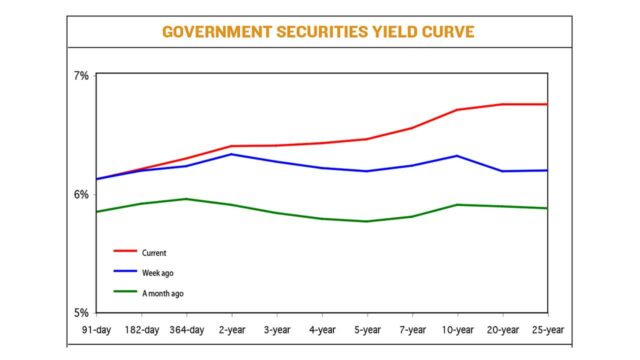
YIELDS on government securities (GS) climbed last week as expectations of strong US jobs data and slower Philippine inflation pushed yields higher.

GS yields, which move opposite to prices, jumped by an average of 23.31 basis points (bps) week on week, according to the PHP Bloomberg Valuation Service Reference Rates as of July 7 published on the Philippine Dealing System’s website.

Yields on the 182- and 364-day Treasury bills (T-bills) went up by 1.24 bps and 6.59 bps fetching 6.1939% and 6.2834%, respectively. Meanwhile, the 91-day T-bill saw its rate drop by 0.25 bp to 6.1088%.

At the belly, rates of the two-, three-, four-, five, and seven-year Treasury bonds (T-bonds) increased by 7 bps (to 6.3871%), 13.67 bps (6.3918%), 20.80 bps (6.4106%), 26.62 bps (6.4436%), and 31.37 bps (6.5360%).

Likewise, at the long-end, yields on the 10-, 20-, and 25-year papers climbed 38.42 bps, 55.82 bps, and 55.09 bps to 6.6878%, 6.7353%, and 6.7348%, respectively.

Total GS volume reached P7.02 billion on Friday, lower than the P7.89 billion on June 30.

Analysts attributed the higher yields seen last week to expectations of a strong US labor market and the release of June Philippine inflation data.

A bond trader said in an e-mail that the slightly lower inflation rate helped limit the upside on short-term rates last week.

“The surprise upside in private payrolls as measured by Automatic Data Processing, Inc. (ADP) has bolstered views of a potentially robust US employment report for June 2023. The said data release continued to support higher bond yields from the previous week,” the bond trader added.

An estimated 497,000 jobs were added in the US in June from the revised 267,000 jobs in May, and jobless claims fell to a four-month low of 1.72 million.

“The strong US economic data continues to drive overall sentiment that the Fed will continue to tighten and put further pressure on other central banks such as the BSP (Bangko Sentral ng Pilipinas),” a second bond trader said in a Viber message.

“While the BSP has reiterated its stance to resume tightening if needed, this will likely be tested if the tightening differential begins to show in the FX (fixed-income) market where the peso weakens significantly against the [US dollar],” the second bond trader added.

The BSP has held borrowing costs steady at its last two meetings, keeping its policy rate at 6.25%, while the US central bank paused its tightening cycle in June, keeping the fed funds rate at a range between 5% and 5.25%.

Following hawkish hints from Fed officials in the coming months, analysts said they are closely monitoring both central banks’ moves, specifically whether the Fed would resume hiking rates in its July 25-26 meeting and if the BSP would follow suit to keep a healthy rate differential.

“Should the BSP decide to move in step with the US, this will likewise spur some tailwinds for the local bond yields to move higher,” the first bond trader said.

For this week, the first bond trader said local yields are likely to trend downwards as the market awaits US consumer and producer inflation data.

“Traders might fixate on core inflation which has proven sticky in the past few months despite notable declines on the headline inflation level,” the trader added.

The second bond trader expects the market to remain defensive this week as the Bureau of the Treasury (BTr) continues to offer bonds.

“Just last week, the BTr issued the same bond for [two] consecutive weeks, drawing adverse reactions from market participants as the first batch of issuances was immediately put under pressure with added supply the following week,” the second bond trader said. — with Reuters

Values education towards moral recovery

PHILIPPINE STAR/ EDD GUMBAN

The 1986 EDSA People Power Revolution was the declaration of independence from the 14-year dictatorship of Ferdinand Marcos, Sr. and the Filipinos’ renewal of vows for moral uprightness in “life, liberty and the pursuit of happiness,” as embodied in the constitutions of democratic nations.

Corazon “Cory” C. Aquino, widow of the assassinated oppositionist Senator Benigno Aquino, Jr. whose death on Aug. 21, 1983 raised the groundswell for protest and revolution against Marcos’ martial law, was president of the revolutionary government after EDSA I, and subsequently president of the Republic under the new Constitution of 1987.

The preamble of the Philippine Constitution of 1987 reads:

“We, the sovereign Filipino people, imploring the aid of Almighty God, in order to build a just and humane society, and establish a Government that shall embody our ideals and aspirations, promote the common good, conserve and develop our patrimony, and secure to ourselves and our posterity, the blessings of independence and democracy under the rule of law and a regime of truth, justice, freedom, love, equality, and peace, do ordain and promulgate this Constitution.”

Article XIV, Sec. 3 directs that:

“All educational institutions shall include the study of the Constitution as part of the curricula.

“They shall inculcate patriotism and nationalism, foster love of humanity, respect for human rights, appreciation of the role of national heroes in the historical development of the country, teach the rights and duties of citizenship, strengthen ethical and spiritual values, develop moral character and personal discipline, encourage critical and creative thinking, broaden scientific and technological knowledge, and promote vocational efficiency.”

Based on the mandate of the 1987 Constitution, Cory Aquino directed the Department of Education, Culture and Sports (DECS) to develop the framework for the implementation of values education programs in the three levels of education: elementary, secondary, and tertiary.

“The changes brought about by the peaceful revolution of 1986, the new expectations for real freedom and democracy, and the emergence of opportunities for the citizens to participate in social transformation and nation building all demand a corresponding re-assessment in the values, the attitudes, and the behaviors of the people. To meet this challenge, the DECS has embarked on a vigorous program of values education designed to enhance human development and strengthen the moral fiber of the people through the educational experience” (DECS Order No. 6, s. 1988).

Values Education was thus institutionalized since 1988 as an educational thrust in all the levels of Philippine education. The new secondary school curriculum was implemented starting school year 1989-1990 and introduced Values Education as a separate subject, while values development was also integrated in all the other subjects in the curriculum.

The Moral Recovery Program that Cory Aquino initiated and implemented “in order to eradicate the social ills that have plagued us for the past several decades, such as graft and corruption, patronage politics, apathy, passivity, mendicancy, factionalism and lack of patriotism” was formally installed by Proclamation No. 62 signed by Aquino’s successor, President Fidel V. Ramos, on Sept. 20, 1992 in the first quarter of the first year of his term as president. The Moral Recovery Program of 1992 envisioned “moral recovery is an integral aspect in ensuring success in the government’s economic development and people empowerment programs and projects” and reminded that “there is a need to prepare the youth to respond to the challenges of modernization and the 21st century.” Thus was the Values Education program re-validated and continued under the Moral Recovery Program of 1992.

However, momentum to moral recovery was broken when Joseph Ejercito Estrada (elected president and installed June 30, 1998), was accused and publicly investigated in October 2000 by committees of Congress for receiving payoffs from the illegal “jueteng” gambling syndicates and owning property and unexplained wealth allegedly from corruption and influence. The investigations continued, leading to an aborted impeachment trial in January 2001. Thousands of people took to EDSA for three days and protested like at the 1986 People Power Revolution, until the Armed Forces of the Philippines (AFP) led by Chief of Staff Gen. Angelo Reyes withdrew support for Estrada on Jan. 19, 2001. The Supreme Court declared the presidency vacant, saying that Estrada had resigned the office. Vice-President Gloria Macapagal Arroyo was sworn in as president, to serve Estrada’s unexpired term of three remaining years.

With such a tenuous environment for a sustainable moral recovery program, the focus on values education in schools was perhaps sensitive and embarrassing for the new government. Still, the Senate and House of Representatives jointly crafted Republic Act No. 9155: “An act instituting a framework of governance for basic education, establishing authority and accountability, renaming the Department of Education, Culture and Sports (DECS) as the Department of Education (DepEd), and for other purposes.” This lapsed into law on Aug. 11, 2001 without the President’s signature, pursuant to Sec. 27(1), Article VI of the Constitution.

Gloria Arroyo’s nine-year presidency was marred by public accusations and Congressional investigations of graft and corruption, including the infamous “Hello Garci” tapes where she was supposed to have arranged with a high-ranking Commission on Elections (Comelec) officer for her winning in the 2004 presidential elections. In 2005, 2006, 2007, and 2008, impeachment complaints were filed against her, although none of these thrived because of the lack of opposition numbers in the Legislature. Before the end of her term in 2009, Gloria Arroyo granted executive pardons to convicts Joseph Estrada (plunder); Claudio Teehankee, Jr. (murder); Romeo Jalosjos (rape); and 11 persons convicted of involvement in the assassination of Benigno Aquino, Jr. (Arroyo would later be pardoned herself by President Rodrigo Duterte for graft and corruption and electoral sabotage cases filed against her in the courts and the Sandiganbayan.)

Benigno Simeon “PNoy” Aquino III, who was elected president after Gloria Arroyo in 2010, vowed to bring back the Moral Recovery Program of his mother, Cory Aquino. A basic step forward was an upgrade of education with the adoption of Senate Bill No. 3286/House Bill No. 6643 in DepEd Order No. 31 s. 2012, entitled “Policy Guidelines on the Implementation of Grades 1 to 10 of the K to 12 Basic Education Program (BEP)” effective school year 2012-2013, with the centerpiece ‘Edukasyon sa Pagpapakatao’ (EsP), or Values Education that ‘teaches grade school pupils and high school students character education, moral values and ethics.’” Implementing Rules and Regulations (IRR) were signed on Sept. 4, 2013. The EsP curriculum was faithfully adhered to by Basic Education schools, both public and private.

When Rodrigo Duterte assumed the presidency after Aquino III in June 2016, his personal style and demeanor might have been considered counter-indicative to the “Pagpapakatao” or dignity and honor ingrained in the people after the noble victory of the peaceful, bloodless 1986 EDSA Revolution. An Inquirer article said, “Known for being-foul-mouthed, President Rodrigo Duterte has defended his cursing in public, saying it is not a crime” (inquirer.net April 24, 2019). Still, the “Bawal Bastos” or Republic Act No. 11313, “The Safe Spaces Act” was signed by Duterte on April 17, 2019, penalizing a range of acts of sexual harassment including catcalling, wolf-whistling, and persistent telling of sexual jokes in public areas such as streets, privately owned places open to the public, and public utility vehicles, among others. The law extends to cyberspace and expands the first Anti-Sexual Harassment Act, or the Republic Act 7877 of 1995.

“Public officials from the President down should lead by example and show proper manners, in both word and deed,” an editorial of the Philippine Star said (July 4, 2020).

On June 25, 2020, Duterte had signed Republic Act No. 11476, the “GMRC and Values Education Act: An Act institutionalizing good manners and right conduct and values education in the K to 12 curriculum, appropriating funds therefor, and for other purposes.” This replaced the Edukasyon sa Pagpapakatao curriculum. But a check with the DepEd confirmed that up to now, the Implementing Rules and Regulations (IRR) for the GMRC-Values Education Act have yet to be finalized and released to the public.

How long must we wait for moral recovery in our country? Values Education for our children would give hope for a better future.


Amelia H. C. Ylagan is a doctor of Business Administration from the University of the Philippines.

ahcylagan@yahoo.com

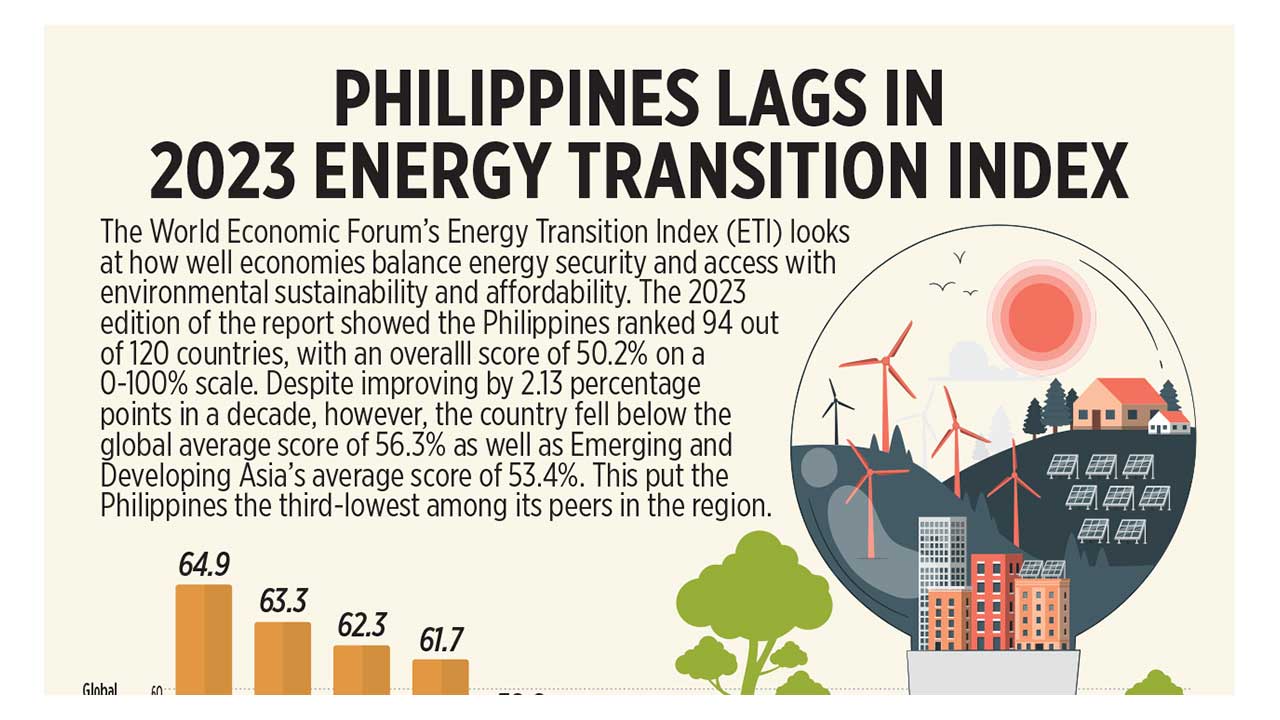
Philippines lags in 2023 Energy Transition Index

The World Economic Forum’s Energy Transition Index (ETI) looks at how well economies balance energy security and access with environmental sustainability and affordability. The 2023 edition of the report showed the Philippines ranked 94 out of 120 countries, with an overalll score of 50.2% on a 0-100% scale. Despite improving by 2.13 percentage points in a decade, however, the country fell below the global average score of 56.3% as well as Emerging and Developing Asia’s average score of 53.4%. This put the Philippines the third-lowest among its peers in the region.

Philippines lags in 2023 Energy Transition Index

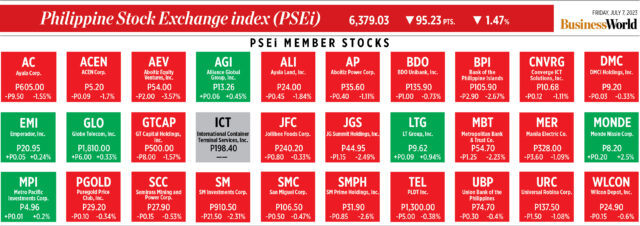
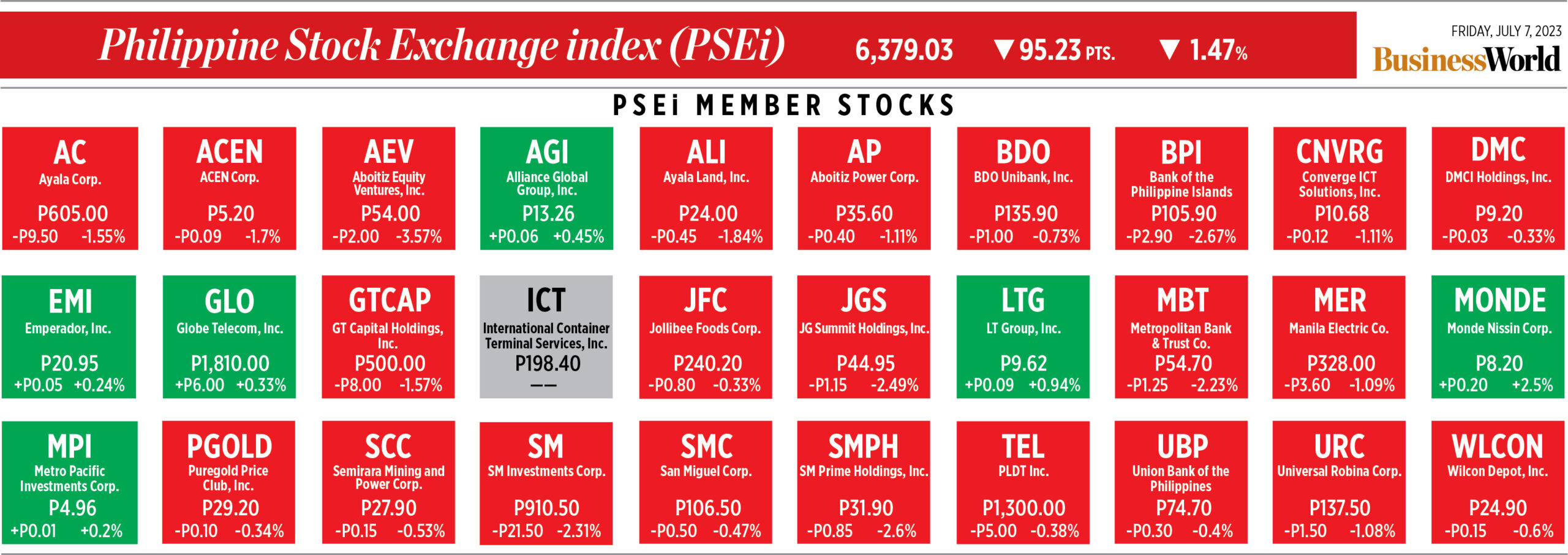
How PSEi member stocks performed — July 7, 2023

Here’s a quick glance at how PSEi stocks fared on Friday, July 7, 2023.


Stocks may trade sideways amid lack of drivers

BW FILE PHOTO

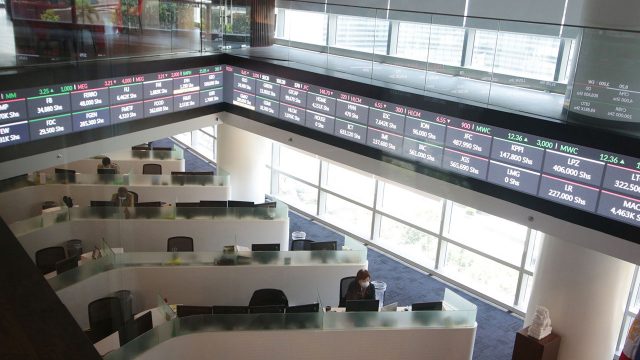
LOCAL EQUITIES may trade sideways this week due to bargain hunting and a lack of fresh leads.

The Philippine Stock Exchange index (PSEi) declined by 95.23 points or 1.47% to 6,379.03 on Friday, while the broader all shares index went down by 33.65 points or 0.97% to close at 3,422.28.

Week on week, the PSEi fell by 89.04 points or 1.38% from its close of 6,468.07 on June 30.

Online brokerage 2TradeAsia.com said in a report that the PSEi fell due to profit taking as investors shrugged off data showing slower June inflation.

“Local inflation came in slower as expected, driven by heavily-weighted baskets. This sequential improvement in CPI (consumer price index) strengthens the case for another status quo on the BSP’s (Bangko Sentral ng Pilipinas) end next Monetary Board meeting in August),” 2TradeAsia.com said.

Inflation slowed to 5.4% in June from 6.1% in May 2023 and June 2022, but marked the 15th straight month that the consumer price index exceeded the BSP’s 2-4% target for the year.

The June print was slightly lower than the 5.5% median estimate by 17 analysts in a BusinessWorld poll conducted the prior week.

For the first six months, inflation averaged at 7.2%, still higher than the central bank’s 5.4% forecast for 2023.

The BSP will hold its next policy review on Aug. 17. It has held rates steady in its last two meetings amid expectations that inflation will return within its target band by the end of the year.

For this week, Philstocks Financial, Inc. Senior Research Analyst Japhet Louis O. Tantiangco said bargain hunting may persist as prices remain attractive.

“However, worries over a possible resumption of the Federal Reserve’s monetary tightening may still weigh on investors’ sentiment. This is as further rate hikes by the Fed put downside risks on the US and the global economy. Investors are also expected to wait for catalysts that could strengthen market confidence. As they wait, trading participation could remain tepid,” Mr. Tantiangco said in a Viber message.

The Fed last month paused its tightening cycle after hiking rates for 10 straight meetings by a total of 500 basis points (bps) to a range between 5% and 5.25%.

Fed Chair Jerome H. Powell has said one or two more 25-bp hikes are possible within the year as stronger-than-expected economic data support further tightening.

The US central bank will next meet to review policy on July 25-26.

“While waiting for turnover to thicken over the next few weeks, upcoming earnings might provide the much-needed electric touch,” 2TradeAsia.com added.

Mr. Tantiangco placed the PSEi’s support at 6,400 and resistance at 6,600, while 2TradeAsia.com put immediate support at 6,300 and resistance at 6,600. — A.H. Halili with Reuters

ADVERTISEMENT
ADVERTISEMENT