Home Blog Page 46

The Testaments series follows a new generation of girls growing up in Gilead

0
<i>The Testaments</i> series follows a new generation of girls growing up in Gilead
The Testaments (2026)

LOS ANGELES — Blue Jean actor Lucy Halliday says the bonds formed between young girls in times of adversity are at the heart of what makes the Hulu drama series The Testaments special.

“We see that in our show, and it’s a really beautiful thing — that friendship can flourish even in the darkest of places,” Ms. Halliday said of the coming‑of‑age drama, which continues the story of Hulu’s The Handmaid’s Tale.

“Sisterhood and community have always been important, and they’ve always been a means of survival,” she added.

Created by Bruce Miller and based on Margaret Atwood’s 1985 novel, The Handmaid’s Tale depicts the totalitarian society of Gilead, a religious extremist regime ruled by powerful men who subjugate women following war and collapsing fertility rates. Some women, known as handmaids, are forced into reproductive servitude for elite, infertile families.

The Testaments is set years later and follows two teenage girls — Agnes, played by One Battle After Another actor Chase Infiniti, and Daisy, portrayed by Ms. Halliday — as they come of age within the same oppressive system.

Agnes has spent most of her life in Gilead, raised to be pious and obedient, while Daisy arrives from Canada as a recent convert.

The girls meet at a Gilead preparatory school for future wives, overseen by Aunt Lydia, played by Ann Dowd, reprising her role from The Handmaid’s Tale.

Ms. Dowd said viewers will see a subtly changed Lydia this time around compared to her explosive and violent-tempered demeanor in the original series.

“I think we see a gentler Lydia, someone who has changed inwardly,” she said, teasing the character’s new mission to reform Gilead as headmistress of a school for daughters of the regime’s most powerful families.

Ms. Infiniti cautioned, however, that The Testaments continues to explore the same cycle of subjugation that defined both the original novel and series.

“Everything that she (Margaret Atwood) writes is pulled directly from history, so unfortunately none of it is new,” said the Golden Globe‑nominated actor.

“Going to set every day and seeing what these girls have to go through — and how their stories unfold — made us feel incredibly fortunate to be able to tell this story,” she added.

The Testaments premieres on Wednesday on Hulu. — Reuters

Gold keeps winning the battle with economists

0
Gold keeps winning the battle with economists
FREEPIK

By Aaron Brown

GOLD is trading near $5,000 an ounce. And yet, in the middle of the US and Israeli war on Iran and as foreign central banks sell Treasuries to defend their currencies and bond yields rise instead of fall, the precious metal has barely budged even as the world’s monetary authorities — the very institutions built to make gold obsolete — buy it at the fastest pace in a generation.

This is not supposed to be happening. The economics profession declared gold a “barbarous relic” a century ago and has spent most of the time since trying to make that verdict stick. It keeps losing.

The opening shot was fired by John Maynard Keynes in 1924. The gold standard, he wrote, was a primitive monetary technology that enlightened modern economies had outgrown. The future belonged to managed currencies, run by expert institutions. His view largely prevailed at Bretton Woods in 1944, where gold was kept as a nominal anchor — convertible to dollars at $35 an ounce — but effectively demoted to figurehead status.

Round one to the economists. Gold was caged.

Or was it?

On Aug. 15, 1971, President Richard Nixon announced that the dollar would no longer be convertible to gold. Economists mostly cheered. Milton Friedman had long argued that floating exchange rates managed by disciplined central banks were superior to the gold standard’s rigidities. The profession was nearly unanimous: Gold was a historical curiosity. You couldn’t run a modern economy tethered to something you dug out of the ground.

Gold’s revenge was swift and embarrassing. Within nine years it had risen from $35 to $850 an ounce — a gain of more than 2,300%. The 1970s, which were supposed to demonstrate the superiority of managed currencies, produced instead stagflation and a dollar that lost more than half its purchasing power. Investors who held cash lost 87% of their real wealth. Those who held the barbarous relic quadrupled theirs.

Round two to gold.

Federal Reserve Chairman Paul Volcker came out swinging in 1979 and soon raised interest rates to 20%, crushing inflation and restoring the credibility of managed money. Gold collapsed — from $850 in 1980 to $255 by 1999, an 85% real loss over two decades. European central banks, in the ultimate act of institutional contempt, began actively selling their reserves. The Bank of England sold 395 tons between 1999 and 2002, at almost the exact bottom — a transaction that became known in the British press as “Brown’s Bottom” after Chancellor Gordon Brown, who ordered it.

Round three to the economists, decisively.

Then came 2008 and the global financial crisis. Lehman Brothers Holdings, Inc. collapsed, governments deployed trillions of dollars in emergency stimulus, and real interest rates turned negative. Gold remembered its lines. From $800 at the depths of the crisis, it climbed to $1,921 by 2011. The economists’ institutions were visibly struggling. Gold, which has no management, no board of directors, and no leverage, sat there looking smug.

But the most consequential round in the modern era had nothing to do with inflation. It was about something more fundamental: whether dollar-denominated assets are truly safe.

On Feb. 26, 2022, two days after Russia invaded Ukraine, the US and its allies froze $300 billion of Russian central bank reserves held in Western institutions. Every non-aligned central bank got the message. Assets held in dollars, euros, or pounds could be confiscated. There was precisely one major reserve asset that could not be frozen by SWIFT, seized by court order, or inflated away by someone else’s monetary policy. It cannot be hacked and it doesn’t require trusting any institution or government.

Which explains why central banks bought a record 1,080 tons of gold in 2022, the most since the gold standard era, and have maintained that pace since. The buyers were China, India, Turkey, Poland, Singapore — countries that watched the Russian sanctions and drew their own conclusions.

For the first time since 1996, global central banks now hold more gold in aggregate than US government bonds. That milestone arrived quietly, with little fanfare, but it represents a structural shift in how sovereign institutions think about reserves.

This is what separates the current gold rally from previous ones. Earlier bull markets were driven by retail investors and inflation fears. This one is being driven by sovereign institutions making a deliberate, long-term strategic choice. It is not inflation hedging. It is geopolitical insurance. And it is a vote of no confidence in the system Keynes and his successors built.*

Which brings us back to the Iran war, and to gold near $5,000.

The conventional haven trade in every previous crisis since the financial crisis — the global COVID-19 pandemic, Russia’s war on Ukraine, the European debt crisis — was into US Treasuries. Yields fell, the dollar strengthened, and the system worked as designed. In the Iran war, foreign central banks have sold $82 billion in Treasuries in five weeks. Yields have climbed. The petrodollar recycling loop — Gulf oil revenues flowing back into US government debt — has seized up as the Strait of Hormuz closes. And gold has held near record highs throughout.

The pattern is now legible. Gold doesn’t perform best when inflation is high. It performs best when trust in monetary institutions is low — when the world’s central banks look at their reserve assets and quietly conclude they would prefer something no government can confiscate. That condition predates the Iran war and will survive it.

Keynes was right that gold’s monetary role is a convention, not a law of nature. What he underestimated is how hard it is to replace a convention that combines liquidity, neutrality, durability, and freedom from political risk — especially when the institution maintaining the alternative is also the world’s largest debtor, the issuer of its own reserve currency, and the aggressor in a major war.

Gold has been making this argument for 5,000 years. The economists have been rebutting it for about 300. The current score, on points, favors the metal.

BLOOMBERG OPINION

*Gold’s argument for the monetary throne has acquired an unlikely understudy. Bitcoin was invented in 2008 and its founding logic mirrors gold’s exactly: a fixed supply, immune to debasement, beyond the reach of any government.


RCBC raises P20.5B via three-year bonds

0
RCBC raises P20.5B via three-year bonds
BW FILE PHOTO

RIZAL Commercial Banking Corp. (RCBC) has raised P20.5 billion from the sale of three-year ASEAN Sustainability bonds, marking its largest peso debt issuance so far.

The Yuchengco-led bank on Wednesday listed the latest bond issue on the Philippine Dealing and Exchange Corp. (PDEx), it said in a disclosure to the stock exchange.

“This is a significant milestone as RCBC’s largest peso-denominated issuance to date. The bonds saw robust demand from retail and institutional investors resulting in an orderbook more than four times the announced minimum issue size of P5 billion,” the bank said.

The strong demand allowed RCBC to end the public offer period on March 17, just five days after the start date and well ahead of the original March 27 schedule.

The notes carry a coupon rate of 6.08% and were offered at a minimum investment of P100,000, with additional increments of P10,000.

Proceeds will be used to finance or refinance eligible green and social projects under the bank’s Sustainable Finance Framework.

RCBC tapped Standard Chartered Bank and RCBC Capital Corp. as joint lead arrangers and bookrunners, with both also serving as selling agents.

The bonds were drawn from the lender’s P200-billion bond and commercial paper program, which was expanded in 2022 from the P100 billion initially approved in 2019.

The issuance brought RCBC’s total bond issuances under its peso fundraising program to P119.5 billion.

The bank last tapped the domestic debt market in July last year, raising P12.21 billion from a 2.5-year sustainability bond offering priced at 6%.

RCBC also raised $350 million from a five-year sustainability bond issuance in January 2025, priced at 5.375%, under its $4-billion medium-term note program.

The bank reported an 11% increase in its net income to P10.6 billion in 2025.

Its shares closed at P24.10 each on Wednesday, climbing by 10 centavos or 0.42%. — Aaron Michael C. Sy

Anker’s new soundcore outdoor speakers now available in the Philippines

0
Anker’s new soundcore outdoor speakers now available in the Philippines
ANKER INNOVATIONS
ANKER INNOVATIONS

ANKER INNOVATIONS’ premium audio brand soundcore has launched its latest outdoor speakers in the Philippines.

The Boom 3i and Boom Go 3i are priced at P2,995 and P5,995, respectively, and can be purchased through the brand’s website and official stores on Lazada, Shopee, and TikTok Shop.

The Boom 3i is a Bluetooth 5.3 speaker that has an IP68 water and dust resistance rating. It features a floating design that keeps the speaker upright in the water and promises up to 16 hours of playtime.

It is available in three colors: Jungle Green, Deep Ocean Blue, and Adventurer Black.

“Additionally, it can withstand immersion to a depth of 1.5 meters for 30 minutes. Designed with a protective coating, the Boom 3i offers five times the saltwater resistance of conventional speakers and has been tested for up to 2,400 hours of salt spray without corrosion. It can also withstand being dropped from up to 1 meter onto concrete, ideal for rowdy beach parties,” the brand said.

The Boom 3i features a 40-watt, 3.7 x 2-inch woofer combined with a 10-watt, 0.65-inch tweeter and a pair of bass radiators.

“Equipped with soundcore’s BassUp 2.0 technology, when enabled, the Boom 3i increases bass output by 3dB — delivering two times more bass than similarly sized competitive models… To make things even more immersive, it supports TrueWireless Stereo pairing, allowing users to connect two speakers for true left-right stereo sound and double the volume.”

The speakers also have a user-programmable LED light show on the bass radiators on the left and right sides of the unit. With the soundcore app, users can access EQ customization, lighting controls, and smart functions like the emergency alarm and voice amplifier.

On the other hand, the Boom Go 3i is a palm-sized speaker designed for on-the-go use. It has up to 22 hours of battery life, IP68 water and dust resistance, and a dual-mode mount strap system. — BVR

Meralco urges action on Batangas, GenSan power plans

0
Meralco urges action on Batangas, GenSan power plans
PHILIPPINE STAR/KJ ROSALES

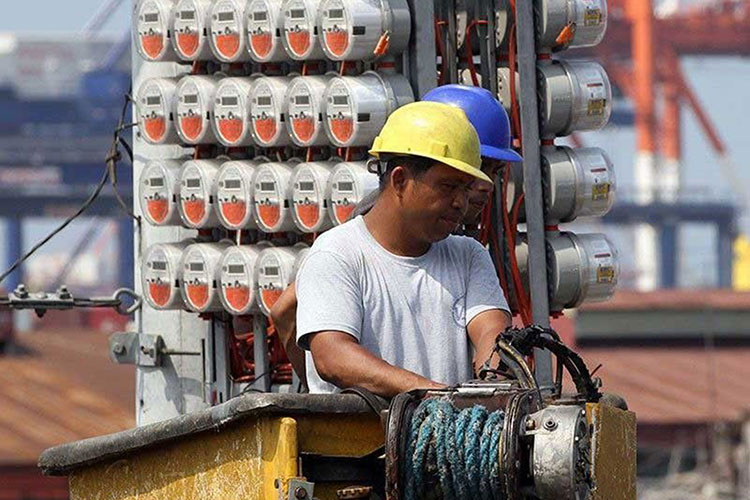
MANILA ELECTRIC CO. (Meralco) is urging electric cooperatives in Batangas and General Santos (GenSan) City to conduct public bidding to determine their power distribution partners, as it seeks to advance proposals to upgrade facilities and address persistent electricity issues in these areas.

“Our request is really to hasten it because it has been there for a long time; we have been pending,” Arnel P. Casanova, senior vice-president and head of strategic distribution utility partnerships of Meralco, told reporters on Tuesday.

Meralco, the country’s largest private electric distribution utility, serves more than 8.2 million customers in Metro Manila and nearby provinces.

The company already supplies electricity to large economic and industrial parks in Batangas but is seeking to expand its service to cover the entire province.

Several years ago, Meralco submitted proposals to Batangas I Electric Cooperative, Inc. (Batelec I), Batangas II Electric Cooperative, Inc. (Batelec II), and South Cotabato II Electric Cooperative, Inc. (Socoteco II) to help upgrade facilities and improve electricity services. These proposals remain pending.

Power consumers in Batangas have reported frequent and prolonged outages that disrupt livelihoods, particularly in a town heavily dependent on tourism, according to a recent survey by Capstone Intel, a research firm.

“I think, for the best interest of the member-consumers, that bidding be conducted immediately so that we will know who can best serve the consumers either in Batelec I or GenSan,” Mr. Casanova said.

He added that a public bidding process would allow consumers and the public to evaluate proposals “that would serve the best interest of the member consumers.”

Mr. Casanova said Meralco does not intend to take over any electric cooperative but aims to provide capital for facility upgrades and development.

“All other proposals that we see out there require the takeover of franchise by a new corporation. So basically, the electric cooperative loses the business itself because it’s transferred to a new corporation, and the asset will be transferred to a new corporation,” he said.

“So what happens in the other proposals is that they lose the franchise, they lose the assets, and they lose the business. So for Meralco, we retain all of them,” he added.

Electric cooperatives are owned and managed by member-consumers, unlike distribution utilities such as Meralco, which are owned by shareholders.

Under the Electric Power Industry Reform Act (EPIRA), electric cooperatives may convert into either stock cooperatives or stock corporations.

“Our approach and our model is to convince the electric cooperatives to convert into stock corporations, which would lead to the members being real stockholders,” Mr. Casanova said, adding that electric cooperatives may receive dividends.

Meralco’s controlling stakeholder, Beacon Electric Asset Holdings, Inc., is partly owned by PLDT Inc. Hastings Holdings, Inc., a unit of PLDT Beneficial Trust Fund subsidiary MediaQuest Holdings, Inc., has an interest in BusinessWorld through the Philippine Star Group, which it controls. — Sheldeen Joy Talavera

Philippine jobless rate falls to 2-month low in February

0
Philippine jobless rate falls to 2-month low in February

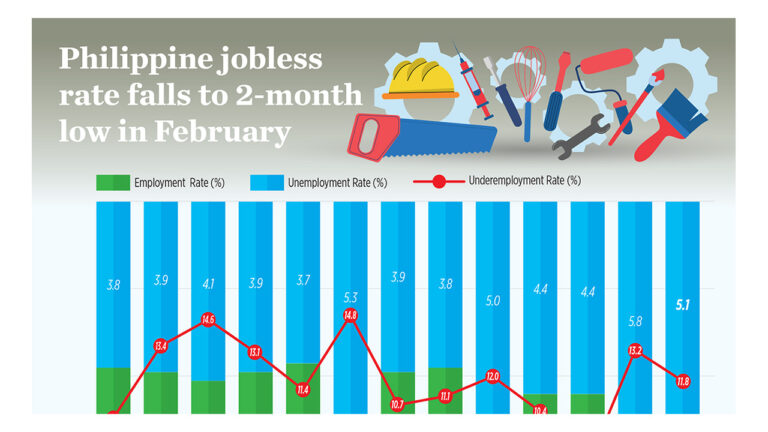
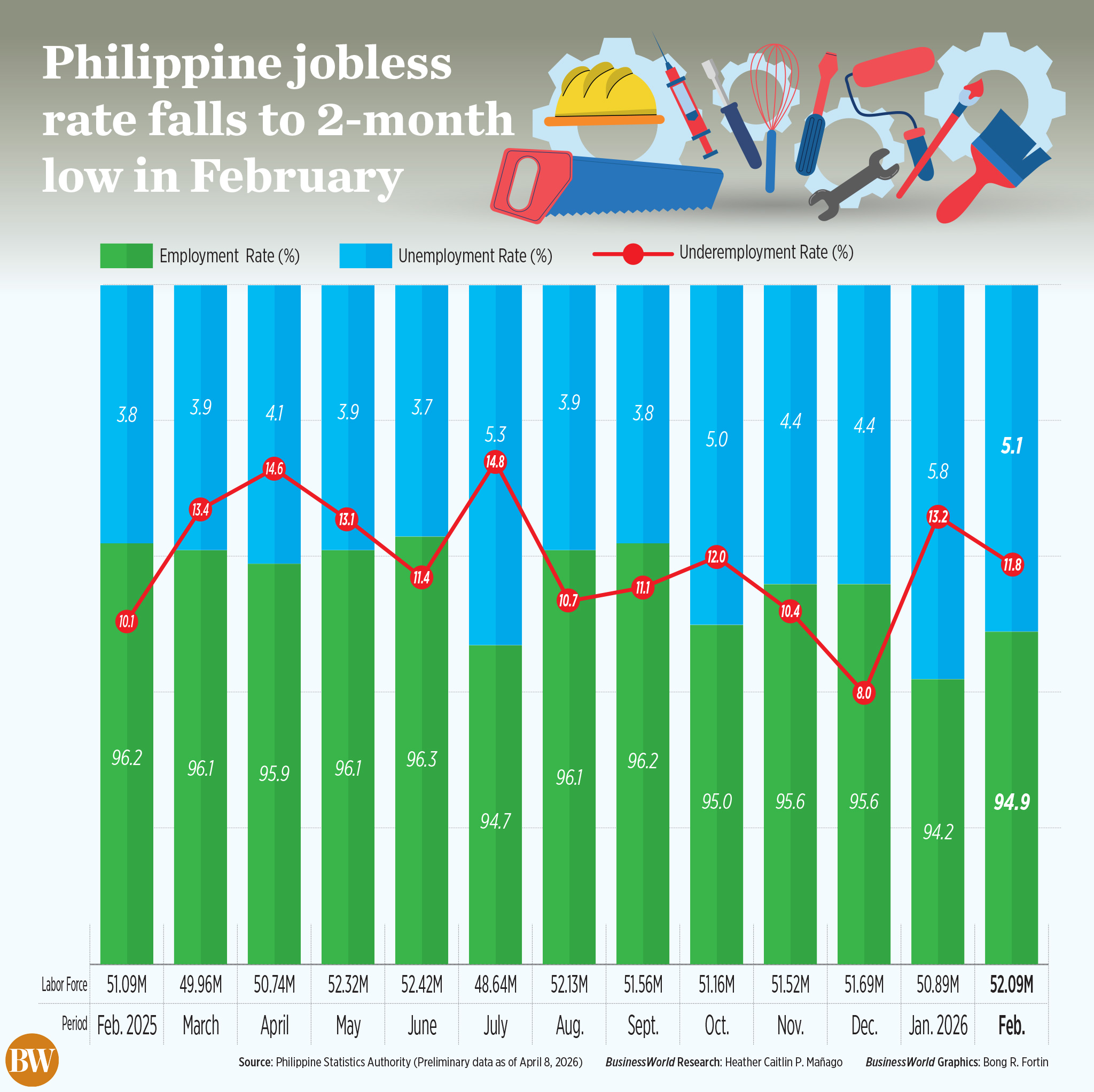
THE unemployment rate fell to a two-month low of 5.1% in February, reflecting the seasonal first-quarter trend of workers re-entering the labor market, the Philippine Statistics Authority (PSA) said on Thursday. Read the full story.

Outcome film captures Keanu Reeves’ character at center of image crisis

0
<i>Outcome</i> film captures Keanu Reeves’ character at center of image crisis
Outcome (2026)
Outcome (2026)

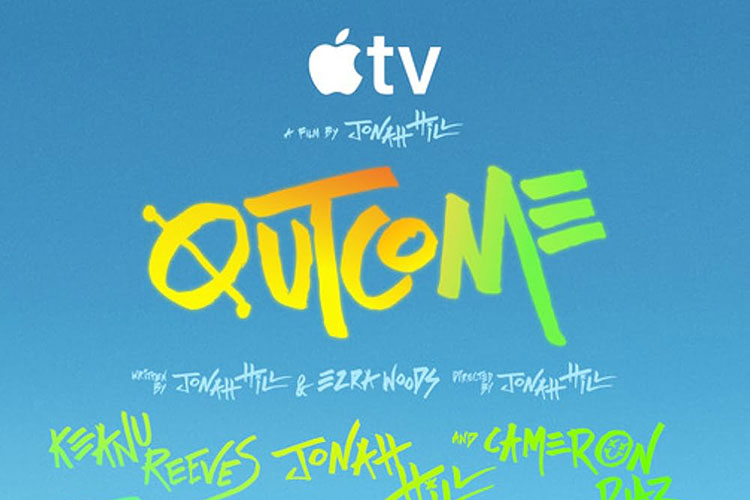
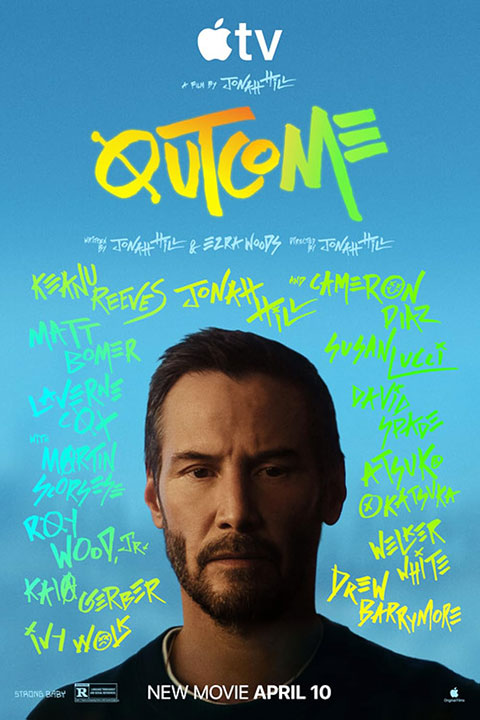
LOS ANGELES — In the dark comedy film Outcome, Keanu Reeves plays a Hollywood movie star whose carefully crafted public image begins to unravel when he is blackmailed with a mysterious video that threatens his career.

Mr. Reeves portrays Reef Hawk, a beloved film icon who turns to his closest circle — including lifelong friends Kyle and Xander, played by Cameron Diaz and Matt Bomer, and his crisis lawyer Ira, portrayed by Jonah Hill — to contain the fallout. Mr. Hill also directed the film and co-wrote it with Ezra Woods.

As pressure mounts, Reef launches an unconventional apology tour, revisiting people he believes he may have wronged in hopes of uncovering the identity of the extorter.

Mr. Hill balances heightened comedy with moments of emotional reflection, using the premise to explore accountability and authenticity in an era defined by public scrutiny.

Mr. Reeves said working with Mr. Hill on the Apple TV movie brought a distinctive energy to the set.

“Energy, vibrancy, creative yummy,” he described.

Ms. Diaz said the film probes what makes an apology meaningful.

“It’s really about the person receiving it,” she said. “Whether it matters is relative to their experience.”

For Mr. Bomer, the story’s focus on friendship resonated during production.

“It made me realize the value of deep friendships that transcend public perception,” he said, adding that the set encouraged creative freedom.

Laverne Cox, who appears as part of Reef’s crisis-management team, said the film poses pointed questions about accountability, highlighting a line delivered by Martin Scorsese in the trailer: “What are you sorry for?”

Outcome premieres globally on Apple TV on April 10. — Reuters

Signals

0
Signals
STOCK PHOTO | Image from Freepik

NOT ALL communications are expressed in words. There are signals using body language, facial expressions, and even the absence of any response after a nagging request.

The non-use of words to communicate a message, as in sign language for the hearing impaired, has become accepted even among those with perfect speech and hearing.

We are already familiar with the routine use of signals, as in a noisy restaurant. When asking for the bill, an imaginary square is drawn in the air with two forefingers, or a signing motion is displayed with one hand. Requesting for the menu entails the opening of two palms joined together. The waiter understands this sign language very well. The same cannot be presumed when traveling abroad.

Even the absence of communication carries its own message.

The “avoidance waltz” is obvious to somebody paying attention. The accidental discovery of being in the same place (or social gathering) as one being avoided can be a choreographed set of movements. When X moves to the right, does Y discreetly move to the left? Here, anonymous crowds are used as screens the same way a three-point shooter uses blockers to get an open look.

Online communications have designated a special term for this avoidance game. “Ghosting” is a word that needed to be invented for the simple non-reaction to any pleas for forgiveness from a “blocked” friend or former partner.

Canceled meetings send their own signal. When regularly scheduled breakfast meetings are scrapped, it only means unscheduled ones have taken their place. When meetings are frequently postponed or canceled altogether, the negative message is clear.

What about an appointment that is hastily called, with no formal agenda? The rule on emergency meetings states: The more inconvenient the time and place for a meeting called by a superior, the higher the probability of bad news for the person summoned. Early breakfast in the suburbs is a bad sign.

Frequent non-notification for corporate events, especially those that do not require any attendance check, indicate removal from a VIP list. While these proceedings are not classified as meetings, they too have an invitation list which indicates who’s up or down, or who does not play golf.

Even meetings that take place as scheduled send non-verbal signals to watch out for. When a slide presentation is being made and the presenter is reading the slide word for word, the CEO in the meeting is not looking at his watch. He is sending and receiving phone messages with his eyes glued to the phone in his hand. Should the presenter hurry up? Online meetings can hide such impatience with the shutting down of the video.

Alertness to signals, and the hidden messages they convey, is required of any corporate player.

Still, there is the danger of reading too much between the lines so that even the most innocent actions are given conspiratorial overtones. What did he mean by “good morning” when I bumped into him at the elevator? Is he referring to just this morning? Does he mean I’m already getting in too late? Is he hinting that I haven’t heard of the WFH policy?

Words have literal meanings and interpreting their connotation too closely can lead to paranoia. Overreaction can be dangerous. What can be worse than being dismissed as “too insecure”? With this description is an implied absence of the ability to be discerning. Can simple greetings be put through torturous analysis for hidden messages?

In live sessions with media, sometimes called an “ambush” interview, signals need to be read carefully. Such encounters are often taped and then posted and reposted on the net for their meaning. Even simple answers followed by facial expressions of cluelessness can be exploited with media editing.

Even when communicating with words, there is a need to read between the lines, and how a message is being delivered. A rambling delivery on a serious question about the mission attached to an unexpected invasion that has disrupted the world economy may invite negative reactions. (Aren’t these nice curtains?)

There is still no substitute for words that are spoken clearly — “Read my lips: you’re out of here.” (Maybe, you were mistaken for somebody else?)


Tony Samson is chairman and CEO of TOUCH xda.

ar.samson@yahoo.com

Pru Life UK launches new diversified investment fund

0
Pru Life UK launches new diversified investment fund
PRULIFEUK.COM.PH

PRU LIFE Insurance Corp. of UK (Pru Life UK) has launched a global investment-linked income insurance fund available for both peso and dollar products as it looks to increase its customers’ access to offshore assets.

The PRULink Strategic Income Fund invests in multiple regions, sectors, and asset classes to provide policyholders a venue for diversification amid the shifting global financial landscape.

“What we want to offer… is some form of safety. When everything is uncertain, what we want to offer them is some sort of safety net that they can have on. It’s only apt that it is now that we are launching this, because the PruLink Strategic Income Fund is our response to the different market challenges,” Pru Life UK Chief Investment Officer Princess Charm Baun Balingit said in a speech at the launch event on Wednesday.

She said this is the life insurer’s first internally managed fund and was designed as a global multi-asset, multi-manager fund-of-funds under an investment-linked insurance product.

“We believe that the real type of diversification is being able to find different growth channels. So, it may come from bonds, it may come from equity dividends, it may come from option premiums, it may come from structured incomes. All of these sources of returns will be able to define the type of growth that our clients will need in their portfolios,” Ms. Balingit said.

The PruLink Strategic Income Fund spreads out its investments across Allianz Global Investors, Amundi Investment Solutions, and BlackRock, Inc.

The life insurer’s in-house fund managers allocate 40% of investments in Amundi’s Income Opportunities Funds that offers downside qualities, 50% in Allianz Income and Growth Fund that skews towards US-centric riskier assets such as equities, high yield, and convertibles, and 10% in BlackRock Systematic Global Equity Fund, which provides upside.

“So, when we talk about the strategic income fund, it puts together not just one, but three global fund managers — three distinct investment policies integrated into one. That is the edge that we are actually giving with this one,” Ms. Balingit said.

She said allocations can be adjusted to up to 80% for either Allianz and Amundi and up to 20% for BlackRock.

The fund aims to provide long-term capital growth to customers with moderate to aggressive risk profiles and is available in unhedged peso and dollar share classes.

Pru Life UK booked a premium income of P52.84 billion last year, latest Insurance Commission data showed. Its net income was at P7.103 billion. — Aaron Michael C. Sy

Anthropic touts AI cybersecurity project with Big Tech partners

0
Anthropic touts AI cybersecurity project with Big Tech partners

ANTHROPIC on Tuesday announced an initiative with major technology companies, including Amazon.com, Microsoft and Apple, that lets partners preview an advanced model with cybersecurity capabilities developed by the artificial intelligence (AI) startup.

Under its “Project Glasswing,” select organizations will be allowed to use the startup’s unreleased and general-purpose AI model, “Claude Mythos Preview,” for defensive cybersecurity work, Anthropic said. Other partners include CrowdStrike, Palo Alto Networks, Google and Nvidia.

The announcement follows a Fortune report last month that Anthropic was testing Claude Mythos, which it said posed security risks and also offered advanced capabilities, dragging shares of cybersecurity firms such as Palo Alto Networks and CrowdStrike sharply lower.

This year’s RSA cybersecurity conference in San Francisco was also dominated by talk about the rise of AI-powered cyberattacks and whether conventional security tools sufficed.

In a blog post on Tuesday, Anthropic said Mythos Preview had found “thousands” of major vulnerabilities in operating systems, web browsers and other software.

The startup said launch partners will use Mythos Preview in their defensive security work, and Anthropic will share findings with industry.

Anthropic said it is also extending access to about 40 additional organizations responsible for critical software infrastructure, and made a commitment of up to $100 million in usage credits and $4 million in donations to open-source security groups.

The AI startup added that its eventual goal is for “our users to safely deploy Mythos-class models at scale.”

The startup said it has also been in ongoing discussions with the US government about the model’s capabilities.

Last year, Anthropic said that hackers exploited vulnerabilities in its Claude AI to attack around 30 global organizations. Moreover, 67% of the 1,000 executives surveyed in an IBM and Palo Alto Networks study said they had been targeted by AI attacks within the past year. — Reuters

Eastern Communications says network designed to stay resilient amid disruptions

0
Eastern Communications says network designed to stay resilient amid disruptions
STOCK PHOTO | Image by Rawpixel.Com from Freepik

EASTERN Telecommunications Philippines, Inc. (Eastern Communications) said its network is designed to remain operational amid potential disruptions linked to geopolitical tensions in the Middle East, citing built-in redundancy and business continuity measures.

“Eastern Communications’ network architecture is built for adaptability. With geographically diverse submarine cable routes and independent core nodes, traffic is automatically rerouted in the event of any localized or regional disruption,” the company said in a media release on Wednesday.

The company said it has activated its business continuity management plan, a framework aimed at ensuring uninterrupted operations.

“Connectivity is essential for businesses and communities, and our priority is to keep it uninterrupted… Our preparedness measures, combined with a resilient network design, allow us to continue providing reliable service even amid global uncertainties,” said Eastern Communications Co-Coordinator Aileen D. Regio.

Eastern Communications said it continues to monitor its network and coordinate with international partners to identify potential risks.

“This vigilance, combined with our technical safeguards, ensures that our customers can rely on us for continuously reliable service,” the company said.

The company added that its sites are equipped with uninterruptible power supply (UPS) systems and backup generators, with fuel reserves in place to address potential commercial power fluctuations.

Eastern Communications provides connectivity and information and communications technology (ICT) solutions, including fiber broadband and managed services for enterprises.

The company earlier said it is looking at Iloilo, Davao, Bohol, Boracay, Cagayan de Oro, Bacolod, and Dumaguete as potential sites for expansion as part of efforts to grow its footprint.

Eastern Communications has expanded its fiber network to more than 9,760 kilometers, with 180 nodes across 42 business cities nationwide. — Ashley Erika O. Jose

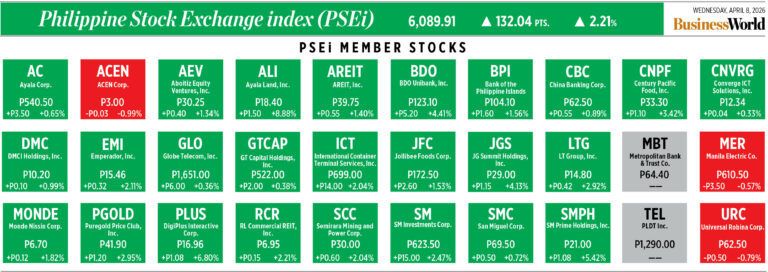
How PSEi member stocks performed — April 8, 2026

0
How PSEi member stocks performed — April 8, 2026

Here’s a quick glance at how PSEi stocks fared on Wednesday, April 8, 2026.