
Analysts’ July inflation rate estimates
INFLATION likely further eased to below the 5% level in July, as base effects and lower power rates may have tempered higher food costs and pump prices, a BusinessWorld poll showed. Read the full story.
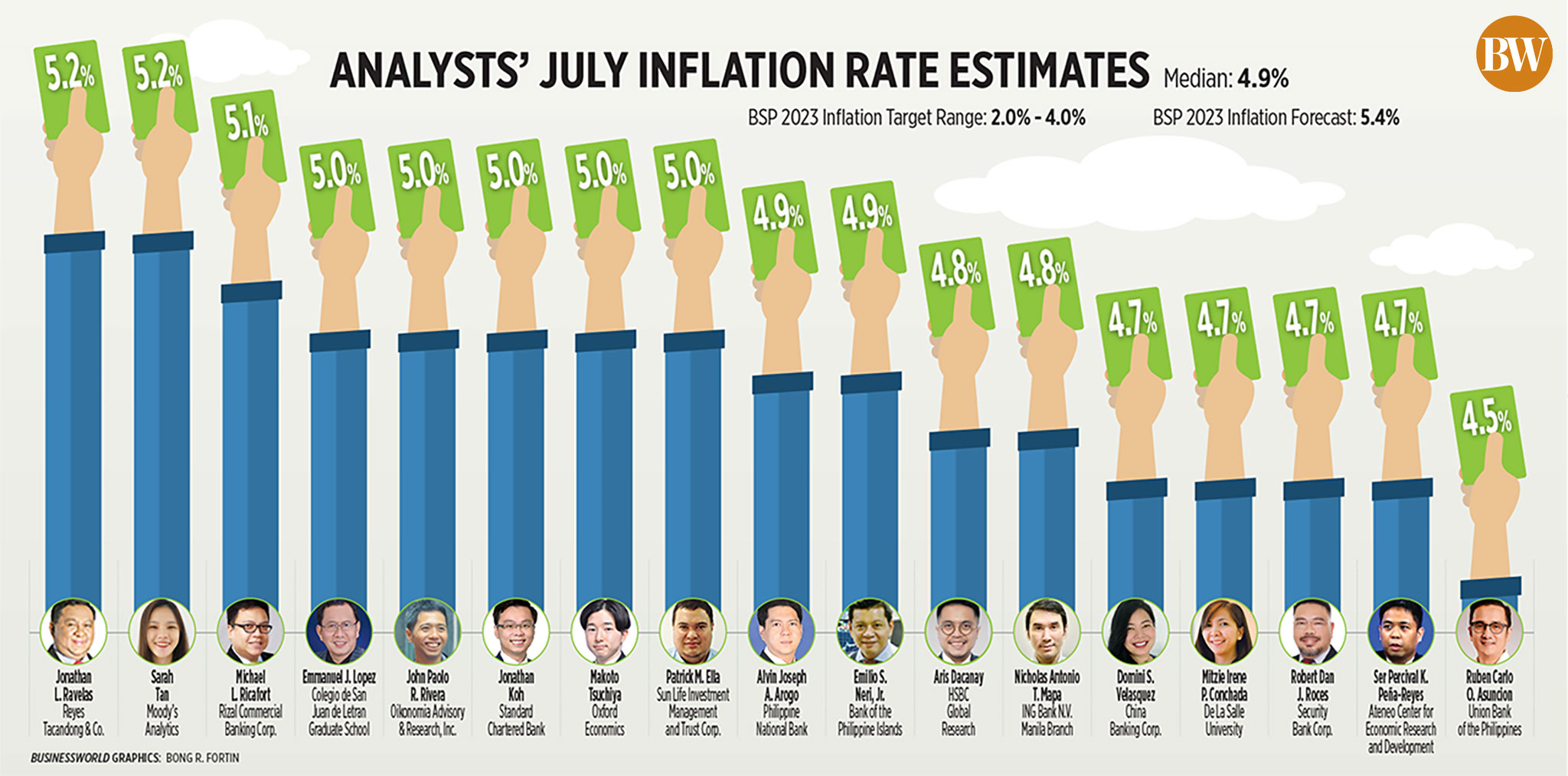
INFLATION likely further eased to below the 5% level in July, as base effects and lower power rates may have tempered higher food costs and pump prices, a BusinessWorld poll showed. Read the full story.
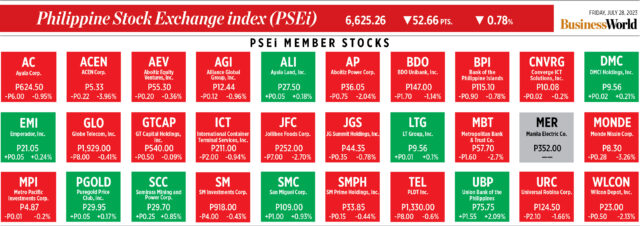
Here’s a quick glance at how PSEi stocks fared on Friday, July 28, 2023.



THE PESO may move sideways against the dollar this week ahead of the release of the July consumer price index (CPI) report on Friday.
The local currency closed at P54.91 versus the dollar on Friday, weakening by 35 centavos from Thursday’s P54.56 finish, data from the Bankers Association of the Philippines’ website showed.
Week on week, the peso dropped by 16 centavos from its P54.75 close on July 21.
The local unit opened Friday’s session at P54.75 per dollar, which was also its intraday best. Its weakest showing was at P54.92 against the greenback.
Dollars traded went up to $1.1 billion on Friday from the $914.1 million recorded on Thursday.
The peso declined on Friday due to higher global crude oil prices and a wider Philippine budget deficit in June, Rizal Commercial Banking Corp. Chief Economist Michael L. Ricafort said in a Viber message.
Oil prices rose on Friday and notched a fifth straight week of gains as investors were optimistic that healthy demand and supply cuts will keep prices buoyant, Reuters reported.
Bolstered by supply cuts from the OPEC+ alliance announced earlier this month, both oil benchmarks gained nearly 5% for the week — a fifth straight week of gains. The benchmarks are on track to gain over 13% for the month.
Brent crude settled 75 cents higher to $84.99 a barrel, while US West Texas Intermediate crude gained 49 cents to $80.58 a barrel.
Meanwhile, the government’s budget deficit in June rose by 4.58% year on year to P225.4 billion.
In the first half, the fiscal deficit narrowed by 18.17% to P551.7 billion from P674.2 billion a year ago.
For this week, the peso may trade sideways ahead of the release of July inflation data on Friday, Mr. Ricafort said.
A BusinessWorld poll of 17 analysts yielded a median estimate of 4.9% for July inflation.
If realized, this would be below the 5.4% in June but would match the 4.9% seen in April last year.
Still, this would be the 16th straight month that the CPI exceeded the central bank’s annual 2-4% target.
Mr. Ricafort sees the peso trading between P54.60 and P55.10 per dollar this week. — A.M.C. Sy

PHILIPPINE STOCKS may move sideways this week as investors await the release of July inflation data and corporate results for the second quarter.
The benchmark Philippine Stock Exchange index (PSEi) lost 52.66 points or 0.78% to close at 6,625.26 on Friday, while the broader all shares index dropped by 20.08 points or 0.56% to 3,526.92.
Week on week, the PSEi dropped by 22.3 points or 0.34% from its close of 6,647.56 on July 21.
“The local market fell last week primarily due to the Federal Reserve’s latest policy rate hike as well as its expression of openness for further monetary tightening. On a positive note, the market was able to hold its ground above the 6,600 support level,” Philstocks Financial, Inc. Senior Research Analyst Japhet Louis O. Tantiangco said in a Viber message.
The US Federal Reserve hiked overnight borrowing rates by a quarter of a percentage point during its two-day Federal Open Market Committee meeting last Wednesday, Reuters reported.
The central bank set the benchmark overnight interest rate in the 5.25%–5.5% range, a level last seen just before the 2007 housing market crash, and which has not been consistently exceeded for about 22 years.
The Fed said in a statement that it would “continue to assess additional information and its implications for monetary policy,” which left the central bank’s policy options open as it searches for a stopping point to the current tightening cycle.
For this this week, China Bank Securities Corp. Research Director Rastine Mackie D. Mercado said selling pressure is expected to continue.
“Generally, we think that price action [this] week will be driven by the following: (1) further reactive moves, particularly at the beginning the of [this] week, to the Bank of Japan’s surprise adjustment to its bond yield control, (2) earnings-related developments as the second-quarter earnings season kicks into full gear, and (3) data releases, particularly domestic inflation, US jobs data, and global manufacturing and services PMI (purchasing managers’ index),” Mr. Mercado said in an e-mail.
Mr. Tantiangco likewise said second quarter financial results and July inflation data would drive market movements this week as “a continued downtrend in inflation is seen to spur optimism, which in turn could lift the market higher.”
July inflation data will be released on Friday, Aug. 4.
Meanwhile, the Bank of Japan made its bond yield control policy more flexible and loosened its defense of a long-term interest rate cap, as it kept its short-term rate target at -0.1% and that for the 10-year government bond yield around 0%.
Mr. Tantiangco placed the PSEi’s support at 6,600 and resistance at 6,800, while Mr. Mercado put support and resistance at 6,580 and 6,750, respectively. — A.H. Halili with Reuters
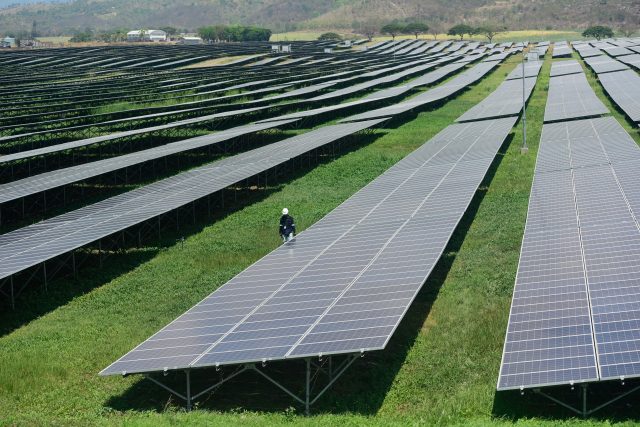
THE Department of Energy (DoE) said it will take time for the Philippines to transition to 100% renewable energy (RE), and called for the industry to be more honest about how long the shift will take.
“For those who are saying that we can go 100% renewable overnight, then I would like to have more honesty from this sector that we are not in a position to do it,” Energy Secretary Raphael P.M. Lotilla said at the BusinessWorld Insights forum last week at the Shangri-La in Bonifacio Global City.
Mr. Lotilla said that while the government continues to work on expanding renewable energy use, the energy transition will take time.
“The energy transition has to take place over time if it is going to be a just transition. But if we are simply going to do away with (legacy technologies) overnight, then these are going to be lost investments as far as the economy is concerned,” Mr. Lotilla said.
He said that the government recognizes that renewable energy is the way forward for attaining security, sustainability and affordability of energy prices.
 “That doesn’t mean that we are not committed to the transition, but we have to do it in a just and fair way, which is to ensure that variable renewable energy is (complemented) by energy storage systems as well as other sources of power and technology,” Mr. Lotilla said.
He said that the effective implementation of energy efficiency and conservation measures is an equally important aspect of the government’s energy programs.
“The effective implementation of energy efficiency to bring down overall energy consumption, lower greenhouse gas emissions… sustainable development goals require a change in lifestyle, a change in consumption patterns,” Mr. Lotilla said.
“Energy efficiency is the one pillar of the energy sector that we have to grow aggressively,” said Alexander D. Ablaza, president of Philippine Energy Efficiency Alliance and chief executive officer of Climargy, Inc.
President Ferdinand R. Marcos, Jr. said in his second State of the Nation Address that the government will need to accelerate its programs to attain the goal of increasing the share of renewable energy to 35% by 2030 and 50% by 2040.
As of end of 2022, renewable energy accounts for about 22% of the energy mix, with coal-fired power plants accounting for almost 60%.
Pedro H. Maniego, Jr., senior policy advisor of the Institute for Climate and Sustainable Cities said that the Philippines has still a long way to go from achieving its Philippine Energy Plan targets.
“We need to act more aggressively and more urgently, as Filipinos have borne the brunt of expensive and unreliable power for years. Renewable energy sources are free, indigenous, and have no supply limitations, and increasing its share in the Philippine energy mix ensures more affordable, reliable, and secure power for Filipinos,” Mr. Maniego said in a statement.
Mr. Maniego has identified the long approval process of the National Grid Corp. of the Philippines (NGCP) for system impact studies (SIS) and the lack of interconnection as major causes of delay in advancing renewable energy projects.
Separately, Mr. Lotilla said that the SIS process needs to be improved further and that the DoE is proposing to shorten the approval timeline to 60 days.
The NGCP said it is currently carrying out a “comprehensive series of actions” to address “the lengthy SIS queue” for power plant connections.
The SIS assesses how adding new energy sources impact the grid. It also helps identify the needed improvements like additional transmission lines, transformers, or substations.
“Generation project proponents who are first in line for SIS are not necessarily first to be ready with complete requirements. In fact, many request time extensions, which also contributes to the prolonged SIS processing time,” Anthony L. Almeda, president and chief executive officer of NGCP, said in a statement. — Ashley Erika O. Jose
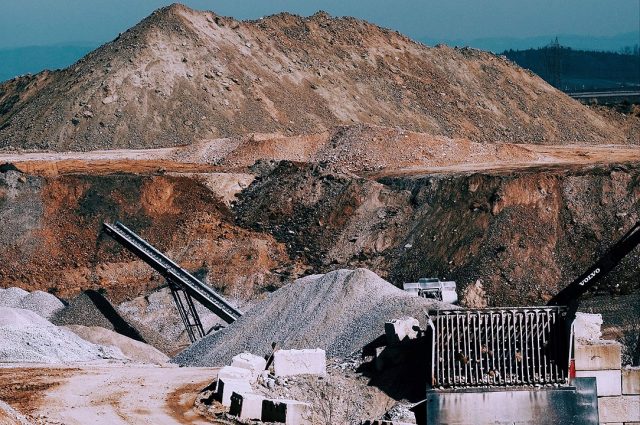
A HOUSE committee has set a target of approving this week a measure overhauling the mining fiscal regime, the committee’s chairman said.
“We will approve on Wednesday,” Albay Rep. Jose Ma. Clemente S. Salceda of the House ways and means committee said in a Viber chat.
The Senate has yet to file a mining fiscal regime bill, a priority measure listed in President Ferdinand R. Marcos, Jr.’s State of the Nation Address.
The mining industry has said it supports the measure, House Bill No. 373, written by Mr. Salceda, which will impose a margin-based royalty and windfall profits tax, which it described as less burdensome to miners.
Chamber of Mines of the Philippines Vice Chairman Gerard H. Brimo said such a tax structure would provide the government “with a progressively larger share in mining revenue when commodity prices go up and give a break to the industry when prices are low.”
The bill proposes a margin-based royalty on large-scale miners outside of mineral reservations. It also proposes a windfall profits tax that is likewise based on margins.
“This is the same tax structure that applies in the two largest copper producing countries in the world, Chile and Peru, who have been able to attract substantial foreign investment to grow their industries. Canada also applies an income-based royalty although the royalty rate does not change,” he said.
Other priority tax bills are the single-use plastics tax and the taxation of digital services, which the House approved last year. The panel approved the proposed motor vehicle users’ charge last week.
Senator Sherwin T. Gatchalian, who heads the Senate ways and means committee, told reporters last week that the ease of paying taxes bill, single-use plastics tax, and MVUC measure are Senate priorities. The digital services tax, on the other hand, is still in committee for deliberation.
Measures seeking to curb smuggling are also a priority.
“We are prioritizing the proposed bills on amendments to the Anti-Agricultural Smuggling Act. We have set the TWG (technical working group) deliberations for this week,” House agriculture and food committee and Quezon Rep. Wilfrido Mark M. Enverga said in a Viber message.
The House passed the proposed anti-financial account scamming act in March, while a similar measure is pending at a Senate committee.
Legislators are considering reforms to the pension system for military and uniformed personnel (MUP) by gradually making members contribute more to their own retirement packages while tapping government savings for its share of the pension contribution.
Santa Rosa City Rep. Dan S. Fernandez, who chairs the House public order and safety committee, said the committee is waiting for the House defense panel, the lead committee, to conduct hearings on the bill.
“I’m quite confident that the savings will not be enough to augment the backlog,” he said via Viber. “At least a hundred billion is needed for 2024 and without reforms that the executive will submit to us for consideration then we might aggravate the already fragile situation of our men in uniform.”
The MUP pension reform bill is also being deliberated at committee level in the Senate.
Government auditors recently called on the Armed Forces of the Philippines to update its Pension Management Information System (PenMIS), following overpayments worth P17.01 million and underpayments of P2.30 million last year.
“Discrepancies in the list of pensioners from the PenMIS resulted in overpayment and underpayment of pensioners and adversely affected the accuracy and reliability of payrolls,” the Commission on Audit said in an audit report make available on July 28.
Discussions on amending the procurement law have been ongoing since May 18, House revision of laws committee secretary Jean Celzo-Dapula said via Viber.
She said that salient points raised during TWG deliberations are setting the threshold amount on projects in a district and readiness of other procuring entities or bidders to use electronic platforms.
“We hope to approve (the bill) in committee within the year,” she said.
The office of Senator Juan Edgardo M. Angara, who chairs the chamber’s finance committee, said its next hearings will involve the Tatak Pinoy bill this week. A similar measure is still pending in committee at the House.
Meanwhile, the measure calling for the automatic income reclassification of local government units, which the House approved in March, is set for second-reading approval in the Senate.
Other Marcos priority bills are amendments to the Fisheries and Cooperative codes, the blue economy development bill, and the proposed Philippine Immigration Act, which are all still in committee.
Mr. Marcos has also called for the creation of a new auditing code. — Beatriz Marie D. Cruz
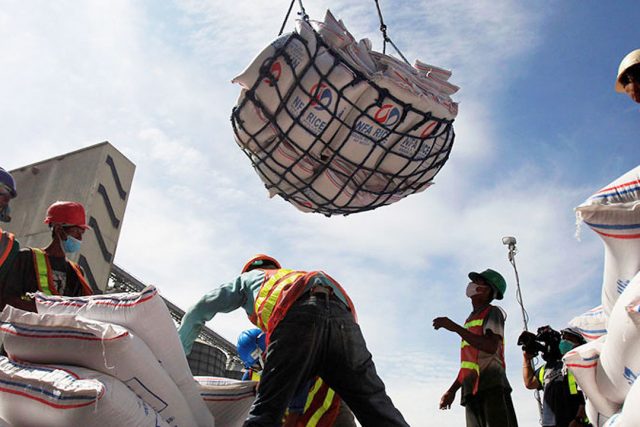
THE Rice Tariffication Law can serve as a model for imports of other farm commodities, National Economic and Development Authority (NEDA) Secretary Arsenio M. Balisacan said.
“We must learn from the lessons from the implementation (of the Rice Tariffication Law) and see how we can expand that to other commodities. We need to make our trade policy more transparent and supportive of our economic agenda,” Mr. Balisacan told reporters on Friday.
Signed in 2019, the Rice Tariffication Law liberalized rice imports by allowing private parties to import rice, formerly a monopoly of the National Food Authority (NFA). Importers must pay tariffs on Southeast Asian grain of 35%, earning revenue for the government in the process.
The law also limited the NFA’s functions to maintaining a rice reserve to stabilize prices and supply grain to calamity-hit regions.
Mr. Balisacan said that the law has so far achieved its objective of keeping rice prices stable.
“Our assessment so far is that the law has done a good job in achieving what we wanted, and that is stabilizing the price of rice, making the market more predictable and efficient so that when there are sharp swings in the prices, the private sector can respond quickly or (the government) can respond quickly,” he said.
“We have to strike a balance, of course, in achieving those objectives, particularly food security and this whole business of picking up the industry and getting it to generate more quality jobs,” he added.
In the five months to May, the Philippines imported 1.62 million metric tons (MT) of rice, the Bureau of Plant Industry estimated. This was 7.69% higher year on year.
The United States Department of Agriculture projected Philippine rice imports to hit 3.8 million MT this year. — Luisa Maria Jacinta C. Jocson

THE Department of Trade and Industry (DTI) said its food logistics action plan could be implemented this year, with economic managers declaring their support for the proposal.
Trade Undersecretary Ruth B. Castelo told reporters on the sidelines of the Post-State of the Nation Address discussions in Pasay City last week that the members of the Economic Development Group (EDG) have been supportive of the proposal.
“Yes (it can be rolled out this year) … We have short-term, immediate-term plans. There are things that we can do now,” Ms. Castelo said.
“There were a lot of questions and then the challenges that it posed, but generally, the other members of the EDG are kind of supportive. We hope that this (support continues) until it reaches the President,” she added.
The EDG members include the DTI, Department of Finance, the National Economic and Development Authority, the Presidential Management Staff, the Department of Budget and Management, and Department of Agriculture.
According to Ms. Castelo, the projected budget for the logistics plan is still being prepared.
“The enumerated deliverables are due by 2026, if we (start) now,” Ms. Castelo said.
On July 25, Ms. Castelo presented the DTI’s food logistics plan, which also seeks address hoarding and smuggling.
Ms. Castelo said the plan would require an executive order or legislation before being implemented.
Some of the measures included in the six-point agenda include a moratoriums on pass-through fees and additional port fees and charges, as well as zero tolerance on gray costs and legislation to regulate high international shipping charges.
“Controversial, but once it’s done, it’s going to provide us the results that we want,” Ms. Castelo said.
Ms. Castelo added that the DTI will adopt a supply chain control-tower approach that would oversee the supply chain from the farm gate to retail.
“The food supply chain involves multiple stages from farmgate to storage, distribution, and retail. Implementing a control tower approach in the food sector could provide real-time visibility into food availability, pricing, demand, and potential disruptions. This could help in managing food security issues, reduce food waste, and curb cartelization, among other benefits,” Ms. Castelo said. — Revin Mikhael D. Ochave

CONSUMER spending has put Philippine economic growth, which was upgraded last week by the International Monetary Fund (IMF), on a separate track from most other countries, East West Banking Corp. (EastWest Bank) said.
“I think consumption will be a driver for GDP (gross domestic product) growth. If you saw recently, the IMF just upgraded the Philippines, while the rest of the world is on a different trajectory,” EastWest Bank Chief Executive Officer Jerry G. Ngo told reporters on Thursday.
The IMF last week raised its growth outlook for the Philippines to 6.2% from the 6% forecast it issued in April, with domestic demand expected to remain robust.
IMF Representative to the Philippines Ragnar Gudmundsson said the Philippine growth forecast this year was revised to reflect the strong first-quarter economic reading.
The economy expanded 6.4% in the first quarter, beating expectations, though it reflects a slowdown from the 8% growth posted a year earlier.
The IMF forecast is within the government’s 6-7% target for this year. In 2022, GDP grew 7.6%.
Mr. Ngo added that the young workforce will also contribute to growth in the medium to long term.
However, this will depend on whether enough jobs are created to absorb the workers available.
“We need to make sure that there’s employment creation. I’m concerned about technology replacing humans. We’re using it already to make people productive,” Mr. Ngo said.
He added that overseas macroeconomic developments outside our control could also dampen growth.
“I do think there will be some headwinds from the US. China is already experiencing a slowdown. (There’s) some fragility in the US with their employment sector which was very strong before. In China, the housing and property sector is starting to be affected as well,” he said.
On Thursday, the bank launched its e-wallet app, EastWest Pay, and its new Platinum Visa credit card.
Mr. Ngo said the e-wallet app has been in testing for four months.
The mobile app, which is only available on Samsung phones, features security functions such as tokenization and biometrics for transaction approval. — Aaron Michael C. Sy

THE Transportation Undersecretary for Railways Cesar B. Chavez said a decision on the future of Metro Rail Transit Line 3 (MRT-3) after its build, lease and transfer (BLT) agreement expires could come within a year.
“Decision must be made by July 2024,” Mr. Chavez told reporters in chance remarks last week.
He added that the current inclination of the Department of Transportation (DoTr) is for MRT-3 to be absorbed alongside Light Rail Transit Line 2 (LRT-2) under the Light Rail Transit Authority (LRTA).
“What we are talking about is 2025 and beyond. That is why we have to decide now up to 2024 if (the two rail lines) will be bundled. If we bundle them, one requirement is that the MRT-3 as a project management office will be under LRTA; that is our direction right now,” Mr. Chavez said.
The new structure will facilitate any LRTA move to enter into a public-private partnership for the operations and maintenance of the two railways, according to Mr. Chavez.
“Remember that LRT-2 was left behind when LRT-1 was put into an operation and maintenance contract with LRMC. That is why the LRT-2 has a bigger subsidy,” he said.
“What we want is to combine good cake and not-so-good cake so that would be the risk shared between the private concessionaire and the government,” he added.
Mr. Chavez said that the decision is currently being discussed. Once a decision is made, it will be passed on to the National Economic and Development Authority.
FARE HIKE
Following the approved fare hikes for LRT Lines 1 and 2, which will be implemented on Aug. 2, Mr. Chavez said that the petition for an MRT-3 fare hike is still with the Office of the Secretary.
On July 3, the MRT-3 re-filed a petition after a technical fault in a previous filing in which its management failed to issue a notice of public hearing in the prescribed time.
“(The process) usually takes three months: three weeks for the publication of the notice to the public, then discussion of decision, and then three weeks for the publication of decision,” Mr. Chavez said.
He added that his office, the Rail Regulatory Unit, is currently awaiting the Office of the Secretary’s referral.
The MRT-3 management petitioned for a P2.29 increase in boarding fare, or a 21-centavo increase per kilometer, similar to the rates approved for LRT Lines 1 and 2.
Under the BLT agreement with the Sobrepeña group, the government pays P7 billion a year as equity rental payments, or about P600 million to P900 million a month, depending on inflation.
“This will end in 2025. So, what will be the focus of the income from fare box and commercial by 2025 and beyond is the maintenance and operations,” Mr. Chavez said. — Justine Irish D. Tabile
THE Philippine Economic Zone Authority (PEZA) plans to launch a digital marketplace for locators by September.
PEZA Director General Tereso O. Panga signed a memorandum of agreement with NetGlobal Solutions, Inc. (NGSI) Chairman and Chief Executive Officer Peter G. Lingatong on July 25 for the development of the PEZA Digital Marketplace, a business-to-business (B2B) e-commerce platform for PEZA locators.
“The PEZA Digital Marketplace completes the local supply and global value chain for Philippine economic development. This will also increase our competitiveness to attract more investors to set up offshore facilities and operations in the Philippines, particularly, in our ecozones,” Mr. Panga said in a statement.
“The signed agreement aims to strengthen the ease of doing business in the economic zones as mandated in Republic Act No. 11032 or the Ease of Doing Business and Efficient Government Services Delivery Act of 2018 which directs all offices and agencies to improve transactions systems and procedures to streamline the delivery of government services,” PEZA said.
Under the agreement, the NGSI will develop, operate, and maintain the digital platform, PEZA directory, and PEZA build-a-site. The database development for the marketplace will also cover local producers and suppliers of goods and services providing support to ecozone locators.
“This key measure to enhance the ecozone forward and backward linkages will accelerate the integration of our Filipino micro, small, and medium enterprises (MSMEs) into the ecozone value chain,” the PEZA said.
For 2023, the PEZA is targeting 10% investment approvals growth after it tallied P140.7 billion in 2022. — Revin Mikhael D. Ochave

In our last article, “IFRS S1 and IFRS S2: Game changers in global sustainability reporting,” the author discussed the first two global sustainability reporting standards published by the International Sustainability Standards Board: IFRS S1 General Requirements for Disclosure of Sustainability-related Financial Information and IFRS S2 Climate-related Disclosures. These standards can be game changers by helping companies identify material sustainability risks and opportunities that will help investors, lenders, and creditors assess the entity’s resilience against changes and uncertainties driven by sustainability-related issues. In response to these new disclosure standards, the International Accounting Standards Board (IASB) republished in July 2023 a document on the effects of climate-related matters on financial statements.
Due to the ubiquitous effects of climate change, there is an increased focus on the measurement and disclosure of climate-related matters in an entity’s financial statements. In effect, investors and stakeholders are keen to understand the potential impact of climate change on an entity’s business models, cash flows, financial position, and financial performance.
While International Financial Reporting Standards (IFRS) do not explicitly touch on climate-related matters, businesses must consider the latter in preparing their financial statements when the effects of those matters are material. The determination of the effects of climate change on an entity’s financial statements may require significant effort and judgment.
At a minimum, entities are required to follow the specific disclosure requirements in each IFRS standard. Entities may need to provide additional disclosures in their financial statements to meet the standards’ disclosure objectives. Hence, in determining the extent of disclosure, entities are required to carefully evaluate what information is required for users to be able to assess the effects of climate change on their financial position, financial performance, and cash flows.
Key points for entities to consider are summarized below:
Going concern, sources of estimation uncertainty, and significant judgments
As a major source of estimation uncertainty, climate risk could add complexity to the application of IFRS. Entities have to consider uncertainties associated with future climate-related developments when assessing an entity’s ability to continue as a going concern. They should therefore ensure they make the relevant disclosure of assumptions and estimates. Those disclosures must be entity-specific and avoid using boilerplate-type or generic language. Entity-specific disclosures include quantifiable information about assumptions, if relevant, and explanations of deviations from known market expectations regarding the same assumptions.
If relevant, quantified sensitivity disclosures should be made to illustrate the uncertainty embedded in the estimates relied on by entities. It is also important that entities stay consistent in both the disclosures about climate-related matters outside the financial statements (e.g., in separate sustainability reports or management commentaries) and how they incorporate climate risk in the financial information (e.g., in measurements and disclosures in the financial statements). Long-term climate risk impacts should also be considered when assessing the uncertainty associated with an entity’s ability to continue as a going concern.
Inventories
Climate-related matters may cause inventories to become obsolete, selling prices to decline, or costs-to-complete to increase. This may result in inventories needing to be written down to their net realizable values.
Income taxes
An entity’s estimate of future taxable profits may be impacted by climate-related matters, resulting in the entity being unable to recognize deferred tax assets. The entity may also be required to derecognize deferred tax assets that were previously recognized. Moreover, an entity may find that climate-related matters affect its future taxable profits potentially resulting in the entity not being able to recognize deferred tax assets for any deductible temporary differences or unused tax losses.
Property, plant and equipment, and intangible assets
To adapt business activities, climate-related matters may lead to a change in expenditures. An entity will need to determine whether these expenditures satisfy the definition of an asset and can therefore be recognized as either property, plant and equipment or as an intangible asset.
Both IAS 16 Property, Plant and Equipment and IAS 38 Intangible Assets require entities to review the estimated residual values and expected useful lives of assets at least annually. For example, climate-related matters may impact both of these estimates due to legal restrictions, obsolescence, or asset inaccessibility. Additionally, estimated residual values, expected useful lives, and changes thereto will also require disclosure.
Asset impairment
Significant judgment may be required in determining the extent to which certain assets, processes, or activities will be impacted by climate-related business requirements and how climate-related risks and opportunities will affect an entity’s forward-looking information, such as cash flow projections in the prognosis period. Entities must consider what information users rely on in assessing the entity’s exposure to climate-related risks.
Provisions/contingent liabilities and assets/levies
The recognition and measurement of provisions, as well as the need for disclosure of contingent liabilities, can be significantly impacted by climate-related matters. However, under IAS 37 Provisions, Contingent Liabilities and Contingent Assets, only the obligations arising from past events that exist independently of an entity’s future actions can be recognized as a provision. Due to the significant uncertainties involved in assessing the extent and impact of climate change, entities should ensure that sufficient disclosures are provided to allow users of financial statements to understand said uncertainties. Sufficient disclosures are also necessary to allow users to understand how climate transition has been taken into account in the measurement of a provision or disclosure of a contingent liability, and the assumptions and judgments made by management in recognizing and measuring provisions.
Financial instruments
Climate-related matters such as environmental calamities or regulatory change may affect a lender’s exposure to credit losses, affecting a borrower’s ability to meet its debt obligations to the lender. This makes climate-related matters potentially relevant in the calculation of expected credit losses if, for example, they impact the range of potential future economic scenarios or the assessment of significant increases in credit risk.
Climate-related matters may also affect the measurement and classification of loans as lenders may include terms linking contractual cash flows to an entity’s achievement of climate-related targets. The lender will have to consider the loan terms in assessing whether the contractual terms of the financial asset give rise to cash flows that are solely payments of principal and interest on the principal amount outstanding. Those climate-related targets may also give rise to embedded derivatives that have to be separated from the host contract.
IFRS 7 Financial Instruments: Disclosures requires entities to disclose the nature and extent of risks arising from financial instruments and how the company manages them. It may be necessary for lenders to provide information about the effects of climate-related matters on the measurement of expected credit losses or on concentrations of credit risk. For holders of equity investments, on the other hand, it may be necessary to disclose their exposure to climate-related risks when disclosing concentrations of market risk.
Fair value measurement
Market participant views of potential climate-related matters, including legislation, may affect the fair value measurement of assets and liabilities in the financial statements. Climate-related matters may also affect the disclosure of fair value measurements where relevant, particularly those categorized within Level 3 of the fair value hierarchy.
Since IFRS 13 Fair Value Measurement requires disclosure of unobservable inputs used in fair value measurements, those inputs should reflect the assumptions that market participants would use, including assumptions about climate-related risk.
Insurance contracts
Since climate-related matters can increase the frequency or magnitude of insured events, there may be an impact on the assumptions used to measure insurance contract liabilities. Similar to other areas, disclosure of the judgments made in applying IFRS 17 Insurance Contracts and relevant risks is required.
Final thoughts
The IASB document provides guidance to preparers of financial statements about the areas they need to consider in relation to climate-related matters. Although it does not introduce any new requirements, knowing how climate-related risks can impact financial statements can help remind its preparers about the scope of existing requirements in IFRS.
This article is for general information only and is not a substitute for professional advice where the facts and circumstances warrant. The views and opinions expressed above are those of the author and do not necessarily represent the views of SGV & Co.
Aris C. Malantic is the Financial Accounting Advisory Services (FAAS) leader of SGV & Co.
