Home Blog Page 454

Indonesia’s Prabowo affirms commitment to new capital city in first visit as president

INDONESIAN Defense Minister Prabowo Subianto signed the Pentagon guest book during a bilateral exchange hosted by Defense Secretary Lloyd J. Austin III at the Pentagon in Washington, D.C. on Aug. 24, 2023. — US DEPARTMENT OF DEFENSE

JAKARTA — Indonesia’s Prabowo Subianto reiterated his commitment to a $32 billion project to build the country’s new capital city as he made his first overnight stay there as president, the government said.

Questions about the fate of the Nusantara capital city project have lingered since Mr. Prabowo took office in October 2024.

The project is a legacy of his predecessor, Joko Widodo, who first announced his plan to move the capital 1,200 kilometers (745 miles) away from overcrowded and sinking Jakarta in Java island in 2019.

Construction of the city in a remote, southeastern part of Borneo island only began in 2022 after delays due to the pandemic and Mr. Widodo missed his target of moving the government by the end of his second and final term in 2024.

Analysts have said Mr. Prabowo is unlikely to have the fiscal space to fund his key programs while continuing to build Nusantara, which Mr. Widodo had envisioned as a green, futuristic capital surrounded by forest.

Mr. Prabowo’s visit, scheduled until Tuesday, “marks an important momentum for the journey to build the Nusantara capital city,” his office said in a statement late on Monday.

“President Prabowo’s presence in Nusantara demonstrates the government’s commitment to ensuring the development in the area proceeds according to plan and is sustainable,” it said.

The Nusantara National Capital Authority, which oversees the development, said in a separate statement that offices and supporting infrastructure for the executive branch were ready.

Construction was underway to meet a completion target of 2028 for buildings for the legislative and judicial branches of government, it said.

Mr. Prabowo last year approved a budget of 48.8 trillion rupiah ($2.89 billion) for the project until 2029, only about 60% of what Mr. Widodo spent between 2022 and 2024.

Mr. Prabowo’s government ran a budget deficit of 2.92% of GDP in 2025, among the largest in two decades and close to a legal deficit ceiling of 3% of GDP.

The Constitutional Court last year halved the maximum duration of land rights for investors in Nusantara, dealing another blow to the project. — Reuters

PHIVOLCS: Mayon Volcano logs 206 rockfall events, spews lava

Incandescent pyroclastic density currents (PDC) or “uson” and rockfall being shed from the summit lava dome of Mayon Volcano on Jan. 9, 2026.—PHIVOLCS-DOST FB PAGE

A total of 206 rockfall events were recorded at Mayon Volcano in Albay in the past 24 hours, while a short-lived lava fountaining was observed early Tuesday, according to the Philippine Institute of Volcanology and Seismology (PHIVOLCS).

In its latest bulletin, PHIVOLC reported that 63 pyroclastic density currents (PDCs) were also recorded at the volcano between Jan. 12 and 13.

Meanwhile, a volcanic plume rising 1,000 meters above the crater was emitted by the volcano in the same monitoring period.

Ground deformation measurements continue to indicate that the volcano is swelling, PHIVOLCS said.

In a separate advisory, PHIVOLCS said that an “incandescent short-lived lava fountaining” of about 100 meters high, was observed at the summit crater of Mayon at exactly 1:39 a.m. on Tuesday.

The event lasted around 35 seconds and was captured by cameras at the Mayon Volcano Observatory.

Alert Level 3 remains in effect at Mayon, following heightened activity observed on Jan. 6.

The state volcanology and seismology agency continues to caution nearby residents to avoid the six-kilometer Permanent Danger Zone due to hazards such as rockfalls, PDCs, and ballistic fragments.

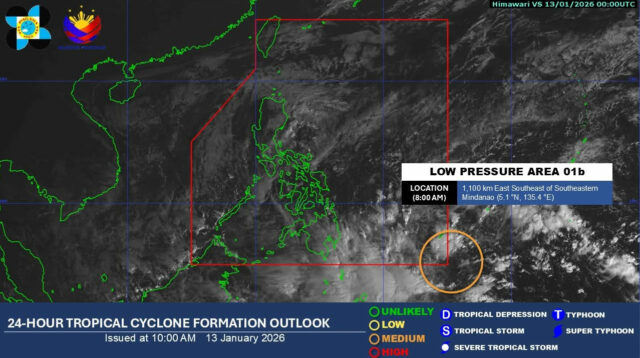
Potential storm Ada to approach CARAGA, Eastern Visayas

DOST-PAGASA FB PAGE

The low-pressure area (LPA) with the potential to develop into Tropical Cyclone Ada is likely to move near the CARAGA region and Eastern Visayas, according to the Philippine Atmospheric, Geophysical and Astronomical Services Administration (PAGASA) on Tuesday.

The potential storm Ada developed into an LPA at 8:00 a.m. and has a medium chance of intensifying into a tropical cyclone within 24 hours, PAGASA said in an advisory few hours ago.

It was also located about 1,100 kilometers east-southeast of Southeastern Mindanao.

Meanwhile, PAGASA said in its 5:00 a.m. advisory that the potential tropical cyclone Ada may bring significant rainfall to affected areas.

“Once it becomes a full-fledged storm, we will immediately raise the Tropical Cyclone Wind Signal for parts of Mindanao and the Visayas,” Chenel Dominguez, PAGASA weather specialist, said during the advisory in Filipino.

If PAGASA formally announces that the LPA has intensified into Storm Ada, information about its track and the areas likely to be affected will be available in a tropical cyclone bulletin.

Ada will be the country’s first tropical cyclone of 2026.

The Philippines averages 20 tropical cyclones per year, with 23 recorded last year. — Edg Adrian A. Eva

Donald Trump versus the Federal Reserve – what you need to know

US President Donald Trump and Federal Reserve Chair Jerome Powell speak during a tour of the Federal Reserve Board building in Washington, DC, US, July 24, 2025. — REUTERS/KENT NISHIMURA

WASHINGTON — Jerome Powell, head of the US Federal Reserve, said on Sunday the Justice Department has opened a criminal investigation against him for allegedly misleading Congress about a building renovation project at the central bank’s headquarters.

The action marks a dramatic escalation in President Donald Trump’s pressure campaign against the top policymaking body for the US economy, which Trump thinks is not lowering interest rates fast enough.

The White House says Trump did not order the investigation, but Trump, who has threatened to fire Powell, has called on him to resign, and has said he should face legal consequences for the renovation’s cost overruns.

Outside observers say Trump’s actions could erode the independence of the world’s most important central bank and reduce confidence in the US economy.

WHY DOES THIS MATTER?
Since returning to office a year ago, Trump has sought to bend the US government to his will by firing tens of thousands of civil servants, eliminating internal watchdog positions, and dismissing Democratic appointees from agencies like the Federal Trade Commission that were set up to be run in an independent fashion.

The Fed is just one of his targets, but perhaps the most significant.

The Federal Reserve is tasked with keeping inflation in check, unemployment low and the financial system operating smoothly. It does this by setting the baseline for the cost of credit. While the Fed only controls the federal funds rate – the interest rate that banks charge each other for overnight loans – that serves as a foundation for the cost of other types of lending like home mortgages and credit cards.

If the Fed sets the interest rate too high, that can discourage borrowing, which can then weigh on consumption and investment and slow the economy. If the Fed sets interest rates too low, the economy can overheat, leading to higher inflation. The Fed sharply hiked the federal funds rate in 2022 and 2023 to combat inflation following the COVID-19 pandemic and has been gradually lowering it since 2024. It cut rates three times at the end of last year.

WHAT’S MEANT BY FED INDEPENDENCE?
Congress designed the Fed to be insulated from political pressure. The seven members of its Board of Governors serve 14-year terms, which ensures that no president can nominate a majority. Moreover, board members make interest-rate decisions with five of the 12 regional bank presidents casting votes as well on an annual rotation, which decentralizes power from Washington. The Fed also controls its own budget and does not rely on Congress for funding.

Trump has repeatedly called on the Fed to slash interest rates to as low as 1% – a level rarely seen outside of a crisis – and he has criticized Powell when the central bank has not followed his wishes.

Trump also tried to fire another Fed governor, Lisa Cook, for allegedly filing misleading mortgage documents. Cook has denied wrongdoing and sued to keep her job. The Supreme Court is due to hear her case on January 21, and its decision is expected to have major implications for the central bank’s independence.

IS THIS NORMAL?
No. While past presidents have on occasion pressured the Fed to lower interest rates, none has ever publicly threatened to fire Fed officials or targeted them with criminal charges.

The Justice Department also is playing an unusual role here. The agency has filed criminal charges or announced investigations into several of Trump’s political rivals over the past year, including former FBI Director James Comey, New York Attorney General Letitia James and Democratic Senator Adam Schiff. That’s a sharp departure from previous administrations, as prior attorneys general have operated with a degree of independence from the White House in order to maintain public confidence in law enforcement.

WHAT IS THE RENOVATION PROJECT?
A planned renovation of two historic buildings in the Fed’s Washington headquarters has run over its initial budget of $1.9 billion to about $2.5 billion. That has been attributed to higher-than-expected labor and materials costs, design changes, and unforeseen issues like asbestos and lead contamination.

Trump has accused Powell of mismanagement and suggested potential fraud, though he has not provided evidence. The White House has also criticized the project as ostentatious, with claims of lavish features like VIP elevators and premium marble. Powell has said that is not accurate and has defended the need to remove hazardous materials.

WHAT IS POWELL BEING INVESTIGATED FOR?
Powell said in a video statement that he has been served with subpoenas by the Justice Department for his testimony to the Senate Banking Committee last July about the renovation. That could indicate the Justice Department is preparing to indict him for lying to Congress – a charge the department also brought against Comey. That case was thrown out of court.

Powell has denied wrongdoing, and the Justice Department has not yet commented on the investigation.

Several Republican members of the Senate Banking Committee have said they are not troubled by the renovation project, or Powell’s testimony about it.

COULD THIS BACKFIRE ON TRUMP?
Potentially. Powell’s term as Fed chair will end in May, but he could opt to remain on the board until 2028, delaying Trump’s opportunity to further reshape the board with more sympathetic figures.

Trump’s move is also upsetting some Republicans in Congress, who until now have largely been deferential to the president.

Senator Thom Tillis of North Carolina said he will not support any of Trump’s future Fed nominees, and Senator Lisa Murkowski of Alaska has called for an investigation of the Justice Department. Tillis’ opposition is significant as he sits on the Banking Committee that oversees the Fed, and Republicans hold just a slender 13-11 majority.

His opposition could deadlock the committee and prevent any nominees from advancing to a confirmation vote in the full Senate. That could prevent Trump from installing a permanent ally after temporary appointee Stephen Miran’s term expires on January 31. The Senate’s top Republican, John Thune, acknowledged Monday that the Powell investigation could make it harder to confirm Fed nominees.

Of course, Trump’s pressure campaign could also succeed. Powell and Cook could be forced off the Fed board one way or another. The Supreme Court could rule that Trump has the right to fire Cook, and Powell could get criminally charged and found guilty.That would open up two spots for Trump to fill.

The Fed next meets to set interest rates on January 27-28, with little expectation of another rate cut. Indeed, several of this year’s crop of voting regional bank presidents are opposed to any further rate cuts and so far seem unbowed by Trump’s pressure.

WHAT DO INVESTORS THINK SO FAR?
Outside observers argue that a politicized Fed would have less freedom to steer the economy as it sees fit, raising the risk of higher inflation and undermining the dollar’s status as the world’s reserve currency. That could cause investors to demand higher interest rates for US government debt and raise borrowing costs, analysts say.

Analysts warn that the Powell investigation is a clear sign that the Fed’s independence is at risk, but investors do not seem alarmed … yet. After a lower start on Monday, major US stock indices closed modestly higher. — Reuters

Why is the Philippine peso so weak and who benefits?

PHILIPPINE STAR/ MIGUEL DE GUZMAN

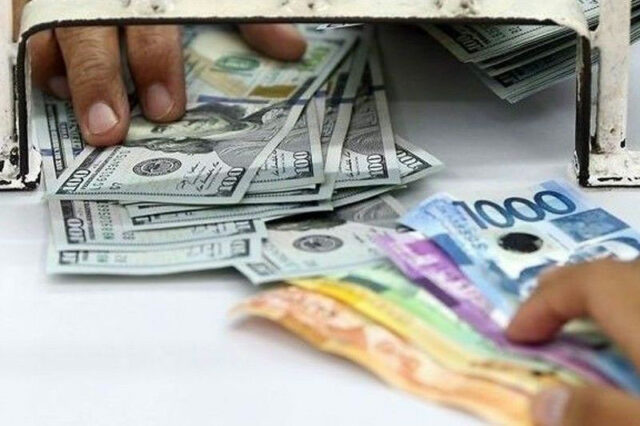
In early January, the Philippine peso slid to 59.38 per dollar — its weakest level on record. While it has since recouped some losses, officials have signaled a tolerance for further depreciation and traders are watching closely for any signs of central bank intervention.

A weak peso is a double-edged sword for the Philippines. It could boost remittance flows from the millions of Filipinos who live overseas and send money home, potentially encouraging higher spending in the consumption-driven economy. But it could also push inflation higher as imports become more expensive. The Philippines is also one of Asia’s most active sovereign bond issuers, and prolonged peso weakness would drive up government borrowing costs and risk further inflating the national debt.

WHAT’S CAUSED WEAKNESS IN THE PESO?

The peso has fallen more than 3% since July when President Ferdinand R. Marcos Jr. revealed during his State of the Nation address that many of the government’s flood infrastructure projects — in what is one of the world’s most typhoon-prone nations — were being used as money-making schemes.

Subsequent congressional hearings uncovered allegations of collusion among lawmakers, public works officials and contractors to divert billions of pesos of government funds earmarked for those projects. That ignited mass protests and a broad foreign investor exodus from the equities market. Global investors pulled out a net $220 million from the local stock market from July 29 — the day after Marcos’ speech — to Jan. 9 this year, according to data compiled by Bloomberg. Foreign investors account for more than 40% of the Philippines’ stock market turnover.

The Philippine central bank said last year that the outlook for domestic economic growth had weakened due to softened business confidence amid concerns about public infrastructure spending.

Also weighing on the peso are expectations of further monetary easing this year, as the central bank moves to cushion the economic fallout from the graft scandal, with spillover effects expected to persist until the end of 2026. Following the scandal, the government lowered its economic growth target for 2026 to 5%-6% from a previous goal of 6%-7%. Other economists, including from the Asian Development Bank, have also trimmed their growth outlook for the Philippines.

The Bangko Sentral ng Pilipinas has already cut the benchmark rate by 200 basis points since August 2024. Bangko Sentral ng Pilipinas (BSP) Governor Eli M. Remolona Jr. said on Jan. 6 that the central bank would consider one more rate cut this year — possibly as early as February.

There are other headwinds for the economy beyond the corruption scandal. The 19% tariff the US imposed on imports of Philippine goods from August has slowed factory activity. The BSP has warned of weaker investment inflows and softer growth in key service exports.

Still, the economy is likely to rebound in the second half of 2026, according to Economic Planning Secretary Arsenio Balisacan, who expects benign inflation to boost consumption. Economic managers — when setting the country’s national budget — have factored in slightly more weakness with an exchange rate of P58-P60 to a dollar for this year through 2028.

WHAT ARE THE PROS AND CONS OF A WEAK PESO?

More than 10 million Filipinos live and work abroad, and many of them send money home to help their families. These remittance flows reached a record $34.5 billion in 2024, and the central bank expected these to hit $35.5 billion last year.

A weaker peso makes the remittances worth more in local-currency terms, increasing purchasing power in the Philippines. This could spur household spending, benefiting consumer-centric companies. Household consumption accounts for about two-thirds of the nation’s gross domestic product.

A weaker peso would also make it cheaper and more attractive for overseas businesses to outsource jobs to the Philippines, providing a favorable backdrop for firms to step up hiring or raise wages, which could in turn support consumption. The Philippines is one of the world’s largest hubs for business-process outsourcing, employing nearly 2 million people in the industry.

A weaker currency also makes a country’s goods cheaper for foreign buyers. The peso’s depreciation could therefore boost the international competitiveness of Philippine manufacturers, potentially leading to an increase in export volumes and revenues. That, in turn, may help to shrink the national trade deficit, which currently averages around $3 billion to $4 billion a month.

On the flipside, a weak peso makes imports more expensive, dampening demand for foreign products while adding to inflationary pressures. The Philippines imports most of its electronic components, as well as industrial machinery, iron and steel, and many meat and dairy products. The country relies on imports for nearly all of its oil requirements, raising the risk of higher fuel prices.

The government’s finances, however, stand to benefit from the peso’s weakness. According to a Department of Budget and Management’s sensitivity analysis, every 1-peso depreciation against the dollar could generate an additional 9.3 billion pesos ($157 million) in tax revenue, including from import duties, in 2026.

WHAT DOES A WEAK PESO MEAN FOR INVESTORS?

A weaker peso makes Philippine assets cheaper for foreign investors, since the same number of dollars is now able to buy more of the local currency. That could encourage overseas investors to invest more in the country and expand their portfolios. That said, the value of any gains or dividends would be worth less in dollar terms.

The appeal of cheaper assets may also be outweighed by what a weaker currency signals — declining investor confidence and broader economic uncertainty. The economic growth of the Philippines may lose steam if the corruption scandal continues to erode business optimism.

ARE THE CENTRAL BANK AND GOVERNMENT WORRIED?

So far, officials don’t appear overly concerned about the peso’s recent decline, and they haven’t signaled any intent to intervene heavily. That stands in contrast to other Asian monetary authorities that have stepped in to support their currencies.

While many of its Asian neighbors are dependent on exports and “would like to purposely weaken currencies,” the services-oriented Philippines also benefits from a soft peso, Mr. Remolona said.

Instead, he said, the central bank allows market forces to determine the foreign exchange rate and that when it does intervene, it is largely to smooth inflationary swings over time rather than to curb day-to-day volatility.

In any event, the BSP maintains robust foreign reserves — $110.9 billion as of the end of 2025, equivalent to 7.4 months of import cover — giving the bank scope to sell US dollars if it needs to intervene. — Bloomberg

Iranians tap Musk’s Starlink to skirt internet blackout, sources say

STARLINK.COM

SOME IRANIANS are still using Elon Musk’s Starlink satellite internet service despite a nationwide communications blackout, three people inside the country said, the latest example of Starlink being used to counter internet shutdowns in geopolitical flashpoints.

Iranian authorities have in recent days launched a deadly crackdown on nationwide protests, including the near-complete shutdown of internet service, which is provided through fiber-optic cables and cellphone towers.

But Starlink, which beams its service directly from thousands of low-earth orbit satellites, is still working in some places in Iran, despite being banned by authorities there, three people using Starlink in the country told Reuters. One of them, in Western Iran, said he knew dozens of people using Starlink and that users in border towns and cities were largely unaffected.

Alp Toker, founder of internet monitoring group NetBlocks, said he has heard from people in the region that there is still some Starlink access in Iran, though service appears reduced.

“It is patchy, but still there,” he said.

Mr. Toker added a broader internet blackout that began in Iran on January 8th continued on Monday, with non-satellite connectivity at around 1% of usual levels in the country, based on the fixed-line and mobile internet data NetBlocks tracks.

While it is not clear how Starlink’s service was being disrupted in Iran, some specialists said it could be the result of jamming of Starlink terminals that would overpower their ability to receive signals from the satellites.

Starlink, which is part of privately held US company SpaceX, did not respond to requests for comment. Authorities in Iran could not be reached on Monday, amid phone and internet outages. Iranian authorities have blamed the unrest on terrorists and vowed to safeguard the governing system.

CRITICAL TOOL AMID GLOBAL CONFLICTS
The communication lifeline Starlink has provided for some protesters in Iran is the latest sign of the influence Mr. Musk and his satellite internet service have in global conflicts and unrest around the world.

Starlink has been a critical tool for Ukrainian forces since Russia’s full-scale invasion in 2022. In Myanmar, where the military junta has imposed repeated internet shutdowns, rebel groups, aid organizations, and medics have used Starlink for communications. In Sudan, Starlink has also been used by both sides in a years-long civil war due to prolonged blackouts.

US President Donald Trump said on Sunday he plans to speak with Mr. Musk about restoring internet in Iran, without mentioning Starlink.

Mr. Musk previously shipped free Starlink terminals, which are slightly larger than a laptop, to Ukraine and offered free internet service there. Standard Starlink terminals cost around $599, plus a monthly service fee, making it unaffordable for many Iranians.

Mr. Musk’s ability to tip the balance in global conflicts was demonstrated when he shut down Starlink as Ukraine retook territory from Russia in 2022, Reuters previously reported.

Starlink is not licensed to operate in Iran, but Mr. Musk has previously said the service is active there. In December 2022, he posted on his social media platform X that the company was “approaching 100 Starlinks active in Iran,” a modest figure given Iran’s population of 92 million.

In June last year, in response to a post on X calling for him to provide Starlink access to Iran, Mr. Musk posted “beams are on.”

Following the 12-day war between Iran and Israel in June, Iran’s parliament passed a law formally banning the use of Starlink, introducing severe penalties for those who use or distribute the unlicensed technology, according to Iranian state media.— Reuters

DepEd expands anti-bullying, mental health programs

Source: DepEd

The Department of Education (DepEd) said on Monday that it aims to expand its school-based mental health and anti-bullying program by involving parents in strengthening learners’ well-being and protection.

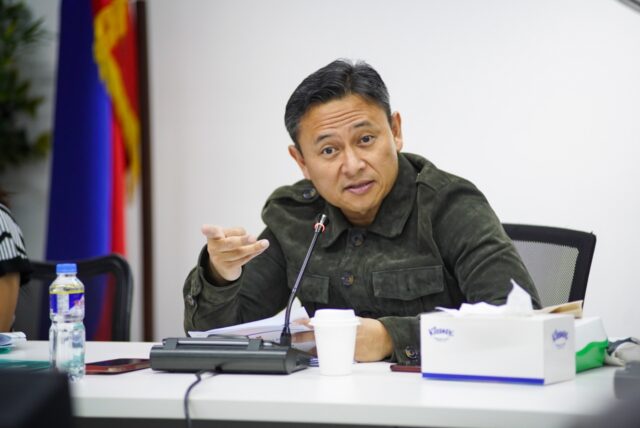
“As a parent myself, I know how heavy the responsibility of caring for and guiding a child can be,” Education Secretary Juan Edgardo “Sonny” M. Angara said in Filipino in a statement.

“When families and schools work together in shaping values and creating a better understanding of what children are going through, learners are better supported, and the work of teachers becomes lighter,” he added.

The Kaagapay program, which aims to align the values taught in schools with parental upbringing, will be implemented through parent engagement sessions and advocacy campaigns.

“The sessions are structured to help parents situate their role within DepEd’s curriculum and learner development priorities before moving into learning discussions on socio-emotional and values support, positive discipline, bullying awareness, and home–school–community partnership,” the DepEd said.

Although participation is voluntary, the agency underscored that all parents and caregivers of public school students are encouraged to participate in the sessions to prevent stigma and ensure proper representation of different family structures and socioeconomic backgrounds.

Sessions may be conducted face-to-face, modular, and asynchronous to cater to parents’ different schedules and circumstances.

The DepEd added that the rollout of the Kaagapay program, which has a P100 million budget allocation, complements the P2.9-billion allocation for the School-Based Mental Health Program, which includes suicide prevention in schools.

In 2025, several school-based violence were reported, prompting the government to strengthen mechanisms for reporting and addressing incidents involving child abuse, bullying, violence, exploitation, discrimination plus gang-related activities on campus.

A lawmaker has also pushed for the designation of mental health counselors in all public schools, including state universities and colleges, to reverse the “disturbingly increasing rates” of depression, anxiety, and even self-harm or suicidal ideation among young Filipinos.

Under House Bill 163, or “Mental Health and Digital Wellbeing for Youth Act of 2025” by Camarines Sur 2nd district Rep. Vincenzo Renato Luigi R. Villafuerte, it mandates annual mental health screenings, the establishment of safe spaces for emotional processing, and training programs for teachers in trauma-informed and empathy-based approaches.— Almira Louise S. Martinez

German Foreign Minister Wadephul says NATO allies must work together

A German national flag flies atop the illuminated Reichstag building in Berlin, Germany. — REUTERS

WASHINGTON — German Foreign Minister Johann Wadephul said on Monday that NATO allies had to work together for security, and said Greenland and Denmark should decide the future of the island, which US President Donald Trump says should belong to the United States.

Mr. Wadephul’s comments, following a meeting with US Secretary of State Marco Rubio, came amid increasing tensions over Washington’s aims toward Greenland, an autonomous region of Denmark which Mr. Trump says is vital for US security.

Mr. Wadephul said his talks with Mr. Rubio had been friendly and intensive and had underlined the importance of the alliance between European countries and the United States.

But he echoed other European politicians in rejecting Mr. Trump’s avowed intention to take control of Greenland, in defiance of his NATO allies.

“We will only strengthen security in the North Atlantic when we work together, in solidarity and united,” he told reporters. “So with regard to the issues that concern Greenland and Denmark, it is up to Greenland and Denmark to decide and it is up to people in Greenland to decide.”

The standoff over Greenland has fueled deepening fears in Europe over the future of the NATO alliance, which Danish Prime Minister Mette Frederiksen said would be finished if the United States seized the island.

Mr. Wadephul said he and Mr. Rubio had agreed on the importance of the alliance in efforts to secure a lasting peace in Ukraine and said both were committed to so-called Article 5 provisions in the NATO treaty that commit member states to come to the defense of a member state under attack.

“And in this period of uncertainty and crises, this is of decisive importance. It is a clear signal to Russia that it should not try to threaten the NATO alliance,” he said.— Reuters

Venezuela says 116 prisoners released, rights groups cite much lower figures

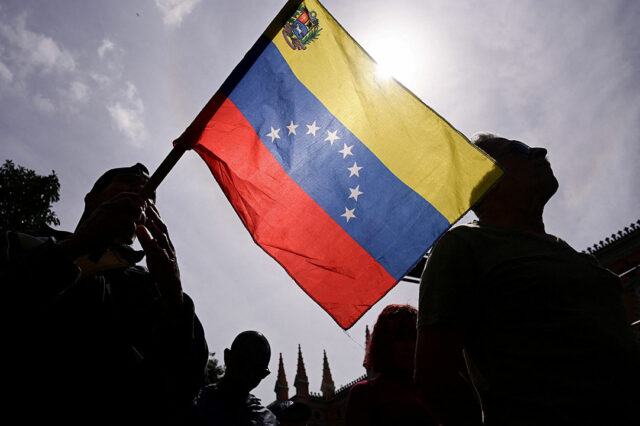
A person holds a Venezuelan flag as government supporters gather after US President Donald Trump said the US has struck Venezuela and captured its President Nicolas Maduro, in Caracas, Venezuela, January 3, 2026. — REUTERS/GABY ORAA

VENEZUELA’S government said on Monday that 116 prisoners have so far been released as part of process announced last week, though rights groups reported a lower figure as family members of the detained awaited liberations, with some sleeping outside prisons.

By late afternoon on Monday, Unidad Venezuela, a group of opposition parties, said just 65 people had been freed so far, urging the Venezuelan government in a post on X to “speed up the release process so that the suffering of political prisoners and their families can finally come to an end.”

Legal advocacy group Foro Penal had a count of just 49.

The government figure, published by the Penitentiary Services Ministry, followed three days of reports from rights organizations about delays in releases. The ministry said those being freed had been involved in “acts associated with disrupting the constitutional order and undermining the stability of the nation.”

Supporters and family members have spent the weekend gathering at detention centers throughout the capital Caracas, where they also held candlelit vigils and some stayed overnight on mattresses outside, hoping to see their loved ones set free.

“I have visited several detention centers and the answer is always the same: he is not here. A long time has passed, and I have no proof of life. I demand proof of life because I need to know how my husband is. It’s been more than a year without hearing my husband’s voice,” said Mariana Gonzalez de Tudares, the daughter of the opposition’s former presidential candidate Edmundo Gonzalez. Her husband Rafael Tudares was detained in January 2025 while driving his two young children to school.

The dripfeed of releases comes after a week of political turmoil in Caracas following the capture of President Nicolas Maduro by the United States, and his appearance in a New York court on drug trafficking charges.

The release of hundreds of political prisoners in the South American country is a long-running demand of human rights groups, international bodies and opposition figures.

Opposition leader and Nobel Peace Prize winner Maria Corina Machado, who is due to meet with US President Donald Trump this Thursday and several of whose close allies are detained, has been one of the main voices calling for releases.

Ms. Machado visited the Vatican on Monday, where she met Pope Leo and asked him to intercede for all Venezuelans who “remain kidnapped and disappeared.”

The head of Venezuela’s National Assembly, Jorge Rodriguez, had said on Thursday that a significant number of prisoners, both foreign and Venezuelan, would be released, though the government has not given a total.

According to Foro Penal, at least 800 people were being held as political prisoners at the beginning of the year in Venezuela. The government denies that there are detainees held for political reasons.— Reuters

Chito Sobrepeña, public servant and former Metrobank Foundation head, dies at 72

Photo credit | Metropolitan Bank & Trust Co. and Metrobank Foundation, Inc.

ANICETO “Chito” M. Sobrepeña, a former Cabinet Secretary who was also a long-time president of Metrobank Foundation, Inc. (MBFI), the corporate social responsibility arm of Metropolitan Bank & Trust Co., has died at the age of 72.

Mr. Sobrepeña was a civic leader and public servant who held various government posts before he moved to the private sector, serving as a Cabinet Secretary during the term of former President Corazon C. Aquino and as Deputy Director-General of the National Economic and Development Authority (now the Department of Economy, Planning, and Development) under former President Fidel V. Ramos.

Following his over 20-year stint in government, he transitioned to the private sector in the mid-1990s to lead MBFI for 30 years before he retired in 2025.

“A titan in corporate social responsibility, Mr. Sobrepeña dedicated his life to the pursuit of the common good. From his years in public service, including key leadership roles in the government, to his long and distinguished tenure as President of Metrobank Foundation, he exemplified integrity, compassion, and principled leadership,” Metrobank and MBFI said in a joint statement on Tuesday.

“In his three decades leading the Metrobank Foundation, he set new standards for corporate social responsibility. MBFI’s programs expanded meaningfully across excellence recognition, education, health, the arts, and livelihood, creating enduring hope and opportunity for Filipinos from all walks of life.”

They said Mr. Sobrepeña’s career was defined by his commitment to service, community development, and excellence with purpose, in line with the cornerstone Jesuit philosophy of being men and women for others.

“Metrobank and the Metrobank Foundation extend our deepest sympathies to his family, loved ones, colleagues, and the many individuals whose lives he touched. We honor his legacy by continuing the work he so passionately advanced, service that uplifts, empowers, and creates enduring positive change,” they said.

“Mr. Sobrepeña will be remembered not only for what he led, but for how he led — with wisdom, empathy, and unwavering commitment to the greater good.”

Trump administration probe of Fed’s Powell sparks pushback

Fed Chairman Jerome Powell — FEDERAL RESERVE

The Trump administration’s decision to open a criminal investigation into Fed Chair Jerome Powell drew condemnation from former Fed chiefs and a chorus of criticism from key members of Trump’s Republican Party on Monday, following an unusually sharp public rebuke from Powell calling the move a “pretext” to win presidential influence over interest rates.

The investigation, revealed late on Sunday when Powell said the Fed had received subpoenas from the US Justice Department, was approved and started by Jeanine Pirro, the US Attorney in Washington and an ally of President Donald Trump, according to two sources with knowledge of the investigation.

Neither Attorney General Pam Bondi nor Deputy Attorney General Todd Blanche was briefed about the decision to subpoena the Fed last week, one of the sources added.

The threat of indictment, ostensibly focused on comments Powell made to Congress about a building renovation project, sent rates on longer-term US Treasury bonds up, as investors parsed what a less independent Fed could mean for inflation and monetary policy.

If amplified, such a market reaction could constrain Trump’s efforts to reshape the Fed, considered the most influential central bank in the world and a cornerstone of the world financial system. A rise in long-term borrowing costs could also backfire against Trump’s efforts to address broad concerns about “affordability.”

The independence of central banks, at least in setting rates in order to control inflation, is considered a central tenet of robust economic policy, insulating monetary policymakers from short-term political considerations and allowing them to focus on longer-term efforts to keep prices relatively stable.

On Monday, former Fed chairs Janet Yellen, Ben Bernanke and Alan Greenspan joined with former government economic policy leaders from both political parties in raising the alarm.

“This is how monetary policy is made in emerging markets with weak institutions, with highly negative consequences for inflation and the functioning of their economies more broadly,” they wrote. Global central bankers including the chiefs of the French and Canadian central banks publicly offered solidarity.

US Republican Senator Thom Tillis, a member of the Senate Banking Committee that vets presidential nominees for the Fed, called the move a “huge mistake” on Sunday and said he would oppose any Trump nominees to the Fed, including whoever is named to succeed Powell as central bank chief, “until this legal matter is fully resolved.”

He was joined on Monday in condemning the development by fellow Banking Committee member Kevin Cramer and Senator Lisa Murkowski, who wrote on X that “the stakes are too high to look the other way: if the Federal Reserve loses its independence, the stability of our markets and the broader economy will suffer.”

Senator Cynthia Lummis, one of Powell’s more strident critics usually, on Monday said the Justice Department’s use of a criminal statute looked like a “heavy lift” and that she did not see any criminal intent.

“We need this like we need a hole in the head,” quipped Senator John Kennedy, also on the banking committee.

Treasury Secretary Scott Bessent told Trump on Sunday that the investigation “made a mess” and could be bad for financial markets, Axios reported on Monday, citing two sources.

The rise in longer-term rates notwithstanding, market reaction was relatively muted. Gold hit a record high and the dollar fell. Major US stock indexes notched record closing highs after gains from artificial intelligence stocks and Walmart.

“The market looks to be taking substantial reassurance from the fact that Powell’s decision to call out the attack on Fed independence has triggered a backlash in the Senate that will be reinforced by public support from former Fed chairs and Treasury Secretaries,” wrote Evercore ISI’s Krishna Guha.

Powell – who was nominated by Trump to lead the Fed in late 2017 and confirmed by the Senate to the position in early 2018 – will complete his term as Fed chief in May, but he is not obligated to leave its Washington-based Board of Governors until 2028. A number of analysts saw the latest move by the administration as adding to the chances that he will defiantly remain at the central bank.

The criminal indictment threat emerged about two weeks before Trump’s effort to fire another Fed official, Governor Lisa Cook, will be argued before the Supreme Court.

Until now Powell had avoided public disagreement with the Trump administration, Republican lawmakers had been largely silent and investors had been warily watching as the sparring match between the White House and the Fed played out during Trump’s second term.

Powell’s pointed response and signs of congressional pushback appear to open a new and more highly charged chapter in that row, even as House Speaker Mike Johnson told reporters he’d let the process “play out.”

‘THREATS AND ONGOING PRESSURE’

The subpoenas from the US Justice Department last week pertained to remarks Powell made to Congress last summer over cost overruns for a $2.5 billion building renovation project at the Fed’s headquarters complex in Washington, and threatened a criminal indictment.

“I have deep respect for the rule of law and for accountability in our democracy. No one – certainly not the chair of the Federal Reserve – is above the law,” Powell said.

“But this unprecedented action should be seen in the broader context of the administration’s threats and ongoing pressure” for lower interest rates and more broadly for greater say over the Fed, he said.

“This new threat is not about my testimony last June or about the renovation of the Federal Reserve buildings. It is not about Congress’ oversight role … Those are pretexts. The threat of criminal charges is a consequence of the Federal Reserve setting interest rates based on our best assessment of what will serve the public, rather than following the preferences of the President.”

Trump told NBC News Sunday that he had no knowledge of the Justice Department’s actions. “I don’t know anything about it, but he’s certainly not very good at the Fed, and he’s not very good at building buildings,” Trump said.

A Justice Department spokesperson declined to comment on the case but added: “The Attorney General has instructed her US Attorneys to prioritize investigating any abuse of taxpayer dollars.” — Reuters

Wage hike for domestic workers eyed

Jobseekers are lined up at a job fair in Antipolo, Rizal, June 12, 2025. — PHILIPPINE STAR/MIGUEL DE GUZMAN

By Erika Mae P. Sinaking

PHILIPPINE WAGE regulators opened talks on a possible increase in the minimum pay for domestic workers in Metro Manila, a move that could raise household costs for millions of families even as authorities grapple with weak compliance and uneven ability to pay.

The Regional Tripartite Wages and Productivity Board-National Capital Region on Monday held a public hearing on adjusting the minimum wage for a kasambahay (domestic worker), marking the start of deliberations that could result in a decision after Jan. 15, according to the board chairperson Sarah Buena S. Mirasol.

“We are hopeful that there will also be an increase for domestic workers, following last year’s adjustment for formal sector workers,” she told BusinessWorld.

Ms. Mirasol said the hearing in Pasay City gathered views from local governments, labor groups, employer representatives, and domestic workers themselves.

Ms. Mirasol said the board is weighing several factors, including cost of living, inflation, prevailing wages, and employers’ capacity to pay. Unlike the formal sector, household employers are largely workers themselves rather than businesses, she added.

Data presented during the hearing indicated that the average wage of domestic workers in Metro Manila is around P9,000 a month, above the current minimum of P7,000. This was set by the last minimum wage order effective Jan. 4, 2025.

“That already reflects the prevailing wage in NCR,” she said.

The board is also seeing a shift toward part-time and live-out arrangements for domestic workers, Ms. Mirasol added.

The board is currently relying on the Philippine Statistics Authority’s Labor Force Survey, while awaiting the release of a more detailed results from the rider questions on kasambahays. The results are expected later this year.

Employer representative Federico R. Marquez, Jr. said any wage hike for domestic helpers would be felt most by middle- and low-income households.

“Those earning below P50,000 a month are the ones who will really feel the increase,” he said, noting that “elite-income” households already pay above the minimum.

“For those in the top group, such as families living in gated subdivisions, the increases are negligible. In fact, the current P7,000 minimum wage is almost nothing for them. Most already pay P10,000 to P11,000 for their kasambahays. They can easily afford this,” Mr. Marquez said.

“But for employees… earning less than P50,000 — the increase is substantial. These are the households that will truly feel the impact of a wage hike for a kasambahay,” he added.

Mr. Marquez stressed the need to balance affordability with worker welfare, warning that steep increases could lead some households to forgo hiring domestic help or to circumvent the law.

He also expressed concern about weak compliance, particularly the lack of written employment contracts, which are mandatory under the Kasambahay Law (Republic Act No. 10361), also known as the Domestic Workers Act.

The law establishes comprehensive labor rights and protections for domestic workers, including a written contract, minimum wage, humane working conditions, and social security benefits.

Labor groups, meanwhile, pushed for a meaningful adjustment and stronger enforcement.

Helena Simplina, project officer of the Federation of Free Workers, said the hearing highlighted persistent noncompliance, citing cases of domestic workers earning as low as P2,000 a month.

“There are still employers who do not comply with the minimum wage and registration requirements,” she said, adding that many households remain unregistered with barangays, contributing to data gaps.

Labor sector representative Angelita D. Señorin said workers are expecting a “good increase,” noting that most domestic workers in Metro Manila already refuse jobs paying only the minimum wage.

“No one is really accepting P7,000 anymore,” she said.

Rizal Commercial Banking Corp. Chief Economist Michael L. Ricafort told BusinessWorld that cost of living and inflation, which vary by region, “are key inputs in wage decisions.”

According to the PSA, full-year NCR inflation averaged 2.4% in 2025, down from 2.6% in 2024, driven by slower food price growth, though higher housing and utility costs exerted upward pressure.

“(The wage) may look low but many of them are stay in. Free or subsidized rent, food, utilities, among others, but mostly free,” Mr. Ricafort added.

Benjamin B. Velasco, an assistant professor at the University of the Philippines Diliman School of Labor and Industrial Relations, said domestic workers deserve higher wages.

“Definitely kasambahays deserve a raise. It’s been a year since they had a wage hike,” he told BusinessWorld in a Facebook Messenger chat.

While the law mandates 10-point criteria for wage adjustments, in practice it boils down to the cost of living and the capacity of employers to pay, Mr. Velasco said.

“In the case of kasambahays, their employers are the rich, the middle class and the small number of higher paid workers in which both parents are most probably working so they need a househelp for domestic and care work,” Mr. Velasco said. “Given the sustained economic growth, I believe they have the capacity to pay kasambahays a higher salary.”

Mr. Velasco said given the option to work abroad and the high cost of living, the reservation wage — the rate at which a kasambahays is willing to work — has gone up.


ADVERTISEMENT
ADVERTISEMENT