Home Blog Page 4527

The state of tourism in the nation

EL NIDO, PALAWAN — EIBNER SALIBA-UNSPLASH

In his second State of the Nation Address on July 24, President Ferdinand Marcos, Jr. touched on several issues that I have mused about many times in this column. Due to space limitation, I will comment only on his report on tourism in today’s column.

On tourism, the President said:

“Tourism is not only an important economic development tool but the abundance of opportunities that the sector creates in terms of regular employment and even job creation at the grassroots level is undeniable.

“To boost our tourism industry, we will first and foremost make basic developments such as road improvements for easier access to tourism spots. We will also upgrade our airports and create more international airports to help decongest the bottleneck in the Manila airport.

“We will also make it more convenient for travelers to go around the country, even to remote areas to help promote undiscovered tourist spots. This program will be led by the Department of Tourism, together with the Department of Public Works and Highways.”

I join the members of both chambers of Congress in applauding the President in boosting the tourism industry. Tourism is a powerful force in the socio-economic development of many countries, both mature industrial economies and developing economies. Tourism is either the first or the second largest business for more than half of the 178 nations represented in the United Nations.

As he said, tourism is an important element of the Philippine economy. It brings in the much-needed US dollars into the country, receipts reaching $3.68 billion in 2022. It generates hundreds of thousands of jobs. Tourism-related industries spawn other industries. The hotels, restaurants, and shops give impetus to the construction industry, the restaurants create demand for farm products, and the souvenir shops and retail establishments in the area promote the handicraft industry.

But the President has to do much more than what he promised to do in his State of the Nation Address. In 2004, I was commissioned to conduct, under a grant from the United States Agency for International Development, a study of the tourism industry with a view to identifying areas of adjustments and upgrading.

I was able to identify the facets of the country that had drawn the most negative comments from visitors. They were the poor security and safety measures for tourists; inadequate infrastructure like airports, seaports, and bus terminals in Metro Manila and in the tourist destinations outside the National Capital Region; low-class domestic land and sea transportation systems; polluted air and poor sanitary conditions of the environs; the horrendous traffic in Metro Manila; and arrogant Immigration and Customs personnel at points entry into the country.

A reading of today’s newspapers and viewing of the evening TV newscast indicate that not only have those areas of concern remained in their sorry state, but they have also deteriorated further. The Ninoy Aquino International Airport, particularly Terminal 1, now ranks among the “Worst Airports in the World.” Seaports are only slightly better than wharves in fishing villages. They are not suitable even for traveling local businessmen. Foreign tourists are turned away by the shabby appearance of these ferry terminals.

Roads to tourist destinations are too narrow to carry a large volume of tourists and too bumpy for their comfort. Those that lead to the beach or mountain resorts are unsafe and are bumpier. The physical conditions of the bus terminals are pathetic. They are cramped, toilets are dirty, and appointments uncomfortable.

But more than improving roads and upgrading airports and seaports, the quality of tourism service needs to be raised several levels. Our tourism service is of low quality.

One of the findings of my study is that many personnel manning immigration windows and customs counters at the airports are arrogant. Not only that, but they are also sleazy. That is what has been my own personal experience. I traveled a lot when I was country manager for a multi-national company.

In 2009, I and my family went on a cruise of the Baltic Sea. Of the 2,000 plus employees of the Emerald Princess, 62% were Filipinos, most of them waiters, kitchen staff, and room boys. I asked some of them why the Princess Cruises had not sailed to Manila. This was their shocking story: “It did once but management of the cruise line decided to delist Manila and any Philippine port from the itinerary of any of its ships after its horrible experience with Customs officials. When one of its ships docked in Manila, the Customs agents confiscated all the liquor bottles in the ship’s bars saying that the ship had no license to sell or serve liquor or alcoholic beverages in Philippine territory. The Customs men justified the confiscation by saying the goods were untaxed items.”

But the No. 1 negative comment of visitors to the Philippines was the lack of safety measures outside airports and seaports. Many visitors to the Philippines warn their relatives and friends of unsavory characters waiting outside airports and seaports ready to pounce on tourists.

The huge traffic jams that occur in the main thoroughfares of Metro Manila every day have caused Cruise Lines International Association, Inc. to issue this warning to its passengers: “Cruise ships dock at the Port of Manila. From there, you can take a bus or cab to downtown Manila. Manila is known for its congested thoroughfares, so it’s wise to choose your transportation options carefully. Taxis are everywhere in Manila, and the meter runs in absurdly low increments of $0.03! However, don’t let a driver convince you that the meter is broken, as they will often try to do, in order to charge you triple the fare.”

A major deterrent to the growth of the tourism industry was the lack of world-class facilities in distant tourist destinations, diminishing their attractiveness. Thanks to the private sector there is now a boom of deluxe hotels in those distant tourist destinations. But transportation to them is still limited or inconvenient. Flights to island resorts and adventure sites are limited in number, if there are any. Unsafe makeshift boats and plain outriggers carry tourists to destinations that are not accessible by air. Not only that, they are not comfortable conveyances, even for a short ride.

The supply of hotel and resort manpower with the skills required to service tourists is way below the current demand for such personnel. Many universities and colleges, including those in the provinces, offer tourism-related courses. But what is badly needed, according to former Tourism Secretary Narzalina Lim, are training programs for waiters, cooks, room boys/girls/gays, and souvenir shop salespersons similar to the training programs of cruise ship companies.

The main function of the secretary of Tourism is to develop tourist destinations and attractions and the support infrastructure and services (product development) and to promote them (advertising and sales promotions). That is why I originally recommended back in 2004, after I completed my study of the tourism industry, that a marketing professional, which many people mistakenly think is the same as an advertising practitioner, be appointed as secretary of Tourism. A marketing person is much more than an advertising or sales person. The marketing professional creates value-satisfying goods and services that consumers — tourists in the case of the tourism industry — will want to buy.

After realizing that the authority of the secretary of Tourism does not extend to many components of the tourism industry like the destinations and the supporting infrastructure, I now suggest that the secretary of Tourism be both a marketing person and a politician, the persuasive kind respected by both political allies and foes.

He/she also has to badger Cabinet members, governors, and mayors to upgrade the infrastructure and domestic transportation system, clean the environment, improve the peace and order situation, and discipline Immigration and Customs personnel at points of entry to the country. This is where the politician’s savvy and network would serve him/her in good stead.

The current secretary of tourism does not have a marketing or advertising background. She is a politician but not the persuasive kind. She is the authoritarian kind, as manifested by her decision to stick to her “Love the Philippines” slogan in total disregard of the advice of experts in the field of promotional campaigns.


Oscar P. Lagman, Jr. is a retired corporate executive, management professor, and business consultant.


Axelum launches coconut milk powder

AXELUM Resources Corp. launched its latest coconut milk powder in flexible retail pouches to boost its branded segment for the consumer market.

In a media release on Monday, the coconut product manufacturer said its Fiesta Coconut Milk Powder may be used as an ingredient in different dishes or as a dairy substitute.

“This forms parts of our strategy of leveraging on our manufacturing expertise, combined with efficient brand-building campaigns, to further strengthen our domestic presence,” said Axelum President and Chief Operating Officer Henry J. Raperoga.

The company is conducting product research and development focused on local and overseas retail sectors to take advantage of the emerging health and active lifestyle trend in plant-based consumption.

“We are excited for customers to partake in a world-class product, with a host of innovative applications at affordable price points to offer a better-for-you guilt-free indulgence,” Mr. Raperoga said.

Axelum said that its new product is available in major supermarket chains nationwide, as well its official stores in Shopee and Lazada.

In the three months ending in March, Axelum reported an attributable net loss of P69.26 million, reversing its P181.93-million net income in the same period last year.

Axelum has business interests in manufacturing coconut water and other coconut products for the domestic and international markets.

It sends its products to the United States, Canada, Australia, New Zealand, Europe, the Middle East, Japan, and other major countries in Asia.

On Monday, Axelum shares went down by six centavos or 2.64% to close at P2.21 apiece. — Sheldeen Joy Talavera

Ghostbusters, Spider-Man are latest films impacted by strike

SONY Pictures is the latest movie studio shaking up its release schedule amid the ongoing work stoppage by Hollywood writers and actors.

Gran Turismo, a car-racing film originally scheduled for a wide release on Aug. 11, will instead get sneak previews for two weekends before coming to more theaters on Aug. 25, a strategy designed to cope with strike-related prohibitions on actors engaging in their usual publicity tours. “The stars can’t promote the movie, but the audience can,” Sony said in an e-mail announcing the changes on Friday.

An untitled Ghostbusters sequel previously scheduled for December has been pushed back to March of next year. Kraven the Hunter, based on the Marvel Comics character of the same name and previously scheduled for October, is now moving to Aug. 30, 2024.

The release date for Spider-Man: Beyond the Spider-Verse, was pulled. The latest in Sony’s series of animated films based on the character had been scheduled for March. “The studio is considering several dates depending on how long the strike lasts,” the company said of the picture.

Strike rules prevent actors represented by the SAG-AFTRA union from participating in red carpet premieres, press interviews, and film festivals to promote their projects. That’s upending marketing strategies and stands to dent the box office performance of films released during the strike.

Delays are especially unwelcome news for theater chains including AMC Entertainment Holdings, Inc. and Cineworld Group Plc that are desperate for more films to accelerate their recovery from pandemic-induced lockdowns.

Walt Disney Co. said earlier this week that it was delaying Poor Things, a film starring Emma Stone, until December. Bloomberg News earlier reported that the company was reviewing its release strategy for several pictures.

Writers and actors are seeking better compensation and benefits from studios as well as protections from artificial intelligence taking over their jobs. They have been on strike since May and July respectively, which has brought many Hollywood productions to a standstill. — Bloomberg

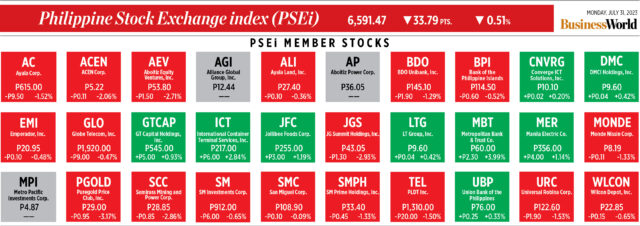
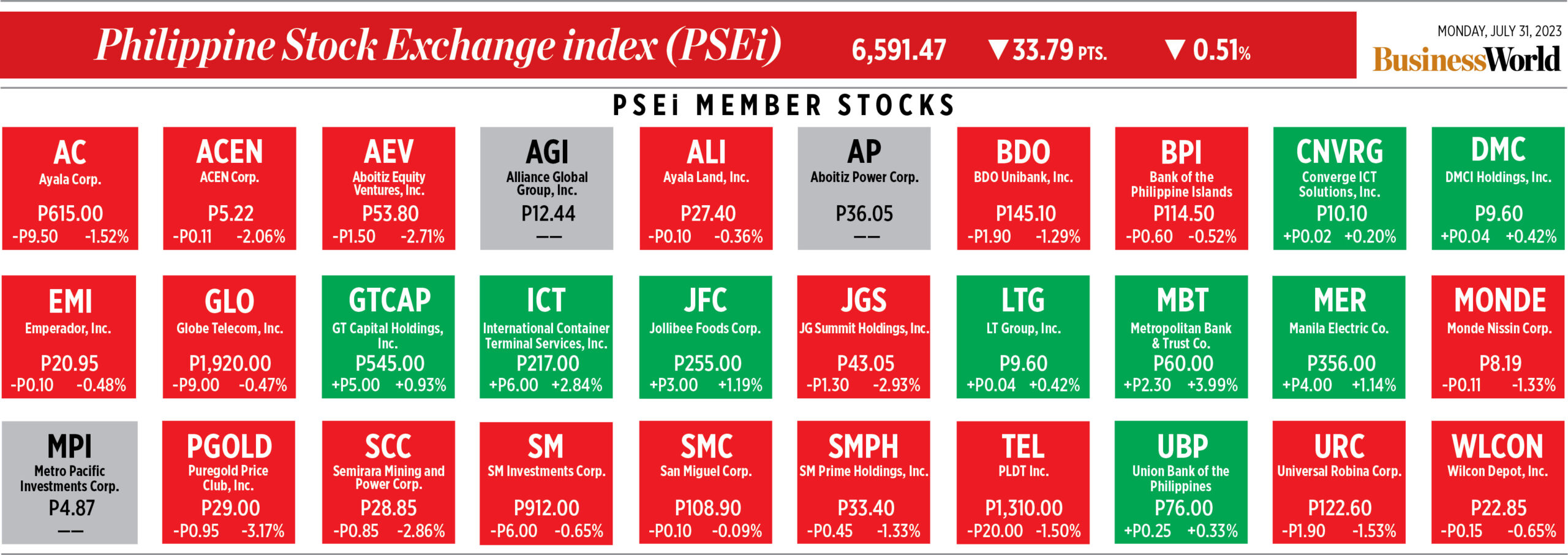
How PSEi member stocks performed — July 31, 2023

Here’s a quick glance at how PSEi stocks fared on Monday, July 31, 2023.


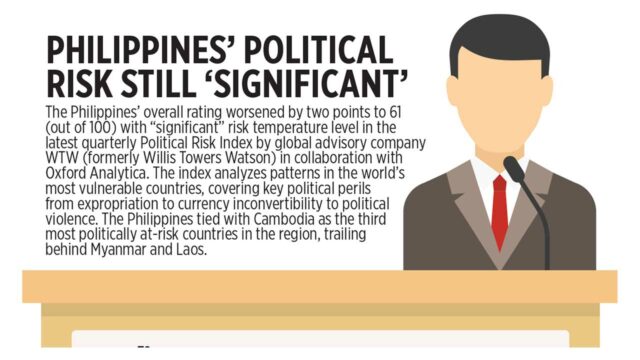
Philippines’ political risk still ‘significant’

The Philippines’ overall rating worsened by two points to 61 (out of 100) with “significant” risk temperature level in the latest quarterly Political Risk Index by global advisory company WTW (formerly Willis Towers Watson) in collaboration with Oxford Analytica. The index analyzes patterns in the world’s most vulnerable countries, covering key political perils from expropriation to currency inconvertibility to political violence. The Philippines tied with Cambodia as the third most politically at-risk countries in the region, trailing
behind Myanmar and Laos.

Peso up on inflation, Fed bets

BW FILE PHOTO

THE PESO appreciated against the dollar on Monday on expectations of easing inflation and bets that the US Federal Reserve would keep rates steady following positive data last week.

The local currency closed at P54.88 versus the dollar on Monday, inching up by three centavos from Friday’s P54.91 finish, data from the Bankers Association of the Philippines’ website showed.

The local unit opened Monday’s session at P54.888 per dollar. Its weakest showing of the day was at P54.91, while its intraday best was at P54.75 against the greenback.

Dollars traded dropped to $1.03 billion on Monday from the $1.1 billion seen on Friday.

The peso strengthened on expectations that Philippine inflation eased in July, Rizal Commercial Banking Corp. Chief Economist Michael L. Ricafort added in a Viber message.

A BusinessWorld poll of 17 analysts yielded a median estimate of 4.9% for July headline inflation.

If realized, this would be below the 5.4% in June but would match the 4.9% seen in April last year. It would also match the upper end of the Bangko Sentral ng Pilipinas’ 4.1% to 4.9% forecast.

Still, this would be the 16th straight month that the consumer price index (CPI) exceeded the central bank’s annual 2-4% target.

The Philippine Statistics Authority will release July CPI data on Friday.

“The peso appreciated after the Federal Reserve’s preferred inflation gauge came in slightly weaker than market expectations at 3%, bolstering views of no further US rate hikes for the year,” a trader said in an e-mail.

Annual US inflation rose at its slowest pace in more than two years in June, with underlying price pressures receding, a trend that, if sustained, could push the Federal Reserve closer to ending its fastest interest rate hiking cycle since the 1980s, Reuters reported.

The personal consumption expenditures (PCE) price index increased 0.2% last month after edging up 0.1% in May, the Commerce department said. In the 12 months through June, the PCE price index advanced 3%. That was the smallest annual gain since March 2021 and followed a 3.8% rise in May.

The Fed hiked interest rates by 25 basis points (bps) last week, bringing its target rate to a range between 5.25% and 5.5%.

The US central bank has now raised rates by 525 bps since it began its tightening cycle in March last year.

For Tuesday, the trader said the peso could strengthen further against the dollar as the market awaits the July inflation report.

The trader sees the peso moving between P54.60 and P54.85 per dollar on Tuesday, while Mr. Ricafort sees it ranging from P54.80 to P55. — A.M.C. Sy with Reuters

PHL stocks decline on last-minute profit taking

BW FILE PHOTO

SHARES declined on Monday due to last-minute profit taking as investors await the release of July inflation data this week.

The Philippine Stock Exchange index (PSEi) declined by 33.79 points or 0.51% to close at 6,591.47 on Monday, while the broader all shares index dropped by 10.25 points or 0.29% to 3,516.67.

“The local market lost 33.79 points to 6,591.47 due to last-minute profit taking. The market mostly traded in the green territory on anticipation of a slower inflation in July at home but it failed to sustain the momentum due to negative sentiment overseas, especially in China, as China’s factory activity for July was in contraction territory,” Philstocks Financial, Inc. Research Analyst Claire T. Alviar said in a Viber message.

Selling pressure affected the market as investors adjusted their portfolios as July came to a close, China Bank Capital Corp. Managing Director Juan Paolo E. Colet said.

The Philippine Statistics Authority will release July consumer price index (CPI) data on Friday, Aug. 4.

A BusinessWorld poll of 17 analysts yielded a median estimate of 4.9% for July inflation.

If realized, this would be below the 5.4% in June but would match the 4.9% seen in April last year.  However, this would mark the 16th straight month that the CPI exceeded the central bank’s 2-4% target.

Meanwhile, China manufacturing activity fell for the fourth straight month in July as its services and construction edged along contraction, threatening growth prospects for the third quarter, Reuters reported.

The official manufacturing purchasing managers’ index inched up to 49.3 in July from 49 in June, staying below the 50-point mark that separates expansion from contraction.

At home, most sectoral indices fell on Monday except for services, which rose by 11.22 points or 0.7% to 1,613.19, and financials, which inched up by 0.54 point or 0.02% to 1,940.59.

Meanwhile, holding firms fell by 67.99 points or 1.06% to 6,328.99; mining and oil dropped by 50.9 points or 0.48% to 10,364.31; property declined by 12.63 points or 0.46% to 2,709.85; and industrials went down 29.59 points or 0.32% to 9,176.73.

Value turnover surged to P20.07 billion on Monday with 1.95 billion shares changing hands from the P2.91 billion with 635.55 million issues seen on Friday.

Decliners narrowly outnumbered advancers, 84 versus 83, while 64 names closed unchanged.

Meanwhile, Asian shares were trying to end the month on a firm note on Monday in a week littered with major economic releases, central bank meetings and earnings updates from mega-caps Amazon and Apple, Reuters reported.

MSCI’s broadest index of Asia-Pacific shares outside Japan  climbed 0.5%, having gained 5.2% so far in July to reach a five-month high.

The initial impetus for markets was positive following Friday’s US data showing an easing in wage costs and core inflation, which fueled hopes the US Federal Reserve was done tightening. — A.H. Halili with Reuters

NFA rice inventory drops to under two days’ worth of consumption

PHILSTAR FILE PHOTO

THE rice inventory held by the National Food Authority (NFA) is currently equivalent to 1.56 days’ demand, well below the nine days targeted by the agency, due to high domestic buying prices, the Department of Agriculture said.

Agriculture Assistant Secretary Rex C. Estoperez told reporters on Monday that the NFA’s holdings totaled 50,000 metric tons (MT) as of July 27, considerably below the 300,000 MT level required to meet nine days’ demand because private traders are outbidding the NFA.

The national daily consumption rate is equivalent to 679,670 bags or 33,983.5 MT, according to the NFA.

“As of now, it seems that the NFA is not able to buy from farmers because of the high price. The private sector can buy (unmilled rice, or palay) between P21-P23 per kilo (while) the NFA buys at P19,” he said.

Istrikto kasi ang NFA sa kanyang tinatawag na equivalent net weight (The NFA is strict in buying only equivalent net weight) as the P19 buying price is for clean and dry palay, while the private traders buy freshly harvested palay at P21-P23. The NFA cannot compete,” he added.

Under Republic Act No. 11203 or the Rice Tariffication Law, the NFA has been stripped of its power to import rice and has been reduced to maintaining an emergency inventory from domestically-grown rice.

Mr. Estoperez said that the NFA Council will submit a recommendation to the President to reconsider the NFA buying price and measures to build up inventory.

The NFA Council is headed by President Ferdinand R. Marcos, Jr., who is also the Secretary of Agriculture, while NFA Administrator Roderico R. Bioco serves as vice-chairman.

Mr. Estoperez said that Mr. Marcos will meet with various agencies to discuss measures to increase rice stocks, including imports.

“Our inter agency group will update the President tomorrow whether to finalize (import deals), what volume, where to source, on a government-to-government basis,” he said. — Sheldeen Joy Talavera

Budget dep’t seeking to fully digitize gov’t procurement process

BUDGET SECRETARY AMENAH F. PANGANDAMAN — DBM

THE Department of Budget and Management (DBM) said it is working on the full digitalization of public procurement.

In a statement on Monday, the DBM said its Procurement Service (PS) is shooting for “an efficient procurement system incorporating global best practices, including the complete digitization of all government procedures,” Budget Secretary Amenah F. Pangandaman said.

“The procurement process, widely seen as the most daunting bottleneck in budget utilization due to alleged rampant corruption, interpretational ambiguities, and a lackluster capability to carry out procurement tasks within government agencies, causes service delivery delays,” the DBM added.

The PS is also working on modernizing the Philippine Government Electronic Procurement System. Improvements include an integrated e-bidding system and electronic payment facility, among others.

“An efficient procurement system underpins effective public expenditure management and fast-tracks the delivery of optimal services to the public in a timely and cost-efficient manner,” PS Executive Director Dennis S. Santiago said.

In his State of the Nation Address last week, President Ferdinand R. Marcos, Jr. called for a new government procurement law.

“I think the procurement law is too stringent. Even digitalization and payment systems are not provided for in the law,” Ms. Pangandaman said.

The DBM is also working on implementing sustainable procurement practices.

“Green procurement is synonymous with responsible procurement. The integration of green solutions into the public procurement process brings us a step closer to our ultimate aim of promoting sustainable management and utilization of natural resources by 2030,” Ms. Pangandaman added.

The DBM has recently met with the United Nations Development Programme to enhance procurement digitalization and analytics. — Luisa Maria Jacinta C. Jocson

Business group supports optional senior high

PHILIPPINE STAR/ MIGUEL DE GUZMAN

THE Management Association of the Philippines (MAP) expressed support for a measure that would make senior high school optional.

“We in the MAP support the bill introduced that seeks to examine the K-12 (Kindergarten to Grade 12) system and replace it with a K+10+2 act,” MAP CEO Conference Committee Chairperson Alma Rita R. Jimenez told the House basic education and culture committee.

“The private sector (has a) continuing preference for hiring college or university graduates over those who finish K-12 primarily because those who finished Grades 11 and 12 still lack the competencies or skills at the level required for employment,” she said.

Ms. Jimenez cited the need to streamline the K-12 curriculum “so that it can fully integrate technical and vocational education and training program to increase enterprise-based learning where the senior high school student will have more immersive experiences through certification training and exposure to actual work settings.”

The committee was considering proposed amendments to Republic Act No. 10533 or the Enhanced Basic Education Act of 2013, which added two more years to basic education with the intent of making graduates employable and globally competitive. 

Committee chairman and Pasig Rep. Roman T. Romulo said House Bill 7893 will propose “multiple education pathways,” which will involve enhancing programs run by the Technical Education and Skills Development (TESDA), making these courses a more viable option for students after Grade 10.

“Meaning, when you reach Grades 10, 11 and 12, if you want to go to college, you’ll be under DepEd (Department of Education). If you want to go to techvoc (technical and vocational education), then enroll in TESDA,” he said.

“We will require TESDA to upgrade itself,” Mr. Romulo added, noting that the agency mostly issues certifications for graduates of Customer Services NC II, a short course to train staff for department stores, supermarkets, fast food outlets, and specialty stores.

He added that only a few students receive the Bookkeeping NC III certification.

Ms. Jimenez added that TESDA should revamp its programs to make them “future-oriented” and to usher in digital transformation. Teachers and instructors should also undergo training, she noted. — Beatriz Marie D. Cruz

PHL businesses to participate in ASEAN Online Sale

ONLINEASEAN.COM

PHILIPPINE BUSINESSES are set to participate in the ASEAN Online Sale Day (AOSD), the Department of Trade and Industry (DTI) said.

The DTI said in a statement on Monday that as of July 27, some 54 businesses are expected to join the event, which is scheduled for Aug. 8-22. The e-commerce event is intended to promote cross-border trade and economic collaboration within Southeast Asia. 

The AOSD, started in 2020, is expected to boost economic ties in the region, increase consumer trust in e-commerce, and provide opportunities for micro-, small- and medium-sized enterprises.

According to the DTI, the Philippines has fielded the highest number of participating businesses in the AOSD since 2020. Last year, 120 e-commerce businesses from the Philippines participated in the event.

The DTI said that a consumer complaint mechanism will be available to mediate any complaints arising from transactions completed during the event.

An onsite edition of the event will take place in Semarang, Indonesia between Aug. 19 and 22. — Revin Mikhael D. Ochave

Travel fair claims P110 million worth of actual, potential sales

Tourists are seen at the beach of Boracay island, Aklan province. — PHILIPPINE STAR/KRIZ JOHN ROSALES

THE Tourism Promotions Board (TPB) said a travel fair which it organized in Cebu generated actual and potential sales of over P110 million.

The three-day 11th Regional Travel Fair at the SM Seaside City in Cebu featured 70 exhibitors. The TPB did not give a breakdown of sales actually booked as against sales under negotiation.

TPB Chief Operating Officer Maria Margarita M. Nograles said in a statement on Monday that the results of the fair “signal a bright future for the tourism industry in the post-pandemic era.”

The TPB said its upcoming fair in Ilocos set for October could result in an even stronger performance.  

“We desire and aim to play a major role in shaping the future of tourism by creating a one-stop shop venue for industry collaboration and partnerships,” Tourism Undersecretary Shahlimar Hofer Tamano said. — Revin Mikhael D. Ochave

ADVERTISEMENT
ADVERTISEMENT