Home Blog Page 4526

8990 Holdings optimistic of hitting P24-B revenues

8990 HOLDINGS, Inc. expects to hit a top line of P24 billion this year, its top official said on Monday, citing the listed developer’s property portfolio as the main driver.

“We are hopeful that we can really target P24 billion [in revenues] for the rest of the year,” said 8990 President and Chief Executive Officer Anthony Vincent Sotto in a media briefing.

Mr. Sotto added that revenues for the year would be mainly driven by the company’s properties in Metro Manila, which would mainly be contributed by its Ortigas and Manila projects.

Additionally, he said that the company is planning to expand to other parts of the country, by developing smaller offerings in the provinces.

“We are now looking at going to provinces that are ripe already for development, but in smaller areas. Before, we were targeting more than 20 hectares in a certain area, and we found out that it was better and faster to develop smaller areas,” he said.

He added that the company is targeting to develop five hectares of horizontal properties as it expands to Tacloban City, the provinces of Samar and Leyte in the Visayas, and other parts of Luzon and Mindanao.

Meanwhile, Mr. Sotto said in a statement that the company has 16 ongoing projects which are expected to contribute about P155 billion in revenues in the next seven to eight years.

“As of the end of the quarter, 8990’s land holdings now stand at 709.35 hectares with the addition of properties acquired in Cebu and Leyte,” he added.

The company said that its land bank in Luzon is expected to generate P98 billion on its top line, while Visayas and Mindanao are expected to contribute P67 billion and P6 billion, respectively.

During the first quarter, the company reported a 2.07% decline in attributable net income to P1.89 billion from P1.93 billion the previous year because of higher material costs.

In the three-month period, its revenues went up by 1.7% to P5.34 billion from P5.25 billion in the same period last year.

8990, through its subsidiaries, develops low-cost mass housing, medium-rise condominiums, and high-rise buildings.

It has six wholly owned subsidiaries, namely: 8990 Housing Development Corp., 8990 Luzon Housing Development Corp., 8990 Mindanao Housing Development Corp., 8990 Davao Housing Development Corp., 8990 Leisure and Resorts Corp., and Fog Horn, Inc.

On Monday, 8990 inched up by 0.11% or one centavo to P9.26 per share. — Adrian H. Halili

Reading the room and filling it with music

THE BEOSOUND A5’s two designs are Dark Oak and Nordic Weave.

NOW that music is more accessible than ever and part and parcel of everyone’s lives, Bang & Olufsen (B&O) has come up with a way to seamlessly integrate playing music into the day-to-day grind.

The Danish audio brand has partnered with GamFratesci Studio for the simple yet detailed Scandinavian design of its latest portable speaker, the Beosound A5. What sets it apart from previous designs is that it masquerades as a picnic basket.

“It becomes a conversation piece when people don’t know it’s even a speaker. People see it and get confused because how could that small thing fill an entire room with music?” Vince Miclat, Bang & Olufsen brand manager, said during the launch on July 27.
“The sound engineers and designers collaborated to produce that, with the material really being wood,” Mr. Miclat said.

The Beosound A5 comes in two designs — Nordic Weave and Dark Oak — both made of real oak wood. Aside from being able to blend into the interiors of a house, it evokes colors and textures found in nature.

As an evolution of B&O’s line of quality audio equipment, the speaker has a powerful woofer that lets you feel the music. Most importantly, its signature RoomSense technology adapts playback based on the space it’s in, whether it’s in a spacious living room or a small bathroom.

“You will get the finest fidelity wherever you are. It has 360-degree sound dispersion so everyone can experience the music regardless of where they are in the room, but you can also narrow the sound direction using the B&O app,” Mr. Miclat explained.

“Some compare our speakers to other brands and wonder why the bass isn’t as strong, but our approach is that however the music or film was recorded, that’s how you’re going to hear it. That’s how the recording artist or filmmaker wanted it to sound,” he added.

The Beosound A5 can also be used outdoors (it does look like a picnic basket, after all) since it has a 12-hour battery life. People can connect to it via Wi-Fi or Bluetooth and it supports all streaming technologies.

Its modular design means that individual parts can be replaced too, unlike most speakers that are entirely disposable as soon as one-part malfunctions.

At the July 27 launch at The Curator bar in Makati, BusinessWorld was invited along with other media outlets to experience the speaker. True enough, the sound was clear and powerful, filling the entire room despite the device’s compact size.

There was also total control over how the music could be projected, with the B&O app able to fine-tune the sound to play to a specific area. It was particularly thrilling to listen to classical music where the violins sounded as crisp as if they were reverberating in a concert hall.

The Nordic Weave is priced at P77,000 while the Dark Oak, being of thicker material, costs P86,000.

These prices, though steep for the average consumer, are definitely worth it for audiophiles who want more bang for their buck, according to Mr. Miclat.

“B&O specializes in design, craftsmanship, and authenticity. That’s what we’ve been known for from 1925 until now, and the Beosound A5 proves no different,” he said.

For more information, visit the Bang & Olufsen official pages on Facebook and Instagram. Its two physical stores are located in Power Plant Mall, Makati City, and Shangri-La Plaza Mall, Mandaluyong City. — Brontë H. Lacsamana

BDO Unibank posts higher net income in the second quarter

BW FILE PHOTO

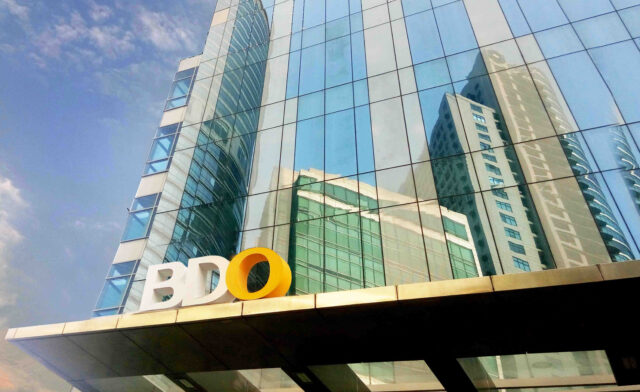
BDO UNIBANK, Inc. saw its net profit climb by 53.18% in the second quarter amid higher net interest earnings.

The Sy-led bank’s attributable net income stood at P18.72 billion in the second quarter, rising from the P12.72 billion booked in the same period last year, its financial statement filed with the local bourse on Monday showed.

This brought its attributable net profit for the first half to P35.25 billion, 11.21% higher year on year, amid growth across its core businesses.

This translated to a return on average common equity of 15.1%, up from 11.27% the year prior, while its return on average assets stood at 1.73% at end-June, also higher than the year-ago level of 1.3%.

BDO’s net interest income rose by 29.73% year on year to P46.10 billion in the second quarter.

Interest earnings from loans and receivables climbed by 47.13% to P48.12 billion. Interest income from trading and securities investments also rose by 48.6% to P8.742 billion. Meanwhile, interest expense jumped to P12.9 billion in the second quarter from P3.514 billion a year prior.

The bank’s net interest margin stood at 4.65% at end-June, up from 4.02% a year ago.

Other operating income also went up by 9.37% to P19.24 billion in the second quarter from P17.6 billion as the bank booked higher earnings from service charges, fees and commissions and a smaller net trading loss.

Meanwhile, total other operating expenses rose by 15.62% to P37.8 billion in the period from P32.69 billion.

The bank’s customer loans grew by 8% year on year to P2.7 trillion at end-June.

Despite the increase in loans, BDO’s nonperforming loan (NPL) ratio dropped to 1.95% at end-June from 1.98% at end-March, while NPL coverage “improved” to 174% “with prudent credit and provisioning policies,” it said.

On the funding side, deposits went up by 12% year on year to P3.3 trillion at end-June amid a 4% growth in demand deposits and 86% increase in time deposits.

BDO’s total resources stood at P4.16 trillion as of June, up by 9% year on year.

Total equity grew by 13% to P489.75 billion at end-June from the year-ago level.

The bank’s capital adequacy ratio stood at 14.97% as of June, up from 14.48% a year prior, while its common equity Tier 1 ratio was at 13.9%.

“With improving macroeconomic trends exemplified by decelerating inflation, sustained GDP (gross domestic product) growth and stable foreign exchange and interest rates, the bank remains poised to capitalize on emerging growth opportunities given its solid balance sheet, strong business franchise and diversified earnings streams,” BDO said in a statement.

BDO’s shares dropped by P1.90 or 1.29% to end at P145.10 each on Monday. — A.M.C. Sy

On the road to recovery (Part 1): Prices, rents recover as M.Manila condominium market rebounds

Condominium buildings are seen from the Estrella-Pantaleon Bridge in Makati City, Dec. 5, 2022. — PHILIPPINE STAR/MIGUEL DE GUZMAN

By Joey Roi Bondoc

Condominium buildings are seen from the Estrella-Pantaleon Bridge in Makati City, Dec. 5, 2022. — PHILIPPINE STAR/MIGUEL DE GUZMAN

COLLIERS PHILIPPINES believes that the residential market will greatly benefit from a strong rebound of the Philippine economy.

Equity analysts and private sector economists are projecting the Philippine economy to expand between 5.5-7% in 2023, after last year’s 7.6% growth which was the fastest pace in more than 40 years. This optimism is supported by the bright outlook of the government’s economic managers. 

Colliers is optimistic that this pace of expansion bodes well for the Philippine property market and should ensure the segment’s rebound after a disruptive two-year period (2020-2021).

In our view, a more optimistic forecast about business expansion and the entry of foreign investments will help drive the property sector, especially the residential market. According to the central bank, consumers and businesses are more optimistic and this should support further expansion of businesses and eventually, the acquisition of more properties, including residential units across the Philippines.

Over the next 12 months, developers are likely to be more cautious with their new launches; with landbanking likely to rely heavily on the government’s massive infrastructure program. Colliers believes that the residential market is starting to see some recovery but this will mainly hinge on economic expansion, including the level of remittances and investments that will flow into the country.

RESIDENTIAL LEASING PICKS UP
Over the past six months, residential leasing has picked up, partly supported by demand from foreign employees of outsourcing firms, consular offices, and multilateral lending firms based in the Makati, Ortigas and Fort Bonifacio central business districts. These business hubs have also been benefiting from improving office space take-up.

The decline in residential vacancies has positively influenced rents and prices. In the pre-selling market, there has been an increase in launches and take-up in the first half.

What’s positive for the residential market is that recovery is seen not just in the secondary but also in the pre-selling market. We are still definitely far from pre-pandemic demand, especially since there is no longer demand from the offshore gaming sector which helped fuel the market’s growth from 2017 to 2019.

Colliers believes that developers should be guided by the interest rate environment and future adjustments should have an impact on the promotions and payment schemes they will implement for the remainder of the year.

Given the compressing yields in the market, property firms should also continue highlighting the capital appreciation potential of condominium units, especially those located in masterplanned communities. Developers should zero in on the residential units’ viability as a hedge against inflation.

In our view, developers should also explore the viability of launching more horizontal projects outside Metro Manila. As I previously noted, there is a strong end-user market outside of Metro Manila and developers are definitely banking on this demand. Hence, we are likely to see more masterplanned and horizontal projects in the provinces moving forward.

MONITOR INTEREST RATE CHANGES
The country’s inflation rate is decelerating but the central bank noted that it is unlikely to cut interest rates for the remainder of 2023.

Colliers believes that developers and investors need to constantly monitor inflation and interest rate changes and these indicators’ eventual impact on mortgage rates. Interest rates remain at 6.25% as of June 2023 while average mortgage rates increased to 8.1% in Q2 2023 from 7.3% a year ago and from 7.4% in 2020.

Colliers encourages investors to proactively monitor interest and mortgage rates, particularly as these strongly influence the viability of condominium as a residential investment. Interest rates should guide developers with their promos and payment schemes and if it is already necessary for developers to revisit their rates, promos and payment schemes to reignite interest from investors and end-users.


Joey Roi Bondoc is the research director at Colliers Philippines.

Finding solutions to economic and tax issues

DRAZEN ZIGIC-FREEPIK

Ever since the pandemic hit, economic development around the world has slowed down. In the Philippines, issues on budget deficits, increasing debt, and rising inflation have been staples in the news. But are these issues really as bad as we make it out to be? Though it may sound surprising, the Philippines is actually doing quite well, economically speaking.

According to Ralph van Doorn, a Senior Economist at the World Bank Philippines, the Philippines outperformed its regional peers in terms of economic growth. In his presentation at the 2023 International Tax Conference, Van Doorn reported that, for the first quarter of 2023, the Philippines grew by 6.4%, attributed largely to strong domestic demand.

Still, this is not all sunshine and rainbows. The Philippines still has the highest headline inflation within the ASEAN, and there are certain risks peculiar to the Philippines, such as the possibility of El Niño creating supply chain bottlenecks that may result in increasing food prices.

Romeo Balanquit, Assistant Secretary of the Department of Budget and Management (DBM), provided a similar positive outlook on the economy. He discussed the government’s Medium-Term Fiscal Framework at the conference. Among the key points of the Framework are improving tax administration, creating a broader revenue base, and the digitalization of government processes.

According to the Framework, tax administration can be improved through the digitalization and the modernization of the Bureau of Internal Revenue (BIR) and the Bureau of Customs (BoC). Meanwhile, a broader revenue base can be achieved through the imposition of taxes on digital service providers and excise taxes on sweetened beverages, single-use plastics, and pre-mixed alcohol products, and other similar policies.

The government’s proposal on the digitalization of its revenue collecting agency is in line with expert views on effective tax policies. Aekapol Chongvilaivan, a Senior Economist at the Asian Development Bank, noted that optimizing tax policy and administration can lead to an increase in the tax-to-GDP ratio by about three to four percentage points in the Asia-Pacific region.

Chongvilaivan noted that developing countries should have a tax-to-GDP ratio of at least 15% to ensure that they have the resources necessary to achieve sustainable economic growth. However, only Cambodia, Thailand, and Vietnam were able to achieve that threshold.

One of the problems he identified was that countries in the Southeast Asia region tended to have inefficient tax administrations. Even though Singapore remained among the top of the World Bank’s Paying Taxes rankings, the majority of the countries in Southeast Asia were in the bottom half of the rankings. Moreover, except for Indonesia, the Philippines, and Vietnam, most jurisdictions in Southeast Asia have not improved significantly since 2020.

He also identified taxation of the digital economy as a possible solution to improving the tax-to-GDP ratio. Presently, multinational companies pay their tax where production occurs, but in the digital economy, businesses can derive their income from consumers all over the world.

Ragnar Gudmundsson, the Resident Representative of the International Monetary Fund (IMF), also noted that once a country’s tax-to-GDP ratio reaches about 12.75%, economic growth increases sharply. However, a higher ratio is needed for emerging markets. Based on IMF estimates, the Philippines reached a tax-to-GDP ratio of 14% in 2020 and was projected to reach 14.7% in 2022. Still, this remains below the average for Asia-Pacific countries.

So, what can we do to fix this?

Gudmundsson noted recommendations on how to improve the collection of personal income tax and corporate income tax, but noted that VAT is where the Philippines was least efficient. VAT revenue collection in the Philippines was significantly below the average for emerging market economies, capturing only about a third of its potential tax base. He discussed that the VAT system could benefit from the adoption of anti-avoidance rules, enhanced VAT administration, and strict compliance mechanisms.

Aside from tax experts, Senator Win Gatchalian also prepared a presentation at the conference. He discussed the tax regime for micro, small and medium enterprises (MSMEs) and the proposed policies on how to improve the tax system. Particularly, he discussed the features of Senate Bill No. 2224, or the Ease of Paying Taxes Act, and Senate Bill No. 1806, or the Taxpayer’s Bill of Rights and Obligations Act.

Improving tax administration and simplifying tax compliance not only boosts revenue collection but can also lessen corruption. In the recently published book Reimagining the World Without Corruption, I provided a discussion on what corruption is and what measures we have implemented, and can implement, in the fight against corruption.

These economic and tax issues and policy proposals were all discussed at the 2023 International Tax Conference held on June 15. Hosted by renowned journalist Rico Hizon, the event was the culmination of the International Tax Roadshow of the Asian Consulting Group (ACG), which sought to guide Filipinos abroad and foreign investors in investing and doing business in the Philippines. Through the International Tax Conference, ACG continued this goal by creating a platform where these issues, which affect business owners and investors alike, could be discussed. As noted by Former Trade and Industry Secretary Ramon Lopez, who was the Conference Chair at the event, discussing these topics and policies is important if we want to help our MSMEs.

This article reflects the personal opinion of the author and does not reflect the official stand of the Management Association of the Philippines or MAP.


Raymond “Mon” A. Abrea is a MPA/Mason Fellow at the Harvard Kennedy School. He is a member of the MAP Tax Committee and the MAP Ease of Doing Business Committee, co-chair of the Paying Taxes on Ease of Doing Business Task Force, and the chief tax advisor of the Asian Consulting Group.

map@map.org.ph

mon@acg.ph

Court of Tax Appeals grants part of Halliburton Worldwide’s refund claim

HALLIBURTON/SEC

THE COURT of Tax Appeals (CTA) has granted part of Halliburton Worldwide, Ltd.’s refund claim in the amount of P7.67 million representing its excess input value-added tax (VAT) traced to zero-rated sales for the calendar year 2017.

In a decision dated July 26 and made public on July 28, the CTA Special Second Division said the firm complied with invoicing requirements under the Tax Code for the amount granted.

Halliburton Worldwide initially sought a P12.24 million refund claim for the period.

“Thus, for purposes of, and with regard to the petitioner’s (Halliburton Worldwide) compliance with the input taxes being attributable to zero-rated sales… only the amount of P7.67 million represents the petitioner’s valid input VAT attributable to its valid zero-rated receipts for the calendar year 2017,” Associate Justice Lanee S. Cui-David said in the ruling.

The firm is engaged in oil field services and the development of equipment and technology related to the oil and gas industries. It is the Philippine branch office of the Cayman Islands-based firm.

Under the law, taxpayers that engage with foreign firms doing business outside the Philippines are entitled to zero-rated sales that do not translate to output tax.

The term “zero-rated sale” must be written on the company’s official invoices.

Sales that qualify for 0% VAT include services other than processing, manufacturing, or repacking of goods; services performed in the Philippines by VAT-registered persons, and sales paid in acceptable foreign currency in line with the central bank’s rules.

In April, the CTA upheld granting only P55,610.63 out of P11.6 million of its excess VAT for the year 2015, for failing to prove that the remaining amount qualified for 0% VAT.

Under the country’s law on renewable energy developers, a VAT-registered entity’s sales to renewable energy developers are subject to 0% VAT, which does not translate to output tax.

“Tax refunds in relation to the VAT are in the nature of such exemptions,” the tax tribunal said. “It is a claimant’s burden to prove the factual basis of a claim for refund or tax credit.” — John Victor D. Ordoñez

Swiss ‘Swifties’ to pay most to see pop star Taylor Swift

TAYLOR SWIFT in Speak Now World Tour in Sydney, Australia

SWISS fans are paying the most to see pop star Taylor Swift. The cheapest ticket for the US singer songwriter’s Eras Tour stops in Zurich in July 2024 will cost 167.50 Swiss francs ($192.57), according to Swiss newspaper NZZ am Sonntag. That’s the most expensive Taylor Swift ticket in Europe, the paper says. In Warsaw, “Swifties” — as the singer’s fans are known — will pay about four times less for the same show, the equivalent of about 43 francs.

“In Switzerland, the production costs are higher than in other countries,” Oliver Niedermann, CEO of Ticketcorner, which organized the advance ticket sale, told NZZ, citing stadium rent and wage costs.

Tickets for the two shows went on sale this month and are almost completely sold out. Zurich’s Letzigrund Stadium, with a capacity of 45,000 spectators, is small compared to other arenas where Ms. Swift will perform. She will do six shows at Wembley stadium in London, which can house about 90,000 fans.

“The artists are well aware of the Swiss purchasing power,” said Ticketcorner’s Mr. Niedermann. In Switzerland, they generally earn more per performance than anywhere else, the newspaper reported.

Ms. Swift’s international tour started in Glendale, Arizona, in March and will finish in London in August 2024. According to the magazine Pollstar, which specializes in the music industry, the 131 shows will generate sales of around $1.3 billion, the highest grossing concert tour in history. — Bloomberg L.P.

UnionBank’s earnings rise by 6% in the first semester

BW FILE PHOTO

UNION BANK of the Philippines, Inc. (UnionBank) booked a net profit of P6.4 billion in the first six months of the year amid growth from its consumer businesses.

The bank said in a statement on Monday that its net income in the first half was up 6% from P6.06 billion as of end-June 2022.

UnionBank’s quarterly report was not available as of press time.

“All our consumer business-engines are running (at) full speed. We now have over 12 million customers. The acquired Citi business is contributing around one-third of our income today. CitySavings continues to be a market leader in providing salary loans. UnionDigital is already profitable and growing fast,” UnionBank President and Chief Executive Officer Edwin R. Bautista said.

“This kind of momentum gives me confidence that UnionBank will achieve its goal of becoming the largest and most profitable retail bank in the Philippines by 2025,” he added.

UnionBank completed its acquisition of Citigroup, Inc.’s Philippine retail banking business in August 2022. The transaction was valued at P55 billion.

City Savings Bank, Inc. is UnionBank’s thrift bank subsidiary, while UnionDigital Bank is the lender’s online bank.

The Bangko Sentral ng Pilipinas (BSP) granted UnionDigital its digital banking license in July 2021. It began operations a year later.

UnionBank’s net revenues rose by 60% year on year to P34.4 billion in the January-June period.

Meanwhile, net interest income increased by 41% to P24 billion from P16.97 billion a year ago on the back of a “43% increase in the bank’s loan portfolio plus better net interest margin.”

UnionBank’s net interest margin stood at 5.2% at end-June, 60 basis points higher than the year-ago level.

“The bank’s strong focus on high-yielding consumer loans more than offsets the impact of the rising cost of funds. The bank’s proportion of consumer loans to total loans improved to 55% this year versus 42% last year,” it added.

Fees and other income increased to P10.5 billion from P4.6 billion, driven by “card-related transactions, digital transactions, and the growing base of the bank’s key subsidiaries.”

Net loans and receivables rose by 43% to P522.2 billion.

On the funding side, total deposits grew by 25% to P693.3 billion.

Meanwhile, operating expenses went up by 82% to P21.8 billion, “on account of one-time integration cost of the acquired Citi consumer business and the establishment of UnionDigital.”

The bank’s total assets grew by 27% to P1.1 trillion at the end of the second quarter.

“We consider this year as a period of investing for our future. Our costs will temporarily be elevated this year, while the integration of the acquired Citi consumer business is ongoing,” UnionBank Chief Financial Officer Manuel R. Lozano said.

“Having said this, we have a healthy earning asset base. We have a well-diversified consumer loan mix and all segments are growing in double digits. As soon as we complete the Citi integration, we expect a substantial reduction in operating expenses that will bring us back to above-industry return on equity we have been known to deliver,” he added.

UnionBank’s shares rose by 25 centavos or 0.33% to close at P76 each on Monday. — Luisa Maria Jacinta C. Jocson

Filigree launches 1001 Parkway Residences

Filigree recently unveiled 1001 Parkway Residences in Filinvest City, Alabang. — COMPANY HANDOUT

LUXURY real estate property developer Filigree recently unveiled its latest residential project, 1001 Parkway Residences in Alabang.
The two-tower high-rise is located in Filinvest City, which is a LEED (Leadership in Energy and Environmental Design) gold-certified neighborhood by the US Green Building Council.

“When we started Filigree, we envisioned it as a brand that represents understated luxury, with particular focus on quality, craftsmanship, and beauty. This vision continues with 1001 Parkway Residences,” said Daphne Mae O. Sanchez, Filigree business head, at the July 26 launch.

Once completed, the residential condominium will have 41 storeys — becoming the tallest residential building in Filinvest City.

There has been an increase in residential buyers after the pandemic, Ms. Sanchez told BusinessWorld. She noted projects in Alabang, in particular, have gained traction over the past year.

The 1001 Parkway Residences is the newest addition to Filigree’s collection of properties, including The Beaufort in BGC, The Enclave Alabang in Daang Hari, Bristol, Botanika Nature Residences Tower 1, and Two Botanika in Filinvest City, and Golf Ridge Private Estate in Filinvest Mimosa+ in Clark, Pampanga.

The new project is marketed towards young, successful individuals and starting families of the upper middle-income bracket.

Each tower will have a total of 382 one- to three-bedroom units, ranging from 50 square meters (sq.m.) to 145 sq.m., and priced from about P14 million to P44 million.

Around 89% of 1001 Parkway Residences is composed of one-bedroom units.

“Compared to other CBDs (central business districts) in Metro Manila, it’s reasonably priced and even offers a sophisticated, cosmopolitan lifestyle,” said Ms. Sanchez. “It takes advantage of its location by seamlessly integrating Filinvest City’s esteemed park system with the indoors.”

Amenities include a Sky Lounge view deck, a 50-meter adult pool and kiddie pool, outdoor and indoor kids play areas, a gym and yoga studio, a dog park, and a pavilion for social gatherings.

“We wanted to combine the charm of nature and the beauty of structure,” Ms. Sanchez added.

The property is scheduled for turnover by 2028. — Brontë H. Lacsamana

Time to chill out about air conditioning’s carbon footprint

FREEPIK

HOW DID the fossil-fuel era begin? With Europeans heating their houses in winter.

The Industrial Revolution would likely never have started if medieval Britain hadn’t turned to coal swept from the beaches of Northumbria to replace firewood from its dwindling forests. One of the world’s first air pollution laws was a 1306 proclamation prohibiting the burning of “sea-coal” in London. We’ve been heating our homes for so long that we take the practice, and its carbon footprint, for granted.

That’s a mistake. With temperatures across the globe breaking record after record in recent weeks, there’s no shortage of alarm about the rising climate impact from the energy we’ll use to cool our homes. People in sweltering developing economies will buy a billion air conditioners by the end of this decade.

Even so, under almost every plausible scenario, the climate in 2050 will be suffering more from heating homes than cooling them. If we want to see an energy transition that addresses human welfare and global inequality, we should be more relaxed about the rise of air conditioning in developing countries, and much more worried about the persistence of conventional heating in rich ones.

The numbers are stark. Globally, heating caused about four times more emissions than cooling last year, according to the International Energy Agency.* Electric heaters alone account for about two-thirds more emissions than every air conditioner on the planet — and that’s the tip of the iceberg, since the majority of domestic heating is done with boilers powered by gas, fuel oil, or coal.

The benefits of this aren’t evenly spread, either. Europe, the former Soviet Union and the Americas, with about a quarter of the world’s population, will account for about 59% of emissions from space heating and cooling in 2025, according to one 2021 study, led by Alessio Mastrucci of Austria’s International Institute for Applied Systems Analysis. Add in China, which has largely hit developed-world standards on this front, and the share rises to 84%.

Why, then, is there so much more concern about the relatively small carbon footprint from cooling?

One factor is that the direction of travel is different. A warmer planet where incomes are climbing fastest in countries close to the equator is one where cooling demand will rise rapidly in the Global South. Meanwhile, milder winters, stagnating population growth, and the spread of insulation and heat pumps should reduce the footprint from heating in the Global North.

Even so, emissions in 2050 from warming homes in Europe, the former Soviet Union, and North America will be greater than the entire world’s cooling footprint, according to Mastrucci’s 2021 study.

There’s good reason for optimism that technology, efficiency, and a warming climate will, indeed, make heating less carbon-intensive over the coming decades — but that’s not happening yet. Over the decade through 2022, it rose by 158 million metric tons of CO2, little less than the 180 million-ton increase in cooling.

It’s true, too, that the rise of air conditioners will pose fresh challenges to the world’s energy systems, quite aside from their climate impact. All those gas and fuel oil boilers mean that home heating doesn’t stress electrical grids the way that AC does.

In Delhi, peak power demand jumped 64% over the decade through 2018, compared to a 42% increase in total electricity consumption, thanks largely to the uptake of air conditioners that often account for half of the city’s energy usage. That peak-and-trough pattern is fiendishly difficult for grid planners to manage, especially as households are more likely to use air-con in the evening and at night, rather than in the middle of the day when solar panels are humming.

The solution to this, however, is not to scold the billions in developing countries who will buy their first cooling units over the coming decade. In many cases, those appliances could literally be life-savers when the temperature rises to levels that strain the limits of survivability. Instead, we should look for ways to give everyone a better standard of living with a lower carbon footprint.

Providing incentives for people to buy the most efficient air conditioners (and fans for periods of less intense heat) would help reduce strains on the grid, emissions, and electricity bills. That could provide a minor boost for fossil fuels, since propane from natural gas might be a more climate-friendly refrigerant than the fluorine compounds that currently predominate.

Building codes should also be introduced, enforced, and tightened. Air conditioners are often just making up for the deficiencies of bad design. Generous shading and floor plans that allow cross-ventilation are the best way to reduce cooling demand in the billions of homes that rapidly urbanizing developing countries will build over the coming decades.

Above all, though, the world should accept that a just energy transition is inevitably going to see poorer countries use more air-con to reach levels of domestic comfort that richer locales take for granted.

Developed nations still struggling to give up their fossil-fired boilers for more efficient heat pumps — let alone turn their thermostats down a degree or two, insulate their roofs and walls, or keep windows closed in the depths of winter — must get their own house in order before they start preaching to the rest of the world.

BLOOMBERG OPINION

* The IEA’s numbers include water heating as well as space heating, but separate data confirms the same picture where space heating’s footprint is vastly greater than that from space cooling.

PhilTower says 250 telco towers now operational

BW FILE PHOTO

LOCAL TOWER company PhilTower Consortium, Inc. said on Monday that the 250 towers it acquired from Globe Telecom, Inc. are now fully operational.

The towers are located in Visayas and Mindanao and are part of the 578 towers the tower company acquired in February.

“This is yet another big milestone for us of full operational handover of towers from Globe. PhilTower believes in its organizational pillars such as people, process, technology readiness and a faster way of asset management to achieve takeover in a short span of time,” said Devid Gubiani, chief executive officer of PhilTower.

“We look forward to extending further operational savings to Globe from the establishment of the 24/7 operational capability and distributed field operations teams in the challenging territories of Visayas and Mindanao.”

The first tranche is part of the 1,350 cell sites under a sale and leaseback deal signed by the two companies in September.

In an answer to an inquiry through e-mail, PhilTower said the remaining towers are targeted to be turned over by Feb. 9, 2024.

It also added that the full stand-alone operation of the first batch of 578 towers is targeted by Sept. 30.

In the five months since the delivery of the first 578 towers, the company has been able to establish two regional operational centers.

“The faster and smooth transitioning is achieved through setting up PhilTower’s transitioning project management office of key experts, internal workstreams, outsourcing of field activities, and management support for critical decision alignment,” said PhilTower Chief Operating Officer PT Pawar.

“We appreciate the valuable inputs and support of Globe teams during transitioning, handholding and now, start of stand-alone operation. PhilTower will ensure post-transitioning improvement of network availability,” he said.

Meanwhile, Globe said that it looks forward to operating PhilTower’s sites that it will acquire from the operator.

“We are happy to hear that the first batch of towers we turned over to PhilTower are now fully operational after just five months. This speaks of the smooth transition between the two companies. This level of efficiency is crucial in ensuring undisrupted services to our customers,” said Ernest L. Cu, president and chief executive officer of Globe. — Justine Irish D. Tabile

‘Barbenheimer’ box office sales keep rolling in second weekend

WARNER BROS.’ Barbie showed no signs of slowing down in its second weekend at the box office, and was set to haul in $93 million in ticket sales Friday through Sunday, according to estimates from media analytics firm Comscore.

Director Greta Gerwig’s take on Barbie – the year’s No. 1 movie by first weekend sales, and the highest-grossing opening weekend for a film directed by a woman – has made more than $351 million in the US and Canada since opening on July 21, and nearly $775 million globally, Comscore reported.

The film, which stars Margot Robbie in the titular role, and Ryan Gosling as Barbie’s iconic beau, Ken, sends Mattel, Inc.’s iconic doll on an adventure into the real world. The toy maker last week posted a surprise second-quarter profit in the wake of the movie’s release, with Chief Executive Officer (CEO) Ynon Kreiz telling analysts the company would expand its Barbie-related toys and products in the second half of 2023.

On Barbie’s heels this weekend was Oppenheimer, director Christopher Nolan’s historical tale of the physicist J. Robert Oppenheimer and the making of the atomic bomb, which made an estimated $46.2 million Friday through Sunday in what Comscore analyst Paul Dergarabedian called a “phenomenal second weekend.”

The two films together have been dubbed “Barbenheimer,” a nod to the relative rarity of two blockbusters opening the same weekend. Their combined sales are “absolutely mind blowing,” Dergarabedian said, with second-weekend numbers that “would have been hailed as opening weekend wins.”

Universal’s Oppenheimer has made $174 million in the US and Canada so far, and $400 million worldwide.

The films have seized American moviegoers’ attention at an uncertain time for Hollywood. The Writers’ Guild of America, a labor union representing writers, has been on strike over pay since May, while SAG-AFTRA — the union for artists and actors, including A-list stars like Robbie — went on strike earlier this month. — Reuters

ADVERTISEMENT
ADVERTISEMENT