Home Blog Page 4523

Garment industry claims European customer cancels PHL orders due to absence of FTA

RIO LECATOMPESSY-UNSPLASH

THE Confederation of Wearable Exporters of the Philippines (CONWEP) said a major European apparel brand canceled its Philippine orders because they are not covered by a free trade agreement (FTA) between the Philippines and the European Union (EU).

CONWEP Executive Director Maritess Jocson-Agoncillo told reporters on the sidelines of a briefing in Makati City on Aug. 1 that the orders were transferred to Vietnam and Cambodia.

She did not identify the customer.

She added that the absence of an FTA “is affecting us” in terms of foregone exports and job security of garment workers, Ms. Jocson-Agoncillo said.

Ms. Jocson-Agoncillo valued the lost potential exports at $200-$300 million each year and estimated the number of impacted workers at 4,800 to 6,000.

The resumption of FTA negotiations with the EU was announced on July 31 by President Ferdinand R. Marcos, Jr. and European Commission (EC) President Ursula von der Leyen.

Official FTA negotiations between the EU and the Philippines were launched in December 2015, with the last taking place in 2017. The FTA talks were delayed due to issues concerning intellectual property rights and data exclusivity, among others.

Trade Secretary Alfredo E. Pascual said preliminary talks on the FTA will begin in September, due for completion within the year. Formal negotiations are expected to begin by 2024.

The Department of Trade and Industry (DTI) has said that the average tariff for wearables exports is 12%.

Ms. Jocson-Agoncillo said Vietnam has an FTA with the EU and Cambodia has an Everything But Arms (EBA) agreement that removes all tariffs except for those on weapons and ammunition. Ms. Jocson-Agoncillo said.

Meanwhile, Trade Undersecretary Ceferino S. Rodolfo said during the International Tobacco Agricultural Summit in Taguig City on Wednesday that the Philippines could be a manufacturing hub for heated tobacco products (HTPs) if it harnesses FTAs.

“Through FTAs, the Philippines can serve as a manufacturing hub to supply HTPs to key markets,” Mr. Rodolfo said.

Mr. Rodolfo said that if manufactured in the Philippines, HTPs could be imported into ASEAN nations except Vietnam, as well as by Australia, New Zealand, Japan, South Korea, and Hong Kong, at zero tariff.

“Given single-digit growth of global demand for tobacco products and the foreseen reduction in local demand for conventional cigarettes, HTPs present a viable market opportunity and (potential source of) government tax revenue,” Mr. Rodolfo said.

“The Philippines is a global player when it comes to conventional tobacco products. While its footprint is currently small, opportunities to specialize and be globally competitive in emerging segments/high-tech products such as HTPs emerges,” he added.

He said companies are looking to tap the opportunities posed by HTPs.

“Multinational companies are actively exploring this opportunity in the Philippines. Philip Morris Fortune Tobacco Corp. is reported to have a plan to invest P9 billion in a state-of-the-art facility in Tanauan, Batangas that will produce HTPs for its IQOS devices,” Mr. Rodolfo said.

“Other potential leads may include Japan Tobacco International, British American Tobacco, China Tobacco and manufacturers of locally distributed HTP brands such as Bohem Cigar, Esse and Liqun,” he added. — Revin Mikhael D. Ochave

House plenary approves natural gas industry dev’t bill calling for zero VAT

ENERGY.AGPGLOBAL.COM

THE House of Representatives passed on third and final reading a measure outlining the development path of the downstream natural gas industry, which includes a provision calling for zero value-added tax (VAT) on the commodity.

At the Tuesday plenary session, 215 legislators voted yes and three no, with no abstentions.

The plenary also approved a bill creating a capital accounting system for valuing natural resources, as well as one regulating cooperative banks.

House Bill (HB) No. 8456 seeks to promote natural gas as an energy fuel, citing its potential to meet domestic fuel demand. It also seeks to position the Philippines as liquefied natural gas (LNG) trading and transshipment hub within the Asia-Pacific region.

The bill seeks to “provide a framework for the development of the Philippines’ downstream natural gas industry and its transition from an emerging into (a) mature industry within a competitive natural gas market.”

The measure aims to promote and speed up the exploration and development of indigenous natural gas resources and facilities.

The sale of natural gas will be subject to a zero percent VAT under the proposed law. Investments to convert facilities from oil and coal to gas will also be deemed as eligible capital expenditures under Section 294 (C) of the National Internal Revenue Code, which governs VAT zero-rating.

LNG terminals, downstream natural gas transmission and distribution systems will also be entitled to zero-rated VAT on local purchases of goods, property, and services needed for their facilities.

The proposed Philippine Downstream Natural Gas Industry Development Act will cover natural gas supply and aggregation, LNG bunkering, LNG storage and regasification terminals, conventional and virtual transportation systems, their related facilities, and end-users.

The bill is part of the common legislative agenda of the Legislative-Executive Development Advisory Council (LEDAC).

Legislators on Monday also passed a measure that will create the Philippine Ecosystem and Natural Capital Accounting System (PENCAS).

HB 8443 was approved with 215 legislators voting in the affirmative, zero opposed, and three abstaining.

PENCAS will result in the accurate valuation of natural resources and ecosystem services, permitting an improved picture of the impact of nature on the economy.

“The PENCAS framework shall include, among others, a list of the officially designated statistics on the depletion, degradation, and restoration of natural capital; environmental protection expenditures, pollution and quality of land, air and water; environmental damage, and genuine savings,” according to the proposed law.

The bill requires the Environment and Natural Resources department to report data to the Philippine Statistics Authority, while the Finance department will integrate PENCAS data into fiscal policy and regulations to promote investment in natural capital.

The bill is listed as a LEDAC common legislative agenda item, but is not a priority measure, according to the President’s State of the Nation Address.

Meanwhile, 206 legislators voted to approve a bill governing the registration, regulation and operation of cooperative banks, with none opposed or abstaining.

Under the proposed law, the Bangko Sentral ng Pilipinas will be the primary regulator of cooperative banks in accordance with the General Banking Law of 2000.

HB 8265 seeks to expand the membership of cooperative banks by opening them up to foreign cooperatives, whose ownership is capped at 40% of outstanding voting shares.

Registered cooperative banks will be granted incentives and privileges including tax exemptions, fees and charges under the cooperative code and related laws, and exemption from publication requirements on foreclosed land and from maximum landholding limits under the law.

President Ferdinand R. Marcos, Jr. has urged Congress to amend the cooperative code. — Beatriz Marie D. Cruz

Tobacco farmers push for higher floor prices

BW FILE PHOTO

TOBACCO FARMERS said they will seek higher floor prices to support domestically-grown leaf, as well as more support from local governments, ahead of a tripartite conference scheduled for October.

“The current price is P75 but considering the increase in imports, increase of labor kaya sana kung pwede hihirit pa kami ng taas kahit P5 sana (we will seek an increase of P5),” Saturnino Distor, president of the Philippine Tobacco Growers Association (PTGA), told reporters on the sidelines of the International Tobacco Agricultural Summit.

“Not just that, we will also ask (local government units) to provide stronger support for farmers,” he said.

It was unclear what floor price Mr. Distor was referring to. According to the National Tobacco Administration (NTA), floor prices are set for various grades of the three varieties of tobacco grown in the Philippines — Virginia, burley and native leaf.

Mr. Distor also asked for subsidies on fertilizer and incentives for farm workers.

The NTA estimates that tobacco production was 39.46 million kilograms in 2022, down 14.74%.

“Tobacco production is mostly dependent on climatic/environmental and biological factors during the growth and development of the tobacco plant and the demand of global and local markets,” the NTA said.

Manufactured and unmanufactured tobacco imports in 2022 amounted to 129.04 million kilograms, down 1.54% from a year earlier.

Rohbert A. Ambros, manager of the NTA regulation department, said that most of the tobacco in the market consists of imports.

“Manufacturers tend to import because there are grades of tobacco that cannot be produced locally so they have blend that with local so the taste can compete with international products,” he said.

Exports of manufactured and unmanufactured tobacco rose 4.69% to 79.02 million kilograms.

Mr. Ambros said that the tripartite conference will be held in the first week of October, with participation from farmers, buyers, and the NTA to set floor prices.

According to Mr. Ambros, the factors being considered for an increase in floor prices include the cost of fertilizer, pesticide, and fuel.

Mr. Ambros said that the NTA is targeting an increase of 12% to 46 million kilograms of tobacco this year. — Sheldeen Joy Talavera

Untaxed tobacco seen costing gov’t P30B this year

BOC PHOTO

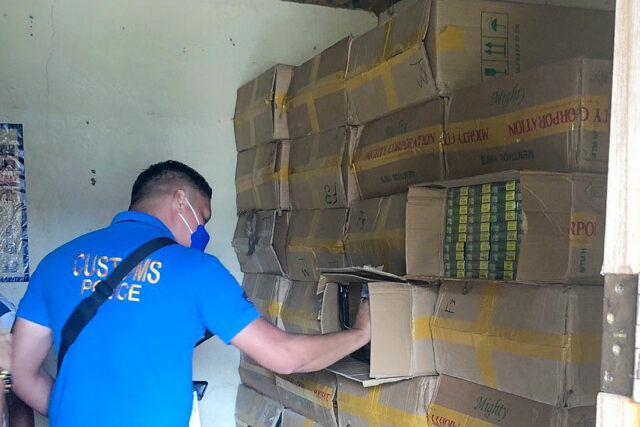
FOREGONE REVENUE due to the illicit tobacco trade are expected to exceed P30 billion this year, the National Tobacco Administration (NTA) said.

“To estimate, I think (the losses) would be a little higher (than) P30 billion. That is the projection for this year,” NTA Regulatory Department Manager Rohbert A. Ambros told reporters on Wednesday.

The Bureau of Internal Revenue (BIR) has reported a shortfall in excise tax collection, mainly due to the illicit tobacco trade.

In May, the agency filed 69 complaints against tobacco traders for tax evasion, estimating the evaded taxes at P1.8 billion.

The BIR also filed in December a P1.2-billion tax evasion case against five vape traders.

NTA Public Relations Officer Freddie G. Lazaro said foregone revenue from the illicit tobacco trade is estimated at P16 billion so far this year.

“The illicit tobacco trade is very alarming. We are losing billions of pesos, more or less P16 billion for this year,” he said.

Mr. Lazaro said that untaxed tobacco is mainly circulating in southern Mindanao and the Visayas. — Luisa Maria Jacinta C. Jocson

BSP rate cuts seen tied to start of Fed easing cycle

Bangko Sentral ng Pilipinas main office in Manila. — BW FILE PHOTO

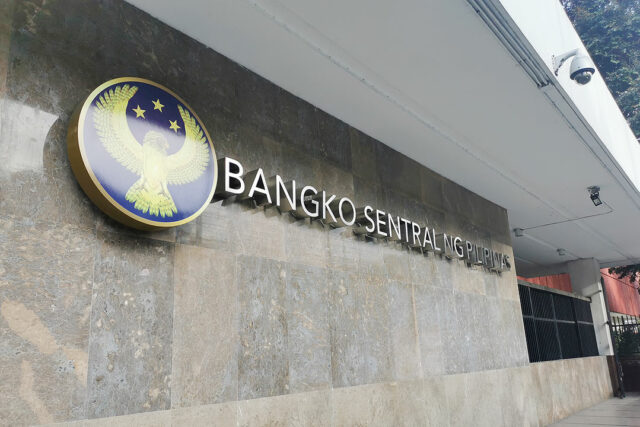
THE Bangko Sentral ng Pilipinas (BSP) will likely cut rates in the third quarter, beginning its monetary easing cycle only after the Federal Reserve slashes its own policy rates, HSBC said.

In a note dated Aug. 2, HSBC Global Research said the Philippines has the least flexibility to diverge from the Fed in the Association of Southeast Asian Nations (ASEAN).

“Between Indonesia and the Philippines, the two ASEAN economies with current account deficits, we believe Indonesia has much more monetary policy freedom to move away from the Fed, whereas the Fed’s gravitational pull is stronger (perhaps even the strongest) in relation to the Philippines,” HSBC Global said.

The BSP extended its pause in June, keeping the key interest rate at 6.25%. The BSP has hiked borrowing costs by a total of 425 basis points (bps) between May 2022 and March 2023.

Meanwhile, the Fed hiked policy rates by 25 bps to 5.25-5.5% last week, bringing them to their highest level in more than two decades.

“We only expect the Philippines to cut policy rates after the Fed cuts its own. We expect the BSP to begin its easing cycle in the third quarter of 2024,” HSBC Global said.

The research unit is forecasting a 25-bp cut in the third quarter next year from the Monetary Board, followed by another 25-bp cut in the fourth quarter. This will bring the key policy rate to 5.75% at the end of 2024.

HSBC Global also expects the current account deficit to deteriorate in the coming years.

The BSP estimates the current account deficit at $4.3 billion, equivalent to 4.3% of gross domestic product (GDP), in the first quarter, up from $4 billion a year earlier.

“Not only is the Philippines a consumption-driven economy, but the government is embarking upon a much-needed and ambitious agenda of spending more than 5% of its GDP on public infrastructure and will, thus, demand a lot of materials from abroad, such as steel and technology,” HSBC said.

The government is planning to spend 5-6% of GDP on infrastructure until 2028.

Meanwhile, HSBC Global projects Philippine headline inflation to continue rising in the second half of 2024.

“The key here is the fact that beginning next year, the temporary tariff cuts on rice, coal, corn, and pork will expire, re-introducing another inflationary wave to the archipelago,” HSBC Global said.

Earlier this year, President Ferdinand R. Marcos, Jr. decided to extend Executive Order (EO) No. 171, which reduced the Most Favored Nation (MFN) tariff rate on swine meat, corn, rice, and coal until Dec. 31, 2023.

“We estimate the maximum impact of these tariff adjustments on inflation to be as much as 1.4 percentage points,” HSBC Global said.

Inflation has been declining since its peak in January. A BusinessWorld poll of 17 analysts last week yielded a median estimate of 4.9% for July inflation, settling at the upper end of the BSP’s 4.1-4.9% forecast for the month.

If realized, July would be the first time that inflation fell below 5% since the 4.9% posted in April 2022. The June reading was 5.4% while the July reading was 6.4%.

July inflation would also likely exceed the central bank’s annual 2-4% target range for a 16th straight month.

The Philippine Statistics Authority is scheduled to release the consumer price index (CPI) data on Aug. 4, Friday.

“We expect headline CPI to be tangent to the BSP’s upper-bound target range of 4% in the second half of 2024 — a level that will likely complicate the BSP’s timing of the rate cuts,” HSBC Global said.

It expects full-year inflation to hit 5.5% this year, before easing to 3.6% in 2024.

The BSP expects inflation to return to the 2-4% target range by the fourth quarter, with full-year inflation hitting 5.4% in 2023 and 2.9% in 2024.

“So, from the perspective of inflation, we expect the Philippines to have the most compelling reason to keep monetary policy tight,” HSBC Global said, adding that economic growth remains resilient as well.

“Currently, the Philippines is the fastest-growing economy in ASEAN, expanding at a rate in line with its historical trend but with consumption and investment seemingly defying gravity. This gives the BSP room to keep the monetary reins tight and steady,” it said. — Keisha B. Ta-asan

The role of transfer pricing in exchange of information

To help strengthen and support initiatives addressing base erosion and profit shifting (BEPS) concerns, the Bureau of Internal Revenue (BIR) issued Revenue Regulations (RR) 11-2022. The RR prescribes guidelines and procedures for the spontaneous exchange of taxpayer-specific rulings, which framework provides tax administrators with access to timely information on rulings that have been granted to a foreign related party or a permanent establishment (PE) of their resident taxpayer, which can be used for risk assessments.

The exchange of information (EoI) provision in international exchange agreements, such as Double Taxation Agreements (DTAs), serves as the legal basis for the exchange between competent authorities of the contracting states as is necessary for carrying out the provisions of the DTA, or of domestic laws concerning the taxes to which the DTA applies.

COVERED RULINGS
RR 11-2022 specifically covers past and future rulings related to certain preferential regimes; unilateral advance pricing arrangements (APAs) or other cross-border unilateral rulings in respect to transfer pricing; rulings providing for a downward adjustment of taxable profits; PE rulings; and related party conduit rulings.

Past rulings in this case only refer to PE rulings or rulings concerning the existence or absence of a PE of a foreign enterprise in the Philippines that were issued either: on or after Jan. 1, 2015 but before Sept. 1, 2017; or on or after Jan. 1, 2012 but before Jan. 1, 2015, provided that they were still in effect as of Jan. 1, 2015. Future rulings refer to rulings issued after such periods.

TIMELINE
The International Tax Affairs Division (lTAD) of the BIR, through its EoI Section, is responsible for sending the taxpayer-specific rulings to the foreign tax authority within three months from issuing a future ruling. For past rulings, the information must be sent as soon as possible after identifying the potential exchange jurisdictions.

The office must likewise ensure that subsequent requests by another jurisdiction for a copy of the taxpayer-specific ruling is responded to, or a status update is provided, within 90 days upon receipt of the request.

FORMAT AND CONTENT
The template to be used is designed by the Forum on Harmful Tax Practices and the Inclusive Framework on BEPS (attached as Annex A to the RR). It contains information on the parties to the transaction, the type of transaction and amounts involved, as well as the reason for the exchange.

The information may either be sent by registered mail or encrypted electronic mail which should be password-protected.

POTENTIAL EXCHANGE JURISDICTIONS
Generally, the potential exchange jurisdictions are the countries of residence of all related parties with whom the taxpayer has the transactions that are covered by ruling, as well as those of the ultimate parent company and the immediate parent company.

• In case the past ruling does not contain sufficient information to enable identification of all the relevant countries with which the information needs to be exchanged, the tax authorities must exert best efforts to identify them. They may check the information included in the file supporting the tax treaty relief application, BIR Form 1709, and any relevant transfer pricing documentation, if available. They may likewise obtain information from the domestic withholding agent, foreign taxpayer or its representative in the Philippines, the Securities and Exchange Commission or other possible information holders.

TRANSFER PRICING CONSIDERATIONS
Clearly, the EoI covered by the RR primarily focuses on related parties. In either past or future rulings, transfer pricing documentation and the Information Return on Related Party Transactions (BIR Form 1709) may be requested by the BIR, especially if the documents provide sufficient information to carry out the EoI.

On that point, Philippine taxpayers, especially those belonging to a Multinational Group with members heavily dealing with cross-border transactions, must ensure their adherence to the arm’s length principle as provided in the Philippine Transfer Pricing Regulations and International Guidelines. Arm’s length means that the charge for intercompany transactions should be that which would have been made and accepted between independent parties in comparable circumstances. Compliance with the arm’s length principle can be demonstrated by ensuring that required information in transfer pricing documentation is properly incorporated and discussed as provided in the Philippine rules.

Considering that transfer pricing documentation is expected to contain complete information about related party dealings, including all the transacting related parties and overview of their operations, the document may provide additional reference for the BIR to identify potential foreign jurisdictions for EoI purposes.

The RR likewise states that the EoI can be used by tax administrators in conducting risk assessments. One of the rulings covered by the EoI are those providing for a downward adjustment of taxable profits. In view of this, in preparing their transfer pricing documentation, Philippine taxpayers should likewise consider how they can demonstrate the reasonableness and compliance of their transactions, especially for those transactions that are covered by such rulings.

On that same premise, taxpayers must likewise be able to explain in the transfer pricing documentation the rationale for entering into transactions with affiliates. It is necessary to maintain the supporting analysis for their intercompany arrangements (e.g., contracts, benchmarking study, etc.), as well as the basis for the applied transfer pricing policy to defend its reasonableness and compliance with the arm’s length principle.

While the BIR may still request documents other than the transfer pricing documentation, the above considerations may be helpful in the taxpayer’s position in case there is a need to apply for such covered rulings.

Finally, considering the continuous efforts of the BIR to address transfer pricing concerns, taxpayers must ensure that as early as possible, all the required information is addressed and maintained head on. With the growing means of tax administrators to access information on cross-border transactions, taxpayers must be one step ahead and should be able to establish that their tax practices are not just reasonable and compliant with Philippine regulations, but also with the relevant international rules.

The views or opinions expressed in this article are solely those of the author and do not necessarily represent those of Isla Lipana & Co. The content is for general information purposes only, and should not be used as a substitute for specific advice.


Joyce Anne Boaloy is a manager at the Tax Services department of Isla Lipana & Co., the Philippine member firm of the PwC network.

+63 (2)8845-2728

joyce.b.boaloy@pwc.com

NCR’s Karl Eldrew Yulo favored to make 5 final gymnastic events

KARL ELDREW YULO — MUNEHIRO KUGIMIYA’S FACEBOOK/PHILSTAR FILE PHOTO

As many Palarong Pambansa records fall

IN THE PALARONG Pambansa men’s artistic gymnastics competition at the Rizal Memorial Coliseum, all 90 participants aspire to be like world champion Carlos “Caloy” Edriel Yulo.

It included one who happens to be Mr. Yulo’s 15-year-old brother Karl Eldrew.

And the younger Mr. Yulo showed he has what it takes to become like his popular sibling as he was heavily favored to make the finals of all five events he is joining and possibly six if his National Capital Region team of three gymnasts would qualify.

Karl Yulo was especially impressive in the floor exercise where he came through with an electric performance that many believed should catapult him straight to Friday’s medal round.

While organizers didn’t give out the official results at press time, it was clear that Mr. Yulo’s performance was the best as affirmed by the loud cheers and applause from the hundreds who trooped the venue on this particularly rainy day.

Everyone knew he would win the moment Mr. Yulo stepped on the mat.

“Hopefully,” said Mr. Yulo after he was hugged by his mother Angelika following his breathtaking routine.

Mr. Yulo, of course, was hoping to surpass his five-gold haul in the last staging of the annual meet for elementary and high school students in Davao City four years ago.

And most, if not all, believed Mr. Yulo would.

Mr. Yulo’s brilliance came the same day four swimming records fell at the Marikina Sports Complex pool, including one by the Big City’s Krystal Ava David in the elementary girls’ 200-meter individual medley where she clocked two minutes and 37.32 seconds.

The 12-year-old Colegio de San Agustin student shattered the five-year-old meet mark of 2:33.12 set by National Capital Region’s (NCR) Michaela Jasmine Mojdeh in Vigan, Ilocos Sur — her second record-breaker after she rearranged the 100m breaststroke standard the day before.

Also joining the record-eclipsing spree were Albert Jose Amaro of Bicol in the secondary boys 50m butterfly, Clara Yzabela delos Santos of NCR in the secondary girls 50m breaststroke, and the NCR secondary girls 200m freestyle relay team of Cezar Nazerano, Victoriano Martin Tirol, Jared Magnus Cheng and Arbeen Miguel Thruelen.

In Poomsae, the Cordillera Administrative Region went on a gold-harvesting mode and scooped up six mints courtesy of Trisha Lobonan (elementary girls individual), Alexandria Daphne Aganon and Jheron Cristobal (elementary mixed pair) and Lobonan, Aganon and Joniyaua Ysabelle Oblacoro (elementary girls team), Caleb Angelo Calde, Zeick Andrei Tacay and Gabriel Ivan Inacay (secondary boys team), Inacay and Aesha Kiara Oglayon (secondary mixed pair) and Oglayon and her sister Acey Kiana and Khia Mae Cortez (secondary girls team). — Joey Villar

Gilas Pilipinas sans aces battles Asian rival Iran in China pocket tourney

GILAS PILIPINAS — FIBA.BASKETBALL

GILAS Pilipinas, sans a bevy of its ace players, battles Asian rival Iran today in the second day of the 2023 Heyuan WUS International Basketball Tournament in Guangzhou for its final overseas build-up before the anticipated FIBA World Cup hosting on Aug. 25 to Sept. 10 here.

Game time is at 8 p.m. at the Heyuan Sport Gymnasium with the Filipino dribblers rekindling their animosity against familiar counterparts to fire off their campaign in the three-team international pocket tournament hosted by China.

Senegal, which battled Iran yesterday, is the other team the Guangdong joust as Lebanon backed out of the competition for a foiled four-team battle.

Without star players Kai Sotto and Jordan Clarkson, Gilas did not waste time upon arrival in China on Tuesday by practicing right away before another session yesterday to prepare for the Iranians.

Gilas has been through countless wars with Iran in the Asian stage, none bigger than the titular showdown in the 2013 FIBA Asia Championship in Manila.

The Philippines then bowed to Iran, 85-71, but nonetheless qualified in the 2014 FIBA World Cup in Spain to ignite three straight World Cup appearances, including this year with Japan and Indonesia as co-hosts.

Though without Messrs. Clarkson, Sotto and Scottie Thompson, Gilas has Ray Parks, Calvin Oftana and Roger Pogoy on board this time in China after they missed the first overseas camp in Europe last month due to injuries.

Gilas, bunched with Dominican Republic, Italy and Angola, is also without naturalized players Justin Brownlee and Ange Kouame, making the team an all-Filipino unit led by six-time PBA MVP June Mar Fajardo.

After Iran, Gilas will play Senegal tomorrow. The Philippines will play the two teams this weekend for additional friendly matches with more than three weeks to go before the 32-team World Cup.

Upon returning home in Manila, Gilas is expected to be joined by Mr. Clarkson from the United States as it hits final gear with polishing tune-ups against teams that are arriving early, including Mexico. — John Bryan Ulanday

De La Salle faces UST in semifinals of Shakey’s Super League

AND they meet again.

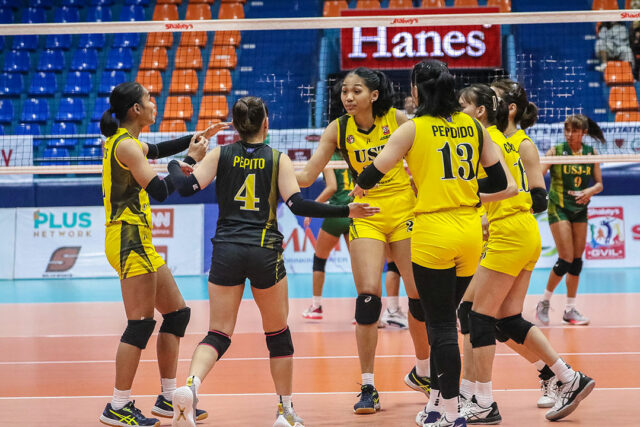
UAAP rivals De La Salle University (DLSU) and University of Santo Tomas (UST) drubbed their respective foes to arrange a semifinal battle in the 2023 Shakey’s Super League (SSL) National Invitationals yesterday (Aug. 2) at the Filoil EcoOil Centre in San Juan.

Shevana Laput and Thea Gagate spearheaded the barrage anew as the reigning UAAP champion De La Salle scored another sweep at the expense of Mindanao qualifier Jose Maria College Foundation, 25-18, 25-14, 25-19, in only 67 minutes of play.

Behind a scattered onslaught, the Golden Tigresses followed suit in the next game by holding off NAASCU champion Enderun Colleges with a 25-13, 25-16, 21-25, 25-14 win.

De La Salle and UST, which also battled in the UAAP Season 85 Final Four, will duke it out for a finals seat on Friday. It’s actually UST that dealt De La Salle its lone loss in a near-perfect run.

It’s the third straight sweep for De La Salle — without a single set allowed — after wiping out Pool A of the 12-team SSL presented by Eurotel as the official hotel and Victory Liner as office transport provider, and in cooperation with the Commission on Higher Education (CHED).

On the other hand, Angeline Poyos (18) showed the way with Regina Jurado (10) and Athena Abbu (9) providing coverage. Xyza Gula, Jonna Perdido and Maribeth Hilongo added eight points apiece for UST.

Top seeds Adamson (Pool C) and NCAA champion College of St. Benilde (Pool D) were to clash against CESAFI champion University of San Jose-Recoletos and University of Perpetual Help System Dalta, respectively, in the other semifinal pairings. — John Bryan Ulanday

UST inks partnership with Cocolife, Dumper Partylist for its basketball program

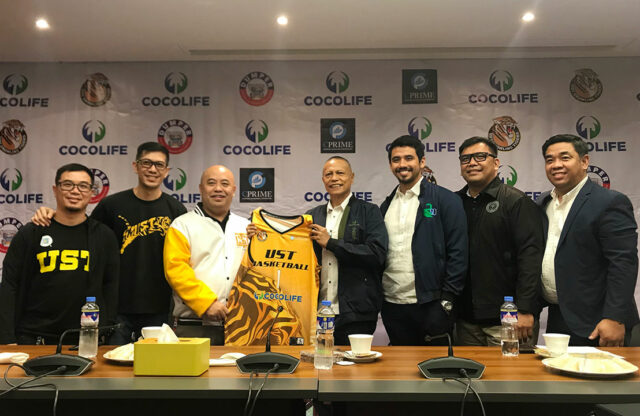
UST OFFICIALS led by IPEA director Fr. Rodel Cansancio and Cocolife officials led by company ambassador and Medal of Valor awardee Col. Ariel Querubin (in the middle) pose for a photo with a customized UST-Cocolife jersey after their partnership that also includes Dumper Partylist on Tuesday at the Cocolife Building in Makati for the UAAP Season 86.

THE UNIVERSITY of Santo Tomas (UST) is not yet done pulling out all the stops to prepare for a long-coveted title redemption bid in the UAAP.

Just less than a month after gaining San Miguel Corp.’s (SMC) support, the España-based squad sealed a partnership with Cocolife and Dumper Partylist for its men’s and boys’ basketball programs on Tuesday at the Cocolife Building in Makati to add to its growing list of resources.

It’s a major boost for the Growling Tigers, under returning mentor Pido Jarencio, and the Tigers Cubs under the watch of Manu Iñigo, as they brace for a new era in España.

“We’re excited for this partnership. We need the help of everyone and we acknowledge this big help,” said UST Institute of Physical Education and Athletics (IPEA) Director Fr. Rodel Cansancio.

“We can assure the Thomasian community that we will bring our basketball program to new heights with these corporate sponsorships from SMC, Cocolife and Dumper Partylist.”

In the memorandum of agreement signing, Mr. Cansancio was joined by Cocolife Senior Vice President Joseph Ronquillo, Cocolife company ambassador and Medal of Valor recipient Col. Ariel Querubin and Dumper Partylist official Bhong Baribar from the Office of Congressman Claude Bautista.

Cocolife and Dumper Partylist have been in partnership for a long time through the Davao Occidental Tigers in different leagues. Now, they’re off to the UAAP with UST in a promise of solid support all throughout.

“UST is one of the great schools in the Philippines. It’s a huge honor for us to be partners with them in this journey as part of our mission to support grassroots sports for Filipino youth. We’re hoping for a great season for UST,” said Mr. Ronquillo, who hinted at the possibility of supporting the entire UST sports program in the future.

UST is currently in South Korea for an 11-day overseas camp against KBL teams as part of its build-up in UAAP Season 86 after a 1-13 finish last season.

Senegal’s Mane joins Saudi side Al-Nassr from Bayern

BAYERN Munich’s Senegal forward Sadio Mane has joined Saudi Pro League club Al-Nassr after one season with the Bundesliga champions, both clubs said on Tuesday.

Mr. Mane has signed a four-year contract, Al-Nassr added on messaging platform X, formerly known as Twitter.

Financial details were not disclosed but media reports said the Saudis paid 40 million euros ($43.85 million) for the 31-year-old who had two more years left on his Bayern contract.

Mr. Mane moved to Bayern last year with high hopes after netting 120 goals in 269 games for Liverpool where he won the Champions League, Premier League, FA Cup, League Cup and Club World Cup.

He was a key figure in the Merseyside club’s attack but failed to make the same impression at Bayern, where he fell out with team mate Leroy Sane and hit the German winger — an offense for which he was fined and suspended.

The twice African Footballer of the Year averaged more than 20 goals a season in his last five campaigns with Liverpool but scored only 12 for Bayern.

“We want to thank Sadio Mane for the past season,” Bayern Chief Executive Officer Jan-Christian Dreesen told the club website.

“It certainly hasn’t been an easy year for him, suffering an injury just before the World Cup and missing out on participation with Senegal, whom he had earlier led to their maiden Africa Cup of Nations triumph and World Cup qualification.

“Due to the long downtime, he wasn’t able to contribute as much to FC Bayern as we and he himself had hoped. That’s why we decided together that he should start a new chapter in his career and make a fresh start at another club.”

Mr. Mane joins an Al Nassr outfit who have strengthened their squad since the marquee signing of Cristiano Ronaldo last term.

The Saudis, who were runners-up last season, have signed midfielders Marcelo Brozovic from Inter Milan and Seko Fofana from Lens while left back Alex Telles has also joined from Manchester United.

Al-Nassr were banned from registering new players earlier this month due to outstanding debts, with FIFA saying they had to pay 460,000 euros ($504,712.00) related to the transfer of Nigerian Ahmed Musa from Leicester City. — Reuters

US stumbles into knockout stages after 0-0 draw with Portugal

AUCKLAND — The United States reached the knockout stages of the Women’s World Cup with a 0-0 draw against Portugal on Tuesday, surviving a late onslaught from the tournament debutants to keep their title defense alive at Eden Park.

The four-times champions were playing with everything on the line but spurned several chances to find the net and the addition of veteran Megan Rapinoe in the second half did little to turn things around against a physical Portugal defense.

They survived a huge scare in stoppage time when Ana Capeta hit the post and another when the striker won a free kick just outside the box a few minutes later but held on in the nerve-searing final minutes of the Group E clash.

Goalkeeper Ines Pereira had no issues stopping forward Lynn Williams’ header in the fourth minute and co-captain Alex Morgan fired wide from the middle of the box in the sixth minute.

Ms. Williams had another header on target in the 14th minute off a cross from Sophia Smith, but Ms. Pereira easily gathered that effort. In the 27th minute, Ms. Williams fired a shot straight at the Portugal keeper and smashed a follow up effort over the crossbar and Ms. Pereira was again equal to the task for the forward’s final shot of the half in stoppage time.

The addition of winger Rapinoe in the 61st minute and forward Trinity Rodman in the 84th minute failed to revive the US front line.

The stadium let out a collective gasp as Ms. Capeta’s stoppage-time shot ricocheted off the post and the Americans scrambled together a frantic defense to avoid a once-unthinkable fate in the final moments of the match.

The United States move on to the last 16 in Melbourne, where they will almost certainly face Sweden, after finishing in second place in Group E behind the Netherlands who thrashed Vietnam 7-0.

“It’s just not going in the back of the net,” Alex Morgan added. “We have so many corners, we have so many opportunities, we got the crosses, I mean just unlucky you know.” — Reuters

ADVERTISEMENT
ADVERTISEMENT