Home Blog Page 4515

Japanese eateries in China fear ruin as Fukushima water discharge looms

PACKS of raw fish are pictured at a Japanese food store, in Beijing, China July 25, 2023. —REUTERS/Tingshu Wang

BEIJING — It’s been just over three weeks since China increased checks on Japanese food imports over radiation concerns, but Kazuyuki Tanioka is already fearful for the future of his upscale Beijing sushi restaurant.

Like most restaurants in China, Tanioka’s eight-year-old Toya has struggled with years of COVID-19 restrictions, which only began to ease late last year.

Now it is facing a shortage of both customers and seafood ahead of Japan’s plans to empty into the sea treated radioactive water from its disaster-stricken Fukushima nuclear plant.

“I’m very worried about whether we can continue,” said the 49-year-old chef-restaurateur from Kumamoto, southern Japan. “The inability to import food ingredients is truly a life-or-death situation for us.”

China is the biggest importer of Japanese seafood. Shortly after the 2011 tsunami and earthquake damaged the Fukushima plant, it banned the import of food and agricultural products from five Japanese prefectures. China later widened its ban, which now covers 10 out of Japan’s total of 47.

It has remained Japan’s biggest seafood export market. The latest import restrictions were imposed this month after the United Nation’s nuclear watchdog approved Japan’s plans to discharge the treated water. China has sharply criticized the move, which has also faced opposition at home, saying the discharge endangers marine life and human health. Imports have since all but ground to a halt, with some Japanese officials fearing the worst is yet to come. The more stringent Chinese checks have led to massive delays at customs, and the strident warnings have kept customers away: posts and hashtags saying Japanese food is radioactive and should be boycotted are rife on Chinese social media.

“China is saying it is contaminated water, while Japan claims it is purified water,” said Kenji Kobayashi, 67, another Japanese restaurant owner in Beijing, who has lost up to a third of his customers this month.

“The difference between the two perspectives is vast, and it affects the level of understanding.”

ALTERNATE SOURCES
Seafood suppliers are also struggling.

Wait times at Chinese ports have gone up from between two and seven days to around three weeks, a spokesman for a large seafood trader said, adding that the company plans to get around these restrictions by diverting shipments to a third country. The spokesman declined to name the company, fearing backlash from Chinese officials.

“Right now we have no shipments to China,” said Tamotsu Fukuoka, director and general manager of sales at Aomori Chuosuisan Co., a seafood wholesaler based in northern Japan.

“If the products get stopped at customs, we would have to spend a lot for the yard and storage fees, and that’s something we don’t want to see.”

While Japanese officials have appealed to their Chinese counterparts, especially in their second-largest market Hong Kong, to avoid a ban, several Chinese diners said they approved of more stringent checks. “Any government should be responsible for the safety of its citizens,” said Duan, a patron at a Japanese restaurant in Beijing. “Because of the government’s policies, we feel at ease.”

With Japan due to begin discharging the Fukushima water in a few weeks, some Japanese restaurateurs said they are adapting their menus and sourcing ingredients from elsewhere to survive.

“Our main focus is to source seafood within China or sourcing from other foreign suppliers,” restaurateur Mr. Tanioka said. “If these efforts succeed, there is a possibility that our business can continue in the future.” — Reuters

Going without a brand

OUR TEAM-FREEPIK

IN THE WORLD of medicine, the unbranded cure is referred to by its generic name, like paracetamol. Alternative cures are even less fancy in their nomenclature, like boiled ginger for all sorts of ailment, or malunggay leaves for the lactation of mothers. (Not sure what it does for fathers.) It is the effectiveness of a generic product and not its branding that drives consumption.

Branding started as a process used to record ownership of a herd of cattle. The ranch that owned the herd seared its name via a heated branding iron on the animal’s rump. This ensured the claim of ownership as protection against cattle rustlers trying to sell stolen goods. Thus, branding originally denoted possession.

The term has evolved from ownership to possession of certain attributes. “Branding” as a marketing discipline tries to project a product’s character. Does a branded sneaker really have a unique personality after it has invested in consumer research, target marketing, design, pricing strategy (more expensive) and a full-blown advertising campaign — “Just do it.” And of course, branding allows premium pricing and a sense of belonging.

The brand attribute can only be unique if it doesn’t claim to be the best. Avis, a car rental company in the 1970s used to sport the slogan “We’re Number 2, We try harder.” Without mentioning the Number One, Hertz, the branding of being second in market share but trying harder to please the customer was both humorous and effective.

The generic approach has only one claim to make — that it works. And there is no copyright infringement if another unbranded alternative is offered. So, for breath freshening, simple headaches, and sleep inducements, all sorts of unbranded products are offered. And marketing is solely by word of mouth — this worked for me, try it.

Do services need to be branded? Maybe, certain types need to be “quality-tested” for competence, integrity, and even connections. Thus, law firms with a reputation for political connections and access to the judiciary system can charge higher fees for their brand and track record. Management consultancies too, with their roster of clients and turnaround stories, can join the bidding process to get big corporations to use them to improve profitability or introduce a corporate culture. Usually, cost-cutting is a low-hanging fruit in this business.

As for generic services needed like housekeeping, security, and caregiving, it is referrals from relatives and friends, dependability, and competence rather than any branding that moves the needle. There is no effort to create a brand wagon to push personal services.

Even CEOs want to enhance their reputation by going into a branding exercise with “reputation consultants.” These consultants advise their clients to embrace an advocacy with which to be identified. The restoration of cultural landmarks is still up for grabs.

It no longer seems to satisfy the wealthy individual to be given a generic tags like “mogul,” “billionaire” …and certainly not “Sugar Daddy” — is that term still being used?

Universities too have jumped into the branding process. The rankings of educational institutions using different metrics have become an obsession, at least among the alums of these universities and their boards of trustees. The ranking is projected to denote the quality (and cost) of the education to be had. What about how their alumni fare in the real world of business and politics? This aspect too has adhered to the school brand, taking the place of fraternities with their violent initiation rites.

For countries, it is the mostly negative news about them, like natural catastrophes, political scandals, and, in some cases, an ongoing war, that have defined what countries are about. The branding of countries is in the hands of news and social media. Even an unfortunate tourist experience, sometimes fake news (I lost my organs and woke up in a bathtub), can derail a carefully crafted branding campaign.

The brand is intended to distinguish a particular product and make it stand out among its competitors. Will its acquired personality attract the consumer to make a purchase?

Does guava need to be branded on the fruit shelf? Isn’t it checked just for its ripeness, color, texture, and taste? Unbranded people are like fruit, then. They prefer to be quietly discovered as generic personalities without any promised brand attributes… and maybe offering some surprises.


Tony Samson is chairman and CEO of TOUCH xda

ar.samson@yahoo.com

LANDBANK’s net profit climbs by 2.7% in 1st half

BW FILE PHOTO

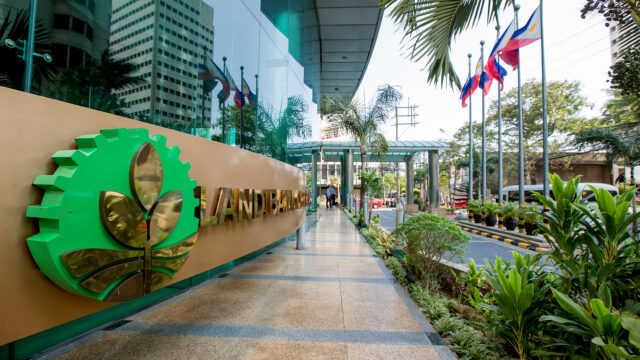
LAND BANK of the Philippines (LANDBANK) saw its net income rise by 2.7% year on year in the first semester, it said on Wednesday.

The state-run lender’s net income stood at P20.9 billion in the six months through June, up from P20.3 billion in the same period last year, it said in a statement.

“We are very much on track in meeting our financial targets for the year, as income from loans and investments continue to expand. LANDBANK is in prime position to sustain our intensified support to the agriculture sector and other key industries,” LANDBANK President and Chief Executive Officer Lynette V. Ortiz said.

The bank’s first-half income exceeded its goal for the period by 19% or P3.3 billion, and represents about 60% of its P35-billion full-year target.

Its financial statement was not available as of press time.

LANDBANK’s first-half performance translated to a return on equity of 13.82%.

Income from loans and investments increased by 49.8% and 43.5%, respectively.

On the funding side, total deposits rose by 9.2% to P2.7 trillion.

Total assets grew by 7.9% year on year to P3 trillion at end-June.

The bank’s capital likewise went up by 14.4% to P236.3 billion.

“LANDBANK consistently ranks among the top universal banks in the country in terms of assets, deposits, loans, and capital,” the state-run lender noted. — AMCS

Cloud service company assisted 17 different government hacking groups — US researchers

TRUSTPAIR.COM

AN OBSCURE cloud service company has been providing state-sponsored hackers with internet services to spy on and extort their victims, a cybersecurity firm said in a report published on Tuesday.

Researchers at Texas-based Halcyon said a company called Cloudzy had been leasing server space and reselling it to no fewer than 17 different state-sponsored hacking groups from China, Russia, Iran, North Korea, India, Pakistan, and Vietnam.

Cloudzy CEO Hannan Nozari disputed Halcyon’s assessment, saying that his firm couldn’t be held responsible for its clients, of which he estimated only 2% were malicious.

In an exchange over LinkedIn, Nozari told Reuters: “If you are a knife factory, are you responsible if someone misuses the knife? Trust me I hate those criminals and we do everything we can to get rid of them.”

Digital defenders say the case is an example of how hackers and ransomware gangs use small firms operating at the fringes of cyberspace to enable big hacks.

Halcyon estimated that roughly half of Cloudzy’s business was malicious, including renting services to two ransomware groups.

“It’s a rogues’ gallery on that through one provider,” said Halcyon executive Ryan Golden ahead of the report’s publication.

Halcyon arrived at its conclusion by mapping out Cloudzy’s digital footprint, in part by renting servers directly from the firm and by tying it to known hacking operations.

The cybersecurity firm CrowdStrike, which wasn’t involved in the research, said that it hadn’t seen state-sponsored hackers using Cloudzy. But it had seen other cybercriminal activity connected to it.

Cloudzy’s geographic base of operations is unclear.

Halcyon researchers analyzed Cloudzy’s employees’ social media, including LinkedIn and Facebook postings, and found the firm is “almost certainly” a front for another internet hosting company called abrNOC, which Nozari runs from Tehran.

Nozari, who says he lives outside Iran but would not be more specific, told Reuters the companies are separate, although he acknowledged that abrNOC employees helped with Cloudzy’s operations. He didn’t provide details.

Cloudzy is registered under its previous name, RouterHosting, in Cyprus and the US state of Wyoming, according to corporate records reviewed by Reuters and confirmed by Nozari. He said the company needed US domicile to be able to register internet protocol addresses in America.

It’s not clear whether Nozari’s registered agent — CloudPeak Law, a Wyoming law firm based in the small city of Sheridan — was aware of the allegations against its client.

A woman who answered at CloudPeak Law’s office confirmed that her firm was RouterHosting’s agent but said that, due to client confidentiality, “that is the extent of what anyone in our firm is going to be able to tell you.” The firm didn’t respond to a follow-up e-mail.

Cloudzy’s business model is typical of several small virtual private server providers that rent internet hosting services in exchange for cryptocurrency, no questions-asked, said Adam Meyers, an executive with CrowdStrike.

“There’s a whole ecosystem of ne’er-do-well kind of folks who are in this business,” he said. — Reuters

Mega Prime: Amending Fisheries Code needs science-based study

MEGA Prime Foods, Inc. (MPFI) said science-based research must be done to support the call of the Marcos administration to revise the Fisheries Code of the Philippines.

Malcolm Tiu Lim, chief technical and innovations officer at MPFI, told reporters on Wednesday that the first step is for the Bureau of Fisheries and Aquatic Resources (BFAR) to make a scientific study.

“For me, what really has to happen first is we have to make a scientific-based study to see where really the fish are, whether it is in the 15 kilometers or closer to the 15-kilometer area,” Mr. Lim said.

In his second State of the Nation Address, President Ferdinand R. Marcos, Jr. said the Fisheries Code must be revised to incorporate and strengthen science-based analysis and determination of fishing areas.

“This approach will protect both the interests of our fisherfolk and our fisheries and aquatic resources,” he said.

“To this end, we will seek the support of Congress to amend the Code to guarantee sustainable development of our fisheries sector in harmony with environmental balance,” he added.

Mr. Lim said the company would partner with BFAR in conducting the study, but said based on its experience “there are more fish in between that 15-kilometer radius.”

Michelle Tiu Lim-Chan, president and chief executive officer of MPFI, said the company is awaiting details of what the amendment will be.

“We do not have details yet about the new amendment, so we will just need to wait for the BFAR to tell us. But right now, we are strictly monitoring and strictly abiding with the Fisheries Law,” she said.

“We will support the President whatever he thinks that the fisheries need but I am sure he will also be fair to all businesses and also the fisher folks,” she added.  — Justine Irish D. Tabile

Lizzo sued by former dancers, accused of creating hostile work environment

LIZZO

LOS ANGELES — Three former dancers for Grammy-winning singer Lizzo accused her of creating a hostile work environment, including weight shaming and sexually denigrating behavior, in a lawsuit released on Tuesday.

The lawsuit in Los Angeles County Superior Court named Lizzo, whose real name is Melissa Viviane Jefferson, her production company Big Grrrl Big Touring, Inc. and the captain of her dance team, Shirlene Quigley, court documents showed.

A representative for Lizzo did not respond to a request for comment.

The complaints filed by plaintiffs Arianna Davis, Crystal Williams, and Noelle Rodriguez include harassment based on sex, religion, race, and disability.

In the lawsuit, the dancers claimed they were coerced into touching nude performers at an Amsterdam strip club in late February.

The suit also stated that Ms. Davis was pressured to participate in a nude photo shoot to stay in a dance competition despite her discomfort. She claimed she feared losing her job if she didn’t comply with Lizzo’s requests.

“The stunning nature of how Lizzo and her management team treated their performers seems to go against everything Lizzo stands for publicly, while privately she weight-shames her dancers and demeans them in ways that are not only illegal but absolutely demoralizing,” the plaintiffs’ attorney, Ron Zambrano, said in a statement.

The lawsuit alleged that Ms. Quigley harassed the dancers by subjecting them to her religious beliefs against their will.

“Ms. Quigley was not only vocal about her religious belief but took every opportunity to proselytize to any and all in her presence regardless of protestations,” the lawsuit stated.

The plaintiffs claimed that Ms. Quigley forced the topic of Ms. Davis’ virginity into conversations and interviews and on social media where she publicly revealed personal details about Ms. Davis without her consent.

Ms. Davis and Ms. Williams were eventually fired while Noelle Rodriguez resigned over the behavior, the lawsuit said. — Reuters

How PSEi member stocks performed — August 2, 2023

Here’s a quick glance at how PSEi stocks fared on Wednesday, August 2, 2023.


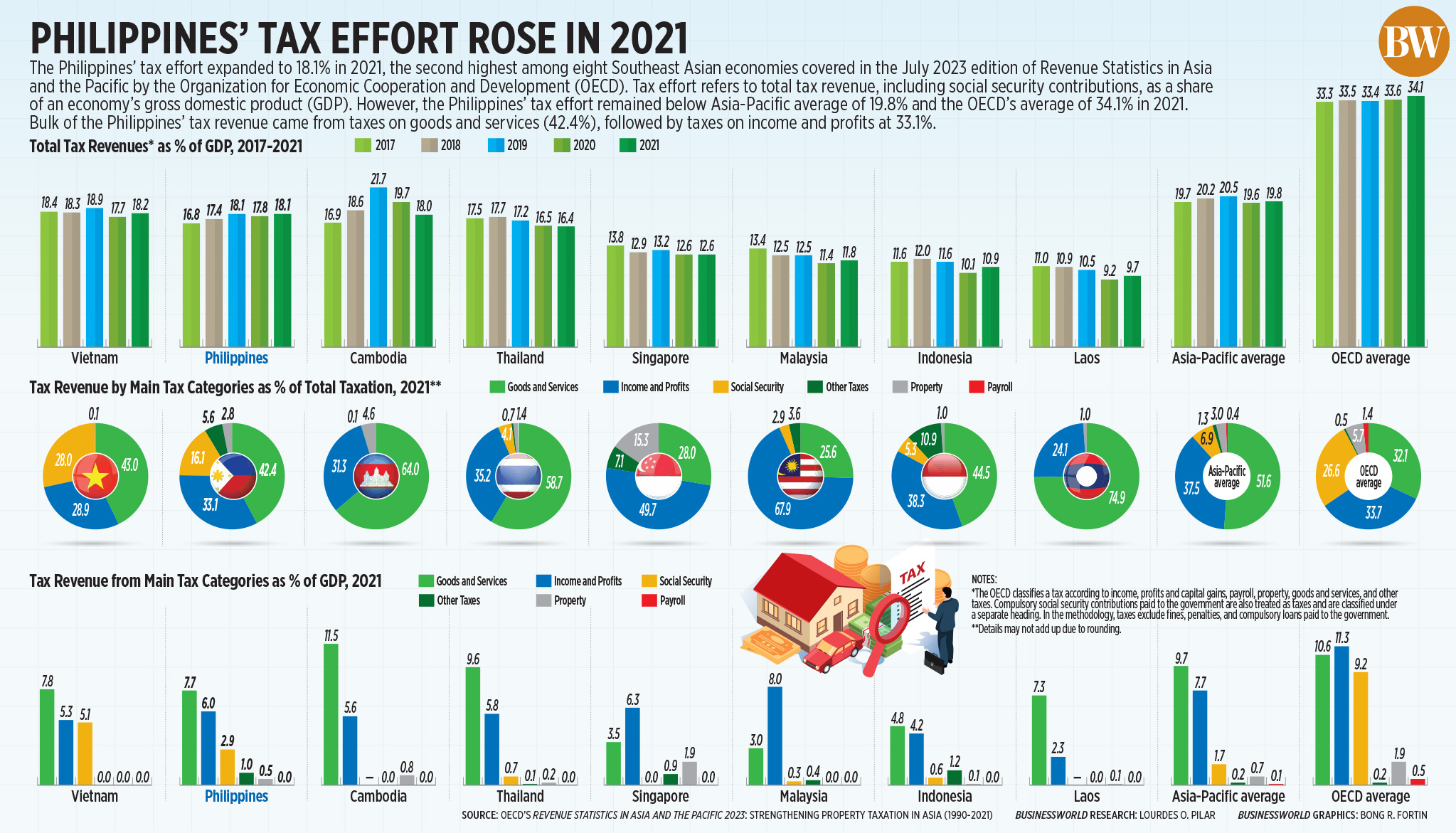
Philippines’ tax effort rose in 2021

The Philippines’ tax effort expanded to 18.1% in 2021, the second highest among eight Southeast Asian economies covered in the July 2023 edition of Revenue Statistics in Asia and the Pacific by the Organization for Economic Cooperation and Development (OECD). Tax effort refers to total tax revenue, including social security contributions, as a share of an economy’s gross domestic product (GDP). However, the Philippines’ tax effort remained below Asia-Pacific average of 19.8% and the OECD’s average of 34.1% in 2021. Bulk of the Philippines’ tax revenue came from taxes on goods and services (42.4%), followed by taxes on income and profits at 33.1%.

What to do for three days in Panglao

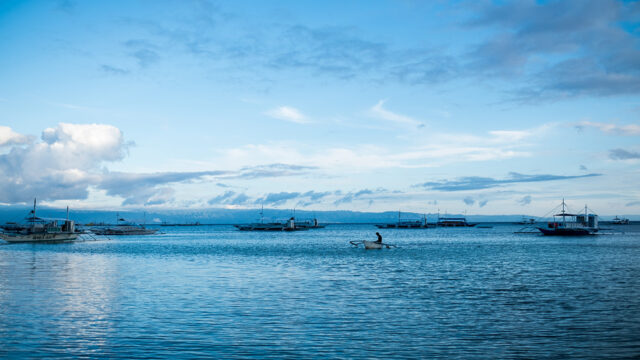
BOBBI WU-UNSPLASH

AUGUST has two long weekends where travelers can squeeze in a respite from all the grind. It’s also the last set of long holidays until November, so it’s the best time to pack your bags and book your stays. But the question is: Where should you go?

According to search data from digital travel platform Agoda, Bohol is a destination capturing the interest of short-term stay travelers — ranking fourth behind popular travel destinations such as Manila, Cebu, and Boracay. Baguio City, a go-to road trip choice, rounds out the top five.

Popularly known for the Chocolate Hills and the floating restaurants that cruise the Loboc River, Bohol remains an underrated beach destination. One of the gems within the province is Panglao Island.

The island is filled with adventure-packed spots (cliff-jumping, anyone?) and serene beaches to enjoy at sunset. Here, Agoda shares a list of things to do on a three-day stay on the island of Panglao.

Embark on an island-hopping tour. A five-to-six-hour boat ride navigates the coast and beaches surrounding Panglao including Balicasag Island, and Virgin Island (Pungtud).

Balicasag Island, located off the coast of Panglao, is a gem for divers seeking the best view of its marine life including turtles and corals. Lucky visitors may spot dolphins in the mornings. Meanwhile, the Virgin Island boasts a beautiful sandbar to explore.

The Villa Tomasa Alona Kew serves as a good base for travelers looking to explore Panglao. It is situated at the heart of Panglao’s tourist spots, but also offers an exceptional view of the Alona Beach. And because of facilities like a swimming pool, it’s a great spot for travelers to relax between activities.

Cliff-Dive. Thrill-seekers can experience this at Molave Cove, for P50 via a five- to six-meter-high diving board. Those brave enough to take the leap into the crystal waters might see schools of sardines moving in harmony.

Uncover the mysteries of Hinagdanan Cave. Adventurous types can explore Hinagdanan Cave’s narrow passages in total darkness, to be rewarded with a magnificent view of stalactite and stalagmite formations.

After all that spelunking, Solea Coast Resort Panglao can provide travelers the ideal recharging station. With its chill vibe and amenities such as an indoor swimming pool, poolside bar, and restaurants, it’s a great spot to end a day spent exploring.

Visit the St. Augustine Church and Tower. The St. Augustine Church is Panglao’s oldest place of worship. Its construction started in 1894 and finished in the 1920s and its architecture is Spanish-colonial with its grand posts and mural-filled ceilings. It’s a mix of art, history, and faith in one spot. Typical of Spanish-time structures, it is situated within a plaza as is a watch tower, said to be one of tallest in the country during its time.

Explore the shells of the world. Learn about the world of seashells by visiting the Nova Shell Museum. One of the biggest shell collections in the world, it not only features local seashells but also displays rare shells from around the world. It provides a captivating and educational experience for nature enthusiasts. Learn how marine life finds its home within the shells and gain valuable insights into their ecological importance.

Travelers looking for unique-looking hotels to enjoy the sights of Pangalao can explore Molly Resort. With its modern wooden look with a swimming pool that looks straight out of movie scene, and central location within Panglao, it offers travelers a picturesque accommodation to make their stay even more memorable.

Peso sinks to three-week low 

BW FILE PHOTO

THE PESO sank to the P55-per-dollar level on Wednesday after Fitch Ratings downgraded the United States’ credit rating.

The local currency closed at P55.19 versus the dollar on Wednesday, weakening by 42 centavos from Tuesday’s P54.77 finish, data from the Bankers Association of the Philippines’ website showed.

This was the peso’s weakest close since its P55.25-per-dollar finish on July 11.

The local unit opened Wednesday’s session at P54.84 per dollar, which was also its intraday best. Its weakest showing of the day was at P55.20 against the greenback.

Dollars traded rose to $1.1 billion on Wednesday from the $972.5 million seen on Tuesday.

“The peso weakened after Fitch downgraded the US sovereign credit rating from ‘AAA’ to ‘AA+’, citing concerns on the growing US fiscal deficit,” a trader said in an e-mail.

This move resulted in profit taking in global stock markets, which dragged down the peso, Rizal Commercial Banking Corp. Chief Economist Michael L. Ricafort added in a Viber message.

Rating agency Fitch on Tuesday downgraded the US government’s top credit rating, a move that drew an angry response from the White House and surprised investors, coming despite the resolution of the debt ceiling crisis two months ago, Reuters reported.

Fitch downgraded the United States to “AA+” from “AAA,” citing fiscal deterioration over the next three years and repeated down-the-wire debt ceiling negotiations that threaten the government’s ability to pay its bills.

Asian stocks and US Treasury yields declined on Wednesday after Fitch’s move.

MSCI’s broadest index of Asia-Pacific shares slid by 1.9%. Japan’s Nikkei dropped by 1.8%, while Australian shares tumbled by 2.3%.

US stock futures, the S&P 500 e-minis, pointed 0.2% lower on Wednesday.

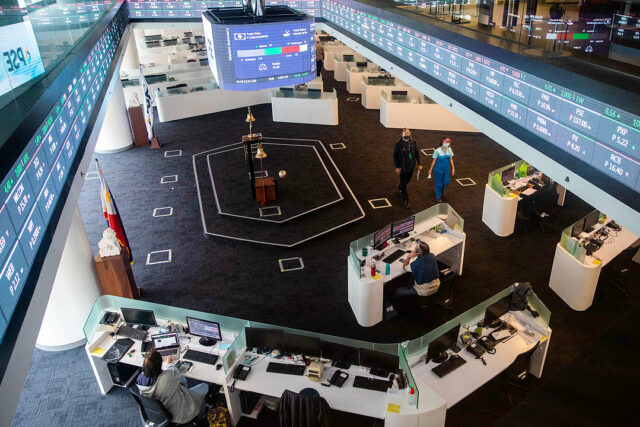
The Philippine Stock Exchange index declined by 110.52 points or 1.67% to close at 6,483.28 on Wednesday, while the broader all shares index went down by 52.09 points or 1.48% to 3,463.86.

For Thursday, the trader said the peso could weaken further against the dollar ahead of potentially robust US labor data this week.

The trader sees the peso moving between P55.15 and P55.30 per dollar on Thursday, while Mr. Ricafort sees it trading from P55.10 to P55.30. — A.M.C. Sy with Reuters

PHL stocks slump as Fitch downgrades US rating

REUTERS

PHILIPPINE SHARES fell on Wednesday on negative market sentiment after Fitch Ratings unexpectedly downgraded the United States’ credit rating.

The Philippine Stock Exchange index (PSEi) declined by 110.52 points or 1.67% to close at 6,483.28 on Wednesday, while the broader all shares index went down by 52.09 point or 1.48% to 3,463.86.

“Philippine shares along with the whole region plummeted as independent rating agency Fitch cut the rating from the top level of AAA to a notch lower at AA+,” Regina Capital Development Corp. Head of Sales Luis A. Limlingan said in a Viber message.

“The announcement comes after US lawmakers waited until the last moment to agree on a debt ceiling deal just this May. While the company Fitch noted steady deterioration in governance over the last 20 years,” Mr. Limlingan added.

Rizal Commercial Banking Corp. Chief Economist Michael L. Ricafort likewise said in a Viber message that the local market tracked the decline of other markets following Fitch’s rating action.

Rating agency Fitch on Tuesday downgraded the US government’s top credit rating, a move that drew an angry response from the White House and surprised investors, coming despite the resolution of the debt ceiling crisis two months ago, Reuters reported.

The rating agency first warned the US of the possible downgrade in May and maintained its position last June after the country’s debt ceiling crisis was resolved saying it intended to finalize the review in the third quarter of this year.

Asian stocks and US Treasury yields declined on Wednesday after Fitch’s move.

MSCI’s broadest index of Asia-Pacific shares slid 1.9%. Japan’s Nikkei by 1.8%, while Australian shares tumbled 2.3%.

In early European trades, the pan-region Euro Stoxx 50 futures were down 0.7%. German DAX futures and FTSE futures fell 0.8% and 0.5%, respectively.

Investors counterintuitively fled to the relative safety of sovereign debt from riskier equity markets. Treasuries, whose yields fall when prices rise, were also bought when Standard & Poor’s cut the US’ top “AAA” rating by one notch to “AA-plus” in 2011.

Back home, all sectoral indices fell on Tuesday. Mining and oil plummeted by 208.35 points or 1.98% to 10,272.38; services declined by 30.83 points or 1.94% to 1,553.84; industrials dropped by 164.84 points or 1.78% to 9,070.30; property shed 47.59 points or 1.75% to end at 2,670.95; holding firms decreased by 92.48 points or 1.45% to 6,251.39; and financials went down by 26.01 points or 1.34% to 1,910.87.

Value turnover rose to P4.23 billion on Wednesday with 787.44 million shares changing hands from the P3.96 billion with 804.27 million issues seen on Tuesday.

Decliners widely outnumbered advancers, 154 versus 27, while 47 names closed unchanged.

Net foreign selling went up to P553.02 million on Wednesday from P131.91 million on Tuesday. — A.H. Halili with Reuters

US flags blacklisted Chinese firm in Manila Bay reclamation projects

By Kyle Aristophere T. Atienza, Reporter

THE US EMBASSY in Manila has expressed concern about the environmental impacts of reclamation projects in Manila Bay and the involvement of a Chinese company that had been blacklisted by Washington.

“We have expressed concerns about the potential negative long-term and irreversible impacts on the environment, the resilience to natural hazards of Manila and nearby areas and on commerce,” embassy spokesman Kanishka Gangopadhyay said in a statement on Wednesday.

The Chinese Embassy in Manila did not immediately reply to a Viber message seeking comment.

Philippine environmentalists and scientists as well as fisherfolk have been opposing the reclamation projects, citing threats to marine ecosystems such as mangroves and wetlands and the displacement of coastal communities.

There are 22 reclamation projects in the bay, which are bounded by Metro Manila and the provinces of Bataan, Pampanga, Bulacan in central Luzon and Cavite in Southern Tagalog.

Permits for the projects were completed from 2019 to 2021 under the administration of former President Rodrigo R. Duterte, who led a foreign policy pivot to China in exchange for investment pledges, few of which had materialized.

The US Embassy also raised concerns about the projects’ ties to China Communications Construction Co., “which has been added to the US Department of Commerce’s entity list for its role in helping the Chinese military construct and militarize artificial islands in the South China Sea.”

It said the company, which is controlled by the Chinese government, has also been cited by the World Bank and Asian Development Bank for engaging in fraudulent business practices.

“We continue to support high-quality, sustainable and transparent investments to benefit the Filipino people and will continue to engage with the appropriate authorities on this matter.”

The embassy said it is in regular discussions with the Philippine government regarding the reclamation projects.

Earlier in the day, Environment Secretary Maria Antonia Yulo-Loyzaga said geological hazards should be considered in assessing the reclamation projects in Manila Bay.

She said the project proponents had failed to include the possible impacts of the movement of the Manila Trench, an oceanic trench in the Pacific Ocean located west of the islands of Luzon and Mindoro.

“It is in Manila Bay,” Ms. Loyzaga told a news briefing. “That is the geological event we are looking at in terms of generation of a potential tsunami. I haven’t seen this in the studies submitted by the proponents.”

The Environment chief said the reclamation projects might also hinder relief and rescue efforts should a 7.2-magnitude earthquake dubbed as the “Big One” hit Metro Manila.

“The Big One actually has a situation wherein Metro Manila will be separated into four segments — the coastal areas facing Manila Bay will be among those that will be affected,” she said. “Rescue and relief operations were meant to come by air and by sea. So reclamation projects could possibly have an impact on that plan.”

Ms. Loyzaga said the rising sea level should likewise be considered in assessing the projects.

“All of these need to be taken into consideration in terms of scenarios for reclamation, as well as the subsidence that is ongoing because of the extraction of groundwater from the coastal areas of Manila Bay.”

Citing its study on the rising sea level, Greenpeace Philippines in 2022 said as much as 80% of Manila, the Philippine capital, could be submerged by 2030.

Ms. Loyzaga said her agency has yet to conduct a cumulative impact assessment of the reclamation projects.

The Environment department is tapping various scientists and engineers, including physical and chemical oceanographers, fishery experts and marine biologists.

“We need certain types of engineers in terms of the evaluation of the potential infrastructure that will be introduced,” she said. “The composition of the cumulative impact assessment team would not be easy.”

She said reclamation has economic value. “However, we need to do the cost-benefit analysis in terms of impacts on geology and the longer-term impacts in terms of what could result from climate change.”

ADVERTISEMENT
ADVERTISEMENT