Home Blog Page 4496

Roxas and Company, Inc. to hold Annual Meeting of Stockholders on Aug. 30


Spotlight is BusinessWorld’s sponsored section that allows advertisers to amplify their brand and connect with BusinessWorld’s audience by enabling them to publish their stories directly on the BusinessWorld website. For more information, send an email to online@bworldonline.com.

Join us on Viber at https://bit.ly/3hv6bLA to get more updates and subscribe to BusinessWorld’s titles and get exclusive content through www.bworld-x.com.

Improved sales lift Holcim’s net income for Q2

HOLCIM PHILIPPINES FACEBOOK PAGE

HOLCIM Philippines, Inc. registered a P478.72-million attributable net income for the second quarter, up by 98.8% from P240.77 million a year ago, boosted by higher sales volume across its business segments.

“We are determined to further accelerate programs for decarbonization, circularity and digitalization to deliver better results and contribute to building progress in the country,” Horia Ciprian Adrian, president and chief executive officer of Holcim Philippines, said in a statement on Monday.

For the April-to-June period, the company posted P6.26 billion in consolidated revenues, a 15.3% increase compared to P5.43 billion a year prior, driven by higher sales volumes across its business segments.

The company said that its profit increase in the second quarter led to a 26.3% rise in its first semester attributable net income to P834.72 million from P661.05 million previously.

Its gross revenues for the January-to-June period recorded a 6% increase to P12.90 billion from P12.17 billion in the same period last year.

“Our focus on sustainability and innovation is continuing to pay off with more efficient operations and higher value offerings that are raising business performance,” Mr. Adrian said.

Higher energy prices were offset by its sustainability efforts such as fuel mix optimization, improved blended portfolio and alternative fuel usage, Holcim said.

The listed company also said it will continue to pursue its portfolio of low-carbon cements to accelerate its net-zero emission targets.

The Philippine Stock Exchange has suspended the trading of shares of the listed cement producer due to its noncompliance with the required public ownership under the regulator’s existing rules and guidelines. — Ashley Erika O. Jose

PBCom books higher net income in Q2

PHILIPPINE BANK of Communications (PBCom) saw its net profit rise by 46.87% year on year in the second quarter as it booked a higher operating income on the back of its better trading performance.

The lender’s attributable net income stood at P458.56 million in the second quarter, up from P312.23 million in the same period last year, based on its quarterly report submitted to the local bourse on Monday.

This brought its first-half net income to P999.96 million, up by 37.5% from P727.27 million a year prior.

The bank’s first semester performance translated to a return on average equity of 12.45%, up from 10.17% the year prior, and a return on average assets of 1.55%, better than the 1.29% seen in the first half of 2022.

PBCom’s net interest income went down by 5.63% to P1.13 billion in the second quarter as the increase in interest expenses (476.7%) outpaced the growth in interest income (40.22%).

As a result, the bank’s net interest margin fell to 4.08% at end-June from 4.75% from the same period last year.

Meanwhile, operating income rose by 17.99% to P1.47 billion as the bank saw a P46.39-million trading gain versus the P199.58-million loss a year ago.

On the other hand, operating expenses went up by 4.07% to P846.72 million from P813.62 million.

The bank’s provisioning for impairment losses dropped to P8.5 million from P37.16 million.

PBCom’s gross loans went up by 2.42% to P78.78 billion at end-June from P76.92 billion at end-2022.

Its nonperforming loan (NPL) ratio was at 2.79%, lower than the 3.23% seen at end-2022.

On the funding side, deposit liabilities dropped by 1.81% to P97.65 billion at end-June from P99.44 billion at end-2022.

Total assets stood at P132.48 billion as of June.

Total equity was at P16.57 billion.

PBCom’s capital adequacy ratio stood at 17.27% as of June, up from 16.55% in the same period last year.

The bank’s liquidity ratio was steady at 21.41% at end-June from end-2022.

PBCom’s shares went up by four centavos or 0.25% to end at P15.84 apiece on Monday. — A.M.C. Sy

Entertainment News (08/08/23)


Newport World Resorts presents ABBA Tribute concert

NEWPORT World Resorts brings Swedish pop band ABBA’s music to life with Mania: The ABBA Tribute concert, featuring a West End tribute band, happening at the Newport Performing Arts Theater on Aug. 25 and 26, Friday and Saturday, at 8 p.m. From “Dancing Queen,” “Mamma Mia,” and “Waterloo,” the two-night concert will showcase chart-topping classics that will make fans dance, jive, and have the time of their lives. Tickets are available at all TicketWorld and SM Tickets outlets, with prices ranging from P1,000 to P7,800. For inquiries, contact JhayR dela Cruz at 0917-818-9847 and Raf Sangco at 0917-807-9387.


Paw Fest scheduled at Robinsons Magnolia

THE PET event Paw Fest will be held on Aug. 12-13 at Robinsons Magnolia. This year’s theme is “Tropical Paradise,” where pets and their owners can enjoy a weekend of fun-filled activities, unique shopping experiences, and entertainment opportunities. Paw Fest by Kott’s, in collaboration with Robinsons Magnolia and Robinsons Malls’ Happy Pets Club, has a focus on education and entertainment, and provides a platform for showcasing various pet brands, products, and services. Among the events is a Tropical Pet Fashion Show at 5 p.m. on both days, showcasing the latest in tropical-themed pet fashion and accessories. There will also be a Pet Blessing at 2 p.m. on both Saturday and Sunday. There will be Educational Talks with experts from Pet Pal Asia at 2:30 p.m. on both days. A raffle’s prizes include luxury pet beds, tropical-themed toys, grooming packages, and much more. For interactive fun, there are games for both pets and owners. Lastly, there is the Paradise Photo Booth to snap picture-perfect keepsakes. Paw Fest by Kott’s will be held on Aug. 12 and 13, 10 a.m. to 10 p.m., at the Atrium, Upper Ground Floor of Robinsons Magnolia.


KCC to hold K-Culture photo exhibit

WITH the ever-growing popularity of K-Culture in the Philippines, the Korean Cultural Center (KCC) in the Philippines (KCC), in partnership with the Korea Tourism Organization Manila Office (KTO), presents “Mga Kuha sa Korea,” a month-long travel photo exhibit set to run from Aug. 17 to Sept. 23 at the KCC Building in Taguig City. The KCC dedicates the months of August and September to promote tourism in Korea through a series of events, starting off with the photo exhibit. There are sections dedicated to the four seasons, showcasing the beauty of Korea’s landscapes as they transform throughout the year; a dedicated section celebrates Korean food; and the 2030 Busan World Expo section highlights the Korean government’s effort to bid as it showcases Busan. There will also be a 2023 Korean Film Festival section, themed “travel.” Through selected films, the KCC aims to transport viewers to different cities and provinces of Korea, allowing them to experience the country’s essence through the world of cinema. More details about the 2023 Korean Film Festival will be announced soon. The exhibit also features the finalists’ entries from the “I Was Here: Mga Kuha sa Korea” contest, where participants shared one of the fondest memories from a trip to Korea. The contest winner will also be awarded during the exhibit’s opening on Aug. 17. The Korean Embassy is also launching Korea Visa Application Center (KVAC) which will start operations on Aug. 14. KVAC will be located at the Brittany Hotel in Bonifacio Global Center, Taguig City.

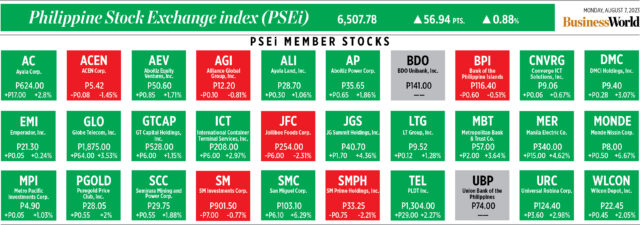
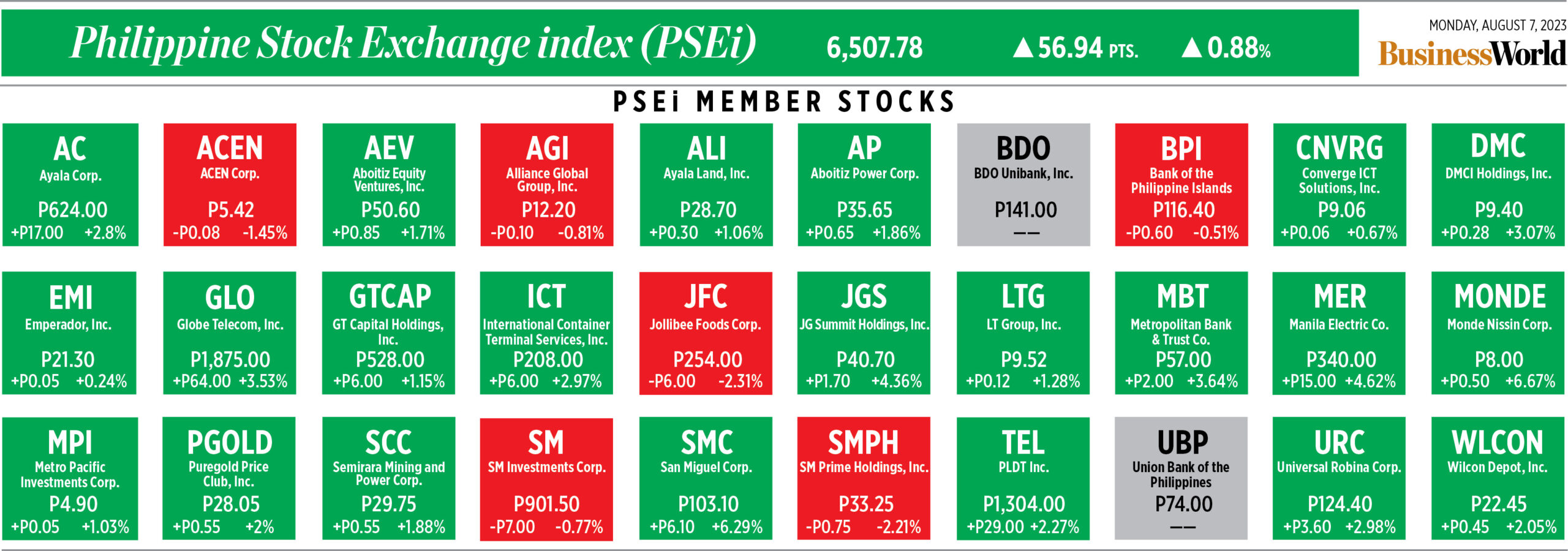
How PSEi member stocks performed — August 7, 2023

Here’s a quick glance at how PSEi stocks fared on Monday, August 7, 2023.


Shares climb ahead of PHL Q2 GDP, US CPI data

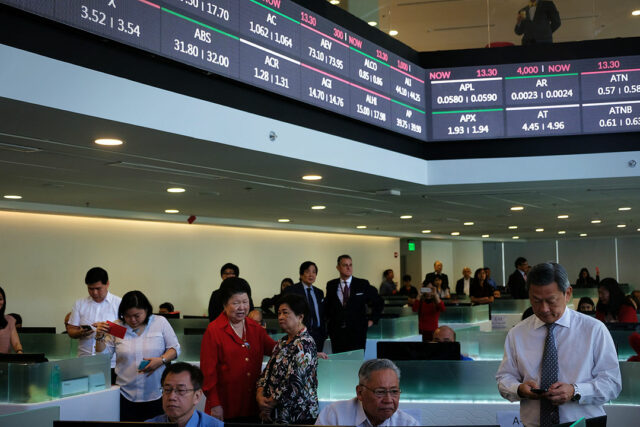
BW FILE PHOTO

STOCKS ended higher on Monday as investors picked up bargains and stayed on the sidelines before the release of second quarter Philippine gross domestic product (GDP) and the July US inflation data later this week.

The Philippine Stock Exchange index (PSEi) rose by 56.94 points or 0.88% to close at 6,507.78 on Monday, while the broader all shares index went up by 26.31 points or 0.76% to end at 3,473.92.

“Local shares headed higher on Monday amid bargain hunting after a steep fall during the prior trading day… The market tentativeness was on account of the continued slump in Wall Street as the S&P 500 and Nasdaq Composite plummeted for a fourth straight session, and notched their worst weeks since March,” Papa Securities, Inc. Equities Strategist Manny P. Cruz said in a Viber message.

Wall Street stocks fell on Friday, while the US dollar and Treasury yields were lower, after a government jobs report showed a slowing but still tight US labor market, Reuters reported.

The Dow Jones Industrial Average fell about 0.4% and the S&P 500 slipped 0.5%, reversing gains earlier in the day. The technology-heavy Nasdaq Composite was down about 0.4%, propped up by a 8% surge by Amazon.com.

“For the week, investors will be looking forward to the local GDP print and US CPI (consumer price index) report by the tail end of the week,” Mr. Cruz added.

Regina Capital Development Corp. Head of Sales Luis A. Limlingan likewise said shares rebounded due bargain hunting as market participants await the US CPI report and economic data releases locally.

The Philippine Statistics Authority will release second-quarter GDP data on Thursday.

Economic growth likely slowed to 6% in the second quarter amid elevated inflation and higher borrowing costs, a BusinessWorld poll of 21 analysts held last week showed.

If realized, this would be slower than the 6.4% growth in the first quarter and the 7.5% expansion in the same period in 2022.

This would bring the average GDP growth to 6.2% in the first half, within the government’s 6-7% full-year target.

Meanwhile, July US CPI data will also be released on Thursday.

Back home, all sectoral indices went up on Monday, except for property, which fell by 22.95 points or 0.83% to 2,738.20.

Meanwhile, services gained 30.57 points or 1.99% to end at 1,560.84; industrials increased by 123.06 points or 1.36% to 9,127.62; holding firms climbed by 65.44 points or 1.06% to 6,203.19; and financials went up by 6.66 points or 0.35% to close at 1,910.53.

Value turnover fell to P3.26 billion on Monday with 578.13 million shares changing hands from the P6.64 billion with 540.93 million issues seen on Friday.

Advancers outnumbered decliners, 97 versus 82, while 51 names closed unchanged.

Net foreign selling went up to P399.3 million on Monday from P245.42 million on Friday. — A.H. Halili with Reuters

Peso sinks to P56:$1 level ahead of GDP data

STOCK PHOTO | Image by iiijaoyingiii from Pixabay

THE PESO dropped to the P56-per-dollar level for the first time in almost two months on Monday on expectations of slower gross domestic product (GDP) growth in the second quarter.

The local currency closed at P56.02 versus the dollar on Monday, weakening by 28 centavos from Friday’s P55.74 finish, data from the Bankers Association of the Philippines’ website showed.

This was the peso’s weakest close since it finished at P56.05 per dollar on June 9.

The local unit opened Monday’s session at P55.65 per dollar. Its intraday best was at P55.60, while its weakest showing for the day was at P56.06 against the greenback.

Dollars traded dropped to $973.75 million on Monday from the $1.14 billion seen on Friday.

“The peso weakened… amid market expectations of a slightly weaker Philippine economic growth in the second quarter,” a trader said in an e-mail.

A BusinessWorld poll of 21 economists conducted last week yielded a median estimate of 6% for second-quarter GDP growth.

If realized, this would be slower than the 6.4% growth in the first quarter and the 7.5% expansion in the same period in 2022.

This would bring the first-half average to 6.2%, within the government’s 6-7% full-year target.

The Philippine Statistics Authority (PSA) will release second-quarter GDP data on Thursday, Aug. 10.

The peso also declined due to a stronger dollar recently and elevated global crude oil prices, Rizal Commercial Banking Corp. Chief Economist Michael L. Ricafort said in a Viber message.

The dollar index was 0.08% higher at 102.14, edging away from Friday’s low of 101.73, Reuters reported.

Meanwhile, oil prices hovered near their highest levels since mid-April after top producers Saudi Arabia and Russia pledged to extend supply cuts through September, further tightening supplies.

Prices have seen a sustained rally, with both key benchmarks notching up their sixth consecutive weekly gains last week.

On Monday, Brent crude futures slipped 24 cents to $86 a barrel by 0820 GMT, while US West Texas Intermediate crude was at $82.55 a barrel, down 27 cents.

For Tuesday, the trader said the peso could recover on expectations of better trade data.

The trader expects the peso to move from P55.85 to P56.10 per dollar on Tuesday, while Mr. Ricafort expects it to trade from P55.90 to P56.10. — AMCS with Reuters

Rice imports sharply lower in 7 months to July as prices rise

PHILIPPINE STAR/ MICHAEL VARCAS

By Sheldeen Joy Talavera, Reporter

THE PHILIPPINES imported 1.96 million metric tons (MT) of rice in the seven months to July, down 16.37% from a year earlier, the Bureau of Plant Industry (BPI) reported.

The BPI said rice imports in July fell 71.26% year on year to 116,195.75 MT as of July 27. The July total was down 46.37% from a month earlier.

“The decline in imports is due to the increasing international price of rice which makes it somewhat risky and expensive for importers to bring in rice from abroad,” Raul Q. Montemayor, national manager of the Federation of Free Farmers, said via Messenger.

Citing Bureau of Customs (BoC) data, he said the price of the supplier countries’ rice of the 5% broken variety had risen $100 per ton in July compared to a year earlier.

This is equivalent to a P7.30 increase in landed cost, including tariffs, he said.

During the seven months, Vietnam remained the Philippines’ top rice supplier, accounting for 1.75 million MT or 89.68% of total imports.

Myanmar supplied 83,460 MT and Thailand 76,287 MT.

Agriculture Undersecretary Mercedita A. Sombilla has urged the private sector to import over a million MT of rice amid concerns over supply following the typhoons that hit the country in July and in preparation for the impact of El Niño.

“We have something like 1.3 million MT in applications (to import) that are pending. We are really encouraging the private sector (to bring in the rice),” she said at a Palace briefing last week.

The Philippine rice inventory is good for 39 days, she said.

“Our current problem is the supply of rice in August and September, during which harvests are going to be very low. We need in effect 60 days of supply, but DA said we had only 39 days of supply as of August 1,” Mr. Montemayor said.

“The only realistic source of the deficit of 21 days’ supply is imports, but the private sector may think twice before importing because of high prices and risks,” he added.

Agriculture Undersecretary Leocadio S. Sebastian said, also citing BoC data, that about two million MT of rice had arrived by the end of July, down 11.38% from a year earlier.

“That’s a large volume, but because we are in the lean months and preparing for El Niño, we are encouraging the private sector to bring in more stocks,” he said in a Viber message.

“There has been a downtrend in the arrival of imports because of the increasing price of imported rice, aggravated by the export ban of non-basmati white rice from India,” he added.

Last month, India announced an immediate ban on exports of non-basmati white rice in order to ensure domestic rice availability and lower prices.

According to Department of Agriculture (DA) price monitors, domestic well-milled rice on Friday sold for between P41 and P49, while regular-milled rice fetched between P37 and P44.

Imported well-milled rice sells in Metro Manila for between P44 and P46. The Philippines does not import regular-milled rice.

Farmers lobby for more poultry, livestock funding as agri budget comes under review

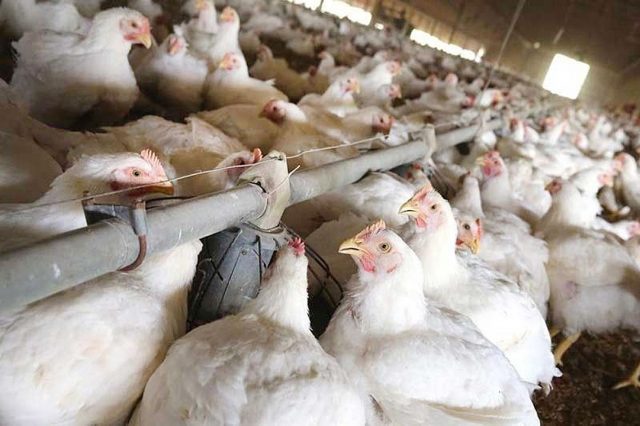
PHILSTAR FILE PHOTO

THE poultry and livestock industries need more funding to protect them from extreme weather events, farmers said with Congress poised to review the 2024 budget proposals for agriculture.

Agriculture has been allocated P181.4 billion in the proposed 2024 national budget, up 4.5% from 2023.

Elias Jose M. Inciong, president of the United Broiler Raisers Association (UBRA), said funding must be less “rice-centric,” and asked for more support for common service facilities for poultry and livestock, as well as infrastructure to store yellow corn, a main component of animal feed.

“There is a need to diversify our carbohydrate sources. Other grains and vegetables should be explored,” he said in a Viber chat.

UBRA Chairman Gregorio A. San Diego, Jr. raised the need to fund neglected crops like corn, tapioca, and tomatoes.

Under the 2024 National Expenditure Program, the National Rice Program has been allotted P30.87 billion, while the programs for corn and high-value crops will receive P5.28 billion and P1.94 billion, respectively. The budget also allocates P10 billion to the Rice Competitiveness Enhancement Fund, an automatic allocation taken from import tariffs according to the provisions of the Rice Tariffication Law.

 The budget also includes P17.27 billion for farm-to-market roads, and P31.18 billion for irrigation.

 “The biggest problem is the country’s loss of agricultural land, especially irrigated land,” he said via Viber.

Samahang Industriya ng Agrikultura Executive Director Jayson H. Cainglet pushed for funding to make the industry more resilient against calamities. 

“With extreme weather becoming the norm, there should have been a corresponding budget response for crop and livestock insurance, indemnity and emergency funds to cover and offset farm losses in the era of extreme weather,” he said via Viber. 

Raul Q. Montemayor, national manager of Federation of Free Farmers, pointed to the need to assign more importance to program effectiveness rather than budget utilization.

“Right now, the (Department of Budget and Management’s) main criterion in deciding whether to fund or not is how much of a program’s budget was disbursed in the previous year, not how effective it was in achieving targets,” he said in a Viber chat. — Beatriz Marie D. Cruz

Philippine fintech user base projected at 59.3 million by end of year

REUTERS

THE NUMBER of financial technology (fintech) users over 15 years old in the Philippines who transact via mobile apps is expected to hit 59.3 million by the end of 2023, consumer finance company Digido said.

In a report, Digido said fintech adoption may hit 72.2% of the eligible user population by the end of 2023, up from 69.3% in 2022 and 64.4% in 2021.

“The findings from our report indicate that the inertial movements towards the “fintechization” of the population are going from strength to strength. The country’s fintech infrastructure is also showing high adaptability to ever-emerging challenges, mainly due to a large domestic market and progressive government support,” Digido country manager Farit Shakirov said in a statement.

“As it stands, there remains opportunity for the fintech industry to maintain momentum and build towards a more vibrant ecosystem by cultivating further trust in their services by providing seamless, communicable user experiences and fruitful collaborations,” he added.

The report said that the payments sector will be the main driver for future fintech adoption. This segment includes electronic wallets, digital banking, and payment of bills and taxes.

Digido estimated that the payments and transfers sector, which is expected to grow at 17.6%, will propel the industry.

This segment includes E-wallets, Digital Lending, and E-commerce.

Over the past five years, E-wallets posted 1,026% user growth, while digital lending grew 330% and E-commerce 222%, Digido noted.

“However, in turn, digital lending shows more stable annual growth rates than all other fintech sectors in the Philippines,” it added.

Blockchain and Cryptocurrency are expected to lag the other segments. Digido expects it to decline 4.3% by the end of 2023.

“In summary, total financial inclusion in the Philippines is only a matter of time,” it said. — Aaron Michael C. Sy

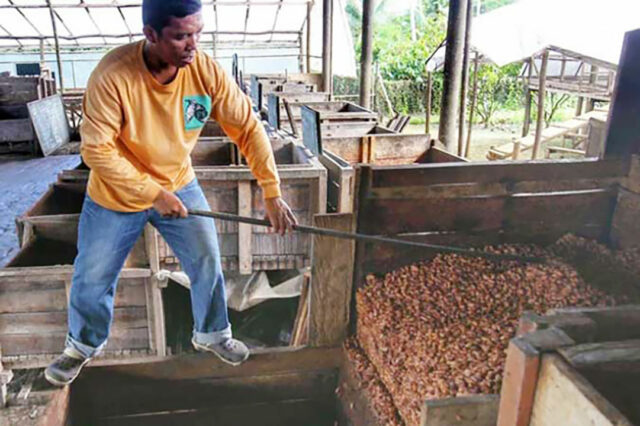
Cacao industry dev’t bill wins committee approval

BW FILE PHOTO

A HOUSE committee has approved a bill creating a national program to raise the international competitiveness of the cacao industry.

“The proposed bill seeks to create integrated and harmonized programs, projects and activities in the promotion of Philippine cacao,” Quezon Rep. Keith Micah DL. Tan, who chaired the technical working group that reviewed the measure, told the committee.

The unnumbered substitute bill aims to implement the Philippine Cacao Industry Roadmap 2021-2025 in partnership with the private sector.

The measure also seeks to create the Philippine Cacao Industry Council under the Department of Agriculture to oversee the implementation of the roadmap.

The bill also proposes the creation of the Cacao Program Management Office, which will identify and recommend priority projects to the council.

Private sector representatives will come from Luzon, the Visayas, and Mindanao, to be selected by the council.

The proposed law also provides a donor’s tax exemption for donations, contributions, grants in cash or in kind whether local or foreign, “the cost of which shall be considered as an allowable deduction from the gross income of the donor,” Mr. Tan said.

“It also encourages chocolate shops, serving cocoa or chocolate drink including local and foreign franchises restaurants and hotels, to serve and include in their menus cacao or chocolate that is grown, produced, sourced, and manufactured locally,” he added. 

At the 2023 International Cocoa Awards at the Salon du Chocolat in Paris in October, three cacao farmers from Davao City will be representing the Philippines.

Armi Lopez-Garcia, president of the Philippine Cacao Industry Association, cited the lack of post-harvest knowledge in producing more globally competitive cacao.

“It’s sad to say that during the PCQA (2022 Philippine Cacao Quality Awards) activity, out of the 43 entries, only three passed…because we realized that the farmers don’t know anything about post-harvest,” Ms. Lopez-Garcia told the committee.

Funding for the program will initially come from various agencies as well as the council, then in succeeding years it will receive money from the national budget.

“Unfortunately now, cacao is under the high value crops program… which means (funding) depends on the priorities (of the program),” House Agriculture and Food panel chairman and Quezon Rep. Wilfrido Mark M. Enverga said. “With this bill, we are ensuring that cacao will have its separate portfolio.” — Beatriz Marie D. Cruz

PEZA on track to exceed lower end of 2023 investment approvals target range

FILINVEST.COM

THE Philippine Economic Zone Authority (PEZA) said it is on pace to exceed the lower end of its 2023 investment approvals target range, judging from the strong results posted in the first seven months of the year.

It also said the P300 billion high end of the target range for 2023 is doable if all current investment leads pan out.

“Our conservative target (this year) is P160 billion but if all (investment) leads are realized within the year, there is a strong chance that we can still hit our (stretch) target of about P300 billion,” PEZA Director General Tereso O. Panga said in a television appearance on Monday.

In a statement on Monday, PEZA said it logged P97.16 billion worth of approved investments in the first seven months, up 332.05% from a year earlier.

The approved investments cover 117 new and expansion projects, which are expected to generate $2.21 billion worth of exports and lead to the creation of 18,407 jobs.

In July, the PEZA Board approved P16.578 billion worth of investments from 15 new and expansion projects, which are expected to generate $419.5 million exports and create 2,983 jobs.

“I would say that we are on track with our target. Right now, the latest investment approvals (are) (over 330%) larger than what we approved last year. I think with the five months to go, we are confident that we will be able to exceed our set targets for 2023,” Mr. Panga said during his TV appearance.

PEZA also said in its statement that the Office of the President (OP) issued Proclamation Nos. 299, 300, and 303 on July 25 which approved the creation of three economic zones in Naga City, Camarines Sur; Bacolod City; and Dumaguete City.

Proclamation No. 299 covers the Naga City Industrial Park in Barangay Carolina, while Proclamations 300 and 303 cover Lopue’s Mandalangan IT Center in Barangay Mandalangan, Bacolod City and Marina Town Dumaguete IT Center in Barangay Piapi, Dumaguete City, respectively.

The three ecozones are projected to generate P750.38 million worth of investments.

In April, the OP also proclaimed two new ecozones in Batangas province and Bacolod City, which are expected to bring in P1.64 billion worth of investments.

Currently, six PEZA ecozones are awaiting proclamation. These ecozones are located in Parañaque City (two IT Centers), Pasig City (IT Center), Tanza, Cavite (manufacturing site), Ilocos Sur (manufacturing site), and Sarangani Province (agro-industrial site).

“We remain on track with our goal of establishing at least thirty ecozones every year that create centers of economic progress outside the National Capital Region to spur countryside development,” Mr. Panga said.

During the TV interview, Mr. Panga said PEZA is also seeking to attract power companies interested in embedding their facilities in ecozones.

“Because of our franchising authority, what we are doing is promoting a distributed energy system (by) attracting power generating companies to… make power cheaper (by eliminating) transmission charges,” Mr. Panga said.

He added that embedded power will ultimately make Philippine exports more competitive.

Mr. Panga said PEZA supports the Marcos administration’s plan to amend the Corporate Recovery and Tax Incentives for Enterprises (CREATE) Law.

“I think it is about time to look into that because our locators are saying that they should be able to enjoy the incentives as promised to them in the CREATE and contained in the registration agreement with PEZA,” Mr. Panga said.

He added that the amendments to the CREATE could be done “through administrative proceedings and amending the implementing rules and regulations (IRR).”

“We agree with the time-bound incentives. But if you look at the 10-year sunset period and even the maximum 17 years of (enjoying) the incentives… our locators will graduate to regular corporate income tax (CIT). And we’re up against ASEAN economies offering a much lower CIT rate,” Mr. Panga said.

“I think this will need revisiting by government so in the end, we will be able to keep our gains and keep our locators expanding in the Philippines rather than losing them to other competitors in the region,” he added.

Last month, Presidential Communications Office Secretary Cheloy Velicaria-Garafil said that some of the issues raised by companies include the 12% value-added tax (VAT) on indirect exporters supplying goods and services to export-oriented enterprises; non-refunds on VAT for local purchases by domestic market enterprises, and ease of doing business issues.

The concerns were raised by companies during a meeting with President Ferdinand R. Marcos, Jr. on the sidelines of the third Asia-Pacific Economic Cooperation Business Advisory Council meeting in Cebu City.

Some of the proposed amendments to the CREATE include allowing domestic market enterprises covered by the 5% gross income tax regime to register as VAT taxpayers, which will allow them to charge domestic customers output VAT, or obtain refunds from the Bureau of Internal Revenue. — Revin Mikhael D. Ochave


ADVERTISEMENT
ADVERTISEMENT