Home Blog Page 4483

SGV, Phinma sign deal for teacher tech training

DEPED.GOV.PH

SGV & CO. and Phinma Education Holdings, Inc. have agreed to provide the latter’s school teachers with upskilling and training programs covering technology trends in education.

In a statement on Thursday, SGV said the partnership was signed on Aug. 8 in Makati City, and will allow Phinma schools to participate in the SGV iTeach Program, which currently has 7,000 participants, teachers as well as students.

“The program aims to enable educators by updating them on the latest accountancy and technology trends and helping them bridge the gap between theoretical principles and actual practice,” it said.

“The SGV iTeach Program aligns with the Firm’s commitment to continue its late founder Washington Z. SyCip’s advocacy for lifelong learning.”

The training programs will have guest lecturers and employ the case method.

SGV said it plans to develop an online platform that teachers can use to collaborate and share modern teaching methods.

The Asian Development Bank (ADB) has said the Philippines needs to boost its adoption of education technology to better prepare its workers, who face the risk of job losses as automation takes hold.

“Preparing for the jobs of tomorrow will require workers to have a robust skill set with technological, higher-order cognitive and behavioral skills underpinned by strong foundational skills developed through solid primary and secondary education,” the ADB said in a July report. — John Victor D. Ordoñez

Some context for Philippine growth and inflation

BW FILE PHOTO

If we may speculate, and given the latest turn of events, many of the economic and financial assessments we hear in boardrooms must now be shifting to one of “fading recession and disinflation bets, resumption of BSP hike expectations… supply pressures keep rates buoyed.” This was captured in one of the board meetings we attended recently. It was an excellent presentation entitled “Shake, Rattle, Rattle Some More,” in obvious allusion to the more volatile, more uncertain global economy. The local equities market has been mimicking this in its roller coaster ride.

Repudiated by the likes of US Treasury Secretary Janet Yellen and former US Treasury Secretary Larry Summers, the US downgrade by Fitch did not help any. A knee-jerk reaction sent the 10-year US treasuries near the highs during the Global Financial Crisis, exacerbated by the expected reaction of the US Fed to stronger than expected US growth and labor market data. As US Fed Chairman Jim Powell declared near the end of last month: “Given the resilience of the economy recently, they (economists, statisticians, and other experts in the US Fed) are no longer forecasting a recession.”

The fast-moving oil market also mirrored the projected rosier outlook on the US economy. There seems to be a good convergence of initial forecasts of growth from different quarters. For instance, the US Energy Information Administration is projecting GDP growth of 1.9% this year while the US’ Bureau of Economic Analysis is bullish given the 2% and 2.4% first and second quarter GDP growth rates, respectively.

Thus, oil prices have started to climb. Although US oil production is expected to expand by 850,000 barrels per day (bpd) to 12.76 million bpd, this may not be enough to offset the cutback in Saudi Arabia’s oil output against the backdrop of steady global demand. China’s oil trade fell, with both exports and imports of oil down by double digits as China’s recovery has proved weaker than expected with consumer prices swinging to deflation last month. The so-called decoupling of China from the US and the West is now beginning to be felt in terms of lower foreign investment in and trade with China.

All of this could have negative spillovers for the rest of the region, namely, on aggregate demand, external trade and investment, exchange rate and inflation.

How is the Philippine economy performing?

While the economic managers were presenting the macroeconomic assumptions to the House of Representatives as members of the Development Budget Coordination Committee (DBCC) yesterday, the Philippine Statistics Authority (PSA) reported a modest output expansion of 4.3% for the 2nd quarter 2023 and with 6.4% growth in the 1st quarter 2023, the first half growth performance stood at 5.3%. First half real GDP last year was at a high 7.8%.

One can observe from the PSA chart that quarterly growth has been moderating since the 1st quarter of 2022. For the 2nd quarter alone, government spending and gross capital formation actually declined. Based on seasonally adjusted national income accounts, GDP recorded a quarter-on-quarter decline of 0.9%. Transportation and storage, manufacturing, and financial and insurance activities largely accounted for the retreat. (See Figure 1.)

This is where many economists and forecasters are coming from when they argue that the Bangko Sentral ng Pilipinas’ forceful, to use the word of Governor Eli Remolona during the congressional presentation, tightening of monetary policy might already be hurting the economy.

After all, it has been observed that year-on-year monthly inflation has shown some easing from the beginning of the year (See Figure 2).

Yet the Bangko Sentral ng Pilipinas (BSP) was correct in saying that any talk about an early cutting of the central bank’s key interest rate is “premature.” Further monetary tightening is still on the table for the Philippines; we are not out of the woods yet. While the easing trend appears obvious, year-to-date headline inflation of 6.8% remains way above the 2-4% inflation target. Core inflation continues to be sticky downwards. The BSP has good reason to remain cautious because upside risks continue to dominate, including the approved higher wages in all the 17 regions averaging 13%, the impact of El Niño on the food supply, and the potential depreciation of the peso should the US Fed decide to resume tightening as the current consensus appears to suggest.

As the BSP governor disclosed to Bloomberg in Canada, “We’re not thinking about whether to cut or not to cut.”

If we may add, global oil prices are beginning to rise with firm demand and lower supply. US economic resilience could also lift the lid on commodity prices. The latest export ban in some Asian capitals on rice could dash the hope of bringing down rice prices to P20 per kilo. With farm output dropping in the 2nd quarter, this is hardly good news for inflation in the next few months.

This set of facts and risks challenge the BSP’s current inflation forecasts of 5.4% for 2023, 2.9% for 2024, and 3.2% in 2025. With the lower GDP outturn for the 2nd quarter 2023, we expect a renewal of the call for the BSP to consider an early lifting of the policy rate after a 425-basis-point increase over a one-year period.

Some may also invoke the latest pronouncement of Nobel laureate Paul Krugman who said that the US Fed should not obsess over getting inflation back down to its target of 2%. After all, he said, the national conversation has started to veer away from it, as inspired by the steady cooling of the US economy. Inflation plummeted from a 41-year peak above 9% to 3% in June. Krugman’s key point is that the inflation target “was arbitrary to begin with.” For him, the more important consideration is to encourage people to cease worrying too much about inflation. Keeping the rates high could push the US economy into recession.

In the US, it may be true that the public seems to have gone slow on inflation talk. Based on the 12-week moving average of Google searches for “inflation,” it has been declining since August 2022. For Krugman, 3% rather than 2% is good enough lest the Fed “put the economy through the wringer.”

The Nobel laureate could be right in his concern about inflation but so far, talk about recession is also receding based on the latest data. The IMF’s World Economic Outlook (WEO) projected global output to fall from 3.4% in 2022 to 3% in both 2023 and 2024. But its forecast of 1.8% and 1% for the US this year and the next are not quite recessionary in exchange for a more decisive reduction in inflation. Inflation in itself could help drive the US economy to retreat following its debilitating impact on personal consumption.

Likewise in the case of the Philippines, we may not be in a Goldilocks situation based on a high actual inflation average of 6.8% and 5.4% forecast for the whole year and a modest 5.3% real GDP average for the first half of 2023 against the whole year target of 6-7%. But it is undeniable that the BSP retains the flexibility to keep a cautious stance on monetary policy. Talk about inflation has never stopped. The latest Pulse Asia survey for June 2023 indicates respondents rating “controlling inflation” as the No. 1 most urgent concern. Growth of 5.3%, with all the risks and headwinds, is resilient enough to give space to depress inflation.

As to economic growth, it would be wise for the rest of government to take up any slack by ensuring that the level of public spending be sustained each year through the judicious deployment of the P5.768-trillion budget which is more than a fifth of the country’s gross domestic product. Let nothing divert the state funds away from ensuring food security, improving infrastructure, enhancing education and skills development, strengthening health and social protection, achieving fiscal sustainability, lasting peace, and preparing for climate change. Fighting corruption also entails expense and nothing should be spared to attain it.

That is the only way by which partnership with business and investment could be inspired to provide the platform for higher and more meaningful economic growth.


Diwa C. Guinigundo is the former deputy governor for the Monetary and Economics Sector, the Bangko Sentral ng Pilipinas (BSP). He served the BSP for 41 years. In 2001-2003, he was alternate executive director at the International Monetary Fund in Washington, DC. He is the senior pastor of the Fullness of Christ International Ministries in Mandaluyong.

Forex gains, property sales boost first-half DBP income

BW FILE PHOTO

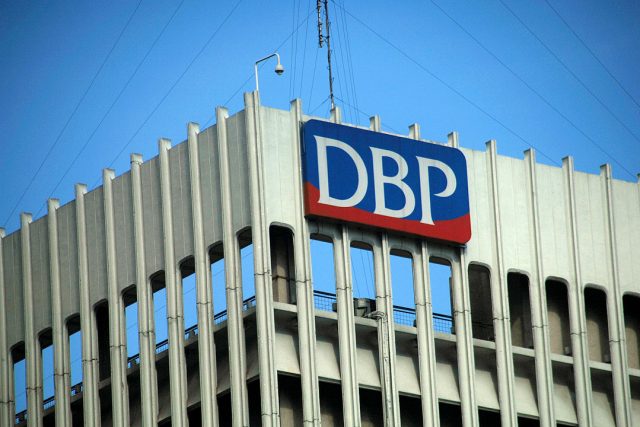
DEVELOPMENT Bank of the Philippines’ (DBP) net profit rose by 60% year on year in the first half, driven by gains from foreign exchange and the sale of properties.

DBP’s net income stood at P4.42 billion in the first semester, up from P2.76 billion in the same period last year, the state-run lender said in a statement on Thursday.

Its financial statement was not available as of press time.

“Notwithstanding the one-time gains, overall, the bank’s performance in the first half of the year demonstrates its resilience as an institution and its readiness to support the National Government’s strategic initiatives to foster economic growth and financial stability,” DBP President and Chief Executive Officer Michael O. de Jesus said.

He added that the bank is on track to meet its full-year income target of P5.2 billion.

The majority of loans disbursed in the first half went to the infrastructure and logistics sector at P281.59 billion. This was followed by loans to social infrastructure and community development at P110.03 billion.

“A significant chunk of our loans or about 55.5% of the bank’s total portfolio of P507 billion was released to bankroll public infrastructure under the banner of the National Government’s “Build, Better, More” program, majority of which are in the National Capital Region, Central Visayas, Davao, and Central Luzon,” Mr. De Jesus said.

DBP also lent P35.38 billion to the agriculture sector and P79.93 billion for other financial and insurance activities, including manufacturing, wholesale and retail trade, and food services. It disbursed P54.43 billion in loans for environment-related projects, and P30.23 billion to support micro, small and medium enterprises.

Meanwhile, total deposits with the bank went up by 4% to P760 billion.

Total capital increased by 8% year on year to P83.64 billion from P77.54 billion.

“DBP’s position as the country’s infrastructure bank is closely aligned with our President’s vision of catalyzing progress through economic efficiency through well-planned and inclusive infrastructure development,” Mr. De Jesus said. — AMCS

Nickel Asia sets $2-M capex per MW for pilot geothermal projects

NICKEL ASIA Corp.’s (NAC) renewable energy subsidiary is allocating approximately $2 million per megawatt (MW) as a capital expenditure (capex) budget for its pilot geothermal power plants in Biliran and Mindoro.

“Capex, I think… about $2 million per megawatt is our current estimate,” Emerging Power, Inc. (EPI) Chief Operating Officer Noel M. Gonzales said during a briefing on Tuesday.

EPI is currently conducting discharge testing for the 2-MW Biliran Geothermal project, which is projected to begin commercial operations by the fourth quarter of this year.

The first phase of the Mindoro geothermal power plant is scheduled to commence operations by the second quarter of 2025.

“Currently, we don’t plan to participate in GEAP (green energy auction program) for now but it is a pilot program to fully test… show, at least in Biliran, that it can support two megawatts worth of power,” he said.

Upon completion, the pilot operations could be expanded to achieve an additional 20 MW or potentially 50 MW through further drilling works.

“With regards to future expansions, we are looking into that and we’ll be looking at fully testing the other existing wells that are in Biliran,” Mr. Gonzales said.

In January, NAC’s board of directors approved an additional investment of P2.92 billion in EPI through a subscription to more common shares. This will support EPI’s operations, cover the operating expenses of its affiliate, Biliran Geothermal, Inc., and provide for the operating expenses of its unit, Mindoro Power Corp.

For the three months ending in June, NAC reported an attributable income of P776.70 million, marking a 72% decrease from P2.78 billion the previous year, mainly due to lower revenues and higher expenses.

Revenues saw a decline of 14.90% to P6.88 million, while gross expenses increased by 9.37% to P4.77 million.

On Thursday, NAC shares dropped by 45 centavos or 7.88%, closing at P5.26. — Sheldeen Joy Talavera

Net Foreign Direct Investment

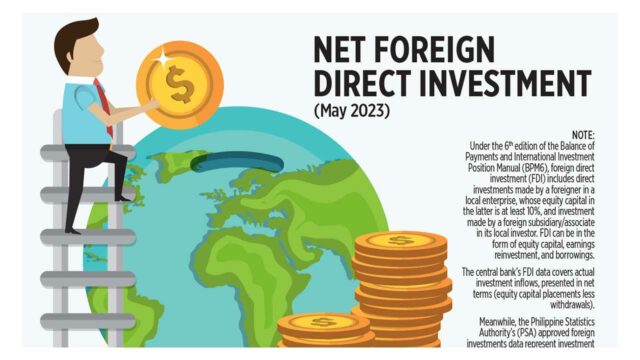
NET INFLOWS of foreign direct investments (FDI) declined in May, as elevated inflation and multi-year high borrowing costs dampened investor sentiment. Read the full story.

Robbie Robertson, songwriting force in rock group The Band, 80

ROBBIEROBERTSON.COM

ROBBIE Robertson, the guitarist and main songwriter in The Band, the Canadian-American group known for songs including “The Weight” and “The Night They Drove Old Dixie Down,” has died at the age of 80, his manager said on Wednesday.

Mr. Robertson, who left his Toronto home at age 16 to pursue his rock ‘n’ roll dreams, died Wednesday in Los Angeles after a long illness, Mr. Robertson’s manager of 34 years, Jared Levine, said in a statement.

“Robbie was surrounded by his family at the time of his death,” the statement added.

The Band included four Canadians – Mr. Robertson, Rick Danko, Garth Hudson, and Richard Manuel – and was anchored by an Arkansas drummer, Levon Helm. Originally dubbed The Hawks as the backing band for rockabilly wild man Ronnie Hawkins, they gained attention supporting Bob Dylan on his Going Electric tours of 1965-1966.

After changing their name to The Band and rebasing in Woodstock, New York, they became one of the most respected groups in rock. Their 1976 farewell concert in San Francisco was the basis of Martin Scorsese’s 1978 movie The Last Waltz.

The Band had a unique chemistry. Known for their vocal harmonies, they had three excellent singers in Helm, bassist Danko, and pianist Manuel. Organist and multi-instrumentalist Garth Hudson was also crucial.

“They were the goods,” Mr. Robertson wrote of his four band mates in his 2016 autobiography, Testimony. “This band was a real band. No slack in the high wire here. Everybody held up his end with plenty to spare.”

“The impact of The Band’s first album can’t be exaggerated,” critic Greil Marcus wrote in 2000, referring to their 1968 debut album, Music from Big Pink. It contained “The Weight” and Mr. Dylan’s “I Shall Be Released,” among others.

Their 1969 sophomore album, titled simply The Band, was even better. With their frontiersman look and unique blend of folk, rock, country, soul, and gospel, The Band influenced the likes of Eric Clapton, Elton John, the Grateful Dead, the Beatles, and generations of later musicians who played music that was by then called “Americana.”

Their music harked back to an earlier America, reflected in such song titles as “Across the Great Divide,” “King Harvest (Has Surely Come),” “Up on Cripple Creek,” and “The W.S. Walcott Medicine Show.”

INDIGENOUS ROOTS
Jaime Royal Robertson was born in Toronto on July 5, 1943. His mother, Rosemarie Dolly Chrysler, was an Indigenous Canadian of Mohawk and Cayuga descent. She married a Canadian Army enlistee named Jim Robertson. Robbie Robertson later learned that his biological father was a man he described as a “card shark” of Jewish heritage named Alex Klegerman, who was killed in a highway hit-and-run accident before Mr. Robertson was born.

As a boy, Mr. Robertson was impressed by his visits with relatives on the Six Nations Indian Reserve in southwestern Ontario. It struck him that “everybody there could play or sing or dance or do something with music,” he told the Canadian Broadcasting Corporation’s Metro Morning in 2017. “To see somebody sitting beside you in a chair and hear their fingers moving on the instrument, and hear them breathing when they were singing, all of that, it gave me chills.”

Mr. Robertson became infatuated with the guitar early on and gained a reputation as a guitar hot shot during his time with the Hawks. Rolling Stone magazine eventually ranked him No. 59 on its 2015 list of “100 Greatest Guitarists.” His unique guitar style was displayed to great effect on such Band songs as “Jawbone” and “Smoke Signal.”

After soaring to the highest heights on their first two albums, The Band continued to produce good work in the 1970s but a certain lethargy and lack of direction set in, not helped by the substance abuse problems of Mr. Danko, Mr. Helm, and Mr. Manuel. They decided to pack it in by holding a star-studded concert in 1976 with such guests as Mr. Dylan, Mr. Clapton, Joni Mitchell, Neil Young, Van Morrison, and Muddy Waters.

After The Band’s breakup, Mr. Robertson created soundtracks for Scorsese films, including Raging Bull. He made a foray into acting in 1980 with the film Carny, starring Jodie Foster. He released several solo albums, exploring new sonic territory rather than trying to recapture the distinctive sound of The Band.

DARK TIMES
In the 1990s, acrimony emerged when Mr. Helm accused Mr. Robertson of failing to give co-credits to the other members on songs he claimed they had co-written. Mr. Robertson denied he had unfairly withheld credit.

Mr. Helm painted a scathing picture of Mr. Robertson in his 1993 autobiography. Mr. Robertson reacted more in sorrow than anger, often saying in interviews that Mr. Helm, in the early days, was “the closest thing I had to a brother.”

The Band’s members reunited in various configurations in the 1980s and 1990s and even made a few albums under The Band name, but Mr. Robertson never took part.

After The Band’s breakup, a lifetime of hard living took its toll on the members. Mr. Manuel hanged himself in a Florida hotel room at age 42 in 1986. Mr. Danko died at age 55 in 1999. Mr. Helm died of throat cancer in 2012. Mr. Hudson is the remaining member still alive.

In February 2022, Variety reported, citing sources, that Mr. Robertson sold his music publishing catalog to a firm called Iconoclast for about $25 million.

After all the highs and lows, Mr. Robertson looked back at his Band mates with love and affection. “Through all the turbulence, I am left with such a deep appreciation for my journey,” he wrote in his autobiography. “This shining path I’ve traveled being part of the Band — there will never be another like it. Such a gift, such talent, such pain, such madness … I wouldn’t trade it for anything.” — Reuters


China slowdown triggers exodus from big cities

REUTERS

BEIJING — Almost half of Chinese undergraduates returned to their hometowns last year within six months of graduation, state media reported, with the proportion rising to 47% from 43% in 2018 amid a sagging job market.

Feeling the pinch of rising living costs, jobless Chinese youth have been leaving mega-cities, traditionally the stepping stone to middle-class wealth and beyond, for their hometowns with a slowing economy this year further pushing them away.

The proportion of undergraduates returning home six months after graduation climbed to 47% in 2022 from 43% in 2018, state-run China News Service reported, citing a private sector survey.

Those going home varied, with the well-developed east seeing the highest percentage of 59% versus 44% in the west and 24% in the northeast rust belt.

China’s youth jobless rate jumped to a record 21.3% in June with limited offers during the traditional job-hunting season, alongside a dim economic outlook, employment mismatch, salary cuts and previous regulatory clampdown that bruised the property, tech and education sectors.

Also pushing the young to return home are continued increases in rents. Among China’s biggest first-tier cities, rents in Beijing soared 5.0% by the end of June from December followed by 2.8% gains in Guangzhou and Shenzhen, according to state-run Xinhua news agency.

The rental market is widely expected to heat up in August, with fresh graduates looking to find lodgings in big cities. The education ministry has predicted the number of 2023 graduates would reach 11.58 million, up 820,000 from last year. — Reuters

The BoJ gets a new doctrine. It just ain’t telling

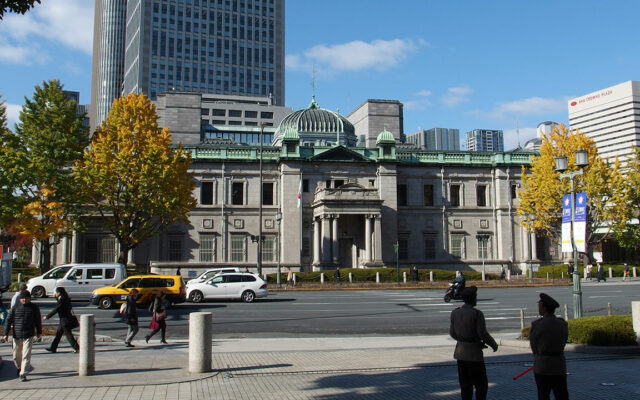
BANK OF JAPAN Osaka Branch — COMMONS.WIKIMEDIA.ORG

WITH few exceptions, the most prominent central banks have retired from the business of providing detailed projections of where interest rates are headed. The costs of being wrong in an era of worrisome inflation were too great. Japan is trying something new: forward misguidance.

Unsettling surprises are a feature of the choices the Bank of Japan (BoJ) has made over the past decade, rather than a bug. Dismantling ultra-loose money and the paraphernalia that has supported it means that communications accidents like the one that rocked global markets recently are bound to happen. If they were, indeed, an accident.

Investors should brace for more adventures on the road to less easy money. With inflation now off the floor — there are arguments about how much momentum prices have — the desired destination is likely an end to vigorous policing of yields on government bonds. And quite possibly, an end to negative official rates. That won’t happen overnight, but the odds of a graceful exit are long. Market sensitivity to tweaks in BoJ policy is extreme because officials are seeking to directly manage the value of securities, rather than guide toward their view.

Few BoJ watchers predicted Governor Kazuo Ueda would let long-term market rates increase at the conclusion of the July 27-28 meeting. Ueda had used a dovish tone earlier in July, affirming at the meeting of the Group of 20 finance ministers and central bankers in India that things were set to stay the same. “Unless the premise is shifted, the whole story will remain unchanged,” he said. Reports from inside the bank seemed to back this narrative; more than 80% of economists expected no policy change, even a tweak.

That was until 2 a.m., Tokyo time, on the morning of July 28, when a story in the Nikkei newspaper hinted that rates on 10-year Japanese government debt would be allowed to go over 0.5%. It was the second time in Ueda’s short reign that Japanese media appeared to be in possession of information from inside the gathering.

Even then, traders didn’t have the full story, with the report carrying no mention of the 1% ceiling. When the official announcement hit after an interminable wait — the BoJ still does not give a time in advance for when policy will be announced, leaving dealers fruitlessly refreshing screens — it confused the market with its mention of three different levels for the 10-year yield (“around zero,” a 0.5% “range,” and the 1% “ceiling” at which the bank would step in). Investors are still debating what the move means.

The July decision “created too many interpretations, because it was just too complex and everybody understood it in a different way,” former board member Sayuri Shirai said in an interview. “I kind of expected that Ueda-san would be a bit clearer.”

It’s far from the first time the bank has struggled to communicate a change in yield-curve control. In fact, every single time the BoJ has changed the way it implements YCC, it has done so differently, going from an ambiguous range to a defined one, and now back to ambiguity.

In an era when communications are a central bank’s foremost tool, the data-driven Ueda was meant to bring clarity. The shock-and-awe strategy of his predecessor, Haruhiko Kuroda, was deliberately designed to stun the market and show he meant business in a way that Masaaki Shirakawa, who led the bank before him, was widely judged not to have. But observers had tired of it by the end of Kuroda’s long decade in charge. Now, Ueda faces the same credibility deficit.

While misunderstanding around the BoJ’s policy partly reflects ignorance of how the bank works and the differing ways in which Japan’s economy operates, Ueda has deepened distrust of whether the bank says what it means and means what it says. A recent comment illuminates this lack of clarity. “There is no specific level in my mind at this stage,” Deputy Governor Shinichi Uchida said last week, in response to a question about when the BoJ would step into the market for 10-year bonds. But then he offered a telling comment: “I mean, I wouldn’t say it even if there was one.”

The BoJ is likely sincere when it says the 2% price goal is still some way off, even if one member seemingly believes it’s on the horizon. But the head fakes are making it difficult to know what it truly believes.

The need for circumspection, to put it charitably, may just be inherent in the whole YCC project. Krishna Guha, who covers global policy at Evercore ISI, has likened the approach to a shift in exchange-rate regimes. You never talk about it in advance for fear that speculators get too far ahead and, consequently, ruin the necessary element of surprise. There’s something to that analogy. During the 1997-98 Asian Financial Crisis, the modus operandi of governments when faced with questions of devaluation was to deny or obfuscate. Same with Latin America in the following years.

There’s a further comparison: capital controls. In the leadup to Malaysia’s decision in September 1998 to slap restrictions on the flow of money out of the country, ministers would discourage discussion of the shift. Shirai is among those who argue that YCC itself was a fudge in the first place to make up for the deep unpopularity of negative rates, which she voted against in early 2016. The BoJ is still working to extricate itself from that decision.

Japan isn’t about to have a currency or debt crisis; the BoJ itself owns a swathe of the domestic bond market after decades of on-again-off-again quantitative easing. But a communications crisis is something else. It would be a tragedy if the mistrust and skepticism that pervaded the end of his predecessor’s second term come to define Ueda’s tenure just a few months after taking the oath of office.

Such are the thrills and spills of unconventional monetary policy. Easier to get in than out.

BLOOMBERG OPINION

Loan growth lifts RCBC’s first-semester earnings

PHILSTAR FILE PHOTO

RIZAL COMMERCIAL Banking Corp. (RCBC) posted a net income of P6.2 billion in the first half of the year amid the expansion of its loan book, it said on Thursday.

The bank’s first semester performance translated to a return on equity of 11.1% and an annualized return on asset of 1.11%, it said in a statement.

Its financial report was unavailable as of press time.

Gross income rose by 10% to P23.5 billion, driven by higher loans and deposits, as well as higher fee income from retail transactions and the sale of assets, RCBC said.

“RCBC continues to perform better than the industry as we focus on high growth segments and equip our people with digital and data science tools. We are also excited to expand further with the help of our newest shareholder, the Sumitomo Mitsui Banking Corp. (SMBC),” RCBC President and Chief Executive Officer Eugene S. Acevedo said.

The lender said it saw a 14% increase in loans.

Broken down, loans to small and medium enterprises (SME) and consumers grew by 18%. Credit card receivables increased by 48%, while gross billings went up by 54% on the back of data-driven and personalized campaigns.

On the funding side, total deposits rose by 22% year on year, with current and savings account deposits growing by 17%, driven by the expansion to the retail and SME markets outside Metro Manila.

The bank’s total assets rose by 17% to P1.2 trillion from last year’s level.

RCBC completed the sale of an additional 15.001% stake to SMBC on July 31, resulting in a P27-billion capital infusion. The bank said this will boost its capital ratios by over 300 basis points.

The lender also enhanced its mobile banking app now called RCBC Pulz.

“This all-in-one app delivers a seamless, better and personalized experience, equipped with multiple security features to ensure safe digital banking for their customers,” RCBC said.

With the enhanced app, clients can access banking services such as investments through the digital unit investment trust fund feature.

As of June, RCBC had a total of 462 branches, 1,409 automated teller machines (ATM), and 2,881 ATM Go terminals nationwide.

RCBC’s shares gained 10 centavos or 0.43% to close at P23.30 apiece on Thursday. — A.M.C. Sy

Global Ferronickel income slides nearly 69% to P195M

GLOBAL FERRONICKEL Holdings, Inc. (FNI) saw its attributable net income fall by 68.9% to P195.65 million for the second quarter from P628.63 million a year earlier amid lower revenues and higher costs and expenses.

“There are risk factors which we cannot predict or control but could adversely affect our business. Weather events such as changes in rainfall patterns that we experienced in Surigao is one of them,” FNI President Dante R. Bravo said in an e-mailed media release.

Nickel ore export revenues fell 8.3% to P1.98 million, which FNI attributed to lower volume shipped and average realized ore price of Surigao mining operations.

Moreover, the company’s expenses increased by 15.6% to P1.58 billion from P1.37 billion a year earlier.

Consolidated net income went down by 56.7% to P266.49 million from P615.58 million a year earlier, it said.

“We continue to assess and monitor such factors. Additionally, our ongoing diversification aims to respond to such risk and ultimately improve FNI’s portfolio quality and performance. ” Mr. Bravo said.

He saw the year-round operations to continue in the Palawan mine brought about by “milder weather” and “a wet season that is not very pronounced.” 

“As we step up efforts to further diversify, the combined strength of the Surigao and Palawan mines enable us to better navigate the short-term challenges ahead,” he added.

The Cagdianao Mine in Surigao del Norte and the Ipilan Nickel Mine in Palawan, both under FNI’s wholly-owned subsidiary Platinum Group Metal Corp., have a combined yearly shipment capacity of 6.5 million wet metric tons (WMT). 

This accounts for 15% of the total nickel ore exports in the country in terms of volume. 

Meanwhile, the company reported a 19.4% decrease in first-half attributable net income to P349.50 million from P433.71 million from the previous year.

In the six months ending in June, revenues increased by 41.2% to P3.1 billion from P2.2 billion last year. While costs and expenses increased further by 37.7% to P2.2 billion from P1.6 billion previously.

Consolidated net income grew by 49.8% to P625.32 million from P417.42 million a year earlier.

“Strong volumes and higher-grade ores at Palawan mine were the main drivers of growth, partially offset by weaker prices and lower-than-average volumes at Surigao mine,” the company said.

Heavy rains prevented the Surigao mine from gaining stronger production and shipment, it said.

Production of nickel ore reached 1.4 million WMT, up 36.7% from 1.08 million WMT last year. Of the total, Palawan mine output rose by 993.2% to 753,098 WMT while Cagdianao mine output dipped by 26.5% to 747,376 WMT.

Total volume of nickel ore sold also climbed by 41% to 1.46 million WMT which comprised 52% medium-grade and 48% low-grade nickel ore.

However, the average realized price went down by 2.2% to $38.37 from $39.21 a year ago, driven by lower selling prices due to expansion of market supply in Indonesia and “muted demand” in China.

Capital expenditures amounted to P145 million or 4.7% of the revenues for the first half, the company said.

“Looking forward, we remain committed to our capital management strategy that is balanced between investing in growth initiatives, providing returns to stakeholders, while maintaining a strong balance sheet,” Mr. Bravo said.

At the local bourse on Thursday, FNI shares went down by two centavos or 0.81% to end at P2.45 apiece. — Sheldeen Joy Talavera

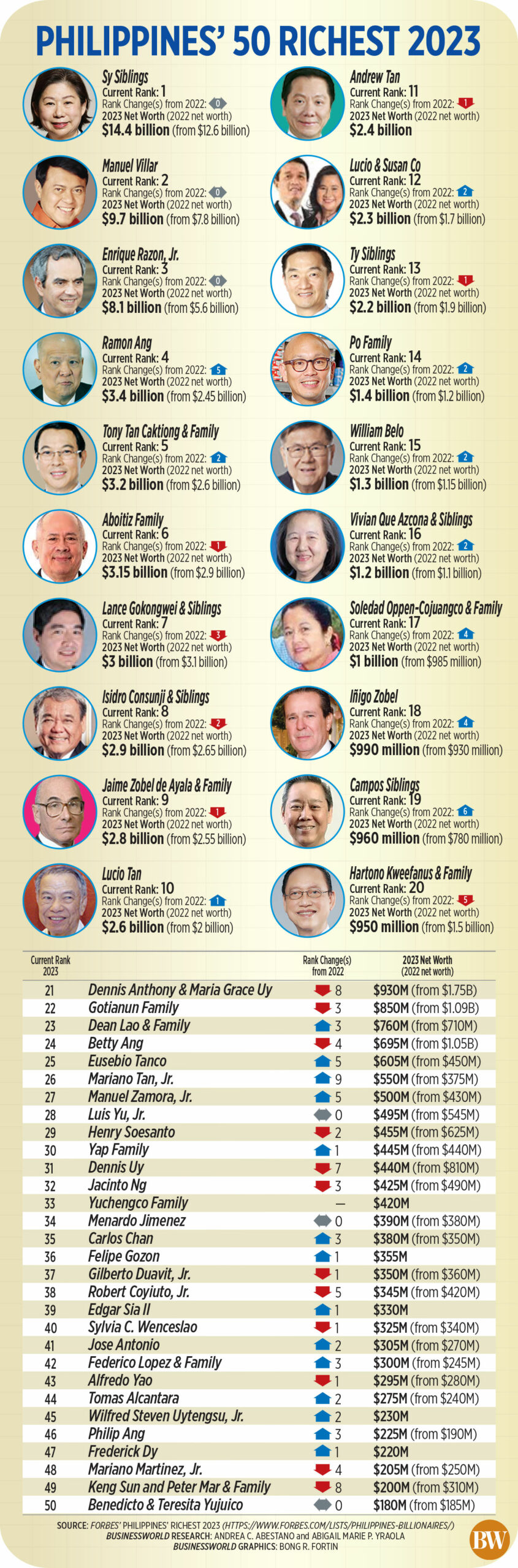
Philippines’ 50 richest 2023

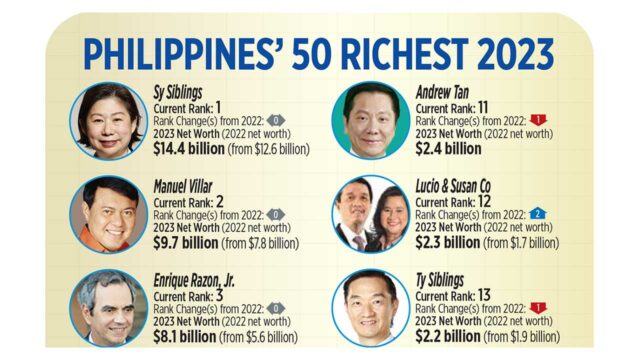
THE SY SIBLINGS remained the richest in the Philippines, as they added $1.8 billion to their net worth this year, Forbes Asia said on Thursday. Read the full story.

Searching for Sugar Man singer Sixto Rodriguez, 81

A young Sixto Rodriguez in Searching for Sugar Man. —IMDB.COM

SIXTO RODRIGUEZ, an American singer-songwriter whose outsized popularity in South Africa inspired the Oscar-winning documentary Searching for Sugar Man, passed away on Tuesday at the age of 81, a website dedicated to him said on Wednesday.

The Detroit-based Mr. Rodriguez did not know how popular he had become in South Africa, where his songs became anthems for the anti-apartheid struggle in the 1970s. Back in the United States, success had eluded him.

Searching for Sugar Man follows two South African music fans on their journey to discover the fate of Mr. Rodriguez.

The 2012 documentary by Swedish filmmaker Malik Bendjelloul won the Oscar in 2013. Mr. Bendjelloul said at the time that he was drawn to the story because it was like a real-life fairy tale.

Mr. Rodriguez wrote and sang about the hard streets of Detroit in 1970 and was considered by many in the music profession to be a talent on the order of Bob Dylan. His lyrics, set to a heart-stirring rasp of a voice, told about the homeless and the working poor.

Songs titled “Street Boy,” and “Inner City Blues,” and “Cause” told the tale of society in decline and the cold comfort of the drug dealer around the corner: “Sugar Man.” His two albums of the 1970s, Cold Facts and Coming from Reality, had no commercial success in the United States.

“You have to be ready for rejection, criticism and disappointment, so those kinds of things are pretty much built into any career and so with music, it’s such,” Mr. Rodriguez said at the premiere of the documentary.

“So, yeah, it was a disappointment to me then, but look at this, it’s quite something to be here.”

His fame soared after the documentary and he performed at top music festivals like Glastonbury in Britain and Montreaux Jazz Festival in Switzerland.

The Sugarman.org site did not reveal the cause of death, but earlier this year said he underwent an operation to repair damage caused by a stroke in February. Mr. Rodriguez is survived by three daughters. — Reuters

ADVERTISEMENT
ADVERTISEMENT