Home Blog Page 4465

Italpinas signs deals for mixed-used development

REAL estate developer Italpinas Development Corp. (IDC) on Monday said that it had entered into a joint venture agreement (JVA) to develop a P2.42-billion mixed-use property in Cagayan de Oro City.

In a regulatory filing, the company said the agreement was signed with Gonzalo Go Jr. for the development of his property in the city’s Gusa area.

It said that Mr. Go contributed 43,198 square meters (sq.m.) of land for the mixed-use development, which would enable the company to develop the property without capital outlay for land.

“The related regulatory requirements include the necessary licenses, environmental clearance, permits, approval from the Local Government Units, DHSUD (Department of Human Settlements and Urban Development), public utility companies, and other government agencies having authority on condominium projects,” it said.

The company said profit-sharing provisions have yet to be determined along with the arrangement on management and operation.

In a separate filing, the company said that its majority-owned subsidiary,  IDC Prime, Inc., has entered into a P2.38-billion JVA with Finca Montero Resources, Inc.

Under the agreement, the subsidiary would develop 23,272 sq.m. of land for another mixed-use project in Morong, Bataan.

“The agreement was negotiated by IDC, but the assignment of the development to IDC Prime is intended to disperse operations, leaving IDC free to make the strategic decisions, and pursue more projects,” IDC said.

The company has not provided other details on the agreement.

On Monday, its shares 1.27% or a centavo to P0.80 each. — Adrian H. Halili

Filinvest Alabang taps Japanese architectural firm to design chapel

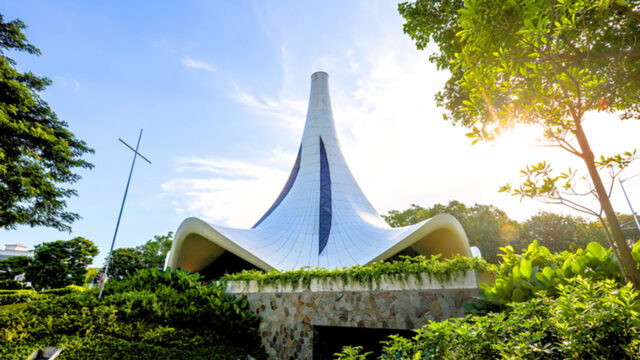
FILINVEST ALABANG, INC. tapped award-winning Japanese architectural firm Hiroshi Nakamura & NAP Architects to design the Our Lady of Lourdes Chapel in Filinvest City.

The chapel, which is located at the River Park, has a distinctive design inspired by an inverted white Lily — the flower that represents the purity of Mother Mary.

“We made the connection between the kindness and gentleness of Mother Mary to the Lily. Through this concept, we envisioned an architecture that gently embraces people, and when the sunlight reflects on the chapel, the purity of the white Lily is emphasized,” Kohei Omori, the project’s lead architect and co-representative of NAP International, said in a statement.

Mr. Omori also highlighted the chapel’s sustainable features.

“The top portion of the chapel acts like a funnel. Heated air is essentially exhausted to the outside, which will then draw in a cool air inside with the help of the creek nearby,” he said.

Design is something that should affect people emotionally and spiritually, Mr. Omori said.

“Just seeing how people interact with the building and looking at how they spend their time inside the chapel made us realize that we did succeed in allowing this to be part of their daily life, which was one of our goals since beginning this project,” he said.

Francis Gotianun, director of Filinvest Development Corp., said the company always wanted to build “an environment that inspires and enables possibilities.”

“Once everything was built and done, we wanted to finally welcome (the Chapel) to Filinvest grounds so that the community may have another space where they can feel safe, protected, and at peace,” he said.

The Our Lady of Lourdes Chapel is open daily from 6 a.m. to 9 p.m. Regular masses are scheduled at 5 p.m. on Saturday, and at 10 a.m. and 3:30 p.m. on Sunday.

Hollywood strikes threaten Britain’s US-dependent film industry

STOCK PHOTO | Image by Peter Thomas from Pixabay

THE UK FILM INDUSTRY is reckoning with its streaming-fueled reliance on US media giants after Hollywood strikes have thrown thousands of jobs into limbo.

The Writers Guild of America (WGA) and Screen Actors Guild (SAG) walked out over pay in May and July respectively after talks with the studios’ Alliance of Motion Picture & Television Producers failed. UK unions are not on strike but crews working on US-funded productions now find themselves with no income in the midst of a cost-of-living-crisis.

Pinewood Studios, Britain’s largest and most famous studio group, home to the James Bond franchise, told investors this month that the seven major films and shows currently being filmed there, including Walt Disney Co. superhero feature Deadpool 3, are all on hiatus. Production of Wicked, a movie of the stage musical starring Ariana Grande at the recently built Sky Studios Elstree owned by Comcast Corp., also ground to a halt.

The situation highlights how closely linked the £12 billion ($15.2 billion) British film and TV industry, which employs 180,000 people, is to the fortunes of US media giants. Over the last five years, US studio-backed productions have consistently funded more than two thirds of total UK film spend, according to the British Film Institute (BFI).

“Pinewood is like a ghost town,” said Peter Titterell, whose catering company was working on Deadpool 3 until production stopped around four weeks ago. He has already had to let 28 freelance staff go and is burning through money to keep his equipment and catering vehicles in good condition for whenever production picks back up.

“It’s a disaster all round,” Mr. Titterell said. “Most people in this industry are freelancers and there’s no protection when things like this happen.”

US RELIANCE
Inward investment to the UK TV and film industry reached a record high of £6.27 billion in 2022 according to the BFI, driven by the efforts of the British Film Commission, which counts Disney, Warner Bros. Discovery, and Netflix, Inc. among its sponsors. Prior to the strikes, Pinewood had been expanding its studios to meet streamer demand — all the space under construction is already pre-let to Netflix, Inc. and Amazon.com, Inc. The dazzlingly pink sets of Warner Bros. Discovery’s Barbie were built in the London suburb of Watford.

“Because this country’s relied on the inward investment, and pumped a huge amount of resources into attracting inward investment, we’ve just seen the impact of that when the circus leaves town,” said Spencer MacDonald, national secretary of BECTU, a union which represents more than 20,000 production workers.

He said thousands of jobs are “in limbo” across everything from set construction, lighting technicians, visual effects artists, costume and make-up artists, and caterers. He added that he expected a “lot of talented people” with transferable skills to leave the industry.

Meanwhile, top US media companies like Disney this month reported stronger-than-expected profits partly thanks to short-term cost savings from industrial action: less production meant less expenses.

COVID SEQUEL
The major Hollywood studios have deemed the strike a “force majeure” event, saying circumstances are out of their control and staff on stalled projects will not be compensated. This means crew are still technically contracted to the major streaming companies but are not being paid, according to BECTU. This leaves thousands of workers reluctant to walk away in case lucrative projects pick back up, but without work or pay in the meantime.

The stoppage has come just as the sector was beginning to recover after COVID-19 lockdowns, with some independent contractors yet to pay off government loans taken out to survive the pandemic, BECTU said.

“It’s like COVID all over again, except this time we don’t have furlough,” said Neil Hatton, chief executive of the UK Screen Alliance, which represents people working in visual effects and post-production in the UK. He said there’s rising alarm among members about delayed productions.

During the pandemic, 23% of people working in visual effects lost their jobs, but Mr. Hatton said the strikes could have an even greater impact.

GHOST TOWN
Films that aren’t financed by members of the Alliance of Motion Picture and Television Producers, against whom the US writers and actors are striking, are able to secure waivers from SAG, according to Jake Seal, a producer who runs Black Hangar Studios, a studio space near Heathrow Airport which in the past catered to a mix of major studio projects like Star Wars: Rogue One as well as independent pictures like jazz biopic Born to be Blue, typically 60% from indies and 40% from majors.

Mr. Seal says that, as he and studios saw the strikes coming, Black Hangar’s production pipeline has shifted to 100% independent movies.

It’s unclear how long the strikes will persist. Top studios have stepped up efforts to resolve the three-month-long writers’ strike, Bloomberg reported Thursday, and senior executives are also working to settle the separate actors’ strike.

Until then, the scarring could get worse.

Elstree Film Studios, home of the Indiana Jones franchise and where Stanley Kubrick shot The Shining, said that although it’s currently “business as usual,” they are bracing for next year, when they have no bookings for the “first time in several years.” — Bloomberg

GDP growth resilience, and the finance and budget lecture at the PDE reunion

Last week the Philippine Statistics Authority announced that the GDP growth in the 2nd quarter (Q2) of 2023 was 4.3% — lower than the Q1 growth of 6.4%, and lower than the 6% expected by most economists. I myself projected growth of 6%, having forgotten to consider the base effect of high government and household spending in the Q2 2022 election period.

Nonetheless, some articles quickly appeared that bashed the 4.3% growth. One paper suggested that Philippine growth is grinding to a “halt,” which is intellectually dishonest. In Q2 2023, Europe’s top two largest economies, Germany and the United Kingdom (UK) had GDP performances of -0.2% and 0.4%. ASEAN’s richest economy, Singapore, grew by 0.5% while South Korea’s was 0.9%. The Philippines grew by 4.3% and it is grinding to a “halt”? That is a ridiculous political hit job.

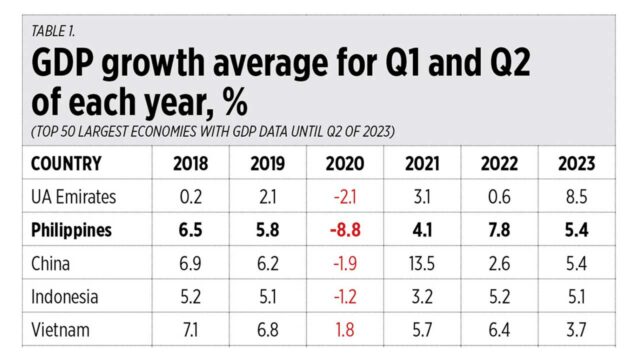
I checked the GDP performance of the world’s top 50 largest economies in GDP size nominal values in 2022 (No. 1 was the USA, No. 2 China, No. 39 the Philippines, No. 50 Portugal). Of these 50 economies, five have no quarterly data, and as of this writing, 22 have GDP data until Q1 only (including Japan, Thailand, India, Malaysia, and Canada), and 23 have data until Q2. I averaged the Q1 and Q2 or first half (H1) performance of the 23 economies that provided the data, and the results are very interesting. (See Table 1)
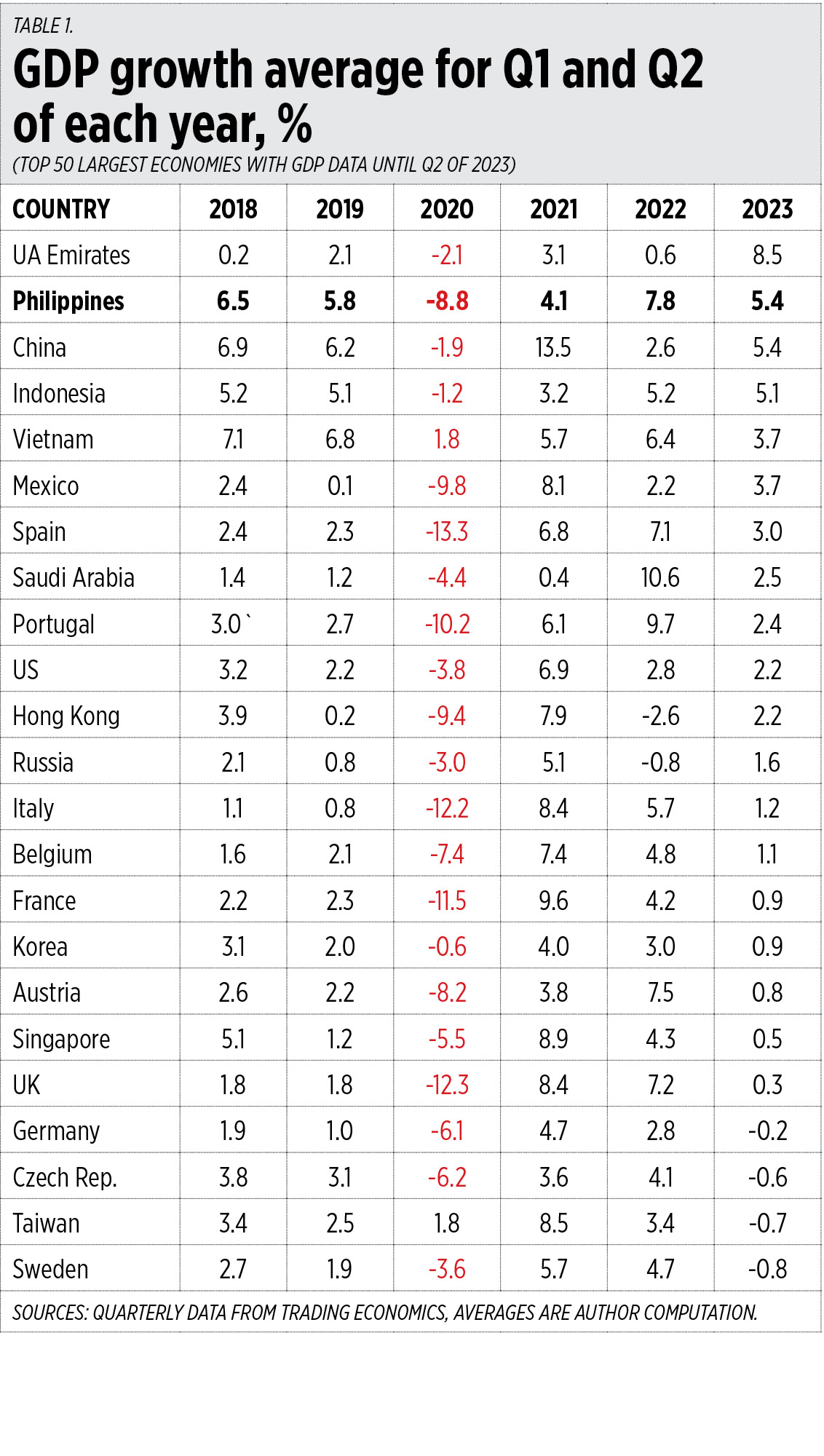
One — The United Arab Emirates (UAE) has had the fastest H1 performance at 8.5%, followed by the Philippines and China with 5.4%. But the UAE’s fast growth rested on a low base, with low growth of only 0.6% in H1 2022, which was the same for China with only 2.6% last year. Whereas the Philippines’ 5.4% rested on a high base, with high growth of 7.8% last year. So, it shows that the Philippines has the most dynamic, most resilient economy out of the 23 here.

Two — If the other 22 economies report their Q2 performance soon, their H1 performance very likely will be lower than Philippines’ because their Q1 data were all lower than the country’s 6.4%.

Three — The global economic environment this year is worse than last year. Of the 23 economies, only five (the UAE, China, Mexico, Hong Kong, and Russia) have H1 2023 results that are higher than in H1 2022. Among the other 18 economies, some suffered huge growth deceleration, like the UK which was at 7.2% in H1 2022 then 0.3% in H1 2023; Austria, which went from 7.5% to 0.8%; Singapore, which went from 4.3% to 0.5%, Taiwan, from 3.4% to -0.7%; and Sweden from 4.7% to -0.8%. Germany is technically in a recession with -0.2% in both Q1 and Q2.

With an economic resilience like this, the Philippines’ economic team has actually done a good job. Minus a political agenda, and just a pure economic assessment considering the worsening global and regional economic environment, one sees that the Philippines deserves a toast.

GOVERNMENT CONSUMPTION
Now, looking at the sources of growth deceleration — GDP on the demand side, the decline showed up in government consumption which constituted 15% of GDP in 2022, again after a high base in H1 2022 related to the elections in May 2022.

Looking at GDP on the supply side, the decline occurred in the industry sector which constitutes 30% of GDP, particularly in manufacturing. The global slowdown in trade plus high domestic interest rates must have contributed to this situation. (See Table 2)
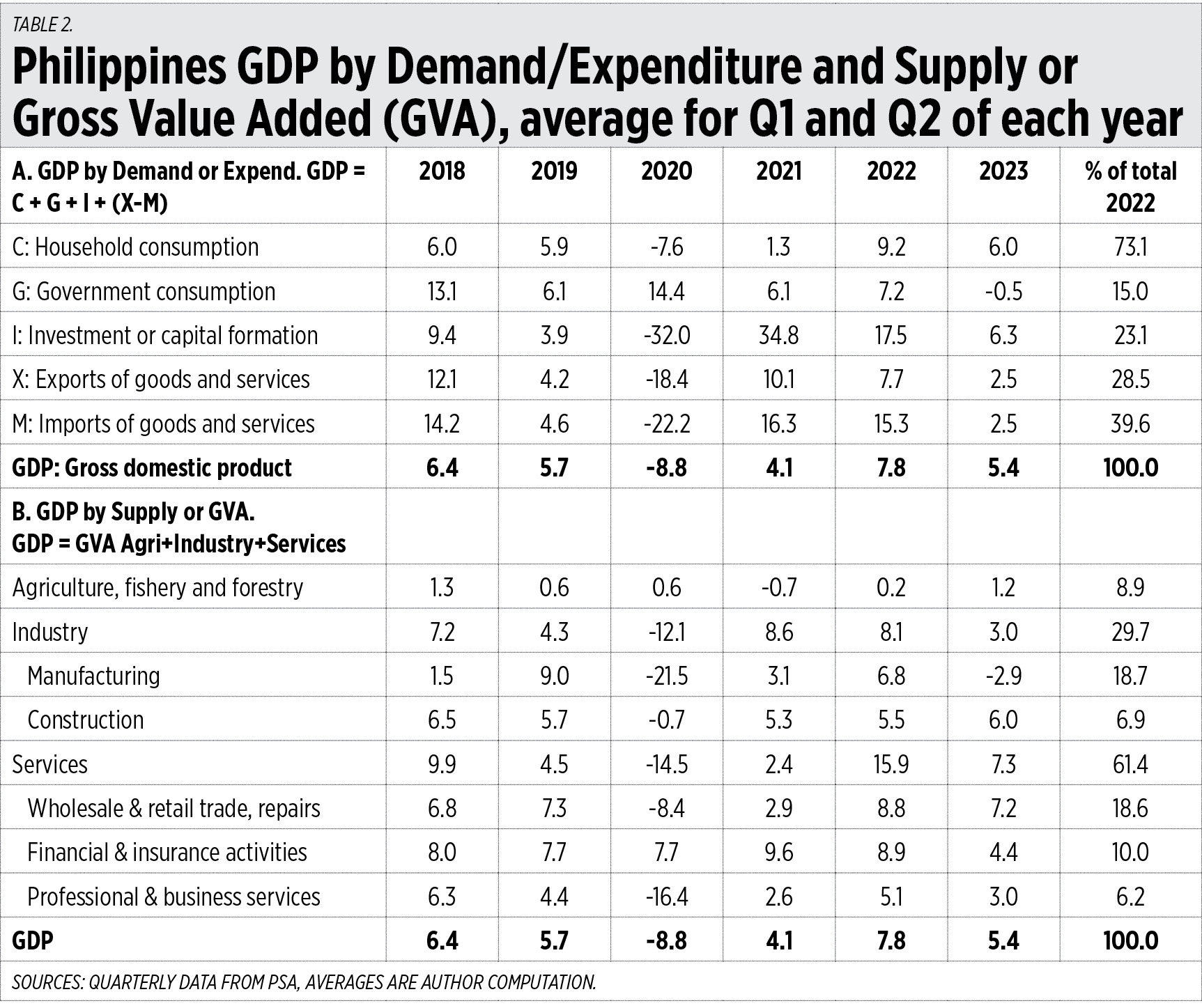
To give more context, the billions of pesos and not just percentage changes are shown in Table 3. The GDP performance in H1 2022 of P9.6 trillion already recovered or overtook the pre-lockdown period H1 2019 of P9.45 trillion.
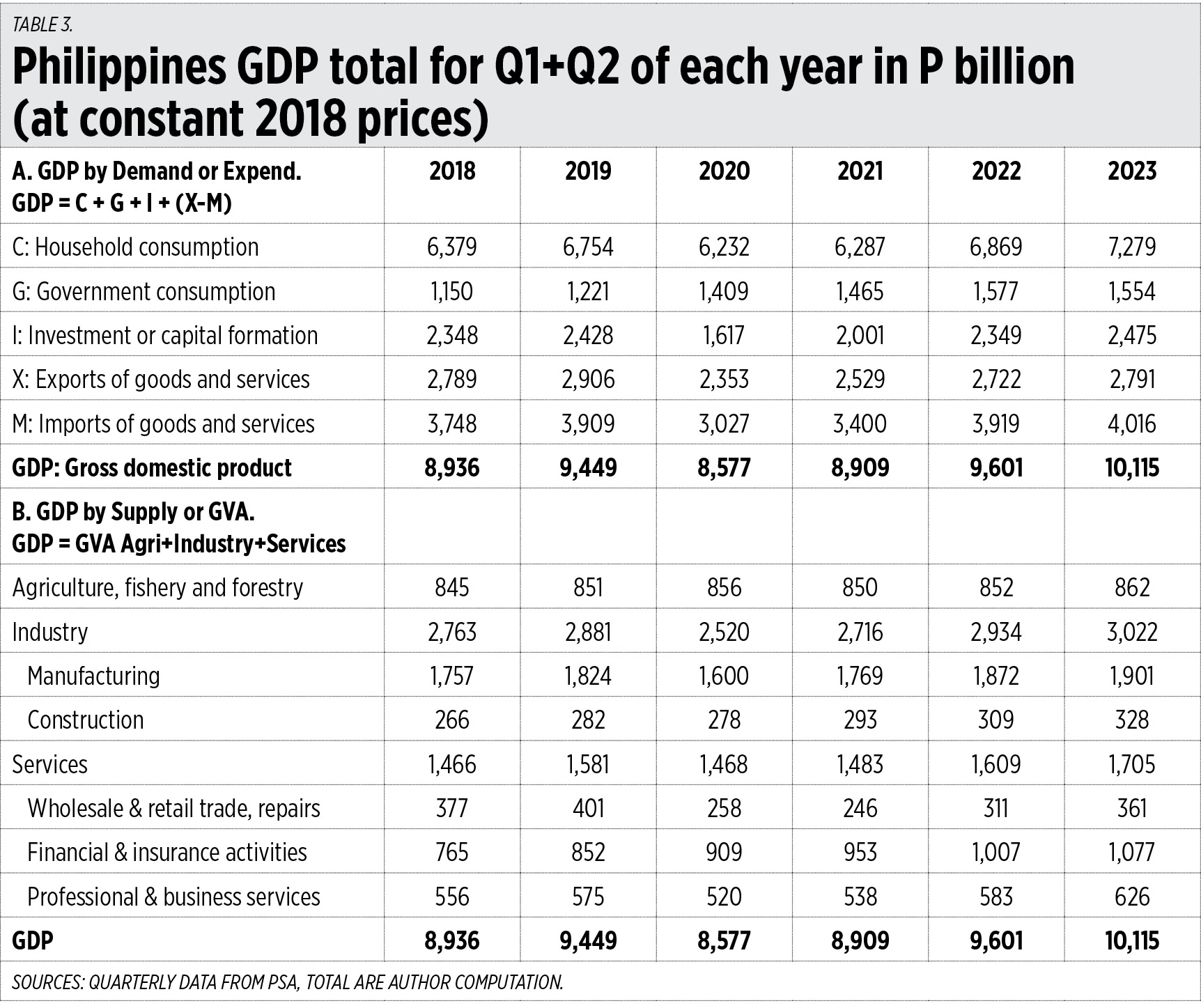
Industry performance in H1 2023 of P3 trillion has slowed down percentage wise, but value is still high compared to H1 2019 of P2.88 trillion or H1 2022 of P2.93 trillion.

PUBLIC DEBT/GDP RATIO
One big issue that the economic team must address seriously is the big jump in the country’s public debt/GDP ratio since the ill-advised strict and prolonged lockdown dictatorship of 2020-2021. Recall again that the Philippines’ GDP contraction of 9.5% in 2020 was the worst in Asia, and the worst in Philippine economic history since World War 2.

I put together a table comparing public debt/GDP ratios. While the Philippines’ ratio has increased to 57.5% in 2022, this is still lower and more manageable compared to the 66% of Malaysia, 76-77% of Pakistan and China, 83% of India, above 100% of Singapore and the G7 countries except Germany. (See Table 4)
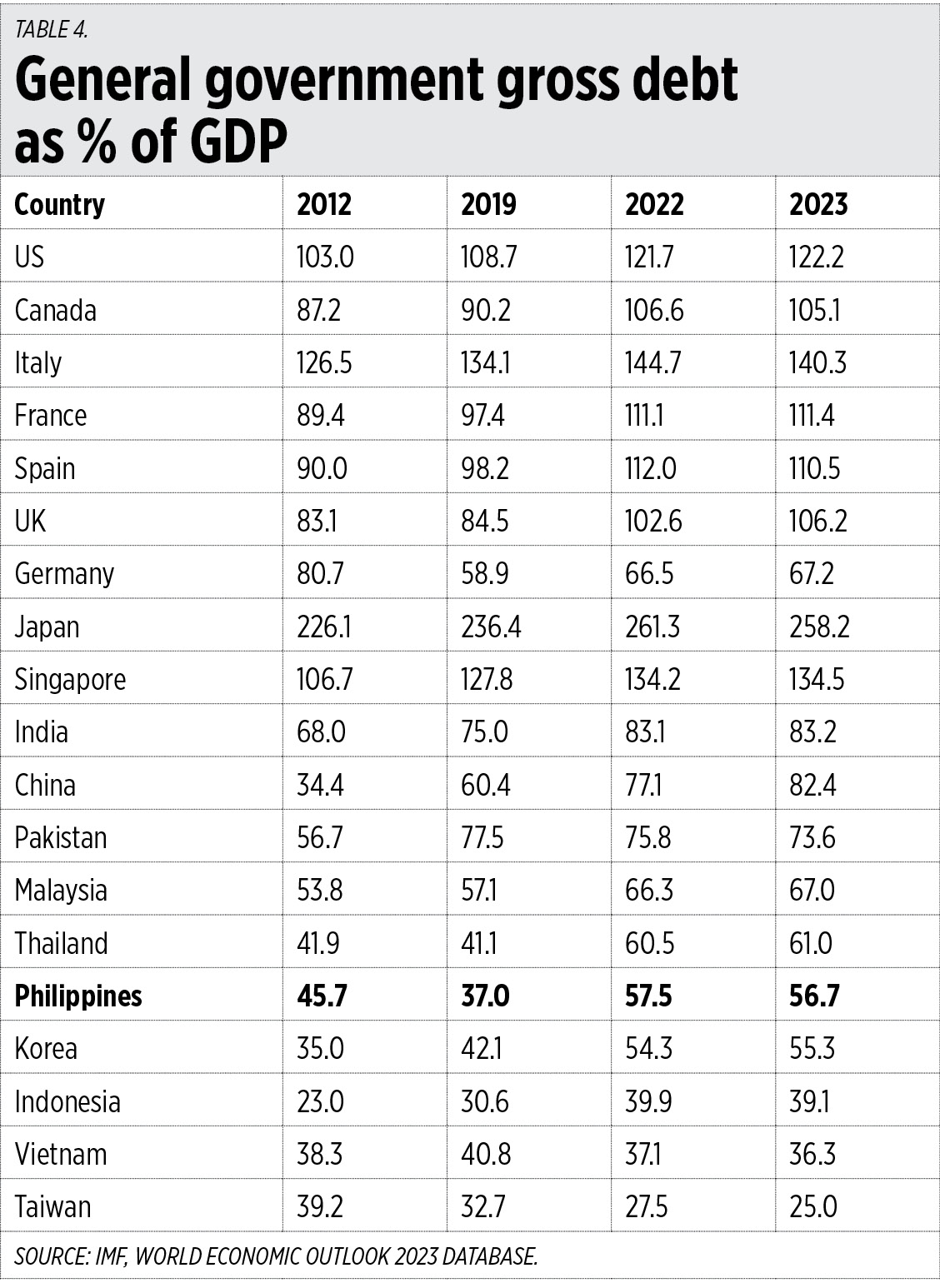
We should focus on reducing the numerator (public debt) while expanding the denominator (GDP size). Political hit jobs via dishonest economic assessments do not contribute to solving these important twin challenges.

DIOKNO AND PANGANDAMAN LECTURES
This coming Saturday, Aug. 19, the UP School of Economics (UPSE) Program in Development Economics (PDE) Alumni Association will hold a homecoming. The first program is “A Conversation with Finance and Budget Secretaries on Financing Sustained Growth” with Finance Secretary Benjamin Diokno (7th PDE batch) and Budget Secretary Amenah Pangandaman (33rd PDE batch) as speakers. This will be held at the UPSE auditorium in UP Diliman at 4 p.m. This is open to the public.

There are oodles of issues in finance and spending in the country and they are the top officials of the government to address these issues. See for instance these recent reports in BusinessWorld, mostly written by my other favorite objective economics reporter, Luisa Maria Jacinta C. Jocson.

A. Finance and taxation reports: “Untaxed tobacco seen costing gov’t P30B this year,” “Sale of defunct GOCCs’ assets expected to raise over P25B,” “Outstanding debt hits P14.15-T as of end-June” (Aug. 2); “Outstanding debt seen to hit P15.8-T in 2024” (Aug. 3); “BIR files 127 tax evasion complaints” (Aug. 4); “Falling interest payments seen benefiting other gov’t programs” (Aug. 8); “Q2 debt-to-GDP ratio flat at 61%” (Aug. 10); “Proposed tax reforms seen to raise P120.5B in revenues next year” (Aug. 11); and, “Business groups welcome amended CREATE rules” (Aug. 14).

B. Budget and spending reports: “Budget dep’t seeking to fully digitize gov’t procurement process” (July 31); “Study on gov’t pay hike could finish in time for 2024 budget” (Aug. 1); “DBM submits P5.77-trillion national budget to House,” “MUP pension budget for 2024 set at P164B” (Aug. 3); “Consensus reached on mandatory MUP pension fund contributions” (Aug. 7); “DBM to review agencies’ budget use” (Aug. 8); and, “Agencies ordered to draft catch-up spending plans” (Aug. 10).

PDE graduates from different batches, from the late 1960s to 2023, are encouraged to attend this very important lecture and meeting with their fellow alumni.

While the lecture is open to the public, the succeeding program, the PDE reunion, is exclusively for PDE alumni and faculty. On behalf of the organizing team, I would like to thank the following corporate sponsors for their donations in kind, for raffles and give away to participants: San Miguel Corp., Robinsons Retail, Meralco, Astoria Hotels and Resorts, Nestlé Philippines, Gallerie Joaquin, Japan Tobacco, Inc., iOptions Ventures Corp., Philip Morris Fortune Tobacco Corp., and Alas Oplas & Co. CPAs. Thank you.

I particularly want to mention these friends who represent their respective companies above: Ferdie, Robina, Joe, Jeffrey, Arlene, Jack, Robert, Pidro, Noel, and my sister Marycris. Thank you.


Bienvenido S. Oplas, Jr. is the president of Bienvenido S. Oplas, Jr. Research Consultancy Services, and Minimal Government Thinkers.

minimalgovernment@gmail.com

Lorenzo Shipping swings to profitability

Lorenzo Shipping Corp. booked a P79.43 million net income in the second quarter, turning around from a loss of P74.37 million, after posting higher revenues and lower costs.

The company’s revenues, which were from its freight business, saw a 10% increase to P853.56 million from P775.9 million last year.

This was supported by a decline of 14.4% in the company’s total direct costs during the period to P680.34 million from P794.62 million a year ago.

For the six months ending June, the company’s net income reached P130.48 million, a reversal of last year’s P105.2 million net loss.

Lorenzo Shipping’s first-half revenues rose by 11.9% to P1.76 billion from P1.57 billion in the same period last year.

“The overall revenue increase was due to determined efforts in the fourth quarter of 2022 to the first quarter of 2023 to recover inflationary costs through freight adjustments,” the company said.

However, the company said that it saw a 13.7% decline in twenty-foot equivalent units handled in the first half due to fewer voyages attributed to the slowdown in domestic consumption.

Total direct costs from January to June totaled P1.46 billion, an 8% decline from the previous year’s P1.59 billion.

On Monday, shares in the company closed unchanged at 60 centavos apiece. — Justine Irish DP. Tabile

Northern Mindanao gets its first flexible office workspace

DAMOSA LAND, INC. recently opened Regus CDO Downtown Tower, the first flexible office workspace in northern Mindanao.

Located at the top floor of SM CDO Downtown Tower, the facility offers 1,136 square meters of office space, co-working areas, meeting rooms, and business lounges. It has a 249-work seat capacity.

Regus CDO Downtown Tower is a partnership between Damosa Land and International Workspace Group (IWG).

“Our partnership with IWG enables business owners to maximize efficiencies using the hybrid work model. We hope to encourage more businesses to follow suit in the city of Cagayan De Oro as we invite more potential investors to focus on the region,” Damosa Land President Ricardo “Cary” Lagdameo said in a statement.

Under the franchise partnership agreement, Damosa Land has exclusivity to develop and operate IWG centers across Mindanao.

“Through the launch of this project with Damosa Land, we get to stay abreast of the evolving nature of work and enable the region to attract more investors in the long run. We look forward to equipping more Filipinos with all-inclusive, digitally-ready, and comfortable working spaces as we showcase Mindanao, its people, and its potential, both on a local and global scale,” Lars Wittig, IWG country manager and senior vice-president, said.

Gov’t partially awards Treasury bill offer

BW FILE PHOTO

THE GOVERNMENT made a partial award of the Treasury bills (T-bills) it offered on Monday at mostly higher rates as some market players expect a hike from the Bangko Sentral ng Pilipinas (BSP) this week.

The Bureau of the Treasury (BTr) raised just P12.185 billion via the T-bills it auctioned off on Monday, short of the P15-billion program, even as total bids reached P40.435 billion or more than two times the amount on offer.

Broken down, the Treasury made a full P5-billion award of the 91-day T-bills as tenders for the tenor reached P16.307 billion. The three-month paper was quoted at an average rate of 5.704%, 10.6 basis points (bps) above the 5.598% seen last week, with accepted rates ranging from 5.648% to 5.740%.

Meanwhile, the government raised just P3.83 billion from the 182-day securities out of the planned P5 billion despite bids for the tenor reaching P13.36 billion. The average rate for the six-month T-bill was at 5.945%, inching down by 4.5 bps from the 5.99% seen last week, with accepted rates at 5.9% to 6%.

The BTr also borrowed just P3.355 billion via the 364-day debt papers out of the P5-billion program, even as demand reached P10.768 billion. The average rate of the one-year T-bill went up by 3.1 bps to 6.325% from the 6.294% quoted last week. Accepted yields were from 6.3% to 6.35%.

At the secondary market before Monday’s auction, the 91-, 182- and 364-day T-bills were quoted at 5.8575%, 6.0551%, and 6.2757%, respectively, based on PHP Bloomberg Valuation Reference Rates data provided by the Treasury.

“Results were mixed in today’s Treasury bills (T-bills) auction as the Auction Committee decided to fully award bids for the 91-day T-bills while partially awarding the 182- and 364-day securities. The 91-day T-bills fetched an average rate of 5.704%. Meanwhile, the 182- and 364-day securities were capped at 5.945% and 6.325%, respectively,” the BTr said in a statement on Monday.

“The auction was 2.7 times oversubscribed, with total tenders reaching P40.4 billion. With its decision, the Committee raised P12.2 billion of the P15-billion total offering,” it added.

T-bill yields mostly rose due to expectations of a rate hike in the BSP’s policy meeting on Thursday to match the US Federal Reserve’s latest move and help stabilize the peso, Rizal Commercial Banking Corp. Chief Economist Michael L. Ricafort said in a Viber message.

The BSP will likely keep its benchmark interest rates steady for a third straight meeting on Thursday amid easing inflation and slowing economic growth.

Some analysts, however, expect the central bank to start cutting rates in the fourth quarter to boost consumer demand following the disappointing second-quarter gross domestic product data.

A BusinessWorld poll last week showed 13 of 15 analysts expect the Monetary Board to extend its pause at its Aug. 17 meeting.

On the other hand, two economists expect the BSP to hike borrowing costs by 25 bps, mirroring the move of the Fed last month. This would bring the key rate to 6.5%.

The Monetary Board kept its key policy rate unchanged at a near 16-year high of 6.25% at its last two meetings after hiking borrowing costs by 425 bps from May 2022 to March 2023 to tame inflation.

For its part, the Fed raised borrowing costs by 25 bps at its July 25-26 meeting, bringing its target interest rate to a range between 5.25% and 5.5%.

The US central bank has now hiked rates by a total of 525 bps since March 2022.

The Fed will hold its next policy meeting on Sept. 19-20.

Meanwhile, the local unit closed at a near nine-month low of P56.315 versus the dollar on Friday, weakening by 9.50 centavos from Thursday’s P56.22 finish, data from the Bankers Association of the Philippines’ website showed.

This was the peso’s worst close since its P56.56-per-dollar finish on Nov. 29, 2022.

Week on week, the peso dropped by 57.50 centavos from its P55.74 close on Aug. 4.

“The higher done rates today reflected the latest uptick in US producer inflation, which is widely viewed as a leading indicator for future consumer inflation,” a trader said in an e-mail on Monday.

The producer price index (PPI) for final demand increased by 0.3% last month, Reuters reported. Data for June was revised lower to show the PPI was unchanged instead of nudging up by the previously reported 0.1%.

In the 12 months through July, the PPI increased 0.8% after gaining 0.2% in June, boosted by a lower base of comparison last year.

On Tuesday, the BTr will offer P30 billion in fresh 10-year Treasury bonds (T-bonds).

The Treasury wants to raise P225 billion from the domestic market this month, or P75 billion via T-bills and P150 billion via T-bonds.

The government borrows from local and foreign sources to help fund its budget deficit, which is capped at 6.1% of gross domestic product this year. — A.M.C. Sy with Reuters

Hollywood writers to evaluate counterproposal from studios

PEDRO MARROQUIN-UNSPLASH

THE UNION representing striking Hollywood writers said on Friday it had received a counterproposal from the studios that it would consider, an apparent sign of progress in the more than 100-day-old strike.

The Writers Guild of America (WGA) said it would respond this week “after deliberation” on the offer from the Alliance of Motion Picture and Television Producers, which negotiates on behalf of companies including Walt Disney and Netflix.

Both sides met on Aug. 4 to discuss resuming talks and the issues each intended to bring to the bargaining table, but the WGA afterwards criticized the studios in a sign the talks were strained.

The strike by Hollywood writers began on May 2 after talks between the WGA and the major studios reached an impasse over compensation, minimum staffing of writers’ rooms, and residual payments in the streaming era, among other issues.

Actors represented by the Screen Actors Guild went on strike on July 14 also over pay and artificial intelligence, effectively halting production of scripted television shows and films and affecting businesses throughout the entertainment world’s orbit. It is the first time both unions have gone on strike since 1960. — Reuters

The law of armed conflict

FREEPIK

On Aug. 12, 1949, the international community ratified the Geneva Conventions, also known as the International Humanitarian Law (IHL), establishing the rules and guidelines during armed conflict. The bombing of Hiroshima and Nagasaki, Japan on Aug. 6 and 9, 1945, respectively, was among the compelling reasons.

The Philippines dedicates the month of August as IHL Month, with every 12th of the month marked as IHL Day. It is to remind everyone of the necessity of complying with rules even during armed conflict situations. This year’s theme is “IHL: Guide to Humanitarian Advancement of Peace,” underscoring the obligation of state and non-state actors. The Philippines, having experienced the horrors of international wars, and confronted with decades-long internal armed conflict, is a strong advocate of IHL. Several pieces of legislation were passed that serve as powerful building blocks of an IHL regime.

The “Philippine Act on Crimes Against International Humanitarian Law, Genocide, and Other Crimes Against Humanity,” (Republic Act 9851) or the IHL Act, was signed on Dec. 11, 2009, codifying universally accepted rules so that they can be made fully effective and better enforced in the country.

On May 7, 2013, Republic Act No. 10530 was passed, defining the use and protection of the Red Cross, Red Crescent, and Red Crystal emblems as symbols of protection over the wounded and those caring for them. Parties to the conflict are prohibited from attacking anything or anyone that displays these emblems.

Another significant piece of legislation is Republic Act 11188, the law that provides for the special protection of Children in Situations of Armed Conflict (CSAC). It was signed on Jan. 10, 2019.

In 2017, the Philippines also signed the Treaty on the Prohibition of Nuclear Weapons (TPNW), joining other states in honoring the memory of the hundreds of thousands of nuclear bomb victims, and echoing the call to “never again” experience such horror.

Non-state armed groups similarly expressed commitment to IHL. On April 10, 1998, the Comprehensive Agreement on Respect for Human Rights and IHL (CARHRIHL) was signed by the Philippine Government and the National Democratic Front-Communist Party of the Philippines, binding the New People’s Army (NPA) to the tenets of human rights and IHL. The Moro Islamic Liberation Front (MILF) has also shown its commitment to IHL principles — on April 7, 2002, it presented its deed of commitment to totally ban the use of anti-personnel mines, and in 2009, it signed an action plan with the UN to end the recruitment of children under the age of 18.

Despite the existence of clear policies and commitments, IHL is still repeatedly violated. Non-international armed conflict like what is present in the Philippines pose a lot of challenges in IHL implementation.

Non-state armed groups, especially those not engaged in peace processes, have breached IHL principles with the following actions: hostage taking, attacking civilian objects and communities, recruiting children into the armed group or its support-system, killing or wounding a person that no longer has means of defense, physical mutilation of adversaries, attacking cultural objects and places of worship, and using schools to recruit members.

State forces (military and police) are more careful in observing IHL because of established legal oversight and monitoring mechanisms within their respective institutions and in civilian agencies like the Ombudsman, Commission on Human Rights, Congress, the Courts, and civil society groups. Nevertheless, the military and police are still accused of IHL violations, the most common of which would be engaging armed rebel groups in civilian communities, campaigning in schools, and using schools as evacuation areas for internally displaced people, thereby hampering children’s education.

Having the military deal with internal armed threat groups would always create problematic situations, since the people whom the military is supposed to serve and protect are also their potential enemy. The military’s operational intent is always the immediate and swift neutralization of the adversary. In an internal armed conflict, however, who determines the acceptable amount of force (or military necessity) to deal with the enemy? If the “enemy” hides in civilian communities, how many civilian casualties are “acceptable”? Moreover, the CAFGU (Citizen Armed Forces Geographical Units), while under the supervision of the military, is not covered by the principle of command responsibility. While cases can be filed in the court of law for violations committed by CAFGU members, this will not necessarily extract accountability from state forces.

Also, while legal policies are in place, customary or time-honored practices are also applied in Muslim communities and indigenous people’s (IP) communities. Legal laws and customary laws are sometimes incompatible. It’s a challenge to manage such grey areas, especially when parties involved are at odds on which policy to adopt. Similarly, the application of human rights policies, applied in peace time, and IHL policies, applied in armed conflict situations, can also pose confusion on the ground, i.e., when is a situation considered as “armed conflict” and hence, necessitates IHL application; and when is a situation a normal/ peaceful situation and hence, necessitates rights-based law enforcement?

IHL prohibits the armed forces from putting civilians in harm’s way; but in an internal armed conflict, the battle grounds are often in areas near to, or in actual civilian communities. Hence, both state forces and armed threat groups are guilty of IHL violations.

Seventy-four years after the ratification of IHL, the danger of another interstate world war is unlikely. Instead, many countries, including the Philippines, are grappling with concerns regarding terrorism. With the recent passage of the Anti-Terrorism Act of 2020 (Republic Act 11479), many groups expressed fear that under the overarching agenda of counterterrorism, the law might be used to impose draconian measures. It is therefore important to keep a watchful eye on the law’s implementation, to ensure that it remains faithful to the principles of IHL.


Jennifer S. Oreta is the director of the Leong Institute for Global and Area Studies of the Ateneo de Manila University.

joreta@ateneo.edu

Harbor Star sees 58% profit fall as revenues drop

Listed shipping company Harbor Star Shipping Services, Inc. saw a 57.8% decline in its attributable net income to P91.91 million in the second quarter from P217.74 million a year ago, after recording lower revenue and higher costs.

Harbor Star’s service income went down 15.5% to P671.47 million in the three months ended June from P794.97 million booked last year.

The shipping company’s bottom line was further brought down by higher cost of services recorded during the quarter ended June at P437.93 million, reflecting a 4.7% rise from P418.38 million in the previous year.

The company said the increase in the cost of services was due to higher insurance and supplies expenses and higher depreciation, personnel cost and port expenses.

Its general and administrative services were 1.5% higher at P117.38 million in the second quarter from P115.62 million a year ago..

In the first half, the company’s attributable net income totaled P141.14 million, a 65.5% decline from the P408.99 million recorded last year.

Service income from January to June amounted to P1.3 billion, 13% lower than the P1.5 billion booked in the same period of 2022.

The decline can be attributed to the P477.72 million salvage income the company booked in the first half of 2022. The figure covers the ship salvage services offered by the company during a shipwreck or maritime casualty.

Despite booking lower revenues, the company’s cost of services was 11.7% higher at P840.14 million from P751.98 million seen in the previous year.

On Monday, shares in the company climbed by a centavo or 1.14% to 89 centavos apiece. — Justine Irish DP. Tabile

Lanson Place Mall of Asia prepares for opening

LANSON PLACE Mall of Asia will offer 389 units designed for both long and short stays and a range of dining outlets when it opens soon.

“The true success of Lanson Place Mall of Asia lies in the unwavering dedication of its exceptional workforce and the unparalleled service they provide to every guest. Beyond the bricks and mortar, it is the thriving community spirit fostered by the staff that sets this establishment apart,” Laurent Boisdron, vice-president and general manager of Lanson Place Mall of Asia, said in a statement.

The property will have 247 hotel rooms, 142 serviced residences and amenities such as a fitness center and rooftop infinity pool.

Cyan Modern Kitchen will be the signature restaurant at Lanson Place Mall of Asia.

While the complete hotel opening has yet to be announced, introductory offers for stays are currently available. For stays booked between Oct. 2 to Nov. 30, 2023, guests can enjoy an exclusive advanced booking offer. Contact: reservations.lpmn@lansonplace.com.

Banks’ net income rises in 1st half

THE PHILIPPINE BANKING industry recorded a higher net profit in the first half of the year on the back of higher net interest income and growth in their loan portfolios, central bank data showed.

Meanwhile, soured loans held by Philippine banks slipped in June, ending five straight months of increases. This brought the nonperforming loan (NPL) ratio to its lowest in two months.

The cumulative net income of the banking system grew by 24.7% to P178.51 billion in the first half from P143.12 billion in the same period in 2022, based on preliminary data from the Bangko Sentral ng Pilipinas (BSP).

Net interest income stood at P414.45 billion in the January-to-June period, up by 16.9% year on year from P354.32 billion.

Total operating income of Philippine banks climbed by 56.1% to P736.16 billion as of June, from P471.32 billion in the prior year.

Broken down, interest earnings surged by 40.9% to P577.23 billion. However, expenses nearly tripled (195%) to P162.6 billion as of June from P54.97 billion a year ago.

Meanwhile, non-interest income declined by 7.7% to P107.94 billion as of June from P117.01 billion in the same period in 2022.

Dividend and trading income in the period dropped by 8.4% and 3.2% to P1.14 billion and P10.01 billion from a year ago, respectively.

On the other hand, earnings from fees and commissions increased by 9.9% to P76.13 billion

Lenders’ non-interest expenses rose by 7.9% year on year to P288.07 billion from P266.95 billion.

The industry’s losses on financial assets dropped by 13.9% to P32.35 billion as of end-June from P37.59 billion a year prior.

Provisions for credit losses declined by 18.9% to P37 billion from P45.65 billion, and bad debts written off fell by 84.5% to P280.28 million from P1.8 billion.

Banks’ total loan portfolio grew by 6.7% to P12.49 trillion as of end-June from P11.72 trillion a year earlier.

Meanwhile, deposit liabilities stood at P17.48 trillion in the first half, rising by 6% year on year from P16.49 trillion.

The industry’s assets rose by 6.9% to P22.83 trillion as of June from P21.35 trillion a year ago.

JUNE NPL SLIPS
Meanwhile, separate central bank data showed the gross NPL ratio of the Philippine banking industry slid to 3.42% in June, from 3.46% in May and 3.6% a year ago. It was the lowest since 3.41% in April.    

Bad loans inched down by 3.2% to P435.01 billion in June from P421.31 billion a year earlier. This was also 0.25% lower than the P436.12 billion in May.

Loans are considered nonperforming once they remain unpaid for at least 90 days after the due date. They are deemed as risk assets because borrowers are unlikely to settle these loans.

Past due loans rose by 5.5% to P518.23 billion from P490.83 billion a year ago. This brought the ratio to 4.08% from 4.19% a year ago.

Restructured loans decreased by 7.7% to P312.81 billion from P338.94 billion in the same month in 2022. These accounted for 2.46% of banks’ loan book.

Banks ramped up their loan loss reserves to P443.33 billion in June from P409 billion a year ago.

The industry’s NPL coverage ratio improved to 101.91% from 97.08% the year prior. — Keisha B. Ta-asan

ADVERTISEMENT
ADVERTISEMENT