Home Blog Page 4453

Marcos travel expenses 10 times bigger 

PHILIPPINE STAR/KRIZ JOHN ROSALES

THE OFFICE of the President’s (OP) traveling expenses increased by tenfold in 2022, the Commission on Audit (CoA) revealed in its audit report released last Tuesday.  

State auditors said the OP spent P403.09 million for traveling expenses in 2022, from only P36.79 million in 2021, increasing by over P366 million.  

“[The] significant increase… is due to the official travels related to the foreign summits and state visits in Singapore, Indonesia, United States, Cambodia, Thailand, and Belgium,” the CoA said.   

Local travels, though, decreased by 6.26% to P10.78 million in 2022 from P11.54 million in 2021.  

In a statement, Presidential Communications Office chief Cheloy Velicaria-Garafil said travel expenses in 2021 were expected to be lower due to pandemic restrictions.   

Last December, the Marcos administration justified that the President’s foreign trips has earned the country $23.6 billion in investment pledges. 

Trade Secretary Alfredo E. Pascual previously said that around $88 million (around P4.83 billion) worth of investment pledges are expected to materialize this year. — Beatriz Marie D. Cruz

Cotabato Airport still under repair 

BANGSAMORO officials inspect repairs on the Cotabato Airport runway on Tuesday, disputing some radio reports that flights are set to resume on Aug. 18.

COTABATO CITY — It will take about nine more weeks for commercial flights to resume in this city, the Bangsamoro region’s Ministry of Transportation and Communications determined last Tuesday after inspecting ongoing airport repairs.

Lawyer Paisalin Pangandaman Tago was among the members of the Bangsamoro parliament who expressed dismay over the slow pace of the runway repairs done by the Koronadal City-based construction company contracted by the Civil Aviation Authority of the Philippines (CAAP). “We are urging the contractor of this runway repair to work faster,” he said.

Since the airport was shut down in the last week of June, all travelers and goods in and out of the city have to be transported by land or diverted to the airports in General Santos and Davao Cities.

Yesterday, Harold Dimacisil Torres who chairs the Bangsamoro Business Council voiced out hopes that commercial flights connecting the city to other parts of the country could resume much sooner to help Central Mindanao’s economy bounce back. — John Felix M. Unson

Reclamation report out in 10 days 

PHILIPPINE STAR/EDD GUMBAN

THE DEPARTMENT of Environment and Natural Resources (DENR) will seek to submit a complete report on its review of reclamation projects in Manila Bay to the House of Representatives in 10 days. 

During yesterday’s hearing on the budget of the department, Environment Secretary Antonia Yulo-Loyzaga said: “There will be some deliberation and some investigation that will be required in order for us to complete. We hope to be able to complete the report within the next 10 days.”

Quezon City Rep. Salvador A. Pleyto had asked Ms. Yulo-Loyzaga for an update, citing the presidential directive issued on Aug. 4 that required the DENR and the Philippine Reclamation Authority to submit a status report on the compliance of the proponents within five days.  

President Ferdinand R. Marcos, Jr. earlier announced the suspension of all 22 reclamation projects in the Manila Bay area pending a review of their compliance with environmental regulations. 

Ms. Yulo-Loyzaga faced the House Appropriations Committee during its deliberations for the P5.768-trillion 2024 national budget. — Sheldeen Joy Talavera

Philippine patrols continue 

BAGUIO CITY — Territorial defense via air and surface patrols continue along the Philippine maritime borders north of the country, monitoring a total of 22,474 foreign and domestic vessels traversing the area since January, the Northern Luzon Command (Nolcom) reported.  

Lt. Gen. Fernyl Buca, Nolcom chief, said these findings were the result of 60 air patrols and 30 surface patrols conducted by the Area Task Force-North, an inter-agency coordinating body operating under the umbrella of the National Task Force-West Philippine Sea.

Mr. Buca said these routine patrols cover the resource-rich maritime area of Bajo de Masinloc (Scarborough Shoal) in the West Philippine Sea, the uncontested Philippine Rise (Benham Rise), and the Batanes Strait “to ensure the safety of our fellow Filipinos, especially our fishermen and protect our marine resources for the benefit of current and future generations.” — Artemio A. Dumlao

Bomb attack kills village chief 

COTABATO CITY — A bomb explosion rocked Shariff Saidona Mustapha town in Maguindanao del Sur Wednesday morning, killing a barangay chairman and wounding another village official.

The Shariff Saydona Municipal Police Station identified the fatality as Datu Manot Silongan, chairman of Barangay Penditen in nearby Datu Salibo town. The wounded victim was Salik Datua, a councilman in Barangay Ganta, Shariff Saydona Mustapha.  

Investigators believe the improvised explosive device (IED) was planted on the roadside near the Ganta Barangay Hall entrance and detonated from a distance using a mobile phone just as the two victims passed by.

They also theorized that Mr. Silongan was the target of the bombing, following the murder of his brother, Councilor Demson Silongan of Datu Salibo, who was gunned down within the premises of the municipal government center last April 17. — John Felix M. Unson

NEDA: Imports temporary, focused on raising output

OFFICIALGAZETTE.GOV.PH

THE National Economic and Development Authority (NEDA) said the government’s strategy for the economy is ultimately geared towards raising domestic production, adding that it is temporarily resorting to imports to stabilize prices.

NEDA Secretary Arsenio M. Balisacan, speaking before a Senate panel, was addressing remarks by Senators on the need to reduce reliance on imports.

“Our trade policy is used to enhance the workings of the economy in such a way that we can stabilize prices, create employment, and make our local products more competitive,” he said before the chamber’s finance committee as he delivered a Development Budget Coordination Committee (DBCC) briefing on the proposed 2024 budget.

“Looking longer-term and for the rest of this medium-term plan, our priority is to improve productivity,” he added.

Senators Ana Theresia N. Hontiveros-Baraquel, Maria Lourdes Nancy S. Binay, and Juan Edgardo M. Angara, who chairs the committee, had asked Mr. Balisacan to explain the government’s efforts to encourage domestic production.

Mr. Balisacan said the government supports enhanced research and is coordinating agency efforts to raise productivity.

“We need to supply our domestic producers with the equipment and farming materials they need,” Ms. Hontiveros-Baraquel said during the DBCC session before the committee.

“We just have to do it and take out the other blocks and exacerbating factors along the way including smuggling.”

She said the proposed P5.768-trillion national budget for 2024 should also incorporate “safety nets” for producers and those vulnerable to the effects of inflation.

Mr. Balisacan said the government must not see imports as a permanent solution, citing the need to invest in logistics and provide technological support to farmers.

“This is a time of crisis, and the 2024 national budget should reflect that fact in the form of greater assistance to our people,” Ms. Hontiveros-Baraquel said.

Finance Secretary Benjamin E. Diokno, also at the briefing, disputed Ms. Hontiveros-Baraquel’s characterization that the economy is in crisis.

“The International Monetary Fund and the World Bank admire the way we have handled the Philippine economy,” he said.

“The credit rating agencies, despite the massive downgrades of economies all over the world, have maintained the Philippines’ credit rating.”

Last week, Japan-based Rating and Investment Information, Inc. (R&I) upgraded its investment rating outlook on the Philippines to “positive” from “stable.”

According to R&I, the Philippine economy has been performing well in the face of global uncertainty. Gross domestic product grew 7.6% in 2022, and 6.4% in the first quarter of 2023.

The Philippines currently falls short of an “A”-level rating, with Moody’s Investors Service rating the country at “Baa2,” S&P Global Ratings “BBB+,” and Fitch Ratings at “BBB.”

Mr. Angara said the government should take advantage of its resources to empower its industries, especially agriculture.

In July, Senate President Juan Miguel F. Zubiri said Congress will focus on passing a measure that will devise a multi-year strategy enhancing the global competitiveness of Philippine companies.

The Tatak Pinoy Bill, written by Mr. Angara, is expected to help the Philippines achieve its goal of becoming a middle-class economy by 2040.

“Let’s use the government and its vast resources over markets to help industries be more competitive,” he told the same briefing.

Senator Cynthia A. Villar, who heads the Senate agriculture committee, called for the modernization of agriculture via collaboration with the farm machinery manufacturers.

“That’s the idea of mechanization; we have to modernize,” she said, calling the days of manual farming over. — John Victor D. Ordoñez

DoE: EV registrations could rise 30% this year 

Image via Ivan Radic/CC BY 2.0

REGISTRATIONS of electric vehicles (EVs) could rise 30% this year, the Department of Energy (DoE) said, citing projections from preliminary data.

Patrick T. Aquino, director of the DoE’s Energy Utilization Management Bureau, said at a briefing in Taguig City on Wednesday that according to Land Transportation Office data EV registrations totaled 9,666 in 2022.  

“We’re looking at the possibility of having EVs annually growing 30% based on rough estimates from preliminary figures,” Mr. Aquino said.

According to Mr. Aquino, 2022 registrations consisted of 8,105 motorcycles and tricycles, 1,168 sport utility vehicles and other utility vehicles, 347 cars, 44 buses, and two trailer trucks.

 He said the government has an EV registration target of around 100,000 by the end of the Marcos administration.

“We hope the number will be 100,000 more or less by 2028,” Mr. Aquino said, with most of the total consisting of electric motorcycles.

The Electric Vehicle Association of the Philippines (EVAP) reported that 2,536 EV units were sold during the first quarter, exceeding the 426 sold in the entirety of 2022.

EVAP President Edmund A. Araga estimated the current EV count at over 16,000 units.

“Right now, the A and B (consumer) markets are more inclined (to adopt the technology) because they really understand the benefits of EVs. And during the pandemic, they were the ones who had the purchasing power,” Mr. Araga said.

Mr. Araga said the needs of the C, D, and E segments are being addressed by the entry of more affordable EV models and more payment options.

“That’s why there is a model that is lower (priced). It is a small car for daily use priced at between P700,000 and P800,000. The dealers are now open and have come up with financing schemes. (Previously), e-tricycle and e-jeep buyers had to pay cash,” he added.

EVAP expects EV numbers to hit 6.61 million units by 2030, with two-wheeled vehicles accounting for 5.50 million units. — Revin Mikhael D. Ochave

PHL to issue permits for 35,000 MT worth of imported fish

BFAR.DA.GOV.PH

THE Department of Agriculture (DA) signaled plans to import 35,000 metric tons (MT) of fish by outlining the procedures for obtaining sanitary and phytosanitary import clearances (SPSICs) and certificates of necessity to import (CNI) in those volumes, which it intends to distribute to commercial fishing companies and fishing associations affected by closed fishing seasons in various parts of the country.

In a memorandum circular dated Aug. 15, the DA said that the species to be imported are frozen round scad or galunggong, bigeye scad, mackerel, bonito, and moonfish for sale in wet markets.

“The fish to be imported under the CNI 35,000 MT 2023 shall be reported to and consolidated by BFAR (Bureau of Fisheries and Aquatic Resources). All fish must arrive within the validity period of the SPSIC and in no case later than Jan. 15, 2024,” according to the memo signed by Agriculture Senior Undersecretary Domingo F. Panganiban.

Under the memo, importers were given seven working days to register with the Philippine Fisheries Development Authority and submit complete requirements to participate.

Some 28,000 MT will be allocated to commercial fishing companies, while the remainder will go to fisheries associations and cooperatives.

Only those whose operations are affected by the closed fishing season are qualified to participate.

The import clearances will be issued in two tranches in which the first 50% going out on Oct. 1-30 and the remaining half releasing on Nov. 6-30.

“The importer must have a cold storage facility or cold storage warehouse lease agreement before the issuance of SPSIC,” the DA said.

Asis G. Perez, former BFAR director and co-convenor of advocacy group Tugon Kabuhayan, said in a Viber message that “we think that the volume is reasonable and the process used in coming up with the decision is acceptable.”

The import plan comes on the heels of an 11% decline in fish production during the second quarter.

In a report, the Philippine Statistics Authority (PSA) said production was 1,082.22 thousand MT during the period.

“Annual declines in production were noted in commercial fisheries, marine municipal fisheries, and aquaculture subsectors,” the PSA said.

In the three months to June, production by the marine municipal fishery, which accounted for 21.7% of total output, fell 16.8% to 234.90 thousand MT.

Commercial fisheries output fell 14.5% to 235.24 thousand MT. This accounted for 21.7% of overall fisheries production. 

Aquaculture production, which accounted for 53% of total output, declined 8.3% to 573.85 thousand MT during the quarter.

Production by the inland municipal fishery rose 4.4% to 38.23 thousand MT. This accounted for 3.5% of the total.

Of the 20 major species, declines were noted in skipjack or gulyasan (49.3%), fimbriated sardines or tunsoy (42.2%), yellowfin tuna or tambakol/bariles (23.2%), milkfish or bangus (19.2%), and seaweed (4.9%). 

Higher production was recorded for round scad (30%) and tiger prawn or sugpo (0.9%). — Sheldeen Joy Talavera

Three agri terminals planned for NCR

DAVAO CITY AGRI OFFICE

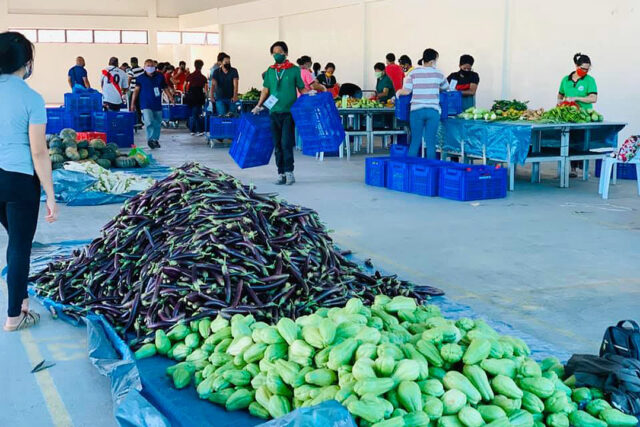
THE Department of Trade and Industry (DTI) said it hopes to establish three agricultural terminals around Metro Manila which will consolidate produce from the hinterland and reduce the gap between farmgate and retail prices.

“We plan to establish these (agricultural) terminals around Metro Manila and we’re thinking of three of them now,” Trade Secretary Alfredo E. Pascual said at a briefing in the City of Manila on Wednesday. He said the terminals will address “the big gap between farmgate and retail prices.”

Mr. Pascual did not say where the terminals will be located.

The intent is to make the linkage between farms and consumers more direct by making available “terminals where farmers can bring their produce,” Mr. Pascual said.

According to Mr. Pascual, the Asian Development Bank (ADB) recently finished a study containing recommendations on establishing terminals for agricultural goods.

“We are assuming responsibility for implementing this because logistics, as an industry, falls within the mandate of the DTI. The purpose of the ADB study is to be able to benchmark with other countries… we need to study our own unique situation here and adapt whatever they have included in their recommendations,” Mr. Pascual said.

“We need to smoothen the supply chain (to make) delivery would be fast and efficient,” he said, thereby reducing logistics costs. — Revin Mikhael D. Ochave

Trials for contactless toll set for September

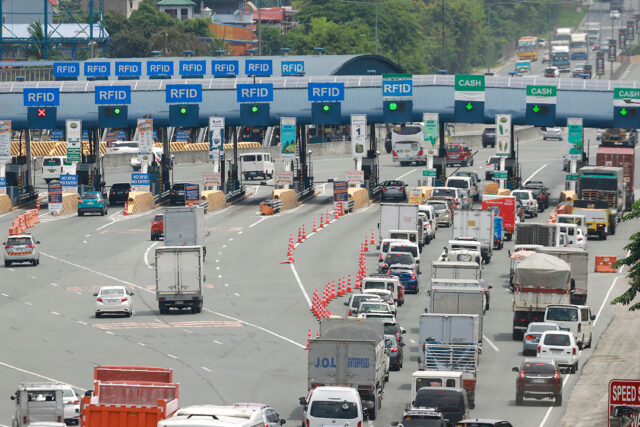
VEHICLES approach the NLEX Balintawak toll plaza, May 18, 2021. — PHILIPPINE STAR/ MICHAEL VARCAS

THE Toll Regulatory Board (TRB) has directed tollway concessionaires and operators to conduct a dry run of contactless toll collection at selected toll plazas starting Sept. 1.

The two-month long dry run is intended to comply with a resolution passed by the House of Representatives calling for the re-implementation of contactless tolls.

“The dry run is necessary to ascertain the readiness of the tollway concessionaires and operators for the smooth and efficient re-implementation of the contactless program,” the TRB said in an advisory on Tuesday.

“As agreed between TRB and the Toll concessionaires and operators, a first batch of qualified toll plazas will initially form part of the dry run to ensure smooth and efficient implementation. Other qualified toll plazas will gradually be included during the dry run period,” it added.

The first batch of toll plazas to join the trials includes NAIA Main A of NAIA Expressway, Nichols Entry and Exit on South Metro Manila Skyway Stage 1 & 2, Del Monte Northbound A on the Metro Manila Skyway Stage 3, and Mamplasan Northbound and Silangan Southbound on the South Luzon Expressway.

The first batch also includes users of the Autosweep system like Tanauan Northbound Entry on the STAR Tollway, the Muntinlupa-Cavite Expressway, and the Rosario Toll Plaza on the Tarlac-Pangasinan-La Union Expressway.

EasyTrip system users in the first batch are Ciudad de Victoria, Sta. Rita, Pulilan, San Simon, Mexico and Dau on the North Luzon Expressway, Dolores and SFEX on Subic-Clark-Tarlac Expressway, Technopark Toll Plaza and Laguna Boulevard A Toll Plaza on the Cavite-Laguna Expressway, and the Taguig and Merville Toll Plazas on the Manila-Cavite Toll Expressway.

“Additional toll plazas will be gradually included in the dry run for smooth and efficient implementation,” the regulator said in a separate advisory on Wednesday.

In 2020, the Department of Transportation (DoTr) issued Department Order No. 2020-12 which required cashless transactions for all vehicles traveling on toll expressways during the pandemic.

The TRB said numerous complaints were received during the order’s implementation, including malfunctioning electronic toll collection systems.

As a result, the DoTr issued an Addendum dated Jan. 29, 2021 which allowed vehicles with no RFID (radio frequency identification) stickers and requiring cash lanes in all toll plazas. — Justine Irish D. Tabile

Building permit approvals fall 14.9% in Q2

PHILSTAR FILE PHOTO

APPROVED building permits fell 14.9% to 36,136 in the second quarter, the Philippine Statistics Authority said on Wednesday, accelerating from a 0.9% decline in the three months to March.

Approved projects were valued at P87.83 billion and covered 7.24 million square meters (sq.m.). The value of the projects declined from the first-quarter total of P104.33 billion and the year-earlier tally of P106.02 billion.

Domini S. Velasquez, chief economist at China Banking Corp. attributed the decline in construction projects to persistently high building vacancy rates dating from the pandemic.

“Although many workers are now onsite, some companies opted to continue their flexible working arrangements, leading to overcapacity in buildings. Hence, developers have been slow to build new non-residential buildings,” she said in an e-mail.

Nicholas Antonio T. Mapa, ING Bank N.V. Manila senior economist, also said base effects from the year-earlier period could also be a factor.

“Last year applications likely jumped upon the reopening of the economy after lockdowns were lifted,” he said in an e-mail.

He also added that rate hikes have made borrowing for construction activity more difficult.

Since May 2022, the central bank has been aggressively raising interest rates by a cumulative 425 basis points in response to inflation, pausing the tightening cycle only in May 2023.

In the second quarter, permits for residential projects accounted for 66.9% of the total, declining 20% to 24,175. These projects were valued at P41.36 billion with a combined floor area of 3.49 million sq.m.

Single homes accounted for 90.8% of approved residential projects, down 16.5% at 21,942.

Applications for apartment buildings decreased 41.7% to 1,949. Approvals for duplex or quadruplex homes totaled 244 (down 55.3%) and other residential applications 28 (down 15.2%). Residential building approvals totaled 12 (up 9.1%) during the period.

Non-residential approvals, on the other hand, totaled 7,928 during the period, up 10.1%. These accounted for 21.9% of all approved permits.

Approved commercial construction applications, which accounted for 71.2% of all non-residential projects, grew 15.7% to 5,645.

Approved institutional building permits fell 5.9% to 1,170, while industrial project approvals rose 0.5% to 579.

Approved agricultural projects totaled 308 in the three months to June period, down 2.2%, while other non-residential works receiving permits totaled 226, up 22.2%.

Permits for additions to existing structures increased 14.7% to 1,553 during the period.

Alteration and repair permits fell 33% to 2,480 approvals.

Calabarzon, composed of the provinces of Cavite, Laguna, Batangas, Rizal, and Quezon, had the highest number of approved construction projects, accounting for 26.3% of all approvals during the period, with 9,504 permits issued.

The Central Visayas had a 12.5% share of approved permits with 4,523, while Central Luzon accounted for 10.2% with 3,682 approved permits.

By value, approved construction projects in Calabarzon amounted to P24.13 billion followed by those in the National Capital Region with P10.12 billion and those in Central Luzon with P10.02 billion.

Ms. Velasquez said she expects the next few quarters to reflect lower vacancy rates.

“However, as interest rates are set to remain high, we think that real estate developments will also be slow in gaining traction. 2024 should be a better year for the industry as interest rates are bound to come down,” Ms. Velasquez said. — Abigail Marie P. Yraola


Meat industry bats for region-based ASF bans

PHILSTAR FILE PHOTO

MEAT IMPORTERS have requested the Bureau of Animal Industry (BAI) to confine its import bans to meat sourced from regions affected by African Swine Fever (ASF), instead of imposing blanket bans on entire countries.

In an Aug. 12 letter, the Meat Importers and Traders Association (MITA) said the Philippines should compartmentalize its bans in accordance with guidelines set by the World Organization for Animal Health.

“We pointed out that the Philippines is practicing regionalization with regard to Avian Influenza,” MITA said in a letter signed by its president Sherwin Choi and president emeritus Jesus C. Cham.

“This should also be made to apply to ASF, not only domestically but also internationally. We request that the BAI adopt the principle of regionalization in accreditation of countries of origin,” it added.

Such a policy would boost the sourcing options for pork, the group said.

The letter follows a meeting between MITA and the BAI on Aug. 8.

MITA also proposed admitting imported pork that is in its original packaging and not tampered with, stored in accredited cold storage warehouses (CSWs). It also sought free movement for products which have never left the custody of the accredited CSW.

“This is necessary to improve availability of supply and temper inflationary pressures,” it said.

MITA also recommended a one-time registration for each foreign meat establishment (FME) instead of importers registering import shipments separately, which it called “cumbersome.”

“As we deal with commodity products, the selfsame item from one FME is traded by numerous exporters. A single importer may buy the same item from 10 different exporters,” it said.

“It is simpler to register one FME instead, distinguishing meat from offal, without going through the individual items,” it added. — Sheldeen Joy Talavera

ADVERTISEMENT
ADVERTISEMENT