Home Blog Page 4383

Meeting Pacquiao a bucket-list item for Timberwolves’ Towns

ALL of the attention may be on the basketball court but some FIBA World Cup visitors have made it their mission to meet a world boxing legend while they are in the Philippines.

Manny Pacquiao, the 44-year-old ring icon, hosted the Dominican Republic’s Karl-Anthony Towns at his Makati home during some tournament downtime for the Minnesota Timberwolves center.

Mr. Towns, whose Dominicans remain unbeaten so far, visited Mr. Pacquiao right after led his team to a stunning 87-82 win over heavy favorite Italy Sunday night at the Smart-Araneta Coliseum.

“It’s fun. It’s great to meet a Filipino legend, boxing legend and sports legend. I’ve known Manny for a while,” Mr. Towns told reporters after the Dominican Republic went 2-0 in Group A to bolster its second-round hopes.

Mr. Towns had just turned in a 24-point, 11-rebound and five-assist performance in the stunner over Italy.

The 7-footer said he had visited Mr. Pacquiao in his training camp for a fight against Errol Spence, Jr., who turned out to be Yordenis Ugas following the former’s withdrawal due to injury in 2021. Mr. Towns has seen some of his matches in the United States.

“Being able to see him in the ring personally, being in training camp. It’s really fun to catch up. We haven’t seen each other in a while,” added Mr. Towns, who also stamped his class in his team’s close 87-81 win against home team Gilas Pilipinas in front of a record-breaking crowd.

Mr. Towns said he could not let a golden opportunity slip away to reconnect with the eight-division champion.

Italy also has a huge Pacquiao fan in its ranks, head coach Gianmarco Pozzecco, who looked for the Pambansang Kamao right after landing in the Philippines.

“I love Manny Pacquiao,” said Mr. Pozzecco, whose wards will battle the Philippines in a crucial game today to determine the teams advancing to the second round. — John Bryan Ulanday

Hidilyn leads 7-strong team to World Championships in Riyadh

HIDILYN DIAZ — PHILIPPINE STAR/JUN MENDOZA

TOKYO Olympics gold medalist Hidilyn Diaz will lead a seven-member team in the World Weightlifting Championships set Sept. 4 to 17 in Riyadh, where the competitors will seek qualifying points for next year’s Paris Olympics.

Apart from Mr. Diaz, the team will also include Tokyo Olympian Elreen Ando, Asian and World junior champion Vanessa Sarno, John Febuar Ceniza, Rosegie Ramos, Lovely Inan and Kristel Macrohon.

“This is an Olympic qualifying event and we’re hoping for the best,” Samahang Weightlifting ng Pilipinas president Monico Puentevella said.

Of the seven, Ms. Diaz, Ms. Sarno and Mr. Ceniza have the strongest chance of making the cut to the quadrennial event as they are currently ranked in the top 10 of their respective divisions.

For them to be officially considered though, they have to participate in at least five International Weightlifting Federation-sanctioned competitions.

So far, the three along with Elreen Ando have competed in two.

Ms. Diaz, whose 55-kilogram division where she struck gold in Tokyo was abolished, has been seeing action in the 59kg class where she will face off again with Ms. Ando on Sept. 8.

Ms. Sarno, who is considered the heiress apparent to Ms. Diaz, will compete in the 71kg division along with Ms. Macrohon on Sept. 13.

Ms. Ramos and Ms. Inan will laso battle each other in the 49kg bracket on Sept. 5 while Mr. Ceniza is plunging into action in the men’s 61kg group on Sept. 6.

Only one lifter per division is allowed per each country. — Joey Villar

Verstappen beats the rain for record-equaling ninth win in a row

ZANDVOORT, Netherlands —  Formula One leader Max Verstappen celebrated a record-equalling ninth successive victory after beating the rain to win a chaotic and red-flagged Dutch Grand Prix for the third year in a row.

The Red Bull driver’s home triumph from pole position at a soggy Zandvoort equaled now-retired Sebastian Vettel’s 2013 streak of success and was the team’s 14th consecutive triumph and 13th of the season.

The race started dry before rain caused chaos at the end of lap one, with a dry period followed by a torrential downpour that halted proceedings on the 65th of 72 laps with cars skidding off.

Fernando Alonso put Aston Martin back on the podium with second place and a bonus point for fastest lap after the eventual rolling re-start behind the safety car led to a thrilling final chase.

Pierre Gasly was third for Renault-owned Alpine as Sergio Perez, Mr. Verstappen’s Mexican team mate and closest rival, collected a five-second post-race penalty for speeding in the pit lane and dropped to fourth.

Mr. Verstappen now leads Perez by a mighty 138 points with nine races remaining.

“Incredible. They didn’t make it easy for us with the weather to make all the right calls. Incredibly proud,” said Mr. Verstappen as his army of orange-clad fans began the celebrations.

“I already had goosebumps when they were playing the national anthem before the start,” added the 25-year-old. “Even with all the bad weather, the rain, the fans are still going at it. So an incredible atmosphere.”

Mr. Verstappen’s 11th victory of the season, and 46th of his career, provided another big push towards clinching a third title well before the end of the season.

Ferrari’s Carlos Sainz finished fifth with Lewis Hamilton sixth for Mercedes and fellow Briton Lando Norris seventh for McLaren. Alex Albon collected more precious points for Williams in eighth, ahead of McLaren’s Oscar Piastri and Esteban Ocon 10th for Alpine. — Reuters

Hovland captures Tour Championship, wins FedEx Cup

LONG seen as a rising star on the PGA Tour, Viktor Hovland has officially arrived.

Mr. Hovland ran away with the Tour Championship and lifted the FedEx Cup trophy for the first time in his young career in Atlanta.

The Norwegian entered the day with a six-shot advantage over Xander Schauffele and never let that margin become smaller than three.

Mr. Hovland turned in a final-round 63 at East Lake Golf Club to finish at 27-under 261, while Mr. Schauffele fired a 62 but landed at 22 under for the week.

Mr. Hovland, 25, won the PGA Tour’s season-long points race and won $18 million in the process. He shot a final-round 61 last week to win the second leg of the FedEx Cup playoffs, the BMW Championship, which vaulted him to second place (8 under) to start the Tour Championship.

Mr. Hovland and Mr. Schauffele each birdied four of their first six holes Sunday to separate from the rest of the field. Mr. Schauffele found an even higher gear, making putts of 11, 18 and 12 feet for three more birdies at Nos. 8, 11 and 12 to close the gap.

But Mr. Hovland held his ground by saving par for nine straight holes. The most critical may have been at the par-4 14th, when Mr. Schauffele was already in with a 4 and Mr. Hovland sank a curling, right-to-left par putt from 23 feet out.

Mr. Hovland then slammed the door with birdies at Nos. 16, 17 and 18, and Mr. Schauffele’s reservoir of birdies ran out until the 18th.

Mr. Schauffele recorded his 28th consecutive round of par or better at East Lake, but it wasn’t enough to help him overtake the entire field.

He began the week seven shots off the pace at 3 under. He settled for a $6.5 million second prize.

US Open champion Wyndham Clark shot a 65 to finish third at 16 under and win $5 million. Rory McIlroy of Northern Ireland, last year’s FedEx Cup champ, birdied five of his final seven holes to post a 65 and place fourth at 14 under. — Reuters

Philexport pushing for review of road user’s tax

PHILIPPINE STAR/ MIGUEL DE GUZMAN

By Justine Irish D. Tabile, Reporter

THE Philippine Exporters Confederation, Inc. (Philexport) said that the government should review proposals to impose a motor vehicle tax, and expressed doubt that such a tax will ultimately control vehicle numbers.

“It is not a problem for us if you tax the luxuries, even if that affects most businessmen; they are willing to do that,” Philexport President Sergio R. Ortiz-Luis told reporters last week.

“However, I think they should first study the road user’s tax. I think what they should find out first is why are the number of cars is growing,” he said.

At his second State of the Nation Address, President Ferdinand R. Marcos, Jr. called for legislators to focus on tax measures, including a motor vehicle user’s charge or road tax.

In July, the House ways and means committee approved amendments to the law regulating motor vehicle user’s charges (MVUCs) which taxes all private, for-hire, and government-owned vehicles.

For-hire vehicles will receive a 50% discount on the MVUC, while motorcycles and tricycles are exempt. The revenue from the MVUC is expected to finance the public utility vehicle modernization program and the government’s road infrastructure and safety programs.

According to Mr. Ortiz-Luis, many cars are now being parked on the roads, which he said was caused by temporary measures that were made permanent.

“Before, when you had one garage, you would only have one car. Now, you can see cars parked on the side of the roads,” he said, blaming the number coding scheme that pushed motorists to buy more cars.

“(Number coding) was introduced as a temporary measure during the construction of the Metro Rail Transit but they made it a permanent measure. And because of that, people bought more cars. Now, if they have the money, they will buy,” he added. 

He said this is the reason why the car industry is growing continuously whatever the state of the economy.

“We still do not have a developed mass transportation system, which we should first fix. They said that the measure of being a developed country is when the rich people ride mass transit not when everyone is buying cars, even the poor,” he said.

In July, the Philippine automotive industry saw a 33% year-on-year rise in sales to 37,086 units, the Chamber of Automotive Manufacturers of the Philippines, Inc. (CAMPI) and the Truck Manufacturers Association (TMA) reported.

For the first seven months of the year, CAMPI-TMA members sold 239,501 units, up 31.1%.

DoE sets Sept. 28 deadline for geothermal, hydro, wind bids

THE Department of Energy (DoE) said the new deadline to submit bids for the fourth round of the open and competitive selection process (OCSP-4) is Sept. 28, with the bids to be opened on the same day.

In an advisory, the DoE said it moved the deadline from Aug. 29. The fourth round will feature 19 sites on offer.

Energy Assistant Secretary Mylene C. Capongcol said the extension will “ensure the widest participation in the OCSP4” and provide enough time for prospective bidders to prepare and submit their proposals.

The DoE is offering three geothermal sites for development, with potential capacity of about 160 megawatts (MW).

The first site, with potential output of 100 MW, straddles the municipalities of Buguias, Benguet and Tinoc, Ifugao. A second site with potential output of 40 MW is in Mabini, Batangas. The third site with potential output of 20 MW straddles Pililla and Jala-Jala, Rizal, and Pangil and Pakil, Laguna.

The DoE has also identified 13 predetermined areas for hydropower projects with an overall capacity of 86.25 MW.

The proposed hydropower sites are located in Tinoc, Ifugao (5 MW); Alilem, Ilocos Sur (16.2 MW); San Remigio, Antique (4.2 MW); Libacao, Aklan (15 MW); Badian, Cebu (0.5 MW); two sites in Malaybalay, Bukidnon (4.5 and 5.65 MW); Dingalan, Aurora (1.0 MW); Surigao del Sur (16.3 MW); Digos City, Davao del Sur (4.0 MW); Manabo, Abra (7 MW); Naujan, Oriental, Mindoro (3.3 MW); and Calamba, Misamis Occidental (3.6 MW).

Wind sites on offer are in San Jose City, Nueva Ecija; Pantabangan, Nueva Ecija; and Bagac, Bataan. The target potential capacity has yet to be determined.

The deadline was first extended in a previous advisory in accordance with the memorandum circular issued by the Office of the President last week. The Palace had suspended work in government offices in Metro Manila for the opening ceremonies of the FIBA Basketball World Cup 2023.

“Bid proposals submitted prior to the issuance of this advisory may be retrieved by a prospective bidder for further enhancement and submitted on or before the deadline stated above,” Ms. Capongcol said.

She also said the DoE will allow two authorized representatives per bidder — in possession of a board resolution or secretary’s certificate — to attend in person or virtually during the opening of bids. — Sheldeen Joy Talavera

EPIRA changes should focus on tax — Congress think tank

BW FILE PHOTO

PROPOSED amendments to the Electric Power Industry Reform Act (EPIRA) of 2001 should focus on rationalizing power taxes to lower electricity costs, according to a policy think tank attached to the House of Representatives.

“Since the burden of the taxes on the power sector and the concomitant higher electricity prices are ultimately borne by the consumer, it is imperative to revisit and rationalize all tax levies on the power sector,” the Congressional Policy and Budget Research Department (CPBRD) said.

 In its policy brief, “Continuing Reform in the Power Sector: Addressing energy insecurity and high prices,” the CPBRD called for a review of the value-added tax (VAT) on systems losses, which it said cannot be classified as goods or services.

 “Systems loss is part of one’s electricity bill representing the cost of electricity lost during transmission, pilferage, and technical inefficiencies,” it said.

The think tank also urged Congress to review other VAT charges on end-user electricity bills, like those on the subsidy to the lifeline rate, capital expenditure contribution, and National Grid Corp. of the Philippines (NGCP) franchise tax.

However, the CPBRD said legislators should consider potential revenue to be foregone in rationalizing taxes on the generation sector.

 “Removing VAT on electricity will bring down electricity prices by 2%, but may result in a corresponding 3.4% reduction in government revenue, estimated at P212 billion,” it said.

To lower power costs, the CPBRD also urged the government to amend the NGCP franchise to allow other private companies and the government to help build transmission infrastructure, strengthen energy governance, and prohibit cross-ownership.

It also called for the fast-tracking of exploration and development of indigenous energy sources, following the expected depletion of the Malampaya gas field by 2027, as well as to strengthen the Energy Virtual One-Stop Shop for energy projects and to include local government units.

Proposed amendments to EPIRA are currently with the House committee on energy. — Beatriz Marie D. Cruz

FullFill plans 10 more sites in the next five years

FULLFILL.COM.PH

STARTUP We Empower Ecommerce Solutions, Inc. (FullFill) is looking at building 10 more facilities over the next five years to reach more small businesses seeking to outsource their fulfillment function.

“Being in the industry for less than a year, FullFill stays aggressive in reaching out to more micro, small and medium enterprises (MSMEs) who want to partner and entrust their fulfillment operations and micro-warehousing to us,” the company said in a statement.

“In terms of our expansion plans, we are targeting at least 10 more facilities in the next five years, in order to cater to more industries and clients,” it added.

FullFill is also looking at the rollout of new services such as temperature-controlled shelves, which can store products at approximately 24 to 26 degrees Celsius, to its merchant partners.

“These enable us to service more products like health supplements, skin care, vitamins, and the like,” it said.

FullFill said it holds a positive view of the fulfillment support industry’s prospects, judging the growth of e-commerce in the Philippines.

“With the rise of e-commerce in the Philippines, there was also a rise in the demand for fulfillment support especially for MSMEs — who don’t always have access to these kinds of services,” it said.

MSMEs account for 99% of all Philippine businesses and over 60% of the workforce.

“We believe that this goes hand-in-hand with the growth in the need for fulfillment support,” the company said. — Justine Irish D. Tabile

Quality health, education programs seen as key to maximizing 4Ps impact

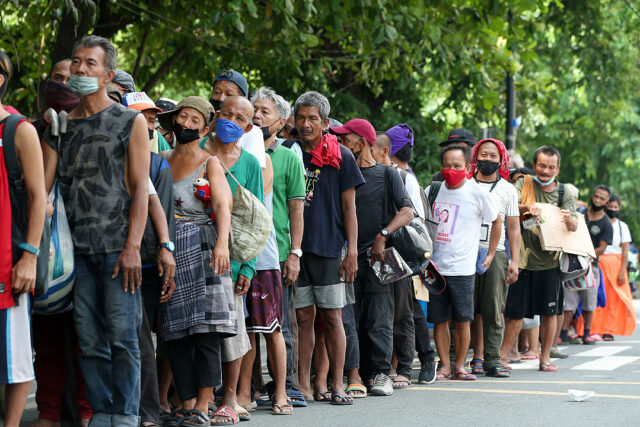
HOMELESS Filipinos are seen awaiting their turn to get free food at T.M. Kalaw in Manila. — PHILIPPINE STAR/KRIZ JOHN ROSALES

QUALITY EDUCATION and health programs will maximize the development impact of cash transfer programs like the Pantawid Pamilyang Pilipino Program (4Ps), the World Bank said.

“The quality of education and health, not just service use, is critical to achieving the expected gains in human capital. Like all conditional cash transfer programs, Pantawid acts on the demand side. The project’s conditionalities, such as the family development sessions, have been fundamental to bringing about behavioral change,” it said in a report.

“The program was quite effective in changing attitudes and behaviors (increasing school attendance and supporting regular visits to health clinics) but not as much in affecting development outcomes such as learning, stunted growth of children, or maternal mortality,” it added.

The World Bank said these outcomes “depend crucially on the quality of services provided.”

“Supply-side conditions need to operate together with incentives on the demand side (such as Pantawid conditionalities) to achieve gains in human capital,” it said.

The 4Ps require recipients to submit to health checks and keep children in school to leverage the impact of the cash into behaviors deemed helpful in achieving development goals.

The World Bank also noted the importance of continuous monitoring and evaluation to ensure the program is constantly evolving.

“The management information system regularly ensures that Pantawid beneficiaries receive the appropriate grant based on their degree of compliance with conditionalities; it is constantly updated to regulate complex interdependent processes. At the same time, evaluation of processes and results is needed to inform the government of the necessary changes to keep the program effective,” it added.

Government ownership is also key to sustaining cash transfer programs, the multilateral lender said.

“The success of a large, nationwide social protection program like Pantawid lies in creating and strengthening the operational and institutional systems needed to support it,” it said.

“Thanks to its solid institutional base, Pantawid expanded much faster than originally anticipated — faster than similar programs in any other country globally —and became the third-largest conditional cash transfer program in the world in population coverage,” it added.

The 4Ps were first launched in 2007 and made a permanent feature of government entitlements in 2019. — Luisa Maria Jacinta C. Jocson

Education, labor reforms seen as potential growth drivers — Moody’s

PHILIPPINE STAR/ MIGUEL DE GUZMAN

EDUCATION and labor sector reforms could complement population-driven growth in South and Southeast Asian, Moody’s Investor Service said in a report.

“Closing the gaps in both educational achievement and workforce participation would provide scope for further economic gains and boost incomes,” Moody’s Investor Service said.

An enhanced education sector will mitigate potential job losses for certain segments of the services industry such as business process outsourcing, especially in India and the Philippines, the report said.

Moody’s said the development of engineering and programming may provide higher value-added job opportunities given the increasing complexity of products on offer.

The report noted that the Philippine average for years spent in education is nine, according to the United Nations Development Programme’s national human development index.

This is the highest average number of years in education, more than Indonesia, Vietnam, and Pakistan, it added.

Moody’s said this was due to a greater percentage of females completing secondary school in the Philippines.

“Among the big six, the Philippines and Vietnam are relatively well placed, although — as their scores for education, and labor and income indicate — neither currently has positive exposure to these factors,” the report said. — Aaron Michael Sy

The arm’s length principle for retail companies

There are a variety of reasons why associated enterprises enter into commercial transactions with each other. The most common is the ease and speed of processing and delivery, since the setup allows the parties to bypass the common processes of doing business with a non-affiliate (e.g., supplier accreditation, credit investigation, etc.) due to the special relations between the affiliated companies.

One thing to consider in such arrangements is that transfer pricing rules dictate that transactions between or among affiliated entities observe the arm’s length principle. This means that whatever price is charged for a similar good sold or service rendered to a related party must be comparable with that charged to an independent or unrelated party.

Sometimes, related party transactions are simple and straightforward arrangements, as is the case with the sale of products which are being offered for sale also to third-party buyers. One example might be a retailer who offers for sale the same pool of commodities to buyers, regardless of whether the latter are affiliates or not.

Hence, if the requirement under the arm’s length principle is simply to ensure that a particular seller charges the same price for similar goods or services sold to unrelated and related buyers, are billing invoices and receipts showing the same prices sufficient evidence to prove that the transaction with related parties complies with the arm’s length standard? The simple and perhaps immediate response to this question would be “yes,” if we focus merely on the nature of the subject of the transaction. However, as is generally the case when determining prices for a particular commodity, there are a lot of factors to be considered which extend beyond the costs incurred in producing the good or providing the service to the end consumer.

This is where transfer pricing documentation (TPD) or transfer pricing policy come into the picture. A TPD supports the analysis performed on the surrounding factors that may impact the pricing of a specific transaction entered into between or among related parties. The analyses cover not only internal factors (e.g., functions performed, assets employed, risks assumed, etc.) but also external factors (e.g., economic and industry, regulatory environment, etc.) that usually affect pricing determination.

Going back to the case of retailers, how then is transfer pricing analysis or the arm’s length principle applied on their related party transactions?

As mentioned earlier, a transaction involving the resale of goods, especially where the reseller does not perform any value-adding activity to the goods being offered for sale, may appear very straightforward. However, a careful examination of the factors surrounding the transaction must be made in order to determine an appropriate transfer pricing method that would identify the arm’s length price.

The possible TP methods that can be applied in the case of retailers are the following:

COMPARABLE UNCONTROLLED PRICE (CUP) METHOD
The CUP method compares the price of the products sold by a retailer to the related party with the price of product sold to third-party buyers. This is the most direct way of ascertaining an arm’s length price but requires the highest degree of comparability of the nature and characteristics of the product, terms and conditions of the transaction with related and third-party buyers. In case of differences, reliable adjustments should be made to eliminate the material effects of such differences.

The CUP method can be applied in two ways — internal and external CUP method.

The internal CUP compares the price of the product charged by the retailer to the related party buyer with the price charged by the same retailer to an independent party. For example, Retailer Corp. sells a specific type of multi-purpose tripod at P900 per unit. Buyers of Retailer Corp. are generally third-party end-consumers. However, in case a related party of Retailer Corp. procures the same multi-purpose tripod from Retailer Corp., the selling price should ideally be comparable to the price charged by Retailer Corp. to third-party buyers (i.e., P900 per unit).

Please note that in using internal CUP, it must be demonstrated that the internal comparables are not transactions that were performed/entered solely to justify that the related party transactions are at arm’s length or to artificially create a comparable uncontrolled transaction that serves as a benchmark.

On the other hand, external CUP compares the price of the product sold to a related party buyer with that of the price charged between two independent parties. For example, Distributor A supplies industrial cleansing liquid to retailers who are all affiliate entities. Distributor A does not supply to third-party retailers. Assuming Distributor B, a direct competitor of Distributor A, sells comparable cleansing liquid to non-affiliate retailers at P80 per kilo, then the price charged by Distributor A to its affiliate retailers should be comparable to the selling price of Distributor B to non-affiliate retailers, that is, P80 per kilo.

Again, the CUP method requires the highest degree of comparability of retail transactions with related and third-party buyers. With that said, a comparability analysis must be performed first between the related and independent transactions. In performing this analysis, it is crucial to know the product characteristics, such as physical features and quality; whether the goods sold are compared at the same points in the supply or production chain; product differentiation is in the form of patented features such as trademarks, design, etc.; volume of sales if it has an effect on price; timing of sale if it is affected by seasonal fluctuations or other changes in market conditions; whether cost of transport, packaging, marketing, advertising, and warranty are included in the deal; whether the products are sold in places where the economic conditions are the same; and whether a business strategy is adopted in the controlled transaction that would produce material difference on the price of the controlled transaction as against the price in an uncontrolled transaction.

The above factors affecting the comparability could be qualitative or quantitative. For example, the products compared shall be of the same kind or model and of the same brand. Products that may appear identical physically but differ in terms of branding would have price variability. Of course, the more well-known the brand is, the higher the price. After-sales service must also be considered since a product sold with warranty that has extensive coverage or is provided for a longer period would normally call for a higher price than products sold without warranty, even if they are similar in nature or even in brand. Similar products sold on different occasions, such as regular sales or promotions, would also lead us to expect differences in pricing. The same is true when differing payment terms are applied, such as in the case of cash or deferred sale and installment sales, where the latter would normally entail higher pricing.

To reiterate, the CUP method is acceptable provided that reliable adjustments can be made to eliminate the factors enumerated above that affect the price of the product.

RESALE PRICE METHOD (RPM)
Another transfer pricing method that can be used in the case of retailers is the RPM. RPM is applied when a product that is purchased from a related party is resold to an independent party. The resale price method evaluates whether the amount charged in a controlled transaction is at arm’s length by reference to the gross profit margin realized in uncontrolled transactions. RPM is most appropriate in a situation where the reseller adds relatively little value to the product.

To illustrate, say Retail Company sells hydraulic desks to non-affiliate buyers. The hydraulic desks are purchased by Retail Company from its affiliate, Manufacturing Company. Assuming the market price of a hydraulic desk with similar features or similar built as that sold by Retail Company is P20,000. In addition, hydraulic desk retailers in the market report a gross margin of 25%. The application of RPM is that the gross margin of independent retailers is P5,000 (P20,000 selling price multiplied by 25% gross margin). This means that the market cost of the product is P15,000 (P20,000 selling price minus P5,000 gross margin).

In the above illustration, the hydraulic desks must be sold by Manufacturing Company to Retail Company at a transfer price of P15,000.

TRANSACTIONAL NET MARGIN METHOD (TNMM)
As opposed to the CUP method and RPM which compare prices charged for comparable transactions, TNMM compares net margins relative to an appropriate base, such as costs, sales or assets attained by an entity from a controlled transaction, as against those attained by comparable independent entities involved in similar transactions. This method is based on the concept that similar firms operating in the same industry would tend to yield similar returns over time.

The advantage of TNMM is that it allows for differences in the characteristics of the products being sold or the terms and conditions surrounding the sale, which generally have no material influence on the net margin.

TNMM uses profit level indicators (PLI) in evaluating whether the transactions with related parties comply with the arm’s length standard. In the case of retailers, which mostly do not perform any value-adding activities to the products they sell, the appropriate PLI is generally the operating margin. Operating margin is calculated by dividing a company’s operating income (before interest and tax) by its net sales.

TAKEAWAY
Given the differing circumstances surrounding retail sales transactions, it is imperative that retailers who regularly transact with related party buyers are able to support their transfer prices by giving due consideration to all factors that may have an influence on their pricing. The best way to do that, of course, is to prepare and maintain TPD. Hopefully, more retailers with regular and material related party transactions will realize the importance of the TPD and consider it a necessary “add-to-cart” item.

Let’s Talk Tax is a weekly newspaper column of P&A Grant Thornton that aims to keep the public informed of various developments in taxation. This article is not intended to be a substitute for competent professional advice.


Arianne Cyril L. Mandac-Villarama is a senior manager from the Tax Advisory & Compliance Practice Area of P&A Grant Thornton. P&A Grant Thornton is one of the leading audit, tax, advisory, and outsourcing firms in the Philippines, with 29 Partners and more than 1000 staff members.

Tweet us: @GrantThorntonPH

Facebook: P&A Grant Thornton, pagrantthornton@ph.gt.com

www.grantthornton.com.ph

US-Philippine civic mission to Thitu sought amid rising China tensions

AN AERIAL photo of Philippine-occupied Thitu Island, locally known as Pag-asa, in the contested Spratly Islands. — REUTERS

By Kyle Aristophere T. Atienza, Reporter

FILIPINO and American troops should conduct civic missions at the Philippine-occupied Thitu Island in the South China Sea, according to a US think tank, after an Aug. 5 water cannon incident that stoked long-running diplomatic tensions over China’s expansive claims in the waterway.

While a civic mission involving American troops “would hardly seem like an audacious step,” ending Washington’s “no-boots-on-the-ground” policy in the South China Sea could be a signal that the US won’t shy away from its commitments to its treaty obligations, Raymond M. Powell, the South China Sea lead at Standford University’s Gordian Knot Center for National Security Innovation, said in an analysis piece posted on the SeaLight website on Aug. 28.

Mr. Powell said the US has been “far too slow” to adapt its South China Sea policy to the new reality, having kept its distance from the occupied features in the waterway to avoid conflict.

Unfortunately, China interpreted the reticence as a weakness and exploited the status quo, while America’s treaty ally, the Philippines, “bore the brunt of China’s gray-zone expansionism.”

While Washington’s ambiguous posture toward South China Sea claims may have made a lot of sense in 1990, “an increasingly expansionist Chinese regime has repeatedly and audaciously exploited this weakness in the US stance to its own gain,” Mr. Powell said.

He cited China’s increasingly “aggressive and hostile” military and paramilitary threats that have upended the status quo.

The Chinese Embassy in Manila did not immediately reply to a Viber message seeking comment.

The US journey toward backing its treaty ally’s posture within its exclusive economic zone in the South China Sea could start with sending US and Philippine military doctors and engineers to Thitu Island, he said.

Thitu Island, which the Philippines calls Pag-asa, is the largest of the nine features occupied by the Philippines in the Spratly Islands, locally known as the Kalayaan Island Group.

Pag-asa is home to almost 200 Filipinos, more than four decades since the Philippines established a municipality in Kalayaan in 1978.

“I have no doubt that even this modest step will meet with shrill accusations from Beijing that the US is provoking China by challenging its ‘indisputable sovereignty over the South China Sea islands,’” Mr. Powell said.

The move could also prompt protests from Vietnam and Taiwan, both of which have their own overlapping claims, he added.

But a possible negative reaction from Vietnam and Taiwan could be handled with “quiet and proactive” diplomacy since both countries “will recognize that their own core interests are not really threatened by closer US-Philippine integration.”

“In fact, they will more likely (secretly) appreciate moves that complicate their chief rival’s strategic South China Sea calculus,” Mr. Powell said.

“The expected People’s Republic of China outrage, on the other hand, should be greeted with heart-warming pictures of the US and Philippine military medical outreach and civil engineering projects, as well as more solemn reminders of America’s treaty commitment to Philippine security,” he said.

The joint civic mission gives meaning and consent to the collective deterrence fostered by allies against incessant Chinese misbehaviors, Chester B. Cabalza, founder of Manila-based International Development and Security Cooperation, said in a Facebook Messenger chat.

“The proposed US-Filipino joint civic mission to Pag-asa Island reaffirms the strong security ties of the two allied countries,” he said. “It gives a more credible posture on the crusade of the Philippines to save its territories and maritime features from intruders and the expansionist Chinese regime.”

Mr. Cabalza said many Filipinos have long waited for the US to challenge China “in our own backyard.”

The Philippines is the US’ oldest ally in the Indo-Pacific region. The two countries became treaty allies in 1951, when they signed a mutual defense treaty that compels both nations to protect each other in case of an attack by a third party.

Tensions between the Philippines and China in the South China Sea have worsened after the Chinese Coast Guard fired water cannons to block Manila’s resupply mission at Second Thomas Shoal on Aug. 5.

The US was among the countries that immediately issued statements of concern after the incident.

The government of President Ferdinand R. Marcos, Jr. has given the US access to four more military bases under their 2014 Enhanced Defense Cooperation Agreement. It also plans to hold sea patrols with the US, Japan and Australia.