Home Blog Page 4350

Maharlika expected to generate 100,000 jobs

THE Maharlika Investment Fund (MIF) is expected to generate 100,000 direct and indirect jobs as its initial capitalization becomes fully paid in over the first 10 years of operations, the Department of Finance (DoF) said.

The MIF is also expected to contribute 0.07 percentage point (ppt) to gross domestic product (GDP) each year over the same period, the DoF said, also citing data from the National Economic and Development Authority (NEDA).

“Due to spillover effects, the value added generated through investment activities in the first 10 years of the Fund is expected to still contribute 0.01 ppt annually to growth over the next 11-20 years,” it added.

The sovereign wealth fund will be managed by the Maharlika Investment Corp. (MIC), which will have authorized capital stock of P500 billion.

The MIC’s initial P125-billion funding will come from the National Government (P50 billion), the Land Bank of the Philippines (P50 billion) and Development Bank of the Philippines (P25 billion).

Under a scenario in which the MIF is not established and the government keeps the P125 billion, the retained initial capitalization is expected to contribute 0.06 ppt to growth.

“There are no spillover effects expected in this scenario,” the DoF added.

A further scenario has the MIF generating 0.2 ppt in GDP growth annually if “in addition to co-investments generated with other parties, the P500-billion authorized capital stock of the corporation can be fully paid in over the course of the first 10 years of operations.” 

“Job creation, both direct and indirect, is projected at 350,000,” it added.

Spillover effects from this scenario are also expected to contribute 0.05 ppt annually to growth over the next 11 to 20 years.

“NEDA also approximates when the impact of the investments in the following will be felt in the capital markets (in the) first few years (and) sectoral investments (in) five to seven years,” it added.

Meanwhile, Finance Secretary Benjamin E. Diokno clarified that the president and chief executive officer (CEO) of the Maharlika Investment Corp. (MIC) needs to be Filipino.

“I know the head of the MIC should be Pinoy. But independent directors (can be foreigners),” he said.

The implementing rules and regulations (IRR) of the Maharlika law do not explicitly state that the MIC president and CEO should be Filipino.

The MIC president and CEO is only required to hold an advanced degree (MBA, MA, MSc, PhD) in finance, economics, business administration, or any related field from a reputable university.

It also requires a minimum of 10 years in a senior leadership role in a “reputable financial institution or public or private sector organization.”

On the other hand, regular directors must be Filipino citizens and at least 35 years old.

Regular and independent directors are also both required to have a master’s degree in finance, economics, business administration and have at least 10 years’ experience in finance, investment, economics, business, or any related field.

The Bureau of the Treasury has started accepting nominations and applications for the president and CEO, independent directors, and regular directors.

The deadline for nominations and applications is on Sept. 27. — Luisa Maria Jacinta C. Jocson

Wild comedy Poor Things wins top prize at Venice Festival

Emma Stone and Ramy Youssef in a scene from Poor Things. — IMDB

VENICE — Poor Things, a gothic, sex-charged comedy directed by Greece’s Yorgos Lanthimos, won the prestigious Golden Lion award at the Venice Film Festival on Saturday.

Starring Emma Stone, Willem Dafoe, and Mark Ruffalo, the British-made film wowed festivalgoers with its zany story of a woman reanimated after suicide by a mad doctor who replaces her brain with that of her unborn baby.

Childlike but with an adult’s body, Ms. Stone’s character Bella Baxter grows increasingly independent and excited by her sexual experimentations as she undertakes a voyage of self-discovery through a surreal version of 19th century Europe.

“The central character is Bella Baxter, an incredible creature, and she would not exist without Emma Stone, another incredible creature,” said Mr. Lanthimos, whose previous films include The Favorite and The Lobster.

Venice marks the start of the awards season and regularly throws up big favorites for the Oscars, with eight of the past 11 best director awards going to films that debuted here.

The top acting awards at the festival went to two US stars — Cailee Spaeny, who played the former wife of Elvis Presley in the biopic Priscilla, and Peter Sarsgaard, who featured in the gritty family drama Memory.

The runner-up Silver Lion award went to Evil Does Not Exist, an enigmatic, rural drama directed by Japan’s Ryusuke Hamaguchi — the only Asian entry among the 23 films competing for the main prize.

STRIKE ACTION
Saturday’s ceremony wrapped up the 11-day movie marathon, which drew an array of top films to Venice, but far fewer stars than normal as a long-running Hollywood actors’ strike prevented many A-listers from coming to promote their work.

Actors and writers are demanding that streaming sites and film studios improve their contracts and impose curbs on the use of artificial intelligence.

Collecting his award, Mr. Sarsgaard said AI had to be curbed, warning that the issue had implications that went far beyond Hollywood.

“This holy experience of being a human will be handed over to the machines and the eight billionaires who own them. So if we lose that battle in the strike, our industry will be the first of many to fall,” he said.

Among other prizes handed out in Venice was a special Jury’s Award for Green Border, a harrowing film about migrants trapped on the Polish-Belarus border, directed by Poland’s Agnieszka Holland.

Best director went to Italy’s Matteo Garrone for Me Captain, another gripping migrant movie, which follows two teenagers from Senegal as they cross Africa hoping to reach Europe. The young star of the film, Seydou Sarr, won the award for best emerging actor or actress.

Best screenplay went to Guillermo Calderon and Pablo Larrain for the script of El Conde, a satirical film about Chilean dictator General Augusto Pinochet. — Reuters

How to be good to the planet while still being stylish

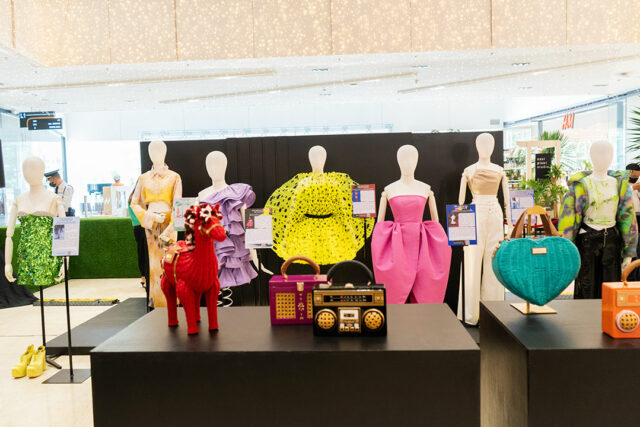
FASHION production creates up 10% of humanity’s carbon emissions, and yet 85% of all textiles simply end up in landfills. This according to the website of the Geneva Environment Network, a partnership of over 70 environmentally conscious organizations. It also cites plastics and chemical run-offs as industry byproducts filling up the world’s oceans. This information, plus an exhibit in SM Aura citing the ways fashion should be healing the world might make one think before shopping.

Fashion Forever provides an overview of the emerging fashion industry in Sweden and novel approaches in fashion design, production, and distribution. The exhibit, which opened on Sept. 8, is an initiative of the Embassy of Sweden in Manila, supported by the Swedish Institute, and held in partnership with SM Aura and Swedish clothing giant H&M.

Displays in the exhibits showed off clothes made of recycled materials, while homegrown brands Zarah Juan (a designer using natural materials) and Lily of the Valley (showing period underwear which is meant to reduce the presence of sanitary pads in landfills) also participated.

Notes across the exhibit showed various ways people can reduce the environmental impact of what they wear. Examples include clothes swapping, renting clothes, buying secondhand items, and simply buying better longer-lasting goods.

Dan Mejia, H&M’s Regional Head of Communications and PR for Southeast Asia, laid down the company’s initiatives for sustainability, noting that the company’s initiatives began back in 1997. “It was in 1997 when we created our Code of Conduct and launched a collection called Nature Calling — that’s when we pioneered the use of organic cotton. Today, 100% of the cotton we use in all our garments are either organic, recycled, or from Better Cotton (a non-profit that pushes for better cotton farming practices).”

“We acknowledge that we are part of the problem… not exactly the opening statement you would expect from us, but that is the truth,” said Mr. Mejia. “By we, I refer not only to H&M but to the entire fashion industry. We all have a stake here. Now, we may be one of the largest fashion retailers in the world, but we only represent 2% in the market. To move the industry to be truly fully sustainable, we need the other 98% to join in.”

Swedish Ambassador Annika Thunborg explained in a speech during the event that “The fashion industry is a big polluter and carbon emitter. Far too many textiles end up in trash bins and landfills, regularly thrown away with household waste. Each year, 4.3 million tons of textile waste is deposited or incinerated in the EU.”

After that depressing statement, she cited initiatives of the Swedish government to tackle the issue, which includes Textile & Fashion 2030, a government-supported initiative led by the University of Borås in collaboration with the Swedish School of Textiles, SmartTextiles, Science Park Borås, and the Research Institute of Sweden. This initiative aims to test and study different techniques of sustainable fashion settings of small-scale sustainability advancements and how these can be rolled out on the world stage. Another is the Swedish Textile Initiative for Climate Action (STICA), a network of businesses launched in 2018 that collaborate to reduce their climate footprint. H&M is a participant, as are Kappahl, Peak Performance, Acne, and Filippa K, in collaboration with Sustainable Fashion Academy.

“Upcycling, reusing, and eventually recycling, rather than using up even more virgin resources are some of the ways for the fashion industry to become good for the planet,” she said.

The Fashion Forever exhibit runs from Sept. 8 to 14 at SM Aura. The exhibit will also make an appearance at Cebu Design Week in November. — JLG

Steady earnings awaited for listed energy firms

BW FILE PHOTO

EARNINGS of listed energy companies are expected to be steady in the second half of the year if no unforeseen developments arise towards year-end, analysts said.

“In a general sense, the sector’s performance is likely to remain stable for the remainder of the year, assuming no stringent regulatory developments,” Luis A. Limlingan, head of sales at Regina Capital Development Corp., said in a Viber message.

“Apart from regulatory factors, fuel and coal prices, infrastructure investments, and weather-related power demand will influence the profitability of power firms,” he added.

For Toby Allan C. Arce, head of sales at Globalinks Securities and Stocks, Inc., the earnings outlook for energy companies is “complex and uncertain” as there are several factors that may affect the performance of the sector.

“Some analysts expect that power companies may see a moderate increase in their earnings in 2023, driven by the growth in electricity sales, the improvement in plant efficiency, and the reduction in operating costs,” he said in a Viber message.

“However, this outlook is subject to risks and challenges, such as regulatory uncertainties, environmental issues, technical problems, and market competition,” he added.

For the second quarter, listed energy companies posted mixed results.

Manila Electric Co. registered an attributable income of P9.78 billion, up 45% from P6.74 billion in the previous year, on the back of higher sales of electricity and other services.

Aboitiz Power Corp. reported a nearly 45% increase in attributable net income to P10.29 billion from P7.10 billion a year earlier after an increase in revenues from its operating segments.

For First Gen Corp., its renewable energy business drove its attributable net income, which rose by 29.6% to $77.21 million from $59.56 million previously.

The expansion of renewables also boosted the income of ACEN Corp. to P2.21 billion, higher by 24.2% from P1.78 billion a year ago.

“The government’s policies on renewable energy (RE) would be a positive factor for power companies that are involved in renewable energy, such as solar and wind power,” Mr. Arce said.

The government targets to increase the share of RE in the country’s energy mix to 35% by 2030 and 50% by 2040.

Last year, the Department of Energy raised the required share of RE for distribution utilities under its renewable portfolio standard or RPS program to 2.52% per annum starting this year from 1% per annum previously.

Meanwhile, Semirara Mining and Power Corp. reported a second-quarter attributable net income of P10.19 billion, down 5.5% on reduced domestic coal sales.

Mr. Limlingan said that the weak coal sales were due to normalized prices despite sustained high demand.

“The third quarter would be challenging but management continues to be bullish as the power segment picks up and the high demand for coal sustains,” he said.

The growth of energy companies for the remainder of the year will depend on power demand and the movement of fuel prices as the “Ber” months kick off.

September to December are associated with cooler temperatures in the Philippines and increased consumer spending due to holiday expenses, Mr. Limlingan said.

“Hence, this translates to lower residential power demand, but we are likely to see higher commercial power demand,” he said, citing visits to “leisurely places” such as malls.

Mr. Arce said possible oil increases will likewise increase the cost of coal and natural gas, resulting in higher fuel prices.

“If the price of oil increases, it would also increase the cost of coal and natural gas, which are the main fuels used to generate electricity in the Philippines,” Mr. Arce said.

In August, fuel retailers raised pump prices by P5.90 per liter for gasoline, P9.90 per liter for diesel, and P10 per liter for kerosene.

Oil prices inched up by 1% on Friday as the market worried about tight supply after Saudi Arabia and Russia announced their decision last week to extend voluntary oil cuts to the end of the year, Reuters reported. — Sheldeen Joy Talavera

Young designer transforms thrifted bedsheets into fashion statements

THE RECENTLY concluded Revive and Renew Upcycling Fashion Competition hailed Darius Jireh Juson as the Top Designer for his project which transformed discarded queen-sized bed linens from ukay-ukays (secondhand stores) into capsule wardrobes.

A project of leadership development organization JCI Manila, the event encouraged the next generation of eco-conscious designers to showcase their ingenuity and passion through modish ensembles made from discarded materials.

Mr. Juson, an alumni of the Fashion Design and Merchandising Program of the De La Salle-College of Saint Benilde, took his inspiration from the Lady of the Lake, a character from the legend of King Arthur and the Knights of the Round Table. He reimagined her as a modern muse of second chances.

“She was awakened by the urgency to warn the world of climate emergence,” he was quoted as saying in a press release. “She had the ability to grant anyone’s mission creating an impact on the environment.”

The young designer converted queen-sized cotton bed sheets into a two-piece outfit, complete with a draped multi-strap bodice and a free-sized and modular detachable train.

“It is a capsule wardrobe with functionality and versatility in mind,” he explained. “The top skirt can be worn separately, either elevated for a formal look or dressed down for a casual feel,” he added. “It can be integrated for an errand look, resort wear, or even bridalwear.”

He likewise highlighted the importance of diverse styling options to prolong the life of the garment with the end-user. “I approach sustainability like a circular framework by reintegrating post-consumer waste in the cycle,” he stated.

His work also bagged the Bingo Plus Foundation Special Award.

The contest’s jury include stylist, menswear and streetwear designer Bang Pineda, Department of Interior and Local Government Undersecretary and Professional Models Association of the Philippines President Marge Gutierrez, fashion designer Kristine Ordinario, and author and entrepreneur Brian Poe Llamanzares.

Mr. Juson is no stranger to sustainable fashion. He, together with fellow Benilde FDM alum and business partner Allesandra Gutierrez, will be relaunching their social enterprise REPAMANA. Grounded in the principles of circular economy, the brand treats waste — from rejected fabrics to floral scraps — as the primary sources of materials.

“REPAMANA breathes new life and higher value to the end product and gives them modern translations with endless styling possibilities,” he expounded.

It also aims to employ persons deprived of liberty as seamstresses to give them a renewed sense of purpose and dignity in their work.

“Through these intentional choices, every stitch, every fabric selection, and every hand involved in REPAMANA supports the story of second chances towards a more meaningful connection with our garments,” Mr. Juson said.

ACEN set to triple investments in Australia’s energy transition

ACEN Corp. is on track in its renewable energy expansion in Australia and is poised to triple its investments in the country’s energy transition, the Ayala-led company’s top official said.

“ACEN fully supports Australia’s energy transition, and the company is gearing up to triple its Australia investments in the next three years,” ACEN President and Chief Executive Officer Eric T. Francia said in an e-mailed media release on Sunday.

Mr. Francia made the statement as President Ferdinand R. Marcos, Jr. and Australian Prime Minister Anthony Albanese signed a strategic partnership agreement on Friday to boost the two countries’ bilateral ties.

The partnership was concluded during the visit to the Philippines of Mr. Albanese, the first Australian leader to do so in 20 years.

The move is part of Australia’s launch of “Southeast Asia Economic Strategy to 2040,” which includes seeking mutual trade and investment opportunities in key sectors in the Philippines such as agriculture and food, education and skills, resources, and the clean energy transition.

ACEN quoted Mr. Albanese as saying that he met with Mr. Francia and that the renewable energy company currently has 2 billion Australian dollars (AUD) of investments in the foreign country.

“They have a large presence in New England region, in Tasmania, as well as investment coming in Western Australia in the Pilbara,” Mr. Albanese was said to have commented in an interview.

“They expect that investment to increase to 6 billion AUD in three years — a substantial investment in Australian renewables, putting online something like three gigawatts of additional capacity in the Australian energy market,” he said, describing ACEN as a “significant company which is making a difference and wants to make more of a difference.”

After a brief meeting with Mr. Albanese on the partnership signing in Malacañang, Mr. Francia renewed the company’s commitment to expand in Australia.

The Australian government is currently rolling out a 20-billion AUD program called “Rewiring the Nation” to upgrade and modernize the country’s electricity grid and infrastructure.

“ACEN appreciates the government’s efforts to augment the much-needed transmission capacity to enable the growth of renewables. Our projects are particularly reliant on the Central West Orana renewable energy zone and the Marinus link transmission projects, among others,” Mr. Francia said.

To date, ACEN has around 4,200 megawatts of attributable capacity spread across the Philippines, Vietnam, Indonesia, India, and Australia. The energy company is targeting to expand its renewable energy portfolio to 20 gigawatts by 2030.

On Friday, shares in the company went up by two centavos or 0.4% to P5.01 apiece. — Sheldeen Joy Talavera

Inditex’s Zara launches its second-hand platform in France

ZARA.COM/UK

MADRID — Spanish fashion retailer Zara would expand its service to sell, repair, or donate second-hand clothes in France last Thursday, its owner Inditex said the day before.

The service, available through Zara’s stores, its website, and a mobile app, already exists for its British customers since last October. The company’s chief executive Oscar Garcia Maceiras has said it will be launched in Germany also this year.

The company aims to extend the life of customers’ Zara clothes, in this way it will contribute to the reduction of waste and the consumption of new raw materials, it said in a statement.

Zara has also said 40% of clothing pieces will be made with recycled fibers by 2030 and it is backing charities such as Moda Re which manage textiles waste. The company seeks to reduce its carbon emissions by 50% by 2030 and by 90% by 2040.

Zara is following other fast fashion brands such as its main competitor H&M in offering products for resale at a time when the global second-hand apparel market is growing. — Reuters

SEC warns public versus investment-taking firms SERP Worldwide, Sprhy

THE Securities and Exchange Commission (SEC) cautioned the public against investing in two entities, which the regulator said are unauthorized to solicit investments.   

In an advisory posted on Sept. 7, the SEC warned about Secret for Elimination of Rampant Poverty Worldwide Corp. (SERP Worldwide) as it did not secure prior registration to solicit investments despite being registered as a corporation.   

According to the SEC, individuals representing SERP Worldwide are allegedly enticing the public to invest their money in the entity. A prospective investor is asked to pay P10,000 to avail of the SGEP10-10K package with a promise to earn 30% to 60% retail profit along with various bonuses.   

“The public is hereby advised to exercise due care and caution in investing their money in this type of scheme being offered by SERP Worldwide and/or its agents. In the instant case, the scheme of SERP Worldwide has the characteristics of a pyramid scheme,” the SEC said.    

“The public is advised not to invest or stop investing in any investment scheme being offered by any individual or group of persons allegedly for or on behalf of SERP Worldwide and to exercise caution in dealing with any individuals or group of persons soliciting investments for and on behalf of it,” it added.     

In a separate advisory also posted on Sept. 7, the SEC warned consumers about investing in Sprhy Gold Investment/Sprhy Cash Paluwagan as it has the characteristics of a Ponzi scheme.   

The SEC said Sprhy Gold, which is not registered with the commission, allegedly solicits investments at a minimum of P5,000 up to P500,000, which is supposed to earn 15% up to 30% after 30 days.   

“The offering and selling of securities in the form of investment contracts using the Ponzi scheme, which is fraudulent and unsustainable, is not a registrable security. The commission will not issue a license to sell securities to the public to persons or entities that are engaged in this business or scheme,” the SEC said.   

“The public is hereby advised not to invest or to stop investing in the investment scheme being offered by Sprhy Gold Investment/Sprhy Cash Paluwagan as well as to any other entities having the same or similar schemes and to exercise caution in dealing with any individuals or group of persons soliciting investments or recruiting investors for and on behalf of Sprhy Gold Investment/Sprhy Cash Paluwagan,” it added. — Revin Mikhael D. Ochave

Ayala Land expects sustained profit growth as holidays near

JOGGERS, runners, and bikers enjoy a car-free Sunday morning along Ayala Avenue in Makati City as the Ayala Land in partnership with the local government of Makati turns Ayala Avenue as an outdoor activity haven for families from 6 a.m. to 10 a.m. for the remaining Sundays of September which aims to promote a healthy lifestyle. — PHILIPPINE STAR/MIGUEL DE GUZMAN

LISTED property developer Ayala Land, Inc. (ALI) is bullish about its performance for the rest of the year, which a company official described as booming as the holiday season nears.

“We’re ending the year really good. It’s booming. Our estates are welcoming new stores,” said Marianne C. Roa, group head for marketing and communications for corporate, estates and malls, on the sidelines of a launch event in Makati City on Sunday.

“We’re also looking forward to more people coming into our communities,” she added.

Ms. Roa said ALI is projecting higher net income and growth this year on the back of increased consumer spending during the holiday season.

“It is not just the estates, but even the malls. The Philippines has the longest celebration and as early as September, we’re welcoming everyone to our communities, to our estates and to our malls,” Ms. Roa said.

“We are looking forward to that (better net income) because people are out. The trajectory towards recovery is really good. In fact, in some [of our] estates, the foot traffic is already [at] pre-pandemic [level],” she added.

Aside from the retail segment, ALI is also expecting more people to purchase properties amid stronger spending confidence.

“When people get their bonuses, that is the time you think [about] where I can invest my money or where I can put it so it will grow. In a way, it is also affected or there is an impact to it (property buying),” Ms. Roa said.

For the first half, ALI logged a 41% increase in its attributable net income to P11.39 billion on the back of higher revenues.

Meanwhile, ALI launched on Sunday its car-free initiative along Ayala Ave. in Makati City as part of its commitment to promote a healthier lifestyle and environmental sustainability.   

Under the initiative, Ayala Ave. will be closed to vehicular traffic every Sunday morning from 6 a.m. to 10 a.m. throughout September. The area will be available for walking, running, and cycling activities.

The company said car-free Sundays is in collaboration with Make It Makati, an initiative that presents the city’s latest offerings and events, as well as supported by the local government of Makati City.

“Both the city of Makati and Ayala Land are steadfast in our commitment to sustainability. We are excited to bring you car-free Sundays for an entire month — a time where the streets are yours to enjoy, free from the usual traffic. It’s an opportunity to run, bike, skate, walk your pets, or partake in any fitness activity you love,” ALI Senior Vice-President and Group Head of Estates Robert S. Lao said

“This initiative is more than just an event — it’s a step towards creating a more livable, breathable city, promoting fitness and wellness, and fostering a sense of community among us all,” he added. — Revin Mikhael D. Ochave

Brazen, original, poetic: hip-hop’s mark on fashion continues

Nike Air Jordan high top sneakers circa 1985 were one of the items on view at the exhibit ‘Fresh, Fly, and Fabulous: Fifty Years of Hip Hop Style.’ — FITNYC.EDU

NEW YORK — As hip-hop celebrates its 50th anniversary this year, elements of the culture are expected to be on the runway during New York Fashion Week from Sept. 8-13, when American designers will showcase their latest collections.

“Hip-hop fashion is defined by its brazenness, its originality, its verbal symphony. You know, hip-hop is poetry,” said costume designer and entrepreneur June Ambrose, a creative director at Puma.

The global culture — which includes music, dance, and fashion — was born on Aug. 11, 1973, when DJ Kool Herc created continuous breakbeats on two turntables at a party in New York’s Bronx borough.

“The tipping point … was when we started seeing average Joe Blow, white guy with the two kids and the picket fence and the PTA wife, in his Timberlands,” said fashion expert and author Constance White. Rappers adopted the rugged yellow boots, originally designed for blue-collar workers, as streetwear, turning the brand into a style statement.

Earlier this year, the Museum at FIT celebrated hip-hop fashion with an exhibition titled “Fresh, Fly and Fabulous: 50 Years of Hip Hop Style.” Pieces included large, gold chains known as Dookie chains, door-knocker earrings, and looks from the past and present.

Ms. Ambrose said it has never been about just the clothes, but about disrupting and transforming fashion’s status quo.

“When you see artists like Jay-Z, how he took that baggy jeans silhouette and we added a button-down shirt to it,” elevating the look for consumers, she said.

Ambrose herself created some of the most iconic costumes in many hip-hop music videos in the 1990s, and worked as a stylist to Jay-Z, Mariah Carey, Mary J. Blige and others.

After five decades, luxury and fast-fashion brands are collaborating with hip-hop designers instead of just being inspired by them.

“Us not asking for permission to work with high fashion designers,” Ms. Ambrose said. “We were purchasing, investing in them, and then we were also creating iconic looks and images that they too were influenced by. And we started to kind of realize that we could all live in the same space.”

White said hip-hop’s influence in fashion can be seen from editors and stylists behind the scenes to musicians now serving as designers.

She cited Virgil Abloh, the first Black man to head Louis Vuitton as the creative director for menswear, until his death in 2021. He was succeeded by rapper-music producer Pharrell Williams in February.

“All these are a result of the influence of hip-hop, hip-hop culture, hip-hop fashion. And we don’t necessarily think about that and appreciate it,” White said. — Reuters

The Velocity Q&A: Kidd Yam (Corporate Affairs Director BMW Group Asia)

Kidd Yam addresses participants of the BMW Driving Challenge in Buri Ram, Thailand. — PHOTO BY KAP MACEDA AGUILA

Interview by Kap Maceda Aguila

THE CHANG INTERNATIONAL Circuit, the first FIA Grade 1 circuit in Thailand, is located in BuriramProvince right in the lower northeast region of the country — some 400 kilometers from Bangkok.

Recently, it proved to be the perfect venue for the BMW Driving Challenge — offering customer and media participants from Malaysia, Singapore, Thailand, and the Philippines a rare chance to push internal combustion engine (ICE)-powered and electrified BMWs on the track, attack gymkhana-style courses, and even off-road sections (in the case of the BMW iX) — ultimately getting a better appreciation of what these machines are capable of beyond the everyday drive. Featured models included the M2, M340i, 330e M Sport and the iX xDrive40 Sport.

In attendance was Kidd Yam, once the chief of Mini Asia and now BMW Group Asia Corporate Affairs Director. After joining the Munich-headquartered brand group in product, sales, and marketing posts in Malaysia in 2010, Mr. Yam went on to Singapore in 2018 for his regional role in Mini.

On the sidelines of the event, we sat down with the executive for a chat. Here are the excerpts.

VELOCITY: What’s the message that the company wants to convey through this event? Why these particular models?

KIDD YAM: All in all, it’s to show that BMW M models are really very track-focused and performance-oriented. This is also a good experience and opportunity to showcase some of the technologies on the newer models like BMW X4M and, of course, the BMW M2 which is coming soon to the Philippines. This is an opportunity for our customers not only in the Philippines but also from Singapore, Malaysia, and Thailand to experience all the featured models. BMW is also going strong with electrified models and we do have the BMW iX that we let our participants drive around the track, and feature its X Drive feature through an off-road course. Not often can you bring a car like the iX off-road, and we’ve shown that the car is able to push the limit — utilizing all the four wheels through the X Drive technology. We also have our other electrified models, not just the full BEVs, like the 330e model available for the guests to experience not only on the track but through gymkhana exercises.

Maybe it’s correct to say that the average person isn’t really used to the idea of electric vehicles being performance vehicles that can also excel on the track — in the case of the iX, not just the track but even off-road situations.

Yes, at the end of the day the iX is a fully electrified model, of course. More importantly, it also features the X Drive technology, which is different from the combustion engine setup in that this is a purely electrified drivetrain system, and features the similar X Drive which is basically BMW terminology for an all-wheel drive system.

BMW, particularly in the Philippines, has been pretty busy lately with the release of new models. I’ve previously asked you this, but how is the supply situation now?

We all can see from the news that most brands and manufacturers are still facing issues with semiconductor supply. But, I think, thanks to the flexibility in terms of BMW production capability, we managed to secure a sufficient number of semiconductors and electronic components that we need to build the cars. More importantly for the Philippines, because of the lead time that we have from the production of the cars to their shipment to the country, most of the time there would already be sufficient units to cater to the first group of customers who order BMWs. More important is the communication, together with SMC Asia Car Distributors Corp. (official country BMW importer and distributor), to the customers to manage their expectation and communicate precisely when exactly the cars can actually be available.

That being said, the demand has been pretty strong — as we have seen for the past few months and even years in the Philippines… and, touch wood, so far, supply has been pretty constant.

Okay, so allocation-wise, it’s getting better?

Exactly. This is also through a lot of intense discussion and communication from our side, together with our importer in the Philippines, and also with our HQ in Munich as well, to ensure that we basically meet the demand together with the supply that we can provide for the markets like the Philippines.

BMW is aggressively rolling out electrified models — both plug-ins and BEVs — in the region. What is the brand seeing in the ASEAN region, particularly in the Philippines, that is giving it the confidence to introduce these vehicles? How would you describe the region’s readiness for electric models?

I can’t speak on behalf of other ASEAN countries save for the countries that BMW Group Asia covers (Bangladesh, Brunei, Cambodia, Guam, Indonesia, Laos, Myanmar, Nepal, New Caledonia, the Philippines, Singapore, Sri Lanka, Tahiti, and Vietnam). First things first: I think the most important thing is what the customer wants. And we can see the trend toward greener vehicles or a greener drivetrain that our customers are demanding. One of the options is, of course, the electric vehicle. We can see this happening already, not only in the Philippines but also in Singapore, in Indonesia, where our customers are actually asking us for more options in electrified vehicles. Hence, we have more and more electrified vehicles being introduced in the market. And of course, talking about the government policy, on one hand, most governments are trying to push the introduction of more electric vehicles, not only because they want to meet the demand for cleaner or more sustainable practices… but because there’s a demand from the citizens of the countries. One good example is Singapore. The Singaporean government has committed that by 2030, only green vehicles can be allowed to be sold and registered.

Green meaning at least a hybrid?

At least a hybrid or full electric — or it could be a new technology introduced later on. In Indonesia and the Philippines, there are some incentives that have been rolled out by the government. I think this is highly appreciated by the people but, of course, there are more things to be considered as well. We have to think about the infrastructure in terms of charging stations, or whether the national grid can support the increased use of electricity across the board. But like I said, more important is customer or user demand.

Do you see a future wherein both electrified options and ICE-powered vehicles can coexist? Will you push one type over the other? What’s the strategy of BMW for the region?

It’s a very difficult question to answer, but in terms of what the BMW Group has announced publicly, we are using the term “technology openness.” We are not putting all our eggs in one basket, but at the end of the day, it also depends on customer needs; if there’s still a demand for combustion engines in certain markets. Take a country as big as the Philippines; you can’t be electrifying all the vehicles yet. You still have commercial vehicles that need to run on diesel or gasoline. And of course, in urban cities where electrified vehicles are more prominent or could have a potential to be utilized, then they can be the options there. If there’s still a demand for combustion engine models, then we will still continue to have that kind of model — at least in the next five to eight years. “The power of choice” is also one of the terms that BMW has been using. For example, when we launched the iX3, we mentioned that we still have the diesel, the petrol, we have the plug-in, and we have the fully electrified. So it really depends on what the customer needs.


Meralco still looking to replace Sual Power’s terminated supply

MANILA Electric Co. (Meralco) said it is still looking for a replacement for one of its suppliers after the termination of the power supply agreement (PSA) with Sual Power, Inc.

“[The replacement] is still ongoing. We just have to follow the rules of the DoE (Department of Energy) and the ERC (Energy Regulatory Commission) for finding emergency power supply agreements, and then we will also consider the laws of the PSA on the long-term supply sourcing of Meralco,” Lawrence S. Fernandez, vice-president and head of utility economics of Meralco, said in an online briefing on Friday.

Meralco said it would raise power rates in September by P0.5006 per kilowatt-hour (kWh) to P11.3997 per kWh due to higher generation charges on the back of the weakening of the peso against the dollar, as well as higher fuel prices.

The power rate was up from P10.8991 per kWh in August and after three consecutive months of decreases.

Of the generation charge’s components, charges from PSAs and independent power producers (IPPs) increased by P1.0362 per kWh and P0.4776 per kWh, respectively.

PSAs accounted for 39% while IPPs contributed 36% to the overall generation charge.

Mr. Fernandez said the contract termination with Sual Power largely contributed to higher generation charges as cheaper supply from a power generation company was lost.

“We lost [a] lower-cost source of power and we had to replace it [with] other sources. Unfortunately, those other sources, including the spot market, were more expensive than what is being supplied before by Sual Power,” Mr. Fernandez said.

In July, San Miguel Global Power Holdings Corp. terminated the 330-megawatt PSA between its unit and Meralco after the Court of Appeals sided with the supplier to end their contract.

The court decision prompted Meralco to partially source replacement power from the Wholesale Electricity Spot Market (WESM).

Mr. Fernandez said that before the termination, Sual Power supplied Meralco at P3.90 per kWh, which is less costly compared with the average P5 per kWh from the WESM.

For September, the WESM share in Meralco’s cost of power purchased from suppliers increased to 23% from 17% previously.

Meanwhile, Meralco said that transmission charges slightly decreased by P0.0081 per kWh after the National Grid Corp. of the Philippines halted the collection of 3% franchise tax from consumers, as directed by the ERC.

Meralco’s controlling stakeholder, Beacon Electric Asset Holdings, Inc., is partly owned by PLDT Inc.

Hastings Holdings, Inc., a unit of PLDT Beneficial Trust Fund subsidiary MediaQuest Holdings, Inc., has an interest in BusinessWorld through the Philippine Star Group, which it controls. — Sheldeen Joy Talavera

ADVERTISEMENT
ADVERTISEMENT