Home Blog Page 4336

Morocco wants IMF-World Bank meetings to proceed despite quake

STOCK PHOTO | Image by mokhtar akel from Pixabay

 – The Moroccan government wants to proceed with International Monetary Fund-World Bank annual meetings scheduled for October in Marrakech despite Friday’s devastating earthquake, two sources familiar with the meeting planning said on Monday.

“From the viewpoint of the Moroccan authorities, the annual meetings of the IMF and World Bank will take place as scheduled: October 9-15, 2023. There is no change of plan as of now,” one of the people, a source close to the Moroccan government, told Reuters.

The people were not authorized to speak publicly on the matter and spoke on condition of anonymity.

The IMF and World Bank declined to comment on Morocco‘s position on the meetings, referring Reuters to a joint weekend statement with India, France, the European Union and the African Union that expressed condolences for the loss of life and damage and spoke of “our willingness to support Morocco in the best possible way,” including addressing urgent short-term financial needs.

Both institutions had said their immediate focus was on the initial response to the disaster.

The death toll from the 6.8 magnitude quake that struck in the High Atlas Mountains, 45 miles (72 kilometers) southwest of Marrakech reached nearly 2,900 on Monday, with over 2,500 injured.

The collapse of the traditional mud brick houses into earthen rubble in the hardest-hit areas has made the search for survivors particularly difficult.

Marrakech suffered some damage in its ancient city center, but more modern parts of the city have largely escaped damage. The site for the IMF and World Bank meetings, a campus of temporary structures on the city’s outskirts near the airport, is largely intact, and preparation work is continuing, one of the sources said.

Bloomberg had earlier reported that Moroccan officials were expecting the meetings to proceed.

The IMF and World Bank annual meetings are expected to draw well over 10,000 people to Marrakech, from the delegations of their 190 member states to media, non-profit and civil society groups, requiring elaborate security and travel arrangements.

The meetings in Marrakech were originally scheduled for 2021, but were postponed twice due to the COVID-19 pandemic.

The IMF and World Bank every three years hold their annual meetings in a developing economy that has shown strong economic policies and governance, to be held up as an example for other countries to follow, including Indonesia in 2018 and Peru in 2015.

In October 2018, the IMF and World Bank proceeded with their annual meetings on the Indonesian resort island of Bali, with more than 11,000 participants, just two weeks after a 7.5-magnitude earthquake and tsunami struck Sulawesi, killing more than 4,300 people.

The Indonesian island of Lombok, just east of Bali, had also suffered more than 500 deaths in a series of quakes in July and August 2018. Both disasters left tens of thousands of people homeless.

Then-IMF Managing Director Christine Lagarde visited disaster recovery areas in Lombok, while Kristalina Georgieva, who was World Bank chief executive officer at the time and later succeeded Ms. Lagarde as the head of the IMF, visited devastated Palu in central Sulawesi.

At the time, Ms. Lagarde said: “Canceling the meetings was not an option because that would be a tremendous waste of the resources that had been committed over the last three years and lose the great opportunity to showcase Indonesia to the world and to create opportunities and jobs.” – Reuters

FDI inflows fall to 5-month low in June

US dollar and euro banknotes are seen in this illustration taken July 17, 2022. — REUTERS/DADO RUVIC

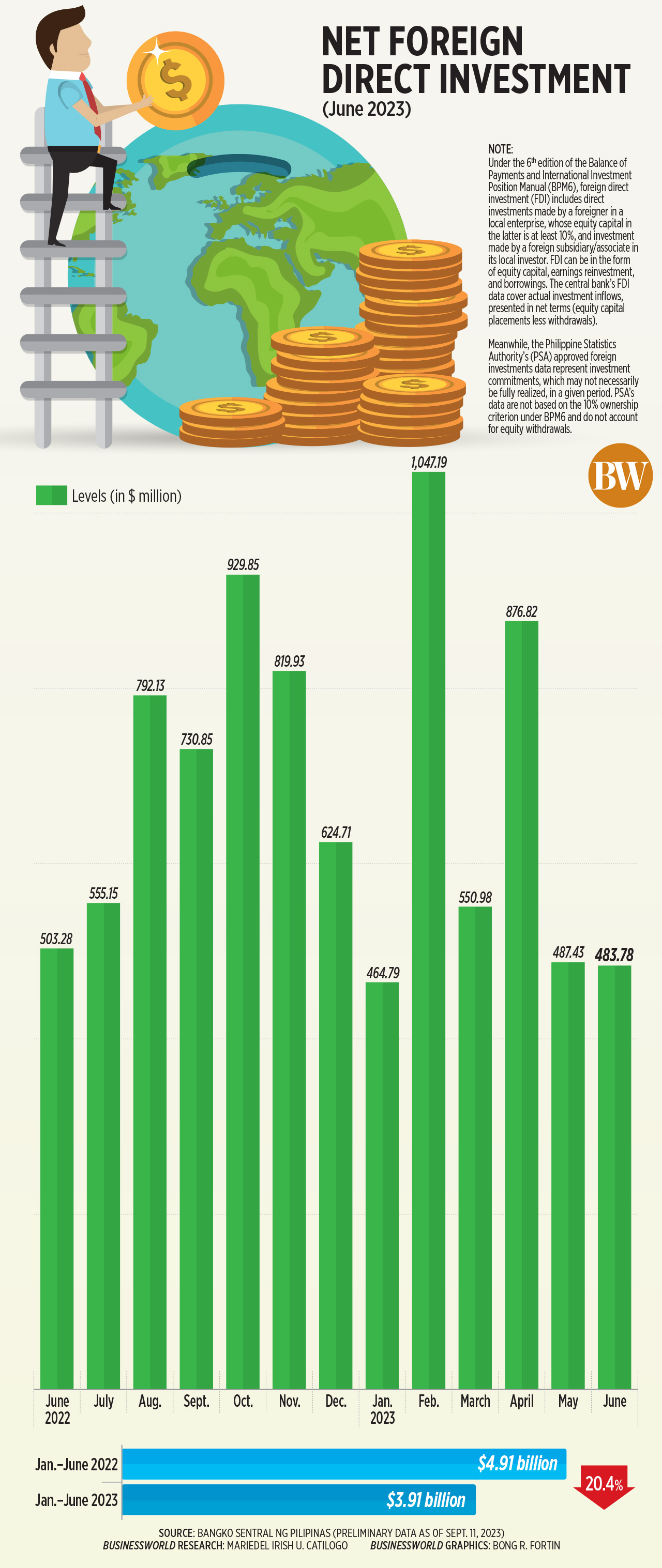
FOREIGN DIRECT INVESTMENT (FDI) net inflows to the Philippines dropped to the lowest in five months in June, as investors worry over slowing economic growth, elevated inflation, and high interest rates.   

Data released by the Bangko Sentral ng Pilipinas (BSP) on Monday showed FDI net inflows declined by 3.9% to $484 million in June from $503 million in the same month in 2022. This was also 0.6% lower than the $487-million FDI net inflows in May.

The June figure was the lowest monthly net inflows of FDI in five months or since $465 million in January.

Net Foreign Direct InvestmentThe BSP attributed the decline in FDI net inflows to the decrease in nonresidents’ net investments in equity capital and their reinvestment of earnings, which offset the growth in investments in debt instruments. 

BSP data showed nonresidents’ net investments in equity capital (other than reinvestment of earnings) fell by 11.8 % to $111 million in June from $126 million in the same month last year. 

Broken down, equity capital placements slipped by 8% to $132 million, while withdrawals increased by 20% to $21 million.

Reinvestment of earnings also slumped by 26.8% year on year to $89 million in June from $122 million in the same month in 2022. 

The equity placements were mainly from Japan, the United States, and Singapore. These were invested mostly in manufacturing, real estate, and information and communication industries.

Investments in equity and investment fund shares also declined by 19.2% to $200 million in June from $248 million in June 2022.

On the other hand, nonresidents’ net investments in debt instruments of local affiliates jumped by 11% to $283 million in June from $255 million a year ago.

“Concerns about global growth as well as anxiety over slowing growth in the Philippines may have prompted investors to hold back on investing at this time,” ING Bank N.V. Manila Senior Economist Nicholas Antonio T. Mapa said in a Viber message.

Philippine gross domestic product (GDP) grew by a weaker-than-expected 4.3% in the second quarter, lower than 6.4% a quarter prior and 7.5% in the second quarter of 2022. In the first half, GDP growth averaged 5.3%.

“Equity and reinvestment of earnings were down (in June) indicating a slow pickup for fresh FDI, and less money being plowed back into the economy from existing firms,” Mr. Mapa said. 

Rizal Commercial Banking Corp. Chief Economist Michael L. Ricafort in a note said elevated inflation and high borrowing costs continue to weigh on FDIs as these raised the cost of investments.

The central bank maintained its key policy rate at 6.25% at its meeting in June.

For the first half of the year, FDI net inflows dropped by 20.4% to $3.9 billion from $4.9 billion a year ago.

BSP data showed foreign investments in debt instruments declined by 24.6% year on year to $2.71 billion in the January-to-June period from $3.59 billion a year prior.

Investments in equity and investment fund shares also slid by 8.8% to $1.2 billion during the six-month period.

Net foreign investments in equity capital fell by 7.3% to $744 million. Equity capital placements inched up by 3.5% to $923 million, while withdrawals doubled to $180 million.

Most of these placements were from Japan, Germany, the United States, and Singapore.

Reinvestment of earnings fell by 11.2% to $459 million in the six-month period from $517 million in the comparable period in 2022. 

“Given heightened uncertainty regarding the global economy, the Philippines may need to convince investors that second-quarter GDP was an aberration. Unless this is done, given our outlook for domestic growth, we could see FDI remain subdued in the coming months,” Mr. Mapa said. 

Economic managers have said GDP needs to grow by 6.6% in the second semester to be able to reach the government’s 6-7% full-year target.

Mr. Ricafort said the free trade agreement (FTA) signed between the Philippines and South Korea earlier this month could boost trade, investments, employment, and overall economic growth.

The Philippine Economic Zone Authority earlier said it expects South Korea to become a top-four source of FDIs into the country, following the recently signed FTA. 

Eventual policy rate cuts, especially in 2024, would also help reduce borrowing costs for investments, Mr. Ricafort added. 

The BSP expects FDI net inflows at $9 billion by end-2023 and at $11 billion by end-2024. — Keisha B. Ta-asan

DTI says rice price cap may be lifted in 2 weeks

PHILIPPINE STAR/KRIZ JOHN ROSALES

By Luisa Maria Jacinta C. Jocson, Reporter

THE GOVERNMENT may lift the price ceiling on rice in two weeks when the local harvest starts and more imports arrive, Trade Secretary Alfredo E. Pascual said on Monday.

“Within September, we are looking at 2 million metric tons of harvest and some entry of imported rice. So maybe within two weeks we should be able to see whether we can lift the price cap,” he said in an interview with ANC on Monday.

The government has been implementing a nationwide rice price cap since Sept. 5 to address a spike in prices of the national staple amid reports of hoarding and price manipulation by cartels.

The ceiling has been set at P41 per kilo for regular milled rice and P45 per kilo for well-milled rice.

Mr. Pascual told reporters that the price ceiling is needed to prevent a spike in retail prices of rice.

“In the next two or one and a half months, because we already started harvesting, we are looking towards a total harvest of 5 million metric tons and that is from our local farmers,” he said on the sidelines of the Asian Regional Conference in Support of Accelerated Life Sciences Innovation on Monday.

The Department of Trade and Industry (DTI) chief said around 90% of retailers in public markets have complied with the price ceiling.

“Our people actually gave warnings to retailers selling over the price ceiling. But what is important is that we have the supply and that the majority of the (retailers) are compliant,” he added.

Meanwhile, President Ferdinand R. Marcos, Jr. said that there is a need to ramp up rice production to bring down prices.

“We have had to control the prices of rice because the markets are very volatile, so we are trying to stabilize it here,” he said during a speech at the Mariano Marcos State University in Ilocos Norte on Monday.

“So, it’s correct that we have to increase our production. But we have to make sure that the increase in production redounds to the benefit of the farmer.”

Finance Secretary Benjamin E. Diokno reiterated that the economic team is in “full support” of the price cap on rice.

“We agree with the President that implementing a price cap on rice is the most prudent course of action at the moment to achieve two critical objectives: stabilizing rice prices and extending immediate support to our fellow countrymen,” he said in a statement.

This comes after Mr. Diokno told reporters on Friday the economic team were “surprised” about the announcement of the price cap, as they were in Japan at that time.

ZERO TARIFF POLICY
Meanwhile, analysts said the government should lift the price cap on rice instead of implementing a zero-tariff policy on rice imports.

“The zero tariff of course will bring down the price of rice, but supply shortage, especially in the aftermath of Indian rice export ban, and increasing local demand will still exert upward pressure on prices,” Filomeno S. Sta. Ana III, coordinator of Action for Economic Reforms, said via Facebook Messenger chat.

“But if the market price still exceeds the price ceiling, despite the zero tariff, don’t expect the exports to come in. So, remove the price ceiling. The price ceiling is not working, based on the stories of rice sellers. It will only exacerbate the shortage. The sooner it is removed, the better,” he added.

The Department of Finance (DoF) has proposed to temporarily slash the 35% rice import tariff rate to 0% or maximum of 10% to “arrest the surge in rice prices.”

Earlier, the Foundation of Economic Freedom (FEF) submitted a petition to the Tariff Commission to reduce the tariff rate on rice to 10%.

Former Agriculture Undersecretary Fermin D. Adriano said that the zero-tariff rate should be implemented until “rice prices stabilize near (to) what they used to cost during normal periods.”

However, Raul Q. Montemayor, national manager for the Federation of Free Farmers, said that the tariff cut will not benefit poor consumers, as most rice imports are premium grade.

“And there is no guarantee that importers and traders will pass on any tariff savings since they know that well-off consumers can afford to pay higher prices,” he said in a Viber message.

Mr. Montemayor said that reducing the tariff to 10% could result in a tariff loss of P9 per kilogram, which translates to a “potential decline in palay (unmilled rice) prices of P6 per kilogram.”

Meanwhile, the temporary reduction in tariff rates and toll fees could lower retail prices and alleviate inflationary pressures, ING Bank N.V. Manila Senior Economist Nicholas Antonio T. Mapa said in a Viber message.

“This, however, may have an impact on domestic producers. This could be more market oriented and introduce less distortion to the market for food,” he added.

Apart from the tariff cut, the DoF is asking toll road operators to temporarily exempt trucks transporting agricultural goods from paying the recently adjusted toll fees.

“I support DoF’s position on exempting trucks from further toll fee increases so that operators will not raise delivery cost, which ultimately consumers pay through high food prices,” Mr. Adriano said.

Ateneo de Manila University economics professor Leonardo A. Lanzona, however, said that it is “unfair” to only exempt trucks, which favors large traders over smaller ones.

“Furthermore, it would not be fair to ordinary road users engaged in other forms of businesses. Worse, it does not really solve the problem of hoarding and smuggling, and may in fact reinforce it,” he added.

Mr. Montemayor also said that the exemption will not “significantly reduce rice prices or ensure the efficient transportation of rice.”

“The recent toll fee increase for large trucks is only P98 per passage. These trucks carry around 25,000 kilos of rice, so the savings amount to only P0.004 per kilogram,” he added.

The DoF’s proposal also includes encouraging the timely importation of rice by the private sector and fully implementing the super green lane.

“Giving them access to a super green lane will only encourage importers to undervalue their shipments and escape detection,” Mr. Montemayor added. — with Justine Irish D. Tabile

Most CEOs still confident of revenue growth in the next 12 months — survey

THE SUN rises behind buildings as seen from Mabini Bridge in Manila, June 16, 2023. — PHILIPPINE STAR/MIGUEL DE GUZMAN

MAJORITY of Philippine chief executive officers (CEOs) are still confident about their revenue growth prospects in the next 12 months despite threats from elevated inflation and economic uncertainty, a survey showed.

Results of the survey conducted by PwC Philippines in partnership with Management Association of the Philippines (MAP) showed that 79% of 157 CEOs are optimistic that their companies will post revenue growth in the next 12 months.

However, this is slightly lower than last year’s survey which showed a peak in optimism among CEOs. Last year, 87% of the 119 CEO respondents said that they are confident of topline growth in the next 12 months.

This year’s survey showed 39% of CEOs are “very confident” of revenue growth, compared to 43% last year.

Meanwhile, 88% of the CEOs said that they are confident that their company will see revenue growth in the next three years. This is slightly lower than the 89% seen in the previous survey.

“We were expecting everything to normalize but it didn’t happen… Inflation actually peaked in the second half of last year and that was after we ran the survey. So, it contributed to some of the losses this year,” Trissy M. Rogacion, deals and corporate partner of PwC, said at a briefing.

Mary Jade T. Roxas-Divinagracia, PwC deals & corporate finance managing partner, said the survey results might have been affected by base effect.

“Last year, we were coming from 2021 where they might have lower revenues. So, therefore, one could only expect that from a very low base there is no way to go but up,” she said.

The survey also showed 83% of the CEOs said that they are confident about their industry’s prospects for the next 12 months.

“However, businesses face threats from inflation, macroeconomic instability, cyber risks, and supply chain constraints. To address these challenges, CEOs are reducing operating costs, diversifying product/service offerings, investing in upskilling their workforce, and deploying technology in their operations,” PwC said in a statement.

The survey showed 39% of CEOs believe their companies will be “highly exposed” to inflation in the next 12 months, and 51% said they are “slightly exposed.”

Inflation is expected to remain elevated this year, amid rising prices of food and fuel.

Meanwhile, Ms. Rogacion said the government’s performance may have contributed to the CEOs’ high level of optimism.

According to the CEOs, the government is currently “performing well” in forging relationships with other nations (64%), pushing for infrastructure development (62%) and promoting foreign investments (46%).

However, only 3% of the CEOs said that the government is currently performing well in fighting corruption. Last year’s survey showed that 67% of the 119 CEOs said that they see corruption to delay the economy’s recovery.

“The government’s support is crucial in ensuring that businesses continue to thrive amid the challenges,” said Roderick M. Danao, chairman and senior partner of Isla Lipana & Co. and PwC, adding that the government’s performance could still be improved.

Of the 157 CEOs, 89% said that improving the ease of doing business could boost collaborations with other countries.

RECOVERY
Around 83% of the CEOs surveyed said their companies have recovered from the impact of the coronavirus disease 2019 (COVID-19) pandemic.

“Last year, our report was also optimistic, but the CEOs back then said that there are still uncertainties. In fact, 52% of the respondents last year said that the Philippines will need around two years to recover from the pandemic,” Ms. Rogacion said.

This year, 62% of CEOs expect revenue growth from pre-pandemic levels, versus only 42% in the 2022 survey. This is mainly due to the full reopening of the economy, lifting of travel restrictions and normalizing consumer demand.

“According to the CEOs, factors that helped drive growth include full reopening of the economy during the year, lifting of all travel restrictions, improved supply chain conditions and normalizing consumer demand,” said Ms. Rogacion.

Although most of the CEOs showed optimism and are expecting growth, Ms. Rogacion said 17% of the CEOs said that they have yet to recover from the impact of the pandemic.

The survey also showed 22% of the CEOs said that they are expecting this year’s revenues to be lower than pre-pandemic levels.

According to the survey, 41% of the CEOs expect their company to only be economically viable for up to six years if they continue running on their current path.

“One of the initiatives that these companies identified that can help them remain viable is diversification,” said Ms. Rogacion.

The survey showed that top initiatives that they are planning to revisit in the next 12 months are: entering a new territory outside the Philippines (28%), entering a new industry (26%), and completing a domestic merger or acquisition (20%).

“To help support these initiatives, most CEOs said that they are looking to invest in relocating their company operations in response to climate risks, deploying technology and automating processes and systems,” said Ms. Rogacion.

Asked what they consider as a priority investment in the next twelve months, 75% of the CEOs said that they are looking to invest in upskilling the company’s workforce in priority areas. — Justine Irish D. Tabile

ANZ hikes inflation forecast for PHL 

REUTERS

ANZ RESEARCH raised its inflation forecast for the Philippines this year and next year, as it expects inflation to remain above the central bank’s 2-4% target band in the fourth quarter.

In a note, ANZ Research economist Debalika Sarkar and Chief Economist Sanjay Mathur said Philippine inflation is now projected to average 6% this year from 5.3% previously. The 2024 projection is 3.5% from 3%.   

If realized, 2023 inflation will be higher than the 5.8% average last year and the 5.6% forecast of the Bangko Sentral ng Pilipinas (BSP). It would also mark the second straight year that inflation exceeds the BSP’s 2-4% target band.

“The trajectory underlying our revised forecast implies that inflation will stay above the BSP’s 4% tolerance level even in the fourth quarter of 2023 and may return to the target band in the first quarter of 2024,” ANZ Research said.   

Last week, BSP Governor Eli M. Remolona, Jr. said in an interview with BusinessWorld that inflation may return to the 2-4% target range in the first quarter next year, and not in the fourth quarter of 2023 as previously forecasted.   

August inflation unexpectedly accelerated for the first time in seven months, amid a spike in food and transport costs. Headline inflation quickened to 5.3% in August from 4.7% in July.

For the first eight months of the year, inflation averaged 6.6%. This is still higher than the central bank’s revised 5.6% inflation forecast for this year.

ANZ Research said more than half of August inflation came from the sharp rise in the heavily weighted index for food and nonalcoholic beverages.

“The acceleration in food prices was broad-based, reflecting a supply shock from seasonal typhoon activity and the impact of India’s restriction on rice exports,” it said.   

ANZ noted the acceleration of transport inflation is an “early sign of risks stemming from rising global oil prices.” Transport inflation rose to 0.2% in August from -4.7% in July.

The research firm noted that high oil and food prices may also affect inflation expectations, raising the risk of second-round effects.

Meanwhile, ANZ Research said recently implemented rice price ceilings offer temporary relief for consumers, as it can bring down prices of regular rice and well-milled rice by 34% and 24%, respectively.  

“However, price ceilings can stoke inflationary pressure or create shortages if not supported by complementary measures such as adequate monetary support to retailers, farmgate price regulations and/or a reduction of the rice import tariffs from its current 35%,” it said.   

On Sept. 5, the government began implementing a price ceiling for rice nationwide amid a spike in prices and reports of hoarding by cartels.

“In short, the Philippines’ inflation battle is not yet over. Even if rice price caps alleviate some pressure and second-round effects are not accounted for, full-year 2023 inflation is likely to exceed our (previous) baseline forecast of 5.3%,” ANZ Research said.

Meanwhile, Moody’s Analytics said the biggest worry for Philippine inflation is the El Niño weather phenomenon, which can further impact agricultural produce and keep food prices elevated for longer.   

Higher train fares may also put upward pressure on inflation, it said.

“Despite that, we expect inflation to ease over the coming months and touch the higher bound of BSP’s 2% to 4% target by the end of the year,” Moody’s said.   

“Unless inflation across food and energy proves to be stickier than expected, the central bank is likely to hold rates steady for the rest of the year and cut rates from the first quarter of 2024. We look for inflation to average 5.7% in 2023,” it added.   

For ANZ Research, the reversal in August inflation will weigh on monetary policy.   

“For now, we maintain the view that the BSP will hold the policy rate at 6.25% and that a cut is unlikely even in 2024. Our earlier view was the BSP would be able to start cutting the policy rate from the second quarter of 2024,” it said. — Keisha B. Ta-asan

Meralco taps US company to study nuclear energy development in PHL

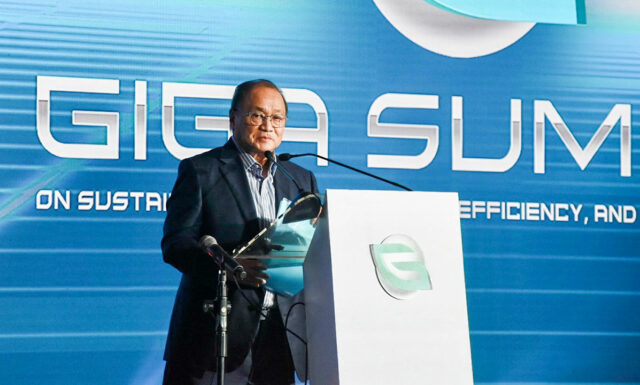
Meralco Chairman and Chief Executive Officer Manuel V. Pangilinan at the Giga Summit 2023

MANILA ELECTRIC CO. (Meralco), together with Ultra Safe Nuclear Corp., is set to conduct a pre-feasibility study on the potential development in the country of nuclear energy, particularly micromodular reactors, its top official said.

“We will start with pre-feasibility study, so that will take three months. The [full] feasibility will take another six months. Hopefully, by the middle [of next] year, we’ll have the feasibility, and we [will] share it with everybody, including the government,” Meralco Chairman and Chief Executive Officer Manuel V. Pangilinan told reporters on the sidelines of the Giga Summit 2023 on Monday.

The pre-feasibility study will cover financial, technical, safety, cost of power, and site proposal, he said.

Last month, Mr. Pangilinan said the company was considering nuclear energy as a long-term solution to the county’s power needs.

Several officials representing his group met with representatives of nuclear manufacturing plants during President Ferdinand R. Marcos, Jr.’s state visit to the United States from April 30 to May 4.

Mr. Pangilinan previously said his team had signed a non-disclosure agreement with US-based Ultra Safe.

Last year, Meralco said it was applying for a grant from the US Trade and Development Agency to do a feasibility study on introducing nuclear energy in the Philippines that can provide up to 300 megawatts of power.

“Meralco, through Meralco Academy and as a company itself is indeed in favor of exploring nuclear power,” Mr. Pangilinan said.

Meanwhile, Meralco has launched a program called Filipino Scholars and Interns on Nuclear Engineering, or FISSION, to develop professionals who will help advance the integration of nuclear power in the country’s energy portfolio.

The two-year graduate program is scheduled to run from 2025 to 2027.

The company is eyeing to send the scholars to top global engineering universities, including the University of California in Berkeley, the University of Illinois, the Korea Advanced Institute of Science and Technology, the University of Ontario Institute of Technology, and the Université Paris-Saclay.

The program will also include a one-year immersion and internship from 2027 to 2028 at partner small modular reactor facilities abroad such as Atomic Energy of Canada Ltd. and Ultra Safe.

Meralco said that the application process for the pilot batch of the program will open next year. Qualifications and other details of the program will be announced in the coming months.

On the stock exchange on Monday, shares of Meralco rose by P13.80 or 3.95% to close at P363 apiece.

Meralco’s controlling stakeholder, Beacon Electric Asset Holdings, Inc., is partly owned by PLDT Inc.

Hastings Holdings, Inc., a unit of PLDT Beneficial Trust Fund subsidiary MediaQuest Holdings, Inc., has an interest in BusinessWorld through the Philippine Star Group, which it controls. — Sheldeen Joy Talavera

Del Monte Pacific readies IPO of US unit in fiscal year 2024

LISTED holding firm Del Monte Pacific Ltd. (DMPL) said the planned initial public offering (IPO) of its United States unit is expected to finish within its fiscal year.

DMPL said in the minutes of its Aug. 29 annual general meeting disclosed to the stock market on Monday that the target completion of the Del Monte Foods, Inc. (DMFI) IPO is during the company’s fiscal year 2024, which started in May this year.   

“DMFI has submitted the registration statement to the US Securities and Exchange Commission (SEC). The time needed depends on the regulatory process prescribed and it is at US SEC’s discretion to approve the IPO. This process may take four to six months. Secondly, the prevailing market conditions would also affect the decision whether to proceed with the IPO,” DMPL said.

“The last IPOs in the US took between 12 to 18 months,” it added.

In April, DMPL disclosed that Del Monte Foods Holdings Ltd. (DMFHL) had sought the approval of the US SEC for the IPO. DMFHL is the parent of DMFI, which manages DMPL’s food production and distribution in the US. 

The company said that DMFHL will “confidentially” submit a draft registration statement on Form F-1 to the US SEC. Form F-1 is used for the registration of foreign private companies that intend to sell securities in a registered offering in the US for the first time.   

Meanwhile, DMPL said the IPO of its Philippine unit, Del Monte Philippines, Inc. (DMPI), might take two to three years.

DMPI was set to have its IPO in June 2018 but the listing did not push through. The plan was revived in 2020 but was shelved as a result of the pandemic.

For the first quarter of its fiscal year, DMPL trimmed its net loss to $13.1 million from the $30.5 million net loss a year ago. The company’s sales rose by 13% to $516.7 million led by stronger sales in the US and of fresh pineapple. 

On Monday, shares of DMPL at the local bourse rose five centavos or 0.67% to finish at P7.55 per share. — Revin Mikhael D. Ochave

Globe takes partner for easy device switching

GLOBE TELECOM, Inc. has partnered with global insurtech Bolttech Management Ltd. — or bolttech — to launch a program for easy postpaid mobile device switching, the listed telecommunications company said on Monday.

“Globe is very proud to launch this new service with bolttech as we continue to look for innovative ways to serve our customers,” Darius Delgado, head of Globe’s consumer mobile business, said in a media release.

The program, which is called Gadget Xchange, offers flexibility to customers and allows them easy mobile device and screen replacement services, Globe said.

“This offer is another first and exclusive from Globe Postpaid, with the convenience of switching mobile devices, no questions asked. With Gadget Xchange, Globe Postpaid customers no longer have to wait for their contract renewal to change their devices, and they get to easily ensure device protection,” Mr. Delgado said.

Globe has cited a study conducted by bolttech that showed cracked screen, accidental breakage, and liquid damage as among the top concerns of mobile plan users in the country.

The program will be available for new and recontracting Globe postpaid and platinum customers through a monthly subscription fee.

He said this program will provide protection for the company’s postpaid mobile users as it gives its customers options in switching devices while also replacing their enrolled devices.

“Our partnership with the Philippines’ leading telecommunications brand Globe allows us to elevate the device protection services locally. Together, we share a vision of providing customers with an enhanced experience, making it easy and convenient, with added flexibility and choice in obtaining the protection they need,” Baldev Singh, chief executive officer Southeast Asia of bolttech, said.

Headquartered in Singapore, bolttech is an international insurtech, company that provides a technology-based ecosystem for protection and insurance. — Ashley Erika O. Jose

Ghibli’s Miyazaki has ideas for next project after The Boy and the Heron

TORONTO — Studio Ghibli’s legendary director, Hayao Miyazaki, 82, still has not put his pencil down, an executive at the Japanese animation studio said on Friday after its long awaited feature, The Boy and the Heron, opened the Toronto International Film Festival.

Mr. Miyazaki, who was not present at the film festival, is the internationally renowned director behind hand-drawn animated favorites like Spirited Away, My Neighbor Totoro, Howl’s Moving Castle, and many other beloved films created under the Studio Ghibli, which he co-founded.

“For the last 20 years, after finishing a movie, he would say I’m done… but this time, he didn’t mention anything about retirement,” Junichi Nishioka, the studio’s vice-president for international distribution told Reuters in an interview on Friday.

“There is nothing concrete on the table yet, but he shows the willingness to create something new,’ Mr. Nishioka said, adding that Mr. Miyazaki, is at the studio every day.

The film’s surprisingly low-key Japanese release in July came with conspicuously little promotional material as a part of the studio’s attempt to build mystery around the enigmatic film.

Mr. Nishioka said the idea not to promote the movie was producer Toshio Suzuki’s idea who wanted to bring an element of his movie-going experience as a child. He said the movie had had over five million viewers in Japan so far.

In Toronto, film buffs and movie fans lined up for the movie, the first time an animated Japanese film opened the festival.

“It was an amazing film… I really had high expectations but it blew past them,” said Gabriel Mas who attended the film’s premiere on Thursday.

MIYAZAKI’S MESSAGE
The film, adapted from a 1937 novel by Genzaburo Yoshino entitled How Do You Live, which Miyazaki read as a child, chronicles the journey of 11-year-old Mahito Maki, who loses his mother during World War II and embarks into a magical world.

The movie is also inspired by how Mr. Miyazaki himself felt after the war and coped with the loss of his mother.

Delighting anime fans with his return a decade after the release of The Wind Rises in 2013, Mr. Miyazaki seeks to convey a message to younger generations about how he lived and how young people should think about how they want to live.

“This is a personal film, showing how he (Miyazaki) lived, how he should have lived and throwing out the question to the audience, ‘So how do you live?’,” Mr. Nishioka said. — Reuters

Figaro Coffee Group’s unit certified as coffee exporter

A SUBSIDIARY of listed food and beverage company Figaro Coffee Group, Inc. (FCG) has secured the government’s approval to become a coffee exporter.

In a stock exchange disclosure on Monday, FCG said Figaro Innovation and Development, Inc. (FIDI) received its certification as a duly accredited coffee exporter from the Department of Trade and Industry (DTI) on Sept. 8.

FIDI is a wholly owned subsidiary of Figaro Coffee System, Inc., which is the operating unit of FCG.

The listed company said that FIDI has been designated as an economic zone export enterprise authorized to engage in the production of different roasted coffee blends such as house reserve, espresso blend, and French roast.

FIDI’s operations will be based at its facility in Laguna Technopark Special Economic Zone in Biñan City, Laguna.

“[The] application for the coffee exporter accreditation was processed as compliance to the requirements by the Philippine Economic Zone Authority (PEZA),” FCG said.

“This certification [is] in accordance with Chapter IX Item 1 of Article 31 of the 2022 International Coffee Agreement (ICA), and Department Circular No. 1 Series 1989, known as Guidelines for Accreditation and Supervision of Coffee Exporters by the International Coffee Organization Certifying Agency/Export Marketing Bureau,” it added.

FCG has various food and beverage brands such as Angel’s Pizza, Figaro Coffee, Tien Ma’s, The Figaro Group Online, and Cafe Portofino.

The PEZA is an investment promotion agency under the DTI. From January to Sept. 7, it generated P111.21 billion worth of investments, up from P39.63 billion a year ago.

On Monday, shares of FCG at the local bourse rose two centavos or 3.13% to close at 66 centavos apiece. — Revin Mikhael D. Ochave

Capitalize on artificial intelligence, local firms told

STOCK PHOTO | Image by Rawpixel.Com from Freepik

PHILIPPINE companies should take advantage of artificial intelligence (AI) to benefit industries such as retail and outsourcing, according to an industry expert. 

“In the Philippines, AI is going to replace jobs. So, let’s accept that. The Philippines should become the country that leads the world in how to use AI, in call centers, recognizing that it will put some people out of work, but at least you define the rules of how it works with people,” Asia School of Business (ASB) President, Chief Executive Officer, and Dean Sanjay Sarma said during a media roundtable in Makati City last week.

“It has to be a national effort. The government needs to be really cognizant that this is an epic moment. It’s like, climate change is going to damage the environment, it’ll hurt a lot of people. This is ‘technology change,’ just like climate change,” he added.

According to Mr. Sarma, industries that could benefit from AI in generating profit include those in the service sectors such as banking, retail, and customer service.

“We spend a lot of time talking, trying to figure things out. AI can automate that,” he said.

Mr. Sarma added that companies only have one to two years to upskill their workers before AI replaces other jobs.

“It’s not very long. It’s one or two years. The reason is that for these transforming technologies, there are now lots of companies working. And there’s hundreds of millions of dollars being spent on it,” Mr. Sarma said.

Meanwhile, Mr. Sarma said workers should focus on upskilling to perform jobs that technology cannot accomplish such as planning and dispute resolution.

“You have to really figure out what the technology can do and what humans can do, and what technology can’t do. And to develop human capital in those directions,” Mr. Sarma said.

“It takes a very careful analysis of the local labor economy. Combined with a very careful analysis of the needs of companies and education or development, put policy incentives, institutions, to let people move from where they are to where they need to be,” he added.

Recently, the International Data Corp. said the Philippines ranked 12th out of 14 economies across the Asia-Pacific region in terms of AI adoption for business and consumer transactions. 

The Philippines trailed other countries such as China, Japan, Australia, South Korea, Singapore, India, Taiwan, New Zealand, Hong Kong, Malaysia, and Thailand.

Previously, the Trade department projected that AI could contribute as much as $90 billion to the country’s economy by 2030.

ASB, established in 2015 by Bank Negara Malaysia in collaboration with the Massachusetts Institute of Technology (MIT) Sloan School of Management, seeks to be a premier business school that is committed to “developing transformative and principled leaders who will create a positive impact in the emerging world and beyond.” — Revin Mikhael D. Ochave

Dicks: The Musical brings laughs to Toronto film festival

TORONTO — During a Toronto International Film Festival (TIFF) expected to lack star power, Bowen Yang brought excitement to the burgeoning crowd at the Dicks: The Musical world premiere.

Mr. Yang, best known for his role on Saturday Night Live, said he felt really lucky to be on the carpet amid the Hollywood strikes over pay and the use of artificial intelligence.

“It feels really fortuitous because I think the union is being really selective in a very intentional way about what movies get these interim agreements and waivers,” he told Reuters, referring to union waivers for some actors to promote films.

Mr. Yang plays the character of God and rapper Megan Thee Stallion stars as the boss of protagonists Josh Sharp and Aaron Jackson in the absurdist musical.

Independent studio A24 ventured into the comedic musical genre for Dicks: The Musical with Larry Charles, the director of Borat, and the producers of The Greatest Showman.

The film follows two long-lost twins (Mr. Sharp and Mr. Jackson) who join forces to reunite their parents (Nathan Lane and Megan Mullally) in a plot they’ve classified as “a riff on The Parent Trap.”

Originally an off-Broadway musical, Mr. Sharp and Mr. Jackson said it was a dream to bring their vision of this “proudly queer” story to the big screen. The duo said they do not need an audience to take anything away from the film other than laughter.

Dicks: The Musical is among 27 projects under TIFF’s 2SLGBTQ+ section, up three from last year. — Reuters

ADVERTISEMENT
ADVERTISEMENT