Home Blog Page 4321

IMF to urge China to shift growth model towards consumption, Georgieva says

WASHINGTON — The International Monetary Fund (IMF) plans to tell China to boost weak domestic consumption, address its troubled real estate sector and rein in local government debt, problems that are dragging down both Chinese and global growth, IMF Managing Director Kristalina Georgieva told Reuters.

Ms. Georgieva said in an exclusive interview the messages will be delivered to Chinese authorities in a forthcoming IMF “Article IV” review of China’s economic policies. The Fund will strongly urge Beijing to shift its growth model away from debt-fueled infrastructure investment and real estate, she said.

“Our advice to China is use your policy space in a way that helps you shift your growth model towards more domestic consumption,” Ms. Georgieva said. “Because the traditional way of infrastructure, pumping in more money, in this current environment is not going to be productive.”

China’s aging population and falling productivity were playing a “suppressing role” in its growth rate, along with companies in the United States and Europe shifting supply chains away from China. China’s problems in the real estate sector have also caused consumers to rein in spending, Ms. Georgieva said.

“We actually project that without structural reforms, medium term growth in China can fall below 4%,” Ms. Georgieva said.

The IMF in July forecast China’s 2023 growth rate at 5.2% and 4.5% in 2024, but warned it could be lower given the contraction in real estate.

Ms. Georgieva also said it was important for China to address consumer confidence in its real estate sector by financing the completion of apartments that buyers have already paid for, rather than bailing out troubled developers. 

The IMF is preparing to issue a new set of global growth forecasts ahead of IMF and World Bank annual meetings Oct. 9-15. Ms. Georgieva said separately the institutions would decide on Monday whether to proceed with the meetings in earthquake-hit Morocco.

The new forecasts are expected to reflect concerns about anemic gross domestic product (GDP) growth around the world, as most large economies are still lagging pre-pandemic growth rates.

The United States is the only large economy to have recovered pre-pandemic growth, while China is four percentage points below pre-pandemic trends, Europe down two percentage points and the world down three percentage points.

With China generating about a third of global growth this year, its growth rate “matters to Asia, and it matters to the rest of the world,” Ms. Georgieva said.

Asked about US Commerce Secretary Gina Raimondo’s recent comment that some US firms viewed China as “uninvestible,” Ms. Georgieva said: “There is some outflow from China. It is a trend that we need to carefully monitor, how it evolves over time.”

She added there were some areas — including digital economy and green technologies — that remained attractive for investors.

She cautioned it was important to ensure China’s big push on electric vehicles was not done using subsidies in a way that created unfair competition. — Reuters

Price growth of NCR construction materials eases in August

PHILIPPINE STAR/RUSSELL PALMA

By Bernadette Therese M. Gadon, Researcher

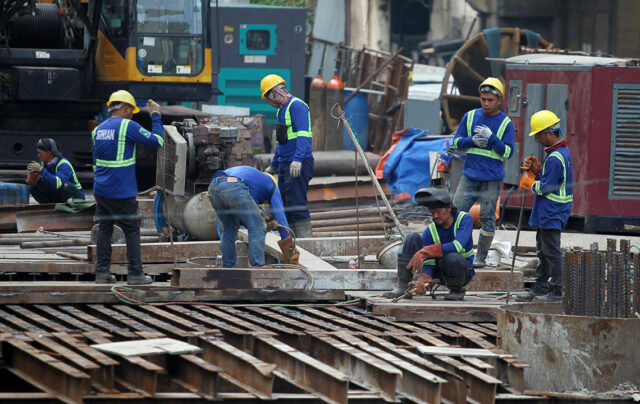
BULK prices of construction materials in the capital region decreased by 5.7% year on year in August, the Philippine Statistics Authority (PSA) reported on Friday.

Analysts attributed this to favorable base effects, the global economic slowdown, and the high-interest rate environment.

Preliminary data from the construction materials wholesale price index (CMWPI) in the National Capital Region (NCR) showed that prices were lower compared to the 7% figure in August last year. In July, CMWPI increased by a revised 5.7% annually.

This was the slowest growth in more than a year, or since the 5.2% recorded in February 2022.

Year to date, CMWPI averaged 7.1%.

Commodities that saw slower year-on-year growth rates were fuels and lubricants (-6.6% this year compared to 30.3% a year ago), PVC pipes (-5.1% from 9.8%), and reinforcing and structural steel (3.5% from 10.7%).

Meanwhile, G.I. sheet registered a growth of 12.8% to 16.4% in August this year, up from 3.6% a year ago.

Following that were painting works (10.3% from 7.1%) and doors, jambs, and steel casement (5.1% from 2.2%).

Out of the 17 commodities monitored by the statistics agency, 10 saw slower growth.

Retail prices, tracked by the PSA’s construction materials retail price index (CMRPI), also decreased by 1.4% year on year, down from 6.9%.

This was the slowest growth recorded in more than two years, matching the 1.4% figure from July 2021, and the slowest since the 1.2% in June 2021.

Over the first eight months of the year, CMRPI averaged 3.1%.

The following commodities recorded slower growth rates: miscellaneous construction (-0.7% in August 2023, down from 10.9% in August 2022), tinsmithry (2.9% from 9%), and plumbing (0.4% from 7.5%).

The easing trend seen in the past few months as world prices of most base metals slipped on the risk of US economic slowdown and softer economic data seen in China also contributed to slower price inflation of construction, according to Rizal Commercial Banking Corp. chief economist Michael L. Ricafort.

“Higher interest rates in the US/globally and locally, after the aggressive Fed rate hikes… effectively increased borrowing/financing costs, thereby leading the slower investments and demand for construction materials,” he said in an e-mail.

The weak outlook on the real estate sector also dampened demand for construction materials, according to China Banking Corp. (China Bank) chief economist Domini S. Velasquez,

“Moving forward, however, we may see an uptick in wholesale prices due to the continued increase in global oil prices, which will likely be passed through to retail prices,” she said in a Viber message.

In the coming months, Mr. Ricafort said that the dollar-peso exchange rate may affect import costs on construction materials; however, the continued increase in infrastructure spending, which accounts for at least 5-6% of gross domestic product (GDP), could support demand for construction materials for the rest of the year.

To recall, second-quarter GDP eased further to 4.3% from 6.4% in the first quarter and from 7.5% in the same quarter a year ago due to government underspending and a lack of election-related spending.

Slower global economic growth likewise dragged down the country’s economic performance.

However, the latest data from the Department of Budget and Management showed infrastructure expenditures reached P507.2 billion in the first half of the year, above the P483.1 billion spending program planned for the period.

“The further reopening of the economy towards greater normalcy, with the final lifting of the COVID state of public health emergency since July 22, 2023, could lead to some pick up in construction and other business/economic activities, thereby could also support demand for construction materials,” Mr. Ricafort said.

“Dry weather due to El Nino conditions expected in [the fourth quarter] will also boost construction activity. On the other hand, downward pressure on prices will likely still come from weak real estate demand from high-interest rates,” China Bank’s Ms. Velasquez said.

BSP revises downward current account deficit forecasts for 2023, 2024

By Keisha B. Ta-asan, Reporter

THE BANGKO Sentral ng Pilipinas (BSP) on Friday lowered its current account deficit projections for this year and 2024 as exports and imports of goods may contract amid weaker global economic conditions.

The BSP projects the current account deficit to reach $11.1 billion, or equivalent to -2.5% of gross domestic product (GDP), which is down from the previously forecasted $15.1 billion (-3.4% of GDP). Current account transactions encompass transactions involving goods, services, and income.

In the second quarter, the current account deficit reached $3.6 billion (-3.4% of GDP), which was lower than the $8 billion shortfall a year ago, due to a narrower trade in goods deficit.

In the first semester, the current account deficit stood at $8.2 billion (-4% of GDP), marking a 32.2% reduction from the $12.1 billion deficit (-6.1% of GDP) recorded in the same period last year.

The central bank also lowered its balance of payments (BoP) projection for this year. The BoP now shows a deficit of $127 million (0% of GDP), which is significantly lower than the previous forecast of a $1.2 billion deficit (-0.3% of GDP).

“The overall BOP position is projected to register a smaller deficit owing mainly to the foreseen narrower current account gap for the year,” the BSP said in a statement.

The BoP provides a glimpse of the country’s transactions with the rest of the world at a given time. A deficit indicates that more funds are leaving the country than entering it, while a surplus indicates that more money has entered the economy.

Latest BSP data showed a $1.2 billion deficit in the country’s BoP position in the second quarter, marking an improvement from the $3.6 billion deficit a year ago.

In the first half of the year, the BoP position saw a surplus of $2.3 billion, marking a turnaround from the $3.1-billion deficit in the same period in 2022.

“Consistent with the emerging trend observed in most economies, both goods exports and imports are predicted to contract this year,” the BSP said.

The BSP revised its forecast for goods imports, which it now expects to contract by -3% this year, compared to the previous projection of 2% growth.

It also expects a -4% decline in goods exports this year, reversing the 1% growth forecast gived in June.

“Goods imports are expected to drop as international commodity prices have decelerated since the last projection round,” the BSP said.

“Meanwhile, services trade is anticipated to retain its strong growth momentum supported by the upbeat demand for BPO (business process outsourcing) services and stronger-than-expected rebound in international tourist arrivals,” it added.

The central bank also lowered its projection for services imports to 9% from 11%, while it anticipates services exports to grow 19% this year, up from the previous forecast of 12%.

The BSP maintained its growth forecast for BPO receipts at 9% and for remittances from migrant Filipinos at 3% for this year. It increased its projection for travel receipts to 100% from the previous 80% provided in June.

Based on central bank data, cash remittances coursing through banks increased by 2.6% to $2.99 billion in July, up from $2.92 billion a year earlier, marking the highest figure since December.

For the first seven months, cash remittances rose by 2.9% to $18.79 billion compared to the previous year.

As for the financial account, it is expected that outflows may reach $10.4 billion, which is lower than the previous estimate of $13.3 billion in net outflows given in June. The financial account records transactions between residents and non-residents involving financial assets and liabilities.

BSP data also showed that financial account inflows declined by 34.9% to $2 billion in the second quarter compared to the $3 billion net inflows reported in the same period in 2022. This brought inflows to $8.4 billion in the first half of the year.

“The prospects for the financial account turned softer during this projection round, following less notable performance of both FDIs (foreign direct investments) and FPIs (foreign portfolio investments) during the first half of the year,” the BSP said.

The BSP also revised its expectations for FDI net inflows to reach $8 billion by the end of this year, slightly lower than the previous forecast of $9 billion.

Data from the central bank indicates that FDI net inflows decreased by 3.9% year-on-year to $484 million in June, marking the lowest level in five months. For the first half of the year, FDI net inflows declined by 20.4% to $3.9 billion.

The BSP also reduced its FPI net inflow projection to $2 billion for this year, down from $2.5 billion. FPIs recorded a net inflow of $962 million in July, a reversal from the $103.14 million in outflows the previous year.

Gross international reserves (GIR) are expected to reach $99.5 billion this year, down from the previous forecast of $100 billion. Dollar reserves decreased by 0.14% to $99.81 billion as of the end of August, compared to $99.95 billion at the end of July.

“The lingering high interest rate environment has further impeded trade and investment decisions, thus, adding another layer of uncertainty to the BoP outlook for the year,” the BSP said.

From May 2022 to March 2023, the BSP raised rates by 425 basis points to 6.25%, marking a nearly 16-year high.

2024 FORECASTS
The central bank expects a narrower current account deficit of $10.3 billion (-2.1% of GDP) next year as the country’s trade in goods gap is expected to decrease.

Meanwhile, the country’s BoP is now seen to reach a $1 billion surplus next year, equivalent to 0.2% of GDP, a change from the previous forecast of a $0.5 billion deficit.

“For 2024, the overall BOP is seen to pivot into a surplus position propped up by expectations of sustained improvements in the current account as well as the financial account,” the BSP said.

While the outlook for next year is optimistic, some risks may intensify in 2024, according to the central bank.

“Among these include possible tightening in financial conditions and worsening global trade imbalance which may complicate the already tight monetary and fiscal policy space of many economies,” it said.

The BSP revised its growth forecasts for goods imports and exports next year to 7% (from 8%) and 5% (from 6%), respectively.

Services imports and exports are projected to increase by 16% and 10%, respectively, in 2024, which remains unchanged from the June forecasts.

“On the domestic front, prospects for goods imports are backed in part by the national government’s plan to catch up on its spending and accelerate infrastructure development in the country,” the BSP said.

BPO receipts are expected to continue expanding at 9%, while travel receipts may grow by 40% next year.

The central bank foresees cash remittances growing by 3% in 2024.

At the same time, the BSP reduced its financial account forecast to a $10.8 billion deficit next year from the previous estimate of $14.4 billion. FDI net inflows are now projected to reach $10.5 billion in 2024, with FPI net inflows expected at $3 billion.

The BSP also expects its dollar reserves to reach $102 billion by the end of 2024.

“The BSP continues to emphasize limitations to the forecasts, particularly given the continued buildup of external challenges,” it said.

“The BSP will continue to monitor closely emerging external sector developments and risks and how these may impact the BSP’s fulfillment of its price and financial stability objectives,” it added.


Remittances reach 7-month high in July

REUTERS

CASH remittances surged in July as overseas Filipino workers (OFWs) sent more money to their families amid higher inflation and borrowing costs.

This was the highest since December when remittances are usually elevated as OFWs send more money to their families before the holidays, data from the Bangko Sentral ng Pilipinas (BSP) on Friday showed. 

Remittances sent through banks increased by 2.6% to $2.99 billion in July, from $2.92 billion a year earlier.

The pace of cash remittance growth was also the fastest in two months or since 2.8% in May.

“The expansion in cash remittances in July 2023 was due to the growth in receipts from land- and sea-based workers,” the central bank said in a statement.

Remittances from land-based workers jumped by 2.7% year on year to $2.43 billion, while those from sea-based workers went up by 1.9% to $560 million.

OFWs likely sent more money back to the Philippines to help their families cope with still-elevated inflation and high-interest rates for debt payments, said Rizal Commercial Banking Corp. Chief Economist Michael L. Ricafort in a Viber message.

Headline inflation slowed to 4.7% in July from 5.4% in June. It still marked the 16th consecutive month during which it surpassed the 2-4% target range of the BSP.

The BSP has maintained its key policy rate at a near-16-year high of 6.25% at its July meeting. The central bank has increased benchmark interest rates by 425 basis points (bps) from May 2022 to March 2023.

“The unusually higher OFW remittances in July 2023…may be largely attributed to some tuition payments and other related spending in preparation for the start of the new school year, as these education-related spending are considered compulsory in nature for many OFW families,” Mr. Ricafort said.

Most schools started the school year on Aug. 28. Student registration usually takes place a month before the next academic year starts.

However, the growth in remittances may have been offset by the stronger peso against the dollar in July, Mr. Ricafort said, adding that remittances from OFWs have a higher peso equivalent for every dollar sent.

The peso closed at P54.88 on July 31, strengthening by 0.58% or 32 centavos from its P55.2 finish on June 30.

In the first seven months, cash remittances increased by 2.9% to $18.79 billion from a year ago.

By country source, the United States remained the biggest source of cash remittances at 41.3%. It was followed by Singapore (6.9%), Saudi Arabia (5.9%), Japan (5%), and the United Kingdom (4.8%).

BSP data also showed that personal remittances increased by 2.5% to $3.32 billion in July from $3.24 billion in the same month last year. This brought the seven-month tally to $20.91 billion, up 2.9% from a year ago.

For the coming months, Mr. Ricafort said migrant Filipinos may continue to support their families in the Philippines at a similar pace as inflationary pressures remain.

Remittances could also accelerate in the fourth quarter during the holiday season, which is a consistent pattern seen for many decades, he said.

“Offsetting risk factors include higher inflation/cost of living for OFWs themselves in host countries where they are based that could lead to more expenses in foreign countries and could potentially reduce any remittances sent back home,” he added.

The BSP expects remittances to grow by 3% this year. – Keisha B. Ta-asan

Cebu Pacific expects impact on fleet in 2024 amid engine inspections

BUDGET carrier Cebu Pacific will lower its fleet growth rate for 2024, according to its listed operator Cebu Air, Inc., as engine maker Pratt and Whitney (P&W) inspects A320/321 NEO aircraft engines worldwide following suspected issues.

The company expects that “a number” of its aircraft will be affected next year. As such, “the growth rate for 2024 will be revised downwards,” Cebu Air said in a disclosure to the stock exchange on Friday.

“There is no immediate impact on our operations, but we expect that this will affect our fleet availability in 2024,” the company noted. “We would like to assure our passengers that this is not a safety issue.”

Cebu Air also said that the inspection is aimed at ensuring the “continued safe operation” of its P&W-powered aircraft fleet.

The budget carrier anticipates having 76 aircraft in its fleet this year and is initially expected to expand to 91 aircraft by 2024.

It is the youngest fleet in the Philippines and includes 25 P&W-powered Airbus aircraft, according to the airline.

“P&W understands the importance of its partnership with Cebu Pacific and has committed to working closely with us to minimize any potential impact that this issue may have on our operations,” Cebu Air said.

“Given the complexity of the situation in the near term, P&W assured us that it has aligned the expertise and resources needed and will work with its partners to resolve things as efficiently as possible,” it added.

Sought for comment, Rene S. Santiago, former president of the Transportation Science Society of the Philippines, said that this will result in “reduced flying hours” for Cebu Pacific.

“This would translate to fewer flights that it can support,” he said in a phone message. “The airline can either cancel some flights on its published schedule or load the same timetable on fewer aircraft.”

“For passengers, this means fewer seat miles for the first option and flight delays for the second option,” he added.

Cebu Pacific Chief Commercial Officer Alexander Lao informed senators during a hearing in July, prompted by customer complaints, that the Pratt & Whitney engine problems have been impacting the global aviation industry.

He said that restoring an engine would now take 220 days instead of the industry norm of 90 days.

Aerospace and defense company RTX Corp., the parent of Pratt & Whitney, has said that around 3,000 engines require inspection.

India’s Directorate General of Civil Aviation has reported three instances of engine failure in IndiGo flights and has recommended that Pratt & Whitney investigate the possible cause, the ministry said in a statement.— Arjay L. Balinbin and Miguel Hanz L. Antivola with Reuters

Meralco leads the charge towards a sustainable energy future

Meralco Executive Vice-President and Chief Operating Officer Ronnie L. Aperocho (third from left) shared his insights about a sustainable energy future at the 6th Annual Energy Forum hosted by the American Chamber of Commerce of the Philippines, Inc. (AmCham Philippines) on Sept. 14, 2023. Seen in the photo as well is Meralco Senior Vice-President and Chief Government and External Relations Officer Arnel Paciano D. Casanova (second from right) together with officials of AmCham Philippines.


Spotlight is BusinessWorld’s sponsored section that allows advertisers to amplify their brand and connect with BusinessWorld’s audience by enabling them to publish their stories directly on the BusinessWorld website. For more information, send an email to online@bworldonline.com.

Join us on Viber at https://bit.ly/3hv6bLA to get more updates and subscribe to BusinessWorld’s titles and get exclusive content through www.bworld-x.com.

China factory output, retail sales beat forecasts in boost to recovery prospects

REUTERS

 – China‘s industrial output and retail sales grew at a faster-than-expected pace in August, but property investment slumped further and could drag on broader demand even as the recent flurry of support policies showed signs of stabilizing the economy.

Industrial output, released on Friday by the National Bureau of Statistics (NBS), rose 4.5% in August from a year earlier, accelerating from the 3.7% pace seen in July and came above expectations for a 3.9% increase in a Reuters poll of analysts. The growth marked the quickest pace since April.

Retail sales, a gauge of consumption, also increased at a faster 4.6% pace in August aided by the summer travel season, and was the quickest growth since May. That compared with a 2.5% increase in July, and an expected 3% increase.

The upbeat data suggest that a flurry of recent measures including property support policies to shore up a faltering economic recovery are starting to bear fruit.

Reacting to the data, the Chinese yuan CNY=CFXS touched two-week high against dollar.

Yet, the recovery is far from sure-footed, analysts say.

“Despite signs of stabilization in manufacturing and related investment, the deteriorating property investment will continue to pressure economic growth,” said Gary Ng, Natixis Asia Pacific senior economist.

Friday’s data followed better-than-expected bank lending figures, narrowing in the declines of exports and imports as well as easing deflationary pressure.

The country’s passenger vehicle sales also returned to growth in August from a year earlier, as deeper discounts and tax breaks for environmentally friendly and electric vehicles boosted consumer sentiment.

To sustain the recovery momentum, China‘s central bank said on Thursday it would cut the amount of cash that banks must hold as reserves for the second time this year to boost liquidity. Earlier in the day, the bank also rolled over maturing medium-term policy loans to inject more liquidity into the finiancial system, while keeping the interest rate unchanged.

But analysts say more fiscal and monetary policy steps are needed as an ailing property sector, high youth unemployment, uncertainty around household consumption and rising Sino-US tensions over trade, technology and geopolitics have raised the bar for a durable economic recovery in the near future.

Ng said confidence remains the root of most problems requiring larger “constructive policy and regulatory changes” to boost growth momentum.

The once mighty property sector still remains a drag on the $18 trillion economy, with the country’s largest private developer Country Garden the latest to stumble due to liquidity squeeze.

For August, property investment extended its fall, down 19.1% year-on-year from a 17.8% slump the previous month, according to Reuters calculations based on NBS data.

Moody’s on Thursday cut China‘s crisis-hit property sector’s outlook to negative from stable, expecting contracted sales to fall by about 5% over the next six to 12 months.

Fixed asset investment expanded 3.2% in the first eight months of 2023 from the same period a year earlier, versus expectations for a 3.3% rise. It grew 3.4% in the first seven months.

An uncertain business climate meant companies remained wary about hiring, but the nationwide survey-based jobless rate improved a touch to 5.2% in August, slightly down from 5.3% in July. – Reuters

US Treasury official visits Hong Kong in bid to deepen ties with China

STOCK PHOTO

 – US Treasury official Brent Neiman visited Hong Kong on Thursday, the highest ranking Treasury official to visit the financial hub since 2019, U.S. authorities said, as Washington aims to deepen ties with Beijing despite rising tensions.

The US Department of the Treasury said on Thursday that Neiman, the department’s assistant secretary for international finance, will hold engagements in Hong Kong “building on President Biden’s direction to deepen ties between the world’s two largest economies”.

The Hong Kong government did not immediately respond to a request for comment.

Neiman’s visit comes as China‘s economy slows, weighed by weak consumer and private business sentiment, high levels of debt and a property market downturn.

The meeting builds on Treasury Secretary Janet Yellen’s visit to China in July, the statement said.

During his visit to the special administrative region, Neiman will speak with “diverse audiences, including government officials, policymakers, scholars, the US business community and financial leaders”. Topics will include bilateral financial and regulatory matters as well as macroeconomic and financial developments in Hong Kong and China, the statement said. Neiman will also engage students and young professionals to deepen US-Hong Kong “people-to-people ties“.

“Neiman will stress the United States’ focus on securing and advancing our economic and national security interests, along with those of our allies and protecting human rights,” the statement said. – Reuters

Malaysia says it penalized 400 companies this year for labor offenses

 – Malaysia has taken action against 400 companies so far this year for violating labour laws, state news agency Bernama reported, citing Human Resources Minister V. Sivakumar.

The ministry’s labour department issued fines totaling 2.17 million ringgit ($463,000) against 272 employers, while the courts fined 128 employers a combined 242,000 ringgit, Bernama cited Sivakumar as saying on Thursday.

The labour violations included illegal wage deductions, Sivakumar said.

The minister did not name the companies, nor did he give details of the labor offenses.

Malaysia is a key link in the global supply chain, manufacturing everything from palm oil to medical gloves and semiconductor chips.

Malaysian companies have faced U.S. bans in recent years over allegations of abuses against migrant workers, who are employed widely in the country’s manufacturing and plantation industries.

The allegations of forced labour include debt bondage, excessive working hours, retention of passports and unhygienic dormitories.

Malaysia has set a target to eliminate forced labour practices by 2030. – Reuters

China newspaper says EU probe into EVs ‘excessive’, sparked by ‘jealousy’

REUTERS

 – The nationalist Chinese newspaper Global Times described as “excessive” Europe’s probe into cheaper Chinese electric vehicles (EVs), and said China‘s superior offering are the envy of other automakers.

European Commission President Ursula von der Leyen announced on Wednesday the investigation a week after executives at Munich’s IAA mobility show said European carmakers had a fight on their hands to produce lower-cost EVs and to close the gap on China‘s lead in making cheaper, more consumer-friendly models.

Beijing has since blasted the investigation as a protectionist act aimed at shielding Europe’s own industry in the name of “fair competition”, and warned economic ties could be harmed.

“To tell the truth, when Chinese new energy vehicles shone brightly at the recent 2023 International Motor Show in Germany, we heard some envious and even jealous remarks but we didn’t expect Europe’s response to be so ‘excessive’,” the Global Times said in an editorial.

Analysts have warned that should the EU levy duties against Chinese EVs after the probe, which could take up to 13 months, China would likely impose countermeasures, hitting European industries.

“If Europe lacks the confidence and courage to win the market through fair competition, it will be impossible to establish competitiveness in the EV industry,” the newspaper wrote.

The investigation is expected to be a focus of talks when EU trade chief Valdis Dombrovskis visits China later this month, where he is expected to renew calls for fair competition. – Reuters

‘Alien bodies’ presented in Mexican Congress panned as ‘stunt’

STOCK PHOTO | Image by Paweł from Pixabay

 – A UFO hearing in Mexico’s congress that featured the presentation of alleged remains of non-human beings faced swift international backlash on Thursday, with critics labeling it a “stunt,” and questions from officials in Peru, where the apparent specimens first emerged.

Mexican journalist and long-time UFO enthusiast Jaime Maussan showed politicians at the hearing on Tuesday two tiny “bodies” displayed in cases, with three fingers on each hand and elongated heads. He claimed they were found in Peru in 2017 and were not related to any life on Earth.

Mr. Maussan has made similar controversial claims in the past.

The images from the congressional hearing, the first of its kind in Mexico, sparked international curiosity as well as substantial scorn.

Former US Navy pilot Ryan Graves, who also attended the hearing to share his personal experience with sightings of “unidentified anomalous phenomena,” or UAP, heaped criticism on the presentation.

“Yesterday’s demonstration was a huge step backwards for this issue,” Mr. Graves said on the X social media platform, formerly known as Twitter. “I am deeply disappointed by this unsubstantiated stunt.”

Graves participated in US Congressional hearings on UAP in July, when he said that airspace sightings of unexplained phenomena were “grossly under-reported.”

Mr. Maussan said in the presentation that the specimens were recovered near Peru’s ancient Nazca Lines and had been carbon-dated by Mexico’s National Autonomous University (UNAM) and concluded to be about 1,000 years old. He claimed they were not related to any species on Earth.

Similar such finds in the past have turned out to be the remains of mummified children.

Peruvian Culture Minister Leslie Urteaga said no scientific institution in the South American country had identified the remains as non-human and questioned how the specimens had left Peru.

“There is a criminal complaint from the Ministry of Culture against some people who had a relationship with these gentlemen,” Ms. Urteaga told journalists late on Wednesday in reference to Mr. Maussan and his associates.

“I am going to ask for information to see what has happened … about the removal of pre-Hispanic objects, because I understand they are part of pre-Hispanic bone remains,” she added.

Mr. Maussan, speaking to Reuters on Thursday, said his critics had yet to present evidence to counter his claims.

“What they want is to take away the force that this discovery has, but only with testimonies, with questioning and without a single piece of evidence,” Mr. Maussan said. “We have been doing investigations for years… they want to come here to investigate with just talk.”

UNAM, in a statement republished on Wednesday that it first issued in 2017, said the work by its National Laboratory of Mass Spectrometry with Accelerators (LEMA) was only intended to determine the age of the samples. UNAM declined a request by Reuters to see the full study results or interview researchers who participated. It also declined to say how old its study had found the samples to be.

In a press conference on Thursday, NASA officials fielded questions about the Mexican presentation as they released their own report on recommendations for helping the Pentagon detect and examine UAP.

David Spergel, former head of Princeton University’s astrophysics department and chair of the report, said he did not know the nature of the samples but urged transparency.

“If you have something strange, make samples available to the world’s scientific community, and we’ll see what’s there,” he said. – Reuters

Remolona sees no need for rate hike if there are no new supply shocks

A woman receives cash as part of the government’s subsidy program for small retailers affected by the imposition of a price ceiling on rice. — PHILIPPINE STAR/WALTER BOLLOZOS

By Keisha B. Ta-asan,  Reporter

THE BANGKO SENTRAL ng Pilipinas (BSP) does not see the need to resume monetary tightening if there are no more supply shocks such as those that fueled the uptick in August inflation.

BSP Governor Eli M. Remolona, Jr. told reporters on Thursday that the acceleration in August inflation was caused by supply shocks in food and fuel, which dissipate “fairly quickly.”

“If that’s all there is, if there are no further supply shocks beyond that uptick in August, then it won’t be necessary to hike the policy rate,” he said in a press briefing during the Alliance for Financial Inclusion (AFI) Global Policy Forum. “It won’t justify an easing, (but) it won’t be necessary to raise the policy rate.”

The BSP has kept its key policy rate at a near 16-year high of 6.25% for the last three meetings. It has hiked borrowing costs by 425 basis points (bps) from May 2022 to March 2023.

Headline inflation quickened for the first time in seven months in August, hitting an annual 5.3%. It marked the 17th consecutive month that inflation surpassed the BSP’s 2-4% target range. Inflation averaged 6.6% in the eight-month period.

“I think we should hit the (2-4%) target range by October if there are no further supply shocks. But hitting the target range is not enough. We want to be comfortably within the target range for the year,” Mr. Remolona said.

The BSP projects inflation to hit 5.6% in 2023, before easing within the target to 3.3% in 2024 and 3.5% in 2025.   

Makoto Tsuchiya, assistant economist from Oxford Economics Japan, said the Philippine central bank is expected to maintain its pause despite the quicker inflation in August.

“The central bank is likely to see through the transitory rise in prices. Inflation is still too high to pivot to easing, but the weakening growth picture means a hike is also undesirable,” he said.

Mr. Tsuchiya said inflation could settle within the 2-4% target range by the end of the year, bringing the full-year average to 5.8%. This will allow the Monetary Board to start cutting rates in the first quarter of 2024, he added.

Security Bank Corp. Chief Economist Robert Dan J. Roces in a note said the central bank will consider inflation, economic growth, and other external factors at next week’s policy-setting meeting.

“The recent uptick in the August inflation alone is unlikely to prompt the BSP to resume tightening, recognizing the supply-side nature of the uptick and the fact that there would only be so much that monetary policy can do in such a situation, which requires fiscal complement,” he said.   

Mr. Roces said the BSP will likely keep interest rates unchanged on Sept. 21.   

Nicholas Antonio T. Mapa, senior economist at ING Bank N.V. Manila, also expects the BSP to keep rates untouched at its next meeting.

“We believe the hurdle for additional rate hikes will be quite high given the glaring slowdown in growth momentum. BSP admits that tightening efforts have yet to be fully felt with the lagged impact still feeding through to bank lending,” Mr. Mapa said.   

The Philippine economy expanded by 4.3% in the second quarter, the slowest in two years. This was slower than the 6.4% growth in the first quarter and 7.5% in the same period last year. For the first half, economic growth averaged 5.3%, lower than the government’s 6-7% target. 

Mr. Mapa noted recent price shocks to inflation are supply side in nature and is best dealt with non-monetary measures.   

“BSP will only hike should inflation expectations become disanchored or to steady the currency,” he said, adding that the Philippine central bank will likely consider the policy decision of the US Federal Reserve.   

The Federal Open Market Committee is scheduled to meet on Sept. 19 and 20.

The Monetary Board will be having its sixth policy review of the year on Sept. 21.

Mr. Remolona told reporters that the new Monetary Board members will be participating in next week’s meeting.

National Treasurer Rosalia V. de Leon and former Finance undersecretary Romeo L. Bernardo were recently appointed as the new members of the policy-making body of the BSP.

ADVERTISEMENT
ADVERTISEMENT