Home Blog Page 4294

Team Lakay takes in new breed of trainers

BAGUIO CITY — Team Lakay vows it continues to innovate with its recent addition of coaches and trainers seeking to propel its new breed of fighters to the top of world of mixed martial arts again.

While coach Mark Sangiao has been at the forefront of Team Lakay’s rise to MMA even with their meager resources, the addition of specialized trainers aimed at sculpting the next generation of fighters is expected to complement their traditional striking prowess with a robust ground game, expanding their fighters’ arsenal and making them more versatile competitors.

More than the trainers and coaches, Mr. Sangiao is also thankful of the support given by Benguet lawmaker Eric Go Yap, who acts as the team’s manager.

Aside from Mr. Sangiao, Team Lakay’s battery of coaches and trainers include former flyweight world champion Geje Eustaquio (wushu,MMA), Jaybe Ban-eg (head trainier), Julio Agalariw (boxing), Ali Heyderabadi (wrestling), Mark Chamos (kickboxing), Jordan Lobida (MMA), 7) Nahuel Gandolfi (jiujitsu), and Rogelio Capan, who also coaches the San Fernando City, La Union based team.

Winston Sibaen, a strength and conditioning coach and Trishan Badua, the team’s nutritionist are also on the side to make sure that every Team Lakay fighter are in tip top shape.

Mr. Sangiao said Team Lakay’s fighters now benefit from the guidance of a nutritionist who tailors meal plans to match individual needs ensuring that fighters make weight efficiently and remain optimally nourished throughout their training camps while aids in improving fighters’ energy levels and recovery, giving them an edge in the cage.

The multi–awarded coach added the strength and conditioning coach has designed comprehensive training programs that not only build raw strength but also enhance agility, speed, and endurance.

Their conditioning also helps prevent injuries and promoting peak physical condition which is key to unlocking the full potential of the team’s fighter.

Mr. Sangiao said each trainers are also assessed based on the fighter’s performance.

Mr. Sangiao added the addition of specialized trainers signals their commitment to producing world champions in every aspect of MMA and with a renewed focus on well-rounded skills, the Benguet-based squad is poised to conquer new heights in MMA world. — Artemio A. Dumlao

WNBA semis

THE STAGE is set for the semifinal round of the 2023 Women’s National Basketball Association (WNBA) Playoffs, and it appears that preseason prognoses are coming to fruition. Out in the West, the Aces, who topped league standings in the regular season, are favored to beat the Wings and advance to the Finals. Similarly, the Liberty, who finished with the second-best slate heading into the postseason, look to make short work of the Sun and emerge as Eastern Conference titleholders. The ensuing battle for the crown between the supercharged sides is seen to be a doozy.

First things first, though, and for the Aces, this means proving true to form and taking care of business in the semis. They won three of four contests against the Wings, with the last two in blowout fashion. For all their supposed lack of depth, they simply have too much firepower for the underdogs to prevail over them. Satou Sabally and Arike Ogunbowale may be as formidable as any one-two combination in the W, but no competition — outside, perhaps, of the Liberty — can trump the collective force produced by A’ja Wilson, Jackie Young, Chelsea Gray, Kelsey Plum, and Alysha Clark.

Meanwhile, the Liberty are dead-set on reasserting their dominance over the Sun, whom they beat in all four meetings in the regular season. Only one of the set-tos was close, although Alyssa Thomas and on- and off-court partner DeWanna Bonner do have the potential to get the orange and blue over the hump. However, nothing short of career outings can hold the charging Breanna Stewart, Jonquel Jones, Courtney Vandersloot, and Sabrina Ionescu back from a mission to finally bring the hardware to Gotham.

Bottom line, both the Aces and the Liberty should be able to claim their twin homestands and then take care of business on the road. The Wings and Sun may yet steal a game under the right circumstances, but the inevitable is clear. The favorites will win. The stage is already set for a showdown between the two superpowers, with nothing less than a humdinger awaiting longtime habitues and casual followers of the league alike.


Anthony L. Cuaycong has been writing Courtside since BusinessWorld introduced a Sports section in 1994. He is a consultant on strategic planning, operations and human resources management, corporate communications, and business development.

PHL mobile internet improves but falls in regional ranking — Opensignal

REUTERS

The Philippines’ mobile internet has improved, but it continues to grapple with challenges that place it behind some of its Southeast Asian counterparts, according to mobile analytics company Opensignal.

The Philippines saw a 37.7% increase in average overall download speeds, reaching 21.6 megabits per second (Mbps), 14 months after President Ferdinand R. Marcos, Jr. was inaugurated, Opensignal said in a Sept. 21 report.

Despite these improvements, the Philippines fell to the fourth from the third position among Southeast Asian markets in terms of download speed. Malaysia, in particular, made significant strides with a remarkable 122.6% increase in download speed. The regional ranking now stood at Singapore, Malaysia, Vietnam, and the Philippines.

The high capital expenditure by the country’s operators, with Globe Telecom investing a substantial P101.4 billion in mobile and fixed networks last year, played a pivotal role in driving these improvements, according to Opensignal.

Additionally, Executive Order No. 32, issued by Mr. Marcos, streamlined the permitting process for the construction of telecommunications and internet infrastructure, a move welcomed by telecom companies, it noted.

“The Marcos administration will… need to incentivize operators to continue investing significantly in their networks if the President’s digitization goals are to become a reality.”

In his second State of the Nation Address, Mr. Marcos said that mobile and broadband internet speeds had improved and would undergo further upgrades to cater to geographically isolated and disadvantaged areas as well.

The Philippines still had the slowest average upload speeds at 5.0Mbps, albeit ranking third in the highest percentage increase at 36.1%, according to the report.

The Philippines still held the title for the slowest average upload speeds at 5.0Mbps. However, it recorded a notable 36.1% increase in upload speeds. At the same time, there was a significant improvement in the multiplayer mobile game experience, with a 28.8% increase, although the country ranked sixth in experience points.

In terms of availability, the Philippines rose from the last position to the fifth with 95.3 points. Availability referred to the proportion of time users spent with a 3G or better connection.

To remain competitive in mobile connectivity, the Philippines needs to align its government initiatives with proven drivers of growth in the digital space, Opensignal said.

Opensignal conducted its data collection among seven Southeast Asian markets from the 90 days ending June 29 last year, to the 90 days ending Aug. 29 — 14 months after the inauguration of Mr. Marcos. — Miguel Hanz L. Antivola

New Thai PM vows to end free use of cannabis

REUTERS

THAILAND’S new prime minister (PM) vowed to restrict the use of marijuana for medical purposes after thousands of weed shops opened across the country since the nation became the first in Asia to decriminalize cannabis a year ago.

The government will seek to “rectify” its cannabis policy and rampant sprouting of dispensaries that freely sell the drug within a six-month time frame, Srettha Thavisin said in an interview with Bloomberg Television’s Haslinda Amin on Wednesday in New York.

“The law will need to be rewritten,” Mr. Srettha said. “It needs to be rectified. We can have that regulated for medical use only,” he said, adding that there can’t be a middle ground for recreational use.

While Mr. Srettha said there was a broad agreement among the 11-party coalition he heads about the need to restrict cannabis use, how exactly his administration will proceed remains unclear.

Mr. Srettha’s Pheu Thai Party promoted a hardline anti-drug campaign ahead of the May election and vowed to undo the landmark policy to decriminalize cannabis. It’s now in a coalition with Bhumjaithai Party led by Anutin Charnvirakul, who has vowed to press ahead with a plan to reintroduce a cannabis bill in parliament that seeks tighter monitoring of the industry but opposes classifying the plant as a drug again.

An ongoing regulatory vacuum, following the move to declassify marijuana as a narcotic, has led to a mushrooming of nearly 6,000 dispensaries all over the country. They sell everything from cannabis buds to oil extracts containing less than 0.2% tetrahydrocannabinol — the psychoactive compound that gives users a “high” sensation.

Thai farmers are also allowed to freely grow cannabis after registering with the nation’s Food and Drug Administration. Local dispensary owners have also complained about unbridled imports and depressing prices.

Mr. Srettha’s government has vowed to “eradicate” drugs from Thai society, with the prime minister saying he will “decisively reduce” the menace within a year while presiding over an event to destroy drugs that were confiscated by authorities earlier this week.

Thailand is considered the main conduit for drug trafficking along Southeast Asia’s vast Mekong river valley, with enforcement agencies perceived to often turn a blind eye. Southeast Asia’s organized crime economy, including the illicit trade in drugs and wildlife, was worth an estimated $130 billion in 2019, according to the United Nations Office on Drugs and Crimes.

“The problem of drug has been widespread lately, especially in the northeastern and northern parts of Thailand,” Mr. Srettha said. “And we don’t need another issue added on top of that.” — Bloomberg

Japan received 2 million visitors for 3rd straight month in August

A RICKSHAW DRIVER takes a souvenir photo for his clients at Asakusa district in Tokyo, Japan. — REUTERS

TOKYO — Japan welcomed more than two million visitors for a third straight month in August, recovering to more than 80% of pre-pandemic levels for the first time, official data showed on Wednesday.

The number of foreign visitors for business and leisure was 2.16 million last month, data from the Japan National Tourism Organization (JNTO) showed.

Visitor arrivals improved to 85.6% of the levels seen in 2019, before the coronavirus disease 2019 (COVID-19) pandemic led to travel curbs around the world.

The August numbers were down from a post-pandemic high of 2.32 million in July, but the recovery is continuing, aided by increases in international flights and a weak yen, which makes trips to Japan more affordable than they have been in decades.

The number of travellers from the United States, Europe, Australia and the Middle East is already above pre-pandemic levels, JNTO data showed. That helps compensate for visitor numbers from China that are still far below 2019 levels.

There were 364,100 visitors from China in August, a 16% increase over the previous month, benefiting from Beijing’s lifting of restrictions on group travel to Japan.

Chinese travellers made up about 30% of all visitors and 40% of all tourist spending in Japan in 2019. The lifting of the ban on group travel “will be a big tailwind for inbound visitor spending,” said Masato Koike, economist at Sompo Institute Plus.

Tourism to Japan nearly stopped for more than two years during the pandemic, but arrivals have risen steadily since the government resumed visa-free travel for many countries in October 2022 and scrapped remaining COVID controls in May 2023.

Just over 15 million visitors have arrived in Japan in the first eight months of 2023, JNTO data showed, still far from the record pace of about 32 million in 2019. — Reuters

UN chief laments ‘naked greed’ of fossil fuel interests, big polluters

REUTERS

UNITED NATIONS — Countries addressing a climate summit during the United Nations General Assembly (UNGA) criticized big polluters for not doing more to tackle global warming, and the UN Secretary-General Antonio Guterres said time was running short thanks to the “naked greed” of fossil fuel interests.

With the two-week UN climate summit, COP28, due to start on Nov. 29 in Dubai in the United Arab Emirates (UAE), Mr. Guterres and leaders from climate-vulnerable nations implored policy makers around the world to phase out climate-warming fossil fuels.

“The move from fossil fuels to renewables is happening — but we are decades behind,” Mr. Guterres said at the start of the one-day summit. “We must make up time lost to foot-dragging, arm-twisting and the naked greed of entrenched interests raking in billions from fossil fuels.”

Guterres invited 34 countries to speak on Wednesday in recognition of their strong action on climate change, including Brazil, Canada, Pakistan, South Africa and the island nation of Tuvalu.

While some railed against the fossil fuel industry and countries’ continued reliance on oil, gas and coal, others highlighted the need to reform financial institutions to improve access to funding for developing nations.

From the Marshall Islands, a tropical South Pacific island nation facing land loss to rising seas, President David Kabua described his government’s struggle to prepare for a warmer world.

But “the boldest actions by my country alone are not enough,” he said. “Major emitters have failed to take these decisions, and so now we must prepare for relentless disaster.”

Those not invited to speak included the world’s two top polluters — the United States and China — though US Special Envoy on Climate Change John Kerry was in the audience. China’s UN mission did not immediately respond to a request for comment.

SLOW PROGRESS BEFORE COP28
The absence of both China and the United States and other major emitters on the stage was conspicuous, with some climate campaigners worrying it was a sign of slow progress ahead of the Conference of the Parties (COP28).

“In the two months or so until COP28, we must see a significant shift in political will,” said Manuel Pulgar-Vidal, who leads the global climate and energy campaign for the World Wildlife Fund.

Kenyan President William Ruto urged countries to create a universal tax on fossil fuel trades, levies on aviation and maritime emissions and financial transactions to raise trillions of dollars. “Neither Africa nor the developing world stands in need of charity” from developed countries, Mr. Ruto said.

California Governor Gavin Newsom spoke about his state’s leadership on climate policies, including a ban on the sale of new gas engine vehicles by 2035. He also called out the oil industry for obstructing climate action.

“This climate crisis is a fossil fuel crisis,” he said, drawing applause from heads of state and others in the room. “For decades and decades, the oil industry has been playing each and every one of us in this room for fools. They’ve been buying off politicians.”

Brazilian Environment Minister Marina Silva announced Brazil was raising its emission reduction target of 50-53% below 2005 levels by 2030, reflecting President Luiz Inacio Lula da Silva’s change of course from his predecessor, Jair Bolsonaro.

Thailand’s Prime Minister Srettha Thavisin said his country had raised its emission reduction target from 20% to 40% below business-as-usual projections by 2030, and also had created a climate change ministry.

While the UAE did not speak about its national climate plans, the UAE’s COP28 President Sultan Ahmed al-Jaber addressed the close of the summit with an optimistic message that the world is not “powerless” in trying to stay on track to meet the goal of limiting the rise in global temperature to 1.5 degrees Celsius.

“Let’s go after gigatons (of emissions), activate a truly global response to the global stocktake…and lets get back on track,” Mr. al-Jaber said, referring to the assessment countries will make of their climate goals against Paris climate targets at COP28.

A CALL FOR FINANCE
With 70 days before COP28 begins, Barbados’s prime minister questioned this week’s focus at UNGA on the war in Ukraine.

“I hope that, in the same way that we can take Ukraine seriously in the Security Council, we can take the climate crisis and the financing for it seriously,” said Mia Mottley, who has called for a debt cancellation for low-income countries among other measures.

Climate change “is as much of a threat — in fact a greater threat because more lives are at stake globally than are at stake in Ukraine,” she added.

European Commission President Ursula von der Leyen said countries need to meet the long-unmet target of mobilizing $100 billion per year in climate finance.

“It is a question of trust,” she said, adding the EU (European Union) would be sending $27 billion as it did last year.

Nepali Prime Minister Pushpa Kamal Dahal, representing the bloc of least developed countries, called for a doubling in finance for adapting to a climate-altered world, as this year is on track to be the warmest on record.

Kristalina Georgieva, managing director of the International Monetary Fund, called on countries to end fossil fuel subsidies, noting they had increased to a record $7 trillion last year despite a global pledge in 2021 to phase them out.

The UN’s Green Climate Fund for disbursing climate finance to developing countries also announced a goal of capitalizing at least $50 billion by 2030.

The fund will also shift its focus from supporting one-off projects to transforming whole systems, said the fund’s executive director, Mafalda Duarte. — Reuters


India’s growing importance leaves Canada isolated in row over murder

A PERSON stands in front of a Canadian flag in Montreal, Quebec, Canada, Sept. 20, 2022. — REUTERS

OTTAWA — Canada this week divulged it had intelligence possibly linking Indian government agents to the murder of a separatist Sikh leader, the kind of news that usually sparks uproar among democratic allies. Not this time.

India is being courted by the United States and others as a counterweight to China, and this means Canada, with a population of just 40 million people, is severely outgunned diplomatically.

“India is important in Western calculations for balancing China, and Canada is not,” said Stephanie Carvin, a professor of international relations at Ottawa’s Carleton University.

“This really does put Canada offside among all other Western countries,” she said in a phone interview.

Prime Minister Justin Trudeau announced on Monday that Canada was “actively pursuing credible allegations” that Indian agents had potentially been involved in the murder of Canadian citizen Hardeep Singh Nijjar in June.

At that point Ottawa had already been discussing the matter with key allies such as the Five Eyes intelligence sharing alliance, which also includes the United States, Britain, Australia and New Zealand.

The results so far have been muted. Britain refused to publicly criticize India and said bilateral trade talks will continue as planned. Indeed, a statement from Foreign Secretary James Cleverly about the affair did not mention India by name.

Britain is in a difficult position, caught between supporting Canada and antagonizing India, a country it wants as a trading partner and ally to help confront China, said Chietigj Bajpaee, India expert at the Chatham House think tank in London.

“Short of there being any definitive evidence of India’s involvement, I think the UK response is likely to remain muted,” he said. A free trade deal would be a “major political win” for both India and Britain, Bajpaee said.

‘WAITING GAME’
White House national security advisor John Kirby said the United States was “deeply concerned,” and encouraged Indian officials to cooperate in any investigation. India rejects the idea it was involved in the murder.

The Washington Post reported Mr. Trudeau had pushed for a joint statement condemning India at last week’s Group of 20 summit in New Delhi and was turned down by the US and others.

Kirby said “any reports that we rebuffed Canada in any way whatsoever are false, and we will continue to coordinate and consult with them on this.”

The muted response to Trudeau’s allegations is stark when compared to the uproar after Russian double agent Sergei Skripal and his daughter Yulia were poisoned by nerve agent in England in 2018. Britain, the United States, Canada and others threw out more than 100 Russian diplomats to punish Moscow for an attack it has always denied carrying out.

“Our Five Eyes partners are understandably reluctant to really wade into this, given everybody’s interest in advancing ties with India, in the context of the ongoing tension with China,” said Wesley Wark of the Centre for International Governance Innovation think tank in Waterloo, Ontario.

“It’s a bit of a waiting game. If the Canadians come up with very solid evidence about egregious Indian state involvement in an assassination attempt, I think we’ll hear more from our allies in support,” he said.

With allies unwilling to contemplate any kind of joint condemnation of India, the Canadian options now look limited, at least until it can provide incontrovertible evidence.

“If we don’t get our allies to support this, either publicly or privately, Canada’s not going to be able to do a great deal to move India,” said Richard Fadden, former head of the Canadian Security Intelligence Service.

“And I think the greatest thing we can aspire to in the short term or the medium term is to get India not to do this again,” he told CTV.

Canadian government sources indicated they would have preferred to wait longer before making a statement, but felt they had to act, given some domestic media outlets were about to break the story.

Mr. Trudeau would have never spoken “out loud if we didn’t have the information lining up into a fact base”, said one source, adding that they hoped more information would come soon.

Canada has not made public the intelligence it has because there is an active murder investigation, the senior source said.

“On the cusp of the global opportunity for India, they absolutely need to handle this responsibly — for their own interests,” the source said. — Reuters

France excludes Chinese electric vehicles from cash incentives

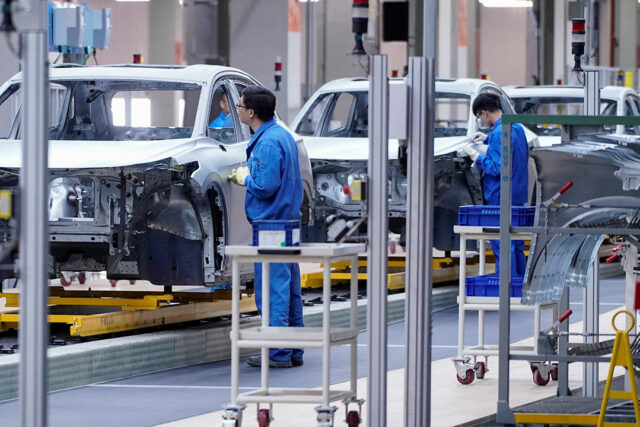
Employees work on assembly line during a construction completion event of SAIC Volkswagen MEB electric vehicle plant in Shanghai, China Nov. 8, 2019. — REUTERS/ALY SONG

PARIS — France on Wednesday published new eligibility rules for electric vehicle (EV) incentives to exclude EVs made in China, even though carmakers in Europe do not have more affordable rival models on the French market.

WHY IS FRANCE REVISING ITS EV BONUS ELIGIBILITY RULES?
The French government currently offers buyers a cash incentive of between 5,000 and 7,000 euros in cash for eligible models to get more electric cars on the road, at a total cost of 1 billion euros ($1.07 billion) per year.

However, in the absence of cheap European-made EVs, a third of all incentives are going to consumers buying EVs made in China, a French finance ministry source said. The trend has helped spur a surge in imports and a growing competitive gap with domestic producers.

The scheme will be revamped from Dec. 15 to take into account the carbon emitted in a model’s manufacturing process.

President Emmanuel Macron and government ministers have made little secret that they want to make sure French state cash is not benefiting Chinese carmakers.

WHAT DO THE NEW RULES DO?
Under the new rules, car models will be scored against government-set thresholds for the amount of energy used to make their materials, in their assembly and transport to market, as well as what type of battery the vehicle has.

Because Chinese industry generally relies heavily on coal-generated electricity, the criteria are likely to put the bonus out of Chinese carmakers’ reach.

The government, which is to publish in December the models meeting the new standards, says the criteria are compliant with World Trade Organization rules because exemptions are allowed for health and environmental reasons.

WILL IT DO ANYTHING?
With Chinese cars estimated to cost 20% less than European-made competitors, the bonus could make a difference for vehicles with a price tag of less than 25,000 euros.

But French car buyers will have to wait because Stellantis’ Slovakia-made e-C3 city car and Renault’s France-made R5 are not due to hit the market until 2024.

Nonetheless, many EVs made in China will remain competitive even without the cash incentive.

With a starting price of 30,000 euros, SAIC group’s MG4 will be less expensive than Renault’s equivalent Megane compact car, which starts at 38,000 euros — or 33,000 euros with a 5,000-euro incentive.

Since its 46,000-euro starting price, just below 47,000-euro for the threshold bonus, Tesla’s Y model — one of the best selling electric vehicles in France — could in theory also be impacted by the new rules for vehicles made in China. 

S&P Global Mobility analyst Lorraine Morard said that even if most Chinese cars are ineligible for the bonus they would probably get 7-8% of France’s electric car market next year, instead of 10% otherwise.

WILL MANUFACTURERS RELOCATE TO EUROPE?
Renault CEO Luca De Meo recently ruled out moving production of the Dacia Spring from China to Europe and said he could live without the bonus.

The model is currently one of the best-selling electric cars in France with the Tesla Y, Peugeot’s e-208, Fiat’s 500e, the Megane eTech and MG4.

MG’s Chinese parent company SAIC has said that it is looking for a production site in Europe as is Chinese rival BYD, whose Dolphin model will compete in the same segment as the MG4 and Megane with a starting price of 29,000 euros. — Reuters

Chinese navy seeks graduate students for warplane pilot roles

REUTERS

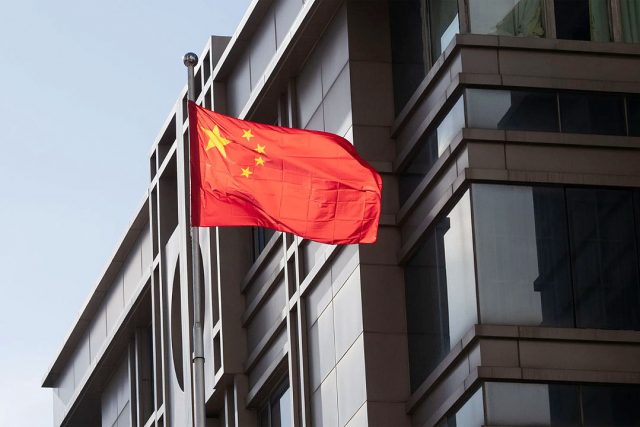
BEIJING — The Chinese navy wants to hire highly educated graduate students to fly shipborne aircraft, and is raising the age limit to expand its search, as it seeks to improve the qualifications of its air personnel and build a “strong army.”

Besides upgrading its hardware from warships to warplanes, China is also trying to improve the caliber of its recruits, as the military is a career path traditionally favored by the less educated.

In an advertisement on social media platform WeChat, the People’s Liberation Army Navy said it was seeking graduate students who hold science and engineering master degrees and who are below 26 years old to pilot aircraft from ships, including China’s growing fleet of aircraft carriers.

Just last year, it allowed undergraduates aged 24 or below to apply for the first time. It limited candidates to high school graduates aged below 20 before that.

“The need for high-quality military talent becomes more imperative day by day,” the People’s Liberation Army Navy said in the advert, published on Wednesday.

“The mission and tasks of the navy continue to expand. The speed of the strategic shift of the navy is being accelerated.”

Candidates must be male with a clean “political history” and have no legal or disciplinary history, according to the advertisement.

Training will include three to four years of aviation theory studies and practical flight training. Successfully candidates will have free medical care for themselves and their immediate family, as well as government-provided housing.

China is in the final stages of preparing its third, but first domestically made, aircraft carrier – the Fujian – for sea trials, a key step before the warship goes into operational service.

China is aiming to modernize its military forces by 2035. — Reuters

US Republicans push for security review of China-linked battery company

STOCK PHOTO | Image by Isabella Fischer from Unsplash

WASHINGTON — Republican lawmakers on Wednesday urged the United States Treasury Department to conduct a security review over China-linked ownership of Gotion Inc, which plans to build electric vehicle battery plants in Michigan and Illinois, arguing its management is under Beijing’s sway.

The move is the latest push by Republicans to question Chinese-linked EV battery producers looking to set up shop in the U.S., possibly with access to taxpayer funding.

The governors of Michigan and Illinois have announced plans for Gotion to open EV plants in their states, facilities expected to create thousands of jobs.

Republican Senator Marco Rubio and Republican representatives from the states sent a letter to Treasury Secretary Janet Yellen, urging the Committee on Foreign Investment in the United States (CFIUS) to review Gotion’s ties to China’s Communist Party.

The lawmakers said that despite Germany’s Volkswagen AG being the largest single shareholder at about 30% of Gotion’s parent company, Gotion High-Tech , China maintained “effective control” through multiple individual shareholders.

Those include the company’s founder Li Zhen and his son whom, they said, were members of CCP organizations. Most of Gotion High-Tech’s other top shareholders, they wrote, were owned by Chinese government-linked entities, and its bylaws vow to implement the major strategic decisions of the party.

That should trigger the review, and if necessary, Gotion High-Tech’s divestment, the lawmakers said, especially since President Joe Biden has identified electric vehicles and batteries as critical parts of transportation infrastructure.

“It is not in the interest of the United States to allow the CCP to control facilities estimated to produce thousands of those batteries, much less to provide it with hundreds of millions of dollars in taxpayer funded subsidies to do so,” they said.

The Treasury Department, Gotion and Gotion High-Tech did not respond immediately to requests for comment.

China has moved in recent years to enhance the CCP’s influence in Chinese companies, where maintaining a party unit is often required under law.

Republicans also have asked Tesla to detail its relationship with Chinese battery manufacturer CATL amid concerns U.S. electric vehicle subsidies were improperly flowing to foreign entities, and have been probing Ford Motor’s planned $3.5 billion investment to build a battery plant in Michigan using technology from CATL. — Reuters

Oil companies cautious about drilling as energy transition looms

BW FILE PHOTO

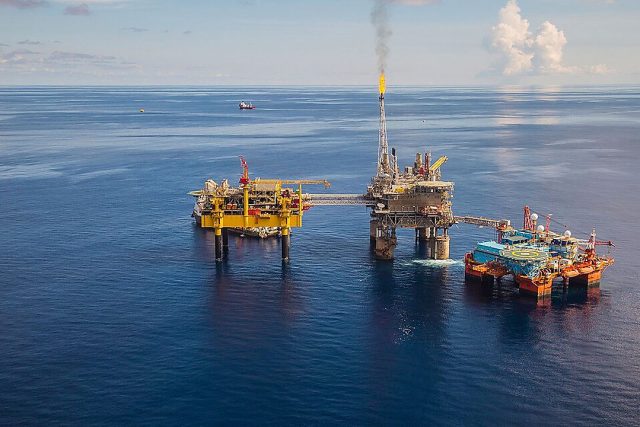
CALGARY — Government policies to fight climate change are discouraging oil companies from investing heavily in new production even as they turn in record profits – a dynamic that could spell tight supply and high prices as clean energy alternatives seek to fill the void.

Crude oil prices have surged above $90 a barrel and some analysts predict they will nudge above $100 by year’s end. But instead of spending big to boost output, companies are boosting dividends or buying back shares to reward investors.

Environmental groups say slowing production growth could accelerate a move to renewable energy and curb carbon emissions. However, lack of drilling investment could exacerbate energy shortages in poor countries and fuel inflation, company executives warned at the World Petroleum Congress in Calgary this week.

“If we don’t maintain some level of investment in the industry, you end up running short of supply which leads to high prices,” Exxon Mobil CEO Darren Woods said. He said oil and gas reserves are depleting at 5-7% annually, and output will decline if companies stop investing to replace them.

“The current transition shortcomings are already causing mass confusion across industries that produce and or rely on energy,” said Aramco CEO Amin Nasser. “Long-term planners and investors do not know which way to turn.”

Global upstream investment is expected to reach $579 billion in 2023, a modest increase from the annual average of $521 billion between 2015 and 2022, according to consultancy Rystad Energy. That period encompassed the 2014-15 oil price crash and the COVID-19 pandemic.

Oil and gas investment peaked in 2014 at $887 billion.

Investment looks “flattish” during the next two to three years, and may start to drop in 2026, as electric vehicle adoption and government emissions policies start flattening oil demand, said Aditya Ravi, Rystad’s senior vice-president of upstream research.

The International Energy Agency warned last week that oil demand will peak by 2030.

Uncertainties about government policy are a bigger factor restraining investment, said Alex Pourbaix, executive chair of Canadian producer Cenovus Energy.

“If you want to add 100,000 barrels a day of production, you’re going to spend billions and billions of dollars,” Pourbaix said in an interview. “In terms of any real meaningful investment in large projects, that’s probably going to have to wait for some more clarity on the government front.”

The Canadian government has not finalized subsidies for projects to capture and sequester emissions and is developing a cap on oil and gas emissions.

Major consumers, including the United States and the European Union, have also adopted ambitious policies to accelerate the transition from fossil fuels to cleaner energy sources as they seek to deliver on emissions reduction pledges made under the Paris Agreement, a global pact to fight climate change.

Deloitte recently reported that investors holding $2.3 trillion of equity in the global oil and gas industry

are changing expectations about growth markets for energy faster than company executives.

About 43% of surveyed investors, for instance, emphasized battery storage as their key area for investment.

Chris Severson-Baker, executive director of the Pembina Institute climate think-tank, said it was encouraging that oil companies were reining in spending on growth as it should curb emissions, but the transition to lower-emitting energy was moving too slowly.

“We’re going to get to a certain point this decade where the adoption of renewable energy, electric vehicles and heat pumps is going to start persistently eating away at demand,” he said.

Omar Farouk Ibrahim, Secretary General of the African Petroleum Producers’ Organization, said policies that discourage investment hurt poor countries the most.

“We are being intimidated into running away from fossil fuel investment,” he said.

The United Nations estimates that close to 2 billion people will still rely on unsafe and polluting fuels for cooking by 2030, down from 2.3 billion currently.

Not all oil companies are reducing spending on production. State-owned Oil India Ltd plans to boost exploration spending within India, a country that relies on oil imports, from $1 billion this year to $10 billion in five years.

“We don’t have an option. Investment is a need,” said managing director Ranjit Rath. “If you don’t invest with the current price, you will miss the bus.”

Greater oil production could provide the revenue to pursue net-zero aims, Rath said.

Brazilian state-owned oil producer Petrobras aims to increase its operating share of production 18% to 3.2 million barrels of oil equivalent per day (boepd) in 2032 from 2.7 million boepd this year. The company would move faster if not for problems securing equipment to build floating production storage and offloading vessels, said Carlos Travassos, Petrobras’ chief engineering technology and innovation officer.

The emphasis on shareholder returns suggests oil companies are working on a short time horizon instead of looking towards future growth, said Yrjo Koskinen, professor of sustainable and transition finance at University of Calgary.

“They claim oil and gas will be around for decades and maybe that’s the case. But they don’t necessarily behave that way.” — Reuters

Europe’s power industry warns aging grids risk green goals

REUTERS

BRUSSELS — Europe’s electricity industry has warned that unprecedented investments are needed to upgrade aging electricity grids, or the EU will fail to meet its clean energy targets.

The European Union’s plans to curb climate change foresee millions more electric vehicles on European roads by 2030, as well as a massive expansion of renewable energy, and electric heat pumps starting to replace fossil fuel boilers in houses.

Electricity industry association Eurelectric said on Thursday that to support those goals, average annual investments in Europe’s electricity grids from now to 2050 need to be at least 84% higher than they were in 2021.

“We want to transform the entire energy system at record speed, replace fossil fuels – oil and gas – with electricity. So we add loads of new generation capacity to the grid, we add electric cars, heat pumps,” Eurelectric Secretary General Kristian Ruby said.

“Therefore, you cannot say today what we used to do 10 years ago will be just fine for the next 10 years. It’s just not the case,” he told Reuters.

The European Commission has said power grid investments of 584 billion euros ($626.3 billion) per year are needed until 2030 to meet green goals.

Much of that is expected to come from private sources or be paid for through grid tariffs. Eurelectric said public funding should target upgrading grids quickly, over other longer-term infrastructure like hydrogen projects that would launch in the 2030s.

EU Energy Commissioner Kadri Simson told Reuters grid projects will be included in an upcoming list of cross-border infrastructure that will be offered faster permits and access to EU funding.

“If we will not upgrade grid infrastructure very fast, we will not achieve our 2030 targets,” she said.

Forty percent of Europe’s power distribution grids are over 40 years old. Most are designed around large centralized power plants, and will need upgrading to distribute power from the fleet of local solar panels and wind farms expected to plug in this decade.

EU countries are negotiating power market reforms that could make it easier and faster for grid operators to invest in upgrading networks. However, governments have been struggling to approve the law since June because of a dispute over state aid for power plants. — Reuters

ADVERTISEMENT
ADVERTISEMENT