Home Blog Page 4289

US Republicans push for security review of China-linked battery company

STOCK PHOTO | Image by Isabella Fischer from Unsplash

WASHINGTON — Republican lawmakers on Wednesday urged the United States Treasury Department to conduct a security review over China-linked ownership of Gotion Inc, which plans to build electric vehicle battery plants in Michigan and Illinois, arguing its management is under Beijing’s sway.

The move is the latest push by Republicans to question Chinese-linked EV battery producers looking to set up shop in the U.S., possibly with access to taxpayer funding.

The governors of Michigan and Illinois have announced plans for Gotion to open EV plants in their states, facilities expected to create thousands of jobs.

Republican Senator Marco Rubio and Republican representatives from the states sent a letter to Treasury Secretary Janet Yellen, urging the Committee on Foreign Investment in the United States (CFIUS) to review Gotion’s ties to China’s Communist Party.

The lawmakers said that despite Germany’s Volkswagen AG being the largest single shareholder at about 30% of Gotion’s parent company, Gotion High-Tech , China maintained “effective control” through multiple individual shareholders.

Those include the company’s founder Li Zhen and his son whom, they said, were members of CCP organizations. Most of Gotion High-Tech’s other top shareholders, they wrote, were owned by Chinese government-linked entities, and its bylaws vow to implement the major strategic decisions of the party.

That should trigger the review, and if necessary, Gotion High-Tech’s divestment, the lawmakers said, especially since President Joe Biden has identified electric vehicles and batteries as critical parts of transportation infrastructure.

“It is not in the interest of the United States to allow the CCP to control facilities estimated to produce thousands of those batteries, much less to provide it with hundreds of millions of dollars in taxpayer funded subsidies to do so,” they said.

The Treasury Department, Gotion and Gotion High-Tech did not respond immediately to requests for comment.

China has moved in recent years to enhance the CCP’s influence in Chinese companies, where maintaining a party unit is often required under law.

Republicans also have asked Tesla to detail its relationship with Chinese battery manufacturer CATL amid concerns U.S. electric vehicle subsidies were improperly flowing to foreign entities, and have been probing Ford Motor’s planned $3.5 billion investment to build a battery plant in Michigan using technology from CATL. — Reuters

Oil companies cautious about drilling as energy transition looms

BW FILE PHOTO

CALGARY — Government policies to fight climate change are discouraging oil companies from investing heavily in new production even as they turn in record profits – a dynamic that could spell tight supply and high prices as clean energy alternatives seek to fill the void.

Crude oil prices have surged above $90 a barrel and some analysts predict they will nudge above $100 by year’s end. But instead of spending big to boost output, companies are boosting dividends or buying back shares to reward investors.

Environmental groups say slowing production growth could accelerate a move to renewable energy and curb carbon emissions. However, lack of drilling investment could exacerbate energy shortages in poor countries and fuel inflation, company executives warned at the World Petroleum Congress in Calgary this week.

“If we don’t maintain some level of investment in the industry, you end up running short of supply which leads to high prices,” Exxon Mobil CEO Darren Woods said. He said oil and gas reserves are depleting at 5-7% annually, and output will decline if companies stop investing to replace them.

“The current transition shortcomings are already causing mass confusion across industries that produce and or rely on energy,” said Aramco CEO Amin Nasser. “Long-term planners and investors do not know which way to turn.”

Global upstream investment is expected to reach $579 billion in 2023, a modest increase from the annual average of $521 billion between 2015 and 2022, according to consultancy Rystad Energy. That period encompassed the 2014-15 oil price crash and the COVID-19 pandemic.

Oil and gas investment peaked in 2014 at $887 billion.

Investment looks “flattish” during the next two to three years, and may start to drop in 2026, as electric vehicle adoption and government emissions policies start flattening oil demand, said Aditya Ravi, Rystad’s senior vice-president of upstream research.

The International Energy Agency warned last week that oil demand will peak by 2030.

Uncertainties about government policy are a bigger factor restraining investment, said Alex Pourbaix, executive chair of Canadian producer Cenovus Energy.

“If you want to add 100,000 barrels a day of production, you’re going to spend billions and billions of dollars,” Pourbaix said in an interview. “In terms of any real meaningful investment in large projects, that’s probably going to have to wait for some more clarity on the government front.”

The Canadian government has not finalized subsidies for projects to capture and sequester emissions and is developing a cap on oil and gas emissions.

Major consumers, including the United States and the European Union, have also adopted ambitious policies to accelerate the transition from fossil fuels to cleaner energy sources as they seek to deliver on emissions reduction pledges made under the Paris Agreement, a global pact to fight climate change.

Deloitte recently reported that investors holding $2.3 trillion of equity in the global oil and gas industry

are changing expectations about growth markets for energy faster than company executives.

About 43% of surveyed investors, for instance, emphasized battery storage as their key area for investment.

Chris Severson-Baker, executive director of the Pembina Institute climate think-tank, said it was encouraging that oil companies were reining in spending on growth as it should curb emissions, but the transition to lower-emitting energy was moving too slowly.

“We’re going to get to a certain point this decade where the adoption of renewable energy, electric vehicles and heat pumps is going to start persistently eating away at demand,” he said.

Omar Farouk Ibrahim, Secretary General of the African Petroleum Producers’ Organization, said policies that discourage investment hurt poor countries the most.

“We are being intimidated into running away from fossil fuel investment,” he said.

The United Nations estimates that close to 2 billion people will still rely on unsafe and polluting fuels for cooking by 2030, down from 2.3 billion currently.

Not all oil companies are reducing spending on production. State-owned Oil India Ltd plans to boost exploration spending within India, a country that relies on oil imports, from $1 billion this year to $10 billion in five years.

“We don’t have an option. Investment is a need,” said managing director Ranjit Rath. “If you don’t invest with the current price, you will miss the bus.”

Greater oil production could provide the revenue to pursue net-zero aims, Rath said.

Brazilian state-owned oil producer Petrobras aims to increase its operating share of production 18% to 3.2 million barrels of oil equivalent per day (boepd) in 2032 from 2.7 million boepd this year. The company would move faster if not for problems securing equipment to build floating production storage and offloading vessels, said Carlos Travassos, Petrobras’ chief engineering technology and innovation officer.

The emphasis on shareholder returns suggests oil companies are working on a short time horizon instead of looking towards future growth, said Yrjo Koskinen, professor of sustainable and transition finance at University of Calgary.

“They claim oil and gas will be around for decades and maybe that’s the case. But they don’t necessarily behave that way.” — Reuters

Europe’s power industry warns aging grids risk green goals

REUTERS

BRUSSELS — Europe’s electricity industry has warned that unprecedented investments are needed to upgrade aging electricity grids, or the EU will fail to meet its clean energy targets.

The European Union’s plans to curb climate change foresee millions more electric vehicles on European roads by 2030, as well as a massive expansion of renewable energy, and electric heat pumps starting to replace fossil fuel boilers in houses.

Electricity industry association Eurelectric said on Thursday that to support those goals, average annual investments in Europe’s electricity grids from now to 2050 need to be at least 84% higher than they were in 2021.

“We want to transform the entire energy system at record speed, replace fossil fuels – oil and gas – with electricity. So we add loads of new generation capacity to the grid, we add electric cars, heat pumps,” Eurelectric Secretary General Kristian Ruby said.

“Therefore, you cannot say today what we used to do 10 years ago will be just fine for the next 10 years. It’s just not the case,” he told Reuters.

The European Commission has said power grid investments of 584 billion euros ($626.3 billion) per year are needed until 2030 to meet green goals.

Much of that is expected to come from private sources or be paid for through grid tariffs. Eurelectric said public funding should target upgrading grids quickly, over other longer-term infrastructure like hydrogen projects that would launch in the 2030s.

EU Energy Commissioner Kadri Simson told Reuters grid projects will be included in an upcoming list of cross-border infrastructure that will be offered faster permits and access to EU funding.

“If we will not upgrade grid infrastructure very fast, we will not achieve our 2030 targets,” she said.

Forty percent of Europe’s power distribution grids are over 40 years old. Most are designed around large centralized power plants, and will need upgrading to distribute power from the fleet of local solar panels and wind farms expected to plug in this decade.

EU countries are negotiating power market reforms that could make it easier and faster for grid operators to invest in upgrading networks. However, governments have been struggling to approve the law since June because of a dispute over state aid for power plants. — Reuters

Canada gathers allies as tensions rise with India over Sikh leader’s murder

PRAVEEN KUMAR NANDAGIRI-UNSPLASH

OTTAWA — Canada this week divulged it had intelligence possibly linking Indian government agents to the murder of a separatist Sikh leader, the kind of news that usually sparks uproar among democratic allies. Not this time.

India is being courted by the United States and others as a counterweight to China, and Trudeau’s rare attack just days after

New Delhi hosted a G20 Summit is putting Western nations in an awkward position.

“India is important in Western calculations for balancing China, and Canada is not,” said Stephanie Carvin, a professor of international relations at Ottawa’s Carleton University.

“This really does put Canada offside among all other Western countries,” she said.

Prime Minister Justin Trudeau announced on Monday that Canada was “actively pursuing credible allegations” that Indian agents had potentially been involved in the murder of Canadian citizen Hardeep Singh Nijjar in June.

At that point Ottawa had already been discussing the matter with key allies such as the Five Eyes intelligence sharing alliance, which also includes the United States, Britain, Australia and New Zealand.

The results so far have been muted. Britain refused to publicly criticize India and said bilateral trade talks will continue as planned. Indeed, a statement from Foreign Secretary James Cleverly about the affair did not mention India by name.

Britain is in a difficult position, caught between supporting Canada and antagonizing India, a country it wants as a trading partner and ally to help confront China, said Chietigj Bajpaee, India expert at the Chatham House think tank in London.

“Short of there being any definitive evidence of India’s involvement, I think the UK response is likely to remain muted,” he said. A free trade deal would be a “major political win” for both India and Britain, Bajpaee said.

‘WAITING GAME’
White House national security adviser John Kirby said the United States was “deeply concerned” and encouraged Indian officials to cooperate in any investigation. India rejects the idea it was involved in the murder.

The Washington Post reported Trudeau had pushed for a joint statement condemning India at last week’s Group of 20 summit in New Delhi and was turned down by the United States and others.

Kirby said “any reports that we rebuffed Canada in any way whatsoever are false, and we will continue to coordinate and consult with them on this.”

The muted response to Trudeau’s allegations is stark when compared to the uproar after Russian double agent Sergei Skripal and his daughter Yulia were poisoned by nerve agent in England in 2018. Britain, the United States, Canada and others threw out more than 100 Russian diplomats to punish Moscow for an attack it has always denied carrying out.

“Our Five Eyes partners are understandably reluctant to really wade into this, given everybody’s interest in advancing ties with India, in the context of the ongoing tension with China,” said Wesley Wark of the Centre for International Governance Innovation think tank in Waterloo, Ontario.

“It’s a bit of a waiting game. If the Canadians come up with very solid evidence about egregious Indian state involvement in an assassination attempt, I think we’ll hear more from our allies in support,” he said.

With allies unwilling to contemplate any kind of joint condemnation of India, the Canadian options now look limited, at least until it can provide incontrovertible evidence.

“If we don’t get our allies to support this, either publicly or privately, Canada’s not going to be able to do a great deal to move India,” said Richard Fadden, former head of the Canadian Security Intelligence Service.

“And I think the greatest thing we can aspire to in the short term or the medium term is to get India not to do this again,” he told CTV.

Canadian government sources indicated they would have preferred to wait longer before making a statement but felt they had to act, given some domestic media outlets were about to break the story.

Trudeau would have never spoken “out loud if we didn’t have the information lining up into a fact base”, said one source, adding that they hoped more information would come soon.

Canada has not made public the intelligence it has because there is an active murder investigation, the senior source said.

“On the cusp of the global opportunity for India, they absolutely need to handle this responsibly – for their own interests,” the source said. — Reuters

Saudi crown prince says rise in oil prices not meant to help Russia

A Saudi flag flutters atop Saudi Arabia’s consulate in Istanbul, Turkey, Oct. 20, 2018. — REUTERS

WASHINGTON — Saudi Crown Prince Mohammed bin Salman said in a US television interview on Wednesday that OPEC’s decision to cut oil production was based on market stability and was not intended to help Russia wage its war in Ukraine.

“We just watch supply, demand. If there is shortage of supply our role in OPEC+ is to fill that shortage. If there is oversupply our role of OPEC+ is to measure that for the stability of the market,” the crown prince said in an interview on Fox News. — Reuters

Bank of England on brink of rate hike pause after inflation surprise

STOCK PHOTO | Image by Stefan Schweihofer from Pixabay

LONDON — The Bank of England will announce on Thursday whether it is halting a run of interest rate hikes that stretches back to December 2021, a day after signs that it had turned a corner in tackling Britain’s high inflation problem.

Investors piled into bets on the BoE keeping Bank Rate at 5.25% on Wednesday as soon as official data showed a surprise fall in the pace of price growth.

Goldman Sachs and other banks ditched their previous calls for one more rate increase and investors put a roughly 50% chance on a pause by the BoE, up from just 20% on Tuesday.

Other analysts said they still thought a final BoE rate hike was the most likely outcome after a recent jump in global oil prices, but they stressed it could go either way.

“We stick with our call for a hike, but now see this as a coin toss,” JP Morgan economist Allan Monks said.

BoE Governor Andrew Bailey and his colleagues on the Monetary Policy Committee have faced intense criticism after consumer price inflation surpassed 11% in October last year.

At 6.7% in August, inflation is falling towards the 5% level that the BoE predicts for the coming months – and which British Prime Minister Rishi Sunak has promised to voters ahead of an election expected next year.

But it remains more than three times the BoE’s 2% target and the highest in the Group of Seven economies.

HIGHER FOR LONGER
Bailey and other officials have stressed in recent weeks that, while they might be close to reaching the peak of their run of rate hikes, they would probably have to keep borrowing costs at high levels for a period, dashing hopes of quick cuts.

Whether it raises rates one more time or not, the challenge for the BoE is likely to be to convince investors that it will stick to its guns and not rush to cut rates even as Britain’s already fragile economy shows signs of weakening.

“While the BoE will no doubt try to project a ‘higher for longer’ message, as the ECB has since its rate hike last week, history tells us that once the peak is in, forward rates move notably lower,” Dominic Bunning, head of European FX Research at HSBC, said in a note to clients.

The BoE is alarmed that wages have so far defied the slowdown in the broader economy and are rising at a record pace, threatening to thwart its attempts to bring inflation down.

British inflation is almost double the rate in the United States, where the Federal Reserve on Wednesday kept borrowing costs on hold.

Last week, the European Central Bank raised rates to a record high but signaled that it was likely to pause.

The BoE is scheduled to make its announcement at 12 p.m. (1100 GMT) on Thursday. It is not due to hold a press conference.

As well as its decision on rates, the central bank is expected to give details of the next phase of program to reduce the stockpile of government bonds which it amassed over a decade and a half to help the economy during the global financial crisis and the COVID-19 pandemic. — Reuters

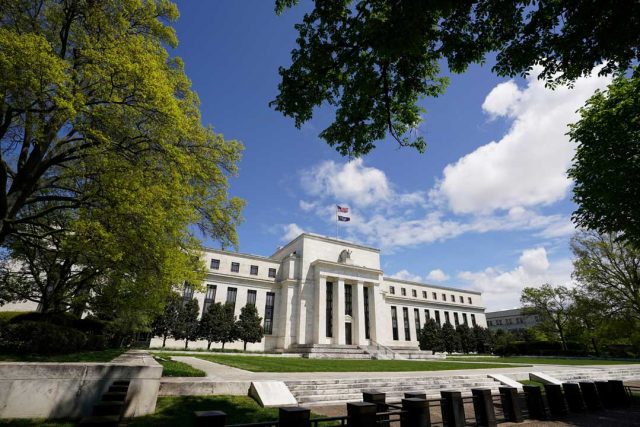
Fed keeps rates steady, toughens policy stance as ‘soft landing’ hopes grow

REUTERS

WASHINGTON – The U.S. Federal Reserve held interest rates steady on Wednesday but stiffened a hawkish monetary policy stance that its officials increasingly believe can succeed in lowering inflation without wrecking the economy or leading to large job losses.

The Fed’s benchmark overnight interest rate may still be lifted one more time this year to a peak 5.50%-5.75% range, according to updated quarterly projections released by the U.S. central bank, and rates kept significantly tighter through 2024 than previously expected.

“People hate inflation. Hate it,” Fed Chair Jerome Powell said in a press conference after the end of a two-day policy meeting at which central bank officials held the benchmark overnight interest rate in the current 5.25%-5.50% range, but sketched a stricter policy path moving forward in an inflation fight they now see lasting into 2026.

But a “solid” economy with still “strong” job growth, Powell said, will allow the central bank to keep that additional pressure on financial conditions through 2025 with much less of a cost to the economy and labor market than in previous U.S. inflation battles.

Indeed, monetary policy is expected to remain slightly restrictive into 2026 while the economy continues to largely grow at its estimated trend level of around 1.8%.

Even as inflation declines for the rest of 2023 and in coming years, the Fed anticipates only modest initial reductions to its policy rate. That means the expected half percentage point of rate cuts in 2024 would have the net effect of raising the inflation-adjusted “real” rate.

As of June, Fed officials had expected to cut rates by a full percentage point next year.

While Powell said the Fed was “in a position to proceed carefully” with future policy moves, he also made clear the jury was, to some degree, still out on the central bank’s fight to contain the worst outbreak of inflation in 40 years.

“We want to see convincing evidence really, that we have reached the appropriate level” of interest rates to return inflation to the Fed’s 2% target, a judgment its policymakers have not yet made, Powell told reporters.

Inflation by some measures remains more than double the Fed’s desired level, though Powell said the pace appeared to be in decline across several key parts of the economy.

Bond yields jumped after the release of the latest Fed projections and policy statement, with the 2-year Treasury note a roughly 17-year high near 5.2%. Major U.S. stock indices fell.

A WIDER RUNWAY?

While Powell’s inflation language remained strict, the tone did shift to accommodate what appears to be a growing sense among U.S. central bankers that the sought-after “soft landing” may be developing.

Powell would not call it the Fed’s “baseline” – yet.

But the path had likely “widened … I do think it’s possible,” he said, a comment underlined by projections showing Fed policymakers at the median see inflation continuing to fall even with gross domestic product continuing to grow and the unemployment rate never rising above 4.1%, an outcome that would fly in the face of U.S. history and the predictions of several top economists.

Even Fed staff had until recently penciled in an expected recession this year, the usual outcome of successful inflation battles that drive out spending and investment and push up joblessness. The median GDP forecast among policymakers for 2023 is now 2.1% – five times where it began the year.

With the federal funds rate falling to 5.1% by the end of 2024 and 3.9% by the end of 2025, the central bank’s main measure of inflation is projected to drop to 3.3% by the end of this year, to 2.5% next year and to 2.2% by the end of 2025. The Fed expects to get inflation back to its 2% target in 2026, which is later than some officials had thought possible.

Ahead of this week’s Fed meeting, investors had been banking on significant rate cuts next year, an expectation clouded by the projections that show 10 of 19 officials see the policy rate remaining above 5% through next year.

That means companies and households will face even tighter credit conditions and higher borrowing costs than they have already absorbed during the Fed’s aggressive two-year battle to contain inflation. Rising government bond yields, for example, will pass through into how banks set interest rates on credit cards, auto loans, and home mortgages.

If it was a hawkish outcome, however, it was because the economy had outperformed, with inflation falling so far at little cost to jobs or economic output.

“The message conveyed in their upward revision to growth and their downward revision to the unemployment rate in 2024 clearly indicates a Fed that has dialed up their expectation for a soft landing, despite higher-for-longer rates,” said Olu Sonola, head of U.S. regional economics at Fitch Ratings.

The Fed’s statement was approved unanimously after a meeting that marked new Fed Governor Adriana Kugler’s debut on the central bank policymaking stage. — Reuters

ADB cuts PHL growth outlook to 5.7%

A child sits in a motorized vehicle loaded with vegetables at a public market in Manila, Philippines, Oct. 21, 2022. — REUTERS/LISA MARIE DAVID

THE ASIAN Development Bank (ADB) cut its gross domestic product (GDP) growth forecast for the Philippines this year, as elevated inflation dampens consumer spending.

In its latest Development Outlook report, the ADB trimmed its GDP growth outlook to 5.7% this year from the 6% projection it gave in April.

If realized, this would be below the government’s 6-7% target for this year, and slower than the 7.6% GDP expansion in 2022.

ADB trims 2023 Philippine GDP growth outlook to 5.7%; inflation steady at 6.2%

“We have downgraded our (Philippine growth) forecast for this year mainly due to the weakening in domestic demand,” ADB Senior Regional Cooperation Officer for Southeast Asia Dulce Zara said in a webinar discussing the report on Wednesday.

She noted last year’s economic performance reflected the reopening of the economy, strong pent-up demand and election-related spending.

“Spending, investments were also high (last year). This year, they have gone down. Another factor is the decline in exports. That’s the reason for the downgrade,” she said.

The Philippine economy expanded by 4.3% in April to June, the slowest growth in over two years, amid weak household consumption and a contraction in government spending.

The ADB’s 2023 growth forecast for the Philippines is still the second fastest among Southeast Asian economies, after Vietnam (5.8%) and ahead of Cambodia (5.3%), Indonesia (5%) and Malaysia (4.5%).

This is also higher than the 4.6% GDP growth projection for Southeast Asia, which was slightly lower than the previous forecast of 4.7%.

“The Philippines’ growth story remains strong despite an expected moderation in 2023. Public investment and private spending fueled by low unemployment rate, sustained increase in remittances from Filipinos overseas, and buoyant services including tourism will support growth,” ADB Philippines Country Director Pavit Ramachandran said in a statement.

For 2024, the ADB expects the Philippines to now be the fastest-growing economy in Southeast Asia with a 6.2% GDP growth projection. This after the ADB downgraded its growth forecast for Vietnam to 6% from 6.8% previously.

“Private consumption and investment will continue to underpin growth. A moderation in inflationary pressures next year bodes well for domestic demand,” the multilateral lender said.

Public expenditure and infrastructure spending are expected to pick up in 2024.

“Moving forward, prospects remain positive for the Philippines. We are looking at investments from the government given its pipeline of infrastructure projects and as well as continued consumer spending, which is the main driver of growth for the Philippines,” Ms. Zara said.

The ADB cited several risks to the Philippine growth outlook such as the expected slowdown in major economies, rising geopolitical tensions, and elevated global commodity prices.

“An intensified and prolonged El Niño, other severe weather disturbances, and a continuation of the Russian invasion of Ukraine could elevate inflationary pressures,” it added.

ELEVATED INFLATION
At the same time, ADB maintained its inflation outlook at 6.2% this year and 4% next year, which are both at the higher end of the Bangko Sentral ng Pilipinas’ (BSP) 2-4% annual target range.

Both forecasts are above the BSP’s average inflation projections of 5.6% for this year, and 3.3% for 2024.

At 6.2%, Philippine inflation is projected to be the third-fastest in Southeast Asia this year, following Laos (28%) and Myanmar (14%).

In 2024, the Philippines is still expected to see the third-fastest inflation, after Cambodia and Vietnam.

“Inflation is expected to soften, though the onset of El Niño and elevated global commodity prices may slow the pace of deceleration,” the ADB said.

The multilateral institution said the El Niño weather phenomenon will likely hurt the upcoming harvest, particularly in Southeast Asia.

“This could dent food security and raise inflation in net rice-importing countries, such as Bangladesh, Bhutan, Maldives, Nepal, and the Philippines,” it said.

Ms. Zara said that agriculture production in countries like the Philippines, Indonesia, Myanmar and Thailand will likely be the most impacted by El Niño-induced dry spells and droughts.

“Although inflation has moderated in the first seven months of the year, food inflation remains elevated, above 5% for Laos, the Philippines, Singapore and Malaysia. Reduced agri output both domestic and globally will be harmful for these economies,” she added.

Meanwhile, second-round effects stemming from higher transport fares and wage adjustments may also impact Philippine inflation this year.

“The government is considering extending the period for the reduced tariffs for some food items including rice which are due to expire by December 2023, to keep inflation contained,” the ADB said.

As core inflation eases, the ADB noted the BSP would likely keep policy rates steady before considering cutting them in 2024.

The BSP hiked the key policy rate by 425 basis points (bps) to 6.25% from May 2022 to March 2023.

The Monetary Board will likely hold interest rates steady for a fourth straight meeting on Thursday, as expected by 14 of 17 analysts in a BusinessWorld poll last week.

SLOWER GROWTH
Meanwhile, economic growth in developing Asia this year will be slightly lower than previously expected as the weakness in China’s property sector and El Niño-related risks cloud regional prospects, the ADB said.

Updating its regional economic outlook, the ADB trimmed its 2023 growth forecast for developing Asia to 4.7% from 4.8% projected in July.

But the growth forecast for next year for the grouping, which consists of 46 economies in the Asia-Pacific and excludes Japan, Australia and New Zealand, was revised slightly upwards to 4.8% from 4.7% previously.

“We see resilient growth in the region really based on pretty strong domestic consumption and investment, and despite reduced external demand, which is a dampener on export-driven growth,” Mr. Park said.

The ADB tempered its growth forecasts for East Asia, South Asia, and Southeast Asia this year, with China and India expected to grow 4.9% and 6.3%, respectively, slightly lower than the July growth projections of 5% and 6.4%.

China’s property crisis “poses a downside risk and could hold back regional growth,” the ADB said in its report.

The Manila-based lender maintained its 2024 growth forecasts for China and India at 4.5% and 6.7% respectively.

While growth has so far been robust and inflation pressures are receding in developing Asia, Mr. Park said governments need to be vigilant against the many challenges the region faces, including food security.

Inflation in developing Asia is forecast to ease to 3.6% this year from 4.4% last year, and continue to slow to 3.5% in 2024, giving central banks policy space, but the ADB said interest rate hiking and easing cycles will vary going forward. — Luisa Maria Jacinta C. Jocson with Reuters


BoP deficit narrows in Aug.

A person shows US dollars at a currency exchange store in Manila, Philippines, Oct. 21, 2022. — REUTERS

THE PHILIPPINES’ balance of payments (BoP) position remained in a deficit for a fifth straight month in August, albeit sharply narrower from a year ago, mainly due to the National Government’s foreign debt payments, the central bank said late on Monday.

Based on data released by the Bangko Sentral ng Pilipinas (BSP), the country’s BoP deficit stood at $57 million in August, 90% lower than the $572-million gap recorded in the same month a year ago.

Month on month, it rose by 7.5% from the $53-million deficit in July.

The August BoP gap was the highest deficit in two months or since the $606-million shortfall seen in June.

The BoP measures the country’s transactions with the rest of the world at a given time. A deficit means more funds fled the economy than what went in, while a surplus shows that more money entered the Philippines.

“The BoP deficit in August 2023 reflected net outflows arising mainly from the National Government’s (NG) payments of its foreign currency debt obligations,” the BSP said in a statement.

For the first eight months of the year, the BoP position swung to a $2.15-billion surplus from the $5.49-billion deficit a year ago.

“Based on preliminary data, this development reflected mainly the improvement in the balance of trade and the sustained net inflows from personal remittances, trade in services, and foreign borrowings by the NG,” the BSP said.

ING Bank N.V. Manila Senior Economist Nicholas Antonio T. Mapa said the overall BoP was better than last year mainly due to the improvement in the trade balance.

“Last year we saw the trade deficit balloon to all-time lows, but we have seen a bit of an improvement this year,” Mr. Mapa said in an e-mail.

The Philippines’ merchandise trade deficit shrank to a $4.2-billion deficit in July amid falling imports and exports. This brought the first-half trade balance to a $32.18-billion gap, lower than the $35.84-billion shortfall in the comparable year-ago period.

Rizal Commercial Banking Corp. Chief Economist Michael L. Ricafort in a note said the year-to-date BoP surplus was due to the proceeds of the NG’s foreign currency-denominated borrowings from commercial and multilateral sources this year.

These include global bond issuances and official development assistance (ODA), as well as the continued structural dollar inflows into the country via remittances, business process outsourcing revenues, and tourism receipts.

The central bank said the eight-month BoP position reflects the final gross international reserves (GIR) level of $99.6 billion at end-August, slipping by 0.4% from $100 billion as of July.

The GIR represents 7.4 months’ worth of imports of goods and payments of services and primary income.

It can also cover up to 5.7 times the country’s short-term external debt based on original maturity and 3.9 times based on residual maturity.

In the coming months, the country’s BoP position will be supported by continued structural dollar inflows and the likely narrower trade deficit, Mr. Ricafort said.

“The proposed $2-billion retail bonds to be offered by the National Government in September 2023… as well as the National Government’s planned debut of about $1-billion Islamic bonds later in 2023 or early 2024… would also be added to the country’s BoP and GIR in the latter part of the year,” he said.

The government is planning to offer retail dollar bonds this month, as well as Islamic bonds or Sukuk bonds by yearend or early 2024.

“For the rest of the year, we do see the BoP likely flat with any potential worsening of the current account deficit possibly offset by inflows related to the financial account (dollar issuance and return of portfolio investments),” Mr. Mapa added.

Last week, the central bank lowered its balance of payments projection for this year as exports and imports of goods may decline amid weaker global economic conditions.

For this year, the BoP is seen to yield a deficit of $127 million (0% of gross domestic product), which is significantly lower than the previous projection of a $1.2-billion gap (-0.3% of GDP).

For 2024, the country’s BoP position is projected to swing to a $1-billion surplus (equivalent to 0.2% of GDP) next year, better than the previous projection of a $0.5-billion deficit. 

The BSP also projects the current account deficit to reach $11.1 billion (-2.5% of GDP), lower than the previous forecast of $15.1 billion (-3.4% of GDP).

The central bank expects a narrower current account deficit of $10.3 billion (-2.1% of GDP) in 2024 as the country’s trade in goods gap is expected to shrink. — Keisha B. Ta-asan

Tech industry eyes more products under WTO’s zero-tariff framework

A logo is pictured outside the World Trade Organization (WTO) in Geneva, Switzerland, Sept. 28, 2021. — REUTERS/DENIS BALIBOUSE

By Norman P. Aquino, Special Reports Editor

GENEVA — The technology industries of dozens of countries including the Philippines are lobbying to bring more than 400 technology products under the World Trade Organization’s (WTO) tariff-eliminating framework, which is expected to add almost $766 billion to the global economy over 10 years.

The global semiconductor and supply chain would be helped by an Information Technology Agreement 3 (ITA-3), which will also play a critical role in driving global sustainability across industries, Philippine Representative to the WTO Manuel Antonio J. Teehankee told a public forum at the WTO headquarters last week.

“We know the benefits,” he told the forum attended by policy makers and representatives from various semiconductor companies worldwide, citing $49 billion worth of Philippine electronic exports in 2022, representing 36% growth over five years and accounting for almost 50% of the country’s exports.

The Philippine electronics sector, including semiconductors, generated three million direct and indirect jobs that year, Mr. Teehankee said. “I have instructions from the capital, and I am convinced [about ITA-3].”

ICT merchandise exports account for 39% of Vietnam’s, 32% of Malaysia’s, 29.2% of South Korea’s, 25.5% of China’s and 16.1% of Thailand’s total exports.

In contrast, ICT goods exports account for a much lower and incredibly meager share of goods exports for non-ITA countries, including for just 2.5% of Cambodia’s goods exports, 0.7% of South Africa’s and less than half a percent each for Brazil, Chile, Pakistan and Argentina.

Twenty-nine countries signed the ITA at the Singapore Ministerial Conference in December 1996. The participants committed to completely eliminate tariffs on eight broad categories of IT products such as semiconductors, computers and telecommunication equipment.

At the Nairobi Ministerial Conference in December 2015, more than 50 member nations concluded the expansion of the agreement, which now covers 201 more products valued at more than $1.3 trillion a year. Members have since grown to 82, representing about 97% of world trade in IT products, according to the WTO website.

Expanding the ITA for the second time could bring products such as 3D printers, industrial robots, commercial-use drones, patient-monitoring systems and other medical devices, lithium-ion batteries, solar cells and high-definition TVs into the agreement.

If the 82 signatories of the original ITA were to join an expanded ITA-3, the global economy could cumulatively rise by almost $766 billion over 10 years, the Information Technology and Innovation Foundation (ITIF), a global think tank, said in a study released last week.

Beyond merchandise trade, a similar story plays out in information and communications technology services, Mr. Teehankee told BusinessWorld on the sidelines of the forum.

“Expanding the agreement could expand our exports because it will increase products [with zero tariffs] and it will have a knockdown effect on our IT-enabled service exports and a multiple knockdown effect on the environment and agriculture,” he said.

The Philippines’ IT-enabled service exports reached $32.5 billion in 2022 and has grown by 10% year on year on the average, he pointed out.

“From an economic viewpoint, development viewpoint and environmental viewpoint, it is an impressive number for developing countries like the Philippines and our ASEAN (Association of Southeast Asian Nations) colleagues and our community of developing countries to take into account,” the Philippine ambassador said.

“The WTO agreement alongside complementary regional agreements have helped spur significant trade and job growth in the Philippines,” Mr. Teehankee said.

Aside from powering consumer goods, semiconductors also play a crucial role in addressing global climate change. Multiple industries including transportation, manufacturing, construction and agriculture rely on semiconductors to enable energy-efficient or clean energy production, which in turn reduces emissions.

‘TIME TO MOVE’
Global IT product exports increased from $550 million under the original ITA agreement in 1996 to $2.5 trillion in 2021 under the expanded ITA-2 signed in 2015, he added.

Almost three-quarters of these IT product exports were concentrated in Asia, where many countries were participants of ITA-1 and ITA-2 and signatories of various free trade agreements such as ASEAN+ and the Regional Comprehensive Economic Partnership, Mr. Teehankee said.

In absolute terms, the United States would be the biggest beneficiary of ITA-3, followed by China, according to the ITIF study. ITA-3 expansion would be poised to deliver a cumulative $208 billion in US GDP growth over 10 years, 0.82% greater US GDP growth than would otherwise be expected.

Moreover, ITA-3 expansion would increase US exports of ICT products by $2.8 billion, boost revenues of US ICT companies by $6.9 billion and support the creation of almost 60,000 US jobs.

China’s economy would cumulatively grow by 0.52% to be about $147 billion greater than would otherwise be the case as a result of ITA-3 expansion.

The economic growth generated by an ITA-3 expansion would produce tax income that, for at least 12 study countries and the European Union, would well exceed tariff revenues forgone, and for four more countries would fill more than 50% of the revenue gaps 10 years post ITA-3 accession, the ITIF said.

Mr. Teehankee said there are no estimates yet for the Philippines in terms of revenue from ITA-3, adding that stakeholders are in a “scoping exercise” for products that should be included in the deal.

“ITA-3 has not taken off yet,” he said. “It’s private sector-led and it’s demand-driven. It’s just the beginning of the conversation. The private sectors have to push their governments.”

“For countries contemplating participation in ITA-1, ITA-2, ITA-3, or all three, the time to move is now, as major economies are looking to diversify their sourcing and supply chains in order to promote greater supply chain resilience, security and sustainability,” the ITIF said in the study.

“As a result, large technology and industrial companies are taking a fresh look at potential suppliers and locations for production and assembly, creating an opportunity for new suppliers and economies to break into technology global value chains,” it added.

In contrast, countries declining to join ITA-1 and ITA-2 or neglecting to participate in an ITA-3 risk experiencing a technologically deficient economy, reduced productivity and exclusion from global technology supply chains, the think tank said.

Nonparticipation in the ITA also limits an economy’s ability to partake in the expanding universe of industrial products that incorporate semiconductors and other advanced technologies, it said.

“Ultimately, refraining from ITA participation reduces countries’ wage growth and opportunity because a technologically deficient workforce cannot be in a position to participate effectively in the advanced global technology supply chains that pay higher wages and demand greater technology training and skills,” it added.

Lawmaker calls for relaxation of biofuel requirement to ease oil prices   

PHILIPPINE STAR/WALTER BOLLOZOS

THE GOVERNMENT should provide P5.19 billion in fuel subsidies to the transport, farm and fisheries sectors in the next three months to avert runaway inflation that could hit 6.2% this year amid spiraling global crude prices, the chairman of the House of Representatives Ways and Means Committee said.

In a memo to House Speaker Ferdinand Martin G. Romualdez, Albay Rep. Jose Ma. Clemente S. Salceda also proposed the reduction of the biofuel requirement for gasoline to 5% to reduce prices by as much as P1.03 a liter.

To address the spike in pump prices, he said the government should implement fuel discounts for the transport, farm and fisheries sectors to prevent second-round effects.

“An increase in fuel prices, however, would have second-round effects on inflation. Historically, a P10 increase in fuel prices results in a one-percentage-point increase in overall consumer price index (CPI),” he added.

Inflation quickened for the first time in seven months to 5.3% in August, due to rising fuel and food costs.

If fuel and rice prices continue to increase, Mr. Salceda noted inflation could average 6.2% this year. This would be higher than the Bangko Sentral ng Pilipinas’ 5.6% full-year projection.

Mr. Salceda estimated that P907 million would be needed to provide fuel discounts for 180,000 jeepneys or P5,040 per driver until the end of the year. He also proposed giving a subsidy of P2,800 per hectare for farmers, which would require a P3.36-billion budget; and a subsidy of P420 for a fisherman, which would need a P924-million budget.

Mr. Salceda, who is also chair of the Ways and Means Committee, said the funds for the fuel subsidies could come from value-added tax (VAT) collection from diesel and gasoline, which are projected to be at least P9.3 billion higher than its target.

The Commission on Elections also said it would exempt the distribution of fuel subsidy from the spending ban currently in place for the village and youth council election, Chairman George Erwin M. Garcia told reporters.

At the same time, Mr. Salceda suggested that the National Biofuels Board lower domestic bioethanol additive requirement to 5% from the current 10% under the Biofuels Law.

“The additive makes pump price more expensive because current domestic bioethanol is P84.11 per liter, above the gasoline pump price. Relaxing the requirement could also increase mileage, as bioethanol contains 30% less energy than pure gasoline. The reduction will result in an outright reduction of per liter price by P1.03, and total savings (due to mileage) of P3.05 per liter,” he said.

The lawmaker also proposed a flexible excise tax regime for fuel products.

“Automatic reduction of excise tax by P3 when the 3-month average Means of Platts Singapore (MOPS) index of prices exceeds $80 and increases the excise tax by P2 when the same is lower than $45,” Mr. Salceda said.

House leaders have proposed the temporary suspension of fuel taxes to address rising pump prices.

However, Mr. Salceda said that suspending fuel excise taxes can only be done if Congress amends the Tax Reform for Acceleration and Inclusion law.

Finance Secretary Benjamin E. Diokno on Tuesday warned that the government may lose up to P37 billion in revenues in the fourth quarter if it suspended collection of VAT and excise tax on petroleum products.

“Removing — or even simply suspending — taxes invariably raises disposable income. Cutting taxes puts more money in everyone’s pocket, enabling them to buy more goods and services, ultimately stimulating the economy,” Terry L. Ridon, convenor of think tank InfraWatch PH, said in a statement. — Beatriz Marie D. Cruz

LEDAC adds 10 more priority measures

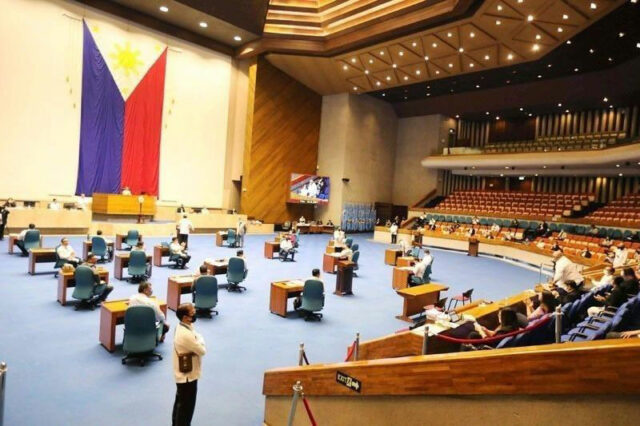
PHILSTAR FILE PHOTO

THE Legislative-Executive Development Advisory Council (LEDAC) identified 10 more bills as priority legislation, including the measures seeking to rationalize the fiscal regime for the mining industry and to amend the public procurement system.

In a statement after LEDAC’s third meeting presided by President Ferdinand R. Marcos, Jr., the Palace said the bill amending the Government Procurement Reform Act and the proposed rationalization of the mining fiscal regime were among the 10 bills added to the common legislative agenda.

The new priority bills also include a measure imposing excise tax on single-use plastics and the proposed amendments to the Cooperative Code and Fisheries Code, the Palace said.

The proposed New Government Auditing Code, Open Access in Data Transmission Act, Defense Industry Development Act, and Philippine Maritime Zones Act were also included in the priority agenda.

Proposed amendments to the Right-of-Way Act were also among the LEDAC’s new 10 priority bills.

Senate President Juan Miguel F. Zubiri said the bills were endorsed by Mr. Marcos’ economic team.

“We committed to support this as well,” he said after the LEDAC meeting, based on the Palace statement.

The Palace said Congress is on track to pass the LEDAC’s top 20 priority bills for this year, including measures amending the Bank Deposit Secrecy Law and Anti-Financial Account Scamming Act.

The two bills, which are still pending at the Senate committee level, had been endorsed by the Bangko Sentral ng Pilipinas (BSP), which aims to remove the Philippines from the Financial Action Task Force’s “gray list” by January 2024.

Another bill proposing changes to the military and uniformed personnel (MUP) pension system, which was approved on second reading by the House of Representatives earlier this week, was also on LEDAC’s list.

Bills targeted for Congress approval by December also include the proposed Property Valuation and Assessment Reform Act, E-Governance Act, Magna Carta for Seafarers, Anti-Agricultural Smuggling Act, and a bill seeking to ease the payment of taxes.

The list also includes bills seeking to rightsize the National Government, create a National Employment Action Plan, institutionalize the automatic income classification of local government units, and develop the salt industry.

The proposed Internet Transaction Act, National Scamming Act, National Citizens Service Training Program Act, New Philippine Passport Act, and proposed amendments to the Build-Operate-Transfer law were also included in the list.

House Speaker Ferdinand Martin G. Romualdez said 18 out of the 20 priority bills were already approved by the lower house.

He said the bill reforming the MUP pension system is slated for approval on third and final reading next week, while the proposed Anti-Agricultural Smuggling Act was already approved at the committee level earlier in the day.

“We are on track to approve the two remaining measures before the October recess,” the House leader said in a separate statement. “In sum, the House of Representatives will meet its commitment to approve all 20 priority measures by the end of September, or three months ahead of target.” — Kyle Aristophere T. Atienza

ADVERTISEMENT
ADVERTISEMENT